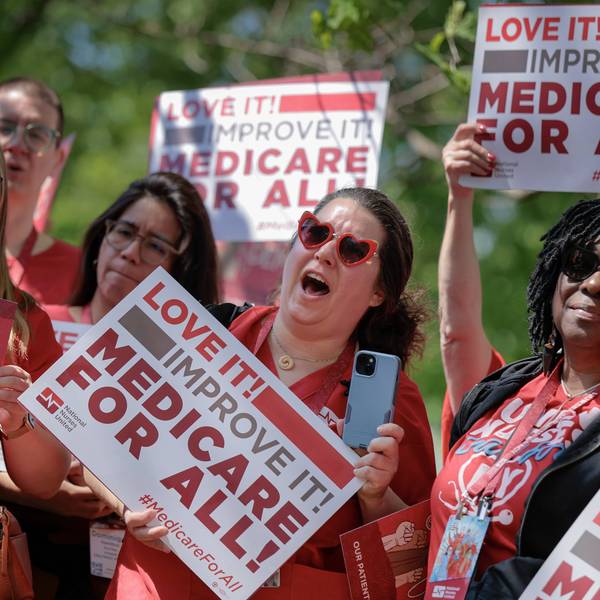
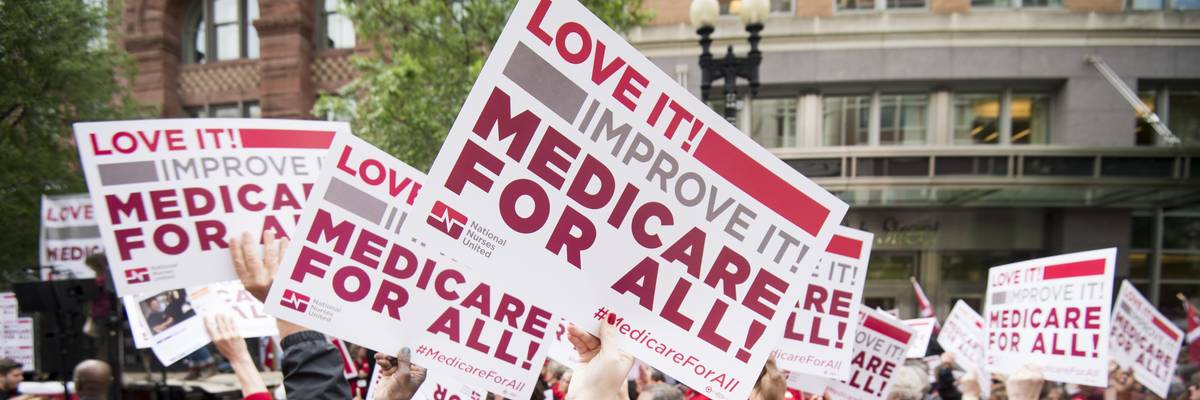
Members of National Nurses United union members wave "Medicare for All" signs during a rally in front of the Pharmaceutical Research and Manufacturers of America in Washington calling for "Medicare for All" on Monday, April 29, 2019.
Medicare for All Also Means This: An Improved, Expanded Medicare
The wrong question is how can we afford Improved Medicare for All. Rather, the right question is how can we afford not to enact it.
Editor's Note: The following is the second excerpt from Nancy J. Altman's latest book, The Road to Medicare for All: A Call to Action (Routledge, 2026), now available for purchase wherever quality books are sold. Read the first excerpt published by Common Dreams here. As the United States continues to spend substantially more on health care than other wealthy nations but with poorer health outcomes, Altman's book analyzes the dysfunction of the current system and sets forth the solution. "Medicare for All won’t happen without a fight," she argues, "but it is a fight we can win."
Imagine having more money in your pocket. Imagine being able to see any doctor you want without checking whether the provider is in your network and covered by your insurance. Imagine having more time with your doctor and, at the end of the appointment, simply walking out the door without having to take out your wallet or even ask what you owe for the visit. Imagine being free of filing insurance claims. Imagine being able to simply get any medicine your doctor prescribes without discovering it is exorbitantly expensive and asking your doctor what, if anything, they can prescribe that is covered by your insurance. Imagine no such thing as medical debt. Imagine simply getting the care, procedures, hospital stays, therapies, and medications your doctor prescribes with your only focus and thought being on how to restore and optimize your health. That is what you will experience.
Where is that destination? It is tantalizingly close. In fact, those who, on average, have the greatest medical needs—seniors and people with disabilities—are already almost there. Medicare, having recently celebrated its 61st anniversary, is well known to Americans. Most people are either covered by Medicare or know someone who is. It already covers Americans from age 65 to the grave. To reach the destination that health care is a right, not a privilege, with all those imaginations a reality, it has to be extended back to the cradle and improved, so that its coverage is completely comprehensive and available without premiums, co-payments, co-insurance, or deductibles. (To be clear, the destination is the expansion of traditional Medicare, not privatized Medicare—the deceptively named Medicare Advantage—whose serious shortcomings are discussed throughout this book.)
As important as Medicare is... it should be improved.
Medicare, which currently covers only seniors and people with disabilities—those who, on average, have the highest healthcare costs—does so more efficiently, comprehensively, and fairly than commercial insurance does, or indeed can. Medicare is the most important birthday gift those turning age 65 get. Too many Americans in their late fifties and early sixties lack adequate health insurance and desperately seek to hang on until they reach that special birthday that brings Medicare. As important as Medicare is, though, it should be improved. As Chapter 3 explains, soon after Medicare was enacted and expanded to people with disabilities, the most powerful forces organized against it. They succeeded in stopping further expansion of its coverage and the services and treatment it provides. They also stood in the way of reducing the costs of those it covers.
On the road to Improved Medicare for All, traditional Medicare should be expanded to cover all essential services. As the nation is driving toward Improved Medicare for All, traditional Medicare should be expanded to cover all safe and effective prescription drugs, also. Under the current system, without Medicare simply covering all safe and effective prescription drugs automatically at no cost, beneficiaries must repeatedly answer the following impossible, ludicrous questions: What illnesses will you contract next year? What medications will your doctor prescribe to treat those yet-to-be-contracted illnesses? Only if you know the answers to those unanswerable questions, can you intelligently decide, in today’s dysfunctional system, which insurance plan has the right drug formulary or list of covered drugs at a price you can afford.
Expanding traditional Medicare to cover all prescription drugs will mean that people can fill all of their prescriptions without worry about their cost. In addition, Medicare should be expanded to cover long-term care—both care at home and in nursing homes.
If Medicare were expanded to cover in-home services and supports as well as nursing home care for those who had no other alternatives, people who were able could age at home, as most want, with the security to know that they would not be a financial burden to those they love. An expanded Medicare for All would meet Americans’ needs today and their unforeseeable needs in the future. As it does today for seniors who have traditional Medicare, it would pool risk among everyone so that everyone is protected; people with costly and complex medical conditions would not be saddled with huge costs.
Under today’s patchwork system, out-of-pocket costs in the form of deductibles, co-pays and co-insurance force people into the arms of commercial insurance, whether they like it or not. Those with traditional Medicare must buy, if they can afford it, private supplemental insurance, colloquially known as Medigap, since traditional Medicare lacks an overall cap on out-of-pocket expenses. Those who can’t afford Medigap may be forced to purchase an inadequate Medicare Advantage plan which includes an overall cap, one more thumb on the scale placed by those who are hostile to single-payer health insurance.
With comprehensive coverage, without co-pays, co-insurance, deductibles, or premiums, there will be no need for supplemental, so-called Medigap, private insurance. We do not pay out of pocket for public libraries, schools, fire protection, or the military. Rather, those services are paid from taxes. We should not be required to pay out of pocket for health care, either. Like those other services, we should have universal, national health insurance, paid for completely out of taxes. The United States is the wealthiest nation in the world at the wealthiest moment in its history. It doesn’t feel that way to many, because so much of that wealth is concentrated in the hands of the very few. A fairer system of taxation which finances an Improved Medicare for All would allow all of us to share the wealth that all of us have created.
We do not pay out of pocket for public libraries, schools, fire protection, or the military. Rather, those services are paid from taxes. We should not be required to pay out of pocket for health care, either.
The nationwide network of Improved Medicare for All providers, which would likely cover all doctors and hospitals nationwide, would ensure that people can continue to get care from the doctors they know and trust. Everyone would be free to see doctors and use hospitals anywhere in the nation. There would be no restrictive networks that keep people from using centers of excellence and seeing the doctors they want to see, including the best specialists. Improved Medicare for All would ensure that everyone—people with costly and complex conditions, people who want good specialty care from doctors and hospitals they know and trust, people who need continuity of care, and those who are currently in excellent health—could get needed health care without financial stress or anxiety.
Improved Medicare for All is fully affordable. Given the unsustainability of the current system, as described in the last chapter, the wrong question is how can we afford Improved Medicare for All. Rather, the right question is how can we afford not to enact it. Relatedly, Improved Medicare for All will cost less than we pay currently. Consequently, the other correct question is not how are we going to pay for Improved Medicare for All, but, rather, how should we divvy up the savings!
Improved Medicare for All will save the nation trillions of dollars while covering everyone comprehensively. In addition to money saved, Improved Medicare for All will save lives. It will result in a higher quality of life for individuals and also a healthier population overall, generating greater productivity for the nation as a whole. Doctors will have more freedom and flexibility. They will be free from the micro-management of commercial insurance companies, concerned about turning a profit.
An Improved Medicare for All system will provide dependable income to healthcare providers. They can count on their bills being paid in a timely manner without the need to chase patients or, even more dispiriting, seek the assistance of loan collection agencies.
Part of the savings should go to doctors, nurses, and other providers to ensure that they are well compensated. They should do better under Improved Medicare for All, not just financially, but also in terms of job satisfaction and time to focus on healing, not paperwork.
Hospitals and those they serve will do better, as well. Improved Medicare for All can reduce physician shortages in underserved areas, often described as healthcare deserts, and help to reduce shortages in areas of medicine where they exist now or are projected to exist. Rural hospitals too often have limited staff without backup. The loss of a surgeon can cause the surgical unit to close, which, in turn, can have a cascading effect, ultimately resulting in the inability to receive care close by, quickly, in an emergency.
Despite all the advantages, Improved Medicare for All won’t happen without a fight.
Like the need to reimburse doctors fairly, in a timely manner, hospitals must be, as well. Whether for-profit, nonprofit, or governmental, hospitals want to remain state-of-the-art, with the latest equipment, and be fully staffed. Consequently, they need to cover their costs and ideally, maintain reserves. Under Improved Medicare for All, hospitals will have reduced costs along with more certainty and dependability of payments, free from charitable cases, which will become a thing of the past. In addition to fairly reimbursing hospitals and other facilities, the costs of maintaining, updating, and constructing them should be a priority, so that all communities are adequately served. At base, under Improved Medicare for All, hospitals, physicians, nurses, and other practitioners should be paid generously. They can and should be paid fully and on a timely basis for care given to every patient. Improved Medicare for All can and should be structured to ensure that providers have the ability to spend the time required to see patients.
In addition to all of the health and health-related advantages that Improved Medicare for All will bring, it can also usher in improvements unrelated to health care. They include a fairer federal tax system, together with reduced income and wealth inequality; more revenue for Social Security; an improved system of workers’ compensation, and more funds for state governments. Improved Medicare for All will provide intangible benefits for everyone, including reduced stress, less paperwork with the accompanying added free time, and, most importantly, greater peace of mind. All of those byproducts are explained at length in the book. They are just some of the fortuitous byproducts that will accompany the enactment of Improved Medicare for All.
Despite all the advantages, Improved Medicare for All won’t happen without a fight. The special interests will fight ferociously, but they will be no match for the hundreds of millions of Americans who will be benefited, as long as the public is engaged and active.
We are at a crossroads
This country and this world are at a monumental crossroads. In a few short weeks, US voters will have an opportunity to beat back the forces of fascism and confront the billionaires who are rigging the economy, our media system, and our democracy, making it increasingly impossible for ordinary people to get by. We’re not just talking about the election. We’re talking about what must be done once these fascist elements are vanquished from power. We need a bolder set of solutions than what either major party has so far been willing to offer and a working-class movement ready to fight like hell for it. Trump didn't emerge from nowhere. The conditions that fueled MAGA authoritarianism were created by decades of radical neoliberal economic policies and a corrupt political system dominated by corporate interests. They slashed taxes on the super-rich, promising that the benefits would trickle down. They said giveaways to the corporate titans would make life more affordable for the rest of us. It was all bullshit. And when a bitter, betrayed populace searches for someone to blame, right-wing demagogues have little trouble finding scapegoats. People know when they're being lied to, but you won't hear any of this from the corporate media. Only independent journalism—powered and funded by people who believe in building a better world—can deliver truly trustworthy daily news. Our Fall Campaign is underway, and we need your help. To power our newsroom through the rest of the year, we need to raise $125,000 by midnight on October 31. So if you share our vision, please contribute whatever you can to sustain our work. |
Nancy Altman is president of Social Security Works and chair of the Strengthen Social Security Coalition. She is co-author of two books and author of three, including her most recent, The Road to Medicare for All: A Call to Action.
Editor's Note: The following is the second excerpt from Nancy J. Altman's latest book, The Road to Medicare for All: A Call to Action (Routledge, 2026), now available for purchase wherever quality books are sold. Read the first excerpt published by Common Dreams here. As the United States continues to spend substantially more on health care than other wealthy nations but with poorer health outcomes, Altman's book analyzes the dysfunction of the current system and sets forth the solution. "Medicare for All won’t happen without a fight," she argues, "but it is a fight we can win."
Imagine having more money in your pocket. Imagine being able to see any doctor you want without checking whether the provider is in your network and covered by your insurance. Imagine having more time with your doctor and, at the end of the appointment, simply walking out the door without having to take out your wallet or even ask what you owe for the visit. Imagine being free of filing insurance claims. Imagine being able to simply get any medicine your doctor prescribes without discovering it is exorbitantly expensive and asking your doctor what, if anything, they can prescribe that is covered by your insurance. Imagine no such thing as medical debt. Imagine simply getting the care, procedures, hospital stays, therapies, and medications your doctor prescribes with your only focus and thought being on how to restore and optimize your health. That is what you will experience.
Where is that destination? It is tantalizingly close. In fact, those who, on average, have the greatest medical needs—seniors and people with disabilities—are already almost there. Medicare, having recently celebrated its 61st anniversary, is well known to Americans. Most people are either covered by Medicare or know someone who is. It already covers Americans from age 65 to the grave. To reach the destination that health care is a right, not a privilege, with all those imaginations a reality, it has to be extended back to the cradle and improved, so that its coverage is completely comprehensive and available without premiums, co-payments, co-insurance, or deductibles. (To be clear, the destination is the expansion of traditional Medicare, not privatized Medicare—the deceptively named Medicare Advantage—whose serious shortcomings are discussed throughout this book.)
As important as Medicare is... it should be improved.
Medicare, which currently covers only seniors and people with disabilities—those who, on average, have the highest healthcare costs—does so more efficiently, comprehensively, and fairly than commercial insurance does, or indeed can. Medicare is the most important birthday gift those turning age 65 get. Too many Americans in their late fifties and early sixties lack adequate health insurance and desperately seek to hang on until they reach that special birthday that brings Medicare. As important as Medicare is, though, it should be improved. As Chapter 3 explains, soon after Medicare was enacted and expanded to people with disabilities, the most powerful forces organized against it. They succeeded in stopping further expansion of its coverage and the services and treatment it provides. They also stood in the way of reducing the costs of those it covers.
On the road to Improved Medicare for All, traditional Medicare should be expanded to cover all essential services. As the nation is driving toward Improved Medicare for All, traditional Medicare should be expanded to cover all safe and effective prescription drugs, also. Under the current system, without Medicare simply covering all safe and effective prescription drugs automatically at no cost, beneficiaries must repeatedly answer the following impossible, ludicrous questions: What illnesses will you contract next year? What medications will your doctor prescribe to treat those yet-to-be-contracted illnesses? Only if you know the answers to those unanswerable questions, can you intelligently decide, in today’s dysfunctional system, which insurance plan has the right drug formulary or list of covered drugs at a price you can afford.
Expanding traditional Medicare to cover all prescription drugs will mean that people can fill all of their prescriptions without worry about their cost. In addition, Medicare should be expanded to cover long-term care—both care at home and in nursing homes.
If Medicare were expanded to cover in-home services and supports as well as nursing home care for those who had no other alternatives, people who were able could age at home, as most want, with the security to know that they would not be a financial burden to those they love. An expanded Medicare for All would meet Americans’ needs today and their unforeseeable needs in the future. As it does today for seniors who have traditional Medicare, it would pool risk among everyone so that everyone is protected; people with costly and complex medical conditions would not be saddled with huge costs.
Under today’s patchwork system, out-of-pocket costs in the form of deductibles, co-pays and co-insurance force people into the arms of commercial insurance, whether they like it or not. Those with traditional Medicare must buy, if they can afford it, private supplemental insurance, colloquially known as Medigap, since traditional Medicare lacks an overall cap on out-of-pocket expenses. Those who can’t afford Medigap may be forced to purchase an inadequate Medicare Advantage plan which includes an overall cap, one more thumb on the scale placed by those who are hostile to single-payer health insurance.
With comprehensive coverage, without co-pays, co-insurance, deductibles, or premiums, there will be no need for supplemental, so-called Medigap, private insurance. We do not pay out of pocket for public libraries, schools, fire protection, or the military. Rather, those services are paid from taxes. We should not be required to pay out of pocket for health care, either. Like those other services, we should have universal, national health insurance, paid for completely out of taxes. The United States is the wealthiest nation in the world at the wealthiest moment in its history. It doesn’t feel that way to many, because so much of that wealth is concentrated in the hands of the very few. A fairer system of taxation which finances an Improved Medicare for All would allow all of us to share the wealth that all of us have created.
We do not pay out of pocket for public libraries, schools, fire protection, or the military. Rather, those services are paid from taxes. We should not be required to pay out of pocket for health care, either.
The nationwide network of Improved Medicare for All providers, which would likely cover all doctors and hospitals nationwide, would ensure that people can continue to get care from the doctors they know and trust. Everyone would be free to see doctors and use hospitals anywhere in the nation. There would be no restrictive networks that keep people from using centers of excellence and seeing the doctors they want to see, including the best specialists. Improved Medicare for All would ensure that everyone—people with costly and complex conditions, people who want good specialty care from doctors and hospitals they know and trust, people who need continuity of care, and those who are currently in excellent health—could get needed health care without financial stress or anxiety.
Improved Medicare for All is fully affordable. Given the unsustainability of the current system, as described in the last chapter, the wrong question is how can we afford Improved Medicare for All. Rather, the right question is how can we afford not to enact it. Relatedly, Improved Medicare for All will cost less than we pay currently. Consequently, the other correct question is not how are we going to pay for Improved Medicare for All, but, rather, how should we divvy up the savings!
Improved Medicare for All will save the nation trillions of dollars while covering everyone comprehensively. In addition to money saved, Improved Medicare for All will save lives. It will result in a higher quality of life for individuals and also a healthier population overall, generating greater productivity for the nation as a whole. Doctors will have more freedom and flexibility. They will be free from the micro-management of commercial insurance companies, concerned about turning a profit.
An Improved Medicare for All system will provide dependable income to healthcare providers. They can count on their bills being paid in a timely manner without the need to chase patients or, even more dispiriting, seek the assistance of loan collection agencies.
Part of the savings should go to doctors, nurses, and other providers to ensure that they are well compensated. They should do better under Improved Medicare for All, not just financially, but also in terms of job satisfaction and time to focus on healing, not paperwork.
Hospitals and those they serve will do better, as well. Improved Medicare for All can reduce physician shortages in underserved areas, often described as healthcare deserts, and help to reduce shortages in areas of medicine where they exist now or are projected to exist. Rural hospitals too often have limited staff without backup. The loss of a surgeon can cause the surgical unit to close, which, in turn, can have a cascading effect, ultimately resulting in the inability to receive care close by, quickly, in an emergency.
Despite all the advantages, Improved Medicare for All won’t happen without a fight.
Like the need to reimburse doctors fairly, in a timely manner, hospitals must be, as well. Whether for-profit, nonprofit, or governmental, hospitals want to remain state-of-the-art, with the latest equipment, and be fully staffed. Consequently, they need to cover their costs and ideally, maintain reserves. Under Improved Medicare for All, hospitals will have reduced costs along with more certainty and dependability of payments, free from charitable cases, which will become a thing of the past. In addition to fairly reimbursing hospitals and other facilities, the costs of maintaining, updating, and constructing them should be a priority, so that all communities are adequately served. At base, under Improved Medicare for All, hospitals, physicians, nurses, and other practitioners should be paid generously. They can and should be paid fully and on a timely basis for care given to every patient. Improved Medicare for All can and should be structured to ensure that providers have the ability to spend the time required to see patients.
In addition to all of the health and health-related advantages that Improved Medicare for All will bring, it can also usher in improvements unrelated to health care. They include a fairer federal tax system, together with reduced income and wealth inequality; more revenue for Social Security; an improved system of workers’ compensation, and more funds for state governments. Improved Medicare for All will provide intangible benefits for everyone, including reduced stress, less paperwork with the accompanying added free time, and, most importantly, greater peace of mind. All of those byproducts are explained at length in the book. They are just some of the fortuitous byproducts that will accompany the enactment of Improved Medicare for All.
Despite all the advantages, Improved Medicare for All won’t happen without a fight. The special interests will fight ferociously, but they will be no match for the hundreds of millions of Americans who will be benefited, as long as the public is engaged and active.
- Medicare for All Legislation Introduced to Address Poor U.S. Health Outcomes, Inequities ›
- Republicans Want to Dismantle Medicare; Democrats Must Fight for Medicare for All ›
- Medicare for All, Says Sanders, Would Show American People 'Government Is Listening to Them' ›
- Medicare for All Backers Argue It's a Better Solution Than Whatever Trump Is Cooking Up ›
- An Open Letter to Congressional Sponsors of Medicare for All ›
- Medicare for All Reintroduced to Save $650 Billion and 68,000 Lives Per Year ›
Nancy Altman is president of Social Security Works and chair of the Strengthen Social Security Coalition. She is co-author of two books and author of three, including her most recent, The Road to Medicare for All: A Call to Action.
Editor's Note: The following is the second excerpt from Nancy J. Altman's latest book, The Road to Medicare for All: A Call to Action (Routledge, 2026), now available for purchase wherever quality books are sold. Read the first excerpt published by Common Dreams here. As the United States continues to spend substantially more on health care than other wealthy nations but with poorer health outcomes, Altman's book analyzes the dysfunction of the current system and sets forth the solution. "Medicare for All won’t happen without a fight," she argues, "but it is a fight we can win."
Imagine having more money in your pocket. Imagine being able to see any doctor you want without checking whether the provider is in your network and covered by your insurance. Imagine having more time with your doctor and, at the end of the appointment, simply walking out the door without having to take out your wallet or even ask what you owe for the visit. Imagine being free of filing insurance claims. Imagine being able to simply get any medicine your doctor prescribes without discovering it is exorbitantly expensive and asking your doctor what, if anything, they can prescribe that is covered by your insurance. Imagine no such thing as medical debt. Imagine simply getting the care, procedures, hospital stays, therapies, and medications your doctor prescribes with your only focus and thought being on how to restore and optimize your health. That is what you will experience.
Where is that destination? It is tantalizingly close. In fact, those who, on average, have the greatest medical needs—seniors and people with disabilities—are already almost there. Medicare, having recently celebrated its 61st anniversary, is well known to Americans. Most people are either covered by Medicare or know someone who is. It already covers Americans from age 65 to the grave. To reach the destination that health care is a right, not a privilege, with all those imaginations a reality, it has to be extended back to the cradle and improved, so that its coverage is completely comprehensive and available without premiums, co-payments, co-insurance, or deductibles. (To be clear, the destination is the expansion of traditional Medicare, not privatized Medicare—the deceptively named Medicare Advantage—whose serious shortcomings are discussed throughout this book.)
As important as Medicare is... it should be improved.
Medicare, which currently covers only seniors and people with disabilities—those who, on average, have the highest healthcare costs—does so more efficiently, comprehensively, and fairly than commercial insurance does, or indeed can. Medicare is the most important birthday gift those turning age 65 get. Too many Americans in their late fifties and early sixties lack adequate health insurance and desperately seek to hang on until they reach that special birthday that brings Medicare. As important as Medicare is, though, it should be improved. As Chapter 3 explains, soon after Medicare was enacted and expanded to people with disabilities, the most powerful forces organized against it. They succeeded in stopping further expansion of its coverage and the services and treatment it provides. They also stood in the way of reducing the costs of those it covers.
On the road to Improved Medicare for All, traditional Medicare should be expanded to cover all essential services. As the nation is driving toward Improved Medicare for All, traditional Medicare should be expanded to cover all safe and effective prescription drugs, also. Under the current system, without Medicare simply covering all safe and effective prescription drugs automatically at no cost, beneficiaries must repeatedly answer the following impossible, ludicrous questions: What illnesses will you contract next year? What medications will your doctor prescribe to treat those yet-to-be-contracted illnesses? Only if you know the answers to those unanswerable questions, can you intelligently decide, in today’s dysfunctional system, which insurance plan has the right drug formulary or list of covered drugs at a price you can afford.
Expanding traditional Medicare to cover all prescription drugs will mean that people can fill all of their prescriptions without worry about their cost. In addition, Medicare should be expanded to cover long-term care—both care at home and in nursing homes.
If Medicare were expanded to cover in-home services and supports as well as nursing home care for those who had no other alternatives, people who were able could age at home, as most want, with the security to know that they would not be a financial burden to those they love. An expanded Medicare for All would meet Americans’ needs today and their unforeseeable needs in the future. As it does today for seniors who have traditional Medicare, it would pool risk among everyone so that everyone is protected; people with costly and complex medical conditions would not be saddled with huge costs.
Under today’s patchwork system, out-of-pocket costs in the form of deductibles, co-pays and co-insurance force people into the arms of commercial insurance, whether they like it or not. Those with traditional Medicare must buy, if they can afford it, private supplemental insurance, colloquially known as Medigap, since traditional Medicare lacks an overall cap on out-of-pocket expenses. Those who can’t afford Medigap may be forced to purchase an inadequate Medicare Advantage plan which includes an overall cap, one more thumb on the scale placed by those who are hostile to single-payer health insurance.
With comprehensive coverage, without co-pays, co-insurance, deductibles, or premiums, there will be no need for supplemental, so-called Medigap, private insurance. We do not pay out of pocket for public libraries, schools, fire protection, or the military. Rather, those services are paid from taxes. We should not be required to pay out of pocket for health care, either. Like those other services, we should have universal, national health insurance, paid for completely out of taxes. The United States is the wealthiest nation in the world at the wealthiest moment in its history. It doesn’t feel that way to many, because so much of that wealth is concentrated in the hands of the very few. A fairer system of taxation which finances an Improved Medicare for All would allow all of us to share the wealth that all of us have created.
We do not pay out of pocket for public libraries, schools, fire protection, or the military. Rather, those services are paid from taxes. We should not be required to pay out of pocket for health care, either.
The nationwide network of Improved Medicare for All providers, which would likely cover all doctors and hospitals nationwide, would ensure that people can continue to get care from the doctors they know and trust. Everyone would be free to see doctors and use hospitals anywhere in the nation. There would be no restrictive networks that keep people from using centers of excellence and seeing the doctors they want to see, including the best specialists. Improved Medicare for All would ensure that everyone—people with costly and complex conditions, people who want good specialty care from doctors and hospitals they know and trust, people who need continuity of care, and those who are currently in excellent health—could get needed health care without financial stress or anxiety.
Improved Medicare for All is fully affordable. Given the unsustainability of the current system, as described in the last chapter, the wrong question is how can we afford Improved Medicare for All. Rather, the right question is how can we afford not to enact it. Relatedly, Improved Medicare for All will cost less than we pay currently. Consequently, the other correct question is not how are we going to pay for Improved Medicare for All, but, rather, how should we divvy up the savings!
Improved Medicare for All will save the nation trillions of dollars while covering everyone comprehensively. In addition to money saved, Improved Medicare for All will save lives. It will result in a higher quality of life for individuals and also a healthier population overall, generating greater productivity for the nation as a whole. Doctors will have more freedom and flexibility. They will be free from the micro-management of commercial insurance companies, concerned about turning a profit.
An Improved Medicare for All system will provide dependable income to healthcare providers. They can count on their bills being paid in a timely manner without the need to chase patients or, even more dispiriting, seek the assistance of loan collection agencies.
Part of the savings should go to doctors, nurses, and other providers to ensure that they are well compensated. They should do better under Improved Medicare for All, not just financially, but also in terms of job satisfaction and time to focus on healing, not paperwork.
Hospitals and those they serve will do better, as well. Improved Medicare for All can reduce physician shortages in underserved areas, often described as healthcare deserts, and help to reduce shortages in areas of medicine where they exist now or are projected to exist. Rural hospitals too often have limited staff without backup. The loss of a surgeon can cause the surgical unit to close, which, in turn, can have a cascading effect, ultimately resulting in the inability to receive care close by, quickly, in an emergency.
Despite all the advantages, Improved Medicare for All won’t happen without a fight.
Like the need to reimburse doctors fairly, in a timely manner, hospitals must be, as well. Whether for-profit, nonprofit, or governmental, hospitals want to remain state-of-the-art, with the latest equipment, and be fully staffed. Consequently, they need to cover their costs and ideally, maintain reserves. Under Improved Medicare for All, hospitals will have reduced costs along with more certainty and dependability of payments, free from charitable cases, which will become a thing of the past. In addition to fairly reimbursing hospitals and other facilities, the costs of maintaining, updating, and constructing them should be a priority, so that all communities are adequately served. At base, under Improved Medicare for All, hospitals, physicians, nurses, and other practitioners should be paid generously. They can and should be paid fully and on a timely basis for care given to every patient. Improved Medicare for All can and should be structured to ensure that providers have the ability to spend the time required to see patients.
In addition to all of the health and health-related advantages that Improved Medicare for All will bring, it can also usher in improvements unrelated to health care. They include a fairer federal tax system, together with reduced income and wealth inequality; more revenue for Social Security; an improved system of workers’ compensation, and more funds for state governments. Improved Medicare for All will provide intangible benefits for everyone, including reduced stress, less paperwork with the accompanying added free time, and, most importantly, greater peace of mind. All of those byproducts are explained at length in the book. They are just some of the fortuitous byproducts that will accompany the enactment of Improved Medicare for All.
Despite all the advantages, Improved Medicare for All won’t happen without a fight. The special interests will fight ferociously, but they will be no match for the hundreds of millions of Americans who will be benefited, as long as the public is engaged and active.
- Medicare for All Legislation Introduced to Address Poor U.S. Health Outcomes, Inequities ›
- Republicans Want to Dismantle Medicare; Democrats Must Fight for Medicare for All ›
- Medicare for All, Says Sanders, Would Show American People 'Government Is Listening to Them' ›
- Medicare for All Backers Argue It's a Better Solution Than Whatever Trump Is Cooking Up ›
- An Open Letter to Congressional Sponsors of Medicare for All ›
- Medicare for All Reintroduced to Save $650 Billion and 68,000 Lives Per Year ›