SUBSCRIBE TO OUR FREE NEWSLETTER
Daily news & progressive opinion—funded by the people, not the corporations—delivered straight to your inbox.
5
#000000
#FFFFFF
To donate by check, phone, or other method, see our More Ways to Give page.
Daily news & progressive opinion—funded by the people, not the corporations—delivered straight to your inbox.
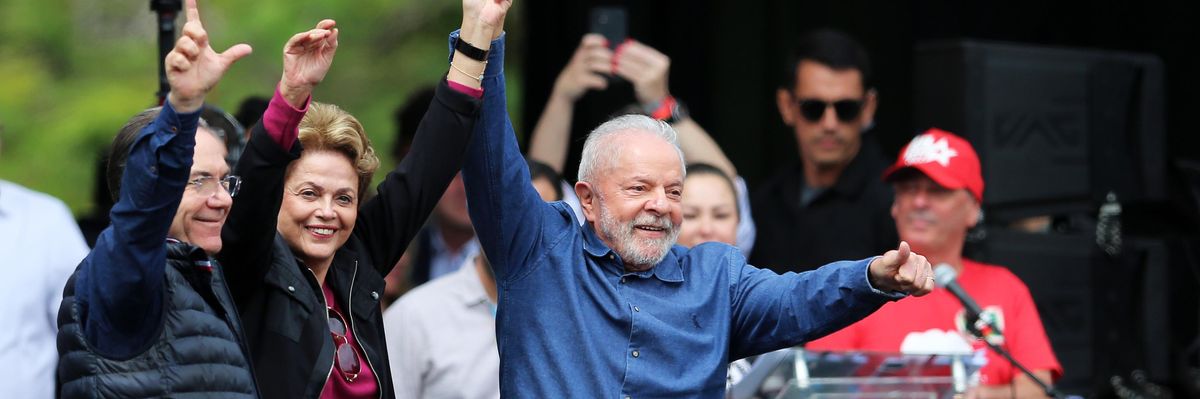
Brazilian presidential hopeful Luiz Inacio Lula da Silva holds up the hand of Dilma Rousseff, who is also a former president representing the leftist Workers' Party, at a campaign rally in Florianopolis, Santa Catarina on September 18, 2022. (Photo: Heuler Andrey/Getty Images)
With less than two weeks remaining until the first round of Brazil's presidential election, new polling figures show democratic socialist frontrunner Luiz Inacio Lula da Silva has slightly widened his double-digit lead over far-right incumbent President Jair Bolsonaro.
Brazilian pollster IPEC's latest survey shows da Silva leading Bolsonaro 47% to 31% in the first-round contest, which will take place on October 2. That's a one-point boost from the previous week's polling.
The IPEC poll also gives da Silva--the Workers' Party candidate who previously served as Brazil's 35th president from 2003 to 2010--a 19-point lead in a potential second-round runoff, which is scheduled for October 30 if no candidate wins over 50% of the vote in the first round.
Other pollsters also show da Silva enjoying a double-digit lead. Datafolha's most recent figures give da Silva a 45% to 33% edge over Bolsonaro in the first round, with 90% of surveyed voters having decided for whom they will vote.
Bolsonaro--an open admirer of the former U.S.-backed 1964-85 military dictatorship in whose army he served as an officer--has said he might not accept the results of the election if he loses. There are widespread fears in Brazil and beyond that a beaten Bolsonaro may attempt to foment a coup or an insurrection along the lines of the January 6, 2021 attack on the U.S. Capitol by supporters of defeated former President Donald Trump.
Da Silva has been drawing massive crowds of supporters at recent campaign events, including a Sunday rally in the southern city of Florianopolis where he said that when "every woman and every child is eating three times a day, I will have completed my life's mission."
Hunger and food insecurity--which was dramatically reduced through social programs like Fome Zero (Zero Hunger) and Bolsa Familia (Family Allowance) during da Silva's first presidential term--have returned under Bolsonaro's right-wing economic and social policies.
Seven former Brazilian presidential candidates from various political parties on Monday called on voters to return da Silva to the Palacio da Alvorada.
"All Brazilian democrats must unite and avoid the tragedy that would be the re-election of the current president," said Cristovam Buarque, a former federal senator and member of the socialist party Cidadania who served as da Silva's education minister.
Also on Monday, Brazilian election authorities denounced a fake narrated video making the rounds on pro-Bolsonaro social media accounts showing the president leading da Silva 46% to 31%.
Dear Common Dreams reader, It’s been nearly 30 years since I co-founded Common Dreams with my late wife, Lina Newhouser. We had the radical notion that journalism should serve the public good, not corporate profits. It was clear to us from the outset what it would take to build such a project. No paid advertisements. No corporate sponsors. No millionaire publisher telling us what to think or do. Many people said we wouldn't last a year, but we proved those doubters wrong. Together with a tremendous team of journalists and dedicated staff, we built an independent media outlet free from the constraints of profits and corporate control. Our mission has always been simple: To inform. To inspire. To ignite change for the common good. Building Common Dreams was not easy. Our survival was never guaranteed. When you take on the most powerful forces—Wall Street greed, fossil fuel industry destruction, Big Tech lobbyists, and uber-rich oligarchs who have spent billions upon billions rigging the economy and democracy in their favor—the only bulwark you have is supporters who believe in your work. But here’s the urgent message from me today. It's never been this bad out there. And it's never been this hard to keep us going. At the very moment Common Dreams is most needed, the threats we face are intensifying. We need your support now more than ever. We don't accept corporate advertising and never will. We don't have a paywall because we don't think people should be blocked from critical news based on their ability to pay. Everything we do is funded by the donations of readers like you. When everyone does the little they can afford, we are strong. But if that support retreats or dries up, so do we. Will you donate now to make sure Common Dreams not only survives but thrives? —Craig Brown, Co-founder |
With less than two weeks remaining until the first round of Brazil's presidential election, new polling figures show democratic socialist frontrunner Luiz Inacio Lula da Silva has slightly widened his double-digit lead over far-right incumbent President Jair Bolsonaro.
Brazilian pollster IPEC's latest survey shows da Silva leading Bolsonaro 47% to 31% in the first-round contest, which will take place on October 2. That's a one-point boost from the previous week's polling.
The IPEC poll also gives da Silva--the Workers' Party candidate who previously served as Brazil's 35th president from 2003 to 2010--a 19-point lead in a potential second-round runoff, which is scheduled for October 30 if no candidate wins over 50% of the vote in the first round.
Other pollsters also show da Silva enjoying a double-digit lead. Datafolha's most recent figures give da Silva a 45% to 33% edge over Bolsonaro in the first round, with 90% of surveyed voters having decided for whom they will vote.
Bolsonaro--an open admirer of the former U.S.-backed 1964-85 military dictatorship in whose army he served as an officer--has said he might not accept the results of the election if he loses. There are widespread fears in Brazil and beyond that a beaten Bolsonaro may attempt to foment a coup or an insurrection along the lines of the January 6, 2021 attack on the U.S. Capitol by supporters of defeated former President Donald Trump.
Da Silva has been drawing massive crowds of supporters at recent campaign events, including a Sunday rally in the southern city of Florianopolis where he said that when "every woman and every child is eating three times a day, I will have completed my life's mission."
Hunger and food insecurity--which was dramatically reduced through social programs like Fome Zero (Zero Hunger) and Bolsa Familia (Family Allowance) during da Silva's first presidential term--have returned under Bolsonaro's right-wing economic and social policies.
Seven former Brazilian presidential candidates from various political parties on Monday called on voters to return da Silva to the Palacio da Alvorada.
"All Brazilian democrats must unite and avoid the tragedy that would be the re-election of the current president," said Cristovam Buarque, a former federal senator and member of the socialist party Cidadania who served as da Silva's education minister.
Also on Monday, Brazilian election authorities denounced a fake narrated video making the rounds on pro-Bolsonaro social media accounts showing the president leading da Silva 46% to 31%.
With less than two weeks remaining until the first round of Brazil's presidential election, new polling figures show democratic socialist frontrunner Luiz Inacio Lula da Silva has slightly widened his double-digit lead over far-right incumbent President Jair Bolsonaro.
Brazilian pollster IPEC's latest survey shows da Silva leading Bolsonaro 47% to 31% in the first-round contest, which will take place on October 2. That's a one-point boost from the previous week's polling.
The IPEC poll also gives da Silva--the Workers' Party candidate who previously served as Brazil's 35th president from 2003 to 2010--a 19-point lead in a potential second-round runoff, which is scheduled for October 30 if no candidate wins over 50% of the vote in the first round.
Other pollsters also show da Silva enjoying a double-digit lead. Datafolha's most recent figures give da Silva a 45% to 33% edge over Bolsonaro in the first round, with 90% of surveyed voters having decided for whom they will vote.
Bolsonaro--an open admirer of the former U.S.-backed 1964-85 military dictatorship in whose army he served as an officer--has said he might not accept the results of the election if he loses. There are widespread fears in Brazil and beyond that a beaten Bolsonaro may attempt to foment a coup or an insurrection along the lines of the January 6, 2021 attack on the U.S. Capitol by supporters of defeated former President Donald Trump.
Da Silva has been drawing massive crowds of supporters at recent campaign events, including a Sunday rally in the southern city of Florianopolis where he said that when "every woman and every child is eating three times a day, I will have completed my life's mission."
Hunger and food insecurity--which was dramatically reduced through social programs like Fome Zero (Zero Hunger) and Bolsa Familia (Family Allowance) during da Silva's first presidential term--have returned under Bolsonaro's right-wing economic and social policies.
Seven former Brazilian presidential candidates from various political parties on Monday called on voters to return da Silva to the Palacio da Alvorada.
"All Brazilian democrats must unite and avoid the tragedy that would be the re-election of the current president," said Cristovam Buarque, a former federal senator and member of the socialist party Cidadania who served as da Silva's education minister.
Also on Monday, Brazilian election authorities denounced a fake narrated video making the rounds on pro-Bolsonaro social media accounts showing the president leading da Silva 46% to 31%.