5
#000000
#FFFFFF
To donate by check, phone, or other method, see our More Ways to Give page.
Daily news & progressive opinion—funded by the people, not the corporations—delivered straight to your inbox.
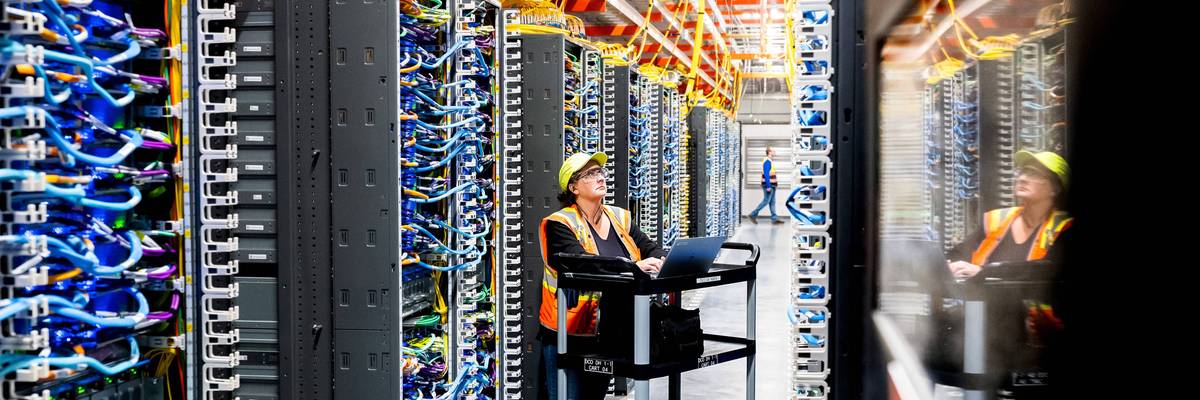
Amazon and the rest of the once aspirationally green tech industry are adding 19th-century smoking chimneys to their facilities in order to churn out more Compute, the 21st century equivalent of wool or steel.
Return with me now to the thrilling days of yesteryear. In 2020, Jeff Bezos announced that Amazon had paid a few hundred million dollars for the naming rights to the new hockey rink in Seattle. But instead of calling it Amazon Arena, he instead decided to commemorate his recent signature on a pledge to go carbon neutral. The name Climate Pledge Arena, if not as mellifluous as Wrigley Field or Candlestick Park, was intended, he said in an Instagram post, to be
a regular reminder of the urgent need for climate action.
Oh, and it would also be
the first net zero carbon certified arena in the world, generate zero waste from operations and events, and use reclaimed rainwater in the ice system to create the greenest ice in the NHL.
Look, even then this seemed mostly PR. Amazon first committed to the Climate Pledge itself—net zero by 2040—the day before a giant 2019 walkout organized by Amazon Employees for Climate Justice. The arena seemed kind of gimmicky from the start. As Ken Belson reported at the time:
Watermelons are served as vegan sashimi, and their rinds are pickled and used in salads. Carrot tops are turned into gremolata, a condiment.
Still, credit Bezos with recognizing the spirit of the moment. Greta Thunberg and her numerous compatriots had scared the oligarchs and financiers of the world into at least rhetorical action. (He could have named it Greta Garden). As he said at the time:
Climate change is the biggest threat to our planet. I want to work alongside others both to amplify known ways and to explore new ways of fighting the devastating impact of climate change on this planet we all share.
But that fright has faded over time, even as the effects of the climate crisis have become ever more legible. And in the eternal battle between fear and greed, the latter has taken on more prominence in the last couple of years. In fact, it would make sense to rename the hockey rink, perhaps AI Avarice Arena.
That’s because Amazon—and, as we shall see, the rest of the once aspirationally green tech industry—are adding 19th-century smoking chimneys to their facilities in order to churn out more Compute, the 21st century equivalent of wool or steel. It’s hard to keep track of the ever-mutating list of grand new plans, often named things like “Prometheus” (or, in the weird case of one Ohio behemoth, “Socrates the Younger”), though here’s a brand new attempt to do so from the folks at Climate Power.
On at least one list of the most polluting proposed data centers, Amazon’s planned facility in Pecos, Texas comes in at the top; indeed, by some calculations it would be the single largest source of climate pollution in the US, with 35 giant natural gas turbines burning through vast quantities of fracked gas. On that same list, if you look carefully, Amazon’s planned “energy campus” in Pennsylvania would come in fourth on the list. Anyway, far from heading for net zero, Amazon’s greenhouse gas emissions were up 16% last year.
Amazon’s chief sustainability officer, Kara Hurst, was designated to go to New York and take the company’s lumps during Climate Week; she told a gathering organized by the news site Semafor that the company needed to “do better.” Not on lessening its environmental impact, but on “communicating its environmental impact.”
There is a lot of debate, backlash against data centers in this country right now, and one of the things that we’re doing is taking a look at what have we done well and where have we fallen down and what do we need to do better. And so, we’re revising a number of our practices. We’re calling for a lot more transparency and accountability because that’s what people in these communities deserve. We’re saying, "Hold us accountable for our practices."
I read this to mean: "It’s getting harder to build data centers, so we’re going to try and up the ante for local communities with more payouts." (Word came today of one Pennsylvania data center that will offer $10,000 to every family in town if they’ll just change the zoning code and let them build).
But of course even if they figure out how to buy off the communities where they want to build their factories, it won’t affect by an iota the quantity of greenhouse gases they plan on pouring into the air—or the fact that this vitiates all their proud climate pledges.
Amazon is not alone, of course. Meta, for instance, had joined RE100, a renewable energy campaign all the way back in 2016, when it was still known as Facebook. It left this summer because… it wanted to use gas, not renewables, to power its data centers. As ESG News reported:
"After several in-depth conversations between Meta and Climate Group, Meta has withdrawn from the RE100 initiative, as it is no longer able to meet the technical criteria due to investments made in new gas power,” a Climate Group spokesperson told the website.
The withdrawal comes as Meta expands its global data center footprint. The company has entered arrangements that support new natural gas generation to supply growing electricity demand.
In Louisiana, utilities are expected to bring 10 new gas plants online to support Meta’s Hyperion data center.
Google reported an 18% increase in emissions in 2025. If you want to talk about an example of fairly comprehensive corporate failure, consider this. As Heather Clancy reports:
Google’s cumulative emissions have risen more than 80% since 2019, the baseline year for the company’s “intentionally aspirational” pledge to cut its operational emissions and certain supply chain emissions in half by 2030.
Planning to cut your emissions in half and instead raising them by eighty% led the company’s chief sustainability officer to change the title of her office to tell investors that they were “navigat[ing]the tension between hyper-growth and environmental stewardship.” In this case, “navigating” seems to involve accelerating full speed ahead into the iceberg that you identified a decade ago.
And of course there’s Elon Musk, whose Colossus data centers in the Tennessee-Mississippi corridor set the early standard for environmental irresponsibility, pouring pollution into poor Black neighborhoods and triggering a wave of lawsuits. Dave Roberts and I were on a panel early in Climate Week with LaTricea Adams of Young, Gifted, and Green and Abre’ Conner, director of Environmental and Climate Justice at the NAACP, and I would not bet against their ability to bedevil the richest man in the history of the world.
In fact, that pushback is now beginning, and the oligarchs behind these hyperscalers are clearly an important target. Not the only target. As Amy Westervelt notes: “We gotta start referring to data centers by both their mother and father's last names, Spain style. The Microsoft-Chevron data center, the Meta-ExxonMobil data center.” And of course we should keep beating on the dirty truth that much of the data center capacity is directly employed in raising the planet’s temperature—as Emily Atkin pointed out last month, companies like Amazon are marketing their AI services to the oil and gas companies to help them find more crude, and this may ultimately do even more damage than their emissions.
Still, the easiest way for organizers to operate may be simply to connect the much-despised oligarchs with the increasingly-despised data centers and in turn with every climate disaster that now unfolds. This is starting to happen. I got to join a demonstration outside Amazon HQ in Manhattan last week, and a day later the folks from Climate Defiance managed to shut down a program with the company’s sustainability guru “in less time than their warehouse worker’s pee break.” It’s definitely worth watching the action. As organizers explained:
A company that co-founded something called "The Climate Pledge" is now building the single largest source of climate pollution in the country, on purpose, in 2026. Lol. No really, it's utterly fucked.
But don't worry guys, because we have a pledge too. And one that we won't break...
We solemnly pledge to keep disrupting all the BS "sustainability" directors doing Simone Biles-level backflips to make emissions sound like a hipster yoga retreat while the planet burns. We pledge to keep confronting all the cowardly politicians who take corrupt death-enabling money while calling it economic development. And we pledge to keep coming for ANYONE who thinks merely uttering the word "pledge" is a substitute for actually keeping one.
Remember, as I said above, that for a jerk like Bezos the equation is always going to be greed versus fear. If he had a mild moment of social responsibility a decade ago, greed has ruled him in recent years (his one useful action this decade was trading in his wife for a younger model, thus freeing McKenzie Scott to become one of the most remarkably effective philanthropists in American history). But fear—of damage to reputation, of investigation by new majorities in Congress, maybe even someday of consumer boycotts of his ever-shabbier and more self-serving empire—might inspire change. (And if you want another reason to dislike them, read this account of waves of drones dropping packages across a test area in suburban Texas. “We hear them zoom, zoom, zoom, back and forth from morning until past dinnertime,” one resident explained).
If you think this is confined to America, think again. Ketan Joshi provides an excellent report from Down Under, where they threaten the country’s efforts to truly rein in emissions. Meanwhile, from Denmark, I had an email today from Søren Hermansen, the hero of the pioneering wind power buildout on Samsø Island, which became a model copied around the world:
I am struggling with Microsoft here in Denmark. They want to establish 2-3 data centers in one municipality and several more all over Denmark.
The two I am involved in are among the largest in Denmark covering 60-70 hectares of building and 110 hectares of land used for diesel-gas turbine back up with a depot of 25.000 tonnes fuel oil for emergencies.
Microsoft is acting like colonial criminals and there is no way we can find the head of the dragon. Every time we find a CEO it is always a lower ranking person who can not answer anything but has to go back and ask someone higher in the system…
The already proposed data centers in Denmark will more than double the total Danish electricity consumption. In other words we will return to the fossil fuel area 30-40 years ago and carbon emissions will skyrocket.
It is all dire. But it can be fought—we are winning plenty of battles.
Earlier this summer, for instance, Microsoft backed away from its commitment to build a giant gas-fired data center in West Virginia. It never said why, but the folks at Stand.Earth speculate that “the groundswell of community resistance and threat to its 'climate leader' public image played a bigger role than they’d like to admit.” As Monica Nickelsburg had reported:
An analysis by Michael Thomas, CEO of the renewable energy research firm Cleanview, estimates the project could increase Microsoft’s data center emissions by 40%.
AI is proving to be plenty unpopular for its own reasons. Microsoft’s Bill Gates warned on Meet the Press yesterday that it could cause “a billion deaths” if “something goes wrong.”
But of course on the climate front something is already going wrong. The closest thing we have to a number comes from a 2021 study, which found that for “every 4,434 metric tons of CO2 that we add beyond the 2020 rate of emissions, we will kill one person.” The Amazon Pecos Ranch project is projected to generate 33 million tons of carbon equivalent annually. You don’t need to ask ChatGPT, you just need a calculator. That’s about 7,442 lives right there.
Ridicule is useful too, of course. I’m grateful to Brian Kahn for an alternate list of names for Bezos’ arena. I think my favorite is The Plunderdome, though The Arena of Public Relations isn’t bad either.
Dear Common Dreams reader, It’s been nearly 30 years since I co-founded Common Dreams with my late wife, Lina Newhouser. We had the radical notion that journalism should serve the public good, not corporate profits. It was clear to us from the outset what it would take to build such a project. No paid advertisements. No corporate sponsors. No millionaire publisher telling us what to think or do. Many people said we wouldn't last a year, but we proved those doubters wrong. Together with a tremendous team of journalists and dedicated staff, we built an independent media outlet free from the constraints of profits and corporate control. Our mission has always been simple: To inform. To inspire. To ignite change for the common good. Building Common Dreams was not easy. Our survival was never guaranteed. When you take on the most powerful forces—Wall Street greed, fossil fuel industry destruction, Big Tech lobbyists, and uber-rich oligarchs who have spent billions upon billions rigging the economy and democracy in their favor—the only bulwark you have is supporters who believe in your work. But here’s the urgent message from me today. It's never been this bad out there. And it's never been this hard to keep us going. At the very moment Common Dreams is most needed, the threats we face are intensifying. We need your support now more than ever. We don't accept corporate advertising and never will. We don't have a paywall because we don't think people should be blocked from critical news based on their ability to pay. Everything we do is funded by the donations of readers like you. When everyone does the little they can afford, we are strong. But if that support retreats or dries up, so do we. Will you donate now to make sure Common Dreams not only survives but thrives? —Craig Brown, Co-founder |
Return with me now to the thrilling days of yesteryear. In 2020, Jeff Bezos announced that Amazon had paid a few hundred million dollars for the naming rights to the new hockey rink in Seattle. But instead of calling it Amazon Arena, he instead decided to commemorate his recent signature on a pledge to go carbon neutral. The name Climate Pledge Arena, if not as mellifluous as Wrigley Field or Candlestick Park, was intended, he said in an Instagram post, to be
a regular reminder of the urgent need for climate action.
Oh, and it would also be
the first net zero carbon certified arena in the world, generate zero waste from operations and events, and use reclaimed rainwater in the ice system to create the greenest ice in the NHL.
Look, even then this seemed mostly PR. Amazon first committed to the Climate Pledge itself—net zero by 2040—the day before a giant 2019 walkout organized by Amazon Employees for Climate Justice. The arena seemed kind of gimmicky from the start. As Ken Belson reported at the time:
Watermelons are served as vegan sashimi, and their rinds are pickled and used in salads. Carrot tops are turned into gremolata, a condiment.
Still, credit Bezos with recognizing the spirit of the moment. Greta Thunberg and her numerous compatriots had scared the oligarchs and financiers of the world into at least rhetorical action. (He could have named it Greta Garden). As he said at the time:
Climate change is the biggest threat to our planet. I want to work alongside others both to amplify known ways and to explore new ways of fighting the devastating impact of climate change on this planet we all share.
But that fright has faded over time, even as the effects of the climate crisis have become ever more legible. And in the eternal battle between fear and greed, the latter has taken on more prominence in the last couple of years. In fact, it would make sense to rename the hockey rink, perhaps AI Avarice Arena.
That’s because Amazon—and, as we shall see, the rest of the once aspirationally green tech industry—are adding 19th-century smoking chimneys to their facilities in order to churn out more Compute, the 21st century equivalent of wool or steel. It’s hard to keep track of the ever-mutating list of grand new plans, often named things like “Prometheus” (or, in the weird case of one Ohio behemoth, “Socrates the Younger”), though here’s a brand new attempt to do so from the folks at Climate Power.
On at least one list of the most polluting proposed data centers, Amazon’s planned facility in Pecos, Texas comes in at the top; indeed, by some calculations it would be the single largest source of climate pollution in the US, with 35 giant natural gas turbines burning through vast quantities of fracked gas. On that same list, if you look carefully, Amazon’s planned “energy campus” in Pennsylvania would come in fourth on the list. Anyway, far from heading for net zero, Amazon’s greenhouse gas emissions were up 16% last year.
Amazon’s chief sustainability officer, Kara Hurst, was designated to go to New York and take the company’s lumps during Climate Week; she told a gathering organized by the news site Semafor that the company needed to “do better.” Not on lessening its environmental impact, but on “communicating its environmental impact.”
There is a lot of debate, backlash against data centers in this country right now, and one of the things that we’re doing is taking a look at what have we done well and where have we fallen down and what do we need to do better. And so, we’re revising a number of our practices. We’re calling for a lot more transparency and accountability because that’s what people in these communities deserve. We’re saying, "Hold us accountable for our practices."
I read this to mean: "It’s getting harder to build data centers, so we’re going to try and up the ante for local communities with more payouts." (Word came today of one Pennsylvania data center that will offer $10,000 to every family in town if they’ll just change the zoning code and let them build).
But of course even if they figure out how to buy off the communities where they want to build their factories, it won’t affect by an iota the quantity of greenhouse gases they plan on pouring into the air—or the fact that this vitiates all their proud climate pledges.
Amazon is not alone, of course. Meta, for instance, had joined RE100, a renewable energy campaign all the way back in 2016, when it was still known as Facebook. It left this summer because… it wanted to use gas, not renewables, to power its data centers. As ESG News reported:
"After several in-depth conversations between Meta and Climate Group, Meta has withdrawn from the RE100 initiative, as it is no longer able to meet the technical criteria due to investments made in new gas power,” a Climate Group spokesperson told the website.
The withdrawal comes as Meta expands its global data center footprint. The company has entered arrangements that support new natural gas generation to supply growing electricity demand.
In Louisiana, utilities are expected to bring 10 new gas plants online to support Meta’s Hyperion data center.
Google reported an 18% increase in emissions in 2025. If you want to talk about an example of fairly comprehensive corporate failure, consider this. As Heather Clancy reports:
Google’s cumulative emissions have risen more than 80% since 2019, the baseline year for the company’s “intentionally aspirational” pledge to cut its operational emissions and certain supply chain emissions in half by 2030.
Planning to cut your emissions in half and instead raising them by eighty% led the company’s chief sustainability officer to change the title of her office to tell investors that they were “navigat[ing]the tension between hyper-growth and environmental stewardship.” In this case, “navigating” seems to involve accelerating full speed ahead into the iceberg that you identified a decade ago.
And of course there’s Elon Musk, whose Colossus data centers in the Tennessee-Mississippi corridor set the early standard for environmental irresponsibility, pouring pollution into poor Black neighborhoods and triggering a wave of lawsuits. Dave Roberts and I were on a panel early in Climate Week with LaTricea Adams of Young, Gifted, and Green and Abre’ Conner, director of Environmental and Climate Justice at the NAACP, and I would not bet against their ability to bedevil the richest man in the history of the world.
In fact, that pushback is now beginning, and the oligarchs behind these hyperscalers are clearly an important target. Not the only target. As Amy Westervelt notes: “We gotta start referring to data centers by both their mother and father's last names, Spain style. The Microsoft-Chevron data center, the Meta-ExxonMobil data center.” And of course we should keep beating on the dirty truth that much of the data center capacity is directly employed in raising the planet’s temperature—as Emily Atkin pointed out last month, companies like Amazon are marketing their AI services to the oil and gas companies to help them find more crude, and this may ultimately do even more damage than their emissions.
Still, the easiest way for organizers to operate may be simply to connect the much-despised oligarchs with the increasingly-despised data centers and in turn with every climate disaster that now unfolds. This is starting to happen. I got to join a demonstration outside Amazon HQ in Manhattan last week, and a day later the folks from Climate Defiance managed to shut down a program with the company’s sustainability guru “in less time than their warehouse worker’s pee break.” It’s definitely worth watching the action. As organizers explained:
A company that co-founded something called "The Climate Pledge" is now building the single largest source of climate pollution in the country, on purpose, in 2026. Lol. No really, it's utterly fucked.
But don't worry guys, because we have a pledge too. And one that we won't break...
We solemnly pledge to keep disrupting all the BS "sustainability" directors doing Simone Biles-level backflips to make emissions sound like a hipster yoga retreat while the planet burns. We pledge to keep confronting all the cowardly politicians who take corrupt death-enabling money while calling it economic development. And we pledge to keep coming for ANYONE who thinks merely uttering the word "pledge" is a substitute for actually keeping one.
Remember, as I said above, that for a jerk like Bezos the equation is always going to be greed versus fear. If he had a mild moment of social responsibility a decade ago, greed has ruled him in recent years (his one useful action this decade was trading in his wife for a younger model, thus freeing McKenzie Scott to become one of the most remarkably effective philanthropists in American history). But fear—of damage to reputation, of investigation by new majorities in Congress, maybe even someday of consumer boycotts of his ever-shabbier and more self-serving empire—might inspire change. (And if you want another reason to dislike them, read this account of waves of drones dropping packages across a test area in suburban Texas. “We hear them zoom, zoom, zoom, back and forth from morning until past dinnertime,” one resident explained).
If you think this is confined to America, think again. Ketan Joshi provides an excellent report from Down Under, where they threaten the country’s efforts to truly rein in emissions. Meanwhile, from Denmark, I had an email today from Søren Hermansen, the hero of the pioneering wind power buildout on Samsø Island, which became a model copied around the world:
I am struggling with Microsoft here in Denmark. They want to establish 2-3 data centers in one municipality and several more all over Denmark.
The two I am involved in are among the largest in Denmark covering 60-70 hectares of building and 110 hectares of land used for diesel-gas turbine back up with a depot of 25.000 tonnes fuel oil for emergencies.
Microsoft is acting like colonial criminals and there is no way we can find the head of the dragon. Every time we find a CEO it is always a lower ranking person who can not answer anything but has to go back and ask someone higher in the system…
The already proposed data centers in Denmark will more than double the total Danish electricity consumption. In other words we will return to the fossil fuel area 30-40 years ago and carbon emissions will skyrocket.
It is all dire. But it can be fought—we are winning plenty of battles.
Earlier this summer, for instance, Microsoft backed away from its commitment to build a giant gas-fired data center in West Virginia. It never said why, but the folks at Stand.Earth speculate that “the groundswell of community resistance and threat to its 'climate leader' public image played a bigger role than they’d like to admit.” As Monica Nickelsburg had reported:
An analysis by Michael Thomas, CEO of the renewable energy research firm Cleanview, estimates the project could increase Microsoft’s data center emissions by 40%.
AI is proving to be plenty unpopular for its own reasons. Microsoft’s Bill Gates warned on Meet the Press yesterday that it could cause “a billion deaths” if “something goes wrong.”
But of course on the climate front something is already going wrong. The closest thing we have to a number comes from a 2021 study, which found that for “every 4,434 metric tons of CO2 that we add beyond the 2020 rate of emissions, we will kill one person.” The Amazon Pecos Ranch project is projected to generate 33 million tons of carbon equivalent annually. You don’t need to ask ChatGPT, you just need a calculator. That’s about 7,442 lives right there.
Ridicule is useful too, of course. I’m grateful to Brian Kahn for an alternate list of names for Bezos’ arena. I think my favorite is The Plunderdome, though The Arena of Public Relations isn’t bad either.
Return with me now to the thrilling days of yesteryear. In 2020, Jeff Bezos announced that Amazon had paid a few hundred million dollars for the naming rights to the new hockey rink in Seattle. But instead of calling it Amazon Arena, he instead decided to commemorate his recent signature on a pledge to go carbon neutral. The name Climate Pledge Arena, if not as mellifluous as Wrigley Field or Candlestick Park, was intended, he said in an Instagram post, to be
a regular reminder of the urgent need for climate action.
Oh, and it would also be
the first net zero carbon certified arena in the world, generate zero waste from operations and events, and use reclaimed rainwater in the ice system to create the greenest ice in the NHL.
Look, even then this seemed mostly PR. Amazon first committed to the Climate Pledge itself—net zero by 2040—the day before a giant 2019 walkout organized by Amazon Employees for Climate Justice. The arena seemed kind of gimmicky from the start. As Ken Belson reported at the time:
Watermelons are served as vegan sashimi, and their rinds are pickled and used in salads. Carrot tops are turned into gremolata, a condiment.
Still, credit Bezos with recognizing the spirit of the moment. Greta Thunberg and her numerous compatriots had scared the oligarchs and financiers of the world into at least rhetorical action. (He could have named it Greta Garden). As he said at the time:
Climate change is the biggest threat to our planet. I want to work alongside others both to amplify known ways and to explore new ways of fighting the devastating impact of climate change on this planet we all share.
But that fright has faded over time, even as the effects of the climate crisis have become ever more legible. And in the eternal battle between fear and greed, the latter has taken on more prominence in the last couple of years. In fact, it would make sense to rename the hockey rink, perhaps AI Avarice Arena.
That’s because Amazon—and, as we shall see, the rest of the once aspirationally green tech industry—are adding 19th-century smoking chimneys to their facilities in order to churn out more Compute, the 21st century equivalent of wool or steel. It’s hard to keep track of the ever-mutating list of grand new plans, often named things like “Prometheus” (or, in the weird case of one Ohio behemoth, “Socrates the Younger”), though here’s a brand new attempt to do so from the folks at Climate Power.
On at least one list of the most polluting proposed data centers, Amazon’s planned facility in Pecos, Texas comes in at the top; indeed, by some calculations it would be the single largest source of climate pollution in the US, with 35 giant natural gas turbines burning through vast quantities of fracked gas. On that same list, if you look carefully, Amazon’s planned “energy campus” in Pennsylvania would come in fourth on the list. Anyway, far from heading for net zero, Amazon’s greenhouse gas emissions were up 16% last year.
Amazon’s chief sustainability officer, Kara Hurst, was designated to go to New York and take the company’s lumps during Climate Week; she told a gathering organized by the news site Semafor that the company needed to “do better.” Not on lessening its environmental impact, but on “communicating its environmental impact.”
There is a lot of debate, backlash against data centers in this country right now, and one of the things that we’re doing is taking a look at what have we done well and where have we fallen down and what do we need to do better. And so, we’re revising a number of our practices. We’re calling for a lot more transparency and accountability because that’s what people in these communities deserve. We’re saying, "Hold us accountable for our practices."
I read this to mean: "It’s getting harder to build data centers, so we’re going to try and up the ante for local communities with more payouts." (Word came today of one Pennsylvania data center that will offer $10,000 to every family in town if they’ll just change the zoning code and let them build).
But of course even if they figure out how to buy off the communities where they want to build their factories, it won’t affect by an iota the quantity of greenhouse gases they plan on pouring into the air—or the fact that this vitiates all their proud climate pledges.
Amazon is not alone, of course. Meta, for instance, had joined RE100, a renewable energy campaign all the way back in 2016, when it was still known as Facebook. It left this summer because… it wanted to use gas, not renewables, to power its data centers. As ESG News reported:
"After several in-depth conversations between Meta and Climate Group, Meta has withdrawn from the RE100 initiative, as it is no longer able to meet the technical criteria due to investments made in new gas power,” a Climate Group spokesperson told the website.
The withdrawal comes as Meta expands its global data center footprint. The company has entered arrangements that support new natural gas generation to supply growing electricity demand.
In Louisiana, utilities are expected to bring 10 new gas plants online to support Meta’s Hyperion data center.
Google reported an 18% increase in emissions in 2025. If you want to talk about an example of fairly comprehensive corporate failure, consider this. As Heather Clancy reports:
Google’s cumulative emissions have risen more than 80% since 2019, the baseline year for the company’s “intentionally aspirational” pledge to cut its operational emissions and certain supply chain emissions in half by 2030.
Planning to cut your emissions in half and instead raising them by eighty% led the company’s chief sustainability officer to change the title of her office to tell investors that they were “navigat[ing]the tension between hyper-growth and environmental stewardship.” In this case, “navigating” seems to involve accelerating full speed ahead into the iceberg that you identified a decade ago.
And of course there’s Elon Musk, whose Colossus data centers in the Tennessee-Mississippi corridor set the early standard for environmental irresponsibility, pouring pollution into poor Black neighborhoods and triggering a wave of lawsuits. Dave Roberts and I were on a panel early in Climate Week with LaTricea Adams of Young, Gifted, and Green and Abre’ Conner, director of Environmental and Climate Justice at the NAACP, and I would not bet against their ability to bedevil the richest man in the history of the world.
In fact, that pushback is now beginning, and the oligarchs behind these hyperscalers are clearly an important target. Not the only target. As Amy Westervelt notes: “We gotta start referring to data centers by both their mother and father's last names, Spain style. The Microsoft-Chevron data center, the Meta-ExxonMobil data center.” And of course we should keep beating on the dirty truth that much of the data center capacity is directly employed in raising the planet’s temperature—as Emily Atkin pointed out last month, companies like Amazon are marketing their AI services to the oil and gas companies to help them find more crude, and this may ultimately do even more damage than their emissions.
Still, the easiest way for organizers to operate may be simply to connect the much-despised oligarchs with the increasingly-despised data centers and in turn with every climate disaster that now unfolds. This is starting to happen. I got to join a demonstration outside Amazon HQ in Manhattan last week, and a day later the folks from Climate Defiance managed to shut down a program with the company’s sustainability guru “in less time than their warehouse worker’s pee break.” It’s definitely worth watching the action. As organizers explained:
A company that co-founded something called "The Climate Pledge" is now building the single largest source of climate pollution in the country, on purpose, in 2026. Lol. No really, it's utterly fucked.
But don't worry guys, because we have a pledge too. And one that we won't break...
We solemnly pledge to keep disrupting all the BS "sustainability" directors doing Simone Biles-level backflips to make emissions sound like a hipster yoga retreat while the planet burns. We pledge to keep confronting all the cowardly politicians who take corrupt death-enabling money while calling it economic development. And we pledge to keep coming for ANYONE who thinks merely uttering the word "pledge" is a substitute for actually keeping one.
Remember, as I said above, that for a jerk like Bezos the equation is always going to be greed versus fear. If he had a mild moment of social responsibility a decade ago, greed has ruled him in recent years (his one useful action this decade was trading in his wife for a younger model, thus freeing McKenzie Scott to become one of the most remarkably effective philanthropists in American history). But fear—of damage to reputation, of investigation by new majorities in Congress, maybe even someday of consumer boycotts of his ever-shabbier and more self-serving empire—might inspire change. (And if you want another reason to dislike them, read this account of waves of drones dropping packages across a test area in suburban Texas. “We hear them zoom, zoom, zoom, back and forth from morning until past dinnertime,” one resident explained).
If you think this is confined to America, think again. Ketan Joshi provides an excellent report from Down Under, where they threaten the country’s efforts to truly rein in emissions. Meanwhile, from Denmark, I had an email today from Søren Hermansen, the hero of the pioneering wind power buildout on Samsø Island, which became a model copied around the world:
I am struggling with Microsoft here in Denmark. They want to establish 2-3 data centers in one municipality and several more all over Denmark.
The two I am involved in are among the largest in Denmark covering 60-70 hectares of building and 110 hectares of land used for diesel-gas turbine back up with a depot of 25.000 tonnes fuel oil for emergencies.
Microsoft is acting like colonial criminals and there is no way we can find the head of the dragon. Every time we find a CEO it is always a lower ranking person who can not answer anything but has to go back and ask someone higher in the system…
The already proposed data centers in Denmark will more than double the total Danish electricity consumption. In other words we will return to the fossil fuel area 30-40 years ago and carbon emissions will skyrocket.
It is all dire. But it can be fought—we are winning plenty of battles.
Earlier this summer, for instance, Microsoft backed away from its commitment to build a giant gas-fired data center in West Virginia. It never said why, but the folks at Stand.Earth speculate that “the groundswell of community resistance and threat to its 'climate leader' public image played a bigger role than they’d like to admit.” As Monica Nickelsburg had reported:
An analysis by Michael Thomas, CEO of the renewable energy research firm Cleanview, estimates the project could increase Microsoft’s data center emissions by 40%.
AI is proving to be plenty unpopular for its own reasons. Microsoft’s Bill Gates warned on Meet the Press yesterday that it could cause “a billion deaths” if “something goes wrong.”
But of course on the climate front something is already going wrong. The closest thing we have to a number comes from a 2021 study, which found that for “every 4,434 metric tons of CO2 that we add beyond the 2020 rate of emissions, we will kill one person.” The Amazon Pecos Ranch project is projected to generate 33 million tons of carbon equivalent annually. You don’t need to ask ChatGPT, you just need a calculator. That’s about 7,442 lives right there.
Ridicule is useful too, of course. I’m grateful to Brian Kahn for an alternate list of names for Bezos’ arena. I think my favorite is The Plunderdome, though The Arena of Public Relations isn’t bad either.