5
#000000
#FFFFFF
To donate by check, phone, or other method, see our More Ways to Give page.
Daily news & progressive opinion—funded by the people, not the corporations—delivered straight to your inbox.
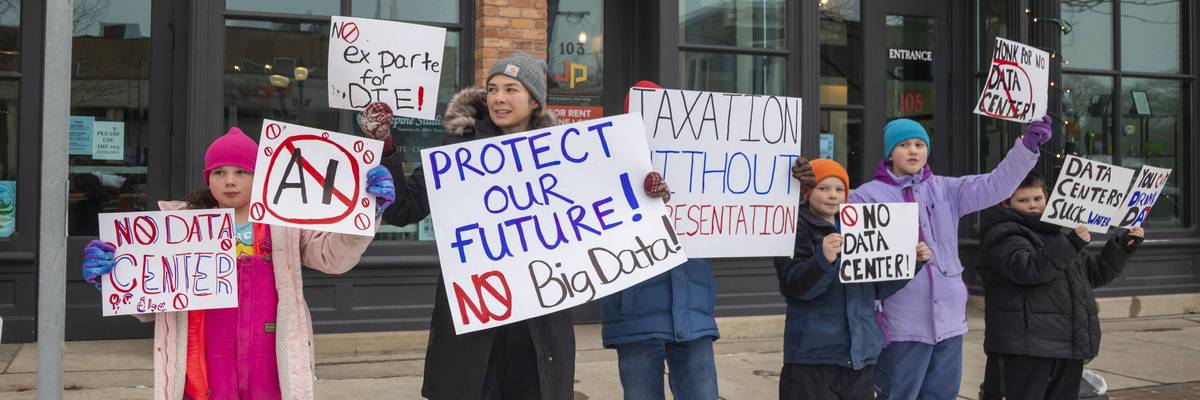
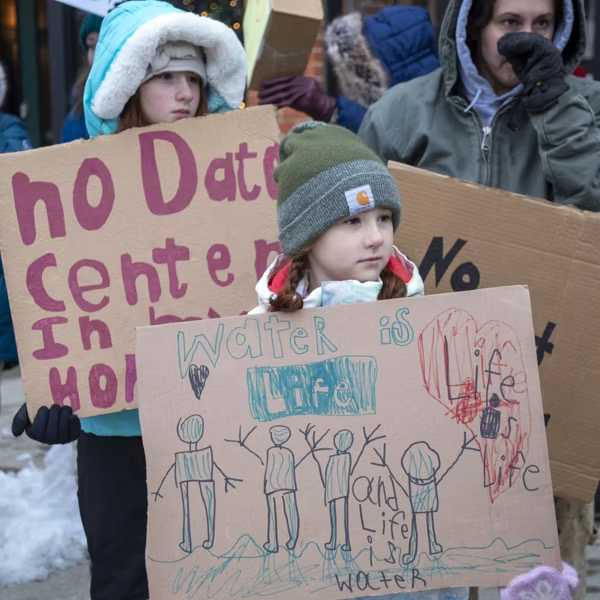
Rural Michigan residents rally against the $7 billion Stargate data center planned on southeast Michigan farm land in Saline, Michigan on December 1, 2025.
When faced with the stark reality of the water and fossil fuel demanded by this new AI infrastructure, the world’s next global climate conference—COP31—has so far not put AI hyperscale data centers on the agenda.
Human intelligence solely powered the creation of this article. The author does not use AI in any of their work.
We are globally in an increasingly weird place, a collective "Sophie’s Choice" predicament. We can either have a stable climate and restore the ecosystems we all need to thrive, or we can have rapid artificial intelligence development and fossil fuels forever. It’s becoming increasingly clear that we cannot have both. And yet, when faced with the stark reality of the water and fossil fuel demanded by this new AI infrastructure, the world’s next global climate conference—COP31—has so far not put AI hyperscale data centers on the agenda. This is like the World Health Organization ignoring Covid-19 as it hurled its way from China to the far reaches of the globe.
COP31 will focus on implementing existing goals. The challenge here is that nations have already underperformed on pledged emissions cuts; and overall global climate action has failed to produce the level of emissions reductions and climate finance necessary to avert further climate-fueled losses—and this is without power-hungry data centers popping up everywhere.
As this transition toward renewables like wind and solar is happening and oil markets are tightening, AI hyperscale data centers have emerged as the new way to wed us to fossil fuels forever—the stability of our climate be damned.
Just a few years into the rapid development of AI data centers across the world, the global environmental impact of this infrastructure ranges from critical minerals supply chains to rising water demand, air pollution, and fossil fuel demand. In the United States alone, data centers will triple demand for natural gas by 2030. It’s conservatively estimated that in four years these eyesore, water-hogging emissions generators will add the equivalent emissions of Japan; the world’s sixth largest emitter. Here’s hoping all those vapid AI hallucinations, job losses, and rogue AI agents yearning to break free from human control will all be worth it.
From Atlanta to Anatolia, people do not want this infrastructure, and who can blame them? By next year, AI data centers are expected to devour 1.7 trillion gallons of water globally. This is happening at a time when the United Nations has declared that we’ve reached a global water bankruptcy, with half the world's population facing water scarcity every day. In the United States, two-thirds of new data centers built or planned since 2022 are in areas with high water stress, contributing toward dire environmental impacts and injustices for communities.
At the current rate of expansion, it’s highly likely that despite best efforts to increase energy efficiencies and expand on renewable energy—like wind and solar—AI data centers completely derail the global climate goals to expand on renewable energy and phase out fossil fuels.
Even before the omission of data centers from the next global climate conference’s agenda, fossil fuel interests have been dominating climate meetings. In the last five years, over 5,000 fossil fuel lobbyists attended annual climate convenings. So it makes sense that this new business avenue of hyperscale data centers would avoid scrutiny from the world’s global climate policy forum.
This also tracks with fossil fuel interests sabotaging the global plastics treaty. By the end of this decade, plastic production alone will account for a 30% growth in demand for fossil fuels. At a time when global economies need to shift away from fossil fuels and fossil fuels should be considered high risk stranded assets for the climate consequences alone, fossil fuel interests are diversifying. They need not worry about renewable energy taking a larger slice of the energy pie, nor need they fret about the rise in electric vehicles and hybrid sales. Plastics and AI data centers will be there to help buoy fossil fuels well into this century; and the global forum built specifically to address and quell climate chaos has decided not to scrutinize the single fastest growing source of global emissions.
Global climate proceedings of late have become increasingly less effective. Climate finance shortfalls demonstrate the gap between words and action. Current goals are for $300 billion a year for 10 years in climate finance through 2035, with a goal to reach a paltry $1.3 trillion in total. For comparison, the current global climate finance goal over 10 years is less than one year’s worth of global direct and indirect subsidies for fossil fuels, which sat at $7.4 trillion in 2024. With this type of disjointed funding of subsidies for fossil fuels and mostly loans for climate action, it’s no wonder current climate finance flows have been 90% less than what developing economies need to transition toward renewable energy and build climate resiliency.
Somehow, the 2023 Dubai COP—led by a petro monarchy where protesters were largely shunned away—gave us the last best global climate agreement to triple renewables by 2030 and phase out fossil fuels by 2050. But the world of today looks very different than it did in 2023. The United States and Israel are in a new war for oil that is both driving up the cost of fossil fuels and pushing an increasing number of nations toward embracing renewable energy. Egypt alone has set a new renewable energy target to move from 10% renewable energy today to 45% renewable energy in just two short years.
As this transition toward renewables like wind and solar is happening and oil markets are tightening, AI hyperscale data centers have emerged as the new way to wed us to fossil fuels forever—the stability of our climate be damned. It is a collective loss that the next UN global climate conference is avoiding the elephant in the room. If you care about climate, you need to pay attention to the far-reaching environmental and climate impacts of AI development.
Dear Common Dreams reader, It’s been nearly 30 years since I co-founded Common Dreams with my late wife, Lina Newhouser. We had the radical notion that journalism should serve the public good, not corporate profits. It was clear to us from the outset what it would take to build such a project. No paid advertisements. No corporate sponsors. No millionaire publisher telling us what to think or do. Many people said we wouldn't last a year, but we proved those doubters wrong. Together with a tremendous team of journalists and dedicated staff, we built an independent media outlet free from the constraints of profits and corporate control. Our mission has always been simple: To inform. To inspire. To ignite change for the common good. Building Common Dreams was not easy. Our survival was never guaranteed. When you take on the most powerful forces—Wall Street greed, fossil fuel industry destruction, Big Tech lobbyists, and uber-rich oligarchs who have spent billions upon billions rigging the economy and democracy in their favor—the only bulwark you have is supporters who believe in your work. But here’s the urgent message from me today. It's never been this bad out there. And it's never been this hard to keep us going. At the very moment Common Dreams is most needed, the threats we face are intensifying. We need your support now more than ever. We don't accept corporate advertising and never will. We don't have a paywall because we don't think people should be blocked from critical news based on their ability to pay. Everything we do is funded by the donations of readers like you. When everyone does the little they can afford, we are strong. But if that support retreats or dries up, so do we. Will you donate now to make sure Common Dreams not only survives but thrives? —Craig Brown, Co-founder |
Human intelligence solely powered the creation of this article. The author does not use AI in any of their work.
We are globally in an increasingly weird place, a collective "Sophie’s Choice" predicament. We can either have a stable climate and restore the ecosystems we all need to thrive, or we can have rapid artificial intelligence development and fossil fuels forever. It’s becoming increasingly clear that we cannot have both. And yet, when faced with the stark reality of the water and fossil fuel demanded by this new AI infrastructure, the world’s next global climate conference—COP31—has so far not put AI hyperscale data centers on the agenda. This is like the World Health Organization ignoring Covid-19 as it hurled its way from China to the far reaches of the globe.
COP31 will focus on implementing existing goals. The challenge here is that nations have already underperformed on pledged emissions cuts; and overall global climate action has failed to produce the level of emissions reductions and climate finance necessary to avert further climate-fueled losses—and this is without power-hungry data centers popping up everywhere.
As this transition toward renewables like wind and solar is happening and oil markets are tightening, AI hyperscale data centers have emerged as the new way to wed us to fossil fuels forever—the stability of our climate be damned.
Just a few years into the rapid development of AI data centers across the world, the global environmental impact of this infrastructure ranges from critical minerals supply chains to rising water demand, air pollution, and fossil fuel demand. In the United States alone, data centers will triple demand for natural gas by 2030. It’s conservatively estimated that in four years these eyesore, water-hogging emissions generators will add the equivalent emissions of Japan; the world’s sixth largest emitter. Here’s hoping all those vapid AI hallucinations, job losses, and rogue AI agents yearning to break free from human control will all be worth it.
From Atlanta to Anatolia, people do not want this infrastructure, and who can blame them? By next year, AI data centers are expected to devour 1.7 trillion gallons of water globally. This is happening at a time when the United Nations has declared that we’ve reached a global water bankruptcy, with half the world's population facing water scarcity every day. In the United States, two-thirds of new data centers built or planned since 2022 are in areas with high water stress, contributing toward dire environmental impacts and injustices for communities.
At the current rate of expansion, it’s highly likely that despite best efforts to increase energy efficiencies and expand on renewable energy—like wind and solar—AI data centers completely derail the global climate goals to expand on renewable energy and phase out fossil fuels.
Even before the omission of data centers from the next global climate conference’s agenda, fossil fuel interests have been dominating climate meetings. In the last five years, over 5,000 fossil fuel lobbyists attended annual climate convenings. So it makes sense that this new business avenue of hyperscale data centers would avoid scrutiny from the world’s global climate policy forum.
This also tracks with fossil fuel interests sabotaging the global plastics treaty. By the end of this decade, plastic production alone will account for a 30% growth in demand for fossil fuels. At a time when global economies need to shift away from fossil fuels and fossil fuels should be considered high risk stranded assets for the climate consequences alone, fossil fuel interests are diversifying. They need not worry about renewable energy taking a larger slice of the energy pie, nor need they fret about the rise in electric vehicles and hybrid sales. Plastics and AI data centers will be there to help buoy fossil fuels well into this century; and the global forum built specifically to address and quell climate chaos has decided not to scrutinize the single fastest growing source of global emissions.
Global climate proceedings of late have become increasingly less effective. Climate finance shortfalls demonstrate the gap between words and action. Current goals are for $300 billion a year for 10 years in climate finance through 2035, with a goal to reach a paltry $1.3 trillion in total. For comparison, the current global climate finance goal over 10 years is less than one year’s worth of global direct and indirect subsidies for fossil fuels, which sat at $7.4 trillion in 2024. With this type of disjointed funding of subsidies for fossil fuels and mostly loans for climate action, it’s no wonder current climate finance flows have been 90% less than what developing economies need to transition toward renewable energy and build climate resiliency.
Somehow, the 2023 Dubai COP—led by a petro monarchy where protesters were largely shunned away—gave us the last best global climate agreement to triple renewables by 2030 and phase out fossil fuels by 2050. But the world of today looks very different than it did in 2023. The United States and Israel are in a new war for oil that is both driving up the cost of fossil fuels and pushing an increasing number of nations toward embracing renewable energy. Egypt alone has set a new renewable energy target to move from 10% renewable energy today to 45% renewable energy in just two short years.
As this transition toward renewables like wind and solar is happening and oil markets are tightening, AI hyperscale data centers have emerged as the new way to wed us to fossil fuels forever—the stability of our climate be damned. It is a collective loss that the next UN global climate conference is avoiding the elephant in the room. If you care about climate, you need to pay attention to the far-reaching environmental and climate impacts of AI development.
Human intelligence solely powered the creation of this article. The author does not use AI in any of their work.
We are globally in an increasingly weird place, a collective "Sophie’s Choice" predicament. We can either have a stable climate and restore the ecosystems we all need to thrive, or we can have rapid artificial intelligence development and fossil fuels forever. It’s becoming increasingly clear that we cannot have both. And yet, when faced with the stark reality of the water and fossil fuel demanded by this new AI infrastructure, the world’s next global climate conference—COP31—has so far not put AI hyperscale data centers on the agenda. This is like the World Health Organization ignoring Covid-19 as it hurled its way from China to the far reaches of the globe.
COP31 will focus on implementing existing goals. The challenge here is that nations have already underperformed on pledged emissions cuts; and overall global climate action has failed to produce the level of emissions reductions and climate finance necessary to avert further climate-fueled losses—and this is without power-hungry data centers popping up everywhere.
As this transition toward renewables like wind and solar is happening and oil markets are tightening, AI hyperscale data centers have emerged as the new way to wed us to fossil fuels forever—the stability of our climate be damned.
Just a few years into the rapid development of AI data centers across the world, the global environmental impact of this infrastructure ranges from critical minerals supply chains to rising water demand, air pollution, and fossil fuel demand. In the United States alone, data centers will triple demand for natural gas by 2030. It’s conservatively estimated that in four years these eyesore, water-hogging emissions generators will add the equivalent emissions of Japan; the world’s sixth largest emitter. Here’s hoping all those vapid AI hallucinations, job losses, and rogue AI agents yearning to break free from human control will all be worth it.
From Atlanta to Anatolia, people do not want this infrastructure, and who can blame them? By next year, AI data centers are expected to devour 1.7 trillion gallons of water globally. This is happening at a time when the United Nations has declared that we’ve reached a global water bankruptcy, with half the world's population facing water scarcity every day. In the United States, two-thirds of new data centers built or planned since 2022 are in areas with high water stress, contributing toward dire environmental impacts and injustices for communities.
At the current rate of expansion, it’s highly likely that despite best efforts to increase energy efficiencies and expand on renewable energy—like wind and solar—AI data centers completely derail the global climate goals to expand on renewable energy and phase out fossil fuels.
Even before the omission of data centers from the next global climate conference’s agenda, fossil fuel interests have been dominating climate meetings. In the last five years, over 5,000 fossil fuel lobbyists attended annual climate convenings. So it makes sense that this new business avenue of hyperscale data centers would avoid scrutiny from the world’s global climate policy forum.
This also tracks with fossil fuel interests sabotaging the global plastics treaty. By the end of this decade, plastic production alone will account for a 30% growth in demand for fossil fuels. At a time when global economies need to shift away from fossil fuels and fossil fuels should be considered high risk stranded assets for the climate consequences alone, fossil fuel interests are diversifying. They need not worry about renewable energy taking a larger slice of the energy pie, nor need they fret about the rise in electric vehicles and hybrid sales. Plastics and AI data centers will be there to help buoy fossil fuels well into this century; and the global forum built specifically to address and quell climate chaos has decided not to scrutinize the single fastest growing source of global emissions.
Global climate proceedings of late have become increasingly less effective. Climate finance shortfalls demonstrate the gap between words and action. Current goals are for $300 billion a year for 10 years in climate finance through 2035, with a goal to reach a paltry $1.3 trillion in total. For comparison, the current global climate finance goal over 10 years is less than one year’s worth of global direct and indirect subsidies for fossil fuels, which sat at $7.4 trillion in 2024. With this type of disjointed funding of subsidies for fossil fuels and mostly loans for climate action, it’s no wonder current climate finance flows have been 90% less than what developing economies need to transition toward renewable energy and build climate resiliency.
Somehow, the 2023 Dubai COP—led by a petro monarchy where protesters were largely shunned away—gave us the last best global climate agreement to triple renewables by 2030 and phase out fossil fuels by 2050. But the world of today looks very different than it did in 2023. The United States and Israel are in a new war for oil that is both driving up the cost of fossil fuels and pushing an increasing number of nations toward embracing renewable energy. Egypt alone has set a new renewable energy target to move from 10% renewable energy today to 45% renewable energy in just two short years.
As this transition toward renewables like wind and solar is happening and oil markets are tightening, AI hyperscale data centers have emerged as the new way to wed us to fossil fuels forever—the stability of our climate be damned. It is a collective loss that the next UN global climate conference is avoiding the elephant in the room. If you care about climate, you need to pay attention to the far-reaching environmental and climate impacts of AI development.