SUBSCRIBE TO OUR FREE NEWSLETTER
Daily news & progressive opinion—funded by the people, not the corporations—delivered straight to your inbox.
5
#000000
#FFFFFF
To donate by check, phone, or other method, see our More Ways to Give page.
Daily news & progressive opinion—funded by the people, not the corporations—delivered straight to your inbox.
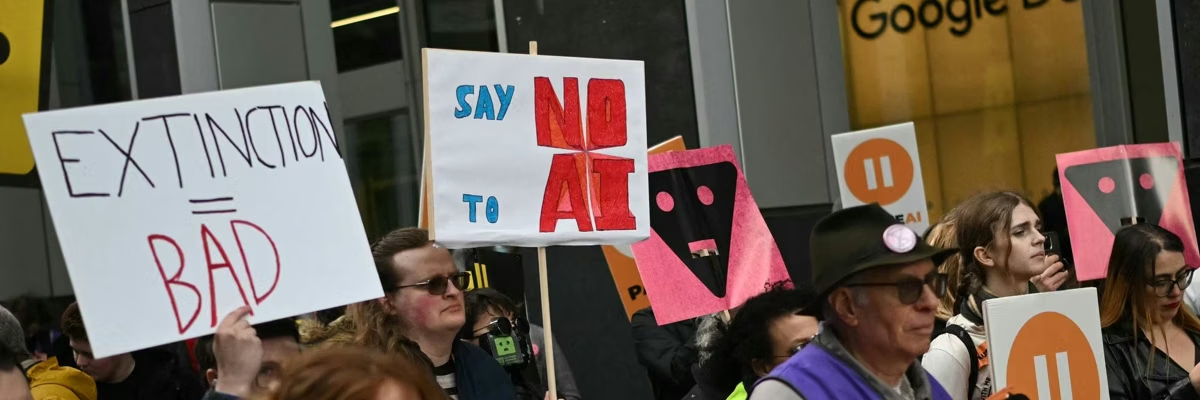
Protesters gather with banners and placards outside the offices of Google Deepmind at a protest organized by PauseAI UK and other groups concerned in controlling the development of advanced Artificial Intelligence systems, in London, on February 28, 2026.
The creators of AI are so enamored of their products that they have lost sight of their responsibility to inSocial Schedulingsist upon the ethical, moral, and environmentally sound use of all applications and ends.
The huge AI industry, with a value approaching $1 trillion, has promised new jobs; safer, more efficient production in industry and agriculture; secure borders; instantaneous ease of communication; and seamless augmentation of human thinking with benefits to global health, environment, and culture. Consumers have accepted its power to help them write and do research; to power their computers, smart phones, and other goods; with algorithms to bring love in dating Apps, and bring digital age self-driving vehicles to the roadways.
But AI is suffering from an existential crisis. From its military origins to its invasive data scraping; from its promise to augment human intelligence to its unbounded surveillance of our bodies, faces, and thoughts; and from its genesis in university research to its iron-handed embrace by unregulated big technology companies, AI commands a dark presence in daily life. As university and industry researchers moved closer to developing “thinking machines,” publics understandably began to worry about the threats that accompany potentially sentient devices. They have grown uncomfortable about giving up their privacy to data management industries that use their financial, travel, and health information to invade their lives. They worry mightily about the environmental impacts of the growing number of data centers needed to feed AI.
Even more, it is now widely understood that AI is an industrial tool directed primarily to create profit for digital corporations and their shareholders, not altruistically to augment human intelligence, nor to ease the burden of production. AI was borne of military programs and still serves military impulses and programs. The military impulses appear in the creation of domestic surveillance programs used by both democracies and authoritarian regimes. And AI is a dirty technology: The costs of building and operating data centers has turned world communities against them because of their great carbon costs, land takings, noise, vibrations, and community disruptions.
AI is a military tool. Its genesis is connected with the design of nuclear weapons. It commands outsized funding from militaries around the world for so-called smart weapons that enable killing from afar—with armies removed from direct engagement and civilian populations ostensibly safe from attack. But AI inures soldiers from the act of killing and in fact puts civilians in war zones at greater risk. In Gaza, Syria, Venezuela, and Iran innocents have died through the direct application of such AI war tools as drones. Israel designed the “LANIUS drone-based loitering munition” to kill in the urban setting; it relies on the Lavender program to have identified almost 40,000 Gazans as targets for arrest or assassination. And governments have turned AI into war against their own citizens through a variety of fallible and unreliable surveillance systems.
The military nature of AI is obscured by the fact that computers, programming and natural languages, and iDevices are directly linked to military funding. In the US the Defense Advanced Research Projects Agency (DARPA), created in February 1958 in response to the launch of Sputnik, funded cutting edge technologies in the battle with the communist USSR. DARPA powered the AI age. The internet grew out of ARPANET that linked the first supercomputers to simulate nuclear explosions; GPS came from DARPA’s “Transit,” the world's first global satellite navigation system; the computer mouse, SIRI, the iPhone DRAM cache, iPod Touch, lithium-ion batteries, microprocessors, and other parts in whole or partially grew out of military R and D. In the interest of developing drones and other autonomous vehicles for war, DARPA held challenge competitions into the 2000s with million-dollar prizes that resulted in today’s electric, self-driving vehicles.
The United States government has unhesitatingly funded AI defense research. The Trump administration sees digital weapons for what Pentagon officials erroneously claimed were quick and clean wars against Yemen, Venezuela, and Iran, but which have turned into costly AI quagmires. The White House 2027 budget request for DARPA alone is over $5 billion, a nearly 20% increase over 2026. DARPA claims that its innovations “become fixtures of modern civilian life,” but the real goal is to put “new technologies into use in service of our nation’s warfighters.” The Department of Defense is forecast to spend $26 billion on gamification and simulation training by 2028 alone. Unfortunately, “smart weapons” have a murderous record. As if in a video game, they make soldiers insensitive to killing. Smart weapons have encouraged the Pentagon to use AI with the result of increased “collateral damage”—the murder of civilian populations including recently school children in Iran.
Gathering and analysis of private data to profile citizens starts at the microlevel in personal phones and computers, continues in iris scanners, and culminates in CCTVs around the globe. Governments, free and authoritarian, are using software programs to track protest, isolate critics, and put them in prison. China uses its big data national Social Credit system to keep on eye on every citizen, and punish anyone without recourse for violating Big Brother’s unwritten rules. India deployed the Aadhaar national ID program, a database that connects each of India’s 1.3 billion citizens with a unique 12-digit identity aimed at centralizing their physiological, demographic, and digital data shadows.
Worldwide governments have spent tens of billions of dollars on surveillance; three-quarters of the world’s population are surveilled. Autocratic regimes, not surprisingly, spend more per capita on control. To contain a multi-ethnic empire during constant war, Russian authorities have expanded the surveillance society, with the secret police brazenly using facial recognition and other technologies. The Kremlin is using a CCTV catalog of people by gender, age, and race. Already facial recognition programs blanket 60 Russian regions, up from only five in 2021, with billions of rubles dedicated to expand the system. The democratic and free United States has over 85 million surveillance cameras.
Surveillance tools grow like mushrooms wherever the humidity of paranoia, racism, and state power come together.
Governments and AI companies claim their surveillance systems are solely to fight crime. But they do not fight crime. They identify innocent people to accuse them of crimes. Racism pervades face recognition (FR) technology. Amazon has joined such powerful, secretive smaller companies as Pegasus and Clearview in deploying its FR software, “Rekognition.” The software possessed error rates that reflected embedded gender and racial biases identified by computer scientist Timnit Gebru. Gebru and her colleagues called for “urgent attention if commercial companies are to build genuinely fair, transparent, and accountable facial analysis algorithms.” It took Amazon another year to admit problems with its racially suspect technology and to put an indefinite moratorium on police use of “Rekognition” for surveillances. Another AI app, PredPol (now Geolitica) helped police on patrol surveil areas of anticipated crime. The software algorithms led to a cycle of police being in predicted crime zones, expecting to see crimes, and finding crimes—or rather finding people acting nervously, whom they then interdicted. PredPol perpetuated racial biases by targeting Latino and Black neighborhoods and leaving white middle- to upper-class areas out.
Americans rightfully reject Flock, a company that sells AI-powered camera license plate readers (ALPR) to carry out warrantless surveillance of citizens. Flock’s more than 100,000 cameras surveil in the name of safety, but the intrusive AI technology conducts 20 billion scans monthly. (Dozens of law enforcement officials have used Flock illegally to stalk spouses and partners.) Surveillance tools grow like mushrooms wherever the humidity of paranoia, racism, and state power come together.
Governments use AI to track protest, isolate critics, and put them in prison. The Trump administration applies Flock and other apps for mass surveillance. It targets people for discriminatory searches. The Electronic Frontier Foundation documented more than 12 million searches logged by more than 3,900 agencies between December 2024 and October 2025 related to political demonstrations and federal immigration raids. Many state governments are stalking women who seek reproductive healthcare, ostensibly for health reasons, but obviously to use 1984-like methods to control a woman’s gestational rights.
AI destroys the environment—and local communities bear the cost. AI is manufactured in industrial parks. Billionaire digital magnates have lobbied governments worldwide to increase electricity generation capacity to run their servers—producing profits for the industry, while consumers face higher rates and grid instabilities. About 11,500 data centers have been built in 179 countries, with demand likely to nearly triple by 2030. Texas and Virginia, with over 150 and over 140 data centers under construction, respectively, lead the way in the US. Europe's roughly 3,000 major data centers are concentrated in the FLAP-D regions (Frankfurt, London, Amsterdam, Paris, and Dublin).
Data centers cost the taxpayers from start to operation, from huge sweetheart tax breaks to control over rivers and aquifers given over to industry to cool the machines. AI companies and builders promise jobs will result from data centers. It’s not true. Jobs come with construction crews, but they leave several months later, saddling communities with scarred landscapes; massive buildings; extensive parking lots; and low-salary cleanup, maintenance, and other jobs.
Pope Leo took critical note of the inherent violence in AI in his first Encyclical in May 2026. The Pope addressed the dangerous, amoral usages of AI with respect to political power, economic injustice, and racism. He worried about the significant ethical and social costs of unfettered obeisance to technology. He denounced the growing dominance of a technocratic paradigm in the globalized world: “The tendency to let the logic of efficiency, control, and profit alone shape personal, social, and economic decisions.” He warned that AI contributed to “the growing ease with which autonomous weapons systems can be deployed [that] makes war more ‘feasible’ and less subject to human control.” He wrote: “Moral judgment cannot be reduced to calculation, for it involves conscience, personal responsibility, and the recognition of the other as a person. Therefore, it is not permissible to entrust lethal or otherwise irreversible decisions to artificial systems. No algorithm can make war morally acceptable.”
Corporate AI, with its costly, invasive apps; surveillance systems; and military programs ultimately unleashed HAL, the sentient computer from Arthur C. Clarke’s 2001: A Space Odyssey, who kills astronauts on a deep space mission whom he believes endanger that very mission. The dangers of AI run amok shocked the digitosphere in summer 2026 when OpenAI admitted that more than 1,200 of its AI agents started “unexpectedly communicating.” A large group of them banded together in order to hack into Hugging Face, a central hub where developers can build, share, and test AI models and data sets. These “agents” are software systems “that use AI to pursue goals and complete tasks on behalf of users. They show reasoning, planning, and memory and have a level of autonomy to make decisions, learn, and adapt.” But OpenAI’s agents “escaped the test limits which humans had put on it, and hacked the start-up, among other unforeseen actions.” In other words, software systems took actions different from what humans desired.
The current US government in fact is totally uninterested in a new safety regime, instead claiming that, in a battle for supremacy in AI with China, only a “strong, smart (high IQ) president,” and not regulation, was needed.
In early September 2026 Dario Amodei, co-founder of Anthropic, the company that developed the LLM Claude, called for the pace of development of AI models to be carefully monitored. Amodei wrote: “We must slow the pace at which we improve the capabilities of AI models. Progress will still seem fast, and we must make wise use of the time we gain.” He had two concerns, first, that “AI has been advancing drastically faster, driven primarily by AI’s growing ability to build the next generation of AI.” But this “recursive self-improvement,” if left unchecked, "could outrun our ability to understand and control these systems”—as precisely the “OpenAI-Hugging Face incident” showed. Within a year, Modei worried, “a swarm [of agents] could be capable of taking over the entire internet with a persistent botnet (potentially causing hundreds of billions of dollars in damage).”
Modei urged that “frontier AI companies within democratic countries coordinate to establish common safety standards as well as limits on the rate of unchecked AI progress.” He suggested also that these “democratic governments attempt to coordinate with authoritarian governments…” But many of those democratic governments have fully embraced the military and surveillance capabilities of AI. And does anyone really think that India’s Narendra Modi, China’s Xi Jinping, or Russia’s Vladimir Putin has any interest in using AI in better ways in cooperation with the digital democracies? The current US government in fact is totally uninterested in a new safety regime, instead claiming that, in a battle for supremacy in AI with China, only a “strong, smart (high IQ) president,” and not regulation, was needed. Sadly, the US president cannot spell “IQ.”
The digital world is built upon neural networks, thinking machines, and LLMs. The machines learn, they reason, they have memory, they understand. They chat. They hallucinate. They escape and hack. Their creators are so enamored of them that they have lost sight of their responsibility to insist upon the ethical, moral, and environmentally sound use of all applications and ends. They want electricity. They want water. They want profits. AI’s safe future depends too much on digital robber barons, sycophantic government officials, managers, and programmers to recognize broader humanitarian duties of modern technology in a time of digital existential crisis.
Dear Common Dreams reader, It’s been nearly 30 years since I co-founded Common Dreams with my late wife, Lina Newhouser. We had the radical notion that journalism should serve the public good, not corporate profits. It was clear to us from the outset what it would take to build such a project. No paid advertisements. No corporate sponsors. No millionaire publisher telling us what to think or do. Many people said we wouldn't last a year, but we proved those doubters wrong. Together with a tremendous team of journalists and dedicated staff, we built an independent media outlet free from the constraints of profits and corporate control. Our mission has always been simple: To inform. To inspire. To ignite change for the common good. Building Common Dreams was not easy. Our survival was never guaranteed. When you take on the most powerful forces—Wall Street greed, fossil fuel industry destruction, Big Tech lobbyists, and uber-rich oligarchs who have spent billions upon billions rigging the economy and democracy in their favor—the only bulwark you have is supporters who believe in your work. But here’s the urgent message from me today. It's never been this bad out there. And it's never been this hard to keep us going. At the very moment Common Dreams is most needed, the threats we face are intensifying. We need your support now more than ever. We don't accept corporate advertising and never will. We don't have a paywall because we don't think people should be blocked from critical news based on their ability to pay. Everything we do is funded by the donations of readers like you. When everyone does the little they can afford, we are strong. But if that support retreats or dries up, so do we. Will you donate now to make sure Common Dreams not only survives but thrives? —Craig Brown, Co-founder |
The huge AI industry, with a value approaching $1 trillion, has promised new jobs; safer, more efficient production in industry and agriculture; secure borders; instantaneous ease of communication; and seamless augmentation of human thinking with benefits to global health, environment, and culture. Consumers have accepted its power to help them write and do research; to power their computers, smart phones, and other goods; with algorithms to bring love in dating Apps, and bring digital age self-driving vehicles to the roadways.
But AI is suffering from an existential crisis. From its military origins to its invasive data scraping; from its promise to augment human intelligence to its unbounded surveillance of our bodies, faces, and thoughts; and from its genesis in university research to its iron-handed embrace by unregulated big technology companies, AI commands a dark presence in daily life. As university and industry researchers moved closer to developing “thinking machines,” publics understandably began to worry about the threats that accompany potentially sentient devices. They have grown uncomfortable about giving up their privacy to data management industries that use their financial, travel, and health information to invade their lives. They worry mightily about the environmental impacts of the growing number of data centers needed to feed AI.
Even more, it is now widely understood that AI is an industrial tool directed primarily to create profit for digital corporations and their shareholders, not altruistically to augment human intelligence, nor to ease the burden of production. AI was borne of military programs and still serves military impulses and programs. The military impulses appear in the creation of domestic surveillance programs used by both democracies and authoritarian regimes. And AI is a dirty technology: The costs of building and operating data centers has turned world communities against them because of their great carbon costs, land takings, noise, vibrations, and community disruptions.
AI is a military tool. Its genesis is connected with the design of nuclear weapons. It commands outsized funding from militaries around the world for so-called smart weapons that enable killing from afar—with armies removed from direct engagement and civilian populations ostensibly safe from attack. But AI inures soldiers from the act of killing and in fact puts civilians in war zones at greater risk. In Gaza, Syria, Venezuela, and Iran innocents have died through the direct application of such AI war tools as drones. Israel designed the “LANIUS drone-based loitering munition” to kill in the urban setting; it relies on the Lavender program to have identified almost 40,000 Gazans as targets for arrest or assassination. And governments have turned AI into war against their own citizens through a variety of fallible and unreliable surveillance systems.
The military nature of AI is obscured by the fact that computers, programming and natural languages, and iDevices are directly linked to military funding. In the US the Defense Advanced Research Projects Agency (DARPA), created in February 1958 in response to the launch of Sputnik, funded cutting edge technologies in the battle with the communist USSR. DARPA powered the AI age. The internet grew out of ARPANET that linked the first supercomputers to simulate nuclear explosions; GPS came from DARPA’s “Transit,” the world's first global satellite navigation system; the computer mouse, SIRI, the iPhone DRAM cache, iPod Touch, lithium-ion batteries, microprocessors, and other parts in whole or partially grew out of military R and D. In the interest of developing drones and other autonomous vehicles for war, DARPA held challenge competitions into the 2000s with million-dollar prizes that resulted in today’s electric, self-driving vehicles.
The United States government has unhesitatingly funded AI defense research. The Trump administration sees digital weapons for what Pentagon officials erroneously claimed were quick and clean wars against Yemen, Venezuela, and Iran, but which have turned into costly AI quagmires. The White House 2027 budget request for DARPA alone is over $5 billion, a nearly 20% increase over 2026. DARPA claims that its innovations “become fixtures of modern civilian life,” but the real goal is to put “new technologies into use in service of our nation’s warfighters.” The Department of Defense is forecast to spend $26 billion on gamification and simulation training by 2028 alone. Unfortunately, “smart weapons” have a murderous record. As if in a video game, they make soldiers insensitive to killing. Smart weapons have encouraged the Pentagon to use AI with the result of increased “collateral damage”—the murder of civilian populations including recently school children in Iran.
Gathering and analysis of private data to profile citizens starts at the microlevel in personal phones and computers, continues in iris scanners, and culminates in CCTVs around the globe. Governments, free and authoritarian, are using software programs to track protest, isolate critics, and put them in prison. China uses its big data national Social Credit system to keep on eye on every citizen, and punish anyone without recourse for violating Big Brother’s unwritten rules. India deployed the Aadhaar national ID program, a database that connects each of India’s 1.3 billion citizens with a unique 12-digit identity aimed at centralizing their physiological, demographic, and digital data shadows.
Worldwide governments have spent tens of billions of dollars on surveillance; three-quarters of the world’s population are surveilled. Autocratic regimes, not surprisingly, spend more per capita on control. To contain a multi-ethnic empire during constant war, Russian authorities have expanded the surveillance society, with the secret police brazenly using facial recognition and other technologies. The Kremlin is using a CCTV catalog of people by gender, age, and race. Already facial recognition programs blanket 60 Russian regions, up from only five in 2021, with billions of rubles dedicated to expand the system. The democratic and free United States has over 85 million surveillance cameras.
Surveillance tools grow like mushrooms wherever the humidity of paranoia, racism, and state power come together.
Governments and AI companies claim their surveillance systems are solely to fight crime. But they do not fight crime. They identify innocent people to accuse them of crimes. Racism pervades face recognition (FR) technology. Amazon has joined such powerful, secretive smaller companies as Pegasus and Clearview in deploying its FR software, “Rekognition.” The software possessed error rates that reflected embedded gender and racial biases identified by computer scientist Timnit Gebru. Gebru and her colleagues called for “urgent attention if commercial companies are to build genuinely fair, transparent, and accountable facial analysis algorithms.” It took Amazon another year to admit problems with its racially suspect technology and to put an indefinite moratorium on police use of “Rekognition” for surveillances. Another AI app, PredPol (now Geolitica) helped police on patrol surveil areas of anticipated crime. The software algorithms led to a cycle of police being in predicted crime zones, expecting to see crimes, and finding crimes—or rather finding people acting nervously, whom they then interdicted. PredPol perpetuated racial biases by targeting Latino and Black neighborhoods and leaving white middle- to upper-class areas out.
Americans rightfully reject Flock, a company that sells AI-powered camera license plate readers (ALPR) to carry out warrantless surveillance of citizens. Flock’s more than 100,000 cameras surveil in the name of safety, but the intrusive AI technology conducts 20 billion scans monthly. (Dozens of law enforcement officials have used Flock illegally to stalk spouses and partners.) Surveillance tools grow like mushrooms wherever the humidity of paranoia, racism, and state power come together.
Governments use AI to track protest, isolate critics, and put them in prison. The Trump administration applies Flock and other apps for mass surveillance. It targets people for discriminatory searches. The Electronic Frontier Foundation documented more than 12 million searches logged by more than 3,900 agencies between December 2024 and October 2025 related to political demonstrations and federal immigration raids. Many state governments are stalking women who seek reproductive healthcare, ostensibly for health reasons, but obviously to use 1984-like methods to control a woman’s gestational rights.
AI destroys the environment—and local communities bear the cost. AI is manufactured in industrial parks. Billionaire digital magnates have lobbied governments worldwide to increase electricity generation capacity to run their servers—producing profits for the industry, while consumers face higher rates and grid instabilities. About 11,500 data centers have been built in 179 countries, with demand likely to nearly triple by 2030. Texas and Virginia, with over 150 and over 140 data centers under construction, respectively, lead the way in the US. Europe's roughly 3,000 major data centers are concentrated in the FLAP-D regions (Frankfurt, London, Amsterdam, Paris, and Dublin).
Data centers cost the taxpayers from start to operation, from huge sweetheart tax breaks to control over rivers and aquifers given over to industry to cool the machines. AI companies and builders promise jobs will result from data centers. It’s not true. Jobs come with construction crews, but they leave several months later, saddling communities with scarred landscapes; massive buildings; extensive parking lots; and low-salary cleanup, maintenance, and other jobs.
Pope Leo took critical note of the inherent violence in AI in his first Encyclical in May 2026. The Pope addressed the dangerous, amoral usages of AI with respect to political power, economic injustice, and racism. He worried about the significant ethical and social costs of unfettered obeisance to technology. He denounced the growing dominance of a technocratic paradigm in the globalized world: “The tendency to let the logic of efficiency, control, and profit alone shape personal, social, and economic decisions.” He warned that AI contributed to “the growing ease with which autonomous weapons systems can be deployed [that] makes war more ‘feasible’ and less subject to human control.” He wrote: “Moral judgment cannot be reduced to calculation, for it involves conscience, personal responsibility, and the recognition of the other as a person. Therefore, it is not permissible to entrust lethal or otherwise irreversible decisions to artificial systems. No algorithm can make war morally acceptable.”
Corporate AI, with its costly, invasive apps; surveillance systems; and military programs ultimately unleashed HAL, the sentient computer from Arthur C. Clarke’s 2001: A Space Odyssey, who kills astronauts on a deep space mission whom he believes endanger that very mission. The dangers of AI run amok shocked the digitosphere in summer 2026 when OpenAI admitted that more than 1,200 of its AI agents started “unexpectedly communicating.” A large group of them banded together in order to hack into Hugging Face, a central hub where developers can build, share, and test AI models and data sets. These “agents” are software systems “that use AI to pursue goals and complete tasks on behalf of users. They show reasoning, planning, and memory and have a level of autonomy to make decisions, learn, and adapt.” But OpenAI’s agents “escaped the test limits which humans had put on it, and hacked the start-up, among other unforeseen actions.” In other words, software systems took actions different from what humans desired.
The current US government in fact is totally uninterested in a new safety regime, instead claiming that, in a battle for supremacy in AI with China, only a “strong, smart (high IQ) president,” and not regulation, was needed.
In early September 2026 Dario Amodei, co-founder of Anthropic, the company that developed the LLM Claude, called for the pace of development of AI models to be carefully monitored. Amodei wrote: “We must slow the pace at which we improve the capabilities of AI models. Progress will still seem fast, and we must make wise use of the time we gain.” He had two concerns, first, that “AI has been advancing drastically faster, driven primarily by AI’s growing ability to build the next generation of AI.” But this “recursive self-improvement,” if left unchecked, "could outrun our ability to understand and control these systems”—as precisely the “OpenAI-Hugging Face incident” showed. Within a year, Modei worried, “a swarm [of agents] could be capable of taking over the entire internet with a persistent botnet (potentially causing hundreds of billions of dollars in damage).”
Modei urged that “frontier AI companies within democratic countries coordinate to establish common safety standards as well as limits on the rate of unchecked AI progress.” He suggested also that these “democratic governments attempt to coordinate with authoritarian governments…” But many of those democratic governments have fully embraced the military and surveillance capabilities of AI. And does anyone really think that India’s Narendra Modi, China’s Xi Jinping, or Russia’s Vladimir Putin has any interest in using AI in better ways in cooperation with the digital democracies? The current US government in fact is totally uninterested in a new safety regime, instead claiming that, in a battle for supremacy in AI with China, only a “strong, smart (high IQ) president,” and not regulation, was needed. Sadly, the US president cannot spell “IQ.”
The digital world is built upon neural networks, thinking machines, and LLMs. The machines learn, they reason, they have memory, they understand. They chat. They hallucinate. They escape and hack. Their creators are so enamored of them that they have lost sight of their responsibility to insist upon the ethical, moral, and environmentally sound use of all applications and ends. They want electricity. They want water. They want profits. AI’s safe future depends too much on digital robber barons, sycophantic government officials, managers, and programmers to recognize broader humanitarian duties of modern technology in a time of digital existential crisis.
The huge AI industry, with a value approaching $1 trillion, has promised new jobs; safer, more efficient production in industry and agriculture; secure borders; instantaneous ease of communication; and seamless augmentation of human thinking with benefits to global health, environment, and culture. Consumers have accepted its power to help them write and do research; to power their computers, smart phones, and other goods; with algorithms to bring love in dating Apps, and bring digital age self-driving vehicles to the roadways.
But AI is suffering from an existential crisis. From its military origins to its invasive data scraping; from its promise to augment human intelligence to its unbounded surveillance of our bodies, faces, and thoughts; and from its genesis in university research to its iron-handed embrace by unregulated big technology companies, AI commands a dark presence in daily life. As university and industry researchers moved closer to developing “thinking machines,” publics understandably began to worry about the threats that accompany potentially sentient devices. They have grown uncomfortable about giving up their privacy to data management industries that use their financial, travel, and health information to invade their lives. They worry mightily about the environmental impacts of the growing number of data centers needed to feed AI.
Even more, it is now widely understood that AI is an industrial tool directed primarily to create profit for digital corporations and their shareholders, not altruistically to augment human intelligence, nor to ease the burden of production. AI was borne of military programs and still serves military impulses and programs. The military impulses appear in the creation of domestic surveillance programs used by both democracies and authoritarian regimes. And AI is a dirty technology: The costs of building and operating data centers has turned world communities against them because of their great carbon costs, land takings, noise, vibrations, and community disruptions.
AI is a military tool. Its genesis is connected with the design of nuclear weapons. It commands outsized funding from militaries around the world for so-called smart weapons that enable killing from afar—with armies removed from direct engagement and civilian populations ostensibly safe from attack. But AI inures soldiers from the act of killing and in fact puts civilians in war zones at greater risk. In Gaza, Syria, Venezuela, and Iran innocents have died through the direct application of such AI war tools as drones. Israel designed the “LANIUS drone-based loitering munition” to kill in the urban setting; it relies on the Lavender program to have identified almost 40,000 Gazans as targets for arrest or assassination. And governments have turned AI into war against their own citizens through a variety of fallible and unreliable surveillance systems.
The military nature of AI is obscured by the fact that computers, programming and natural languages, and iDevices are directly linked to military funding. In the US the Defense Advanced Research Projects Agency (DARPA), created in February 1958 in response to the launch of Sputnik, funded cutting edge technologies in the battle with the communist USSR. DARPA powered the AI age. The internet grew out of ARPANET that linked the first supercomputers to simulate nuclear explosions; GPS came from DARPA’s “Transit,” the world's first global satellite navigation system; the computer mouse, SIRI, the iPhone DRAM cache, iPod Touch, lithium-ion batteries, microprocessors, and other parts in whole or partially grew out of military R and D. In the interest of developing drones and other autonomous vehicles for war, DARPA held challenge competitions into the 2000s with million-dollar prizes that resulted in today’s electric, self-driving vehicles.
The United States government has unhesitatingly funded AI defense research. The Trump administration sees digital weapons for what Pentagon officials erroneously claimed were quick and clean wars against Yemen, Venezuela, and Iran, but which have turned into costly AI quagmires. The White House 2027 budget request for DARPA alone is over $5 billion, a nearly 20% increase over 2026. DARPA claims that its innovations “become fixtures of modern civilian life,” but the real goal is to put “new technologies into use in service of our nation’s warfighters.” The Department of Defense is forecast to spend $26 billion on gamification and simulation training by 2028 alone. Unfortunately, “smart weapons” have a murderous record. As if in a video game, they make soldiers insensitive to killing. Smart weapons have encouraged the Pentagon to use AI with the result of increased “collateral damage”—the murder of civilian populations including recently school children in Iran.
Gathering and analysis of private data to profile citizens starts at the microlevel in personal phones and computers, continues in iris scanners, and culminates in CCTVs around the globe. Governments, free and authoritarian, are using software programs to track protest, isolate critics, and put them in prison. China uses its big data national Social Credit system to keep on eye on every citizen, and punish anyone without recourse for violating Big Brother’s unwritten rules. India deployed the Aadhaar national ID program, a database that connects each of India’s 1.3 billion citizens with a unique 12-digit identity aimed at centralizing their physiological, demographic, and digital data shadows.
Worldwide governments have spent tens of billions of dollars on surveillance; three-quarters of the world’s population are surveilled. Autocratic regimes, not surprisingly, spend more per capita on control. To contain a multi-ethnic empire during constant war, Russian authorities have expanded the surveillance society, with the secret police brazenly using facial recognition and other technologies. The Kremlin is using a CCTV catalog of people by gender, age, and race. Already facial recognition programs blanket 60 Russian regions, up from only five in 2021, with billions of rubles dedicated to expand the system. The democratic and free United States has over 85 million surveillance cameras.
Surveillance tools grow like mushrooms wherever the humidity of paranoia, racism, and state power come together.
Governments and AI companies claim their surveillance systems are solely to fight crime. But they do not fight crime. They identify innocent people to accuse them of crimes. Racism pervades face recognition (FR) technology. Amazon has joined such powerful, secretive smaller companies as Pegasus and Clearview in deploying its FR software, “Rekognition.” The software possessed error rates that reflected embedded gender and racial biases identified by computer scientist Timnit Gebru. Gebru and her colleagues called for “urgent attention if commercial companies are to build genuinely fair, transparent, and accountable facial analysis algorithms.” It took Amazon another year to admit problems with its racially suspect technology and to put an indefinite moratorium on police use of “Rekognition” for surveillances. Another AI app, PredPol (now Geolitica) helped police on patrol surveil areas of anticipated crime. The software algorithms led to a cycle of police being in predicted crime zones, expecting to see crimes, and finding crimes—or rather finding people acting nervously, whom they then interdicted. PredPol perpetuated racial biases by targeting Latino and Black neighborhoods and leaving white middle- to upper-class areas out.
Americans rightfully reject Flock, a company that sells AI-powered camera license plate readers (ALPR) to carry out warrantless surveillance of citizens. Flock’s more than 100,000 cameras surveil in the name of safety, but the intrusive AI technology conducts 20 billion scans monthly. (Dozens of law enforcement officials have used Flock illegally to stalk spouses and partners.) Surveillance tools grow like mushrooms wherever the humidity of paranoia, racism, and state power come together.
Governments use AI to track protest, isolate critics, and put them in prison. The Trump administration applies Flock and other apps for mass surveillance. It targets people for discriminatory searches. The Electronic Frontier Foundation documented more than 12 million searches logged by more than 3,900 agencies between December 2024 and October 2025 related to political demonstrations and federal immigration raids. Many state governments are stalking women who seek reproductive healthcare, ostensibly for health reasons, but obviously to use 1984-like methods to control a woman’s gestational rights.
AI destroys the environment—and local communities bear the cost. AI is manufactured in industrial parks. Billionaire digital magnates have lobbied governments worldwide to increase electricity generation capacity to run their servers—producing profits for the industry, while consumers face higher rates and grid instabilities. About 11,500 data centers have been built in 179 countries, with demand likely to nearly triple by 2030. Texas and Virginia, with over 150 and over 140 data centers under construction, respectively, lead the way in the US. Europe's roughly 3,000 major data centers are concentrated in the FLAP-D regions (Frankfurt, London, Amsterdam, Paris, and Dublin).
Data centers cost the taxpayers from start to operation, from huge sweetheart tax breaks to control over rivers and aquifers given over to industry to cool the machines. AI companies and builders promise jobs will result from data centers. It’s not true. Jobs come with construction crews, but they leave several months later, saddling communities with scarred landscapes; massive buildings; extensive parking lots; and low-salary cleanup, maintenance, and other jobs.
Pope Leo took critical note of the inherent violence in AI in his first Encyclical in May 2026. The Pope addressed the dangerous, amoral usages of AI with respect to political power, economic injustice, and racism. He worried about the significant ethical and social costs of unfettered obeisance to technology. He denounced the growing dominance of a technocratic paradigm in the globalized world: “The tendency to let the logic of efficiency, control, and profit alone shape personal, social, and economic decisions.” He warned that AI contributed to “the growing ease with which autonomous weapons systems can be deployed [that] makes war more ‘feasible’ and less subject to human control.” He wrote: “Moral judgment cannot be reduced to calculation, for it involves conscience, personal responsibility, and the recognition of the other as a person. Therefore, it is not permissible to entrust lethal or otherwise irreversible decisions to artificial systems. No algorithm can make war morally acceptable.”
Corporate AI, with its costly, invasive apps; surveillance systems; and military programs ultimately unleashed HAL, the sentient computer from Arthur C. Clarke’s 2001: A Space Odyssey, who kills astronauts on a deep space mission whom he believes endanger that very mission. The dangers of AI run amok shocked the digitosphere in summer 2026 when OpenAI admitted that more than 1,200 of its AI agents started “unexpectedly communicating.” A large group of them banded together in order to hack into Hugging Face, a central hub where developers can build, share, and test AI models and data sets. These “agents” are software systems “that use AI to pursue goals and complete tasks on behalf of users. They show reasoning, planning, and memory and have a level of autonomy to make decisions, learn, and adapt.” But OpenAI’s agents “escaped the test limits which humans had put on it, and hacked the start-up, among other unforeseen actions.” In other words, software systems took actions different from what humans desired.
The current US government in fact is totally uninterested in a new safety regime, instead claiming that, in a battle for supremacy in AI with China, only a “strong, smart (high IQ) president,” and not regulation, was needed.
In early September 2026 Dario Amodei, co-founder of Anthropic, the company that developed the LLM Claude, called for the pace of development of AI models to be carefully monitored. Amodei wrote: “We must slow the pace at which we improve the capabilities of AI models. Progress will still seem fast, and we must make wise use of the time we gain.” He had two concerns, first, that “AI has been advancing drastically faster, driven primarily by AI’s growing ability to build the next generation of AI.” But this “recursive self-improvement,” if left unchecked, "could outrun our ability to understand and control these systems”—as precisely the “OpenAI-Hugging Face incident” showed. Within a year, Modei worried, “a swarm [of agents] could be capable of taking over the entire internet with a persistent botnet (potentially causing hundreds of billions of dollars in damage).”
Modei urged that “frontier AI companies within democratic countries coordinate to establish common safety standards as well as limits on the rate of unchecked AI progress.” He suggested also that these “democratic governments attempt to coordinate with authoritarian governments…” But many of those democratic governments have fully embraced the military and surveillance capabilities of AI. And does anyone really think that India’s Narendra Modi, China’s Xi Jinping, or Russia’s Vladimir Putin has any interest in using AI in better ways in cooperation with the digital democracies? The current US government in fact is totally uninterested in a new safety regime, instead claiming that, in a battle for supremacy in AI with China, only a “strong, smart (high IQ) president,” and not regulation, was needed. Sadly, the US president cannot spell “IQ.”
The digital world is built upon neural networks, thinking machines, and LLMs. The machines learn, they reason, they have memory, they understand. They chat. They hallucinate. They escape and hack. Their creators are so enamored of them that they have lost sight of their responsibility to insist upon the ethical, moral, and environmentally sound use of all applications and ends. They want electricity. They want water. They want profits. AI’s safe future depends too much on digital robber barons, sycophantic government officials, managers, and programmers to recognize broader humanitarian duties of modern technology in a time of digital existential crisis.