SUBSCRIBE TO OUR FREE NEWSLETTER
Daily news & progressive opinion—funded by the people, not the corporations—delivered straight to your inbox.
5
#000000
#FFFFFF
To donate by check, phone, or other method, see our More Ways to Give page.
Daily news & progressive opinion—funded by the people, not the corporations—delivered straight to your inbox.
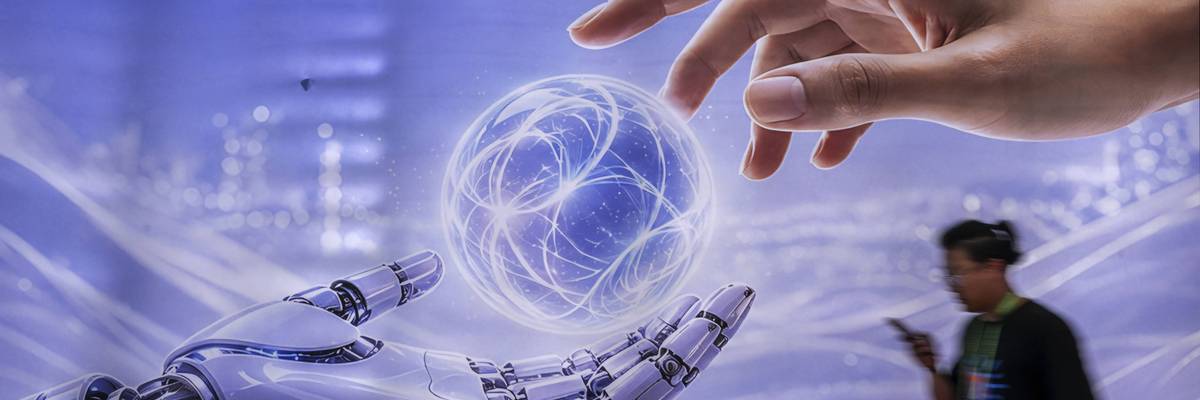
A man walks by a billboard showing a humanoid robot in the AI section at the Chinese International Supply Chain Expo (CISCE) on June 26, 2026 in Beijing, China.
We are now faced once more with the logic of a global suicide pact. Everyone may recognize the danger, yet no participant feels free to withdraw from the competition.
Artificial intelligence confronts humanity with a paradox of historic significance. Used to enhance human cooperation and shared learning in service to life, AI can be a powerful tool for creating a world that works for all. Used as a competitive weapon in the pursuit of profit, political control, and military dominance, it will almost certainly accelerate humanity’s path to self-extinction.
The threat is real and immediate. Yet it may also be our greatest source of hope. AI confronts us more clearly than any previous technology with a truth we have long resisted: humanity cannot survive as a collection of competing individuals, businesses, and nations pursuing their separate advantage without regard for the wellbeing of the whole. By making the consequences of our current path unmistakable and potentially imminent, AI may provide the most powerful incentive humanity has ever experienced to undertake the deep cultural transformation on which our common future now depends.
Public discussion commonly treats AI as an independent intelligence that may one day turn against its human creators. This directs our attention to the wrong question. AI does not possess an independent moral purpose. It is a human-created tool that serves the purposes of those who develop, own, and control it. The defining question is not whether AI will choose to control humanity. It is whether humanity can transcend its commitment to competition and domination sufficiently to govern AI—and itself—in service to life.
The intelligence most essential to our future would reside neither in the machine nor in the isolated individual, but in the relationships through which we share experience, deepen understanding, and organize collective action in service to life.
Within our current global culture, AI is being developed primarily as an instrument of competitive advantage. Businesses use it to eliminate jobs, monitor workers, manipulate consumers, appropriate human creativity, capture personal information, and achieve market dominance. Political actors use it to spread falsehoods, inflame fear, and discredit opponents. Governments use it to expand surveillance, while militaries use it to identify targets, guide weapons, and develop autonomous killing systems.
The justification for developing AI as quickly as possible is always essentially the same: If we do not do it, our competitors will. Corporate executives may recognize that eliminating millions of jobs could devastate society, yet fear losing to businesses that move more quickly. National leaders may understand that autonomous weapons could escape human control, yet fear defeat by nations that develop them first. Political leaders may know that AI-generated deception is destroying democracy, yet fear losing to opponents who use it more aggressively.
This is the logic of a global suicide pact. Everyone may recognize the danger, yet no participant feels free to withdraw from the competition.
AI increases the speed, scale, and reach of every competitive undertaking. It can manipulate millions of minds, monitor entire populations, eliminate vast numbers of livelihoods, and make military decisions at speeds beyond human comprehension. It can concentrate unprecedented power in the hands of the corporations and governments that control the largest data systems and computing facilities. Meanwhile, those facilities consume growing quantities of electricity, water, land, and scarce minerals, further burdening the living Earth on which all life depends.
These dangers are not intrinsic to AI. They are consequences of a civilization that defines progress as increasing consumption, treats money as humanity’s highest value, rewards the pursuit of unlimited private wealth, and organizes relationships around domination and competition. AI does not create these pathologies. It magnifies them.
We urgently need laws prohibiting the most dangerous applications of AI, including for autonomous weapons, mass surveillance, political impersonation, theft of intellectual work, and reckless uses of energy and water. We need transparency, democratic accountability, protection for workers and creators, and clear legal responsibility for harms. Such measures are essential to slow the damage and give humanity time to choose a different future.
They will not, however, be sufficient. No regulatory system can make AI safe so long as businesses and nations remain locked in struggles for dominance. Rules will continually be weakened, evaded, or abandoned by those who fear that compliance will place them at a competitive disadvantage.
Our only enduring protection is therefore a transformation of the global culture that determines how we humans use AI. This requires that we move from a civilization organized around competition for money and power to a civilization dedicated to the wellbeing of living Earth and all its humans and other living beings. What many of us choose to call an Ecological Civilization.
Such a civilization will recognize Earth as a living community, not a storehouse of commodities waiting to be claimed, extracted, and sold for profit. It will understand that human wellbeing depends on the wellbeing of the whole and that our distinctive capacity for conscious choice carries a responsibility to care for the life that sustains us. It will organize economies to meet the needs of all while healing Earth, distributing power, limiting extremes of wealth, restoring local self-reliance, and holding businesses accountable to the communities and ecosystems that depend on them.
For the first time, humanity is creating an instrument so powerful that its safe use may be impossible without transforming the culture of the civilization that created it.
An Ecological Civilization will not eliminate competition. It will encourage competition, not to dominate and exploit others, but rather to be the most creative and excellent in advancing a culture of cooperation and mutual responsibility on behalf of the wellbeing of the whole. Essential AI capabilities will be governed as part of a global information commons. The knowledge on which they depend—created over generations by countless human beings—will be treated as a shared inheritance. Its use will be subject to democratic oversight, ecological limits, and the foundational requirement that its use serves life.
AI could then help educators, farmers, healers, scientists, public officials, Indigenous knowledge keepers, and community organizers share what they are learning. It will identify relationships beyond the reach of any individual mind, translate among languages, expose error, and support us in adapting successful approaches to the distinctive needs of each place. It could strengthen our collective capacity to restore soils and forests, conserve water, prevent disease, eliminate waste, localize production, resolve conflict, and secure a good life for all.
In this role, AI would not replace human intelligence. It would augment our ability to learn together. The intelligence most essential to our future would reside neither in the machine nor in the isolated individual, but in the relationships through which we share experience, deepen understanding, and organize collective action in service to life.
Climate disruption, ecological collapse, extreme inequality, and war have demonstrated the failure of our competitive civilization. Yet these threats have often seemed distant, gradual, or separable. AI brings them together and makes it increasingly apparent that no business can secure its future by destroying the society that sustains its markets; no nation can achieve security through weapons that threaten all nations; and no part of humanity can flourish on a dying Earth.
For the first time, humanity is creating an instrument so powerful that its safe use may be impossible without transforming the culture of the civilization that created it. This may be AI’s greatest gift. It confronts us with a choice we can no longer postpone. Cooperate to secure the wellbeing of the whole or continue competing toward our common destruction.
The question is whether we will recognize the choice and act in time.
Author's Note: My purpose in sharing this column is to help move this essential message into the world as quickly and widely as possible through many messengers and channels. If this column speaks to you, please, without need for my permission or acknowledgement, forward our newsletter, share the link to our website, post on social media, and/or otherwise reproduce it, adapt it, share it with your friends and followers, and publicly express its message in your own words and voice. Then, I invite you to share with me how you are using it by sending the information to info@greatturning.org.
Dear Common Dreams reader, It’s been nearly 30 years since I co-founded Common Dreams with my late wife, Lina Newhouser. We had the radical notion that journalism should serve the public good, not corporate profits. It was clear to us from the outset what it would take to build such a project. No paid advertisements. No corporate sponsors. No millionaire publisher telling us what to think or do. Many people said we wouldn't last a year, but we proved those doubters wrong. Together with a tremendous team of journalists and dedicated staff, we built an independent media outlet free from the constraints of profits and corporate control. Our mission has always been simple: To inform. To inspire. To ignite change for the common good. Building Common Dreams was not easy. Our survival was never guaranteed. When you take on the most powerful forces—Wall Street greed, fossil fuel industry destruction, Big Tech lobbyists, and uber-rich oligarchs who have spent billions upon billions rigging the economy and democracy in their favor—the only bulwark you have is supporters who believe in your work. But here’s the urgent message from me today. It's never been this bad out there. And it's never been this hard to keep us going. At the very moment Common Dreams is most needed, the threats we face are intensifying. We need your support now more than ever. We don't accept corporate advertising and never will. We don't have a paywall because we don't think people should be blocked from critical news based on their ability to pay. Everything we do is funded by the donations of readers like you. When everyone does the little they can afford, we are strong. But if that support retreats or dries up, so do we. Will you donate now to make sure Common Dreams not only survives but thrives? —Craig Brown, Co-founder |
Artificial intelligence confronts humanity with a paradox of historic significance. Used to enhance human cooperation and shared learning in service to life, AI can be a powerful tool for creating a world that works for all. Used as a competitive weapon in the pursuit of profit, political control, and military dominance, it will almost certainly accelerate humanity’s path to self-extinction.
The threat is real and immediate. Yet it may also be our greatest source of hope. AI confronts us more clearly than any previous technology with a truth we have long resisted: humanity cannot survive as a collection of competing individuals, businesses, and nations pursuing their separate advantage without regard for the wellbeing of the whole. By making the consequences of our current path unmistakable and potentially imminent, AI may provide the most powerful incentive humanity has ever experienced to undertake the deep cultural transformation on which our common future now depends.
Public discussion commonly treats AI as an independent intelligence that may one day turn against its human creators. This directs our attention to the wrong question. AI does not possess an independent moral purpose. It is a human-created tool that serves the purposes of those who develop, own, and control it. The defining question is not whether AI will choose to control humanity. It is whether humanity can transcend its commitment to competition and domination sufficiently to govern AI—and itself—in service to life.
The intelligence most essential to our future would reside neither in the machine nor in the isolated individual, but in the relationships through which we share experience, deepen understanding, and organize collective action in service to life.
Within our current global culture, AI is being developed primarily as an instrument of competitive advantage. Businesses use it to eliminate jobs, monitor workers, manipulate consumers, appropriate human creativity, capture personal information, and achieve market dominance. Political actors use it to spread falsehoods, inflame fear, and discredit opponents. Governments use it to expand surveillance, while militaries use it to identify targets, guide weapons, and develop autonomous killing systems.
The justification for developing AI as quickly as possible is always essentially the same: If we do not do it, our competitors will. Corporate executives may recognize that eliminating millions of jobs could devastate society, yet fear losing to businesses that move more quickly. National leaders may understand that autonomous weapons could escape human control, yet fear defeat by nations that develop them first. Political leaders may know that AI-generated deception is destroying democracy, yet fear losing to opponents who use it more aggressively.
This is the logic of a global suicide pact. Everyone may recognize the danger, yet no participant feels free to withdraw from the competition.
AI increases the speed, scale, and reach of every competitive undertaking. It can manipulate millions of minds, monitor entire populations, eliminate vast numbers of livelihoods, and make military decisions at speeds beyond human comprehension. It can concentrate unprecedented power in the hands of the corporations and governments that control the largest data systems and computing facilities. Meanwhile, those facilities consume growing quantities of electricity, water, land, and scarce minerals, further burdening the living Earth on which all life depends.
These dangers are not intrinsic to AI. They are consequences of a civilization that defines progress as increasing consumption, treats money as humanity’s highest value, rewards the pursuit of unlimited private wealth, and organizes relationships around domination and competition. AI does not create these pathologies. It magnifies them.
We urgently need laws prohibiting the most dangerous applications of AI, including for autonomous weapons, mass surveillance, political impersonation, theft of intellectual work, and reckless uses of energy and water. We need transparency, democratic accountability, protection for workers and creators, and clear legal responsibility for harms. Such measures are essential to slow the damage and give humanity time to choose a different future.
They will not, however, be sufficient. No regulatory system can make AI safe so long as businesses and nations remain locked in struggles for dominance. Rules will continually be weakened, evaded, or abandoned by those who fear that compliance will place them at a competitive disadvantage.
Our only enduring protection is therefore a transformation of the global culture that determines how we humans use AI. This requires that we move from a civilization organized around competition for money and power to a civilization dedicated to the wellbeing of living Earth and all its humans and other living beings. What many of us choose to call an Ecological Civilization.
Such a civilization will recognize Earth as a living community, not a storehouse of commodities waiting to be claimed, extracted, and sold for profit. It will understand that human wellbeing depends on the wellbeing of the whole and that our distinctive capacity for conscious choice carries a responsibility to care for the life that sustains us. It will organize economies to meet the needs of all while healing Earth, distributing power, limiting extremes of wealth, restoring local self-reliance, and holding businesses accountable to the communities and ecosystems that depend on them.
For the first time, humanity is creating an instrument so powerful that its safe use may be impossible without transforming the culture of the civilization that created it.
An Ecological Civilization will not eliminate competition. It will encourage competition, not to dominate and exploit others, but rather to be the most creative and excellent in advancing a culture of cooperation and mutual responsibility on behalf of the wellbeing of the whole. Essential AI capabilities will be governed as part of a global information commons. The knowledge on which they depend—created over generations by countless human beings—will be treated as a shared inheritance. Its use will be subject to democratic oversight, ecological limits, and the foundational requirement that its use serves life.
AI could then help educators, farmers, healers, scientists, public officials, Indigenous knowledge keepers, and community organizers share what they are learning. It will identify relationships beyond the reach of any individual mind, translate among languages, expose error, and support us in adapting successful approaches to the distinctive needs of each place. It could strengthen our collective capacity to restore soils and forests, conserve water, prevent disease, eliminate waste, localize production, resolve conflict, and secure a good life for all.
In this role, AI would not replace human intelligence. It would augment our ability to learn together. The intelligence most essential to our future would reside neither in the machine nor in the isolated individual, but in the relationships through which we share experience, deepen understanding, and organize collective action in service to life.
Climate disruption, ecological collapse, extreme inequality, and war have demonstrated the failure of our competitive civilization. Yet these threats have often seemed distant, gradual, or separable. AI brings them together and makes it increasingly apparent that no business can secure its future by destroying the society that sustains its markets; no nation can achieve security through weapons that threaten all nations; and no part of humanity can flourish on a dying Earth.
For the first time, humanity is creating an instrument so powerful that its safe use may be impossible without transforming the culture of the civilization that created it. This may be AI’s greatest gift. It confronts us with a choice we can no longer postpone. Cooperate to secure the wellbeing of the whole or continue competing toward our common destruction.
The question is whether we will recognize the choice and act in time.
Author's Note: My purpose in sharing this column is to help move this essential message into the world as quickly and widely as possible through many messengers and channels. If this column speaks to you, please, without need for my permission or acknowledgement, forward our newsletter, share the link to our website, post on social media, and/or otherwise reproduce it, adapt it, share it with your friends and followers, and publicly express its message in your own words and voice. Then, I invite you to share with me how you are using it by sending the information to info@greatturning.org.
Artificial intelligence confronts humanity with a paradox of historic significance. Used to enhance human cooperation and shared learning in service to life, AI can be a powerful tool for creating a world that works for all. Used as a competitive weapon in the pursuit of profit, political control, and military dominance, it will almost certainly accelerate humanity’s path to self-extinction.
The threat is real and immediate. Yet it may also be our greatest source of hope. AI confronts us more clearly than any previous technology with a truth we have long resisted: humanity cannot survive as a collection of competing individuals, businesses, and nations pursuing their separate advantage without regard for the wellbeing of the whole. By making the consequences of our current path unmistakable and potentially imminent, AI may provide the most powerful incentive humanity has ever experienced to undertake the deep cultural transformation on which our common future now depends.
Public discussion commonly treats AI as an independent intelligence that may one day turn against its human creators. This directs our attention to the wrong question. AI does not possess an independent moral purpose. It is a human-created tool that serves the purposes of those who develop, own, and control it. The defining question is not whether AI will choose to control humanity. It is whether humanity can transcend its commitment to competition and domination sufficiently to govern AI—and itself—in service to life.
The intelligence most essential to our future would reside neither in the machine nor in the isolated individual, but in the relationships through which we share experience, deepen understanding, and organize collective action in service to life.
Within our current global culture, AI is being developed primarily as an instrument of competitive advantage. Businesses use it to eliminate jobs, monitor workers, manipulate consumers, appropriate human creativity, capture personal information, and achieve market dominance. Political actors use it to spread falsehoods, inflame fear, and discredit opponents. Governments use it to expand surveillance, while militaries use it to identify targets, guide weapons, and develop autonomous killing systems.
The justification for developing AI as quickly as possible is always essentially the same: If we do not do it, our competitors will. Corporate executives may recognize that eliminating millions of jobs could devastate society, yet fear losing to businesses that move more quickly. National leaders may understand that autonomous weapons could escape human control, yet fear defeat by nations that develop them first. Political leaders may know that AI-generated deception is destroying democracy, yet fear losing to opponents who use it more aggressively.
This is the logic of a global suicide pact. Everyone may recognize the danger, yet no participant feels free to withdraw from the competition.
AI increases the speed, scale, and reach of every competitive undertaking. It can manipulate millions of minds, monitor entire populations, eliminate vast numbers of livelihoods, and make military decisions at speeds beyond human comprehension. It can concentrate unprecedented power in the hands of the corporations and governments that control the largest data systems and computing facilities. Meanwhile, those facilities consume growing quantities of electricity, water, land, and scarce minerals, further burdening the living Earth on which all life depends.
These dangers are not intrinsic to AI. They are consequences of a civilization that defines progress as increasing consumption, treats money as humanity’s highest value, rewards the pursuit of unlimited private wealth, and organizes relationships around domination and competition. AI does not create these pathologies. It magnifies them.
We urgently need laws prohibiting the most dangerous applications of AI, including for autonomous weapons, mass surveillance, political impersonation, theft of intellectual work, and reckless uses of energy and water. We need transparency, democratic accountability, protection for workers and creators, and clear legal responsibility for harms. Such measures are essential to slow the damage and give humanity time to choose a different future.
They will not, however, be sufficient. No regulatory system can make AI safe so long as businesses and nations remain locked in struggles for dominance. Rules will continually be weakened, evaded, or abandoned by those who fear that compliance will place them at a competitive disadvantage.
Our only enduring protection is therefore a transformation of the global culture that determines how we humans use AI. This requires that we move from a civilization organized around competition for money and power to a civilization dedicated to the wellbeing of living Earth and all its humans and other living beings. What many of us choose to call an Ecological Civilization.
Such a civilization will recognize Earth as a living community, not a storehouse of commodities waiting to be claimed, extracted, and sold for profit. It will understand that human wellbeing depends on the wellbeing of the whole and that our distinctive capacity for conscious choice carries a responsibility to care for the life that sustains us. It will organize economies to meet the needs of all while healing Earth, distributing power, limiting extremes of wealth, restoring local self-reliance, and holding businesses accountable to the communities and ecosystems that depend on them.
For the first time, humanity is creating an instrument so powerful that its safe use may be impossible without transforming the culture of the civilization that created it.
An Ecological Civilization will not eliminate competition. It will encourage competition, not to dominate and exploit others, but rather to be the most creative and excellent in advancing a culture of cooperation and mutual responsibility on behalf of the wellbeing of the whole. Essential AI capabilities will be governed as part of a global information commons. The knowledge on which they depend—created over generations by countless human beings—will be treated as a shared inheritance. Its use will be subject to democratic oversight, ecological limits, and the foundational requirement that its use serves life.
AI could then help educators, farmers, healers, scientists, public officials, Indigenous knowledge keepers, and community organizers share what they are learning. It will identify relationships beyond the reach of any individual mind, translate among languages, expose error, and support us in adapting successful approaches to the distinctive needs of each place. It could strengthen our collective capacity to restore soils and forests, conserve water, prevent disease, eliminate waste, localize production, resolve conflict, and secure a good life for all.
In this role, AI would not replace human intelligence. It would augment our ability to learn together. The intelligence most essential to our future would reside neither in the machine nor in the isolated individual, but in the relationships through which we share experience, deepen understanding, and organize collective action in service to life.
Climate disruption, ecological collapse, extreme inequality, and war have demonstrated the failure of our competitive civilization. Yet these threats have often seemed distant, gradual, or separable. AI brings them together and makes it increasingly apparent that no business can secure its future by destroying the society that sustains its markets; no nation can achieve security through weapons that threaten all nations; and no part of humanity can flourish on a dying Earth.
For the first time, humanity is creating an instrument so powerful that its safe use may be impossible without transforming the culture of the civilization that created it. This may be AI’s greatest gift. It confronts us with a choice we can no longer postpone. Cooperate to secure the wellbeing of the whole or continue competing toward our common destruction.
The question is whether we will recognize the choice and act in time.
Author's Note: My purpose in sharing this column is to help move this essential message into the world as quickly and widely as possible through many messengers and channels. If this column speaks to you, please, without need for my permission or acknowledgement, forward our newsletter, share the link to our website, post on social media, and/or otherwise reproduce it, adapt it, share it with your friends and followers, and publicly express its message in your own words and voice. Then, I invite you to share with me how you are using it by sending the information to info@greatturning.org.