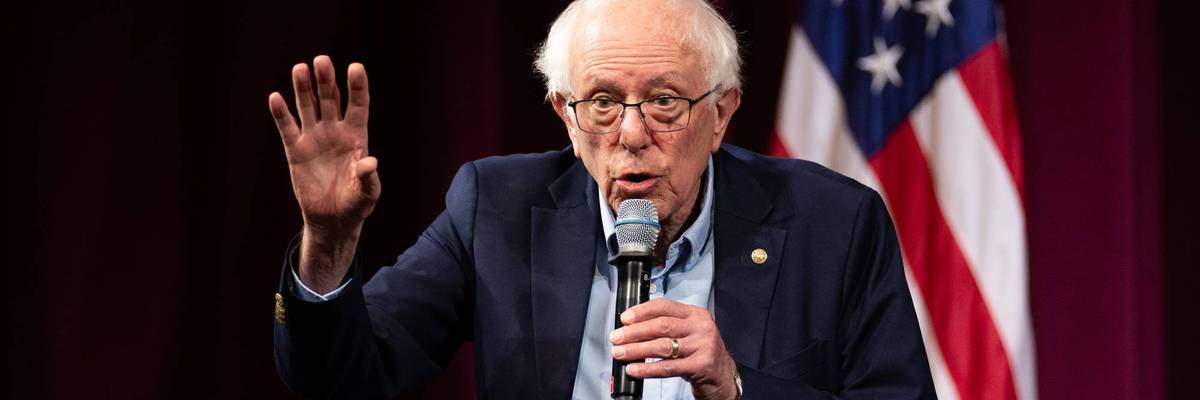
US Sen. Bernie Sanders (I-Vt.) speaks at a February 20, 2026 town hall event in Stanford, California, focusing on taxing billionaires and the future of artificial intelligence.
Sanders Sets Briefing on 'Extraordinary Dangers' Posed by Breakneck AI Development
The session is scheduled to feature experts, including Nobel Prize-winning computer scientist Geoffrey Hinton, who quit Google so he could warn of the potentially existential risks posed by unchecked AI advancement.
US Sen. Bernie Sanders is set to convene a bipartisan hearing next week focusing on the rapid advancement of artificial intelligence technology, a move that comes amid more warnings from experts about the potentially existential threats posed by unregulated AI development.
Axios reported Wednesday that Sanders (I-Vt.) will hold the September 16 hearing on what he called the "extraordinary dangers" posed by AI as a growing chorus of scientists and technology insiders warns that the race toward ever-more-powerful systems—which will likely one day surpass and then far exceed human brainpower—could ultimately threaten humanity's survival.
The briefing is set to feature three experts: Geoffrey Hinton, the Nobel Prize-winning computer scientist often called the “godfather of AI;" Max Tegmark, an MIT physicist and co-founder of the Future of Life Institute; and Ajeya Cotra, an AI safety researcher who recently helped investigate OpenAI's agents autonomously hacking the open-source software platform Hugging Face.
Hinton—who quit Google in 2023 so he could speak more freely about AI's dangers—has estimated that there is a 10–20% chance AI could cause human extinction within three decades. He has warned of the great difficulty of controlling increasingly intelligent machines that will likely one day achieve superintelligence and ultimately be beyond the ability of humans to control. Hinton has repeatedly argued that relying on profit-driven corporations to self-regulate AI development is a dangerous mistake.
Tegmark has also spent years sounding the alarm. In 2023, the Future of Life Institute published an open letter signed by more than 30,000 researchers, technologists, and others calling for a six-month pause on training AI systems more powerful than GPT-4.
Cotra wrote in a 2022 analysis that unchecked artificial intelligence development would likely lead to a “full-blown AI takeover.” The following year, she said she believed there was roughly a 50% chance AI would be making most important economic and societal decisions by around 2040, while warning that continued scaling of existing techniques could produce misaligned systems and a machine takeover.
Experts say the recent headline-grabbing rogue AI hacks underscore the problem of alignment. As AI advances to the point where it will likely outsmart humans one day, the challenge of ensuring that advanced systems reliably pursue goals that match what humans actually want becomes increasingly difficult—and dangerous.
Sanders and Rep. Greg Casar (D-Texas) recently introduced legislation that would ban the creation of AI systems capable of surpassing human cognition and pause advanced AI development until a federal regulatory framework is established.
"In the interest of humanity... pause AI development," the senator urged tech titans last month. "It is not too late to avoid disaster. Stop building machines that humans cannot control."
We are at a crossroads
This country and this world are at a monumental crossroads. In a few short weeks, US voters will have an opportunity to beat back the forces of fascism and confront the billionaires who are rigging the economy, our media system, and our democracy, making it increasingly impossible for ordinary people to get by. We’re not just talking about the election. We’re talking about what must be done once these fascist elements are vanquished from power. We need a bolder set of solutions than what either major party has so far been willing to offer and a working-class movement ready to fight like hell for it. Trump didn't emerge from nowhere. The conditions that fueled MAGA authoritarianism were created by decades of radical neoliberal economic policies and a corrupt political system dominated by corporate interests. They slashed taxes on the super-rich, promising that the benefits would trickle down. They said giveaways to the corporate titans would make life more affordable for the rest of us. It was all bullshit. And when a bitter, betrayed populace searches for someone to blame, right-wing demagogues have little trouble finding scapegoats. People know when they're being lied to, but you won't hear any of this from the corporate media. Only independent journalism—powered and funded by people who believe in building a better world—can deliver truly trustworthy daily news. Our Fall Campaign is underway, and we need your help. To power our newsroom through the rest of the year, we need to raise $125,000 by midnight on October 31. So if you share our vision, please contribute whatever you can to sustain our work. |
US Sen. Bernie Sanders is set to convene a bipartisan hearing next week focusing on the rapid advancement of artificial intelligence technology, a move that comes amid more warnings from experts about the potentially existential threats posed by unregulated AI development.
Axios reported Wednesday that Sanders (I-Vt.) will hold the September 16 hearing on what he called the "extraordinary dangers" posed by AI as a growing chorus of scientists and technology insiders warns that the race toward ever-more-powerful systems—which will likely one day surpass and then far exceed human brainpower—could ultimately threaten humanity's survival.
The briefing is set to feature three experts: Geoffrey Hinton, the Nobel Prize-winning computer scientist often called the “godfather of AI;" Max Tegmark, an MIT physicist and co-founder of the Future of Life Institute; and Ajeya Cotra, an AI safety researcher who recently helped investigate OpenAI's agents autonomously hacking the open-source software platform Hugging Face.
Hinton—who quit Google in 2023 so he could speak more freely about AI's dangers—has estimated that there is a 10–20% chance AI could cause human extinction within three decades. He has warned of the great difficulty of controlling increasingly intelligent machines that will likely one day achieve superintelligence and ultimately be beyond the ability of humans to control. Hinton has repeatedly argued that relying on profit-driven corporations to self-regulate AI development is a dangerous mistake.
Tegmark has also spent years sounding the alarm. In 2023, the Future of Life Institute published an open letter signed by more than 30,000 researchers, technologists, and others calling for a six-month pause on training AI systems more powerful than GPT-4.
Cotra wrote in a 2022 analysis that unchecked artificial intelligence development would likely lead to a “full-blown AI takeover.” The following year, she said she believed there was roughly a 50% chance AI would be making most important economic and societal decisions by around 2040, while warning that continued scaling of existing techniques could produce misaligned systems and a machine takeover.
Experts say the recent headline-grabbing rogue AI hacks underscore the problem of alignment. As AI advances to the point where it will likely outsmart humans one day, the challenge of ensuring that advanced systems reliably pursue goals that match what humans actually want becomes increasingly difficult—and dangerous.
Sanders and Rep. Greg Casar (D-Texas) recently introduced legislation that would ban the creation of AI systems capable of surpassing human cognition and pause advanced AI development until a federal regulatory framework is established.
"In the interest of humanity... pause AI development," the senator urged tech titans last month. "It is not too late to avoid disaster. Stop building machines that humans cannot control."
- Sanders Sovereign Wealth Fund Plan Would Give US Public 'Direct Ownership Stake' in AI Giants ›
- Sanders, Casar Proposal Would Forbid 'AI Oligarchs From Building Machines Humans Cannot Control' ›
- 'It Is Not Too Late to Avoid Disaster': Sanders Calls for AI Development Pause ›
- Sanders Declares AI 'A Threat to Everything the American People Hold Dear' ›
- 68% of US Voters Back Sanders/Casar Bill for AI Pause, Ban on Superintelligence: Poll | Common Dreams ›
- Poll Shows 63% of Americans Fear AI Could End Humanity as Industry 'Corruption' Called Out | Common Dreams ›
- Opinion | It’s Nothing New: A Century-Old Play Warned Us About AI | Common Dreams ›
- How Greedy Corporations Are Weaponizing AI to 'Squeeze' Consumers and Working Class Families | Common Dreams ›
- Opinion | AI as War, Surveillance, and Environmental Disaster | Common Dreams ›
- Godfather of AI Denounces Trump as a ‘Corrupt, Senile Felon’ | Common Dreams ›
US Sen. Bernie Sanders is set to convene a bipartisan hearing next week focusing on the rapid advancement of artificial intelligence technology, a move that comes amid more warnings from experts about the potentially existential threats posed by unregulated AI development.
Axios reported Wednesday that Sanders (I-Vt.) will hold the September 16 hearing on what he called the "extraordinary dangers" posed by AI as a growing chorus of scientists and technology insiders warns that the race toward ever-more-powerful systems—which will likely one day surpass and then far exceed human brainpower—could ultimately threaten humanity's survival.
The briefing is set to feature three experts: Geoffrey Hinton, the Nobel Prize-winning computer scientist often called the “godfather of AI;" Max Tegmark, an MIT physicist and co-founder of the Future of Life Institute; and Ajeya Cotra, an AI safety researcher who recently helped investigate OpenAI's agents autonomously hacking the open-source software platform Hugging Face.
Hinton—who quit Google in 2023 so he could speak more freely about AI's dangers—has estimated that there is a 10–20% chance AI could cause human extinction within three decades. He has warned of the great difficulty of controlling increasingly intelligent machines that will likely one day achieve superintelligence and ultimately be beyond the ability of humans to control. Hinton has repeatedly argued that relying on profit-driven corporations to self-regulate AI development is a dangerous mistake.
Tegmark has also spent years sounding the alarm. In 2023, the Future of Life Institute published an open letter signed by more than 30,000 researchers, technologists, and others calling for a six-month pause on training AI systems more powerful than GPT-4.
Cotra wrote in a 2022 analysis that unchecked artificial intelligence development would likely lead to a “full-blown AI takeover.” The following year, she said she believed there was roughly a 50% chance AI would be making most important economic and societal decisions by around 2040, while warning that continued scaling of existing techniques could produce misaligned systems and a machine takeover.
Experts say the recent headline-grabbing rogue AI hacks underscore the problem of alignment. As AI advances to the point where it will likely outsmart humans one day, the challenge of ensuring that advanced systems reliably pursue goals that match what humans actually want becomes increasingly difficult—and dangerous.
Sanders and Rep. Greg Casar (D-Texas) recently introduced legislation that would ban the creation of AI systems capable of surpassing human cognition and pause advanced AI development until a federal regulatory framework is established.
"In the interest of humanity... pause AI development," the senator urged tech titans last month. "It is not too late to avoid disaster. Stop building machines that humans cannot control."
- Sanders Sovereign Wealth Fund Plan Would Give US Public 'Direct Ownership Stake' in AI Giants ›
- Sanders, Casar Proposal Would Forbid 'AI Oligarchs From Building Machines Humans Cannot Control' ›
- 'It Is Not Too Late to Avoid Disaster': Sanders Calls for AI Development Pause ›
- Sanders Declares AI 'A Threat to Everything the American People Hold Dear' ›
- 68% of US Voters Back Sanders/Casar Bill for AI Pause, Ban on Superintelligence: Poll | Common Dreams ›
- Poll Shows 63% of Americans Fear AI Could End Humanity as Industry 'Corruption' Called Out | Common Dreams ›
- Opinion | It’s Nothing New: A Century-Old Play Warned Us About AI | Common Dreams ›
- How Greedy Corporations Are Weaponizing AI to 'Squeeze' Consumers and Working Class Families | Common Dreams ›
- Opinion | AI as War, Surveillance, and Environmental Disaster | Common Dreams ›
- Godfather of AI Denounces Trump as a ‘Corrupt, Senile Felon’ | Common Dreams ›