

SUBSCRIBE TO OUR FREE NEWSLETTER
Daily news & progressive opinion—funded by the people, not the corporations—delivered straight to your inbox.
5
#000000
#FFFFFF
To donate by check, phone, or other method, see our More Ways to Give page.
Daily news & progressive opinion—funded by the people, not the corporations—delivered straight to your inbox.

The Cabinet of the Progressive International firmly condemns the US military attack against Venezuela, the bombing of Caracas, and the kidnapping of President Nicolás Maduro and his wife Cilia Adela Flores de Maduro.
On 2 January, US military forces launched an illegal and unprovoked military assault against Venezuela — bombing Fuerte Tiuna, La Carlota Air Base, the port of La Guaira, residential neighborhoods across Caracas, and military and civilian installations in the states of Miranda, Aragua, and La Guaira. Missiles fired from US helicopters killed military personnel and civilians, left entire neighborhoods without power, and terrorized the Venezuelan people.
Hours later, President Donald Trump announced that US special forces "captured" President Nicolás Maduro and First Lady Cilia Flores. The kidnapping of a sovereign head of state represents an act of imperial lawlessness with few precedents in history.
President Donald Trump has clearly articulated the imperial logic of this intervention — to seize control over Venezuela's natural resources and reassert US domination over the hemisphere. The "Trump corollary" to the Monroe Doctrine — applied in recent hours with violent force over the skies of Caracas — is the single greatest threat to peace and prosperity that the Americas confront today.
This armed attack on Venezuela is not an isolated event. It is the next step in the United States' campaign of regime change that stretches from Caracas to Havana — and an attack on the very principle of sovereign equality and the prospects for the Zone of Peace once established by the Community of Latin American and Caribbean States. This renewed declaration of impunity from Washington is a threat to all nations around the world.
In this moment of clear, acute, and mounting violence against the people of Venezuela, silence is complicity.
The Progressive International calls upon political parties, trade unions, social movements, and civil society organizations across the world to act with urgency and determination. We urge — and commit to collaborate with all efforts to develop — coordinated actions, worker strikes, and assemblies that promise to halt these acts of wanton aggression.
The Progressive International stands in solidarity with the Bolivarian Revolution, with the people of Venezuela, and with all those in the region who refuse a future defined by foreign domination and imperial plunder. We enter 2026 with a renewed commitment to the struggle for a world in which peace is secured by social justice; not by force, but by sovereign self-determination.
Progressive International is an international organization uniting and mobilizing progressive left-wing activists and organizations.
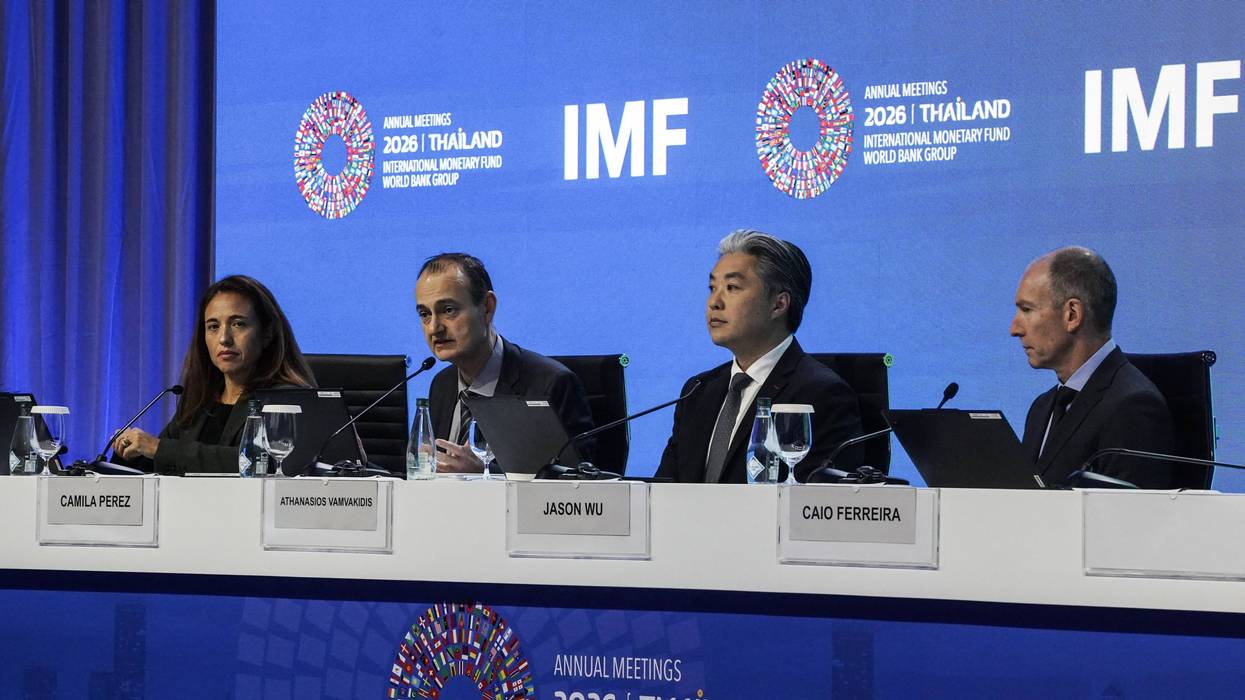
"Instead of helping countries withstand another major shock," Oxfam's executive director said, the IMF "is forcing them to cut back on the very spending that can help protect people and recover."
The US-Israeli war with Iran has exacerbated economic hardship across the world. It's especially bad for the developing nations currently being forced to implement austerity programs by the International Monetary Fund.
Under IMF loan programs, countries struggling with debt are required to reduce government budget deficits by introducing spending cuts and tax increases that tend to hurt their poorest citizens. They often include cuts to public services and welfare programs, caps on government workers' salaries, and the elimination of subsidies that keep basic needs affordable.
According to a report out Monday from Oxfam—amid the IMF's annual meeting in Bangkok this week—24 of the 28 nations currently receiving IMF loans have been forced to implement austerity measures. Some of them, like Sierra Leone and Guinea-Bissau, are among the poorest nations in the world.
Even before the war—which has caused oil prices to soar and driven inflation worldwide—people in many of these countries were struggling to meet their basic needs and facing severe economic pressure: 51% were food insecure, and 57% lacked access to clean cooking fuel.
Emergency government programs have been able to backstop the worst effects for up to 130 million of the world's poorest people, according to a report published before the meeting by the United Nations Development Program.
But as those countries run out of resources, many are being forced to pivot, and the stiff requirements imposed by the IMF may exacerbate the hardship.
In Ecuador and Guinea-Bissau, the IMF is requiring governments to cut spending, raise taxes, or both to the equivalent of roughly 4% of the nations' annual gross domestic product (GDP).
The terms are even harsher for Sierra Leone, where the government is required to cut spending or raise costs equivalent to more than five times its annual healthcare budget.
A loan approved last week for Bolivia requires the government to slash as much as 8.5% of its GDP from the deficit—about twice its annual healthcare spending. The country has already been forced to eliminate a diesel subsidy that drove high prices down for consumers and businesses.
The IMF has acknowledged that these cuts are likely to make the strain worse for many low-income countries already suffering from the war, but said they had "no choice" but to cut spending or restructure their debts.
Oxfam International executive director Amitabh Behar noted that during previous crises like the Covid-19 pandemic and the war in Ukraine, the IMF has enacted tools to ease the burden on nations in debt by providing emergency loans and access to foreign currency without requiring additional borrowing.
"But this time, the fund is taking a very different path," he said. "Instead of helping countries withstand another major shock, it is doubling down on austerity—forcing them to cut back on the very spending that can help protect people and recover—and leaving them even more vulnerable to the next crisis."
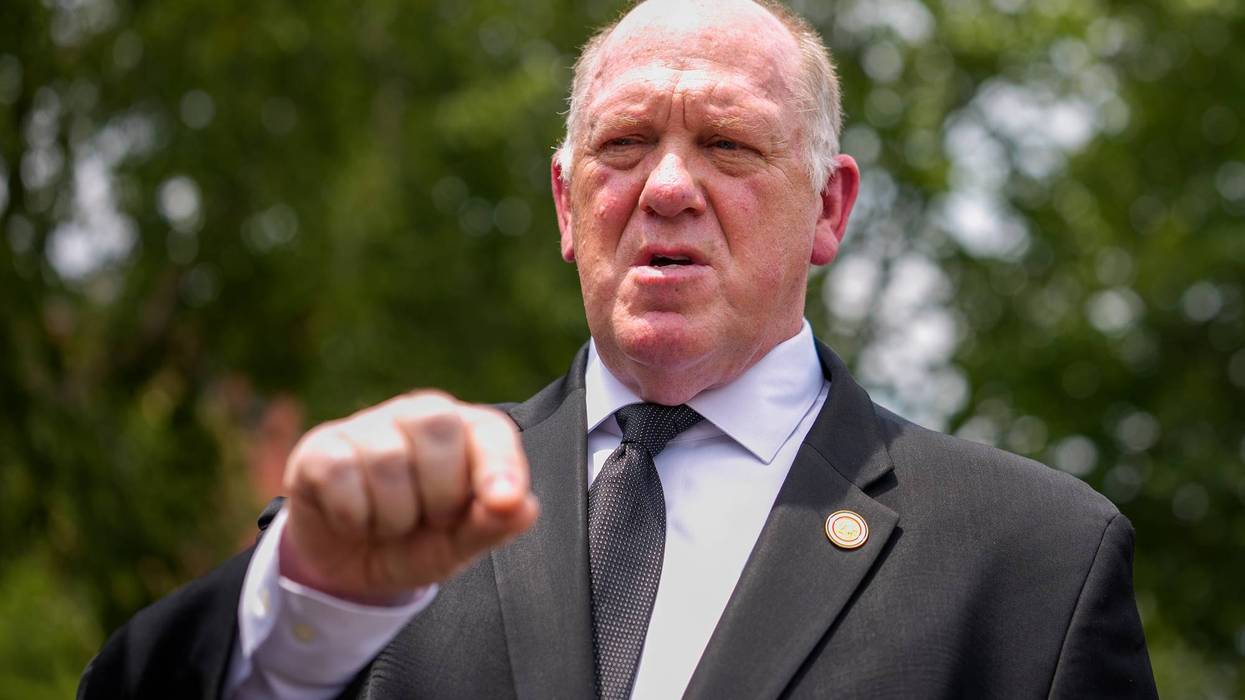
"If the administration wants to investigate anyone, maybe they should look at themselves first."
Progressive US Rep. Pramila Jayapal this week not only joined a growing chorus outraged by President Donald Trump's "rogue" Department of Homeland Security agents raiding Congresswoman Ilhan Omar's home, the Washington Democrat took it a step further.
After putting out a nearly three-minute video decrying Trump's repeated attacks on her Democratic colleague from Minnesota, Jayapal reminded social media users of the president's "border czar," Tom Homan, allegedly accepting a bribe in the form of a paper bag stuffed with $50,000 in cash.
As part of a probe launched under the Biden administration, Homan was the target of a Federal Bureau of Investigation sting operation. In September 2024, he was recorded taking the bag of cash from undercover FBI agents posing as businessmen interested in securing government contracts if Trump returned to the White House.
"If the administration wants to investigate anyone, maybe they should look at themselves first. Anyone remember this?" Jayapal wrote alongside a photo of media coverage that notes Trump's Department of Justice (DOJ) closed the probe into Homan last year.
Before former US Attorney General Pam Bondi was fired by Trump this past April, she insisted last year that "the investigation into Mr. Homan was subjected to a full review by the FBI, agents, and DOJ prosecutors," who "found no credible evidence of any wrongdoing."
However, congressional Democrats as well as the groups Democracy Defenders Fund and Democracy Forward have fought for access to records, including the recording of Homan and the undercover agents.
Homan is far from the only member of Trump's second administration to face credible allegations of corruption. In fact, according to polling results released Tuesday, 59% of Americans believe the president himself has done illegal or unethical things to cash in on his return to power.
Jayapal also isn't the only critic of the Omar raid to point a finger at Trump's border czar this week. Rep. Don Beyer (D-Va.) similarly wrote on social media that "Tom Homan, the man leading Trump’s authoritarian 'investigation' of Rep. Ilhan Omar right before the midterm, was caught by the FBI accepting a bribe of $50,000 in cash in a paper bag."
"But Trump's Justice Department simply dropped the case and covered it up," Beyer stressed. "The most corrupt presidential administration in history."
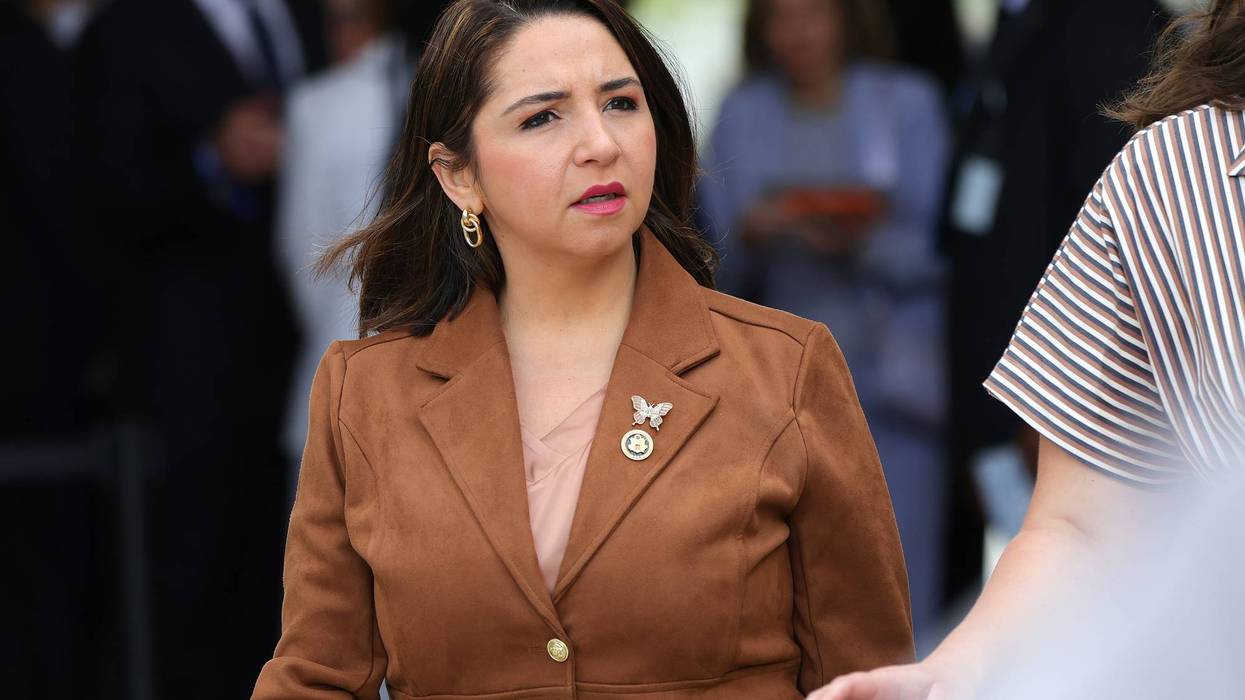
"For 23 years, since its inception, DHS has been utilized by the government to target and persecute those they consider the public enemy," Ramirez said.
In response to the agency's rampant abuses during President Donald Trump's second term, many elected Democrats have warmed to the idea of abolishing US Immigration and Customs Enforcement. But one progressive lawmaker is pushing to go a step further: abolishing the entire Department of Homeland Security.
Rep. Delia Ramirez (D-Ill.) introduced legislation on Tuesday that would repeal all “duplicative and overreaching terrorism laws,” including getting rid of DHS, which was created in 2003 following the September 11 terrorist attacks.
The bill, titled the Reimagining Safety Act, would not only eliminate ICE and Customs and Border Protection (CBP). It seeks to eliminate immigration detention altogether and begin the process of replacing it with a civil court-based immigration system run through the US Department of Justice (DOJ).
In a dramatic departure from current immigration procedures, all deportations would need to be approved by Congress before they could proceed.
The bill comes just one day after agents with the DHS Investigations unit raided the home of Ramirez's colleague, Rep. Ilhan Omar (D-Minn.), as part of a federal criminal investigation related to her citizenship documents.
The investigation---which follows years of attacks by President Donald Trump and other Republicans against Omar's Somali background and Muslim faith, and comes just weeks before an election---has been described by critics as intimidation against a political opponent.
"For almost a decade, Trump and Republicans have lied about Congresswoman Omar to silence her dissent," Ramirez said on Monday. "My sister [Ilhan] has not backed down, so now they are using DHS and the federal government to target and persecute her."
"We must strip them of their weapons," she said. "We must dismantle DHS."
Under Ramirez's legislation, a new agency called the Department of Community Safety would assume DHS's duties. This would include running the Federal Emergency Management Agency (FEMA), which handles the federal response to natural disasters and other emergencies.
The new agency would use DHS's massive pot of federal funding for programs that aim to stop gun violence and other crime; provide support to asylum seekers at the border; redirect federal resources toward community needs like healthcare, housing, education, and emergency preparedness; and support community-based safety programs that do not adopt the militarized law enforcement of DHS.
Other functions of DHS would be scattered across different agencies: Immigration enforcement would belong to the DOJ, the Department of Transportation would take over the Transportation Security Administration and Coast Guard, and the Treasury Department would conduct customs enforcement.
Some of the expansive powers introduced during the War on Terror would also be rolled back: Those without criminal convictions or warrants would no longer be able to be put on "no-fly" lists, which civil liberties advocates have long criticized for stripping people of their right to travel on arbitrary, often racist, grounds.
The legislation would also eliminate the authority of the secretary of state to declare "foreign terrorist" organizations, a power that has been wielded to criminalize protest.
Ramirez told The Intercept that the need to abolish the agency was also underscored by an ICE agent's shooting of 28-year-old Oscar Belgal in the neck last week in New York. Belgal was shot through the window of his car while his 5-year-old child was in the back seat. In the past year, ICE agents have shot at least 25 people, and six of those shootings have been fatal.
Since Trump's return to office in January 2025, at least 58 people have died in immigration custody, according to the ACLU—a dramatic spike from previous administrations.
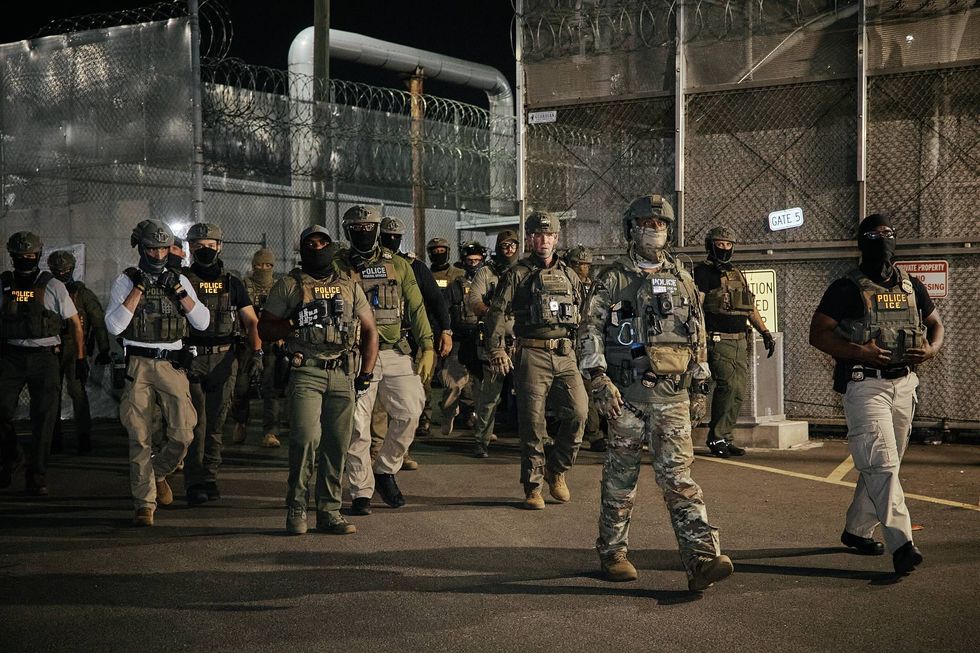 ICE agents arrive to clear protesters from a gate outside the Delaney Hall detention facility during a demonstration protesting the transfer of detainees and conditions inside the facility on June 11, 2026, in Newark, New Jersey. (Photo by Andres Kudacki/Getty Images)
The rising death toll comes as the Trump administration and Republican Congress have dramatically expanded DHS and its budget to create a massive network of new detention camps, where immigrants (and some US citizens)—most of whom have not been convicted of crimes—have been disappeared, often arbitrarily, denied access to legal representation, and subjected to severe physical mistreatment.
Some noncitizens have been targeted explicitly over their political speech, including the hundreds of students who suddenly found their legal status stripped over their participation in pro-Palestine protests, many of whom were summarily arrested and faced with the threat of deportation.
Ramirez told The Intercept all of these were examples of how DHS is "not rogue," but working as designed.
"For 23 years, since its inception, DHS has been utilized by the government to target and persecute those they consider the public enemy," she said, "whether it is Muslim Americans, Haitians escaping violence, Latinos yearning for a better life, or dissenting voices demanding an end to the genocide in Palestine and the kidnapping of our neighbors.”
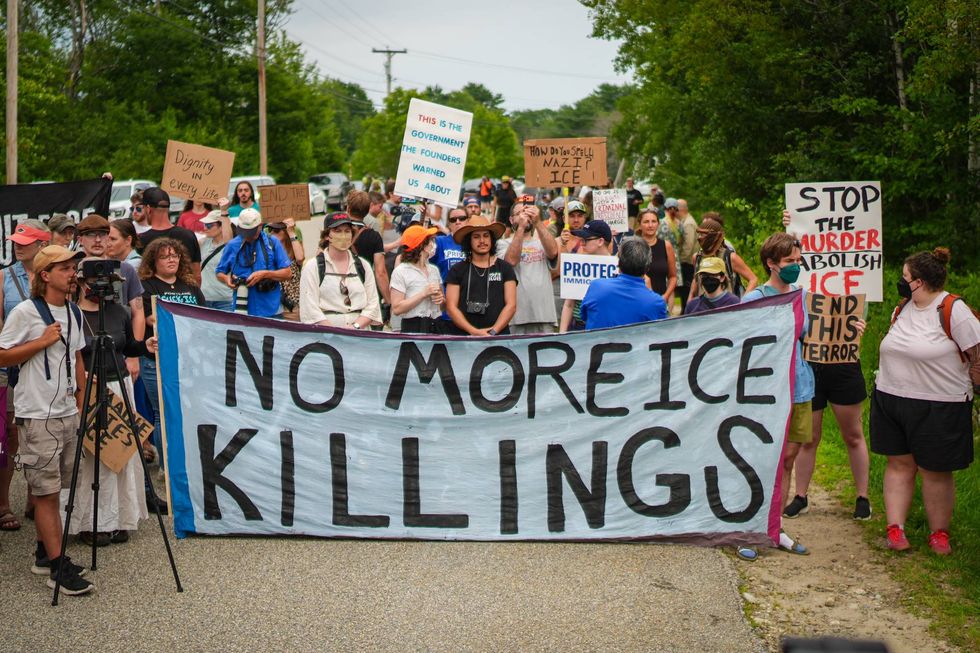 People protest outside a federal immigration office after a man was fatally shot by ICE agents on July 14, 2026, in Scarborough, Maine. (Photo by Ryan Murphy/Getty Images)
During the second Trump administration, public opinion has dramatically shifted against ICE, to the point where a plurality of voters, 48%, said they wanted the agency abolished in a July YouGov poll. In a February poll by the Public Religion Institute, 60% said they opposed increasing ICE's budget, compared with just 36% who favored it.
“In the past, the type of policy we are fighting for would have been written off as outlandish, too ‘extreme,’ or simply put, impossible," said Viviana Baraja, a Chicago-based immigrants' rights advocate who has helped to launch Ramirez's proposal.
"I have seen this administration make the most impossible nightmares possible," Baraja said. "And in the most distorted way, it has strengthened my resolve that if the worst can be possible, we can also dare to dream and to believe that the best can be possible too."

"If we don’t see the massive gains in productivity promised by the AI enthusiasts, then we will almost certainly see a collapse in the stock market," said one economist.
The International Monetary Fund warned Tuesday that the global economy faces serious risks from Big Tech firms taking on massive debt to fund the buildout of artificial intelligence data centers worldwide.
The IMF's latest Global Financial Stability Report outlines a number of risks to economic growth in the coming years, including a reliance on AI industry spending that it warns could lead to a new financial crisis.
The report points to the methods the world's largest data center operators, known as hyperscalers, are using to fund new construction as particularly troubling.
"Hyperscalers have strong earnings from their core businesses," the report states. "Yet, free cash flows are rapidly declining as hyperscalers try to sustain large AI investment needs, leaving debt financing increasingly necessary."
The analysis also details the role played by so-called circular financing agreements, in which one company agrees to fund another company's AI project in exchange for the firm receiving the money buying the investing firm's products.
These arrangements could create dangerous interdependence within the industry that could spark a financial contagion if one of the firms goes belly up, according to the report.
"While investors... are generally financially sound, distress at key investee firms could present significant 'wrong-way risk' to the AI ecosystem," the report states. "Equity and debt investments in the firms depreciate in value precisely when future revenue streams tied to them are impaired."
Investment expert Bret Jensen, in an analysis published by Seeking Alpha on Tuesday, examined projected capital expenditures from the five biggest hyperscalers—Oracle, Microsoft, Facebook parent company Meta, Amazon, and Google parent company Alphabet—and highlighted how they have increasingly moved financing off their corporate balance sheets.
"Over the past 12-18 months, there has been a huge increase in debt and equity issuance," Jensen explained. "The five hyperscalers now have a combined over $1.3 trillion of debt on their balance sheets and roughly $3 trillion in off-balance-sheet allocations."
Because of this, Jensen continued, "debt markets are starting to groan" by "signaling a substantial chance of default over the next half-decade on the debt of Oracle."
Jensen also pointed out that half of this infrastructure was being built for the benefit of frontier AI labs OpenAI and Anthropic, which he described as "unprofitable" and "bleeding cash."
Dean Baker, co-founder of the Center for Economic and Policy Research argued in an analysis published on Friday that AI is completely propping up the US economy at the moment, as investors are holding out hope that it delivers an unprecedented boom in productivity.
The problem, Baker pointed out, is there is little sign that AI is going to deliver anywhere near the increased productivity needed to make these historic investments pay off.
"If we believe the hype, we are about to see an incredible surge in productivity that will make us ridiculously wealthy," Baker explained. "To date, there is no evidence to support this view. Productivity growth has been at best on its trend pace the last couple of years."
"If we don’t see the massive gains in productivity promised by the AI enthusiasts," Baker added, "then we will almost certainly see a collapse in the stock market, with a serious recession almost guaranteed."
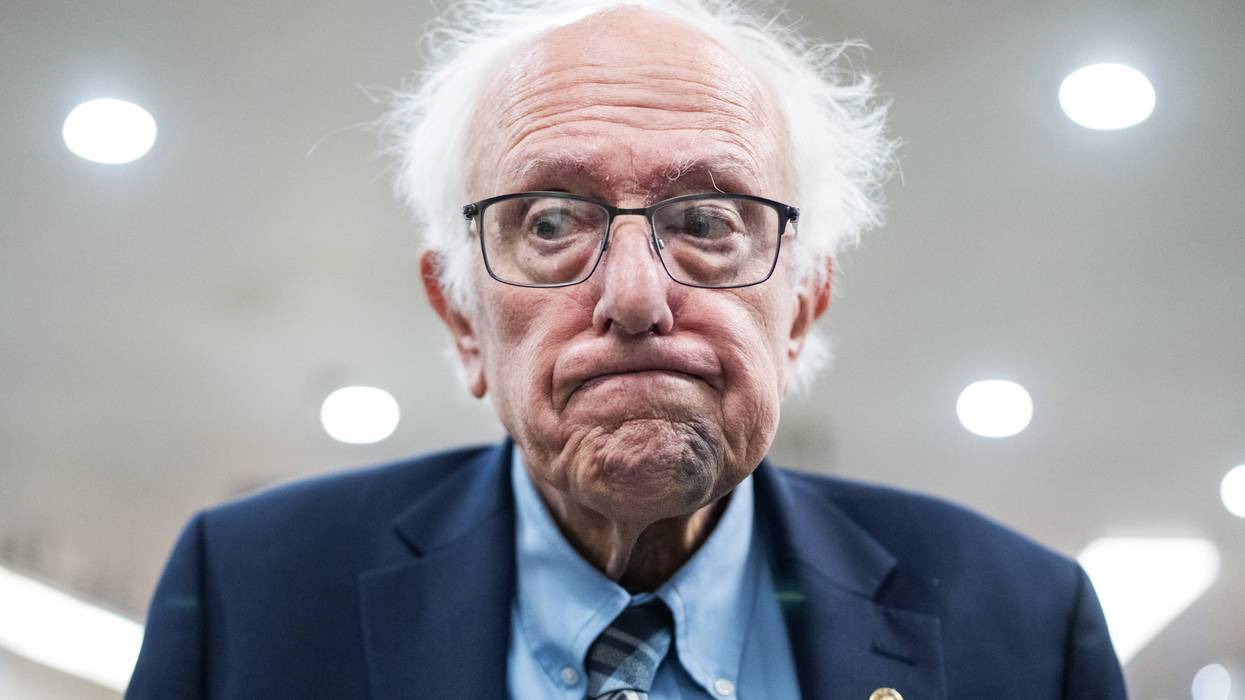
"We need Medicare for All," one critic said. "No private insurance necessary."
Corporate-backed Democrats evidently see the writing on the wall.
The latest polling from Axios-Ipsos American Health Index, released Wednesday, found that a purality of Americans support replacing the for-profit health insurance industry with a government-run Medicare for All plan, and that 62% of Democrats back the idea. Supporters of a single-payer healthcare program like those that have long existed in the United States' peer countries swept primary races across the US this year. And one of the top potential 2028 Democratic presidential candidates, Rep. Alexandria Ocasio-Cortez (D-NY), is a vehement supporter of the idea.
But instead of simply joining efforts to extend the popular Medicare program to everyone in the US, Majority Democrats—a group of Democratic lawmakers aimed at "reshaping and growing" the party, with billionaire hedge fund manager Stephen Mandel as its top funder—is intent on recycling an old proposal, with a new name.
The group introduced "Medicare for Americans" in a six-minute video posted on social media Tuesday—one that essentially described a "public option"—or a government-run healthcare program that would "compete" with health insurers instead of dismantling the $5.3 trillion-per-year for-profit system.
The video describes a plan similar to one unveiled in 2020 by former Transportation Secretary Pete Buttigieg, then a presidential candidate, who called his proposal "Medicare for All Who Want It."
"If we want to earn voters' trust back," says the narration, "we need a real solution... A revolutionary plan that will make a real difference in how we handle healthcare in this country."
The plan would "offer every American who is sick and tired of private insurance a plan through Medicare," the narrator continues. "People who want to keep the private insurance they have should be able to."
Sick of our broken healthcare system?Medicare is one of the most popular programs in American history. Why not give people the choice to enroll—and force insurance companies to compete?That’s Medicare for Americans. https://t.co/HQ8aIPPBRy
— Majority Democrats (@MajorityDems) October 11, 2026
The video goes on to say that proponents of Medicare for All, like Sen. Bernie Sanders (I-Vt.) and Ocasio-Cortez, want to "blow up the whole system and tax the hell out of everyday Americans," while Republicans want to keep a "dysfunctional status quo."
It warns that Medicare for All "comes with a $40 trillion price tag," naming the estimated cost over a decade. But it neglects to mention that the annual cost of the current healthcare system—$5.3 trillion in 2024—is about $1 trillion higher than the annual cost of Medicare for All that was projected by researchers at Yale School of Public Health in an August study. Americans are also spending more on healthcare following the Republican Party's Medicaid cuts and refusal to extend subsidies under the Affordable Care Act.
"In one Axios-Ipsos survey, two-thirds of Americans, including half of Republicans, believe the federal government should be willing to increase public healthcare spending to lower consumer costs. But it’s misleading to suggest Medicare for All would cost more than our current system," noted The Lever, calling Medicare for Americans "the billionaire option."
Lis Smith, a Democratic political operative who has worked for Buttigieg and disgraced former New York Gov. Andrew Cuomo, praised the proposal as a "transformative, once-in-a-generation healthcare reform" that is "within reach... if Democrats are smart."
But one progressive streamer wrote that Majority Democrats "want to pretend like they support progressive healthcare policy but are just protecting private insurance."
"We need Medicare for All," she said. "No private insurance necessary."

The editorial board of The Philadelphia Inquirer wrote that President Donald Trump is engaging in "rank bribery" ahead of the midterms.
US President Donald Trump's pledge to send every American adult $5,000, delivery of small healthcare rebates to millions of people, and announcement of a deal to secure Russian diesel amount to "a last-ditch attempt to buy off voters and dodge a richly deserved reckoning," the editorial board of The Philadelphia Inquirer argued Tuesday as the midterm elections approach.
The editorial accuses Trump–whose illegal war against Iran has sent gas prices soaring and whose signature legislative achievement has stripped healthcare and food aid from millions of Americans—of engaging in "rank bribery" as a "last crass resort" ahead of the midterm elections as his approval rating plummets and threatens to drag Republican candidates down with it.
"His deeply unpopular Middle East war is metastasizing, contributing to persistently high prices and a historically low public opinion of his presidency," the editorial reads. "Republican schemes to rig the vote by gerrymandering and other means appear insufficient to withstand a Democratic wave, forcing them to abandon formerly favorable territory such as Georgia and North Carolina and fight for ruby-red turf in Kansas and South Carolina."
"And polls have shown voters are divided over Trump’s crude promises of cash, which most don’t believe," the editorial adds. "When it comes to winning over voters, it seems promises of payoffs are no substitute for a record of success."
Trump's flurry of pledges and rebate announcements come amid widespread discontent over high energy prices and surging health insurance premiums—which the president's $90 Medicare rebates and $500 Affordable Care Act checks will do very little to offset for most Americans. People who receive the healthcare checks will also get an accompanying letter in which Trump touts his record—without mentioning his unprecedented cuts to Medicaid or the millions of people who have lost coverage during his second term.
"There is no better reflection of the purely transactional nature of Donald Trump’s politics than his love for buying Americans’ affections with cold hard cash," New York magazine's Ed Kilgore wrote last week. "The reality is that he’s commandeering (with no apparent legal authority) money designed for other public purposes and sending it out as individual checks. The ACA money is legally supposed to go to Obamacare enrollment and outreach efforts... while the Medicare dollars have typically gone to provider reimbursement-rate adjustments. Neither source was supposed to finance a preelection slush fund for politicians."
Reuters estimated that the Trump administration is sending a combined $2.35 billion in direct payments to millions of Americans ahead of next month's elections.
That total doesn't include Trump's promised $5,000 checks, which would cost an estimated $1.2 trillion. The president is explicitly dangling the checks as an enticement to vote Republican. During a Monday rally in Ohio, Trump said that "if Republicans win the House of Representatives and the Senate, I am going to give all adult citizens in the United States $5,000 each."
"Only Republicans can do that," Trump declared.
Tim Burga, president of the Ohio AFL-CIO, told The Washington Post that Trump is clearly attempting to distract from the nation's worsening affordability crisis and trying to "buy votes."
"It reeks of desperation," said Burga.
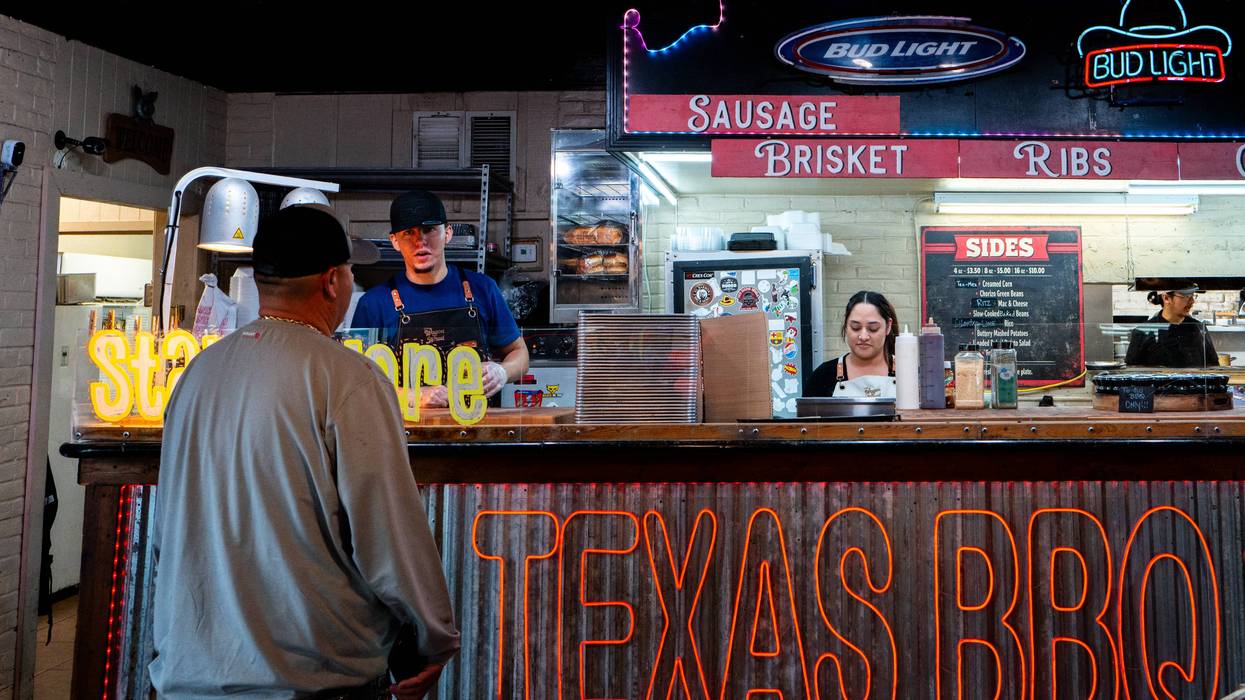
"Costs are hitting Main Street from every direction at once and Washington doesn't seem to care about the needs of small business owners," said the head of a national coalition.
Arizona-based Gabe Hagen said Tuesday that "to keep my business afloat, I invested my 401(k) savings and leveraged my home equity as collateral for additional capital, putting my family's financial security on the line to sustain my business and employees."
"I raised my prices, but sales have just flattened out because customers are ordering less," explained Hagen, who founded the Tempe coffee roasting company Brick Road Community Corporation. He's among over 1,000 US small business owners polled by the national coalition Small Business for America's Future from mid-August to early October.
Among those surveyed, 77% have seen customers spend less, delay purchases, or trade down recently, with 46% saying that shoppers are spending "significantly less." Meanwhile, owners like Hagen are increasingly enduring more financial stress, with many cutting their own pay or pulling money from personal savings to keep their companies operating.
The survey exposes how "a combination of factors is crushing small business," the coalition said in a statement announcing its resulting report—which highlights soaring costs for everything from fuel to healthcare, and was released just weeks away from the US midterm elections that will determine control of Congress for the latter half of Trump's second term.
"Costs are hitting Main Street from every direction at once and Washington doesn't seem to care about the needs of small business owners," said Walt Rowen, the coalition's co-chair and president of Susquehanna Glass Co., a family-owned glass manufacturer in Columbia, Pennsylvania that's been around for over a century.
Rowen—whose company is located in a key swing state—noted that "my business is a good example of what is happening. We've been navigating erratic tariff policies that have disrupted our supply chains, and now my heating oil costs $4,000 to $6,000 a month."
"We've lived through the Depression, wars, and recessions," he said. "Heating my factory in this current economy is some of the hardest math I've ever had to do, and I'm expecting the bill to jump 30% to 40% this winter. This survey shows us that I am far from alone. Small business owners everywhere are comparing this economy to some of the worst moments we've had this century."
The survey shows that 83% of small business owners are concerned about their company's financial health over the next year, including 44% who are very concerned. Three-quarters called this one of the hardest economies of their careers, with over half drawing comparisons to the Covid-19 pandemic, and nearly a third pointing to the Great Recession.
A similar share (78%) accused decision-makers in Washington, DC of putting large corporations first, and 72% said running their business is harder than it was a year ago—with 85% citing inflation and rising prices as the source of strain. Majorities saw increases for utilities (72%); fuel (68%); transportation, shipping, or supplies (64%); business services (64%); healthcare and health insurance (54%); and employee wages and benefits (53%).
Those soaring costs have had consequences. Two-thirds of surveyed owners said they canceled, delayed, or scaled back investments in equipment, facilities, or technology. Over half did the same for hiring and expansion to new markets. Nearly two-thirds skipped or reduced their own pay, and 52% said their personal debt has increased in the past year.
Rising costs can be clearly connected to decisions by Trump and congressional Republicans—many of whom are up for reelection next month, as the GOP tries to hang on to its slim majorities in both chambers.
The president returned to power early last year having campaigned on a mass detention and deportation agenda, despite arguments from economists and elected Democrats that his approach was not only inhumane but economically risky. A clear majority of surveyed owners (61%) said that immigration enforcement has hurt the small business economy.
Trump and Republican lawmakers also enacted a 2025 budget package that cut federal healthcare spending and did not extend Affordable Care Act enhanced premium tax credits. Among surveyed business owners who buy their own insurance coverage through an ACA marketplace, 90% saw their premiums rise after the subsidies expired. Nearly three-quarters also said they fear rising health insurance costs will make it harder to hire and keep needed employees.
The administration's shifting tariff policy and refund process have caused further stress: 59% of owners said trade-related cost increases have made it harder to run their business, and only 3% have filed refund claims since the US Supreme Court's February ruling against many of Trump's tariffs.
Trump's illegal war on Iran continues to drive up fuel prices. The construction of artificial intelligence data centers—which the president has encouraged—is also increasing energy costs. Nearly three-quarters of those surveyed are worried about the impact of electricity demand from new AI facilities. Around the same share is concerned about the consequences of the new armed conflict in the Middle East, which the GOP-controlled Congress never authorized, but has refused to end.
In a social media post about all the findings, Small Business for America's Future urged, "Lawmakers, make your next decision with Main Street in mind."
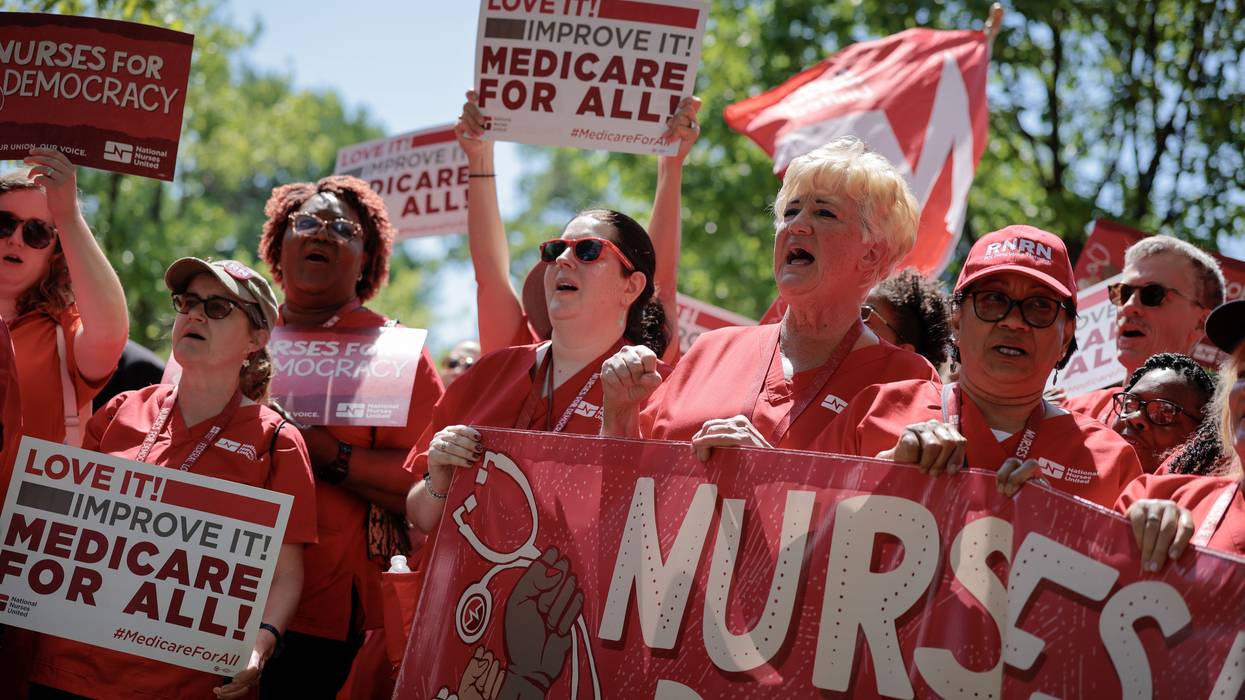
“Healthcare is one of the significant ways that people experience economic pressure every day,” said Ipsos' president.
Yet another poll, this one released on Tuesday, shows significant support for Medicare for All as Americans grapple with rising healthcare costs and the Trump administration and congressional Republicans target federal programs upon which tens of millions of people rely.
A plurality—43%—of respondents to the latest Axios-Ipsos American Health Index said they support replacing private health insurance with a government-run Medicare for All system, compared with 24% who oppose the idea. Another 32% were unsure, leaving supporters outnumbering opponents by nearly two to one. Two-thirds of respondents also backed increased federal spending to reduce healthcare costs.
Respondents' views on Medicare for All are divided along party lines, with a majority of Democrats (62%) and a plurality of independents (47%) supporting the proposal, while a majority of Republicans (52%) oppose it.
Again: Supporting Medicare for All is not Radical — opposing it is. We can’t afford NOT to do it. #MedicareForAllNOW www.axios.com/2026/10/13/a...
[image or embed]
— The Tennessee Holler (@thetnholler.bsky.social) October 13, 2026 at 5:24 AM
The most commonly cited reason people said they oppose Medicare for All is fear that the quality of care would be inferior to that offered by private health insurance (38%), followed by concern that the program would be too expensive for taxpayers (22%), and that the federal government should not be involved in providing healthcare (21%). Supporters were not asked why they favor Medicare for All.
The survey also revealed deepening distrust of political leaders on healthcare issues. Just 20% of respondents said that they trusted President Donald Trump for health-related information, down from 31% in March 2025, while only 25% trusted Health and Human Services Secretary Robert F. Kennedy Jr. The poll also found that 49% would be less likely to support a candidate who received money from pharmaceutical company political action committees.
"Healthcare is one of the significant ways that people experience economic pressure every day," Mallory Newall, Ipsos senior vice president for US public affairs, told Axios. She noted that while many Americans still "have questions" about Medicare for All, the current level of support for the proposal is "noteworthy—and it is not solely driven by members of the Democratic Party."
Newall said that even if candidates "don't call it Medicare for All," expanding federal healthcare programs so that they cover more people "is a message that can connect with voters" as they prepare to cast their ballots in next month's midterm elections.
The stakes extend beyond Medicare for All. Republicans' sweeping 2025 budget law enacted the biggest cuts to Medicaid in the program's six-decade history, while enhanced Affordable Care Act premium tax credits expired at the beginning of 2026, threatening higher costs for millions of enrollees.
Progressives have cited these and other developments to argue that the private insurance system leaves working-class families vulnerable to corporate profiteers and political attacks.
A separate survey released last week by the health policy research organization KFF found that 66% of Americans favor Medicare for All, the highest level of support since the organization began tracking the issue a decade ago. While 84% of Democrats and 72% of Independents polled backed Medicare for All, 66% of Republican respondents opposed the proposal.
According to a study published in August by researchers at Yale University, shifting to a Medicare for All-type system would save more than 114,000 lives and around $1 trillion annually in the US. Sen. Bernie Sanders (I-Vt.) has cited the study while promoting his Medicare for All Act.
"Do not tell me we cannot afford Medicare for All," he said at the time of the study's publication. "What we cannot afford is a broken healthcare system based on greed."

"She needs to get much better, fast, otherwise she'll break Scaramucci's record," said one unnamed White House official.
New White House Press Secretary Katie Zacharia gave her debut press conference on Tuesday and was quickly panned by critics, including some anonymous Trump administration officials.
Zacharia's first briefing, which lasted less than 15 minutes, was marked by halting speech and apparent difficulty in reading her prepared remarks.
The Trump press secretary took just three questions from right-wing outlets—Fox News, The Daily Mail, and Breitbart—before abruptly ending the briefing.
😬 Katie Zacharia's first press briefing was brutally bad 😬Trump managed to find a press secretary who can barely read, but she does have the number one qualification -- looking like IvankaHere's a supercut from Zacharia's first briefing, which made Karoline Leavitt seem like Ronald Reagan
— Aaron Rupar (@atrupar) October 13, 2026
An anonymous Trump administration official told MS NOW White House correspondent Jake Traylor that Zacharia might already be on thin ice after such a poor first performance.
The official compared her to former White House Press Secretary Anthony Scaramucci, who was infamously fired from his job after only 11 days.
"Getting behind the podium is tough, but she got off on the wrong foot," the official said. "She needs to get much better, fast, otherwise she'll break Scaramucci's record."
Scaramucci himself predicted that Trump wouldn't long tolerate Zacharia's bumbling performance, writing in Tuesday social media post that "the clock is running" on her tenure.
Other White House officials told CNN's Kaitlan Collins that they were similarly unsure how long Zacharia would last on the job, with one official describing her performance as "unusual" and another calling it "brutal."
MS NOW's Pete Alexander said he spoke with "a former high-level Trump aide" who said of Zacharia, "I think she is going to be a train wreck."
Journalist Aaron Rupar described Zacharia's debut as "an SNL cold open come to life," adding that "she can barely read."
Mother Jones' Inae Oh observed that Zacharia "appeared physically strained as she struggled to deliver prepared remarks" during her first day on the job, "as if the task of reading was too much to endure."
"By turns halting and anxious," Oh wrote, "it made [former White House Press Secretary] Karoline Leavitt, who resigned in September, seem like a rhetorical genius."
Democratic political strategist Adam Parkhomenko sarcastically praised Zacharia as doing "a great job for someone who was clearly pissing herself."
New Yorker theater critic Emily Nussbaum described Zacharia as "a shining role model for women crippled by imposter syndrome."

"Our future is being robbed away from us," said the Swedish climate activist. "It just gives a signal to young people that you're not prioritized in our society."
Arriving Tuesday in the Paris suburb of Saint-Denis to stand with students demonstrating against poor school conditions, climate and rights activist Greta Thunberg had one question for French leaders and authorities who have appeared shocked that hundreds of thousands of high schoolers would rise up against disinvestment in their education: "What do you expect young people to do?"
"Of course we're going to revolt, of course we're going to rise up," the Swedish climate action leader told L'Humanité. "It should have been expected."
Thunberg joined the protesters—a group that originally included students, mostly aged 15-18, when the demonstrations began last month, but that's grown to include hundreds of thousands of people including union members and teachers—as the movement entered its fourth week.
She expressed pride in the French students who have led the movement, and denounced political leaders for refusing to invest in public education.
"Our future is being robbed away from us," she told Agence France-Presse. "Schools are not getting investments that they need... It just gives a signal to young people that you're not prioritized in our society."
Greta Thunberg est venue manifester mardi matin devant le lycée Paul-Eluard de Saint-Denis, un des épicentres du mouvement lycéen, où plus d'une centaine de jeunes étaient rassemblés pour l'acte V de la mobilisation ⤵️ #geneu_AFP https://t.co/dd1Rur6NZb
— Agence France-Presse (@afpfr) October 13, 2026
Hundreds of schools have been closed as students have formed chains at the building entrances and marched through Paris and cities and towns across France, demanding more funding for schools.
Students are raising alarm about dilapidated buildings, overcrowded classrooms, and too many teacher absences, and the protests have exploded as French President Emmanuel Macron's government tries to pass a budget including a modest increase in education funding—which students and teachers have denounced as an effective cut due to inflation.
Students are calling for €10 billion increase in investment for the country’s lycées, or high schools.
Thunberg said that students "are not being included in the conversation," and condemned French authorities for their "extremely violent" response to the protests.
Police were pushed to end their use of stun grenades last week after a teenager lost his hand because of one of the weapons. Another student lost the use of his eye, and another lost many teeth when tear gas canisters were fired at close range.
"That the police are now meeting it with such violence and politicians are meeting it as if it's something unexpected, or that young people are destroying things, just shows that they are living in a completely different reality," said Thunberg.
🔴 FLASH — Greta Thunberg est actuellement à Saint-Denis (93). 👉 « La police est tellement violente, évidemment que nous allons nous révolter et nous soulever ! La jeunesse française est un exemple pour le monde entier.» https://t.co/RKdT2WQ8h5
— FranceUnie 🇫🇷 (@FranceSouvUnie) October 13, 2026
At least 24 instances of police brutality are being investigated, and the violent police response has drawn condemnation from international human rights groups.
"They should know that all over the world we are following these developments. We are inspired by the young people who are demanding their basic rights,” Thunberg told reporters outside Lycée Paul Eluard in Saint-Denis. “Whether it’s not funding schools enough, or the climate crisis, or social injustice crises... It’s about time that young people are stepping up and reclaiming that future.”
The government is prosecuting about 1,500 people for their participation in the protests, which are backed by the leftist political party France Unbowed, led by presidential candidate Jean-Luc Mélenchon.
In Paris on Tuesday, students blockaded the entrances to their schools, while in Marseille, some pushed dumpsters on wheels in front of school doors.
Speaking to L'Humanité, Thunberg called on "workers' movements, migrants' rights movements, climate movements" and others to "stand united because we are facing the same enemy."
"We are not going to give up, and we are going to fight for this future that is being stolen from us right before our eyes," she said.