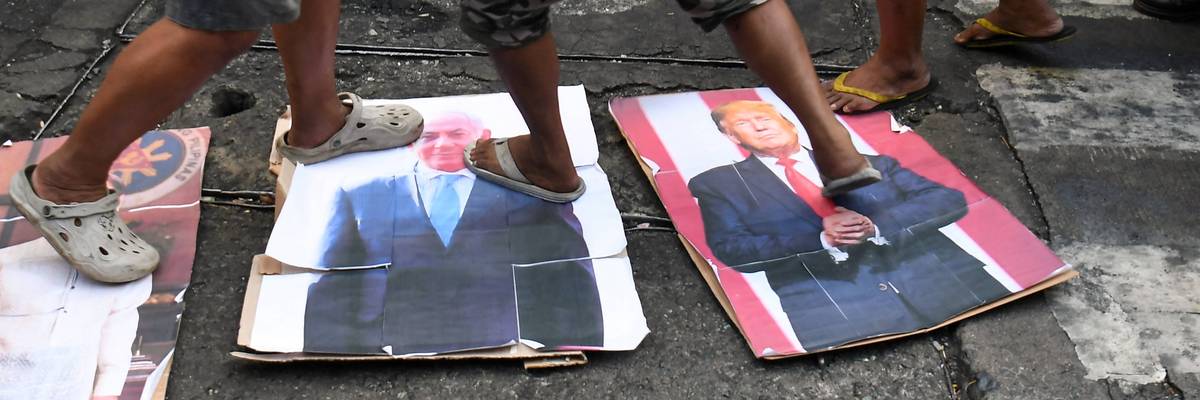
Jeepney drivers step on portraits of Israeli Prime Minister Benjamin Netanyahu and US President Donald Trump during a protest in Manila, Philippines on April 15, 2026.
Amnesty Calls for Resistance to 'Predatory World Order' Pushed by Trump, Netanyahu in Annual Rights Report
"We must imagine a transformed and transformative human rights vision for the world that we are becoming, not merely defend human rights in terms of the world we once were."
Opening Amnesty International's annual report on human rights around the globe on Tuesday, the group's secretary general named the leaders of two powerful countries as being at the forefront of a push for a "predatory alternative world order."
While the US and Israel are viewed as two of the world's leading democracies, said longtime human rights advocate Agnes Callamard, President Donald Trump and Prime Minister Benjamin Netanyahu have spent the past year promoting "a global environment where primitive ferocity" is flourishing.
"Throughout 2025, voracious predators stalked through our global commons, hulking hunters plundering unjust trophies," wrote Callamard in the preface to the report, "The State of World's Human Rights."
"Political leaders like Trump, [Russian President Vladimir] Putin, and Netanyahu, among many others, carried out their conquests for economic and political domination through destruction, suppression, and violence on a massive scale," she added.
The report was published nearly two months after the US and Israel began attacking Iran in an unprovoked war—violating international law, including the United Nations Charter, according to legal experts. A temporary ceasefire deal was struck nearly two weeks ago, and Trump said Tuesday that he is unwilling to extend the truce and expects "to be bombing" Iran again soon if a permanent deal isn't reached.
More than 3,300 people have been killed in Iran since the US and Israel began the war, while the Israel Defense Forces (IDF) have also killed at least 2,294 people in Lebanon as it wages what it says are attacks on the Iran-aligned group Hezbollah—an assault that has displaced about 1.2 million people, representing more than 20% of Lebanon's population, and included attacks on schools, healthcare facilities, and journalists.
Israeli officials have said they are using Gaza as a "model" for the IDF's assault on Lebanon. Israel's US-backed war on Gaza began in October 2023 in retaliation for a Hamas-led attack, and has killed more that 72,000 Palestinians, including at least 777 people since a ceasefire was agreed to in October 2025. Leading human rights groups including Amnesty as well as Holocaust scholars have said the war on Gaza is a genocide, and South Africa has filed a genocide case at the International Court of Justice (ICJ). The International Criminal Court (ICC) issued a warrant for Netanyahu's arrest, accusing him of war crimes and crimes against humanity in Gaza.
In addition to waging war on Iran, in the past year the Trump administration has invaded Venezuela and abducted President Nicolás Maduro and his wife, accusing them of drug trafficking; bombed more than 50 boats in the Caribbean Sea and eastern Pacific Ocean, killing at least 180 people in an operation officials have also claimed is aimed at stopping the drug trade; and imposed an oil blockade on Cuba while threatening military intervention there.
Meanwhile, the White House has slashed foreign aid spending, threatening millions of lives worldwide, as well as investments in domestic social programs, as it's pushed to further increase the United States' astronomical military budget.
"The predatory world order discards racial and gender justice, mocks women’s rights, declares civil society a common enemy, and rejects international solidarity," wrote Callamard. "It directs an unprecedented hike in military investments, enables unlawful arms transfers, and imposes sweeping cuts to international aid budget, risking millions of avoidable death and decimating thousands of organizations working for human rights, sexual and reproductive rights, or press freedom."
Callamard warned that far too many world leaders—confronted with superpowers that "recklessly poured" accelerants over "dry kindling" and took "sharp U-turns... away from the international order that had been imagined out of the ashes of the Holocaust and the utter destruction of world wars"—either appeased Trump and Netanyahu over the past year, attempted to imitate their authoritarian tendencies, or "ducked for cover under their shadow."
She noted that a "handful chose to stand up to them," such as Spanish Prime Minister Pedro Sánchez, who refused to allow the US to use its airspace and military bases for the Iran war, and countries that joined South Africa's genocide case at the ICJ.
But overall, Callamard wrote, "one firebreak after another was breached: through complicity in, or silence about, the commissions of genocide and crimes against humanity; and through imposition of crippling sanctions against those working to deliver justice. That’s how 2025 will be remembered: for its bullies and predators; for the pouring of the politics of appeasement onto burning betrayals of international obligations; for self-defeatism; for states playing with a fire that threatens now to burn us all and scorch the future too, for generations to come."
Callamard emphasized that around the world in 2025, countries showed that "predatory" leaders can still be held accountable and that "reports of the death of the international rule-based order are greatly exaggerated":
Rodrigo Duterte, former president of the Philippines, was handed over to the ICC under a warrant for the crime against humanity of murder. In the First Committee of the UN General Assembly, 156 states voted for negotiations on an international instrument on autonomous weapons systems. In July, the EU extended the scope of goods covered by its pioneering Anti-Torture Regulation. Significant progress was made in 2025 towards a binding UN tax convention. At COP30, civil society and trade union pressure helped adoption of a Just Transition Mechanism for the protection of workers and communities as countries shift to clean energy and a climate-resilient future. The International Court of Justice and the Inter-American Court of Human Rights issued advisory opinions affirming state human rights obligations to respond to climate damage. Colombia and the Netherlands agreed to co-host the First International Conference on Transitioning Away from Fossil Fuels in April 2026. Countrywide strikes and actions by dockworkers mounted in France, Greece, Italy, Morocco, Spain, and Sweden disrupted arms shipment routes to Israel. The governments of Belgium, Bolivia, Canada, Colombia, Cuba, Honduras, Malaysia, Namibia, Slovenia, South Africa, and Spain committed in 2025 to modify or halt arms trade with Israel. Women gained expanded abortion rights in Denmark, the Faroe Islands, Norway, Luxembourg, and Malawi. In Nepal, a youth-led uprising against corruption toppled the government.
Those victories, suggested Callamard, don't change the fact that the world is now facing a "challenging moment, threatening to destroy all that was built up over the last 80 years."
"Today 'still we rise' means focusing on what must be defended as a matter of priority and at all costs, not only for the sake of our human rights but those of future generations too," said Callamard. "In our resistance, we must also clearly identify what must be disrupted as a matter of absolute priority, among the tsunami of laws, policies, and practices unleashed by predatory state and nonstate actors."
"We must imagine a transformed and transformative human rights vision for the world that we are becoming, not merely defend human rights in terms of the world we once were," she wrote. "Together, we must then lead that transformation into existence, with all our creativity, determination, and resilience."
We are at a crossroads
This country and this world are at a monumental crossroads. In a few short weeks, US voters will have an opportunity to beat back the forces of fascism and confront the billionaires who are rigging the economy, our media system, and our democracy, making it increasingly impossible for ordinary people to get by. We’re not just talking about the election. We’re talking about what must be done once these fascist elements are vanquished from power. We need a bolder set of solutions than what either major party has so far been willing to offer and a working-class movement ready to fight like hell for it. Trump didn't emerge from nowhere. The conditions that fueled MAGA authoritarianism were created by decades of radical neoliberal economic policies and a corrupt political system dominated by corporate interests. They slashed taxes on the super-rich, promising that the benefits would trickle down. They said giveaways to the corporate titans would make life more affordable for the rest of us. It was all bullshit. And when a bitter, betrayed populace searches for someone to blame, right-wing demagogues have little trouble finding scapegoats. People know when they're being lied to, but you won't hear any of this from the corporate media. Only independent journalism—powered and funded by people who believe in building a better world—can deliver truly trustworthy daily news. Our Fall Campaign is underway, and we need your help. To power our newsroom through the rest of the year, we need to raise $125,000 by midnight on October 31. So if you share our vision, please contribute whatever you can to sustain our work. |
Opening Amnesty International's annual report on human rights around the globe on Tuesday, the group's secretary general named the leaders of two powerful countries as being at the forefront of a push for a "predatory alternative world order."
While the US and Israel are viewed as two of the world's leading democracies, said longtime human rights advocate Agnes Callamard, President Donald Trump and Prime Minister Benjamin Netanyahu have spent the past year promoting "a global environment where primitive ferocity" is flourishing.
"Throughout 2025, voracious predators stalked through our global commons, hulking hunters plundering unjust trophies," wrote Callamard in the preface to the report, "The State of World's Human Rights."
"Political leaders like Trump, [Russian President Vladimir] Putin, and Netanyahu, among many others, carried out their conquests for economic and political domination through destruction, suppression, and violence on a massive scale," she added.
The report was published nearly two months after the US and Israel began attacking Iran in an unprovoked war—violating international law, including the United Nations Charter, according to legal experts. A temporary ceasefire deal was struck nearly two weeks ago, and Trump said Tuesday that he is unwilling to extend the truce and expects "to be bombing" Iran again soon if a permanent deal isn't reached.
More than 3,300 people have been killed in Iran since the US and Israel began the war, while the Israel Defense Forces (IDF) have also killed at least 2,294 people in Lebanon as it wages what it says are attacks on the Iran-aligned group Hezbollah—an assault that has displaced about 1.2 million people, representing more than 20% of Lebanon's population, and included attacks on schools, healthcare facilities, and journalists.
Israeli officials have said they are using Gaza as a "model" for the IDF's assault on Lebanon. Israel's US-backed war on Gaza began in October 2023 in retaliation for a Hamas-led attack, and has killed more that 72,000 Palestinians, including at least 777 people since a ceasefire was agreed to in October 2025. Leading human rights groups including Amnesty as well as Holocaust scholars have said the war on Gaza is a genocide, and South Africa has filed a genocide case at the International Court of Justice (ICJ). The International Criminal Court (ICC) issued a warrant for Netanyahu's arrest, accusing him of war crimes and crimes against humanity in Gaza.
In addition to waging war on Iran, in the past year the Trump administration has invaded Venezuela and abducted President Nicolás Maduro and his wife, accusing them of drug trafficking; bombed more than 50 boats in the Caribbean Sea and eastern Pacific Ocean, killing at least 180 people in an operation officials have also claimed is aimed at stopping the drug trade; and imposed an oil blockade on Cuba while threatening military intervention there.
Meanwhile, the White House has slashed foreign aid spending, threatening millions of lives worldwide, as well as investments in domestic social programs, as it's pushed to further increase the United States' astronomical military budget.
"The predatory world order discards racial and gender justice, mocks women’s rights, declares civil society a common enemy, and rejects international solidarity," wrote Callamard. "It directs an unprecedented hike in military investments, enables unlawful arms transfers, and imposes sweeping cuts to international aid budget, risking millions of avoidable death and decimating thousands of organizations working for human rights, sexual and reproductive rights, or press freedom."
Callamard warned that far too many world leaders—confronted with superpowers that "recklessly poured" accelerants over "dry kindling" and took "sharp U-turns... away from the international order that had been imagined out of the ashes of the Holocaust and the utter destruction of world wars"—either appeased Trump and Netanyahu over the past year, attempted to imitate their authoritarian tendencies, or "ducked for cover under their shadow."
She noted that a "handful chose to stand up to them," such as Spanish Prime Minister Pedro Sánchez, who refused to allow the US to use its airspace and military bases for the Iran war, and countries that joined South Africa's genocide case at the ICJ.
But overall, Callamard wrote, "one firebreak after another was breached: through complicity in, or silence about, the commissions of genocide and crimes against humanity; and through imposition of crippling sanctions against those working to deliver justice. That’s how 2025 will be remembered: for its bullies and predators; for the pouring of the politics of appeasement onto burning betrayals of international obligations; for self-defeatism; for states playing with a fire that threatens now to burn us all and scorch the future too, for generations to come."
Callamard emphasized that around the world in 2025, countries showed that "predatory" leaders can still be held accountable and that "reports of the death of the international rule-based order are greatly exaggerated":
Rodrigo Duterte, former president of the Philippines, was handed over to the ICC under a warrant for the crime against humanity of murder. In the First Committee of the UN General Assembly, 156 states voted for negotiations on an international instrument on autonomous weapons systems. In July, the EU extended the scope of goods covered by its pioneering Anti-Torture Regulation. Significant progress was made in 2025 towards a binding UN tax convention. At COP30, civil society and trade union pressure helped adoption of a Just Transition Mechanism for the protection of workers and communities as countries shift to clean energy and a climate-resilient future. The International Court of Justice and the Inter-American Court of Human Rights issued advisory opinions affirming state human rights obligations to respond to climate damage. Colombia and the Netherlands agreed to co-host the First International Conference on Transitioning Away from Fossil Fuels in April 2026. Countrywide strikes and actions by dockworkers mounted in France, Greece, Italy, Morocco, Spain, and Sweden disrupted arms shipment routes to Israel. The governments of Belgium, Bolivia, Canada, Colombia, Cuba, Honduras, Malaysia, Namibia, Slovenia, South Africa, and Spain committed in 2025 to modify or halt arms trade with Israel. Women gained expanded abortion rights in Denmark, the Faroe Islands, Norway, Luxembourg, and Malawi. In Nepal, a youth-led uprising against corruption toppled the government.
Those victories, suggested Callamard, don't change the fact that the world is now facing a "challenging moment, threatening to destroy all that was built up over the last 80 years."
"Today 'still we rise' means focusing on what must be defended as a matter of priority and at all costs, not only for the sake of our human rights but those of future generations too," said Callamard. "In our resistance, we must also clearly identify what must be disrupted as a matter of absolute priority, among the tsunami of laws, policies, and practices unleashed by predatory state and nonstate actors."
"We must imagine a transformed and transformative human rights vision for the world that we are becoming, not merely defend human rights in terms of the world we once were," she wrote. "Together, we must then lead that transformation into existence, with all our creativity, determination, and resilience."
- 'Netanyahu Is Sabotaging Diplomacy': Israeli Attack Kills Top Iranian Nuclear Negotiator ›
- Sanders Rips Trump-Netanyahu for 'Unraveling International Law' With War on Iran ›
- Israeli Election Panel OKs Ben-Gvir and Smotrich's Far-Right Parties After Voting to Ban Arab Ones | Common Dreams ›
Opening Amnesty International's annual report on human rights around the globe on Tuesday, the group's secretary general named the leaders of two powerful countries as being at the forefront of a push for a "predatory alternative world order."
While the US and Israel are viewed as two of the world's leading democracies, said longtime human rights advocate Agnes Callamard, President Donald Trump and Prime Minister Benjamin Netanyahu have spent the past year promoting "a global environment where primitive ferocity" is flourishing.
"Throughout 2025, voracious predators stalked through our global commons, hulking hunters plundering unjust trophies," wrote Callamard in the preface to the report, "The State of World's Human Rights."
"Political leaders like Trump, [Russian President Vladimir] Putin, and Netanyahu, among many others, carried out their conquests for economic and political domination through destruction, suppression, and violence on a massive scale," she added.
The report was published nearly two months after the US and Israel began attacking Iran in an unprovoked war—violating international law, including the United Nations Charter, according to legal experts. A temporary ceasefire deal was struck nearly two weeks ago, and Trump said Tuesday that he is unwilling to extend the truce and expects "to be bombing" Iran again soon if a permanent deal isn't reached.
More than 3,300 people have been killed in Iran since the US and Israel began the war, while the Israel Defense Forces (IDF) have also killed at least 2,294 people in Lebanon as it wages what it says are attacks on the Iran-aligned group Hezbollah—an assault that has displaced about 1.2 million people, representing more than 20% of Lebanon's population, and included attacks on schools, healthcare facilities, and journalists.
Israeli officials have said they are using Gaza as a "model" for the IDF's assault on Lebanon. Israel's US-backed war on Gaza began in October 2023 in retaliation for a Hamas-led attack, and has killed more that 72,000 Palestinians, including at least 777 people since a ceasefire was agreed to in October 2025. Leading human rights groups including Amnesty as well as Holocaust scholars have said the war on Gaza is a genocide, and South Africa has filed a genocide case at the International Court of Justice (ICJ). The International Criminal Court (ICC) issued a warrant for Netanyahu's arrest, accusing him of war crimes and crimes against humanity in Gaza.
In addition to waging war on Iran, in the past year the Trump administration has invaded Venezuela and abducted President Nicolás Maduro and his wife, accusing them of drug trafficking; bombed more than 50 boats in the Caribbean Sea and eastern Pacific Ocean, killing at least 180 people in an operation officials have also claimed is aimed at stopping the drug trade; and imposed an oil blockade on Cuba while threatening military intervention there.
Meanwhile, the White House has slashed foreign aid spending, threatening millions of lives worldwide, as well as investments in domestic social programs, as it's pushed to further increase the United States' astronomical military budget.
"The predatory world order discards racial and gender justice, mocks women’s rights, declares civil society a common enemy, and rejects international solidarity," wrote Callamard. "It directs an unprecedented hike in military investments, enables unlawful arms transfers, and imposes sweeping cuts to international aid budget, risking millions of avoidable death and decimating thousands of organizations working for human rights, sexual and reproductive rights, or press freedom."
Callamard warned that far too many world leaders—confronted with superpowers that "recklessly poured" accelerants over "dry kindling" and took "sharp U-turns... away from the international order that had been imagined out of the ashes of the Holocaust and the utter destruction of world wars"—either appeased Trump and Netanyahu over the past year, attempted to imitate their authoritarian tendencies, or "ducked for cover under their shadow."
She noted that a "handful chose to stand up to them," such as Spanish Prime Minister Pedro Sánchez, who refused to allow the US to use its airspace and military bases for the Iran war, and countries that joined South Africa's genocide case at the ICJ.
But overall, Callamard wrote, "one firebreak after another was breached: through complicity in, or silence about, the commissions of genocide and crimes against humanity; and through imposition of crippling sanctions against those working to deliver justice. That’s how 2025 will be remembered: for its bullies and predators; for the pouring of the politics of appeasement onto burning betrayals of international obligations; for self-defeatism; for states playing with a fire that threatens now to burn us all and scorch the future too, for generations to come."
Callamard emphasized that around the world in 2025, countries showed that "predatory" leaders can still be held accountable and that "reports of the death of the international rule-based order are greatly exaggerated":
Rodrigo Duterte, former president of the Philippines, was handed over to the ICC under a warrant for the crime against humanity of murder. In the First Committee of the UN General Assembly, 156 states voted for negotiations on an international instrument on autonomous weapons systems. In July, the EU extended the scope of goods covered by its pioneering Anti-Torture Regulation. Significant progress was made in 2025 towards a binding UN tax convention. At COP30, civil society and trade union pressure helped adoption of a Just Transition Mechanism for the protection of workers and communities as countries shift to clean energy and a climate-resilient future. The International Court of Justice and the Inter-American Court of Human Rights issued advisory opinions affirming state human rights obligations to respond to climate damage. Colombia and the Netherlands agreed to co-host the First International Conference on Transitioning Away from Fossil Fuels in April 2026. Countrywide strikes and actions by dockworkers mounted in France, Greece, Italy, Morocco, Spain, and Sweden disrupted arms shipment routes to Israel. The governments of Belgium, Bolivia, Canada, Colombia, Cuba, Honduras, Malaysia, Namibia, Slovenia, South Africa, and Spain committed in 2025 to modify or halt arms trade with Israel. Women gained expanded abortion rights in Denmark, the Faroe Islands, Norway, Luxembourg, and Malawi. In Nepal, a youth-led uprising against corruption toppled the government.
Those victories, suggested Callamard, don't change the fact that the world is now facing a "challenging moment, threatening to destroy all that was built up over the last 80 years."
"Today 'still we rise' means focusing on what must be defended as a matter of priority and at all costs, not only for the sake of our human rights but those of future generations too," said Callamard. "In our resistance, we must also clearly identify what must be disrupted as a matter of absolute priority, among the tsunami of laws, policies, and practices unleashed by predatory state and nonstate actors."
"We must imagine a transformed and transformative human rights vision for the world that we are becoming, not merely defend human rights in terms of the world we once were," she wrote. "Together, we must then lead that transformation into existence, with all our creativity, determination, and resilience."
- 'Netanyahu Is Sabotaging Diplomacy': Israeli Attack Kills Top Iranian Nuclear Negotiator ›
- Sanders Rips Trump-Netanyahu for 'Unraveling International Law' With War on Iran ›
- Israeli Election Panel OKs Ben-Gvir and Smotrich's Far-Right Parties After Voting to Ban Arab Ones | Common Dreams ›