
SUBSCRIBE TO OUR FREE NEWSLETTER
Daily news & progressive opinion—funded by the people, not the corporations—delivered straight to your inbox.
5
#000000
#FFFFFF
To donate by check, phone, or other method, see our More Ways to Give page.


Daily news & progressive opinion—funded by the people, not the corporations—delivered straight to your inbox.
"Every country with a single ounce of decency should do the same," said one academic.
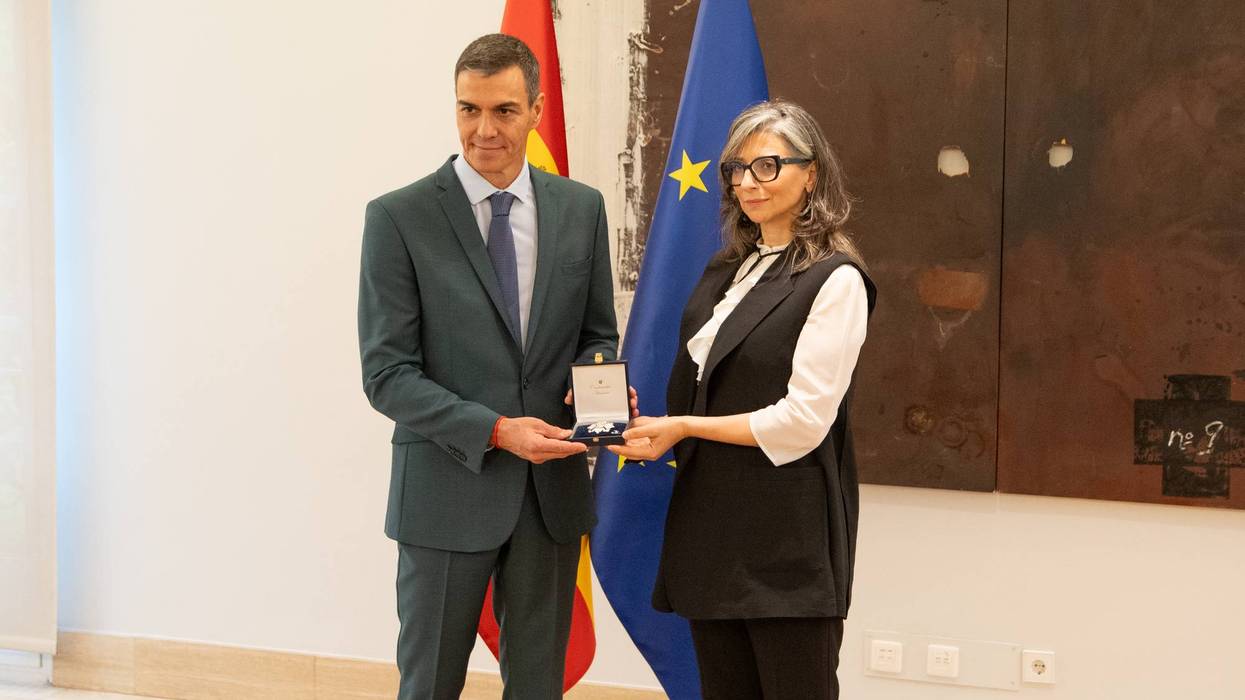
Doubling down on its commitment to saying, "No to war" as Israel and the US bombard Iran in a widening conflict of choice that has also included Israeli attacks on Lebanon, the Spanish government on Wednesday formally withdrew its ambassador to Israel, Ana María Sálomon Pérez.
“At the proposal of the minister for foreign affairs, the European Union, and cooperation, and following deliberation by the Council of Ministers at its meeting on March 10, 2026, I hereby order the termination of Ms. Ana María Sálomon Pérez’s appointment as ambassador of Spain to the state of Israel,” a communication from Spanish Prime Minister Pedro Sánchez in the official state gazette read Wednesday morning.
The Foreign Ministry told Reuters that the Spanish Embassy in Tel Aviv will be led by a charge d'affaires.
"Every country with a single ounce of decency should do the same," said UK-based researcher Philip Proudfoot.
The decision to terminate the appointment of Sálomon Pérez comes more than a week after Sánchez denounced the United States' and Israel's assault on Iran as "unjustified, dangerous, and outside international law," and said the countries would be barred from using Spanish military bases to launch attacks on Iran.
Spain has also been outspoken in its condemnation of Israel's US-backed war on Gaza, which began in October 2023 in retaliation for a Hamas-led attack.
Last September, the prime minister announced an arms embargo on Israel, noting that its attacks on Gaza—which have now killed more than 75,000 Palestinians, according to peer-reviewed studies—has been described as a "genocide" by experts, including the United Nations special rapporteur on the occupied Palestinian territories.
Sánchez also announced Spain would formally recognize Palestinian statehood in May 2024, angering Israel and prompting the country to recall its ambassador to Spain.
Last week, Sánchez gave a 10-minute address saying he was not intimidated by President Donald Trump's threat to impose a trade embargo on Spain in retaliation for its refusal to allow the US and Israel use its military bases. He reiterated that Spain's view on Iran is, "No to war."
"Spain stands with the founding principles of the European Union. It stands with the charter of the United Nations. It stands with international law and therefore with peace and peaceful coexistence between countries," said the prime minister.
In an interview with El Diario on Tuesday, Sánchez called on other European countries to "raise the rules-based international order and the defense of renewed multilateralism."
The war against Iran "has been a war unilaterally driven by two nations," he said. "We are consistent with the foreign policy we have maintained during these almost eight years of government. We will not resolve the situation of instability in the Middle East with such flagrant illegality."
President Sánchez’s voice has been the bravest in Europe. His peace communication and action have the potential to disarm the authoritarian brutality of war as events in Iran and the Middle East grip the hearts and minds of the peoples of the world.
In a move that has sent shockwaves from Washington to Tel Aviv, passing through Berlin and Ankara, Spanish President Pedro Sánchez has positioned Spain as the primary European holdout against the escalating military conflict in Iran. Invoking the ghost of protests against the 2003 Iraq War, Sánchez’s government has blocked the United States from using Spanish military bases at Rota and Morón de la Frontera to bomb Iran—a decision that has triggered threats of a trade embargo from US President Donald Trump.
Sánchez has provided a three-fold argument against the war: that it is contrary to international law, unethical, and catastrophic for the world. He is simultaneously presenting himself as a courageous politician whose principles transcend any fear of US retaliation and a pragmatist who wishes to avoid the negative consequences of the war, from economic disaster to Islamist terrorism.
No a la Guerra captures this narrative in a way that resonates strongly not only in the minds of Spaniards but across the world. Sánchez has satisfied an international demand to speak out against Trump and Israeli Prime Minister Benjamin Netanyahu and put peace on the agenda. His government has broken a spiral of silence. Can it stir support to stop the war?
Sánchez’s predecessor, José Maria Aznar, dragged Spain into the illegal and catastrophic Iraq War against the will of its people. That remains strongly embedded in the Spanish collective consciousness. The right-wing Partido Popular (PP) knows it lost the subsequent election because “weapons of mass destruction” did not exist, innocent people were killed en masse, there were jihadist terrorist attacks in Madrid as retaliation, and the party lied, blaming the domestic terrorist group ETA. Today’s No a la Guerra is a slap to the face of the PP and the far-right party Vox, which both support the US-Israeli war.
In opposing the Iranian war, the Spanish government is part of a wider movement that can unsettle the sense of helplessness that often grips Europe during Middle East conflicts.
While 80-90% of the Spanish population opposed the invasion of Iraq, almost 70% rejects the current war; 53% of the public supports the government’s stance on military bases. Just 23% supports the war. The right-wing opposition, and Podemos on the left, accuse Sánchez of hypocrisy for sending the frigate Cristóbal Colón to the United Kingdom’s military base in Cyprus. Per Britain’s claims for mobilizing forces and matériel, the Spanish government has responded that this is merely for protection rather than offensive purposes, in accordance with NATO’s doctrine of collective defense. Of course, such doctrines may be invoked quite differently should Iran attack US forces stationed in Europe.
Spain’s government must navigate the tension of geopolitical power relations while avoiding any mismatch between its discourse and practice, per the slaughter in Gaza. Some on the left also maintain that it is impossible to oppose the war effectively without sanctioning Israel and leaving NATO.
The right labels Sánchez as posturing ahead of a potential snap election. Yet the PP leader Alberto Núñez Feijóo has offered babbling, erratic responses that are themselves framed almost entirely through the lens of domestic partisan politics.
Feijóo also argues that Sánchez has abandoned Spain’s allies, jeopardizing the national interest. But the PP’s alignment with pro-war interests represents a regression to an outdated colonialist mindset of total servility. Much like during Aznar’s era, the PP is willing to kneel to US interests, sacrificing national sovereignty to serve as a submissive junior partner in a foreign military campaign. Sanchez’s performance is approved by 42% of the population; 19% support the opposition’s reaction.
The country’s main business association has expressed deep concern about the possibility of the US severing trade relations with Spain and placed responsibility on the Spanish government, urging it to ameliorate the situation.
The European Commission, Italy, France, Portugal, Austria, Ireland, Malta, Turkey, and China have expressed solidarity with Spain in the face of Trump’s threats. However, France and Portugal, together with Germany, the UK, Greece, and Australia have adopted bellicose positions, and Canada is wavering. The President of the European Commission Ursula von der Leyen has justified the attack on Iran and stated that the European Union must be prepared to “project power” as it can no longer rely on the “rules-based” system to protect the continent’s interests, while the President of the European Council Antonio Costa and the Vice-President of the European Commission Teresa Ribera have spoken up for international law.
Within Latin America, Brazil, Colombia, Mexico, Venezuela, and Chile have advocated for adherence to international law and diplomatic resolution; conversely, Argentina has signaled explicit support for the US and Israeli governments.
Israel accuses Spain of failing to fulfill its obligations per NATO, while Trump, as ever the class bully, threatens to punish it. While remaining submissive to Trump, German Chancellor Friedrich Merz has reminded him that he cannot unilaterally block trade with Spain because it shares most-favored nation status with all European Union members. NATO Secretary General Mark Rutte justifies the offensive against Iran at the same time as he defends Spain’s contribution to the organization.
Positions may change as the war evolves. Sánchez needs to go further and mobilize international opposition to the war. He must show it is possible and beneficial (including in electoral terms) to stand up to bullying. That will mean developing new alliances and favoring European strategic autonomy and sovereignty. Should the war go badly for US interests, Sánchez’s blend of ethical resistance and enlightened self-interest could encourage other leaders to join him.
For now, Spain is holding up a mirror to other European countries, challenging them to reflect on their diminished sovereignty. Merz looks weak by contrast when he claims that international law does not apply to Iran.
The US National Security Strategy frames the EU as an enemy to be destroyed, while DC and techno-authoritarians promote the far right. Positive coverage of the Spanish government’s stand in the international press can encourage European governments and citizens to confront Trump and Netanyahu. Significant majorities in Spain, Germany, Italy, and Britain oppose military intervention. It is about time democratic leaders understand the US not as an ally but an irresponsible actor seeking to weaponize Europe in its own interest. Iran’s democratic opposition needs peaceful conditions, as opposed to bombs. And the violence that the regime uses to deter dissent and seek internal cohesion against the external enemy. The country’s democratization must be accompanied by democratization and pacification across the globe, especially the United States.

In opposing the Iranian war, the Spanish government is part of a wider movement that can unsettle the sense of helplessness that often grips Europe during Middle East conflicts. Per 2003’s invasion of Iraq, grassroots popular culture is playing a key role in expressing peaceful solidarity.
A Turkish news anchor moved audiences by thanking Spain—in Spanish—for being “on the right side of history” and “representing the common consciousness of humanity,” while a video of Turkish football fans passionately singing the pasodoble España Cañí has become viral; a surreal display of cultural support. Other viral videos feature a skilled Palestinian skater holding a Spanish flag and a Japanese influencer advocating for Spanish products in response to Trump’s threat.
Peace has a chance should the US people rise decidedly against the war. Spain has paved the way for citizens around the world.
Peace and democracy require symbolic triumphs that bring binding affects to the people and joy to the collective political body. Believing that “yes, we can” is a necessary step to the realization of objectives. As Susan Sarandon said in cinema’s recent Goya Awards, “Silence is very dangerous.” When Sánchez broke the silence of world leaders, the possibility of resistance turning viral emerged: “In a place where you feel repression and censorship, to see Spain come forward with such a strong voice and moral clarity is so important to us, the United States; it makes you feel less alone and that there is hope.”
The US and Israel seem to be losing the battle of international public opinion, but that’s not enough: Authoritarian leaders such as Trump and Netanyahu act through force more than consensus in the international arena. Nevertheless, they rely on their own voters. Although 93% of Israeli Jews and 26% of Israeli Arabs support the war, as of early March, 44% of US citizens support the war and 56% oppose it. Despite Trump’s electoral promise of “no war,” only 15% of his supporters oppose the attacks on Iran, but support for Trump and the war are based on a cult of personality and spectacular demonstrations of force and victory in short wars with few national casualties. Some notable isolationist and antisemitic conservatives have already broken with him over Iran.
Although the figures vary depending on the survey, support for the strikes is far lower than that at the beginnings of previous wars. As ever, support for military action may wane as the economic and human costs of war increase. International-relations mavens are unified in their skepticism. While current opposition remains insufficient to halt the conflict, it highlights a decline in President Trump’s support that could prove decisive in the November midterm elections. However, given the catastrophic consequences of the war, an electoral shift may come too late. Because of the illegal nature of the strikes and the bypassing of congressional approval, it may be time to pursue impeachment based on executive overreach and the violation of international law, albeit with no prospect of conviction.
The role of peace communication is to engage with Trump’s supporters: listening to them, empathizing where possible, sharing information, and showing how they are negatively affected by the war.
Peace has a chance should the US people rise decidedly against the war. Spain has paved the way for citizens around the world. But peace communication should not merely be refusal; it should mobilize diplomacy, internationalism, and interculturality. Peace communication must encourage others to agree, not push them away, and do so in the name of mutual transformation. That depends on a shared will, creativity, and care for humanity.
European leaders expressed solidarity with Spain after Trump threatened a trade embargo in retaliation for the prime minister saying the US could not use Spanish military bases to attack Iran.
Spanish Prime Minister Pedro Sánchez on Wednesday appeared undaunted by President Donald Trump's threat to impose a full trade embargo on Spain in retaliation for its refusal to allow the US to use its military bases to wage war on Iran.
In a 10-minute televised address, Sánchez told the Spanish public that the country "will not be complicit in something that is bad for the world and contrary to our values and interests simply out of fear of reprisals from someone."
Despite Trump's threat, the Spanish government's position on the US and Israel's attacks on Iran, the prime minister said, can be summarized as "no to war."
The address came hours after Trump claimed the US military would use Spain's military bases to launch warplanes "if we want," despite Spanish Foreign Minister José Manuel Albares' earlier statement that the facilities could not be used "for anything that isn’t covered by the [United Nations] Charter.”
The US and Israel began attacking Iran early Saturday morning after Oman's foreign minister said American and Iranian officials had been making progress toward a deal on Iran's nuclear program.
Legal experts have said the unprovoked attacks are a clear violation of international law and the UN Charter, which prohibits the use of force unless it is "authorized by the UN Security Council or is a necessary and proportionate act of individual or collective self-defense in response to an armed attack.”
Secretary of State Marco Rubio stunned observers this week when he claimed the US and Israel had waged war because of an "imminent threat"—one that was posed because the US believed Israel was planning to strike Iran, and Iran was expected to retaliate against that potential attack.
On Wednesday, Sánchez said the US and Israeli strikes against Iran, which have so far killed more than 1,000 people, according to Iranian officials, signify a "breakdown of international law."
He compared the bombings to the George W. Bush administration's invasion of Iraq, which led to eight years of war and killed over 100,000 Iraqi civilians, and warned against “repeating the mistakes of the past."
“Very often great wars start with a chain of events spiraling out of control due to miscalculations, technical failures, and unforeseen circumstances," said the prime minister, who has also been outspoken in his opposition to Israel's US-backed assault on Gaza and the Trump administration's invasion of Venezuela in January. "Therefore, we must learn from history and cannot play Russian roulette with the fate of millions."
Trump on Tuesday also expressed anger over Spain's refusal to cave to his demand that all North Atlantic Treaty Organization (NATO) member states commit to spending 5% of their gross domestic product on defense by 2035.
But other members of the European Union, which collectively negotiates trade with the US, were quick to express solidarity with Spain.
German Chancellor Friedrich Merz, who met with Trump at the White House on Tuesday, told the president that European countries would not agree to a trade agreement with the US that didn't include Spain, while French President Emmanuel Macron spoke to Sánchez to convey his "solidarity." European Council President António Costa also said he has spoken to the Spanish prime minister and reaffirmed the EU's "firm commitment to the principles of international law and the rules-based order everywhere in the world."
Despite Europe's strong stance against Trump's threats, US Treasury Secretary Scott Bessent on Wednesday doubled down on the president's rhetoric, appearing on CNBC to accuse Spain of "not meeting their NATO requirement" and of putting "American lives at risk" by not allowing the US to use its bases.
Stéphane Séjourné, the EU's internal market commissioner, was not deterred by Bessent's comments, warning that "any threat against member state is by definition a threat against the EU."
He noted that European countries already joined together this year to defend Greenland from Trump's claim that he would take over the autonomous territory, part of the Danish kingdom, by force.
"If you threaten one particular country... well, we’ve seen that about Greenland," said Séjourné. "I think we saw that there was a lot of unity.”