SUBSCRIBE TO OUR FREE NEWSLETTER
Daily news & progressive opinion—funded by the people, not the corporations—delivered straight to your inbox.
5
#000000
#FFFFFF
To donate by check, phone, or other method, see our More Ways to Give page.
Daily news & progressive opinion—funded by the people, not the corporations—delivered straight to your inbox.
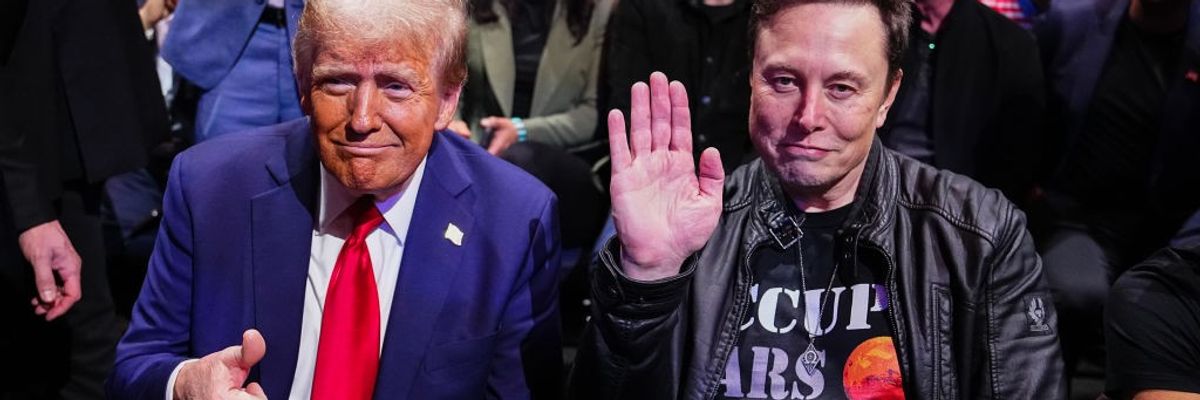
Then President-elect Donald Trump and Elon Musk pose for a photo during the UFC 309 event at Madison Square Garden on November 16, 2024 in New York City.
"If you think back at the last economic crashes... the rich were able to buy up assets on the cheap and emerged even wealthier and more powerful than before," noted one progressive commentator.
Are U.S. President Donald Trump, top adviser Elon Musk, and allied oligarchs deliberately trying to tank the economy in order to line their own gilded pockets?
More and more observers from both sides of the political aisle are asking the question this week as the U.S. president implemented steep tariffs on some of the country's biggest trade partners, threatened a global trade war, and is taking chainsaw to government spending and programs—policies that, while inflicting economic pain upon nearly everyone else, could dramatically boost their already stratospheric wealth.
Numerous observers have likened it to the " disaster capitalism" examined in Naomi Klein's seminal 2007 book, The Shock Doctrine: The Rise of Disaster Capitalism—politicians and plutocrats exploit the chaos of natural or human-caused crises to push through unpopular policies like privatization and deregulation that harm the masses while boosting the wealth and power of the ruling class.
Economic alarm bells were already ringing before Trump's 25% tariffs on most products from Canada and Mexico and an additional 10% on China—for a total of 20%—took effect on Tuesday, prompting retaliatory measures and threats of more to come.
Then, during his rambling joint address to Congress on Tuesday night, Trump threatened to impose reciprocal tariffs on every nation on Earth starting April 2 (because he "didn't want to be accused of April Fools' Day") if those countries did not lower barriers to trade with the United States.
@jamellebouie Replying to @C. Stetzer ♬ original sound - b-boy bouiebaisse
New York Times economic policy reporters Alan Rappeport and Ana Swanson called Trump's sweeping tariffs "one of the biggest gambles of his presidency," and a move "that risks undermining the United States economy."
But what if that's the whole point?
"I've been entertaining this theory a little bit more lately, because [Trump's] economic moves seem so stupid and terrible and counterproductive without thinking that he is intentionally trying to cause harm," progressive political commentator Krystal Ball—who also has a degree in economics and is a certified public accountant— said Tuesday on the social media site X.
Ball cited an X
post by Saikat Chakrabarti, a progressive Democrat running for Congresswoman Nancy Pelosi's (D-Calif.) House seat who worked on Wall Street for six years and helped found the online payment processing company Stripe, in which he accused Trump of "manufacturing a recession."
"But it makes sense when you realize his goal is to create something like Russia where the economy is run by a few oligarchs loyal to him," Chakrabarti added. "Creating that state is hard in a large, dynamic, powerful economy with too many actors who can oppose him. So he's accelerating concentrating money and power into the hands of his loyalists while he crashes the rest out."
Responding to this, Ball asserted that "at this point, until proven otherwise, the primary actor in the government and the economy is actually Elon, so I think it makes sense to think of Elon's incentives here and what he may actually want to accomplish."
"If you think back at the last economic crashes—both in Covid and in the 2008 financial crash—while initially everyone suffered, including the rich, out of both, the rich were able to buy up assets on the cheap and emerged even wealthier and more powerful than before," she noted.
"So in 2008, not only did they get their own custom bailout, but they were able to buy housing stock at absurdly low prices," Ball recalled. "The rich got richer than ever, inequality skyrocketed, and the big banks got bigger than ever."
"Same deal with the Covid-era recession," she continued. "So, while again, everyone suffered initially, there was a huge bailout package which, yes, did benefit ordinary people, but if you look at who came out really on top... you could see people like Elon Musk, people like Jeff Bezos, people like Mark Zuckerberg getting far wealthier. Their net worths, which were already very high, skyrocketed beyond anyone's wildest dreams."
Indeed, as Common Dreams reported, 700 billionaires got $1.7 trillion richer during two years of pandemic. Between March 2020 and April 2022, Musk got 10 times richer, while Zuckerberg's net worth more than tripled and Bezos' grew by nearly $80 billion, according to Forbes.
"Here's the other piece that's worth thinking about as well," Ball added. "Crash and crisis leads to governments and authoritarian leaders claiming more power for themselves. They can use the crisis and the emergency as a justification for taking on extraordinary powers and for taking extraordinary measures... measures that can be custom fit to primarily benefit oligarchs like Elon Musk."
"So I don't know guys, while we're running around here going... 'can't they understand how this is going to be devastating for the economy,' maybe they do understand," she concluded, "and maybe that's kind of the point."
Dear Common Dreams reader, It’s been nearly 30 years since I co-founded Common Dreams with my late wife, Lina Newhouser. We had the radical notion that journalism should serve the public good, not corporate profits. It was clear to us from the outset what it would take to build such a project. No paid advertisements. No corporate sponsors. No millionaire publisher telling us what to think or do. Many people said we wouldn't last a year, but we proved those doubters wrong. Together with a tremendous team of journalists and dedicated staff, we built an independent media outlet free from the constraints of profits and corporate control. Our mission has always been simple: To inform. To inspire. To ignite change for the common good. Building Common Dreams was not easy. Our survival was never guaranteed. When you take on the most powerful forces—Wall Street greed, fossil fuel industry destruction, Big Tech lobbyists, and uber-rich oligarchs who have spent billions upon billions rigging the economy and democracy in their favor—the only bulwark you have is supporters who believe in your work. But here’s the urgent message from me today. It's never been this bad out there. And it's never been this hard to keep us going. At the very moment Common Dreams is most needed, the threats we face are intensifying. We need your support now more than ever. We don't accept corporate advertising and never will. We don't have a paywall because we don't think people should be blocked from critical news based on their ability to pay. Everything we do is funded by the donations of readers like you. When everyone does the little they can afford, we are strong. But if that support retreats or dries up, so do we. Will you donate now to make sure Common Dreams not only survives but thrives? —Craig Brown, Co-founder |
Are U.S. President Donald Trump, top adviser Elon Musk, and allied oligarchs deliberately trying to tank the economy in order to line their own gilded pockets?
More and more observers from both sides of the political aisle are asking the question this week as the U.S. president implemented steep tariffs on some of the country's biggest trade partners, threatened a global trade war, and is taking chainsaw to government spending and programs—policies that, while inflicting economic pain upon nearly everyone else, could dramatically boost their already stratospheric wealth.
Numerous observers have likened it to the " disaster capitalism" examined in Naomi Klein's seminal 2007 book, The Shock Doctrine: The Rise of Disaster Capitalism—politicians and plutocrats exploit the chaos of natural or human-caused crises to push through unpopular policies like privatization and deregulation that harm the masses while boosting the wealth and power of the ruling class.
Economic alarm bells were already ringing before Trump's 25% tariffs on most products from Canada and Mexico and an additional 10% on China—for a total of 20%—took effect on Tuesday, prompting retaliatory measures and threats of more to come.
Then, during his rambling joint address to Congress on Tuesday night, Trump threatened to impose reciprocal tariffs on every nation on Earth starting April 2 (because he "didn't want to be accused of April Fools' Day") if those countries did not lower barriers to trade with the United States.
@jamellebouie Replying to @C. Stetzer ♬ original sound - b-boy bouiebaisse
New York Times economic policy reporters Alan Rappeport and Ana Swanson called Trump's sweeping tariffs "one of the biggest gambles of his presidency," and a move "that risks undermining the United States economy."
But what if that's the whole point?
"I've been entertaining this theory a little bit more lately, because [Trump's] economic moves seem so stupid and terrible and counterproductive without thinking that he is intentionally trying to cause harm," progressive political commentator Krystal Ball—who also has a degree in economics and is a certified public accountant— said Tuesday on the social media site X.
Ball cited an X
post by Saikat Chakrabarti, a progressive Democrat running for Congresswoman Nancy Pelosi's (D-Calif.) House seat who worked on Wall Street for six years and helped found the online payment processing company Stripe, in which he accused Trump of "manufacturing a recession."
"But it makes sense when you realize his goal is to create something like Russia where the economy is run by a few oligarchs loyal to him," Chakrabarti added. "Creating that state is hard in a large, dynamic, powerful economy with too many actors who can oppose him. So he's accelerating concentrating money and power into the hands of his loyalists while he crashes the rest out."
Responding to this, Ball asserted that "at this point, until proven otherwise, the primary actor in the government and the economy is actually Elon, so I think it makes sense to think of Elon's incentives here and what he may actually want to accomplish."
"If you think back at the last economic crashes—both in Covid and in the 2008 financial crash—while initially everyone suffered, including the rich, out of both, the rich were able to buy up assets on the cheap and emerged even wealthier and more powerful than before," she noted.
"So in 2008, not only did they get their own custom bailout, but they were able to buy housing stock at absurdly low prices," Ball recalled. "The rich got richer than ever, inequality skyrocketed, and the big banks got bigger than ever."
"Same deal with the Covid-era recession," she continued. "So, while again, everyone suffered initially, there was a huge bailout package which, yes, did benefit ordinary people, but if you look at who came out really on top... you could see people like Elon Musk, people like Jeff Bezos, people like Mark Zuckerberg getting far wealthier. Their net worths, which were already very high, skyrocketed beyond anyone's wildest dreams."
Indeed, as Common Dreams reported, 700 billionaires got $1.7 trillion richer during two years of pandemic. Between March 2020 and April 2022, Musk got 10 times richer, while Zuckerberg's net worth more than tripled and Bezos' grew by nearly $80 billion, according to Forbes.
"Here's the other piece that's worth thinking about as well," Ball added. "Crash and crisis leads to governments and authoritarian leaders claiming more power for themselves. They can use the crisis and the emergency as a justification for taking on extraordinary powers and for taking extraordinary measures... measures that can be custom fit to primarily benefit oligarchs like Elon Musk."
"So I don't know guys, while we're running around here going... 'can't they understand how this is going to be devastating for the economy,' maybe they do understand," she concluded, "and maybe that's kind of the point."
Are U.S. President Donald Trump, top adviser Elon Musk, and allied oligarchs deliberately trying to tank the economy in order to line their own gilded pockets?
More and more observers from both sides of the political aisle are asking the question this week as the U.S. president implemented steep tariffs on some of the country's biggest trade partners, threatened a global trade war, and is taking chainsaw to government spending and programs—policies that, while inflicting economic pain upon nearly everyone else, could dramatically boost their already stratospheric wealth.
Numerous observers have likened it to the " disaster capitalism" examined in Naomi Klein's seminal 2007 book, The Shock Doctrine: The Rise of Disaster Capitalism—politicians and plutocrats exploit the chaos of natural or human-caused crises to push through unpopular policies like privatization and deregulation that harm the masses while boosting the wealth and power of the ruling class.
Economic alarm bells were already ringing before Trump's 25% tariffs on most products from Canada and Mexico and an additional 10% on China—for a total of 20%—took effect on Tuesday, prompting retaliatory measures and threats of more to come.
Then, during his rambling joint address to Congress on Tuesday night, Trump threatened to impose reciprocal tariffs on every nation on Earth starting April 2 (because he "didn't want to be accused of April Fools' Day") if those countries did not lower barriers to trade with the United States.
@jamellebouie Replying to @C. Stetzer ♬ original sound - b-boy bouiebaisse
New York Times economic policy reporters Alan Rappeport and Ana Swanson called Trump's sweeping tariffs "one of the biggest gambles of his presidency," and a move "that risks undermining the United States economy."
But what if that's the whole point?
"I've been entertaining this theory a little bit more lately, because [Trump's] economic moves seem so stupid and terrible and counterproductive without thinking that he is intentionally trying to cause harm," progressive political commentator Krystal Ball—who also has a degree in economics and is a certified public accountant— said Tuesday on the social media site X.
Ball cited an X
post by Saikat Chakrabarti, a progressive Democrat running for Congresswoman Nancy Pelosi's (D-Calif.) House seat who worked on Wall Street for six years and helped found the online payment processing company Stripe, in which he accused Trump of "manufacturing a recession."
"But it makes sense when you realize his goal is to create something like Russia where the economy is run by a few oligarchs loyal to him," Chakrabarti added. "Creating that state is hard in a large, dynamic, powerful economy with too many actors who can oppose him. So he's accelerating concentrating money and power into the hands of his loyalists while he crashes the rest out."
Responding to this, Ball asserted that "at this point, until proven otherwise, the primary actor in the government and the economy is actually Elon, so I think it makes sense to think of Elon's incentives here and what he may actually want to accomplish."
"If you think back at the last economic crashes—both in Covid and in the 2008 financial crash—while initially everyone suffered, including the rich, out of both, the rich were able to buy up assets on the cheap and emerged even wealthier and more powerful than before," she noted.
"So in 2008, not only did they get their own custom bailout, but they were able to buy housing stock at absurdly low prices," Ball recalled. "The rich got richer than ever, inequality skyrocketed, and the big banks got bigger than ever."
"Same deal with the Covid-era recession," she continued. "So, while again, everyone suffered initially, there was a huge bailout package which, yes, did benefit ordinary people, but if you look at who came out really on top... you could see people like Elon Musk, people like Jeff Bezos, people like Mark Zuckerberg getting far wealthier. Their net worths, which were already very high, skyrocketed beyond anyone's wildest dreams."
Indeed, as Common Dreams reported, 700 billionaires got $1.7 trillion richer during two years of pandemic. Between March 2020 and April 2022, Musk got 10 times richer, while Zuckerberg's net worth more than tripled and Bezos' grew by nearly $80 billion, according to Forbes.
"Here's the other piece that's worth thinking about as well," Ball added. "Crash and crisis leads to governments and authoritarian leaders claiming more power for themselves. They can use the crisis and the emergency as a justification for taking on extraordinary powers and for taking extraordinary measures... measures that can be custom fit to primarily benefit oligarchs like Elon Musk."
"So I don't know guys, while we're running around here going... 'can't they understand how this is going to be devastating for the economy,' maybe they do understand," she concluded, "and maybe that's kind of the point."