SUBSCRIBE TO OUR FREE NEWSLETTER
Daily news & progressive opinion—funded by the people, not the corporations—delivered straight to your inbox.
5
#000000
#FFFFFF
To donate by check, phone, or other method, see our More Ways to Give page.
Daily news & progressive opinion—funded by the people, not the corporations—delivered straight to your inbox.
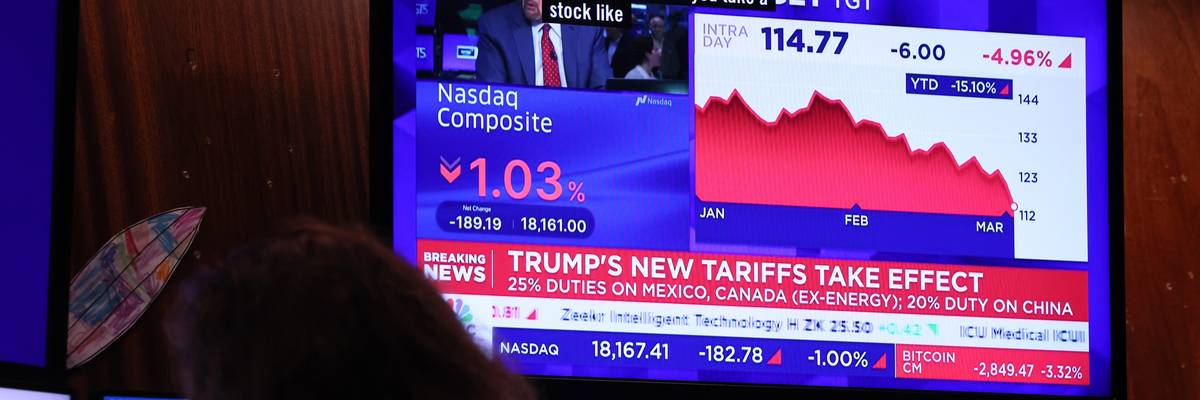
Financial news is seen on a television on the floor of the New York Stock Exchange during morning trading on March 4, 2025 in New York City.
After a monthlong delay, Trump administration tariffs on Mexican and Canadian imports went into effect Tuesday.
As the Trump administration's purge of federal workers continues and tariffs imposed on key U.S. trade partners Mexico and Canada take effect Tuesday, multiple economic indicators are warning of potential pain ahead.
On Monday, the Federal Reserve Bank of Atlanta released an estimate for GDP performance in the first quarter of 2025, which showed an economic contraction of 2.8%. The "GDPNow" estimate is a model-based projection that is not an official forecast from the Atlanta Fed, but it does paint a different economic picture from just a few weeks ago, when the same model-based projection estimated growth of almost 3% in early February.
"Basically unprecedented for a new administration to inherit a strong economy and immediately tank it as both businesses and consumers internalize its agenda," wrote Bharat Ramamurti, a former deputy director at the National Economic Council, in response to the prediction from the Atlanta Fed.
Stocks also tumbled Monday after Trump announced that 25% tariffs on Canada and Mexico would go into effect the next day. Trump also reiterated that the U.S. would impose an additional 10% tariff on China, on top of 10% tariffs that were already in effect.
Meanwhile there are also signs that consumer confidence is declining. The research group the Conference Board released its Consumer Confidence Index for February on Tuesday, which showed the largest monthly decline in consumer confidence since August 2021. "Respondents to the board's survey expressed concern over inflation with a significant increase in mentions of trade and tariffs, the board said," according to The Associated Press. The retail giant Target said Tuesday that consumer confidence is waning, according to CNN.
In a video discussing the Atlanta Fed's "GDPNow" estimate, journalist Krystal Ball reminded listeners that billionaire Elon Musk, the man Trump has deputized to help oversee cuts to the federal spending and bureaucracy, said that the work of his Department of Government Efficiency would cause pain. Musk in October 2024 said that then yet-to-be-created body's work would "necessarily involve some temporary hardship," according to Vox.
The Trump administration has so far already cut tens of thousands of workers, but even if Trump successfully carried out his proposed mass firings of probationary workers (which a judge recently said were likely illegal), possibly impacting 200,000 people, that "on its own, is not recessionary," according to economist Ernie Tedeschi, director of economics at the Yale University Budget Lab, who was interviewed by CNBC.
The U.S. Bureau of Labor Statistics' February employment situation report will be released on Friday, and economist Dean Baker, who works for the left-leaning Center for Economic and Policy Research, wrote Tuesday that the numbers "are not not likely to pick up much of the effect of the DOGE cuts." That's partly because the data will not capture the time period when many of the cuts went into effect, according to Baker.
The impact of tariffs, however, is more certain. China, Mexico, and Canada account for over 40% of U.S. imports, and key goods imported from the three countries include crude petroleum, cars, computers, telephones, and car parts and accessories, according to the The New York Times.
Tariffs are essentially a tax on imported goods that economists say are largely passed on to consumers.
According to analysis released in early February, the Peterson Institute for International Economics found that the tariffs that were previously announced but went into effect on Tuesday constitute the "the largest tax increase in at least a generation."
Taking into account the 25% tariffs on goods from Canada (aside from the lower rate for Canadian energy) and Mexico, and the 10% increase in tariffs on imports from China, "the direct cost of these actions to the typical, or median, U.S. household would be a tax increase of more than $1,200 a year."
After the Trump administration announced the tariffs on Mexico and China, which the White House said were being implemented to pressure the three countries into halting the flow of fentanyl and immigrants, Trump agreed in February to delay their imposition on Canada and Mexico for a month after those countries announced concessions.
The left-leaning economist Paul Krugman called the tariffs on Mexico and Canada, two countries with whom Trump once helped negotiate a free trade deal, "a profoundly self-destructive move."
"It will impose huge, possibly devastating costs on U.S. manufacturing, while significantly raising the cost of living—without any visible justification," he wrote.
Dear Common Dreams reader, It’s been nearly 30 years since I co-founded Common Dreams with my late wife, Lina Newhouser. We had the radical notion that journalism should serve the public good, not corporate profits. It was clear to us from the outset what it would take to build such a project. No paid advertisements. No corporate sponsors. No millionaire publisher telling us what to think or do. Many people said we wouldn't last a year, but we proved those doubters wrong. Together with a tremendous team of journalists and dedicated staff, we built an independent media outlet free from the constraints of profits and corporate control. Our mission has always been simple: To inform. To inspire. To ignite change for the common good. Building Common Dreams was not easy. Our survival was never guaranteed. When you take on the most powerful forces—Wall Street greed, fossil fuel industry destruction, Big Tech lobbyists, and uber-rich oligarchs who have spent billions upon billions rigging the economy and democracy in their favor—the only bulwark you have is supporters who believe in your work. But here’s the urgent message from me today. It's never been this bad out there. And it's never been this hard to keep us going. At the very moment Common Dreams is most needed, the threats we face are intensifying. We need your support now more than ever. We don't accept corporate advertising and never will. We don't have a paywall because we don't think people should be blocked from critical news based on their ability to pay. Everything we do is funded by the donations of readers like you. When everyone does the little they can afford, we are strong. But if that support retreats or dries up, so do we. Will you donate now to make sure Common Dreams not only survives but thrives? —Craig Brown, Co-founder |
As the Trump administration's purge of federal workers continues and tariffs imposed on key U.S. trade partners Mexico and Canada take effect Tuesday, multiple economic indicators are warning of potential pain ahead.
On Monday, the Federal Reserve Bank of Atlanta released an estimate for GDP performance in the first quarter of 2025, which showed an economic contraction of 2.8%. The "GDPNow" estimate is a model-based projection that is not an official forecast from the Atlanta Fed, but it does paint a different economic picture from just a few weeks ago, when the same model-based projection estimated growth of almost 3% in early February.
"Basically unprecedented for a new administration to inherit a strong economy and immediately tank it as both businesses and consumers internalize its agenda," wrote Bharat Ramamurti, a former deputy director at the National Economic Council, in response to the prediction from the Atlanta Fed.
Stocks also tumbled Monday after Trump announced that 25% tariffs on Canada and Mexico would go into effect the next day. Trump also reiterated that the U.S. would impose an additional 10% tariff on China, on top of 10% tariffs that were already in effect.
Meanwhile there are also signs that consumer confidence is declining. The research group the Conference Board released its Consumer Confidence Index for February on Tuesday, which showed the largest monthly decline in consumer confidence since August 2021. "Respondents to the board's survey expressed concern over inflation with a significant increase in mentions of trade and tariffs, the board said," according to The Associated Press. The retail giant Target said Tuesday that consumer confidence is waning, according to CNN.
In a video discussing the Atlanta Fed's "GDPNow" estimate, journalist Krystal Ball reminded listeners that billionaire Elon Musk, the man Trump has deputized to help oversee cuts to the federal spending and bureaucracy, said that the work of his Department of Government Efficiency would cause pain. Musk in October 2024 said that then yet-to-be-created body's work would "necessarily involve some temporary hardship," according to Vox.
The Trump administration has so far already cut tens of thousands of workers, but even if Trump successfully carried out his proposed mass firings of probationary workers (which a judge recently said were likely illegal), possibly impacting 200,000 people, that "on its own, is not recessionary," according to economist Ernie Tedeschi, director of economics at the Yale University Budget Lab, who was interviewed by CNBC.
The U.S. Bureau of Labor Statistics' February employment situation report will be released on Friday, and economist Dean Baker, who works for the left-leaning Center for Economic and Policy Research, wrote Tuesday that the numbers "are not not likely to pick up much of the effect of the DOGE cuts." That's partly because the data will not capture the time period when many of the cuts went into effect, according to Baker.
The impact of tariffs, however, is more certain. China, Mexico, and Canada account for over 40% of U.S. imports, and key goods imported from the three countries include crude petroleum, cars, computers, telephones, and car parts and accessories, according to the The New York Times.
Tariffs are essentially a tax on imported goods that economists say are largely passed on to consumers.
According to analysis released in early February, the Peterson Institute for International Economics found that the tariffs that were previously announced but went into effect on Tuesday constitute the "the largest tax increase in at least a generation."
Taking into account the 25% tariffs on goods from Canada (aside from the lower rate for Canadian energy) and Mexico, and the 10% increase in tariffs on imports from China, "the direct cost of these actions to the typical, or median, U.S. household would be a tax increase of more than $1,200 a year."
After the Trump administration announced the tariffs on Mexico and China, which the White House said were being implemented to pressure the three countries into halting the flow of fentanyl and immigrants, Trump agreed in February to delay their imposition on Canada and Mexico for a month after those countries announced concessions.
The left-leaning economist Paul Krugman called the tariffs on Mexico and Canada, two countries with whom Trump once helped negotiate a free trade deal, "a profoundly self-destructive move."
"It will impose huge, possibly devastating costs on U.S. manufacturing, while significantly raising the cost of living—without any visible justification," he wrote.
As the Trump administration's purge of federal workers continues and tariffs imposed on key U.S. trade partners Mexico and Canada take effect Tuesday, multiple economic indicators are warning of potential pain ahead.
On Monday, the Federal Reserve Bank of Atlanta released an estimate for GDP performance in the first quarter of 2025, which showed an economic contraction of 2.8%. The "GDPNow" estimate is a model-based projection that is not an official forecast from the Atlanta Fed, but it does paint a different economic picture from just a few weeks ago, when the same model-based projection estimated growth of almost 3% in early February.
"Basically unprecedented for a new administration to inherit a strong economy and immediately tank it as both businesses and consumers internalize its agenda," wrote Bharat Ramamurti, a former deputy director at the National Economic Council, in response to the prediction from the Atlanta Fed.
Stocks also tumbled Monday after Trump announced that 25% tariffs on Canada and Mexico would go into effect the next day. Trump also reiterated that the U.S. would impose an additional 10% tariff on China, on top of 10% tariffs that were already in effect.
Meanwhile there are also signs that consumer confidence is declining. The research group the Conference Board released its Consumer Confidence Index for February on Tuesday, which showed the largest monthly decline in consumer confidence since August 2021. "Respondents to the board's survey expressed concern over inflation with a significant increase in mentions of trade and tariffs, the board said," according to The Associated Press. The retail giant Target said Tuesday that consumer confidence is waning, according to CNN.
In a video discussing the Atlanta Fed's "GDPNow" estimate, journalist Krystal Ball reminded listeners that billionaire Elon Musk, the man Trump has deputized to help oversee cuts to the federal spending and bureaucracy, said that the work of his Department of Government Efficiency would cause pain. Musk in October 2024 said that then yet-to-be-created body's work would "necessarily involve some temporary hardship," according to Vox.
The Trump administration has so far already cut tens of thousands of workers, but even if Trump successfully carried out his proposed mass firings of probationary workers (which a judge recently said were likely illegal), possibly impacting 200,000 people, that "on its own, is not recessionary," according to economist Ernie Tedeschi, director of economics at the Yale University Budget Lab, who was interviewed by CNBC.
The U.S. Bureau of Labor Statistics' February employment situation report will be released on Friday, and economist Dean Baker, who works for the left-leaning Center for Economic and Policy Research, wrote Tuesday that the numbers "are not not likely to pick up much of the effect of the DOGE cuts." That's partly because the data will not capture the time period when many of the cuts went into effect, according to Baker.
The impact of tariffs, however, is more certain. China, Mexico, and Canada account for over 40% of U.S. imports, and key goods imported from the three countries include crude petroleum, cars, computers, telephones, and car parts and accessories, according to the The New York Times.
Tariffs are essentially a tax on imported goods that economists say are largely passed on to consumers.
According to analysis released in early February, the Peterson Institute for International Economics found that the tariffs that were previously announced but went into effect on Tuesday constitute the "the largest tax increase in at least a generation."
Taking into account the 25% tariffs on goods from Canada (aside from the lower rate for Canadian energy) and Mexico, and the 10% increase in tariffs on imports from China, "the direct cost of these actions to the typical, or median, U.S. household would be a tax increase of more than $1,200 a year."
After the Trump administration announced the tariffs on Mexico and China, which the White House said were being implemented to pressure the three countries into halting the flow of fentanyl and immigrants, Trump agreed in February to delay their imposition on Canada and Mexico for a month after those countries announced concessions.
The left-leaning economist Paul Krugman called the tariffs on Mexico and Canada, two countries with whom Trump once helped negotiate a free trade deal, "a profoundly self-destructive move."
"It will impose huge, possibly devastating costs on U.S. manufacturing, while significantly raising the cost of living—without any visible justification," he wrote.