SUBSCRIBE TO OUR FREE NEWSLETTER
Daily news & progressive opinion—funded by the people, not the corporations—delivered straight to your inbox.
5
#000000
#FFFFFF
To donate by check, phone, or other method, see our More Ways to Give page.
Daily news & progressive opinion—funded by the people, not the corporations—delivered straight to your inbox.
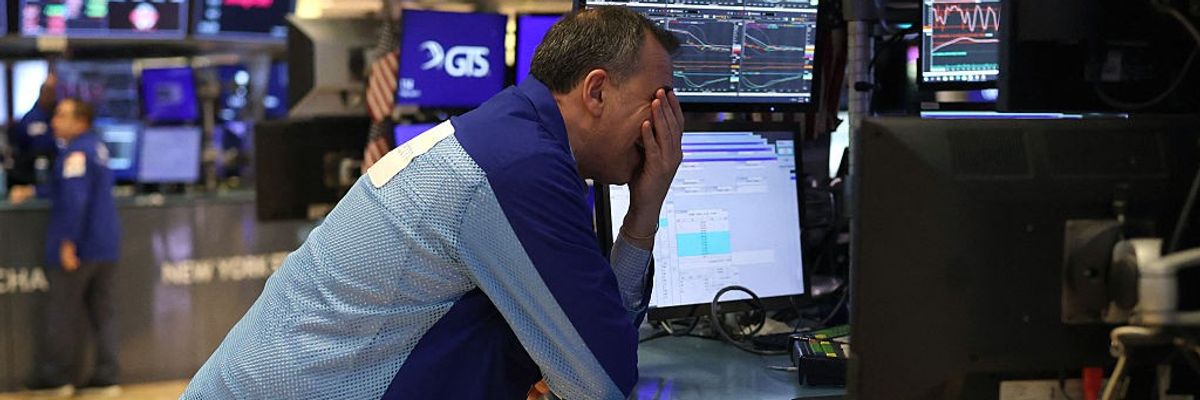
Traders work on the floor of the New York Stock Exchange (NYSE) in New York City, on April 4, 2025.
When private corporations employ bait and switch advertising, Americans are rightfully indignant. Why should we accept similarly dishonest marketing by political entrepreneurs attempting to win elections?
Are Americans victims of political bait and switch? Immediate pain isn't what Republicans promised voters.
President Donald Trump promised immediate benefits, much of it on "day one"—cheaper eggs, lower inflation, peace in Ukraine. The war rages on. Egg prices have increased. Inflation, fueled by tariffs, is on the way up. But stocks, including Americans' 401-K retirement accounts, are way down.
Mr. Trump is now saying that Americans will suffer pain, but that it will pave the way for long term gains: "Sometimes you have to take medicine to fix something."
When people invest, they personally bear the costs of their better future—a lower short-run standard of living. The current national "investment" is being made at other people's expense, not at the personal expense of our wealthy leaders.
The immediate pain is real, but the gains will come slowly if at all. "Reshoring" cannot be done overnight. It takes years to develop skilled workers, create supply chains, and build new factories.
New factories require investments, but with constantly changing rules investors cannot know whether new factories will be profitable.
Accepting less now in order to get a better future is a classical definition of investment. An individual could work but chooses further education, living on very little in order to earn a better future living. Instead of spending all our income, we buy stock or bonds, increasing our future purchasing power.
But when people invest, they personally bear the costs of their better future—a lower short-run standard of living. The current national "investment" is being made at other people's expense, not at the personal expense of our wealthy leaders.
Indeed there is speculation that some leaders, or friends with whom they shared inside information, became even more wealthy buying stock options minutes before the announcement of the 90-day tariff "postponement" set off a one-day surge in the markets.
There is now pain all around the country. Thousands of federal workers are losing their jobs. Projects around the country and world are being discontinued, causing additional unemployment. When people lose jobs, they also usually lose medical insurance.
There are threats to eliminate medical care for millions of other Americans. Research into disease treatments and avoidance of future epidemics is being reduced.
Reindustrialization—encouraged by tax reductions for the rich and tariffs—will supposedly produce benefits that will trickle down to the men and women in the street. But trickle down benefits have been doubtful in the past, and could well be pure "vaporware."
A more certain way to improve the economy would be to distribute dependable government benefits—jobs, research, health insurance, even cash—right now, and allow consumer expenditures to bubble up to benefit industries that cater to people's actual wishes.
Cutting taxes for the rich, or giving the rich more ability to cheat on their taxes by whacking the Internal Revenue Service enforcement budget, is trickle-down economics run wild.
These tax decreases for the wealthy will be partially paid for with income from higher tariffs. These tariffs will not be paid by foreigners, but by average Americans who purchase the imported goods. Tariffs are an indirect sales tax.
When private corporations employ bait and switch advertising, Americans are rightfully indignant and government regulators may try to outlaw it. Why should we accept similarly dishonest marketing by political entrepreneurs attempting to win elections?
Donald Trump clearly loves tariffs and would like to be considered a second President William McKinley—McKinley II. But the recent stock and bond market behavior, reflecting investors' cold-blooded analysis of Trump's policies, suggests that he could instead become Hoover II. (Republican President Herbert Hoover led the country into the Great Depression after signing a major increase in tariffs.)
Congressional Republicans should remember that, after Hoover, their party did not capture the White House again for 20 years. It was nearly that long before they again controlled Congress.
This is too bad. American political parties are both rife with bad ideas at the moment. Like Republicans, Democratic politicians have some bad ideas that need to be opposed by a responsible opposition party that can sometimes win elections.
Dear Common Dreams reader, It’s been nearly 30 years since I co-founded Common Dreams with my late wife, Lina Newhouser. We had the radical notion that journalism should serve the public good, not corporate profits. It was clear to us from the outset what it would take to build such a project. No paid advertisements. No corporate sponsors. No millionaire publisher telling us what to think or do. Many people said we wouldn't last a year, but we proved those doubters wrong. Together with a tremendous team of journalists and dedicated staff, we built an independent media outlet free from the constraints of profits and corporate control. Our mission has always been simple: To inform. To inspire. To ignite change for the common good. Building Common Dreams was not easy. Our survival was never guaranteed. When you take on the most powerful forces—Wall Street greed, fossil fuel industry destruction, Big Tech lobbyists, and uber-rich oligarchs who have spent billions upon billions rigging the economy and democracy in their favor—the only bulwark you have is supporters who believe in your work. But here’s the urgent message from me today. It's never been this bad out there. And it's never been this hard to keep us going. At the very moment Common Dreams is most needed, the threats we face are intensifying. We need your support now more than ever. We don't accept corporate advertising and never will. We don't have a paywall because we don't think people should be blocked from critical news based on their ability to pay. Everything we do is funded by the donations of readers like you. When everyone does the little they can afford, we are strong. But if that support retreats or dries up, so do we. Will you donate now to make sure Common Dreams not only survives but thrives? —Craig Brown, Co-founder |
Are Americans victims of political bait and switch? Immediate pain isn't what Republicans promised voters.
President Donald Trump promised immediate benefits, much of it on "day one"—cheaper eggs, lower inflation, peace in Ukraine. The war rages on. Egg prices have increased. Inflation, fueled by tariffs, is on the way up. But stocks, including Americans' 401-K retirement accounts, are way down.
Mr. Trump is now saying that Americans will suffer pain, but that it will pave the way for long term gains: "Sometimes you have to take medicine to fix something."
When people invest, they personally bear the costs of their better future—a lower short-run standard of living. The current national "investment" is being made at other people's expense, not at the personal expense of our wealthy leaders.
The immediate pain is real, but the gains will come slowly if at all. "Reshoring" cannot be done overnight. It takes years to develop skilled workers, create supply chains, and build new factories.
New factories require investments, but with constantly changing rules investors cannot know whether new factories will be profitable.
Accepting less now in order to get a better future is a classical definition of investment. An individual could work but chooses further education, living on very little in order to earn a better future living. Instead of spending all our income, we buy stock or bonds, increasing our future purchasing power.
But when people invest, they personally bear the costs of their better future—a lower short-run standard of living. The current national "investment" is being made at other people's expense, not at the personal expense of our wealthy leaders.
Indeed there is speculation that some leaders, or friends with whom they shared inside information, became even more wealthy buying stock options minutes before the announcement of the 90-day tariff "postponement" set off a one-day surge in the markets.
There is now pain all around the country. Thousands of federal workers are losing their jobs. Projects around the country and world are being discontinued, causing additional unemployment. When people lose jobs, they also usually lose medical insurance.
There are threats to eliminate medical care for millions of other Americans. Research into disease treatments and avoidance of future epidemics is being reduced.
Reindustrialization—encouraged by tax reductions for the rich and tariffs—will supposedly produce benefits that will trickle down to the men and women in the street. But trickle down benefits have been doubtful in the past, and could well be pure "vaporware."
A more certain way to improve the economy would be to distribute dependable government benefits—jobs, research, health insurance, even cash—right now, and allow consumer expenditures to bubble up to benefit industries that cater to people's actual wishes.
Cutting taxes for the rich, or giving the rich more ability to cheat on their taxes by whacking the Internal Revenue Service enforcement budget, is trickle-down economics run wild.
These tax decreases for the wealthy will be partially paid for with income from higher tariffs. These tariffs will not be paid by foreigners, but by average Americans who purchase the imported goods. Tariffs are an indirect sales tax.
When private corporations employ bait and switch advertising, Americans are rightfully indignant and government regulators may try to outlaw it. Why should we accept similarly dishonest marketing by political entrepreneurs attempting to win elections?
Donald Trump clearly loves tariffs and would like to be considered a second President William McKinley—McKinley II. But the recent stock and bond market behavior, reflecting investors' cold-blooded analysis of Trump's policies, suggests that he could instead become Hoover II. (Republican President Herbert Hoover led the country into the Great Depression after signing a major increase in tariffs.)
Congressional Republicans should remember that, after Hoover, their party did not capture the White House again for 20 years. It was nearly that long before they again controlled Congress.
This is too bad. American political parties are both rife with bad ideas at the moment. Like Republicans, Democratic politicians have some bad ideas that need to be opposed by a responsible opposition party that can sometimes win elections.
Are Americans victims of political bait and switch? Immediate pain isn't what Republicans promised voters.
President Donald Trump promised immediate benefits, much of it on "day one"—cheaper eggs, lower inflation, peace in Ukraine. The war rages on. Egg prices have increased. Inflation, fueled by tariffs, is on the way up. But stocks, including Americans' 401-K retirement accounts, are way down.
Mr. Trump is now saying that Americans will suffer pain, but that it will pave the way for long term gains: "Sometimes you have to take medicine to fix something."
When people invest, they personally bear the costs of their better future—a lower short-run standard of living. The current national "investment" is being made at other people's expense, not at the personal expense of our wealthy leaders.
The immediate pain is real, but the gains will come slowly if at all. "Reshoring" cannot be done overnight. It takes years to develop skilled workers, create supply chains, and build new factories.
New factories require investments, but with constantly changing rules investors cannot know whether new factories will be profitable.
Accepting less now in order to get a better future is a classical definition of investment. An individual could work but chooses further education, living on very little in order to earn a better future living. Instead of spending all our income, we buy stock or bonds, increasing our future purchasing power.
But when people invest, they personally bear the costs of their better future—a lower short-run standard of living. The current national "investment" is being made at other people's expense, not at the personal expense of our wealthy leaders.
Indeed there is speculation that some leaders, or friends with whom they shared inside information, became even more wealthy buying stock options minutes before the announcement of the 90-day tariff "postponement" set off a one-day surge in the markets.
There is now pain all around the country. Thousands of federal workers are losing their jobs. Projects around the country and world are being discontinued, causing additional unemployment. When people lose jobs, they also usually lose medical insurance.
There are threats to eliminate medical care for millions of other Americans. Research into disease treatments and avoidance of future epidemics is being reduced.
Reindustrialization—encouraged by tax reductions for the rich and tariffs—will supposedly produce benefits that will trickle down to the men and women in the street. But trickle down benefits have been doubtful in the past, and could well be pure "vaporware."
A more certain way to improve the economy would be to distribute dependable government benefits—jobs, research, health insurance, even cash—right now, and allow consumer expenditures to bubble up to benefit industries that cater to people's actual wishes.
Cutting taxes for the rich, or giving the rich more ability to cheat on their taxes by whacking the Internal Revenue Service enforcement budget, is trickle-down economics run wild.
These tax decreases for the wealthy will be partially paid for with income from higher tariffs. These tariffs will not be paid by foreigners, but by average Americans who purchase the imported goods. Tariffs are an indirect sales tax.
When private corporations employ bait and switch advertising, Americans are rightfully indignant and government regulators may try to outlaw it. Why should we accept similarly dishonest marketing by political entrepreneurs attempting to win elections?
Donald Trump clearly loves tariffs and would like to be considered a second President William McKinley—McKinley II. But the recent stock and bond market behavior, reflecting investors' cold-blooded analysis of Trump's policies, suggests that he could instead become Hoover II. (Republican President Herbert Hoover led the country into the Great Depression after signing a major increase in tariffs.)
Congressional Republicans should remember that, after Hoover, their party did not capture the White House again for 20 years. It was nearly that long before they again controlled Congress.
This is too bad. American political parties are both rife with bad ideas at the moment. Like Republicans, Democratic politicians have some bad ideas that need to be opposed by a responsible opposition party that can sometimes win elections.