SUBSCRIBE TO OUR FREE NEWSLETTER
Daily news & progressive opinion—funded by the people, not the corporations—delivered straight to your inbox.
5
#000000
#FFFFFF
To donate by check, phone, or other method, see our More Ways to Give page.
Daily news & progressive opinion—funded by the people, not the corporations—delivered straight to your inbox.
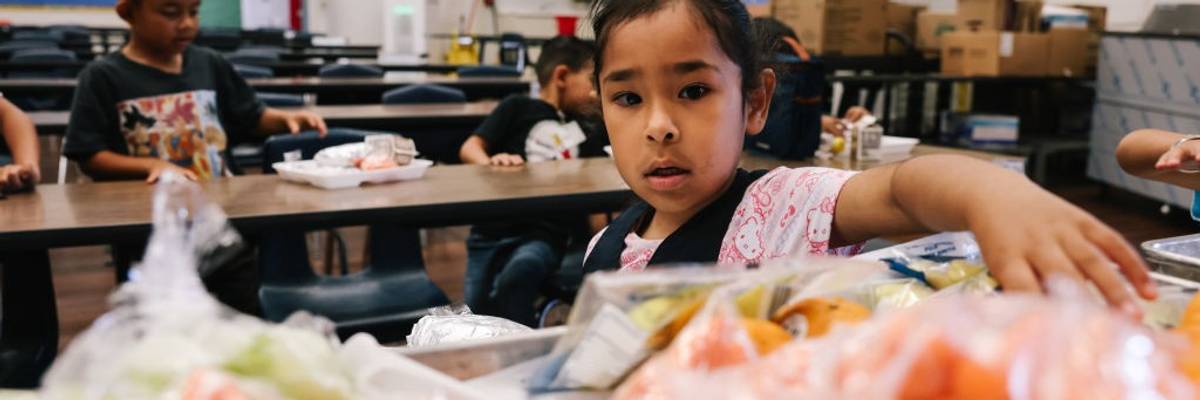
A girl reaches for vegetables during lunch inside the makeshift cafeteria at Wilson Elementary School in Los Angeles, California on July 1, 2024.
The Republican Party's proposed cuts to nutrition assistance for children, said one analyst, "would be part of legislation that would give massive tax cuts to the wealthiest people and businesses."
The Trump administration and Republicans in Congress are waging a multi-front war on nutrition benefits for children, with the U.S. Department of Agriculture moving this week to end programs that provided over $1 billion in funding for schools and charity organizations to buy food from local farmers as GOP lawmakers simultaneously take aim at school meal programs as part of an effort to fund tax breaks for the wealthy.
Schools and farmers are "bracing for impact," as The Washington Post put it, after the USDA axed the Local Food Purchase Assistance Cooperative Agreement Program and the Local Food for Schools Cooperative Agreement Program as part of a purported effort to "return to long-term, fiscally responsible initiatives."
The Local Food for Schools Program, according to the USDA, "no longer effectuates agency priorities."
The decision to kill the programs could be disastrous for schools, childcare facilities, and other organizations that were expecting federal funding this year. Politico observed that "roughly $660 million that schools and childcare facilities were counting on to purchase food from nearby farms" has been terminated by the Trump administration.
"Trump and Elon Musk have declared that feeding children and supporting local farmers are no longer 'priorities,'" Democratic Massachusetts Gov. Maura Healey said in a statement, noting that her state was set to receive $12.2 million "to provide local healthy food to childcare programs and schools, and to create new procurement relationships with local farmers and small businesses."
"Instead of strengthening our food supply chain and supporting students and food banks, the Trump White House wants cuts, chaos, and cruelty."
Rep. Shontel Brown (D-Ohio), vice ranking member of the House Agriculture Committee, said that "the Trump administration is proving to be bad for farmers, bad for children, and bad for people in need."
Food insecurity rose for the second consecutive year in 2024, and roughly 14 million children in the U.S. are food insecure, according to the nonprofit Feeding America.
"Instead of strengthening our food supply chain and supporting students and food banks, the Trump White House wants cuts, chaos, and cruelty," said Brown. "These two programs were a win-win for farmers and communities, and it is incredibly short-sighted to abruptly end them."
Congressional Republicans, meanwhile, are pushing for deep cuts to the Supplemental Nutrition Assistance Program and Medicaid that "could make it harder for schools to operate meal programs and for families to obtain free or reduced-price school meals, Summer EBT, or benefits through the Special Supplemental Nutrition Program for Women, Infants, and Children (WIC)."
That's according to an analysis published Wednesday by the Center on Budget and Policy Priorities (CBPP), which noted that "school meal programs and Summer EBT use SNAP and Medicaid data to automatically enroll children."
"If low-income families with children lose their SNAP and/or Medicaid benefits, they would have to complete a school meal application instead of being automatically enrolled," CBPP warned. "In addition to diminished access to meals during the school year, families who are unable to successfully navigate the application process would no longer be automatically enrolled in Summer EBT. Families with children who lose SNAP and/or Medicaid would also lose their adjunctive income eligibility for WIC."
Zoë Neuberger, a senior fellow at CBPP, said that "as families struggle to keep up with the rising cost of food, Republicans in Congress are looking at making it harder for millions of children in families with low incomes to get free meals at school."
"Worse yet, the proposed cuts would be part of legislation that would give massive tax cuts to the wealthiest people and businesses," said Neuberger. "Congress should instead focus on removing red tape for schools and families so parents can afford groceries and children can get the meals they need for healthy development."
The School Nutrition Association (SNA), a national nonprofit whose members help provide meals to schools across the U.S., is sounding the alarm about three specific proposals that Republicans are weighing as they craft their sprawling reconciliation package:
"These proposals would cause millions of children to lose access to free school meals at a time when working families are struggling with rising food costs," SNA president Shannon Gleave warned in a statement earlier this week. "Meanwhile, short-staffed school nutrition teams, striving to improve menus and expand scratch-cooking, would be saddled with time-consuming and costly paperwork created by new government inefficiencies."
Dear Common Dreams reader, It’s been nearly 30 years since I co-founded Common Dreams with my late wife, Lina Newhouser. We had the radical notion that journalism should serve the public good, not corporate profits. It was clear to us from the outset what it would take to build such a project. No paid advertisements. No corporate sponsors. No millionaire publisher telling us what to think or do. Many people said we wouldn't last a year, but we proved those doubters wrong. Together with a tremendous team of journalists and dedicated staff, we built an independent media outlet free from the constraints of profits and corporate control. Our mission has always been simple: To inform. To inspire. To ignite change for the common good. Building Common Dreams was not easy. Our survival was never guaranteed. When you take on the most powerful forces—Wall Street greed, fossil fuel industry destruction, Big Tech lobbyists, and uber-rich oligarchs who have spent billions upon billions rigging the economy and democracy in their favor—the only bulwark you have is supporters who believe in your work. But here’s the urgent message from me today. It's never been this bad out there. And it's never been this hard to keep us going. At the very moment Common Dreams is most needed, the threats we face are intensifying. We need your support now more than ever. We don't accept corporate advertising and never will. We don't have a paywall because we don't think people should be blocked from critical news based on their ability to pay. Everything we do is funded by the donations of readers like you. When everyone does the little they can afford, we are strong. But if that support retreats or dries up, so do we. Will you donate now to make sure Common Dreams not only survives but thrives? —Craig Brown, Co-founder |
The Trump administration and Republicans in Congress are waging a multi-front war on nutrition benefits for children, with the U.S. Department of Agriculture moving this week to end programs that provided over $1 billion in funding for schools and charity organizations to buy food from local farmers as GOP lawmakers simultaneously take aim at school meal programs as part of an effort to fund tax breaks for the wealthy.
Schools and farmers are "bracing for impact," as The Washington Post put it, after the USDA axed the Local Food Purchase Assistance Cooperative Agreement Program and the Local Food for Schools Cooperative Agreement Program as part of a purported effort to "return to long-term, fiscally responsible initiatives."
The Local Food for Schools Program, according to the USDA, "no longer effectuates agency priorities."
The decision to kill the programs could be disastrous for schools, childcare facilities, and other organizations that were expecting federal funding this year. Politico observed that "roughly $660 million that schools and childcare facilities were counting on to purchase food from nearby farms" has been terminated by the Trump administration.
"Trump and Elon Musk have declared that feeding children and supporting local farmers are no longer 'priorities,'" Democratic Massachusetts Gov. Maura Healey said in a statement, noting that her state was set to receive $12.2 million "to provide local healthy food to childcare programs and schools, and to create new procurement relationships with local farmers and small businesses."
"Instead of strengthening our food supply chain and supporting students and food banks, the Trump White House wants cuts, chaos, and cruelty."
Rep. Shontel Brown (D-Ohio), vice ranking member of the House Agriculture Committee, said that "the Trump administration is proving to be bad for farmers, bad for children, and bad for people in need."
Food insecurity rose for the second consecutive year in 2024, and roughly 14 million children in the U.S. are food insecure, according to the nonprofit Feeding America.
"Instead of strengthening our food supply chain and supporting students and food banks, the Trump White House wants cuts, chaos, and cruelty," said Brown. "These two programs were a win-win for farmers and communities, and it is incredibly short-sighted to abruptly end them."
Congressional Republicans, meanwhile, are pushing for deep cuts to the Supplemental Nutrition Assistance Program and Medicaid that "could make it harder for schools to operate meal programs and for families to obtain free or reduced-price school meals, Summer EBT, or benefits through the Special Supplemental Nutrition Program for Women, Infants, and Children (WIC)."
That's according to an analysis published Wednesday by the Center on Budget and Policy Priorities (CBPP), which noted that "school meal programs and Summer EBT use SNAP and Medicaid data to automatically enroll children."
"If low-income families with children lose their SNAP and/or Medicaid benefits, they would have to complete a school meal application instead of being automatically enrolled," CBPP warned. "In addition to diminished access to meals during the school year, families who are unable to successfully navigate the application process would no longer be automatically enrolled in Summer EBT. Families with children who lose SNAP and/or Medicaid would also lose their adjunctive income eligibility for WIC."
Zoë Neuberger, a senior fellow at CBPP, said that "as families struggle to keep up with the rising cost of food, Republicans in Congress are looking at making it harder for millions of children in families with low incomes to get free meals at school."
"Worse yet, the proposed cuts would be part of legislation that would give massive tax cuts to the wealthiest people and businesses," said Neuberger. "Congress should instead focus on removing red tape for schools and families so parents can afford groceries and children can get the meals they need for healthy development."
The School Nutrition Association (SNA), a national nonprofit whose members help provide meals to schools across the U.S., is sounding the alarm about three specific proposals that Republicans are weighing as they craft their sprawling reconciliation package:
"These proposals would cause millions of children to lose access to free school meals at a time when working families are struggling with rising food costs," SNA president Shannon Gleave warned in a statement earlier this week. "Meanwhile, short-staffed school nutrition teams, striving to improve menus and expand scratch-cooking, would be saddled with time-consuming and costly paperwork created by new government inefficiencies."
The Trump administration and Republicans in Congress are waging a multi-front war on nutrition benefits for children, with the U.S. Department of Agriculture moving this week to end programs that provided over $1 billion in funding for schools and charity organizations to buy food from local farmers as GOP lawmakers simultaneously take aim at school meal programs as part of an effort to fund tax breaks for the wealthy.
Schools and farmers are "bracing for impact," as The Washington Post put it, after the USDA axed the Local Food Purchase Assistance Cooperative Agreement Program and the Local Food for Schools Cooperative Agreement Program as part of a purported effort to "return to long-term, fiscally responsible initiatives."
The Local Food for Schools Program, according to the USDA, "no longer effectuates agency priorities."
The decision to kill the programs could be disastrous for schools, childcare facilities, and other organizations that were expecting federal funding this year. Politico observed that "roughly $660 million that schools and childcare facilities were counting on to purchase food from nearby farms" has been terminated by the Trump administration.
"Trump and Elon Musk have declared that feeding children and supporting local farmers are no longer 'priorities,'" Democratic Massachusetts Gov. Maura Healey said in a statement, noting that her state was set to receive $12.2 million "to provide local healthy food to childcare programs and schools, and to create new procurement relationships with local farmers and small businesses."
"Instead of strengthening our food supply chain and supporting students and food banks, the Trump White House wants cuts, chaos, and cruelty."
Rep. Shontel Brown (D-Ohio), vice ranking member of the House Agriculture Committee, said that "the Trump administration is proving to be bad for farmers, bad for children, and bad for people in need."
Food insecurity rose for the second consecutive year in 2024, and roughly 14 million children in the U.S. are food insecure, according to the nonprofit Feeding America.
"Instead of strengthening our food supply chain and supporting students and food banks, the Trump White House wants cuts, chaos, and cruelty," said Brown. "These two programs were a win-win for farmers and communities, and it is incredibly short-sighted to abruptly end them."
Congressional Republicans, meanwhile, are pushing for deep cuts to the Supplemental Nutrition Assistance Program and Medicaid that "could make it harder for schools to operate meal programs and for families to obtain free or reduced-price school meals, Summer EBT, or benefits through the Special Supplemental Nutrition Program for Women, Infants, and Children (WIC)."
That's according to an analysis published Wednesday by the Center on Budget and Policy Priorities (CBPP), which noted that "school meal programs and Summer EBT use SNAP and Medicaid data to automatically enroll children."
"If low-income families with children lose their SNAP and/or Medicaid benefits, they would have to complete a school meal application instead of being automatically enrolled," CBPP warned. "In addition to diminished access to meals during the school year, families who are unable to successfully navigate the application process would no longer be automatically enrolled in Summer EBT. Families with children who lose SNAP and/or Medicaid would also lose their adjunctive income eligibility for WIC."
Zoë Neuberger, a senior fellow at CBPP, said that "as families struggle to keep up with the rising cost of food, Republicans in Congress are looking at making it harder for millions of children in families with low incomes to get free meals at school."
"Worse yet, the proposed cuts would be part of legislation that would give massive tax cuts to the wealthiest people and businesses," said Neuberger. "Congress should instead focus on removing red tape for schools and families so parents can afford groceries and children can get the meals they need for healthy development."
The School Nutrition Association (SNA), a national nonprofit whose members help provide meals to schools across the U.S., is sounding the alarm about three specific proposals that Republicans are weighing as they craft their sprawling reconciliation package:
"These proposals would cause millions of children to lose access to free school meals at a time when working families are struggling with rising food costs," SNA president Shannon Gleave warned in a statement earlier this week. "Meanwhile, short-staffed school nutrition teams, striving to improve menus and expand scratch-cooking, would be saddled with time-consuming and costly paperwork created by new government inefficiencies."