SUBSCRIBE TO OUR FREE NEWSLETTER
Daily news & progressive opinion—funded by the people, not the corporations—delivered straight to your inbox.
5
#000000
#FFFFFF
To donate by check, phone, or other method, see our More Ways to Give page.
Daily news & progressive opinion—funded by the people, not the corporations—delivered straight to your inbox.
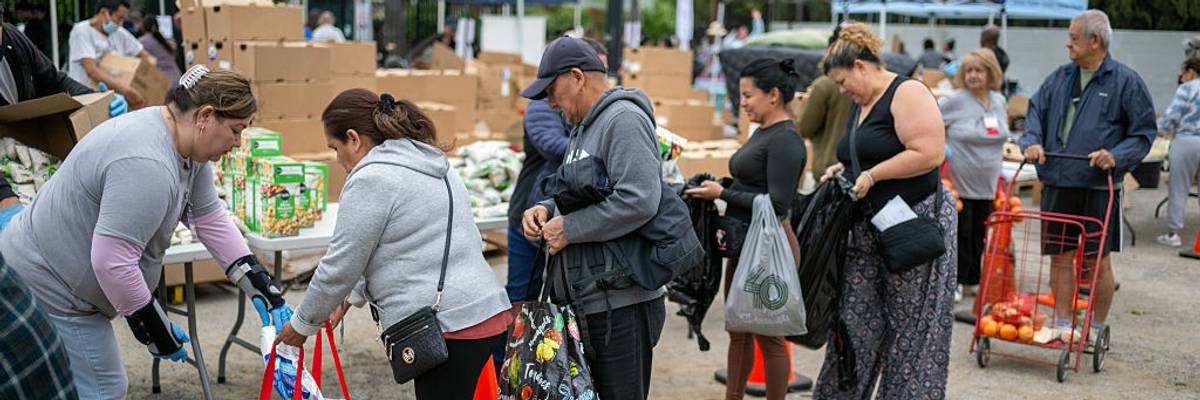
Volunteers hand out groceries in Van Nuys, California on May 5, 2025.
"First they slashed food aid, and now they are canceling the USDA’s decades-old food insecurity survey so no one can measure the harm," said one critic.
Two months after President Donald Trump enacted the biggest-ever cut to federal food assistance, his administration ended a key yearly report on food insecurity, drawing widespread condemnation Monday from critics who accused the president of once again trying to hide the harms of his policies.
The US Department of Agriculture (USDA) announced Saturday that it will stop publishing its annual Household Food Security reports, claiming that the surveys—which are the federal government's primary means of gauging hunger—"failed to present anything more than subjective, liberal fodder."
"These redundant, costly, politicized, and extraneous studies do nothing more than fear-monger," USDA added.
Experts warned that the USDA's move will make it more difficult to track the harmful effects. Critics say that's exactly the point.
"Step 1: Increase hunger with massive SNAP cuts, increase food prices with tariffs," Congresswoman Shontel Brown (D-Ohio) said Monday on social media, referring to the Supplemental Nutrition Assistance Program, commonly known as food stamps. "Step 2: Abruptly end USDA hunger report."
"The Trump administration doesn’t solve problems, it hides them," Brown added.
Congresswoman Ayanna Pressley (D-Mass.) also posted about the matter Monday, calling the USDA move "shameful and cowardly."
"Trump wants the USDA to stop collecting data on food insecurity because he knows hunger will spike after his Big, Ugly Bill kicks millions of families off food assistance," she wrote, referring to the One Big Beautiful Bill Act the president signed on July 4.
The legislation approved the deepest cuts to Medicaid and SNAP in history while slashing billions from other essential social programs to fund massive tax breaks for billionaires and corporations. The law ends health coverage and food assistance for millions of Americans at a time when more than 47 million Americans—including 1 in 5 US children—are living in food insecure households.
"As grocery prices rise and Republicans’ cuts to food assistance drive more families into food insecurity, President Trump wants to disguise these devastating effects from the public," Sen. Michael Bennet (D-Colo.) said Monday on social media. "This report is critical to our fight against hunger in America, and Trump has abandoned it just as he’s abandoned working families."
As Common Dreams has reported, food banks and other lifelines—many of them severely underresourced—are bracing for a surge in hunger resulting from the Republican cuts.
The USDA's move follows Trump's August 1 firing of former Bureau of Labor Statistics (BLS) Commissioner Erika McEntarfer, baselessly accusing her of manipulating economic data to harm him politically after the agency published a report showing only 73,000 jobs added to the economy the previous month.
On Friday, the BLS announced that it is postponing publication of an annual report on consumer spending by more than one month.
"Trump promised transparency and life-changing prosperity for families, but instead of keeping his promise, his administration is burying economic data," the liberal super political action committee American Bridge 21st Century said on social media on Monday. "When housing, food, and utility costs are rising faster than paychecks, hiding economic reports is an act of deception."
Dear Common Dreams reader, It’s been nearly 30 years since I co-founded Common Dreams with my late wife, Lina Newhouser. We had the radical notion that journalism should serve the public good, not corporate profits. It was clear to us from the outset what it would take to build such a project. No paid advertisements. No corporate sponsors. No millionaire publisher telling us what to think or do. Many people said we wouldn't last a year, but we proved those doubters wrong. Together with a tremendous team of journalists and dedicated staff, we built an independent media outlet free from the constraints of profits and corporate control. Our mission has always been simple: To inform. To inspire. To ignite change for the common good. Building Common Dreams was not easy. Our survival was never guaranteed. When you take on the most powerful forces—Wall Street greed, fossil fuel industry destruction, Big Tech lobbyists, and uber-rich oligarchs who have spent billions upon billions rigging the economy and democracy in their favor—the only bulwark you have is supporters who believe in your work. But here’s the urgent message from me today. It's never been this bad out there. And it's never been this hard to keep us going. At the very moment Common Dreams is most needed, the threats we face are intensifying. We need your support now more than ever. We don't accept corporate advertising and never will. We don't have a paywall because we don't think people should be blocked from critical news based on their ability to pay. Everything we do is funded by the donations of readers like you. When everyone does the little they can afford, we are strong. But if that support retreats or dries up, so do we. Will you donate now to make sure Common Dreams not only survives but thrives? —Craig Brown, Co-founder |
Two months after President Donald Trump enacted the biggest-ever cut to federal food assistance, his administration ended a key yearly report on food insecurity, drawing widespread condemnation Monday from critics who accused the president of once again trying to hide the harms of his policies.
The US Department of Agriculture (USDA) announced Saturday that it will stop publishing its annual Household Food Security reports, claiming that the surveys—which are the federal government's primary means of gauging hunger—"failed to present anything more than subjective, liberal fodder."
"These redundant, costly, politicized, and extraneous studies do nothing more than fear-monger," USDA added.
Experts warned that the USDA's move will make it more difficult to track the harmful effects. Critics say that's exactly the point.
"Step 1: Increase hunger with massive SNAP cuts, increase food prices with tariffs," Congresswoman Shontel Brown (D-Ohio) said Monday on social media, referring to the Supplemental Nutrition Assistance Program, commonly known as food stamps. "Step 2: Abruptly end USDA hunger report."
"The Trump administration doesn’t solve problems, it hides them," Brown added.
Congresswoman Ayanna Pressley (D-Mass.) also posted about the matter Monday, calling the USDA move "shameful and cowardly."
"Trump wants the USDA to stop collecting data on food insecurity because he knows hunger will spike after his Big, Ugly Bill kicks millions of families off food assistance," she wrote, referring to the One Big Beautiful Bill Act the president signed on July 4.
The legislation approved the deepest cuts to Medicaid and SNAP in history while slashing billions from other essential social programs to fund massive tax breaks for billionaires and corporations. The law ends health coverage and food assistance for millions of Americans at a time when more than 47 million Americans—including 1 in 5 US children—are living in food insecure households.
"As grocery prices rise and Republicans’ cuts to food assistance drive more families into food insecurity, President Trump wants to disguise these devastating effects from the public," Sen. Michael Bennet (D-Colo.) said Monday on social media. "This report is critical to our fight against hunger in America, and Trump has abandoned it just as he’s abandoned working families."
As Common Dreams has reported, food banks and other lifelines—many of them severely underresourced—are bracing for a surge in hunger resulting from the Republican cuts.
The USDA's move follows Trump's August 1 firing of former Bureau of Labor Statistics (BLS) Commissioner Erika McEntarfer, baselessly accusing her of manipulating economic data to harm him politically after the agency published a report showing only 73,000 jobs added to the economy the previous month.
On Friday, the BLS announced that it is postponing publication of an annual report on consumer spending by more than one month.
"Trump promised transparency and life-changing prosperity for families, but instead of keeping his promise, his administration is burying economic data," the liberal super political action committee American Bridge 21st Century said on social media on Monday. "When housing, food, and utility costs are rising faster than paychecks, hiding economic reports is an act of deception."
Two months after President Donald Trump enacted the biggest-ever cut to federal food assistance, his administration ended a key yearly report on food insecurity, drawing widespread condemnation Monday from critics who accused the president of once again trying to hide the harms of his policies.
The US Department of Agriculture (USDA) announced Saturday that it will stop publishing its annual Household Food Security reports, claiming that the surveys—which are the federal government's primary means of gauging hunger—"failed to present anything more than subjective, liberal fodder."
"These redundant, costly, politicized, and extraneous studies do nothing more than fear-monger," USDA added.
Experts warned that the USDA's move will make it more difficult to track the harmful effects. Critics say that's exactly the point.
"Step 1: Increase hunger with massive SNAP cuts, increase food prices with tariffs," Congresswoman Shontel Brown (D-Ohio) said Monday on social media, referring to the Supplemental Nutrition Assistance Program, commonly known as food stamps. "Step 2: Abruptly end USDA hunger report."
"The Trump administration doesn’t solve problems, it hides them," Brown added.
Congresswoman Ayanna Pressley (D-Mass.) also posted about the matter Monday, calling the USDA move "shameful and cowardly."
"Trump wants the USDA to stop collecting data on food insecurity because he knows hunger will spike after his Big, Ugly Bill kicks millions of families off food assistance," she wrote, referring to the One Big Beautiful Bill Act the president signed on July 4.
The legislation approved the deepest cuts to Medicaid and SNAP in history while slashing billions from other essential social programs to fund massive tax breaks for billionaires and corporations. The law ends health coverage and food assistance for millions of Americans at a time when more than 47 million Americans—including 1 in 5 US children—are living in food insecure households.
"As grocery prices rise and Republicans’ cuts to food assistance drive more families into food insecurity, President Trump wants to disguise these devastating effects from the public," Sen. Michael Bennet (D-Colo.) said Monday on social media. "This report is critical to our fight against hunger in America, and Trump has abandoned it just as he’s abandoned working families."
As Common Dreams has reported, food banks and other lifelines—many of them severely underresourced—are bracing for a surge in hunger resulting from the Republican cuts.
The USDA's move follows Trump's August 1 firing of former Bureau of Labor Statistics (BLS) Commissioner Erika McEntarfer, baselessly accusing her of manipulating economic data to harm him politically after the agency published a report showing only 73,000 jobs added to the economy the previous month.
On Friday, the BLS announced that it is postponing publication of an annual report on consumer spending by more than one month.
"Trump promised transparency and life-changing prosperity for families, but instead of keeping his promise, his administration is burying economic data," the liberal super political action committee American Bridge 21st Century said on social media on Monday. "When housing, food, and utility costs are rising faster than paychecks, hiding economic reports is an act of deception."