November, 05 2015, 10:45am EDT

For Immediate Release
Contact:
Tel: 020 7820 4900 (general enquiries) / 07711 875 345 (media enquiries)
Email: offleyroad@globaljustice.org.uk (general enquiries) / kevin.smith@globaljustice.org.uk (media enquiries)
TPP Text Released: "A Disaster for Jobs, and Environment and Our Democracy" say Campaigners
WASHINGTON
The release of the Trans Pacific Partnership (TPP) text - a giant trade and investment between 12 countries including the US and Japan - has led to claims by campaigns groups that the pact will cost jobs and represents 'a disaster for democracy.' The TPP is a parallel agreement to TTIP, the US-EU deal, which has met with serious opposition from across Europe.
Like TTIP, the TPP contains the controversial 'corporate court' mechanism, knows as Investor State Dispute Settlement (ISDS), which allows foreign corporations to sue governments for enacting public policy which impacts on corporate profits. It is strongly opposed by trade unions, who believe it will lead to offshoring of jobs and a reduction in working standards. Environmental campaigners say it risks fuelling climate change, while Wikileaks have shown that it will make whistleblowing and investigative journalism harder.
The text was not publicly available during the negotiations. Now US and other congresses have limited time to block ratification of the deal.
Nick Dearden, the director of Global Justice Now said:
"The TPP is a disaster for jobs, and environment and our democracy. It is the latest stage in the corporate capture of our society.
"TPP has less to do with selling more goods, than with rewriting the rules of the global economy is favour of big business. Like the North American Free Trade Agreement (NAFTA), 20 years ago, it will be very good for the very richest, and a disaster for everything and everyone else. NAFTA entrenched inequality and caused massive job losses in the USA, and TPP is turbo-charged NAFTA.
"The good news is this can still be stopped. We'll be doing all we can to support the huge swathe of trade unions, campaigners, activists and consumer groups in all those countries fighting TPP in the coming months."
Global Justice Now is a democratic social justice organisation working as part of a global movement to challenge the powerful and create a more just and equal world. We mobilise people in the UK for change, and act in solidarity with those fighting injustice, particularly in the global south.
020 7820 4900LATEST NEWS
'It Needs to End. Now': Trump and Allies Ripped for Lying to Dodge Iran War Powers Deadline
"Republicans are out of excuses and should join Democrats and stop this war," said one congressional Democrat. "Let's put the pressure on."
May 01, 2026
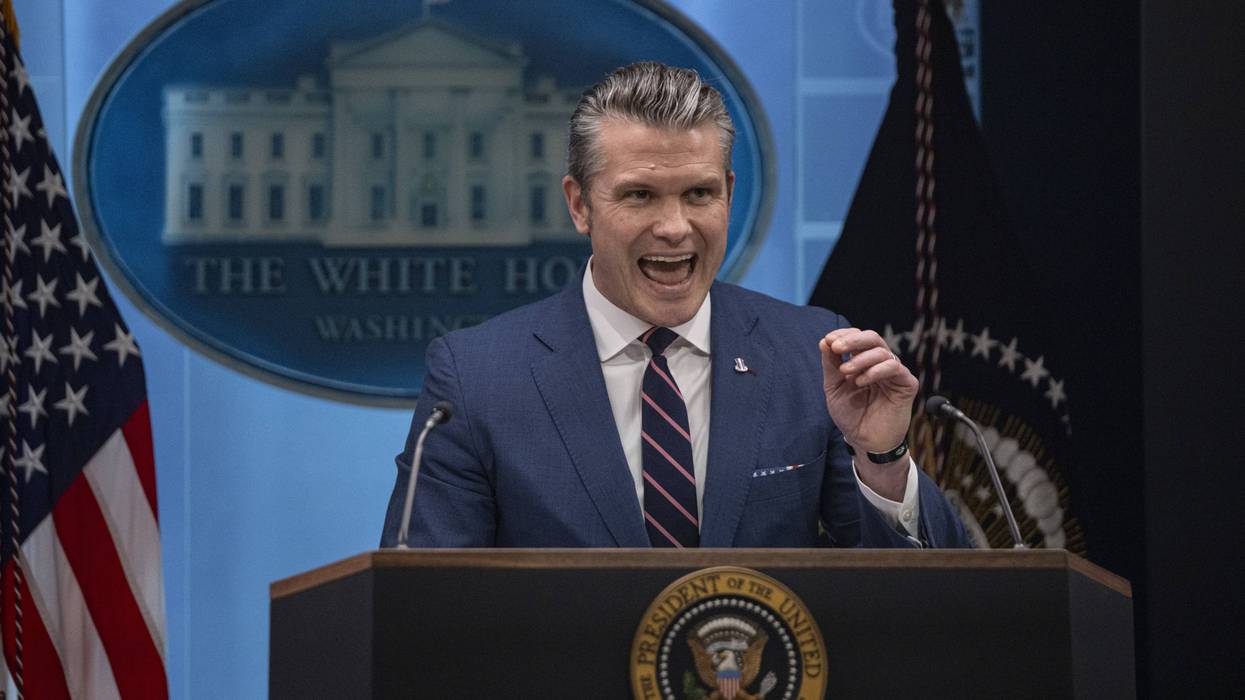
Friday marks 60 days since President Donald Trump formally notified Congress of the US and Israel's illegal war on Iran. However, on the eve of that key deadline under a relevant federal law, the president and other top Republicans claimed that the United States isn't, in fact, at war.
"Look, the country's doing really well, and that's despite a military operation—I don't call it a war," Trump, a well-documented liar, told reporters in the Oval Office on Thursday. "Iran is dying to make a deal."
Since Trump began bombing Iran on February 28, legal experts and US lawmakers have alleged violations of international law and the Constitution, which empowers only Congress to declare war. However, both chambers are narrowly controlled by Republicans, nearly all of whom have refused to support Democratic war powers resolutions intended to end the conflict, most recently in the Senate on Thursday.
Defenders of Trump's so-called "Operation Epic Fury" argue that he was allowed to strike Iran under the War Powers Act of 1973, which empowers the president to deploy military forces for up to 60 days as long as he notifies Congress within 48 hours. After those two months, he is required to end hostilities or seek permission from federal lawmakers to continue them.
"He seems set against doing so," Tess Bridgeman and Oona A. Hathaway wrote Friday for Just Security. "If he refuses, he will take a war that is already doubly illegal and turn it into a triply illegal war. He will also make it clear, if it was not already, that he regards the law as no constraint on his use of the US military's lethal power."
On Thursday, as the latest Senate resolution was blocked in a 47-50 vote, Trump allies joined the president in suggesting that, as House Speaker Mike Johnson (R-La.) told NBC News in the Capitol, "We are not at war."
"I don't think we have an active, kinetic military bombing, firing, or anything like that. Right now, we are trying to broker a peace," Johnson said. "I would be very reluctant to get in front of the administration in the midst of these very sensitive negotiations, so we'll have to see how that plays out."
The US and Iran agreed to a two-week ceasefire on April 7, just hours after Trump's genocidal threat to wipe out the Middle Eastern country's "whole civilization." That truce has since been extended, but it and another deal for Israel's supposed targeting of Hezbollah in Lebanon are both "fragile, temporary, and in danger of collapse at any moment," as Amnesty International stressed in a Wednesday statement calling on the international community to push for sustainable peace in the region.
Throughout the ceasefire, Trump has maintained his naval blockade on Iran, which has responded to the war by closing the Strait of Hormuz to most ship traffic. Restrictions on the trade route have driven up fuel prices around the world, including across the United States, where new polling shows that over 60% of Americans say the president's war was a "mistake."
US Secretary of Defense Pete Hegseth cited the ceasefire on Thursday when questioned about how the administration plans to address the 60-day deadline by Sen. Tim Kaine (D-Va.)—a leading voice for war powers resolutions on Iran and other military aggression by the administration—during a Senate Armed Services Committee hearing.
Hegseth said that "ultimately, I would defer to the White House and White House counsel on that. However, we are in a ceasefire right now, which, [in] our understanding, means the 60-day clock pauses, or stops, in a ceasefire."
Interjecting, Kaine responded that "I do not believe the statute would support that. I think the 60 days runs maybe tomorrow, and it's gonna pose a really important legal question for the administration. We have serious constitutional concerns and we don't want to layer those with additional statutory concerns."
A senior Trump administration official on Friday affirmed that what Hegseth laid out is the official White House position, telling Reuters that the US military and Iran have not exchanged fire since April 7 and, for War Powers Act purposes, "the hostilities that began on Saturday, February 28, have terminated."
Highlighting Trump's ongoing blockade of Iran, US Rep. Mike Levin (D-Calif.) called Hegseth "flat wrong," and declared that the Pentagon chief "does not get to rewrite the law because following it is inconvenient."
Another California Democrat, Rep. Sara Jacobs, said on social media Thursday: "Trump's war on Iran was illegal from day one—Congress never authorized it. Tomorrow, the statutory 60-day clock runs out too. Republicans are out of excuses and should join Democrats and stop this war. Let's put the pressure on."
In a video released Friday, Rep. Don Beyer (D-Va.) noted his role in the Obama administration's Iran nuclear deal—which Trump ditched during his first term—and emphasized the president's "legal obligation to withdraw troops after 60 days, or come to Congress for authorization."
Democrats have vowed to keep introducing war powers resolutions. As one went down in the Senate on Thursday, Rep. Becca Balint (D-Vt.) introduced another in the House, following in the footsteps of other Congressional Progressive Caucus members.
"Americans don't even know why we are in this war, and neither does Congress," Balint said in a statement. "This unauthorized war is yet another example of the Trump administration's brazen and illegal attempts to consolidate power. At a time when Americans have told us everything is too expensive, it is shameful that we are wasting upwards of a billion dollars a day on this."
"We need it to end, to bring our service members back to safety, and to get Congress and this administration to focus on lowering the cost of living here at home," she added. "Today, I introduced a war powers resolution which would direct the president to stop the use of US armed forces in Iran unless explicitly authorized by a declaration of war from Congress. It is essential to hold every member of Congress accountable for allowing this war to continue and put them on record for the American people to see."
Keep ReadingShow Less
61% of Americans See Trump's Iran War as 'Mistake', Far Outpacing Disapproval of Vietnam and Iraq: Poll
"In Iraq, it took more than three years to reach that high. In Vietnam, it took six years."
May 01, 2026
More than 6 in 10 Americans now say President Donald Trump's war in Iran was a "mistake," according to a poll out Friday from the Washington Post/ABC News/Ipsos.
Within two months, the war—which has inflicted thousands of civilian deaths and caused gas prices to spike worldwide with little tangible gain—has reached levels of unpopularity that previous wars now seen as historic boondoggles took years to reach.
The Post has asked the "mistake" for other major wars. But CNN senior political reporter Aaron Blake explained: "In Iraq, it took more than three years to reach that high. In Vietnam, it took six years."
Despite a massive protest movement, voters overwhelmingly supported President George W. Bush's decision to invade Iraq, with 81% believing it was the "right thing" in April 2003 and just 16% believing it was a mistake.
But the occupation turned into a long, deadly, and costly disaster, and the administration's pretexts for the war were revealed to be lies. Public opinion steadily eroded to the point where 64% viewed it as a mistake by January 2007.
Vietnam never had the overwhelming support of Iraq, but 60% of Americans still supported President Lyndon Johnson's decision to begin direct US military involvement in 1965, while just 24% said it was a mistake.
While the protest movement against the war is as present in Americans' memories today as the conflict itself, public opinion was still split until 1968 and only reached a high of 61% in May 1971, after more than 50,000 US soldiers had been killed in battle.
Trump's war in Iran is unique in history in that it never enjoyed even a moment of consensus support. In a Reuters/Ipsos poll just days after the opening salvo of what the Trump administration dubbed "Operation Epic Fury," just 27% said they approved of the strikes, which killed 555 Iranians, including Supreme Leader Ayatollah Ali Khamenei and several other top Iranian officials.
At this point, 43% of Americans already said they disapproved of the strikes, far eclipsing Iraq and Vietnam. But 30% still said they had not yet made up their minds.
In the coming months, they would. It was revealed that an airstrike on a school, which killed at least 155 people, including 120 children, was a double-tap attack by the United States. Iran retaliated by blocking oil shipments through the Strait of Hormuz, which sent US gas prices hurtling above $4 per gallon. And Trump took on an increasingly erratic and at times outright genocidal posture toward Iran that made any peaceful resolution appear increasingly impossible, even with the current fragile ceasefire.
Friday's poll shows that while the war still maintains a core base of support—36% of Americans who say it was the right decision, nearly all of them Republicans—it is dwarfed by the 61% who say it was a mistake.
Majorities of respondents across all demographics show that they believe the war has increased the risks of "terrorism against Americans" (61%), "the US economy going into a recession" (60%), and "weakening relationships with US allies." (56%)
Looking beneath the surface shows an even more worrying sign for Trump: The war has almost no constituency outside of his biggest fans. Self-identified Democrats (91%) overwhelmingly say the war was a mistake. But 71% of independents—many of whom were undecided at the war's outset—now disapprove too, with just 24% in support.
Even within the GOP, there is a decisive split: 86% of those who self-identify as "MAGA Republicans" are still baying for blood. But "non-MAGA Republicans" have grown uncertain—50% still say war was the right decision, while 49% say it was a mistake.
They were particularly rattled by Trump's threat last month that "a whole civilization will die tonight" if Iran did not negotiate a deal to his liking. The threat of genocide was too much even for the majority of Republicans, 53% of whom said they viewed it negatively.
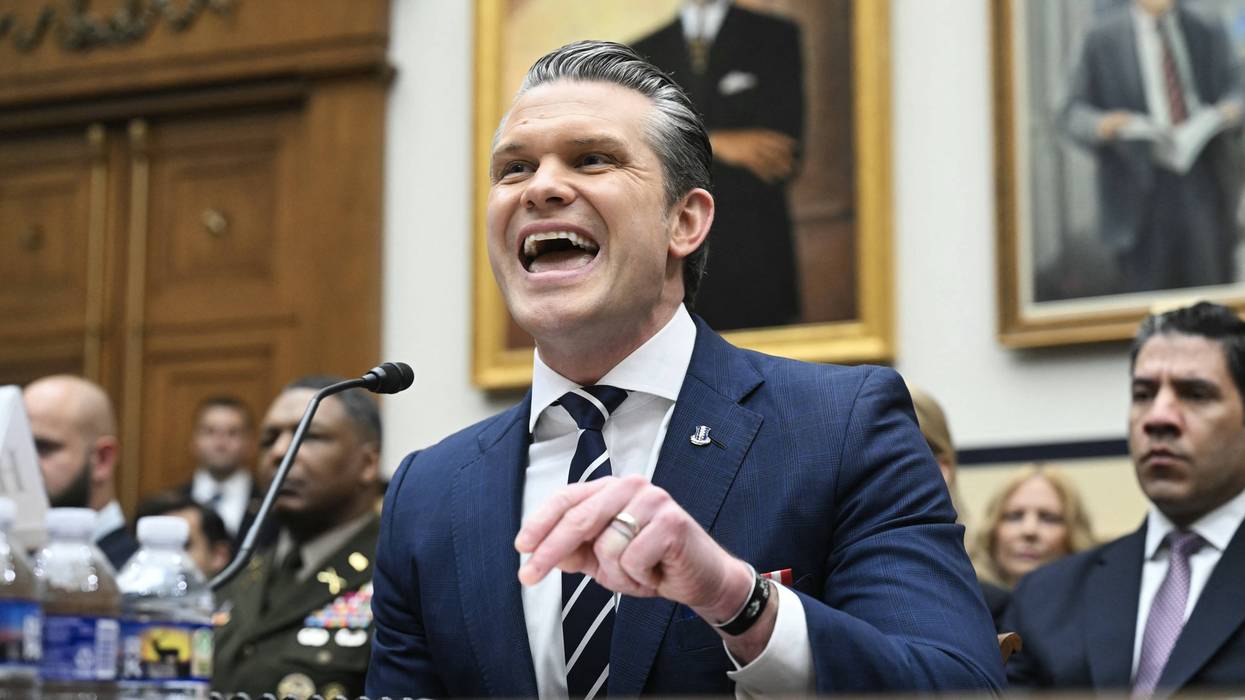
What remains to be seen is whether even Trump's most faithful backers will turn against the war as it drags on. If Defense Secretary Pete Hegseth's appearance in Congress on Thursday is any guide, the country may soon find out.
On Thursday, when Sen. Kirsten Gillibrand (D-NY) pressed Hegseth about why he has "not sought the support of the American people" and added that "3 out of 5 Americans are against this war today," he appeared in abject denial about the war's unpopularity.
"I believe we do have the support of the American people," he said. "I would remind you and this group that we're two months in to an effort, and many congressional Democrats want to declare defeat two months in."
He specifically invoked lengthy past conflicts, repeatedly emphasizing that this one had only lasted "two months," as if to urge patience with a war Trump had previously said was intended to last only "four to five weeks."
"Iraq took how many years? Afghanistan took how many years? And they were nebulous missions that people went along with," he said.
"This is different," he said of a war that has—depending on the day—been described as one aimed at regime change in Iran, defending protesters, destroying its nuclear program, eliminating its ballistic missile supply, taking its oil, defending Israel, and reopening the Strait of Hormuz, among other objectives.
Keep ReadingShow Less
May Day Demonstrations Worldwide Condemn US-Israeli War on Iran, Champion Workers
"Working people refuse to pay the price for Donald Trump’s war in the Middle East," said the European Trade Confederation.
May 01, 2026
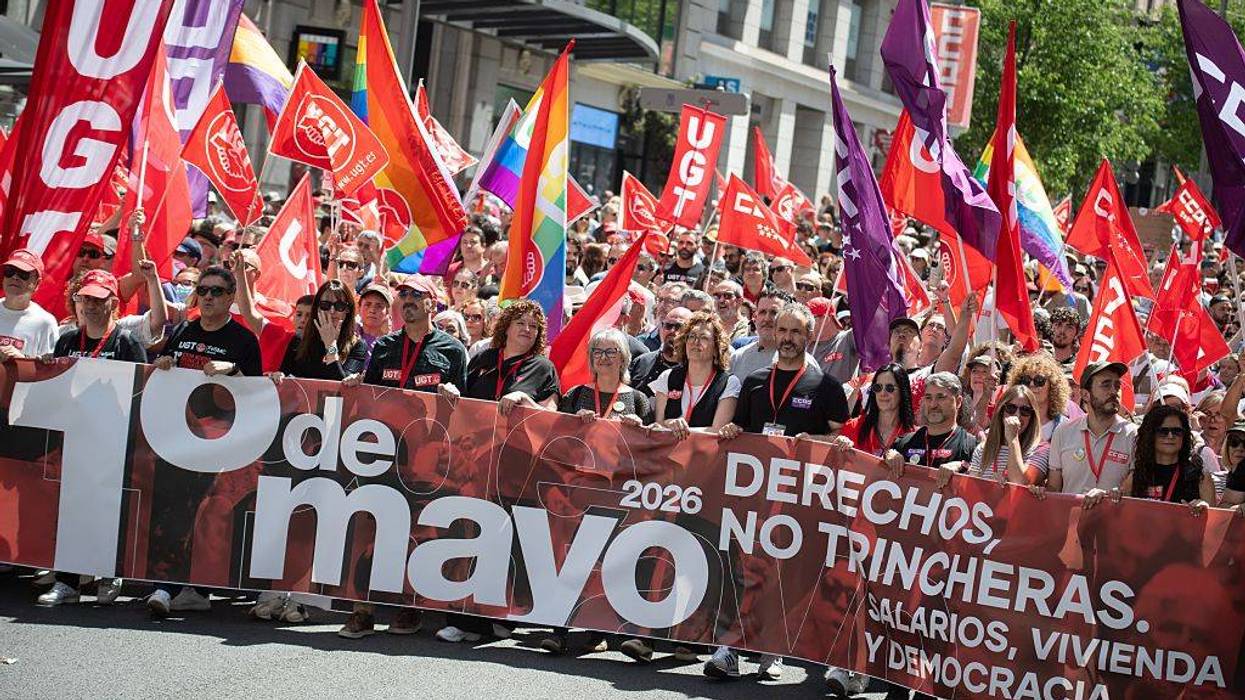
May Day demonstrations across the world on Friday denounced the US-Israeli war against Iran, which has caused a global energy crisis that is disproportionately harming working-class people.
Among the earliest May Day demonstrations took place in the Philippines, and a video published by The Associated Press shows protesters clashing with police near the US Embassy in the capital city of Manila.
While many demonstrators held signs that referenced local issues, American foreign policy was also a major focus of the protesters, as marchers in Manila carried a large banner that read, "Down With US Imperialism."
Josua Mata, leader of the SENTRO umbrella group of labor federations, told The Associated Press that the war with Iran was a central focus of protests because of the impact it's had on energy costs.
"Every Filipino worker now is aware that the situation here is deeply connected to the global crisis," Mata explained.
Indonesian President Prabowo Subianto attended a May Day rally held in the capital of Jakarta, where Jakarta Globe reported that he announced a host of worker-friendly policies including plans "to build daycare facilities for workers’ children and accelerate the construction of at least 1 million homes."
France 24 reported that hundreds of demonstrators in Istanbul, Turkey were arrested after attempting to march to the city's iconic Taksim Square, which police had sealed off.
The Turkish Contemporary Lawyers’ Association (ÇHD) said on Friday afternoon that at least 350 demonstrators in Istanbul have been detained as a result of the protests, with hundreds more potentially in custody.
May Day demonstrations are also taking place across Europe, with many demonstrators blaming US President Donald Trump's war for the deterioration of workers' living standards.
The European Trade Union Confederation, which represents 93 trade union organizations in 41 European countries, released a statement declaring that "working people refuse to pay the price for Donald Trump’s war in the Middle East," adding that "today’s rallies show working people will not stand by and see their jobs and living standards destroyed."
Trump is also facing protests at home, with more than 4,000 "May Day Strong" events planned across the United States.
Daniel Bertossa, general secretary for Public Services International, said this year's May Day demonstrations are providing a desperately needed backlash to power grabs being made by the global billionaire class.
Bertossa pointed to the US-Israel attack on Iran, as well as Trump's repeated threats to invade Greenland, as key turning points that have pushed workers to organize and fight back.
"Rising living costs caused by the war are now driving anger among working-class people and producing a rare and powerful moment to connect and educate," said Bertossa. "Fascists don't have the answers to the economic pain they exploited to get elected—international affairs impact us all—and international working-class solidarity matters."
Bertossa added that "May Day is a vivid reminder that working-class politics is not a spectator sport," and "we have never won by watching, waiting, or relying on great power leaders to gift us our future."
Keep ReadingShow Less
Most Popular