SUBSCRIBE TO OUR FREE NEWSLETTER
Daily news & progressive opinion—funded by the people, not the corporations—delivered straight to your inbox.
5
#000000
#FFFFFF
To donate by check, phone, or other method, see our More Ways to Give page.
Daily news & progressive opinion—funded by the people, not the corporations—delivered straight to your inbox.
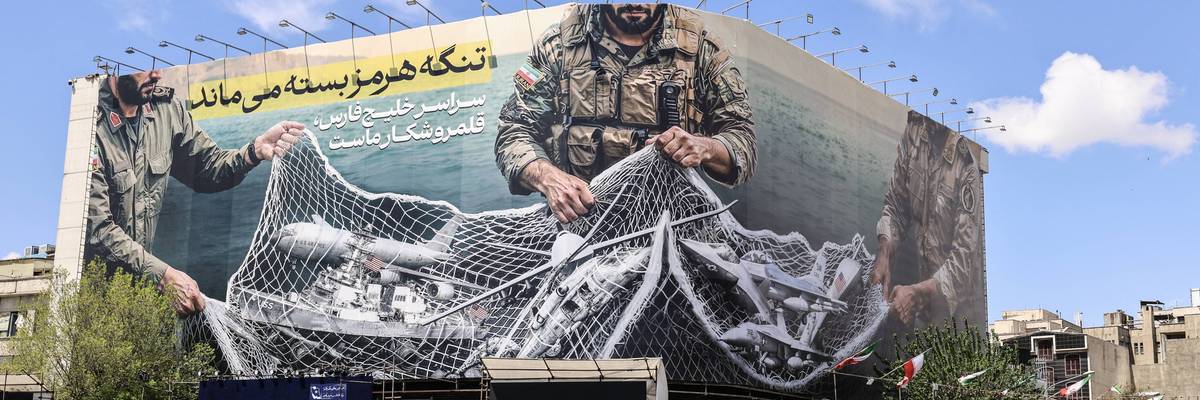
Vehicles drive past a large billboard reading "The Strait of Hormuz remains closed" as people gather in Tehran's Revolution Square after the United States and Iran agreed to a two-week ceasefire, on April 8, 2026. The United States and Iran agreed to a two-week ceasefire barely an hour before the US president's April 8 deadline to obliterate the country, triggering global relief alongside apprehension.
The Iranian government went 12 rounds with a genocidal Trump—and its people suffered a lot of punches—but the nation is still standing. That counts as a win and a massive failure for the United States..
Trump announced a two-week ceasefire on Tuesday, April 7, the 39th day of the Israeli-US war on Iran. He depended on Pakistani mediators and a 10-point peace plan put forward by Iran itself.
And so, Iran won the 2026 war.
It did not win as in, scoring a knockout. It won in the sense that if I went 12 rounds with Deontay Wilder and was still standing up at the end of it, it would count as a win.
The Israeli-US attempt to decapitate the government failed. Ayatollah Ali Khamenei was assassinated along with family members, but the 88-member clerical Assembly of Experts simply elected his son, Mojtaba Khamenei, to succeed him. The civilian minister of defense was killed, which is probably a war crime. President Masoud Pezeshkian appointed IRGC General Majid Ebnelreza as acting minister of defense. The pragmatic civilian Secretary of the National Security Council, Ali Larijani was assassinated, likely another war crime. He was succeeded by hard liner Mohammad Bagher Zolghadr, a former IRGC general. In essence, Trump and Netanyahu made an internal coup against Iran’s centrist pragmatists in government, ensuring that they were replaced by far right hard liners.
Going into the war, the Iranian government had just committed a massacre of thousands of protesters and was without a friend in the world. Trump and Netanyahu committed breathtaking war crimes on Iran and acted and spoke so monstrously that many countries ended up at least rhetorically supporting Iran, or at least opposing the war on it. Israel comes out of the war a pariah. The US is too rich, big and powerful to be a pariah but its standing has certainly plummeted and it can expect much less cooperation going forward.
Iran likely inflicted a billion dollars worth of damage on the 13 US military bases in the Middle East, most of which are largely destroyed. It used cheap little drones to take out radar installations in Kuwait and elsewhere worth hundreds of millions of dollars, blinding the US to its missile barrages and allowing some deadly strikes, as on Dimona in Israel. Iran demonstrated that having a US military base does not protect the host country but rather exposes it to greater danger. Most US military personnel appear to have had to flee the bases, relocating to local hotels. Iranian intelligence in the Gulf is good enough so that some of those hotels were attacked by drones. Some personnel arrived back in Washington D.C. with only the clothes on their back and Pete Hegseth doesn’t seem to have helped them much.
Whether Gulf states will want US bases in the medium to long term, after this, is now an open question. And are any US personnel at all left in Iraq? Iraqi Shiites supported Iran in the war.
Israeli military censorship makes it difficult to assess the damage to that country. The Haifa refinery was hit, as were military and intelligence research institutes. Netanyahu was clearly over-confident in Israeli interceptors. Many Israelis have had to move house to sleep in shelters. Moreover, Israel is running out of interceptors faster than Iran is running out of ballistic missiles, so that if the war continued, at some point Israel would be a sitting duck. If Israel actually does agree to abide by Trump’s two-week ceasefire, that is the reason–Israel is days from being completely vulnerable to Iran’s strikes. Already, Arrow interceptors are so low that Israel has had to let some missiles through if they seemed to be headed for relatively unpopulated areas. In that sense, Israel lost on points.
I have argued that the war failed not only because the government still stands but because its annual income from petroleum and new Strait of Hormuz tolls could be several times what it was earning from petroleum sales to China before the war. Petroleum prices are falling from highs because of the two-week ceasefire, which may or not signal the end of the war. But so much supply has been destroyed or delayed in the Gulf that prices could remain high in the coming year. Likely a third of the Gulf’s refining capacity has been damaged.
Trump has been forced to lift sanctions on Iranian petroleum. It is unclear whether, in the tight market of 2026, they can realistically be reimposed.
The Israeli-US aggression on Iran has taught it that it can use drone sabotage to extract tolls from ships crossing the Strait of Hormuz. It is difficult to see how that claim on fees can be reversed, since cheap drone strikes can always start fires on petroleum and Liquefied Natural Gas tankers. It is so expensive to erect an anti-drone system that it would be much cheaper just to pay the toll. Moreover, insurers would want a system that was 100% effective, which no anti-drone or anti-missile system is. Iran can’t be made to back off by threatening its oil rigs, since if they were hit Iran could take out the Saudi, UAE, Bahraini and Kuwaiti oil rigs and cripple the world’s energy. As it is, Iran did substantial damage to Kuwait oil fields and on Monday struck the Saudi petrochemical complex at Jubail, as well as taking out 17% of Qatar’s LNG production capacity at Ras Laffan.
Iran certainly suffered horribly during the 39-day Israeli-US campaign this spring. It lost on the order of 3,600 dead, including at least 1,665 civilians—babies and children (at least 200), women (at least 200) and over a thousand noncombatant men. Perhaps 20,000 Iranians have been wounded.
Other estimates for Iranians killed have ranged up to 6,000 but that may just be boasting by Israeli Prime Minister Benjamin Netanyahu and Whiskey Pete Hegseth, the secretary of weird tattoos and loud boasting.
Iran has seen important research institutes, university programs, steel mills, petrochemical complexes, and other economic and infrastructural sites destroyed. It is likely, however, that these can be rebuilt if Iran has convinced Israel that it has the means of deterrence. It is likely that Russia and China will help with the rebuilding, behind the scenes, because a strong Iran able to stand up to the US and its Israeli proxy is in their interests.
The Department of Defense alleges that it used 26 different aircraft, four land-based missile systems, and six sea-based weapons systems to hit some 13,000 targets inside Iran.
Some of these targets were civilian objects and so the Pentagon is boasting of war crimes of a sort for which Japanese and German generals were prosecuted after WW II.
I can’t find a separate count for Israeli strikes on Iran and I wonder if the Pentagon numbers are joint US and Israeli hits.
The Stars and Stripes reports that CENTCOM “said U.S. forces have hit Iranian command and control centers, Iranian Revolutionary Guard headquarters, and intelligence sites, ballistic missile launchers, drone batteries, and anti-ship and anti-aircraft sites. The attacks have also hit at least one major bridge near Tehran, the capital, as well as warehouses and bunkers used in manufacturing.”
The Iranian government, however, clearly did not lose command and control, and though perhaps 1200 Iranian Revolutionary Guards Corps (IRGC) personnel and officers were killed, there were plenty to take their place. The IRGC is thought to have between 125,000 and 190,000 active personnel. The IRGC could be analogized to the US National Guards Corps. Iran also has a conventional standing army of 400,000. Although it is impossible to know the exact number, there may be an additional 400,000 to 800,000 members of the local neighborhood militiamen and regime enforcers known as the basij. The way rank works is that if you kill a general, a colonel is promoted to take his place. Iran’s military has seen a lot of promotions, but no collapse.
The attacks by the US and Israel on IRGC, police and basij buildings do not appear to have weakened the government of the Islamic Republic of Iran in any measurable way. Indeed, these institutions probably gained some authority by standing up to foreign attackers.
Apparently large numbers of the US and Israeli strikes on supposed missile launchers, missiles and drones hit cleverly disguised decoys. So the 13,000 targeted sites begin to seem less impressive if a lot of them just stirred up sand and destroyed Papier-mâché “missile” “launchers.”
Iran ends the war with as many as 1,000 of its ballistic missiles intact, having begun with 2,500. The US and Israeli strikes were therefore remarkably ineffective, since surely Iran fired a good thousand missiles at Israel and neighboring Gulf states. Since one of the key goals of Israel and the US was to take out Iran’s ballistic missiles, they failed. They only appear to have destroyed half of the ballistic missile launchers in Iran.
Iran also likely still has tens of thousands of Shahed drones.
It is a pyrrhic victory in many ways, since Iran has new enemies among its neighbors and it has lost industrial capacity. But it is a victory of sorts.
Dear Common Dreams reader, It’s been nearly 30 years since I co-founded Common Dreams with my late wife, Lina Newhouser. We had the radical notion that journalism should serve the public good, not corporate profits. It was clear to us from the outset what it would take to build such a project. No paid advertisements. No corporate sponsors. No millionaire publisher telling us what to think or do. Many people said we wouldn't last a year, but we proved those doubters wrong. Together with a tremendous team of journalists and dedicated staff, we built an independent media outlet free from the constraints of profits and corporate control. Our mission has always been simple: To inform. To inspire. To ignite change for the common good. Building Common Dreams was not easy. Our survival was never guaranteed. When you take on the most powerful forces—Wall Street greed, fossil fuel industry destruction, Big Tech lobbyists, and uber-rich oligarchs who have spent billions upon billions rigging the economy and democracy in their favor—the only bulwark you have is supporters who believe in your work. But here’s the urgent message from me today. It's never been this bad out there. And it's never been this hard to keep us going. At the very moment Common Dreams is most needed, the threats we face are intensifying. We need your support now more than ever. We don't accept corporate advertising and never will. We don't have a paywall because we don't think people should be blocked from critical news based on their ability to pay. Everything we do is funded by the donations of readers like you. When everyone does the little they can afford, we are strong. But if that support retreats or dries up, so do we. Will you donate now to make sure Common Dreams not only survives but thrives? —Craig Brown, Co-founder |
Trump announced a two-week ceasefire on Tuesday, April 7, the 39th day of the Israeli-US war on Iran. He depended on Pakistani mediators and a 10-point peace plan put forward by Iran itself.
And so, Iran won the 2026 war.
It did not win as in, scoring a knockout. It won in the sense that if I went 12 rounds with Deontay Wilder and was still standing up at the end of it, it would count as a win.
The Israeli-US attempt to decapitate the government failed. Ayatollah Ali Khamenei was assassinated along with family members, but the 88-member clerical Assembly of Experts simply elected his son, Mojtaba Khamenei, to succeed him. The civilian minister of defense was killed, which is probably a war crime. President Masoud Pezeshkian appointed IRGC General Majid Ebnelreza as acting minister of defense. The pragmatic civilian Secretary of the National Security Council, Ali Larijani was assassinated, likely another war crime. He was succeeded by hard liner Mohammad Bagher Zolghadr, a former IRGC general. In essence, Trump and Netanyahu made an internal coup against Iran’s centrist pragmatists in government, ensuring that they were replaced by far right hard liners.
Going into the war, the Iranian government had just committed a massacre of thousands of protesters and was without a friend in the world. Trump and Netanyahu committed breathtaking war crimes on Iran and acted and spoke so monstrously that many countries ended up at least rhetorically supporting Iran, or at least opposing the war on it. Israel comes out of the war a pariah. The US is too rich, big and powerful to be a pariah but its standing has certainly plummeted and it can expect much less cooperation going forward.
Iran likely inflicted a billion dollars worth of damage on the 13 US military bases in the Middle East, most of which are largely destroyed. It used cheap little drones to take out radar installations in Kuwait and elsewhere worth hundreds of millions of dollars, blinding the US to its missile barrages and allowing some deadly strikes, as on Dimona in Israel. Iran demonstrated that having a US military base does not protect the host country but rather exposes it to greater danger. Most US military personnel appear to have had to flee the bases, relocating to local hotels. Iranian intelligence in the Gulf is good enough so that some of those hotels were attacked by drones. Some personnel arrived back in Washington D.C. with only the clothes on their back and Pete Hegseth doesn’t seem to have helped them much.
Whether Gulf states will want US bases in the medium to long term, after this, is now an open question. And are any US personnel at all left in Iraq? Iraqi Shiites supported Iran in the war.
Israeli military censorship makes it difficult to assess the damage to that country. The Haifa refinery was hit, as were military and intelligence research institutes. Netanyahu was clearly over-confident in Israeli interceptors. Many Israelis have had to move house to sleep in shelters. Moreover, Israel is running out of interceptors faster than Iran is running out of ballistic missiles, so that if the war continued, at some point Israel would be a sitting duck. If Israel actually does agree to abide by Trump’s two-week ceasefire, that is the reason–Israel is days from being completely vulnerable to Iran’s strikes. Already, Arrow interceptors are so low that Israel has had to let some missiles through if they seemed to be headed for relatively unpopulated areas. In that sense, Israel lost on points.
I have argued that the war failed not only because the government still stands but because its annual income from petroleum and new Strait of Hormuz tolls could be several times what it was earning from petroleum sales to China before the war. Petroleum prices are falling from highs because of the two-week ceasefire, which may or not signal the end of the war. But so much supply has been destroyed or delayed in the Gulf that prices could remain high in the coming year. Likely a third of the Gulf’s refining capacity has been damaged.
Trump has been forced to lift sanctions on Iranian petroleum. It is unclear whether, in the tight market of 2026, they can realistically be reimposed.
The Israeli-US aggression on Iran has taught it that it can use drone sabotage to extract tolls from ships crossing the Strait of Hormuz. It is difficult to see how that claim on fees can be reversed, since cheap drone strikes can always start fires on petroleum and Liquefied Natural Gas tankers. It is so expensive to erect an anti-drone system that it would be much cheaper just to pay the toll. Moreover, insurers would want a system that was 100% effective, which no anti-drone or anti-missile system is. Iran can’t be made to back off by threatening its oil rigs, since if they were hit Iran could take out the Saudi, UAE, Bahraini and Kuwaiti oil rigs and cripple the world’s energy. As it is, Iran did substantial damage to Kuwait oil fields and on Monday struck the Saudi petrochemical complex at Jubail, as well as taking out 17% of Qatar’s LNG production capacity at Ras Laffan.
Iran certainly suffered horribly during the 39-day Israeli-US campaign this spring. It lost on the order of 3,600 dead, including at least 1,665 civilians—babies and children (at least 200), women (at least 200) and over a thousand noncombatant men. Perhaps 20,000 Iranians have been wounded.
Other estimates for Iranians killed have ranged up to 6,000 but that may just be boasting by Israeli Prime Minister Benjamin Netanyahu and Whiskey Pete Hegseth, the secretary of weird tattoos and loud boasting.
Iran has seen important research institutes, university programs, steel mills, petrochemical complexes, and other economic and infrastructural sites destroyed. It is likely, however, that these can be rebuilt if Iran has convinced Israel that it has the means of deterrence. It is likely that Russia and China will help with the rebuilding, behind the scenes, because a strong Iran able to stand up to the US and its Israeli proxy is in their interests.
The Department of Defense alleges that it used 26 different aircraft, four land-based missile systems, and six sea-based weapons systems to hit some 13,000 targets inside Iran.
Some of these targets were civilian objects and so the Pentagon is boasting of war crimes of a sort for which Japanese and German generals were prosecuted after WW II.
I can’t find a separate count for Israeli strikes on Iran and I wonder if the Pentagon numbers are joint US and Israeli hits.
The Stars and Stripes reports that CENTCOM “said U.S. forces have hit Iranian command and control centers, Iranian Revolutionary Guard headquarters, and intelligence sites, ballistic missile launchers, drone batteries, and anti-ship and anti-aircraft sites. The attacks have also hit at least one major bridge near Tehran, the capital, as well as warehouses and bunkers used in manufacturing.”
The Iranian government, however, clearly did not lose command and control, and though perhaps 1200 Iranian Revolutionary Guards Corps (IRGC) personnel and officers were killed, there were plenty to take their place. The IRGC is thought to have between 125,000 and 190,000 active personnel. The IRGC could be analogized to the US National Guards Corps. Iran also has a conventional standing army of 400,000. Although it is impossible to know the exact number, there may be an additional 400,000 to 800,000 members of the local neighborhood militiamen and regime enforcers known as the basij. The way rank works is that if you kill a general, a colonel is promoted to take his place. Iran’s military has seen a lot of promotions, but no collapse.
The attacks by the US and Israel on IRGC, police and basij buildings do not appear to have weakened the government of the Islamic Republic of Iran in any measurable way. Indeed, these institutions probably gained some authority by standing up to foreign attackers.
Apparently large numbers of the US and Israeli strikes on supposed missile launchers, missiles and drones hit cleverly disguised decoys. So the 13,000 targeted sites begin to seem less impressive if a lot of them just stirred up sand and destroyed Papier-mâché “missile” “launchers.”
Iran ends the war with as many as 1,000 of its ballistic missiles intact, having begun with 2,500. The US and Israeli strikes were therefore remarkably ineffective, since surely Iran fired a good thousand missiles at Israel and neighboring Gulf states. Since one of the key goals of Israel and the US was to take out Iran’s ballistic missiles, they failed. They only appear to have destroyed half of the ballistic missile launchers in Iran.
Iran also likely still has tens of thousands of Shahed drones.
It is a pyrrhic victory in many ways, since Iran has new enemies among its neighbors and it has lost industrial capacity. But it is a victory of sorts.
Trump announced a two-week ceasefire on Tuesday, April 7, the 39th day of the Israeli-US war on Iran. He depended on Pakistani mediators and a 10-point peace plan put forward by Iran itself.
And so, Iran won the 2026 war.
It did not win as in, scoring a knockout. It won in the sense that if I went 12 rounds with Deontay Wilder and was still standing up at the end of it, it would count as a win.
The Israeli-US attempt to decapitate the government failed. Ayatollah Ali Khamenei was assassinated along with family members, but the 88-member clerical Assembly of Experts simply elected his son, Mojtaba Khamenei, to succeed him. The civilian minister of defense was killed, which is probably a war crime. President Masoud Pezeshkian appointed IRGC General Majid Ebnelreza as acting minister of defense. The pragmatic civilian Secretary of the National Security Council, Ali Larijani was assassinated, likely another war crime. He was succeeded by hard liner Mohammad Bagher Zolghadr, a former IRGC general. In essence, Trump and Netanyahu made an internal coup against Iran’s centrist pragmatists in government, ensuring that they were replaced by far right hard liners.
Going into the war, the Iranian government had just committed a massacre of thousands of protesters and was without a friend in the world. Trump and Netanyahu committed breathtaking war crimes on Iran and acted and spoke so monstrously that many countries ended up at least rhetorically supporting Iran, or at least opposing the war on it. Israel comes out of the war a pariah. The US is too rich, big and powerful to be a pariah but its standing has certainly plummeted and it can expect much less cooperation going forward.
Iran likely inflicted a billion dollars worth of damage on the 13 US military bases in the Middle East, most of which are largely destroyed. It used cheap little drones to take out radar installations in Kuwait and elsewhere worth hundreds of millions of dollars, blinding the US to its missile barrages and allowing some deadly strikes, as on Dimona in Israel. Iran demonstrated that having a US military base does not protect the host country but rather exposes it to greater danger. Most US military personnel appear to have had to flee the bases, relocating to local hotels. Iranian intelligence in the Gulf is good enough so that some of those hotels were attacked by drones. Some personnel arrived back in Washington D.C. with only the clothes on their back and Pete Hegseth doesn’t seem to have helped them much.
Whether Gulf states will want US bases in the medium to long term, after this, is now an open question. And are any US personnel at all left in Iraq? Iraqi Shiites supported Iran in the war.
Israeli military censorship makes it difficult to assess the damage to that country. The Haifa refinery was hit, as were military and intelligence research institutes. Netanyahu was clearly over-confident in Israeli interceptors. Many Israelis have had to move house to sleep in shelters. Moreover, Israel is running out of interceptors faster than Iran is running out of ballistic missiles, so that if the war continued, at some point Israel would be a sitting duck. If Israel actually does agree to abide by Trump’s two-week ceasefire, that is the reason–Israel is days from being completely vulnerable to Iran’s strikes. Already, Arrow interceptors are so low that Israel has had to let some missiles through if they seemed to be headed for relatively unpopulated areas. In that sense, Israel lost on points.
I have argued that the war failed not only because the government still stands but because its annual income from petroleum and new Strait of Hormuz tolls could be several times what it was earning from petroleum sales to China before the war. Petroleum prices are falling from highs because of the two-week ceasefire, which may or not signal the end of the war. But so much supply has been destroyed or delayed in the Gulf that prices could remain high in the coming year. Likely a third of the Gulf’s refining capacity has been damaged.
Trump has been forced to lift sanctions on Iranian petroleum. It is unclear whether, in the tight market of 2026, they can realistically be reimposed.
The Israeli-US aggression on Iran has taught it that it can use drone sabotage to extract tolls from ships crossing the Strait of Hormuz. It is difficult to see how that claim on fees can be reversed, since cheap drone strikes can always start fires on petroleum and Liquefied Natural Gas tankers. It is so expensive to erect an anti-drone system that it would be much cheaper just to pay the toll. Moreover, insurers would want a system that was 100% effective, which no anti-drone or anti-missile system is. Iran can’t be made to back off by threatening its oil rigs, since if they were hit Iran could take out the Saudi, UAE, Bahraini and Kuwaiti oil rigs and cripple the world’s energy. As it is, Iran did substantial damage to Kuwait oil fields and on Monday struck the Saudi petrochemical complex at Jubail, as well as taking out 17% of Qatar’s LNG production capacity at Ras Laffan.
Iran certainly suffered horribly during the 39-day Israeli-US campaign this spring. It lost on the order of 3,600 dead, including at least 1,665 civilians—babies and children (at least 200), women (at least 200) and over a thousand noncombatant men. Perhaps 20,000 Iranians have been wounded.
Other estimates for Iranians killed have ranged up to 6,000 but that may just be boasting by Israeli Prime Minister Benjamin Netanyahu and Whiskey Pete Hegseth, the secretary of weird tattoos and loud boasting.
Iran has seen important research institutes, university programs, steel mills, petrochemical complexes, and other economic and infrastructural sites destroyed. It is likely, however, that these can be rebuilt if Iran has convinced Israel that it has the means of deterrence. It is likely that Russia and China will help with the rebuilding, behind the scenes, because a strong Iran able to stand up to the US and its Israeli proxy is in their interests.
The Department of Defense alleges that it used 26 different aircraft, four land-based missile systems, and six sea-based weapons systems to hit some 13,000 targets inside Iran.
Some of these targets were civilian objects and so the Pentagon is boasting of war crimes of a sort for which Japanese and German generals were prosecuted after WW II.
I can’t find a separate count for Israeli strikes on Iran and I wonder if the Pentagon numbers are joint US and Israeli hits.
The Stars and Stripes reports that CENTCOM “said U.S. forces have hit Iranian command and control centers, Iranian Revolutionary Guard headquarters, and intelligence sites, ballistic missile launchers, drone batteries, and anti-ship and anti-aircraft sites. The attacks have also hit at least one major bridge near Tehran, the capital, as well as warehouses and bunkers used in manufacturing.”
The Iranian government, however, clearly did not lose command and control, and though perhaps 1200 Iranian Revolutionary Guards Corps (IRGC) personnel and officers were killed, there were plenty to take their place. The IRGC is thought to have between 125,000 and 190,000 active personnel. The IRGC could be analogized to the US National Guards Corps. Iran also has a conventional standing army of 400,000. Although it is impossible to know the exact number, there may be an additional 400,000 to 800,000 members of the local neighborhood militiamen and regime enforcers known as the basij. The way rank works is that if you kill a general, a colonel is promoted to take his place. Iran’s military has seen a lot of promotions, but no collapse.
The attacks by the US and Israel on IRGC, police and basij buildings do not appear to have weakened the government of the Islamic Republic of Iran in any measurable way. Indeed, these institutions probably gained some authority by standing up to foreign attackers.
Apparently large numbers of the US and Israeli strikes on supposed missile launchers, missiles and drones hit cleverly disguised decoys. So the 13,000 targeted sites begin to seem less impressive if a lot of them just stirred up sand and destroyed Papier-mâché “missile” “launchers.”
Iran ends the war with as many as 1,000 of its ballistic missiles intact, having begun with 2,500. The US and Israeli strikes were therefore remarkably ineffective, since surely Iran fired a good thousand missiles at Israel and neighboring Gulf states. Since one of the key goals of Israel and the US was to take out Iran’s ballistic missiles, they failed. They only appear to have destroyed half of the ballistic missile launchers in Iran.
Iran also likely still has tens of thousands of Shahed drones.
It is a pyrrhic victory in many ways, since Iran has new enemies among its neighbors and it has lost industrial capacity. But it is a victory of sorts.