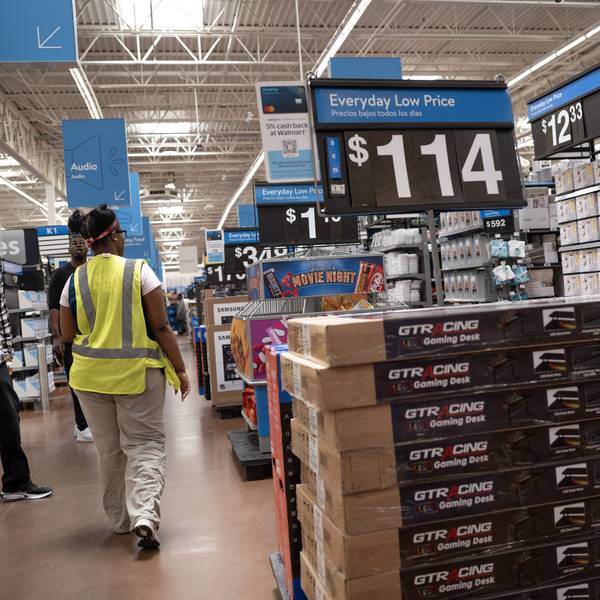
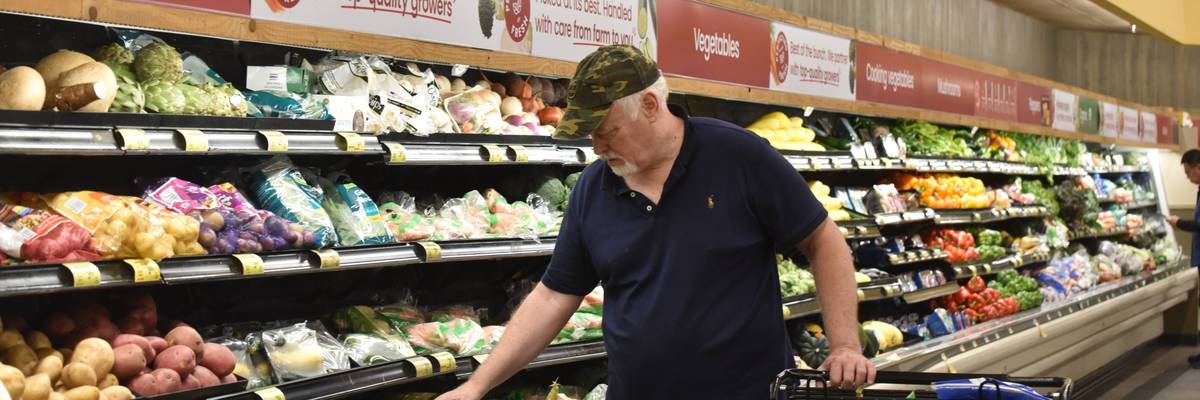
People shop at a supermarket on July 18, 2025, in Rockville, Maryland.
Maryland Becomes First US State to Ban Surveillance Pricing for Groceries
A new law will ban retailers from using shoppers' personal data to hike grocery prices—but consumer advocates warn it contains loopholes that companies could exploit.
Maryland will become the first US state to outlaw "surveillance pricing" for groceries after Democratic Gov. Wes Moore signed a bill on Monday barring retailers and food delivery services from using customers' personal data to alter prices.
The practice has already become rampant in online commerce, with companies like Amazon, Uber, and Delta Air Lines accused of using everything from browsing history and location to demographic information to squeeze every possible cent from consumers.
The Protection from Predatory Pricing Act, which takes effect in Maryland beginning on October 1, targets the growing use of such tactics by grocery chains and delivery apps, which Moore has accused of using "new technologies to drive up the bill for working families."
These include electronic shelf labels, which advocates have warned could allow companies to instantly change grocery prices based on the time of day, weather, and other factors that influence consumer demand.
“Digital price tags are replacing paper ones. It’s happening because we are having cameras that are watching aisles, it’s happening because we have apps that are moving from search-based to predictive,” Moore said.
Moore has cited an investigation published in December by Consumer Reports and the Groundwork Collaborative, which found that Instacart was running a “pricing experiment” that charged some customers as much as 23% more for the same items than others based on shoppers' personal data.
Another investigation by Consumer Reports last May found that Kroger was collecting lengthy profiles of individual customers, including estimates of their household size, education level, income, and even perceived "loyalty" to the company, along with sometimes dozens of other pages of personal data.
"Surveillance pricing can drive up the price of food," said Grace Gedye, senior policy analyst at Consumer Reports. "Retailers have a lot of data about individual shoppers: how often we search for or hover over particular items, whether we live near competitor stores, inferences about our likes and dislikes, our dietary needs, our income, our family size, and more."
"Surveillance pricing," she said, "allows companies to take advantage of that information asymmetry and charge you as much as they think you’re individually willing to pay.”
To combat this, Maryland's new law requires that shelf prices remain steady for one full business day. It also bars retailers from using surveillance data, such as inferred income, ethnicity, family size, neighborhood, or purchasing history, to raise prices for individuals.
Companies that violate the law will receive civil penalties of up to $10,000 for first offenses and $25,000 for repeat offenses. They will also be given 45 days to correct violations before these fines apply.
Gedye said, "While it’s encouraging to see the Maryland Legislature take up this issue, this law has loopholes that will limit its real-world impact."
The law faced fierce opposition from industry groups, including the Maryland Retailers Alliance. The group ultimately withdrew its opposition, but only after several new provisions were introduced that Consumer Reports said "undercut" the law's effectiveness.
While the law bans the use of personal data to set higher prices, the group said there is no way to determine what constitutes a "baseline or standard price," meaning price fluctuations could easily be marketed as discounts. It also said companies could use loyalty and subscription programs—which are exempt from the law—to raise prices.
The group also warned that the law is too hard to enforce, since only the Maryland attorney general, not customers themselves, can bring suits, which it said is a "departure from Maryland’s primary consumer protection law."
Many other states—including California, New York, and Illinois—are considering similar bans, and legislation has been proposed at the federal level to outlaw surveillance and surge-pricing practices nationwide.
Gedye said, "We urge other state legislatures considering personalized pricing legislation to build in stronger consumer protections and avoid loopholes that weakened this bill.”
We are at a crossroads
This country and this world are at a monumental crossroads. In a few short weeks, US voters will have an opportunity to beat back the forces of fascism and confront the billionaires who are rigging the economy, our media system, and our democracy, making it increasingly impossible for ordinary people to get by. We’re not just talking about the election. We’re talking about what must be done once these fascist elements are vanquished from power. We need a bolder set of solutions than what either major party has so far been willing to offer and a working-class movement ready to fight like hell for it. Trump didn't emerge from nowhere. The conditions that fueled MAGA authoritarianism were created by decades of radical neoliberal economic policies and a corrupt political system dominated by corporate interests. They slashed taxes on the super-rich, promising that the benefits would trickle down. They said giveaways to the corporate titans would make life more affordable for the rest of us. It was all bullshit. And when a bitter, betrayed populace searches for someone to blame, right-wing demagogues have little trouble finding scapegoats. People know when they're being lied to, but you won't hear any of this from the corporate media. Only independent journalism—powered and funded by people who believe in building a better world—can deliver truly trustworthy daily news. Our Fall Campaign is underway, and we need your help. To power our newsroom through the rest of the year, we need to raise $125,000 by midnight on October 31. So if you share our vision, please contribute whatever you can to sustain our work. |
Maryland will become the first US state to outlaw "surveillance pricing" for groceries after Democratic Gov. Wes Moore signed a bill on Monday barring retailers and food delivery services from using customers' personal data to alter prices.
The practice has already become rampant in online commerce, with companies like Amazon, Uber, and Delta Air Lines accused of using everything from browsing history and location to demographic information to squeeze every possible cent from consumers.
The Protection from Predatory Pricing Act, which takes effect in Maryland beginning on October 1, targets the growing use of such tactics by grocery chains and delivery apps, which Moore has accused of using "new technologies to drive up the bill for working families."
These include electronic shelf labels, which advocates have warned could allow companies to instantly change grocery prices based on the time of day, weather, and other factors that influence consumer demand.
“Digital price tags are replacing paper ones. It’s happening because we are having cameras that are watching aisles, it’s happening because we have apps that are moving from search-based to predictive,” Moore said.
Moore has cited an investigation published in December by Consumer Reports and the Groundwork Collaborative, which found that Instacart was running a “pricing experiment” that charged some customers as much as 23% more for the same items than others based on shoppers' personal data.
Another investigation by Consumer Reports last May found that Kroger was collecting lengthy profiles of individual customers, including estimates of their household size, education level, income, and even perceived "loyalty" to the company, along with sometimes dozens of other pages of personal data.
"Surveillance pricing can drive up the price of food," said Grace Gedye, senior policy analyst at Consumer Reports. "Retailers have a lot of data about individual shoppers: how often we search for or hover over particular items, whether we live near competitor stores, inferences about our likes and dislikes, our dietary needs, our income, our family size, and more."
"Surveillance pricing," she said, "allows companies to take advantage of that information asymmetry and charge you as much as they think you’re individually willing to pay.”
To combat this, Maryland's new law requires that shelf prices remain steady for one full business day. It also bars retailers from using surveillance data, such as inferred income, ethnicity, family size, neighborhood, or purchasing history, to raise prices for individuals.
Companies that violate the law will receive civil penalties of up to $10,000 for first offenses and $25,000 for repeat offenses. They will also be given 45 days to correct violations before these fines apply.
Gedye said, "While it’s encouraging to see the Maryland Legislature take up this issue, this law has loopholes that will limit its real-world impact."
The law faced fierce opposition from industry groups, including the Maryland Retailers Alliance. The group ultimately withdrew its opposition, but only after several new provisions were introduced that Consumer Reports said "undercut" the law's effectiveness.
While the law bans the use of personal data to set higher prices, the group said there is no way to determine what constitutes a "baseline or standard price," meaning price fluctuations could easily be marketed as discounts. It also said companies could use loyalty and subscription programs—which are exempt from the law—to raise prices.
The group also warned that the law is too hard to enforce, since only the Maryland attorney general, not customers themselves, can bring suits, which it said is a "departure from Maryland’s primary consumer protection law."
Many other states—including California, New York, and Illinois—are considering similar bans, and legislation has been proposed at the federal level to outlaw surveillance and surge-pricing practices nationwide.
Gedye said, "We urge other state legislatures considering personalized pricing legislation to build in stronger consumer protections and avoid loopholes that weakened this bill.”
Maryland will become the first US state to outlaw "surveillance pricing" for groceries after Democratic Gov. Wes Moore signed a bill on Monday barring retailers and food delivery services from using customers' personal data to alter prices.
The practice has already become rampant in online commerce, with companies like Amazon, Uber, and Delta Air Lines accused of using everything from browsing history and location to demographic information to squeeze every possible cent from consumers.
The Protection from Predatory Pricing Act, which takes effect in Maryland beginning on October 1, targets the growing use of such tactics by grocery chains and delivery apps, which Moore has accused of using "new technologies to drive up the bill for working families."
These include electronic shelf labels, which advocates have warned could allow companies to instantly change grocery prices based on the time of day, weather, and other factors that influence consumer demand.
“Digital price tags are replacing paper ones. It’s happening because we are having cameras that are watching aisles, it’s happening because we have apps that are moving from search-based to predictive,” Moore said.
Moore has cited an investigation published in December by Consumer Reports and the Groundwork Collaborative, which found that Instacart was running a “pricing experiment” that charged some customers as much as 23% more for the same items than others based on shoppers' personal data.
Another investigation by Consumer Reports last May found that Kroger was collecting lengthy profiles of individual customers, including estimates of their household size, education level, income, and even perceived "loyalty" to the company, along with sometimes dozens of other pages of personal data.
"Surveillance pricing can drive up the price of food," said Grace Gedye, senior policy analyst at Consumer Reports. "Retailers have a lot of data about individual shoppers: how often we search for or hover over particular items, whether we live near competitor stores, inferences about our likes and dislikes, our dietary needs, our income, our family size, and more."
"Surveillance pricing," she said, "allows companies to take advantage of that information asymmetry and charge you as much as they think you’re individually willing to pay.”
To combat this, Maryland's new law requires that shelf prices remain steady for one full business day. It also bars retailers from using surveillance data, such as inferred income, ethnicity, family size, neighborhood, or purchasing history, to raise prices for individuals.
Companies that violate the law will receive civil penalties of up to $10,000 for first offenses and $25,000 for repeat offenses. They will also be given 45 days to correct violations before these fines apply.
Gedye said, "While it’s encouraging to see the Maryland Legislature take up this issue, this law has loopholes that will limit its real-world impact."
The law faced fierce opposition from industry groups, including the Maryland Retailers Alliance. The group ultimately withdrew its opposition, but only after several new provisions were introduced that Consumer Reports said "undercut" the law's effectiveness.
While the law bans the use of personal data to set higher prices, the group said there is no way to determine what constitutes a "baseline or standard price," meaning price fluctuations could easily be marketed as discounts. It also said companies could use loyalty and subscription programs—which are exempt from the law—to raise prices.
The group also warned that the law is too hard to enforce, since only the Maryland attorney general, not customers themselves, can bring suits, which it said is a "departure from Maryland’s primary consumer protection law."
Many other states—including California, New York, and Illinois—are considering similar bans, and legislation has been proposed at the federal level to outlaw surveillance and surge-pricing practices nationwide.
Gedye said, "We urge other state legislatures considering personalized pricing legislation to build in stronger consumer protections and avoid loopholes that weakened this bill.”