

SUBSCRIBE TO OUR FREE NEWSLETTER
Daily news & progressive opinion—funded by the people, not the corporations—delivered straight to your inbox.
5
#000000
#FFFFFF
To donate by check, phone, or other method, see our More Ways to Give page.
Daily news & progressive opinion—funded by the people, not the corporations—delivered straight to your inbox.
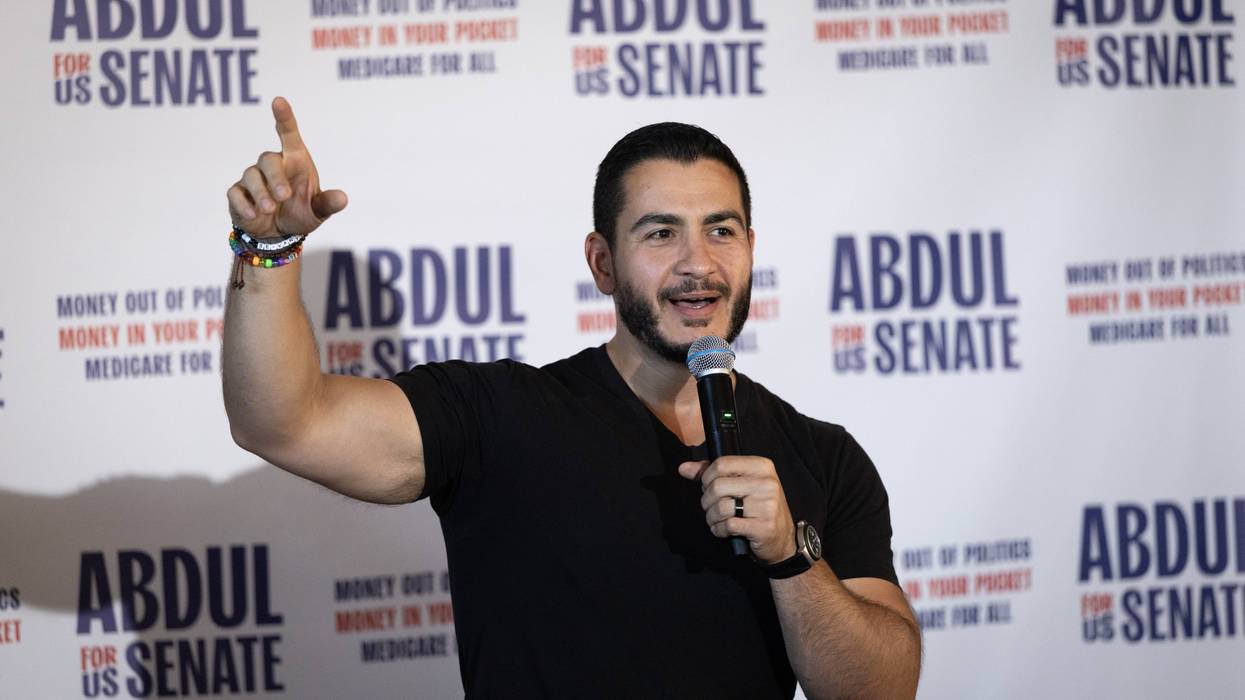
"If I were him, I wouldn't debate me either," said Democratic US Senate nominee Abdul El-Sayed.
Democratic US Senate candidate Abdul El-Sayed on Tuesday ridiculed Republican rival Mike Rogers after he skipped out on a town hall event hosted by FOX 2 Detroit.
Shortly after the event, a reporter asked El-Sayed what he thought of "the elephant in the room, or lack thereof," in reference to Rogers' absence.
"The elephant was not in the room," the Michigan Democrat replied. "The elephant decided that they did not want to be in the room. The elephant cowarded out."
Reporter: The elephant in the room tonight, or lack thereof—
El-Sayed: No, the elephant was not in the room. The elephant decided that they did not want to be in the room. The elephant cowarded out. Although the elephants were all in the room in Dallas.
It’s wild to me that… pic.twitter.com/cd9OYD5smM
— Acyn (@Acyn) September 16, 2026
El-Sayed noted that Rogers was able to attend President Donald Trump's midterm convention in Dallas last week, even as he skipped out on a chance to talk directly with Michigan voters.
"It’s wild to me that this guy is more interested in going to speak for, what, six minutes and 48 seconds in Dallas," he said, "than he is to have 60 minutes with Michiganders here in Detroit. But it tells you who he is. He’s a coward."
El-Sayed then expressed mock empathy for his Republican opponent.
"[Rogers] knows that the minute he and I have to actually share the same stage and share podiums, he's not going to have much to say," he said. "Because at the end of the day, I'm going to hold him accountable to his record, which is awful on all the things... If I were him, I wouldn't debate me either."
A reported then asked El-Sayed if he bought Rogers' excuse for not being at the event.
"He's probably at a corporate fundraiser," he replied. "What was his excuse? He's in Florida? He got stuck in Dallas? He's in all the places that are not Michigan? What's his excuse, I don't even know what it is."
In an interview with CBS News Detroit published Wednesday, Rogers defended his decision to skip the event, and pointed out that his campaign had never agreed to attend.
The Michigan Republican also reiterated his concerns about Fox 2 Detroit Roop Raj, whom he alleged is biased against his campaign.
"When you have someone who's already picked their candidate," said Rogers, "you can't have a two-on-one event in a TV studio."
El-Sayed and Rogers are both scheduled to take part in two debates in October.

One group said the people of Detroit "will soon have a representative who prioritizes the people of the district over Israel’s genocide."
Michigan state Rep. Donavan McKinney has defeated incumbent Congressman Shri Thanedar in Tuesday's 13th Congressional District Democratic primary, delivering yet another rebuke to corporate-backed Democrats and their support for Israel as it continues its US-backed genocidal assault on Gaza.
The Associated Press called the race for McKinney (D-11) just before 10:00 am local time on Wednesday, with preliminary results showing the 34-year-old Detroit sonative received 51.9% of the vote, while Thanedar—whose close ties to corporate interests made him a frequent target of progressive criticism—received 48.1%, with 99% of all votes tallied.
McKinney—a 34-year-old organizer backed by social democrats including US Sen. Bernie Sanders (I-Vt.) and Rep. Rashida Tlaib (D-Mich.)—ran a campaign centered on working-class issues like affordable housing, healthcare, labor rights, and environmental justice.
He also sharply criticized US support for Israel's war in Gaza—which a United Nations Commission of Inquiry last year called a genocide—joining a growing number of progressive candidates calling for an end to the billions of dollars in annual armed aid the US provides Israel and a permanent ceasefire. His stance won him widespread support in a district with a significant and growing Arab American and Muslim population.
Congratulations to @donavanmckinney.bsky.social Mi-13 will soon have a representative who prioritizes the people of the district over Israel's genocide.Donavan is a real fighter who doesn't just talk about change, he delivers it!Let’s go!!!
[image or embed]
— PAL PAC (@votepalpac.bsky.social) August 5, 2026 at 7:08 AM
“Detroit, I am honored beyond measure to be your Democratic nominee to represent the Mighty 13th in Congress," McKinney said in a statement published by Michigan Advance. "I am so proud that our community is sending me to Congress to fight for a better future—because that means our movement has shown them a fighter is what they truly deserve in Washington."
“Today, we showed why being always with the people is more than a slogan—it’s a roadmap for the Democratic Party on how to move forward to defeat the fascism and divisiveness harming our country, and to deliver the leadership the Mighty 13th deserves," he added. "Taking back our seat and taking back our power has always been at the core of our movement, and I’m so excited for all that our community will accomplish together.”
Democratic Socialists of America congratulated McKinney—a DSA member—in a Bluesky post touting his progressive platform.
Congratulations to Donavan McKinney on winning his congressional primary, unseating a millionaire AIPAC stooge! Donavan is a former union member fighting to get money out of politics, a green new deal, and union jobs. @donavanmckinney.bsky.social @detroitdsa.bsky.social
[image or embed]
— Democratic Socialists of America (@demsocialists.bsky.social) August 5, 2026 at 7:33 AM
Indivisible, which organizes against what it calls a "fascistic clown show of a regime"—the Trump administration—hailed McKinney's victory as "a huge win for working families."
"In addition to overcoming millions in outside spending, Donavan defeated a multimillionaire incumbent who enriched himself in office and voted to enrich [President Donald Trump]," the group added. "This is how we build a better Democratic Party!"
McKinney's victory came amid a wave of wins for progressives in Michigan and across the country.
Michigan voters also nominated progressive Abdul El-Sayed for the US Senate after he narrowly defeated Congresswoman Haley Stevens (D-Mich.) despite tens of millions of dollars in outside spending, much of it from pro-Israel groups like the American Israel Public Affairs Committee (AIPAC) and its United Democracy Project.
Meanwhile, Sunrise Movement co-founder Will Lawrence won the Democratic nomination in Michigan's battleground 7th Congressional District, underscoring what supporters called the strength of climate-focused and working-class organizing.
Progressive candidates also notched victories in several Michigan state legislative contests backed by the DSA, Working Families Party, Our Revolution, and other left-leaning groups.
In metro Detroit, Chris Gilmer-Hill unseated incumbent state Rep. Helena Scott (D-8) after running on a platform centered on labor rights, housing affordability, and universal healthcare. In a closely watched state Senate primary, Abbas Alawieh—a co-founder of Michigan's Uncommitted movement, which emerged in protest of the Biden administration's support for Israel's annihilation of Gaza—handily won the Democratic nomination over state Rep. Erin Byrnes (D-15). Joanna Whaley, a former megachurch pastor, is set to become the first transgender member of the state Legislature after comfortably winning her race against opponents including former state Rep. Frank Liberati (D-13), who tried to disqualify Whaley because she did not run under her deadname.
Reacting to the wins, Our Revolution executive director Joseph Geevarghese said Wednesday that "Michigan voters rejected the idea that elections can simply be bought, and they rejected a politics that asks them to settle for the status quo."
Tuesday's victories in Michigan point to a Democratic electorate that is apparently becoming more willing to reject candidates aligned with corporate donors and AIPAC in favor of unapologetic working-class progressives. While establishment Democrats and outside groups continue to wield enormous financial power—and have scored victories of their own, including incumbent Rep. Wesley Bell's defeat of former Congresswoman Cori Bush in Missouri—Tuesday's wins added to mounting evidence that working-class, pro-Palestine candidates are reshaping the Democratic agenda from coast to coast, including in crucial battleground states.
"Ordinary people understand what's happening in this country. They know the economy is rigged against working families," Geevarghese said. "They know our campaign finance system allows billionaires and special interests to buy power. And they're tired of a political establishment that too often protects that broken system instead of confronting it."
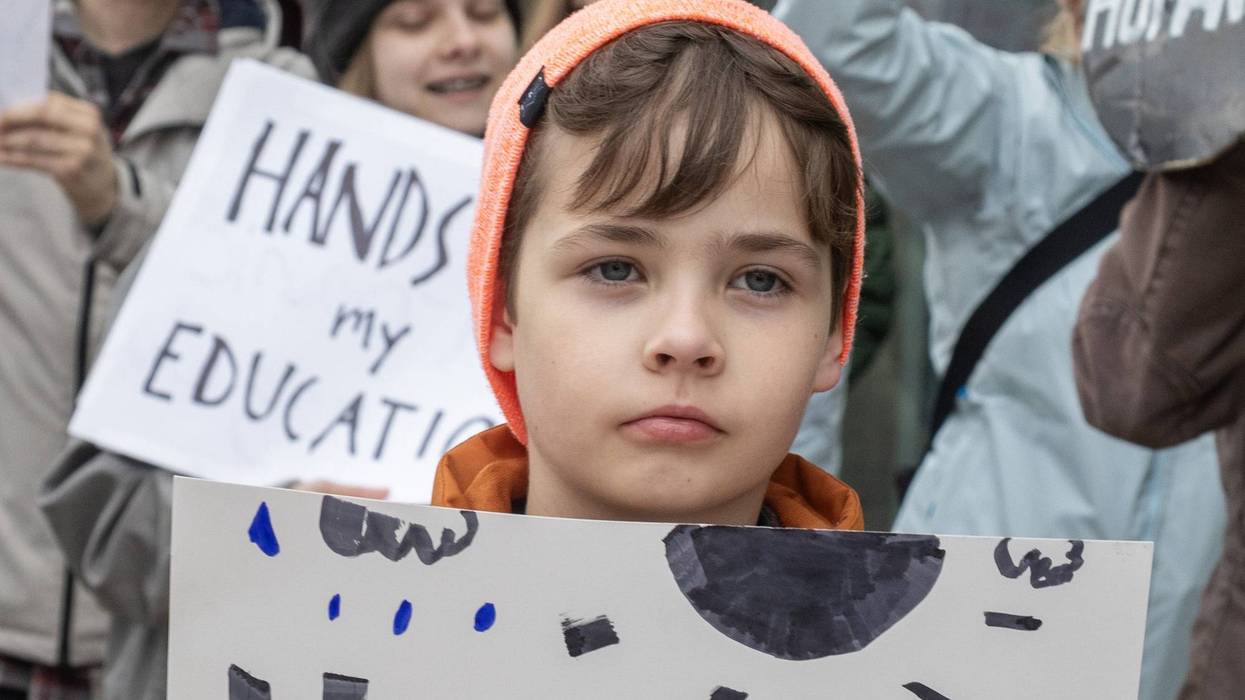
"We urge federal officials to focus on real threats to student well-being like gun violence, funding cuts, and staffing shortages rather than singling out districts that work to support all children," said one advocacy leader.
Denouncing the Trump administration's probes to determine whether three public school districts "have included sexual orientation and gender ideology" content in courses as "part of a broader attack on our rights as Michiganders," the head of one progressive group pledged Friday to keep fighting to ensure that "all of our kids can thrive at school free from bullying, harassment, and other unfair treatment."
The US Department of Justice announced Wednesday that its Civil Rights Division is investigating Detroit Public Schools Community District, Godfrey-Lee Public Schools, and the Lansing School District. The DOJ is examining content for pre-K through 12th grade courses, opt-out policies, and whether the districts "limit access to single-sex intimate spaces, such as bathrooms and locker rooms, based on biological sex."
In a Friday statement, Justin Mendoza, executive director of Progress Michigan, emphasized that his state's "civil rights laws explicitly protect LGBTQ+ students, and our state must enforce them to the fullest extent."
Mendoza condemned not only the Trump administration's efforts to harm "the most vulnerable and historically marginalized among us," but also Republicans at the state and federal level who "are trying to limit honest conversations about our nation's history, while fighting each and every attempt to create safe, inclusive schools for our children."
"Attorney General Pam Bondi is setting a terrible example for younger generations—considering the way she behaved at a recent congressional hearing where she name-called members of Congress—and now she's going a step further by throwing nondiscrimination policies into the dumpster," he said. "People of all genders, races, and backgrounds benefit from strong nondiscrimination policies."
"From Marquette to Monroe, teachers, students, and their families are committed to having an educational system that reflects the diversity of the world they live in," Mendoza continued. "Classrooms deserve to have age-appropriate conversations about health, identity, and respect, and if parents choose to opt their children out of participating in these conversations, they are already allowed to by Michigan law."
"The Trump Department of Justice is truly looking to invent problems instead of actually fighting crime and violence towards youth," he concluded, "and Michiganders won't take this intrusion into our education system."
"The Trump Department of Justice is truly looking to invent problems instead of actually fighting crime and violence towards youth, and Michiganders won't take this intrusion into our education system."
Other state and nationwide groups have also spoken out against the administration's probes and targeting of LGBTQ+ youth this week. Brian Dittmeier, director of LGBTQI+ equality at the National Women's Law Center, blasted the investigations as a "blatant attempt to discourage inclusive education."
Jay Kaplan, a staff attorney for the ACLU of Michigan, told Chalkbeat that "this is an attempt to harass and bully districts into discriminating against trans kids and into erasing the existence of LGBTQ people."
Equality Michigan executive director Erin Knott said that "LGBTQ+ youth are among the most vulnerable young people in our state. They face higher rates of bullying, harassment, and mental health challenges. Inclusive education policies are not 'ideology,' they are evidence-based efforts to ensure that every student feels safe, respected, and seen in their own school community."
"All kids deserve an education that reflects the diversity of the world they live in," she stressed. "Age-appropriate discussions about health, identity, and respect help create safer classrooms for all students. We urge federal officials to focus on real threats to student well-being like gun violence, funding cuts, and staffing shortages rather than singling out districts that work to support all children."
State Superintendent Glenn Maleyko was similarly critical of the federal administration in his response, saying Thursday that "the Michigan Department of Education strongly supports all students and supports the school districts that have been targeted by the US Department of Justice."
Maleyko continued:
If we want to put Students First and make sure children can learn, we need all students to be healthy and safe and feel included. The much-needed updates to health education guidelines—which the Department of Justice falsely said are state requirements—help local districts make decisions on how they can support student health.
As required by state law, MCL 380.1507, local school boards set health curriculum with input from local sex education advisory boards. Local control remains in place. Parents retain the right to decide whether their children should participate in sex education instruction.
The Michigan Department of Education strongly supports and will work closely with the three districts' efforts to select a curriculum that best supports the needs of their students, consistent with state standards and guidelines. We remain committed to protecting the rights of all students and to upholding Michigan’s constitutional guarantee of access to a free public education for every child.
"The breadth and scope of the federal requests, premised on a mischaracterization of the Michigan Health Education Standards Guidelines adopted by the State Board of Education, place a significant administrative burden on local districts and risk diverting time and resources away from the core mission of educating students," Maleyko added.
As for the targeted districts, a spokesperson for the Detroit schools declined to comment, while Guillermo Lopez, the Lansing school board president, told the Detroit Free Press that parents in his district are informed that "they can opt out of certain classes."
Arnetta Thompson, superintendent of Godfrey-Lee schools, told Chalkbeat that her district will provide information requested by the DOJ and "is not facing any charges or findings of wrongdoing. We remain committed to complying with all applicable federal, state, and local laws and have consistently operated in accordance with those laws."
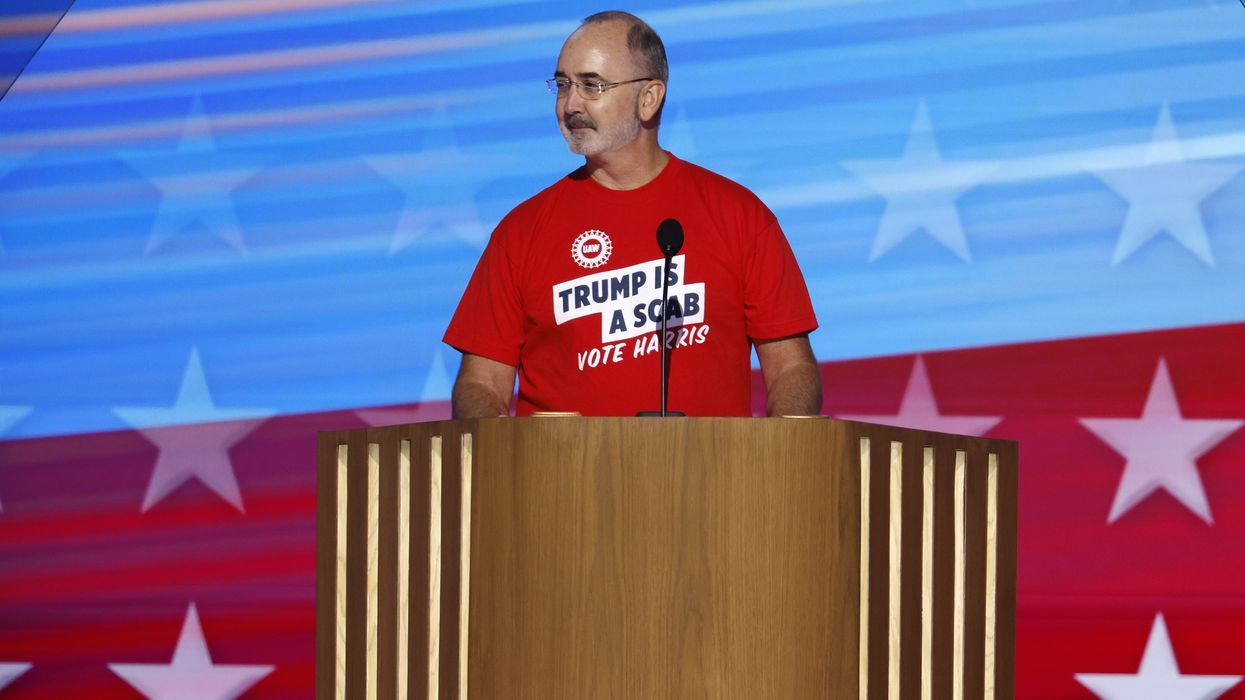
"Kamala Harris has stood with labor," said Shawn Fain. "She's walked the walk. Donald Trump serves himself. He's always served himself."
The head of the largest U.S. autoworkers union on Thursday highlighted the yawning chasm between former President Donald Trump's campaign promises to protect the country's auto industry and the 2024 Republican nominee's White House record—which includes hundreds of thousands of lost manufacturing jobs.
Speaking on a call hosted by the campaign for Vice President Kamala Harris, the Democratic nominee, United Auto Workers president Shawn Fainargued that "there is a stark contrast between Donald Trump and Kamala Harris."
"Kamala Harris has stood with labor," Fain said of the UAW-endorsed candidate. "She's walked the walk. Donald Trump serves himself. He's always served himself."
Taking aim at Trump's claims that he's the best choice for U.S. autoworkers and that he's "always had their back," Fain said:
Look at the Lordstown, Ohio assembly plant. [Trump] told workers there, "Don't sell your houses." The plant closed. He came to Warren, Michigan, a week ago or two. Again, wants to talk about how he cares about autoworkers. But we had [General Motors'] powertrain plant in Warren closed under his watch. He did nothing. Trump stood there in 2016 and promised that he wouldn't allow a single plant to close.
However, plant closures and offshoring increased during the Trump administration, during which domestic auto production plummeted from nearly 12.2 million units in 2016, the last full year of the Obama administration, to under 8.2 million units in 2020, Trump's last full year in office, according to the U.S. Bureau of Transportation Statistics. While Covid-19 affected that year's production, fewer than 10.9 million vehicles were manufactured domestically in pre-pandemic 2019.
Fain, who noted this trend, called Trump the "job-killer-in-chief."
The UAW chief also mocked reports that numerous attendees wearing "autoworkers for Trump" T-shirts at a Tuesday rally for the Republican in Detroit weren't actually autoworkers.
"It's pathetic. Everything he does is a con," Fain said of Trump.
Referring to the multibillionaire CEO of electric vehicle maker Tesla, Fain added that Trump "sits there and applauds Elon Musk for trying to fire striking workers, and they laugh about that."
"And that's why I said Donald Trump is a scab," the union leader added, using the term for nonunion workers who cross picket lines during strikes.
During last year's UAW strike for a fair contract, President Joe Bidenmade history by becoming the first-ever sitting U.S. president to join striking workers on a picket line. Four years earlier, Harris, then a U.S. senator from California running for president, walked a picket line with striking UAW workers in Reno, Nevada.
The Biden-Harris administration has often been called the most pro-labor presidency in modern history.
Fain's remarks came hours before Trump infuriated many Michiganders by telling local business owners at a Detroit rally that if Harris wins, the entire country will "end up being like Detroit"—which is in the midst of an economic revival.
Congressman Shri Thanedar (D-Mich.), who represents the city,
admonished Trump to "keep Detroit and our people out of your mouth."
"Detroit is a city with a booming economy, diverse culture, and some of the best people in America," he said, adding that the heavily Democratic city "will elect Kamala Harris."
Michigan Democratic Party Chair Lavora Barnes said Thursday: "Plain and simple, a second Donald Trump presidency would be a disaster for Michigan workers. His agenda will raise costs and kill jobs."
"When he was president," she added, "Trump gave tax cuts to the wealthy at the expense of Michigan's working families, tanked our economy during the pandemic, and only helped the rich get richer."

Michigan Gov. Gretchen Whitmer said the city is "defined by winners willing to get their hands dirty to build up their city and create their communities—something Donald Trump could never understand."
Federal, state, and local leaders in Michigan took issue with former President Donald Trump's latest apparent voter mobilization strategy in the crucial battleground state: insulting its largest city while delivering a campaign speech there on Thursday.
At the Detroit Economic Club, the Republican presidential nominee told business owners that if Democratic Vice President Kamala Harris wins the election, the entire country will "end up being like Detroit."
"The whole country will be like, you want to know the truth? It'll be like Detroit if she's your president. You're gonna have a mess on your hands," he said. "We're not going to let her do that to this country. We're not gonna let it happen."
Trump didn't specify why Detroit residents should recoil at the thought of a country that resembles their city, long recognized as an industrial and cultural center in the Rust Belt. He has previously attacked other large cities, calling Milwaukee "horrible" weeks before the Republican National Convention and saying at Temple University in Philadelphia that the city is "one of the most egregious places anywhere in the world."
The former president has also frequently lambasted Chicago, comparing violence in the nation's third-largest city to that of a war zone.
Critics have accused Trump of singling out cities with large Black and brown communities for his vitriol. More than 77% of Detroit residents are Black.
U.S. Rep. Shri Thanedar (D-Mich.), who represents the city in Congress, implored Trump to "keep Detroit and our people out of your mouth."
"Detroit is a city with a booming economy, diverse culture, and some of the best people in America," he said, adding that the heavily Democratic city "will elect Kamala Harris."
Detroit Mayor Mike Duggan, a Democrat, also responded to Trump's comment, pointing to the success of the city's major sports teams, growing population, and sinking crime rate.
Michigan Gov. Gretchen Whitmer, also a Democrat, suggested the "grit" of Detroit, which has made a significant rebound since becoming the largest city in U.S. history to declare bankruptcy in 2013, is likely unfamiliar to Trump.
Detroit, she said, is "defined by winners willing to get their hands dirty to build up their city and create their communities—something Donald Trump could never understand."
An Emerson College poll out Thursday showed Trump and Harris tied at 49% in Michigan.
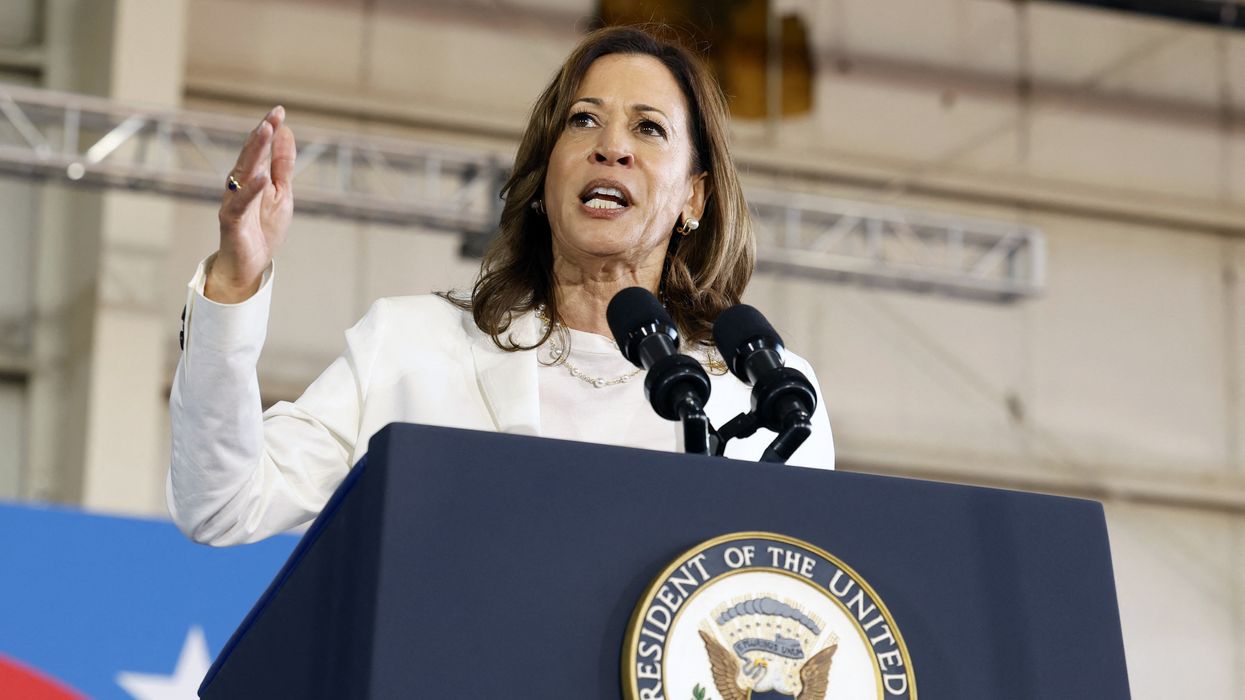
"It's clear to us that Vice President Harris can lead our country's Gaza policy to a more humane place," said Layla Elabed and Abbas Alawieh. "We hope she will meet with us so we can move forward to discuss an arms embargo."
Leaders of the Uncommitted National Movement aimed at pushing the U.S. government to end its support for Israel's assault on Gaza called on Vice President Kamala Harris on Thursday to commit to a policy change and to follow through with her statement—made to them in a brief meeting Wednesday evening just before her campaign rally in Detroit—that she was open to discussing an arms embargo.
Layla Elabed and Abbas Alawieh, two Michigan voters who co-founded the Uncommitted National Movement earlier this year, spoke with Harris and vice presidential candidate Tim Walz, the governor of Minnesota, about the deep personal connection many people in the crucial swing state feel to the 2.3 million Palestinians who have been under siege in Gaza since last October.
Elabed broke down in tears as she told Harris that she meets "with community members every day in Michigan who are losing tens and hundreds of family members in Gaza."
"Michigan voters want to support you, but we need a policy that will save lives in Gaza right now," Elabed told the Democratic presidential nominee. "Right now, we need an arms embargo. Will you meet with us to talk about an arms embargo?"
According to a statement released by Uncommitted after the rally, Harris "shared her sympathies and expressed an openness to a meeting with Uncommitted leaders to discuss an arms embargo."
On Thursday morning, however, Harris' national security adviser, Phil Gordon, said on social media that the vice president "does not support an arms embargo on Israel" and "will always ensure Israel is able to defend itself against Iran and Iran-backed terrorist groups."
Elabed and Alawieh responded to Gordon's remarks by saying they would "continue engaging because people we love are being killed with American bombs."
"When we told Vice President Harris that members of our community in Michigan are losing dozens and hundreds of their family members to Israel's assault in Gaza, she said back: 'It's horrific,'" said the leaders of the movement, which includes 700,000 supporters across the country. "It's clear to us that Vice President Harris can lead our country's Gaza policy to a more humane place. We hope she will meet with us so we can move forward to discuss an arms embargo."
Elabed and Alawieh urged Harris to unite the Democratic Party "by correcting course because our democracy cannot afford to pay the bill for disregarding Palestinian lives should it come due in November."
The leaders engaged with Harris and Walz amid outrage from human rights groups over a leaked video that apparently showed Israel Defense Forces members gang-raping a Palestinian prisoner at the Sde Teiman military base. World Health Organization officials on Wednesday warned that without a cease-fire, polio virus that has been found in wastewater in Gaza could spread widely and cause an epidemic among a population that has suffered mass displacement since October, and United Nations experts said last month that famine has taken hold in the enclave due to Israel's blocking of humanitarian aid—which Israeli Finance Minister Bezalel Smotrich suggested Monday was "justified and moral."
As several House Democrats told the Biden administration in March, advocates for an arms embargo on Israel are only demanding that the federal government follow U.S. laws, including the Humanitarian Aid Corridor Act—Section 620I of the Foreign Assistance Act of 1961, which states that the U.S. cannot provide military aid to any country that is prohibiting or restricting the delivery of U.S. assistance into an area.
"We want to support you, Vice President Harris, and our voters need to see you turn a new page on Gaza policy that includes embracing an arms embargo to save lives," Alawieh, a delegate to the Democratic National Convention, told Harris on Wednesday evening.
Although the leaders' meeting with the Democratic ticket reportedly left them feeling relatively hopeful about Harris' "openness to engaging with the demands of Uncommitted voters," the vice president's reaction to a group of protesters who chanted, "We won't vote for genocide!" during her rally speech left some advocates calling on Harris to bring the same empathy regarding Gaza that Elabed and Alawieh saw to her public appearances.
Harris first responded to the protesters by saying, "I'm here because we believe in democracy. Everyone's voice matters. But I am speaking now." After the chanting continued, she said, "If you want Donald Trump to win, then say that. Otherwise, I'm speaking."
Human rights lawyer Qasim Rashid said Harris had missed "a golden opportunity to show empathy to people in deep pain because their family is suffering torture, famine, displacement, and genocide."
"They don't want Trump to win," said Rashid. "They want the suffering to stop. Don't push them away. Invite them in. She should remedy this ASAP."
Hours before the rally and Harris' meeting with Elabed and Alawieh, Sen. Bernie Sanders (I-Vt.) posted on social media a video taken at an event he held in Portland, Maine on July 27, in which an attendee told the senator that there are many uncommitted voters across the country "who are absolutely wanting to see Donald Trump defeated, but the big issue is Gaza."
"What can we do to convince Harris that she must take a different position now?" asked the voter.
The American people do not support Netanyahu’s horrific war.
We must remind the Democratic Party: If they want young people to get involved in the political process, they must change their approach to Gaza. pic.twitter.com/u7IXjXBjs2
— Bernie Sanders (@BernieSanders) August 7, 2024
Sanders approached the issue with support for voters who are unsure they can back a candidate who won't terminate the billions of dollars in military aid the U.S. has provided to Israel since last October, noting that opposition to the current U.S. policy is hardly radical; numerous polls have shown a majority of Americans don't support Israeli Prime Minister Benjamin Netanyahu's U.S.-backed actions in Gaza and that conditioning military aid could improve support for the Democratic candidate.
"What we have got to do in a grassroots way is, say to the Democratic Party, is that the policies that you have right now regarding Netanyahu are wrong," said Sanders. "And if you really want to get young people involved in this campaign, the time is now to change those policies.
The Sunrise Movement, a member of the Green New Deal Network, which endorsed Harris days after Biden announced he was stepping aside in the presidential race, called on the vice president to "accept the meeting invitation from the Uncommitted National Movement and turn the page on Biden's unconditional support for Netanyahu."
"Millions of young people are watching what you do next," said the Sunrise Movement. "Don't miss this moment."

"We need to pass my bill to prohibit the use of biometric technologies by federal entities and law enforcement so that people like Porcha aren't wrongly accused."
In response to reporting about an innocent Black woman misidentified as a criminal suspect by facial recognition software and arrested in Michigan, U.S. Sen. Ed Markey on Monday demanded federal legislation he first proposed years ago.
The New York Times detailed Sunday that Porcha Woodruff was eight months pregnant and getting her daughters ready for school in February when members of the Detroit Police Department (DPD) arrested her for alleged robbery and carjacking. The 32-year-old was held at the Detroit Detention Center for 11 hours, after which she required hospital treatment for dehydration. The case against her was dismissed, but on Thursday she filed suit against the city and Detective Officer LaShauntia Oliver in the U.S. District Court for the Eastern District of Michigan.
"In the warrant affidavit, Detective Oliver omitted the fact that [Woodruff's] facial recognition was eight years old, and [Woodruff's] recent driver's license photo was available," the suit states, according to The Detroit News. "[Oliver] deliberately omitted facts because the magistrate would have possibly denied the warrant. The omitted facts were material in finding probable cause to obtain a warrant affidavit for [Woodruff's] arrest."
Responding on social media, Markey (D-Mass.) said: "Unacceptable. Facial recognition frequently misidentifies vulnerable and marginalized people. We need to pass my bill to prohibit the use of biometric technologies by federal entities and law enforcement so that people like Porcha aren't wrongly accused."
Markey and Sen. Jeff Merkley (D-Ore.) along with Reps. Pramila Jayapal (D-Wash.) and Ayanna Pressley (D-Mass.) first introduced the Facial Recognition and Biometric Technology Moratorium Act in 2020. In March, they reintroduced the bill with Rep. Rashida Tlaib (D-Mich.) as well as Sens. Bernie Sanders (I-Vt.), Elizabeth Warren (D-Mass.), and Ron Wyden (D-Ore.).
"The year is 2023, but we are living through 1984. The continued proliferation of surveillance tools like facial recognition technologies in our society is deeply disturbing," Markey said at the time, referencing George Orwell's dystopian novel. "Biometric data collection poses serious risks of privacy invasion and discrimination, and Americans know they should not have to forgo personal privacy for safety. As we work to make our country more equitable, we cannot ignore the technologies that stand in the way of progress and perpetuate injustice."
According to his office, the bill would:
Experts and rights advocates have long warned about the inaccuracy and biases of facial recognition technology and raised the alarm about its use by all levels of law enforcement.
While some states and municipalities have passed restrictions on such technology, there are no federal regulations—though experiences like that of Woodruff have fueled demands for swift and sweeping action by the divided Congress.
According to the Times:
The ordeal started with an automated facial recognition search, according to an investigator's report from the Detroit Police Department. Ms. Woodruff is the sixth person to report being falsely accused of a crime as a result of facial recognition technology used by police to match an unknown offender's face to a photo in a database. All six people have been Black; Ms. Woodruff is the first woman to report it happening to her.
It is the third case involving the Detroit Police Department, which runs, on average, 125 facial recognition searches a year, almost entirely on Black men, according to weekly reports about the technology's use provided by the police to Detroit's Board of Police Commissioners, a civilian oversight group. Critics of the technology say the cases expose its weaknesses and the dangers posed to innocent people.
In a statement to multiple media outlets, DPD Chief James White said: "I have reviewed the allegations contained in the lawsuit. They are very concerning. We are taking this matter very seriously, but we cannot comment further at this time due to the need for additional investigation. We will provide further information once additional facts are obtained and we have a better understanding of the circumstances."
Another incident involving the city's police landed Robert Williams behind bars in January 2020, after state-owned facial recognition software misidentified the Black Michigander as a shoplifting suspect. He is represented by the national and state ACLU as well as the University of Michigan Law School's Civil Rights Litigation Initiative in an ongoing legal battle.
"It's deeply concerning that the Detroit Police Department knows the devastating consequences of using flawed facial recognition technology as the basis for someone's arrest and continues to rely on it anyway," Phil Mayor, senior staff attorney at the ACLU of Michigan, said in a statement Sunday as news outlets shared Woodruff's story.
"As Ms. Woodruff's horrifying experience illustrates, the department's use of this technology must end," Mayor continued. "Furthermore, the DPD continues to hide its abuses of this technology, forcing people whose rights have been violated to expose its wrongdoing case by case. DPD should not be permitted to avoid transparency and hide its own misconduct from public view at the same time it continues to subject Detroiters to dragnet surveillance."
The ACLU was among the groups that endorsed Markey's legislation in March, with senior policy counsel Chad Marlow saying the senator "understands Congress should not be using federal funds to underwrite the use of technologies that threaten our most sacred civil rights and civil liberties" and applauding all of the bill's sponsors for working to safeguard "our freedoms against the prying eyes of unchecked government surveillance."

Director dream hampton’s new film Freshwater, about flooding in the historically Black neighborhood of Belle Isle, offers room for reflection and melancholy in a summer of extremes.
My limbic system is down for repairs; week after week of record high temperatures around the globe, with fires blazing, reefs bleaching, ice sheets melting. It’s the biggest story on Earth, and I will go on working on it for the rest of my life, but today, for whatever reason, I found myself in need of something… not more cheerful but more meditative, something that engages a different part of my brain.
So I found it useful to spend a day watching and rewatching a short new film by the director dream hampton (she lowercases her name, in part in tribute to the beloved essayist bell hooks) about her home city of Detroit. hampton is a big-time movie-maker; her harrowing account of an abusive R&B star, Surviving R. Kelley, has gotten all kinds of awards. But perhaps her limbic system needed a break too; in any event, this video, made for the Times Op-Docs series (in conjunction with the remarkable folks at the Hip Hop Caucus), is in a very different key. It’s about the way that as the Great Lakes have risen in recent years they’ve begun to flood the Belle Isle section of Detroit, which as she explains in a study guide accompanying the video is a park rich in memories for her and “historically a gathering place for Black Detroiters’ family reunions, celebrations, or just sunny afternoons.”
Whenever I come home, one of the first things I do is go to Belle Isle. I just do a lap around the isle. It doesn’t matter what season it is. It could be the dead of winter, or it could be a crowded summer day. But that’s like a real grounding for me, you know. When I was growing up and when my daddy would come get me on the weekends, we would do a lap around Belle Isle in his ‘98. He always knew somebody in the park.
There’s been flooding in other parts of Detroit in recent years too, as rainstorms have gotten stronger, and much of the film is imagery of people’s basements, where stored memories end up soggy and mildewed. In the film she puts it like this:
The flooding eats your memories. It destroys them. It literally takes your old photographs, your prom dress, your father’s boots. When I think about flooding, I think about how when water is still, flooding is literally like water being trapped and having nowhere to go. Sometimes we don’t even have not just the energy, but the means to deal with flooding. I think about what’s about to happen to this whole region. I think about individuals’ basement, and what it means every spring to have to go down there and bail out your basement every year and try to repair that damage, and have some resilience against the way that it eats your house, the foundation of your house. And so then, what we do consequently with memories and with, just, love thoughts, really, is we store them in a place. And sometimes we pull ‘em out to tend to ‘em, you know.
When I talked with her this week, she said—kindly—”I’m of course thinking about Vermont when I see stories like that,” and indeed we are busy across the Green Mountain State mucking out basements. Someone just sent me this picture of a book of mine about the climate crisis wrecked by the flooding and discarded in a pile outside the Montpelier library.

But of course in Detroit, and in so many other places, the devastation is compounded by specific histories of unfairness. As she wrote me the other day: “Divestment, decades of neoliberal policy—Detroit became the hole in the donut, surrounded by segregated, sometimes but not always wealthy, hostile suburbs. Water was central to the struggle between the city of Detroit, which has rights to some of the best drinking water in the country, and the suburbs, who have tried relentlessly to get it for pennies. A part of the Flint crisis was (then-governor) Snyder trying to avoid paying for Detroit Water.”
We’re used to the idea—adopted as a slogan in the Indigenous-led fight to block the Dakota Access pipeline—that “Mni Winconi—Water is Life.” And it is, of course. But it’s also sometimes other things. We’ve seen videos these past weeks of fast-rushing water devastating cities in Asia and Europe, with cars being swept down roads past buildings and hotels falling into rivers. Sea water off the Florida Keys set a new high-temperature record—101°F, or ‘hot tub’—and is in the process of devastating the coral reefs. Changes in salinity and temperature of that seawater are also threatening to collapse the Gulf Stream. And in places like Detroit, still water, in a rainy spring, can invade a basement, wrecking memories.
So much of what’s important about Detroit is the Blackness of it. You know, and as we lose that, just how much gets buried, whether it’s when freeways are created or when we just necessarily have to move forward, and things just get stored away. Maybe to be looked at some other time, but it could also be that they just end up being eaten up by the water, by the mold, by the neglect. I don’t have anything profound to say about erasure. It’s just this sinking feeling of, like, cities that may or may not have existed, you know, whether it was Atlantis or some city of gold. Will we exist moving forward? And if not, will these memories and these stories persist in 1,000 years?
We’re adults. We need room for fear and anger, and for planning and doing, but we also need room for reflection and melancholy. This film let me find that, and i hope it will do the same for you.

"We can't afford to wait. Climate action now."
More than 120 million people across the U.S.—over a third of the country's population—were living under air quality alerts as of late Wednesday as smoke from hundreds of out-of-control Canadian wildfires blanketed much of the Northeast and the Midwest, temporarily leaving Detroit and Chicago with the most polluted air in the world.
Michigan's air quality alert was extended through Thursday "as weather forecasters expected low-level winds to change direction, potentially resulting in more smoke and reduced visibility as a result of the Canadian wildfires," the Detroit Free Press noted Wednesday.
Residents of Michigan and other U.S. states reported smelling burning plastic, prompting toxicologists at Michigan's Department of Environment, Great Lakes, and Energy to observe that "wood fires emit a lot of volatile organic compounds (VOCs)," most of which "are noticeable to our noses as the familiar 'campfire' smell, but they break down quickly when exposed to UV radiation from sunlight."
"Other VOCs like benzene, formaldehyde, and acrolein are also released and they outlast the 'campfire' VOCs," the state officials said. "It's these chemical compounds that you're smelling as the smoke wafts around for a few days and settles to the ground and reaches your nose."
Dr. Glen Clark, emergency center chief at Corewell Health's Beaumont Hospital in Grosse Pointe, Michigan, said in a statement to the Free Press that his medical center has seen "a significant increase in respiratory complaints" over the past week.
"We've seen both asthma and COPD patients, who have been well controlled, presenting with exacerbations requiring an increase in use of asthma medications, including rescue inhalers," said Clark. "Even otherwise healthy individuals have come in complaining of chest tightness."
As of Thursday morning, the Swiss firm IQAir ranked Chicago and Detroit as the cities with the worst air quality in the world. Minneapolis briefly cracked the top five the previous day.
CNN reported Wednesday that "Chicago asked all residents—especially those with heart or lung disease, older adults, pregnant people, and young children—to avoid outdoor activities and protect themselves from exposure."
"Chicago Public Schools and camps are also moving activities indoors, city officials said in a news release," the outlet added. "About 11 miles away, Evanston, Illinois closed all swimming beaches and canceled a concert Tuesday due to the poor air quality, the city said on Facebook, asking residents to limit outdoor exposure through Wednesday."
As air quality deteriorated across Northeast and the Midwest, the U.S. South and Southwest experienced scorching temperatures, with at least nine people dying of heat-related causes in Texas.
"This is what we've been warning about... more extreme heat linked to the climate crisis," the youth-led Sunrise Movement tweeted Wednesday.
"We need to declare a climate emergency," the group added, reiterating a longstanding demand that President Joe Biden has thus far rejected.
Late Wednesday afternoon, the National Weather Service (NWS) wrote on social media that "dangerous heat persists for much of the southern U.S.," where tens of millions of people are living under heat advisories.
"Heat is the leading cause of weather-related fatalities each year," the agency stressed. "Take it seriously."
The Washington Post reported that "much of the United States felt like a blazing inferno on Wednesday, as record heat attacked the South like a blowtorch, thick smoke from Canadian wildfires blanketed the Great Lakes region, and triple-digit temperatures threatened to wallop California for the first time this year."
"Scientists said climate change helped shape the weather conditions that were causing misery and putting lives at risk from Mexico to Canada," the Post added. "There was no disputing the impact: If it wasn't way too smoky, it was way too hot."
"Texas is seeing a heatwave so deadly that the state is breaking all-time records for energy usage," the Institute for Policy Studies wrote Wednesday. "Detroit, Chicago, and Minneapolis are among the four cities with the worst air quality in the world due to [Canada wildfire] smoke. "We can't afford to wait. Climate action now."
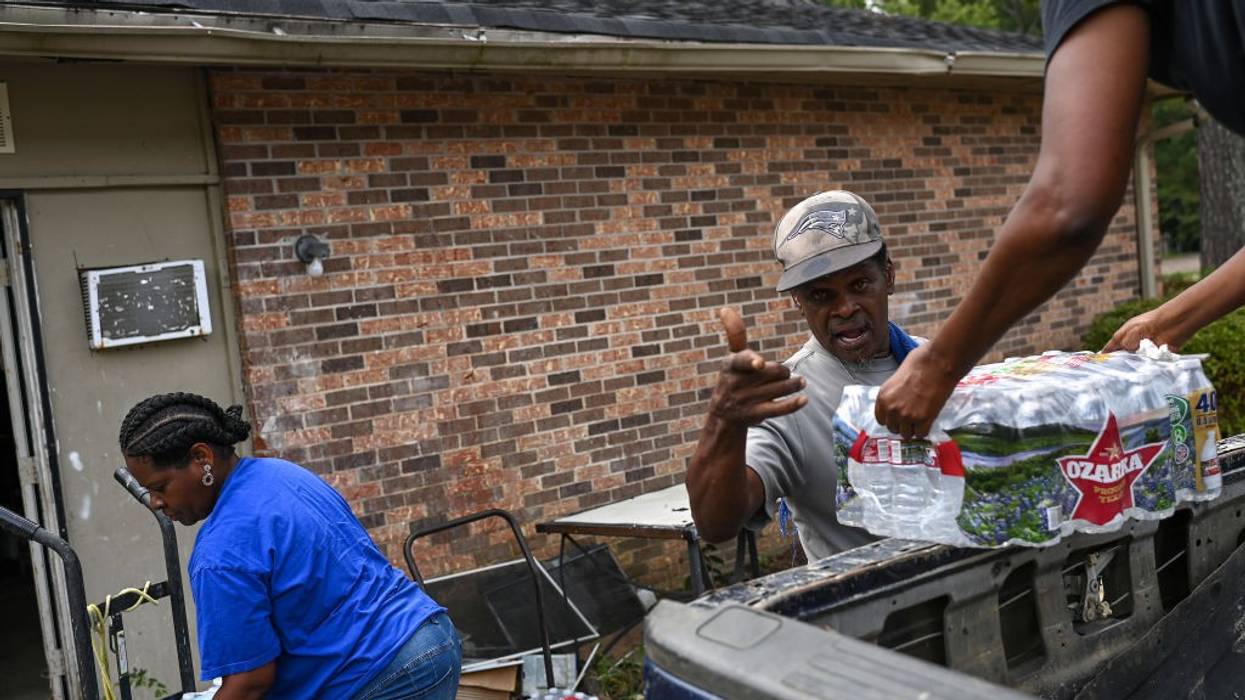
Water isn't a commodity to be sold to only those that can pay. It's a basic right our government must provide to all residents.
More than a decade ago, the United Nations declared that access to clean water and sanitation is a human right, underpinning all other goals for equality, health, and economic prosperity. The United States did not sign on. Today, on World Water Day, global leaders are gathering in New York to discuss progress towards this goal. It's the first time the UN Water Conference is being held in the U.S. and time for our nation to embrace the moral imperative: Water is a human right.
People tend to think of clean water and sanitation access as issues for countries with the lowest GDPs. Yet, more than 2 million U.S. residents live without safe running water or a working toilet. Millions more experience water shutoffs because of unaffordable water and sewer bills, and climate change threatens reliable access to clean water for many more communities. The water access gap also costs our national economy more than $8 billion a year.
But the toll is human. From Detroit to California's Central Valley, people are sick and dying when we fail to prioritize access to clean water, public health, and safety. This dire situation led a UN expert investigator to visit these two hot spots for U.S. water challenges: water shutoffs, unaffordable bills, and contaminated water supplies.
From Detroit to California's Central Valley, people are sick and dying when we fail to prioritize access to clean water, public health, and safety.
In Michigan, the rate of water and sewer prices have increased by more than 400% for the poorest households since 1986, rising faster than wages and the cost of all other utility services. This steep rise led to widespread shutoffs, hurting people's ability to care for themselves and their families. After decades of predatory and racist shutoff practices, Detroit was actually one of the first utilities to stop shutting off water during the pandemic. But the moratorium on water shutoffs in the city ended in January, and now the community is pushing for inclusive affordability programs that keep people in their homes with their water running.
In California's Central Valley, groundwater pollution and overuse have left many communities with dry wells or water that is unsafe to drink. This forces low-income families to pay for their water twice: once for tap water they cannot drink and second for expensive trucked-in or bottled water so they can cook and bathe. Ten years ago, California recognized the human right to water, and is working to connect more communities to safe water supplies, but still has work to do on affordability as well as contamination.
Climate change is exacerbating economic inequalities and stressing water systems. Every year, extreme weather causes flooding, burst pipes, sewage spills, and other crises that force people out of their homes and put families on boil notices for months. The cost of building climate-resilient infrastructure or recovering from disaster only makes it harder for families to afford water, a deadly combination for low-income and communities of color in this country.
Fortunately, billions of dollars from the Bipartisan Infrastructure Law and Inflation Reduction Act are flowing to communities right now to fund safe and climate-resilient water systems. This is a great first step, but U.S. leaders must ensure these funds reach the communities that need them most, and then continue investing in our water and wastewater systems while keeping water affordable for all.
Water isn't a commodity to be sold to only those that can pay. It's a basic right our government must provide to all residents.
On World Water Day, policy makers have a job to do. We can make progress right now by getting water infrastructure dollars to places with the most pressing water injustices, like Detroit and the Central Valley, and funding water bill assistance for lower-income families. In the long run, we need to follow the leadership of local communities, sustain investment in our water systems, end water shutoffs, and make a national commitment to water affordability.
Only then can we say water is a human right in the United States.