SUBSCRIBE TO OUR FREE NEWSLETTER
Daily news & progressive opinion—funded by the people, not the corporations—delivered straight to your inbox.
5
#000000
#FFFFFF
To donate by check, phone, or other method, see our More Ways to Give page.
Daily news & progressive opinion—funded by the people, not the corporations—delivered straight to your inbox.
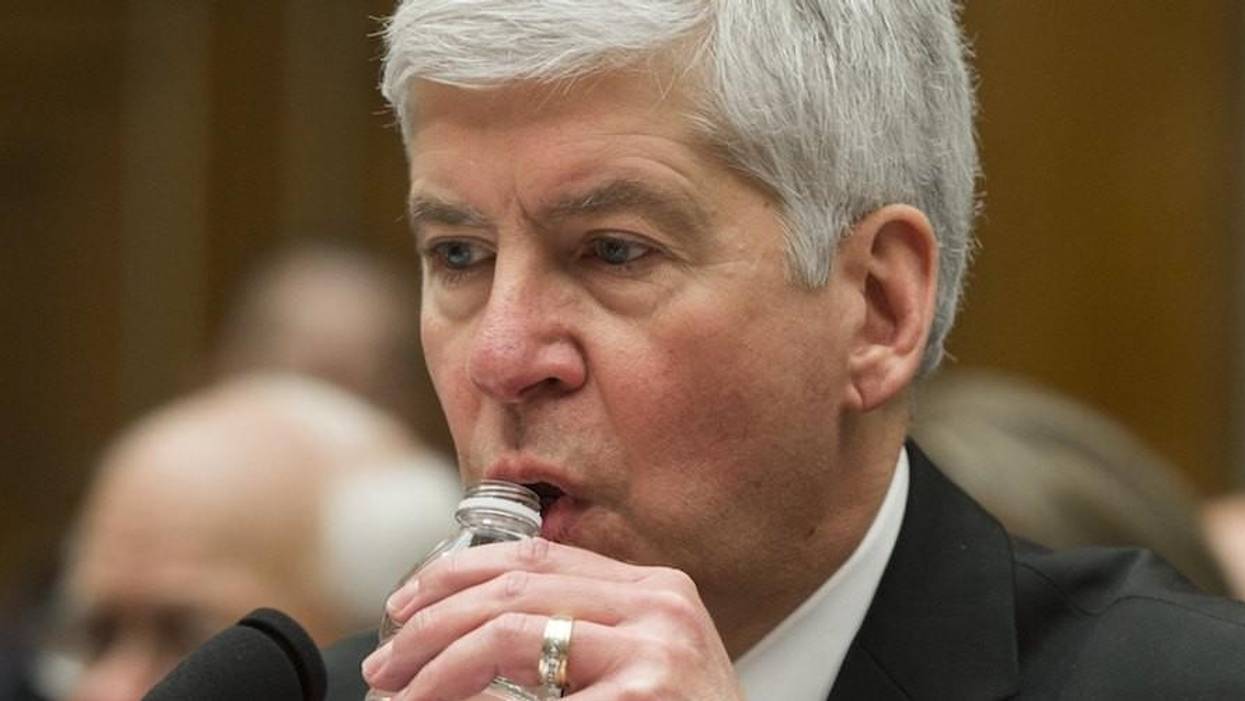
VICE on Thursday published an "astounding" and "important" exclusive report on how Rick Snyder, a Republican who served as Michigan's governor from 2011 to 2019, "knew about Flint's toxic water--and lied about it."
The report, based on a year-and-a-half investigation, comes almost six years after an emergency manager appointed by Snyder switched Flint's water supply from Detroit's system to the Flint River. Since that move on April 25, 2014, city residents have endured health consequences resulting from a deadly Legionella pneumophila bacterial outbreak and exposure to heavy metals and cancer-causing contaminants.
As Jordan Chariton and Jenn Dize reported Thursday:
Hundreds of confidential pages of documents obtained by VICE, along with emails and interviews, reveal a coordinated, five-year cover-up overseen by Snyder and his top officials to prevent news of Flint's deadly water from going public--while there was still time to save lives--and then limit the damage after the crisis made global headlines.
All told, the waterborne bacterial disease may have killed at least 115 people in 2014 and 2015, and potentially more whose pneumonia wasn't officially considered Legionnaires' disease, the illness caused by Legionella. In addition to the outbreak, Flint's water supply was contaminated with lead and other heavy metals, harmful bacteria, carcinogens, and other toxic components. This wreaked havoc on Flint residents, leaving them with a laundry list of illnesses, including kidney and liver problems, severe bone and muscle pain, gastrointestinal problems, loss of teeth, autoimmune diseases, neurological deficiencies, miscarriages, Parkinson's disease, severe fatigue, seizures, and volatile mood disorders.
Beyond this, the long-term effects of heavy-metal poisoning takes years to develop, meaning many ill residents' conditions are worsening as the years go on. Many have said they still rely on bottled water to avoid using the water that comes through their pipes and into their homes, schools, and businesses.
The report detailed actions of local and state officials both leading up to and during the public health crisis, which continues today. It is based on interviews and documents from a criminal investigation of Snyder's administration that was led by special prosecutor Todd Flood from 2016 until last year, when newly elected state Attorney General Dana Nessel fired Flood and others.
The prosecution team led by Flood charged 15 Flint and Michigan officials with various crimes; seven of those cases were resolved with plea agreements. In January 2019, Nessel appointed Fadwa Hammoud as the state's solicitor general and assigned her to take over the Flint criminal cases.
In June, the state's prosecution team dismissed all pending criminal charges against the eight remaining defendants and launched a new probe based on concerns about the initial one. That decision, as Common Dreams reported, "elicited fresh concerns and demands for justice."
VICE noted that with Flint about to enter its sixth year of the water crisis, "the clock for justice is also ticking." Unless the Republican-controlled state legislature intervenes, the statute of limitations for filing new felony misconduct-in-office charges will run out next week. Chariton highlighted that detail in a series of tweets about the reporting Thursday.
In August, a pair of state legislators from Flint proposed legislation to extend the statute of limitations from six years to 10. Karen Weaver, then-mayor of Flint, expressed support for the proposal, declaring at the time that "there is no time limit that can be put on the amount of suffering that we have faced, nor the amount of pain as a result of the loss of life."
Weaver told VICE that the governor's office repeatedly dangled "a pot of money for different things" and pressured her to publicly claim that the city's water was safe. The outlet reported that "after repeated attempts by the Snyder administration to get Mayor Weaver to cooperate proved unsuccessful, the promised funding suddenly became unavailable."
The outlet added:
Weaver was even pressed to say the water in Flint's schools was safe to drink, according to former city government officials familiar with the administration's overtures to Weaver. Weaver didn't, and soon after, the remaining free water-bottle stations Flint residents relied on were prematurely shut down.
When the stations were shuttered, Weaver attempted to reopen them by turning to the $48.8 million rainy-day fund that was allocated to Flint from the state's 2017-2018 budget. But when Weaver looked, the money was gone. The Snyder administration had been using these funds--meant to be under Flint's control--to pay for the water stations.
In addition to detailing interactions between Weaver and the Snyder administration from the mayor's perspective, the report highlighted a few findings from the Flint criminal investigation documents:
Snyder and his attorneys did not respond to VICE's requests for comment. Several other officials named in the exhaustive report also declined to respond or comment, with some of them citing the ongoing criminal investigation.
The reporting provoked a fresh wave of criticism directed at government officials involved in the crisis and was published as the international community contends with a global pandemic that has infected more than two million people since late last year.
Sharing Chariton and Dize's Flint piece on Twitter Thursday, VICE senior editor Maxwell Strachan wrote that "coronavirus is the biggest story in the country, and rightfully so. But today, this enormous, exclusive, and damning story should be a very, very close second."
As evidence against the state government continues to accrue, Michigan House Democratic leader Tim Greimel on Wednesday became the first member of the state legislature to join a growing call for Gov. Rick Snyder's resignation over Flint's water contamination crisis.
"It's now clear that for over a year, the governor's top aides and advisers wrote thousands of emails relating to the Flint situation and that they held many meetings and had many conversations about Flint," said Greimel. "It is inconceivable that the governor wasn't aware of what was happening. In fact, the governor's own chief of staff came out last week and indicated that he had been keeping the governor informed all along the way."
"Governor Snyder is a criminal disguised as a public servant."
--Shaunna Thomas, UltraViolet
What's more, the Michigan Democratic Party revealed on Wednesday records obtained under Michigan's Freedom of Information Act suggest that the Snyder administration "forced Flint residents to continue drinking poisoned water due to a dirty deal it signed with the city's Emergency Manager in April 2015."
According to the Detroit Free Press, the state of Michigan prevented Flint from returning water from the Detroit water system to Lake Huron when it agreed to grant the city an emergency loan of $7 million in April 2015.
The deal was signed off on "even after alarm bells were going off all over the Governor's office that lead and Legionnaires' disease were poisoning families," said Brandon Dillon, chair of the Michigan Democratic Party.
"The Snyder administration effectively put a financial gun to the heads of Flint's families by using the emergency manager law to lock the city into taking water from a poisoned source," Dillon said. "While children were being poisoned, the Snyder administration was playing political power games."
Meanwhile, an email in ongoing data dumps shows that Snyder planned to discuss "Flint water" with top staffers in February 2015—nearly nine months before the governor said he knew about a water crisis in Flint.
Progress Michigan said Wednesday:
The message was sent on February 17, 2015 to the Rick for Michigan campaign email account -- rather than the official state email account -- of Allison Scott, the executive director to the governor, and shows that Rick Snyder wanted to personally discuss the "Flint water" situation with top officials in his administration, among other issues. The email seems to be proof that Gov. Snyder lied each and every time he claimed that his staff never brought the crisis to him and that it was not on his radar.
"Gov. Snyder wants us to believe that he knew nothing of the problems in Flint and that he was poorly served by his staffers. This email shows that Snyder was not only aware of the Flint Water Crisis but was concerned enough to discuss it with high-ranking staff in February of 2015," said Lonnie Scott, executive director of Progress Michigan.
"Every time Snyder is confronted with news about this crisis, his excuse has been that he didn't know--he can't say that this time."
--Lonnie Scott, Progress Michigan
"Every time Snyder is confronted with news about this crisis, his excuse has been that he didn't know--he can't say that this time," Scott continued. "This email is the smoking gun people have been looking for and proves that Snyder knew about and discussed the Flint water situation with top-level staffers months before taking any action."
Meanwhile, on Wednesday, the national women's advocacy organization UltraViolet announced it has placed full-page ads in three Michigan newspapers this week. The ads give residents and businesses a cut-out sign that they can put up in their homes and storefronts declaring, "Governor Snyder Not Welcome."
"Governor Snyder is a criminal disguised as a public servant," said UltraViolet co-founder Shaunna Thomas. "Snyder's actions have resulted in more than ten thousand children and pregnant women being exposed to dangerously toxic levels of lead that will cause severe brain, nervous system, and liver damage for their entire lives. This is unforgivable."
"Snyder must immediately resign and face criminal prosecution for poisoning the kids and families of Flint," Thomas declared.
Also Wednesday, a coalition of environmental and racial justice groups called on the Democratic National Committee to focus Sunday's debate, which will take place in Flint, solely on racial and environmental injustice.
"The poisoning of Flint epitomizes a larger national crisis of people of color being physically endangered and politically ostracized," said Color of Change executive director Rashad Robinson.
"We need to hear real plans for how to safeguard the people of Flint and other communities in peril from anyone who wants our vote," he said. "The Democratic Party has an opportunity to use their platform to elevate this necessary conversation, putting the voices of those most impacted front and center and hopefully building greater momentum for change."
Having notched Super Tuesday victories in Colorado, Minnesota, Oklahoma, and Vermont, the Bernie Sanders presidential campaign says it's "going all the way to the Democratic National Convention in Philadelphia and beyond."
The results in the 11 states that voted on March 1, seven of which went to Hillary Clinton, widened the former secretary of state's delegate lead against Sanders and reinforced her support among minority voters. Some even suggested that Clinton's solid Super Tuesday performance would increase pressure on Sanders to drop out of the race.
But at a rally Tuesday night with more than 4,000 supporters in his home state of Vermont--where he won resoundingly with 86 percent of the vote--and in a statement Wednesday morning, Sanders stressed his determination to carry his message to voters in all 50 states.
"At the end of tonight, 15 states will have voted, 35 states remain," he told the crowd in Burlington, where he once served as mayor. "And let me assure you, we are going to take our fight for economic justice, social justice, environmental sanity, and a world of peace to every one of those states."
"People should not underestimate us," Sanders' campaign manager Jeff Weaver added in an email to supporters late Tuesday night.
"By winning four states last night, including the general election swing state of Colorado, and many delegates, Bernie Sanders has shown that this campaign to take on a rigged political system and economy is gaining momentum," declared Ilya Sheyman, executive director of MoveOn.org Political Action. "There are still more than forty primaries and caucuses to go and MoveOn members are excited to continue to mobilize to support Bernie and turn out the progressive vote. Your zip code should not determine if your primary vote matters or not."
Meanwhile, even Clinton's narrow victory in Massachusetts was painted as a partial win for Sanders.
Clinton "was made a better candidate thanks to Bernie Sanders engaging her in a race to the top on popular economic populism issues like debt-free college, expanding Social Security, and jailing Wall Street bankers who break the law," said Adam Green, co-founder of the Progressive Change Campaign Committee (PCCC), in a statement Wednesday.
There's no denying that Sanders faces an uphill climb. "Democrats award delegates proportionally, which means Sanders would need to win by big margins in the remaining states to catch up," Harry Enten wrote at FiveThirtyEight.
Still, John Nichols wrote at The Nation on Wednesday, "Sanders won more states from Clinton in the Democratic contests on Super Tuesday than the combined efforts of Ted Cruz and Marco Rubio won from Donald Trump in the far more intensely covered Republican contest."
"That," he continued, "to borrow a phrase from Sanders, was 'pretty good'--especially because the Super Tuesday map was always seen as favoring Clinton."
Nichols continued:
If he hopes to level things out, Sanders must broaden his appeal to African-American and Latino voters, who will be a factor in many of the states where he must win in the weeks to come. He must also recognize that Clinton's pivot to a focus on fighting Trump is an example of not just smart but necessary, politics. Democratic primary and caucus voters want to hear about issues - especially the economic-and-social justice issues that have animated the Sanders campaign -- but they also want to be reassured that their party's nominee will have a message and a strategy that is sufficient to see off Donald Trump. Right now, Clinton is doing a very good job of providing that assurance - and it is helping her to have some very super Tuesdays.
To that very end, top Sanders strategists reportedly held a press briefing Wednesday morning highlighting Sanders' electability against Trump.
"The political revolution has begun," Sanders himself said Wednesday. "I look forward to a contest this fall between democracy and demagoguery, between ordinary Americans and the oligarchs. I look forward to the chance for our people-powered campaign to show Donald Trump that the United States of America belongs to all of us and not just billionaire bullies."
The Democrats will face off in two debates over the next 10 days, including one Sunday in Flint, Michigan. Earlier this year, Sanders called on Michigan Gov. Rick Snyder to resign for his administration's failure to deal with a lead-poisoning crisis that has sickened thousands of children in that city.
Michigan Governor Rick Snyder could have declared a state of emergency in Flint over its water contamination crisis months earlier than he did, according to new emails released Sunday that contradict the governor's defense of his delayed actions.
Snyder declared a state of emergency in Flint and Genesee County on January 5, months after acknowledging lead in the region's public water supply. He has repeatedly said he could not take action until local officials requested it, which Genesee County did on January 4.
However, a November 13 email from Michigan State Police (MSP) Captain Chris Kelenske, who also serves as the deputy state director of emergency management and homeland security, to Snyder's office reads, "As you know, the Governor can declare at any time, for any reason."
"The state will formally own the event if we put a Governor's Declaration in place," Kelenske wrote to Snyder's deputy legal counsel, Paul Smith. "This could be viewed as the state owning up to how the water issue was caused."
Previously released communications suggest that Snyder told state officials to suppress lead testing results and that the governor knew the water was toxic as far back as October 2014.
Kelenske also noted in the email that Snyder's office had not formally requested assistance. "A state declaration sets a precedent for issuing a state declaration for an infrastructure maintenance event," Kelenske wrote. "What if lead is found in other areas of the state's drinking water due to infrastructure issues? This action opens the door to any other jurisdiction with water quality issues."
State Sen. Jim Ananich (D-Flint) told the Detroit Free Press that the email is "further confirmation that there was much more concern about protecting the reputation of the governor and the state than there was protecting the citizens of Flint."
"It's infuriating," Ananich said.
Progress Michigan, a grassroots democracy group, wrote in a blog post on Monday, "This lie goes to the heart of Snyder's painfully slow and inadequate response to the Flint Water Crisis."
"Choosing to not declare a state of emergency in Flint further delayed critical resources to people who continue to struggle to get basic water needs met," the group stated. "Snyder needs to resign immediately. Revelation after revelation shows us just how badly he and his entire administration bungled the response to this crisis, which, he too, is responsible for creating."
Emails released Friday rekindled calls for Rick Snyder's resignation. They revealed that advisers to the Michigan governor knew Flint's water was toxic as early as October 2014.
"My Mom is a City resident. Nice to know she's drinking water with elevated chlorine levels and fecal coliform," the governor's chief legal counsel said in an email sent just three weeks before the Republican governor's re-election, according to the Detroit Free Press.
After examining over 500 emails released by the governor's office, the Detroit News reported that "[t]wo top advisers to Gov. Rick Snyder urged switching Flint back to Detroit's water system in October 2014, after General Motors Co. said the city's heavily chlorinated river water was rusting engine parts."
"There's no reasonable person who can believe at this point that every top adviser to Rick Snyder knew that there was an issue, but Snyder knew nothing," said Lonnie Scott, executive director of Lansing-based watchdog group Progress Michigan, in a press release. "At worst, he's been lying all along, and at best, he's the worst manager on the planet. Under either scenario, he's clearly unfit to lead our state and should resign immediately."
The Detroit Free Press reported that Valerie Brader, deputy legal counsel, and senior policy adviser to Snyder, in her email argued:
[...] for returning the city to Detroit's system drawn from Lake Huron, saying it made economic and environmental sense for an "urgent matter to fix." She cited bacterial contamination in the treated river water and reduced quality that caused "GM to leave due to rusted parts."
[...] Michael Gadola, then the governor's legal counsel, echoed those concerns in an e-mail responding to Brader and sent to the governor's top aides. He called using the Flint River as a drinking water source "downright scary."
Flint "should try to get back on the Detroit system as a stopgap ASAP before this thing gets too far out of control," Gadola wrote 12 minutes after Brader's e-mail.
These revelations came just weeks after prior releases of administration emails demonstrated that the governor had been explicitly informed of issues with Flint's water as far back as February 2015 and that his administration had attempted to suppress the lead testing results of Flint water in October 2015, as Common Dreams reported.
"Without question, Snyder and his entire administration have failed Flint and the residents of Michigan," Scott said. "We knew that there was a reason the Governor was refusing to release these documents, and now it is all too clear: to him, Flint families weren't as important as the bottom line on his spreadsheet. There are no more excuses and no more scapegoats. The Governor must resign."
As the Rust Belt city's water crisis continues, one public health expert is stressing that "the children of Flint remain in harm's way"--and suggests that the best response at the moment may be to consider temporary resettlement of the families affected.
Irwin Redlener, president and co-founder of Children's Health Fund, a professor at Columbia University's Mailman School of Public Health, and director of the National Center for Disaster Preparedness makes the argument in an op-ed published Wednesday at the Washington Post.
He acknowledges the task would be "unprecedented and complex" but states that doing so "needs to be on the table," as "some 9,000 young children may have been exposed to contaminated water" already. And because "lead is still leaching into the drinking water from corroded pipes, and we can't be certain that the widely distributed hardware store water filters, which need to be installed properly and replaced on schedule, will reliably keep the water safe," parents have no certainty that their children will be spared exposure to the poison.
Redlener suggests two things happen to make the community safe for children. Securing sufficient emergency funding to repair the damaged infrastructure swiftly is necessary, he writes. In addition, providing comprehensive health, education, and other support services for "every family with a potentially lead-affected child" is needed because "nobody can be certain that continued exposure to lead will not be a problem until all of the damaged pipes are replaced."
Until those things happen, "every additional day in a home with lead-contaminated water puts a young child at further risk," he writes.
Among those who is able to leave town is Flint native Ariana Hawk and her family. Hawk's three-year-old son became the face of the water crisis when he appeared on the cover of TIME magazine in January.
"I'm just getting impatient with using bottled water and stuff," she told the Detroit Free Press. "It's just frustrating. ... I can't do it."
Redlener's call for resettlement comes as liberal groups arrive in Lansing to deliver nearly one million signatures calling on Gov. Rick Snyder to resign over his role in the water crisis and as he and Flint Mayor Karen Weaver spar over the approach and speed to replacing the city's lead pipes.
Michigan Gov. Rick Snyder's successive emergency managers are now gone from Flint, but the wreckage of their rule there still pollutes many homes. The crisis in Flint is, on the surface, about water. In April 2014, the city switched from the Detroit water system, which it had used for more than 50 years, to the Flint River, ostensibly to save money. The Flint River water made people sick, and is likely to have caused disease that killed some residents. The corrosive water, left untreated, coursed through the city's water system, leaching heavy metals out of old pipes. The most toxic poison was lead, which can cause permanent brain damage. The damage to the people of Flint, the damage to the children who drank and bathed in the poisoned water, is incalculable. The water is still considered toxic to this day.
The Flint debacle also is about democracy. As a team of us from the "Democracy Now!" news hour traveled to Flint last weekend to report on the crisis, we received a text message from a native son of that city, Oscar-winning filmmaker Michael Moore. "Lead isn't the poison in Michigan. Fascism is," Michael wrote. "How do u toss a democratic election in the garbage and get away with it?"
Moore had just visited Flint to help organize a rally calling for the arrest of the governor. Rick Snyder ran for governor in 2010 as a fiscal conservative, and won in the tea-party wave of electoral victories that year. He pushed for a strengthened emergency-manager law, which would give him broader powers to take over city governments and school districts that were deemed (by a board that Snyder appointed) to be in a state of "financial emergency." The governor could then appoint an emergency manager with sweeping powers, overriding elected city councils and mayors, imposing severe austerity measures, selling off public assets and breaking existing contracts with labor unions. He did this primarily in black communities.
"We don't have just a water problem. We've got a democracy problem. We've got a dictatorship problem," Claire McClinton told me in Flint. She is a lifelong resident of the city, from a union family, and a lead organizer with the Democracy Defense League. She and her group were meeting just across the Flint city line at a restaurant in Flint Township, which never switched off the Detroit water. As they met, a woman approached them. Kawanne Armstrong was visibly upset, desperate to get clean water for her newborn grandson. Audrey Muhammad, one of those attending the meeting, offered her water that she had just bought for herself, which she had in her car. These two women, both, like 60 percent of Flint's residents, African-American, walked into the bitter cold to move gallon jugs of water from one car trunk to another. "It's for my grandson. He was born February 6. ... That's my concern," Armstrong told us.
We left that meeting and went to a Catholic church in Flint, where scores of people were preparing to head out, canvassing door to door to distribute water and water filters, and to assess the needs of each household. Union members from Detroit, social workers and plumbers from Ann Arbor, and many Flint residents were volunteering their time on a bitter-cold winter Saturday afternoon.
Last October, under enormous pressure, the governor was forced to switch Flint's water back to the Detroit source, but the damage to the pipes has been done, and toxins continue to leach into the water. Melissa Mays was in the church, as a founder of Water You Fighting For, an activist group. "All three of my sons are anemic now. They have bone pain every single day. They miss a lot of school because they're constantly sick. Their immune systems are compromised," she told us. She, too, is sick. "Almost every system of our bodies have been damaged." Despite her illness, she was out helping others.
The emergency manager is now gone, and the people of Flint have elected a mayor, Karen Weaver, who can actually represent them. She immediately declared a state of emergency, focusing national media attention on the crisis. She has demanded $55 million to jump-start the immediate repair of Flint's water system. Gov. Snyder has countered with a fund of $25 million, and insists that it be spent on contractors of his choice--conditions that Weaver rejects. "We're going to get rid of these lead pipes one house at a time, one street at a time, one neighborhood at a time, until they are all gone," Mayor Weaver said. "We cannot afford to wait any longer."
Two parallel investigations, state and federal, are underway in an attempt to determine if any crimes have been committed. The first step to healing Flint has been taken, though: the restoration of democratic control. All else will flow, like water, from that.
In the latest fallout from Flint, Michigan's public health crisis of lead poisoning its drinking water, Gov. Rick Snyder on Tuesday said he was "very sorry," and the state's top environmental official resigned. One advocacy group, however, says that full accountability and transparency for this "man-made catastrophe" are still absent.
That catastrophe began in April 2014, as the Rust Belt city was under control of an emergency manager, and it moved its water supply from the Detroit system to the Flint River without the proper corrosive controls. Lead leached from pipes, putting thousands of the city's children at risk of brain damage from the contamination and prompting local outcry. A local pediatrician has called it an "emergency" situation that is "alarming and gut-wrenching."
The latest developments are in response to initial findings released by a Snyder-appointed task force charged with looking into how and why the crisis occurred. The body put most of the blame on Michigan's environmental regulatory agency.
In a letter (pdf) addressed to Snyder, Flint Water Advisory Task Force members write, in part,
We believe the primary responsibility for what happened in Flint rests with the Michigan Department of Environmental Quality (MDEQ). Although many individuals and entities at state and local levels contributed to creating and prolonging the problem, MDEQ is the government agency that has responsibility to ensure safe drinking water in Michigan. It failed in that responsibility and must be held accountable for that failure.
The letter goes on to fault a "minimalist approach" in the Office of Drinking Water and Municipal Assistance (ODWMA) at MDEQ "to regulatory and oversight responsibility [that] is unacceptable and simply insufficient to the task of public protection"; and states that the "agency's response [to public concerns] was often one of aggressive dismissal, belittlement, and attempts to discredit these efforts and the individuals involved."
It further states that the agency's decision not to call for "optimized corrosion control treatment" as per the federal Lead and Copper rule "led directly to the contamination of the Flint water system."
On Tuesday, both Dan Wyant, director of the MDEQ, and Brad Wurfel, DEQ spokesman, resigned.
Synder said in a media statement that it was "appropriate to accept " Wyant's resignation, adding, "I want the Flint community to know how very sorry I am that this has happened. And I want all Michigan citizens to know we will learn from this experience."
He acknowledged that "many Flint citizens are angry and want more than an apology." He said, "When it comes to matters of health and quality of life, we're committed to doing everything we can to protect the well-being of our citizens."
But the Lansing-based group Progress Michigan says that the people of Flint still need justice.
"So far, under Gov. Rick Snyder's watch, there has been zero accountability in this crisis, and that continues today," said Lonnie Scott, executive director of Progress Michigan. "Dan Wyant gets to walk away from this crisis, but the people of Flint do not. There's a lot we don't know about this man-made catastrophe.
"What did Gov. Snyder know, and when did he know it? We need complete transparency so that justice for the families of Flint can be realized and the proper people can be held accountable. All documentation related to this crisis needs to be released to the public immediately," Scott stated.