

SUBSCRIBE TO OUR FREE NEWSLETTER
Daily news & progressive opinion—funded by the people, not the corporations—delivered straight to your inbox.
5
#000000
#FFFFFF
To donate by check, phone, or other method, see our More Ways to Give page.
Daily news & progressive opinion—funded by the people, not the corporations—delivered straight to your inbox.
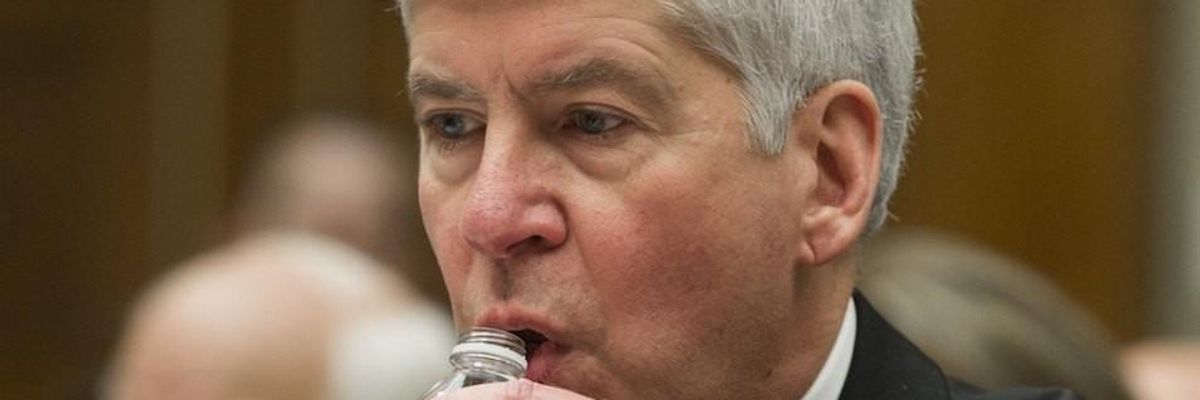
Former Michigan Gov. Rick Snyder (R) testifies on the tainted water scandal in the city of Flint, Michigan, during a House Oversight and Government Reform Committee hearing on Capitol Hill in Washington, DC, March 17, 2016.
VICE on Thursday published an "astounding" and "important" exclusive report on how Rick Snyder, a Republican who served as Michigan's governor from 2011 to 2019, "knew about Flint's toxic water--and lied about it."
The report, based on a year-and-a-half investigation, comes almost six years after an emergency manager appointed by Snyder switched Flint's water supply from Detroit's system to the Flint River. Since that move on April 25, 2014, city residents have endured health consequences resulting from a deadly Legionella pneumophila bacterial outbreak and exposure to heavy metals and cancer-causing contaminants.
As Jordan Chariton and Jenn Dize reported Thursday:
Hundreds of confidential pages of documents obtained by VICE, along with emails and interviews, reveal a coordinated, five-year cover-up overseen by Snyder and his top officials to prevent news of Flint's deadly water from going public--while there was still time to save lives--and then limit the damage after the crisis made global headlines.
All told, the waterborne bacterial disease may have killed at least 115 people in 2014 and 2015, and potentially more whose pneumonia wasn't officially considered Legionnaires' disease, the illness caused by Legionella. In addition to the outbreak, Flint's water supply was contaminated with lead and other heavy metals, harmful bacteria, carcinogens, and other toxic components. This wreaked havoc on Flint residents, leaving them with a laundry list of illnesses, including kidney and liver problems, severe bone and muscle pain, gastrointestinal problems, loss of teeth, autoimmune diseases, neurological deficiencies, miscarriages, Parkinson's disease, severe fatigue, seizures, and volatile mood disorders.
Beyond this, the long-term effects of heavy-metal poisoning takes years to develop, meaning many ill residents' conditions are worsening as the years go on. Many have said they still rely on bottled water to avoid using the water that comes through their pipes and into their homes, schools, and businesses.
The report detailed actions of local and state officials both leading up to and during the public health crisis, which continues today. It is based on interviews and documents from a criminal investigation of Snyder's administration that was led by special prosecutor Todd Flood from 2016 until last year, when newly elected state Attorney General Dana Nessel fired Flood and others.
The prosecution team led by Flood charged 15 Flint and Michigan officials with various crimes; seven of those cases were resolved with plea agreements. In January 2019, Nessel appointed Fadwa Hammoud as the state's solicitor general and assigned her to take over the Flint criminal cases.
In June, the state's prosecution team dismissed all pending criminal charges against the eight remaining defendants and launched a new probe based on concerns about the initial one. That decision, as Common Dreams reported, "elicited fresh concerns and demands for justice."
VICE noted that with Flint about to enter its sixth year of the water crisis, "the clock for justice is also ticking." Unless the Republican-controlled state legislature intervenes, the statute of limitations for filing new felony misconduct-in-office charges will run out next week. Chariton highlighted that detail in a series of tweets about the reporting Thursday.
In August, a pair of state legislators from Flint proposed legislation to extend the statute of limitations from six years to 10. Karen Weaver, then-mayor of Flint, expressed support for the proposal, declaring at the time that "there is no time limit that can be put on the amount of suffering that we have faced, nor the amount of pain as a result of the loss of life."
Weaver told VICE that the governor's office repeatedly dangled "a pot of money for different things" and pressured her to publicly claim that the city's water was safe. The outlet reported that "after repeated attempts by the Snyder administration to get Mayor Weaver to cooperate proved unsuccessful, the promised funding suddenly became unavailable."
The outlet added:
Weaver was even pressed to say the water in Flint's schools was safe to drink, according to former city government officials familiar with the administration's overtures to Weaver. Weaver didn't, and soon after, the remaining free water-bottle stations Flint residents relied on were prematurely shut down.
When the stations were shuttered, Weaver attempted to reopen them by turning to the $48.8 million rainy-day fund that was allocated to Flint from the state's 2017-2018 budget. But when Weaver looked, the money was gone. The Snyder administration had been using these funds--meant to be under Flint's control--to pay for the water stations.
In addition to detailing interactions between Weaver and the Snyder administration from the mayor's perspective, the report highlighted a few findings from the Flint criminal investigation documents:
Snyder and his attorneys did not respond to VICE's requests for comment. Several other officials named in the exhaustive report also declined to respond or comment, with some of them citing the ongoing criminal investigation.
The reporting provoked a fresh wave of criticism directed at government officials involved in the crisis and was published as the international community contends with a global pandemic that has infected more than two million people since late last year.
Sharing Chariton and Dize's Flint piece on Twitter Thursday, VICE senior editor Maxwell Strachan wrote that "coronavirus is the biggest story in the country, and rightfully so. But today, this enormous, exclusive, and damning story should be a very, very close second."
Dear Common Dreams reader, It’s been nearly 30 years since I co-founded Common Dreams with my late wife, Lina Newhouser. We had the radical notion that journalism should serve the public good, not corporate profits. It was clear to us from the outset what it would take to build such a project. No paid advertisements. No corporate sponsors. No millionaire publisher telling us what to think or do. Many people said we wouldn't last a year, but we proved those doubters wrong. Together with a tremendous team of journalists and dedicated staff, we built an independent media outlet free from the constraints of profits and corporate control. Our mission has always been simple: To inform. To inspire. To ignite change for the common good. Building Common Dreams was not easy. Our survival was never guaranteed. When you take on the most powerful forces—Wall Street greed, fossil fuel industry destruction, Big Tech lobbyists, and uber-rich oligarchs who have spent billions upon billions rigging the economy and democracy in their favor—the only bulwark you have is supporters who believe in your work. But here’s the urgent message from me today. It's never been this bad out there. And it's never been this hard to keep us going. At the very moment Common Dreams is most needed, the threats we face are intensifying. We need your support now more than ever. We don't accept corporate advertising and never will. We don't have a paywall because we don't think people should be blocked from critical news based on their ability to pay. Everything we do is funded by the donations of readers like you. When everyone does the little they can afford, we are strong. But if that support retreats or dries up, so do we. Will you donate now to make sure Common Dreams not only survives but thrives? —Craig Brown, Co-founder |
VICE on Thursday published an "astounding" and "important" exclusive report on how Rick Snyder, a Republican who served as Michigan's governor from 2011 to 2019, "knew about Flint's toxic water--and lied about it."
The report, based on a year-and-a-half investigation, comes almost six years after an emergency manager appointed by Snyder switched Flint's water supply from Detroit's system to the Flint River. Since that move on April 25, 2014, city residents have endured health consequences resulting from a deadly Legionella pneumophila bacterial outbreak and exposure to heavy metals and cancer-causing contaminants.
As Jordan Chariton and Jenn Dize reported Thursday:
Hundreds of confidential pages of documents obtained by VICE, along with emails and interviews, reveal a coordinated, five-year cover-up overseen by Snyder and his top officials to prevent news of Flint's deadly water from going public--while there was still time to save lives--and then limit the damage after the crisis made global headlines.
All told, the waterborne bacterial disease may have killed at least 115 people in 2014 and 2015, and potentially more whose pneumonia wasn't officially considered Legionnaires' disease, the illness caused by Legionella. In addition to the outbreak, Flint's water supply was contaminated with lead and other heavy metals, harmful bacteria, carcinogens, and other toxic components. This wreaked havoc on Flint residents, leaving them with a laundry list of illnesses, including kidney and liver problems, severe bone and muscle pain, gastrointestinal problems, loss of teeth, autoimmune diseases, neurological deficiencies, miscarriages, Parkinson's disease, severe fatigue, seizures, and volatile mood disorders.
Beyond this, the long-term effects of heavy-metal poisoning takes years to develop, meaning many ill residents' conditions are worsening as the years go on. Many have said they still rely on bottled water to avoid using the water that comes through their pipes and into their homes, schools, and businesses.
The report detailed actions of local and state officials both leading up to and during the public health crisis, which continues today. It is based on interviews and documents from a criminal investigation of Snyder's administration that was led by special prosecutor Todd Flood from 2016 until last year, when newly elected state Attorney General Dana Nessel fired Flood and others.
The prosecution team led by Flood charged 15 Flint and Michigan officials with various crimes; seven of those cases were resolved with plea agreements. In January 2019, Nessel appointed Fadwa Hammoud as the state's solicitor general and assigned her to take over the Flint criminal cases.
In June, the state's prosecution team dismissed all pending criminal charges against the eight remaining defendants and launched a new probe based on concerns about the initial one. That decision, as Common Dreams reported, "elicited fresh concerns and demands for justice."
VICE noted that with Flint about to enter its sixth year of the water crisis, "the clock for justice is also ticking." Unless the Republican-controlled state legislature intervenes, the statute of limitations for filing new felony misconduct-in-office charges will run out next week. Chariton highlighted that detail in a series of tweets about the reporting Thursday.
In August, a pair of state legislators from Flint proposed legislation to extend the statute of limitations from six years to 10. Karen Weaver, then-mayor of Flint, expressed support for the proposal, declaring at the time that "there is no time limit that can be put on the amount of suffering that we have faced, nor the amount of pain as a result of the loss of life."
Weaver told VICE that the governor's office repeatedly dangled "a pot of money for different things" and pressured her to publicly claim that the city's water was safe. The outlet reported that "after repeated attempts by the Snyder administration to get Mayor Weaver to cooperate proved unsuccessful, the promised funding suddenly became unavailable."
The outlet added:
Weaver was even pressed to say the water in Flint's schools was safe to drink, according to former city government officials familiar with the administration's overtures to Weaver. Weaver didn't, and soon after, the remaining free water-bottle stations Flint residents relied on were prematurely shut down.
When the stations were shuttered, Weaver attempted to reopen them by turning to the $48.8 million rainy-day fund that was allocated to Flint from the state's 2017-2018 budget. But when Weaver looked, the money was gone. The Snyder administration had been using these funds--meant to be under Flint's control--to pay for the water stations.
In addition to detailing interactions between Weaver and the Snyder administration from the mayor's perspective, the report highlighted a few findings from the Flint criminal investigation documents:
Snyder and his attorneys did not respond to VICE's requests for comment. Several other officials named in the exhaustive report also declined to respond or comment, with some of them citing the ongoing criminal investigation.
The reporting provoked a fresh wave of criticism directed at government officials involved in the crisis and was published as the international community contends with a global pandemic that has infected more than two million people since late last year.
Sharing Chariton and Dize's Flint piece on Twitter Thursday, VICE senior editor Maxwell Strachan wrote that "coronavirus is the biggest story in the country, and rightfully so. But today, this enormous, exclusive, and damning story should be a very, very close second."
VICE on Thursday published an "astounding" and "important" exclusive report on how Rick Snyder, a Republican who served as Michigan's governor from 2011 to 2019, "knew about Flint's toxic water--and lied about it."
The report, based on a year-and-a-half investigation, comes almost six years after an emergency manager appointed by Snyder switched Flint's water supply from Detroit's system to the Flint River. Since that move on April 25, 2014, city residents have endured health consequences resulting from a deadly Legionella pneumophila bacterial outbreak and exposure to heavy metals and cancer-causing contaminants.
As Jordan Chariton and Jenn Dize reported Thursday:
Hundreds of confidential pages of documents obtained by VICE, along with emails and interviews, reveal a coordinated, five-year cover-up overseen by Snyder and his top officials to prevent news of Flint's deadly water from going public--while there was still time to save lives--and then limit the damage after the crisis made global headlines.
All told, the waterborne bacterial disease may have killed at least 115 people in 2014 and 2015, and potentially more whose pneumonia wasn't officially considered Legionnaires' disease, the illness caused by Legionella. In addition to the outbreak, Flint's water supply was contaminated with lead and other heavy metals, harmful bacteria, carcinogens, and other toxic components. This wreaked havoc on Flint residents, leaving them with a laundry list of illnesses, including kidney and liver problems, severe bone and muscle pain, gastrointestinal problems, loss of teeth, autoimmune diseases, neurological deficiencies, miscarriages, Parkinson's disease, severe fatigue, seizures, and volatile mood disorders.
Beyond this, the long-term effects of heavy-metal poisoning takes years to develop, meaning many ill residents' conditions are worsening as the years go on. Many have said they still rely on bottled water to avoid using the water that comes through their pipes and into their homes, schools, and businesses.
The report detailed actions of local and state officials both leading up to and during the public health crisis, which continues today. It is based on interviews and documents from a criminal investigation of Snyder's administration that was led by special prosecutor Todd Flood from 2016 until last year, when newly elected state Attorney General Dana Nessel fired Flood and others.
The prosecution team led by Flood charged 15 Flint and Michigan officials with various crimes; seven of those cases were resolved with plea agreements. In January 2019, Nessel appointed Fadwa Hammoud as the state's solicitor general and assigned her to take over the Flint criminal cases.
In June, the state's prosecution team dismissed all pending criminal charges against the eight remaining defendants and launched a new probe based on concerns about the initial one. That decision, as Common Dreams reported, "elicited fresh concerns and demands for justice."
VICE noted that with Flint about to enter its sixth year of the water crisis, "the clock for justice is also ticking." Unless the Republican-controlled state legislature intervenes, the statute of limitations for filing new felony misconduct-in-office charges will run out next week. Chariton highlighted that detail in a series of tweets about the reporting Thursday.
In August, a pair of state legislators from Flint proposed legislation to extend the statute of limitations from six years to 10. Karen Weaver, then-mayor of Flint, expressed support for the proposal, declaring at the time that "there is no time limit that can be put on the amount of suffering that we have faced, nor the amount of pain as a result of the loss of life."
Weaver told VICE that the governor's office repeatedly dangled "a pot of money for different things" and pressured her to publicly claim that the city's water was safe. The outlet reported that "after repeated attempts by the Snyder administration to get Mayor Weaver to cooperate proved unsuccessful, the promised funding suddenly became unavailable."
The outlet added:
Weaver was even pressed to say the water in Flint's schools was safe to drink, according to former city government officials familiar with the administration's overtures to Weaver. Weaver didn't, and soon after, the remaining free water-bottle stations Flint residents relied on were prematurely shut down.
When the stations were shuttered, Weaver attempted to reopen them by turning to the $48.8 million rainy-day fund that was allocated to Flint from the state's 2017-2018 budget. But when Weaver looked, the money was gone. The Snyder administration had been using these funds--meant to be under Flint's control--to pay for the water stations.
In addition to detailing interactions between Weaver and the Snyder administration from the mayor's perspective, the report highlighted a few findings from the Flint criminal investigation documents:
Snyder and his attorneys did not respond to VICE's requests for comment. Several other officials named in the exhaustive report also declined to respond or comment, with some of them citing the ongoing criminal investigation.
The reporting provoked a fresh wave of criticism directed at government officials involved in the crisis and was published as the international community contends with a global pandemic that has infected more than two million people since late last year.
Sharing Chariton and Dize's Flint piece on Twitter Thursday, VICE senior editor Maxwell Strachan wrote that "coronavirus is the biggest story in the country, and rightfully so. But today, this enormous, exclusive, and damning story should be a very, very close second."

