

SUBSCRIBE TO OUR FREE NEWSLETTER
Daily news & progressive opinion—funded by the people, not the corporations—delivered straight to your inbox.
5
#000000
#FFFFFF
To donate by check, phone, or other method, see our More Ways to Give page.
Daily news & progressive opinion—funded by the people, not the corporations—delivered straight to your inbox.

"Donald Trump knows he can’t get these cuts through Congress, so he is illegally making them through the back door," said the House Budget Committee's top Democrat.
Elected Democrats—and even the Senate's top Republican appropriator—blasted President Donald Trump late Friday for rescinding nearly $1 billion in congressionally approved spending that the White House deemed "wasteful and harmful" through a legally contested process.
In a statement announcing what was targeted, the administration celebrated funding cuts for what it called "pro-illegal immigration programs," a "nefarious" Department of Justice subagency, a program that "propagates America Last climate alarmism," an office that promotes diversity, equity, and inclusion (DEI)—or "discrimination, and radical woke ideologies"—and more.
House Budget Committee Ranking Member Brendan Boyle (D-Pa.) responded in a statement that "Donald Trump knows he can't get these cuts through Congress, so he is illegally making them through the back door."
"Trump's actions are a blatant attack on Congress' constitutional power of the purse," he added. "It is exactly why we need to pass my Congressional Power of the Purse Act and stop any president from illegally overriding Congress."
The Associated Press reported that "under federal law, Congress has 45 days to review the president's proposed spending cuts before they take effect. But Trump made that all but impossible by announcing them with just five days left in the federal fiscal year and the House out of session through the November election."
Senate Budget Committee Ranking Member Jeff Merkley (D-Ore.) stressed on social media that "a pocket rescission is an illegal line-item veto. It is the president saying that he and he alone will convert a bipartisan spending bill (that has been signed into law) into a partisan spending bill. He is canceling the lines of spending he doesn't like."
"This violates the core separation of powers embedded in our Constitution in which it is the Congress, not the president, who decides what programs are designed and at what level they are funded," he continued. "Republican colleagues said they would never let this happen. Well, here it is. They should ask themselves: 'How would I like to have a Democratic president canceling out the Republican flavored programs he or she doesn't like in a bipartisan spending bill that has been signed into law?' If they have any integrity or any spine, they will join us in ending this practice."
Noting that the cuts will impact everything from critical health research, to combating the international illicit narcotics trade, Senate Appropriations Committee Vice Chair Patty Murray (D-Wash.) declared: "This is theft from the American people, plain and simple. These are funds Congress has delivered on a bipartisan basis and should be helping people—not cut off by a president more focused on building a ballroom than investing in families."
She specifically called out Office of Management and Budget (OMB) Director Russell Vought—a co-author of Project 2025, the Heritage Foundation-led blueprint for a right-wing overhaul of the federal government, who was recently condemned as an "unelected shadow president" by the House Democrat who introduced impeachment articles against him. According to Murray, "Every Republican who voted for these bills should be furious because Vought is saying their votes don't count."
Murray also pointed out that during negotiations for the recently enacted stopgap spending legislation, "Democrats fought to include language to prevent the Trump administration from once again usurping Congress' power—but for the second time in a year, Republicans refused to take common sense action and prevent this from happening."
"While Trump spends tax dollars on ads promoting himself, Congress needs to reassert its powers to help people, and it's past time Republicans join us in that fight," she argued. "Russ Vought's message to Congress is that your votes don't count, and your laws are optional. It is now time for my Republican colleagues who said they would never let this happen to stand up and join us to stop this, and remind this administration this is not how this works."
Senate Minority Leader Chuck Schumer (D-NY) emphasized the impact of the administration's move, saying that "Trump is gleefully eviscerating programs and protections that help hardworking American families live a safe and healthy life, all while he continues to punish them with skyrocketing gas and grocery prices."
"With this rescissions package, the Trump administration is illegally stripping nearly $1 billion in critical funding that supports kids, K-12 students, small businesses, and health and clean air research," he highlighted. "Americans are crying out for relief."
"Instead of ending his Iran War and tariff chaos that are driving up costs, Trump is rolling out the red carpet for our adversaries while stealing funds meant to help American families," he added. "Senate Democrats will challenge Trump's illegal cuts at every turn and continue the fight to help American families, lower healthcare costs and secure our communities."
The administration's rescission announcement came less than six weeks away from the midterm elections. Democrats aim to win majorities, while Trump's Republican Party is fighting to keep control of both chambers of Congress. One of the nationally watched races is that of Senate Appropriations Committee Chair Susan Collins (R-Maine).
As some congressional Republicans cheered the Friday action, Collins put out a statement denouncing it. She said that "without warning or consultation, Congress just received an $810 million package of pocket rescissions from the administration," which she called OBM's most recent attempt "to undermine Congress' constitutional power of the purse."
"This move shows that OMB intentionally withheld these funds for months to execute this unlawful cancellation of appropriations that were approved on a bipartisan basis and signed into law," Collins continued. "Not only is the delay itself an impoundment that was not reported to Congress, but also it is a usurpation of Congress' appropriations powers. OMB is an agency of the executive branch. It does not get to decide which programs are worth funding."
"The independent Government Accountability Office has concluded that pocket rescissions are unlawful and not permitted by the Impoundment Control Act," she added. "Any effort to rescind appropriated funds without congressional approval is a clear violation of the law. I will work with my colleagues to address these illegal actions."
While some Democrats had called for their Republican colleagues to make such promises, Sen. Chris Murphy (D-Conn.) fired back at Collins on social media, writing that "Senate Republicans had chance after chance to stop Trump's illegal seizure of taxpayer money. Time after time, they pledged allegiance to Trump instead of to citizens. And he'll keep rolling them if the Senate doesn't change hands."
So did Troy Jackson, the former Democratic Maine Senate president running to unseat Collins. He said that "Susan Collins voted for Trump's pick to lead the OMB. Now she’s surprised he's doing exactly what he promised to do? She's the appropriations chair who voted with Trump 96% of the time. Expressing concern isn't enough. Mainers see through the bullshit."
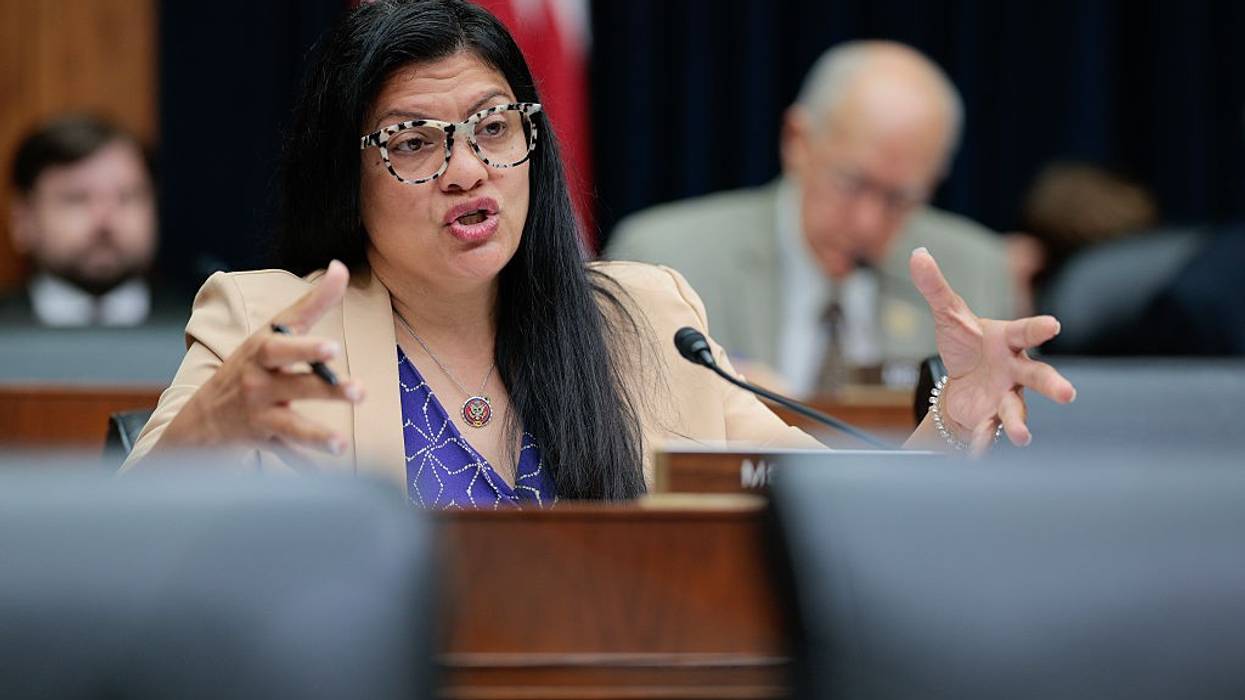
"Every year, Congress votes to invest in death and destruction instead of healthcare, housing, clean air and water, or ending child poverty here at home," said Rep. Rashida Tlaib.
The U.S. House passed legislation early Friday that would provide roughly $832 billion in funding for military programs for the coming fiscal year, a vote that came shortly after the chamber approved a $9 billion rescissions package that takes an axe to public media and foreign aid.
Five House Democrats—Reps. Don Davis of North Carolina, Jared Golden of Maine, Vicente Gonzalez of Texas, Adam Gray of California, and Marie Gluesenkamp Perez of Washington—joined most Republicans in voting for the military appropriations bill for fiscal year 2026. Just three Republicans voted no.
Rep. Rashida Tlaib (D-Mich.), who opposed the legislation along with other members of the Congressional Progressive Caucus, wrote on social media following the vote that "our country is obsessed with war."
"Every year, Congress votes to invest in death and destruction instead of healthcare, housing, clean air and water, or ending child poverty here at home," Tlaib continued. "I will not vote to send another $831.5 billion to the Pentagon."
Republican supporters of the legislation touted provisions that boost investments in the immensely wasteful F-35 and other aircraft, support "modernization of the nuclear triad," and allocate "approximately $13 billion for missile defense and space programs to augment and integrate in support of the Golden Dome effort."
"In the middle of the night, House Republicans just passed a bill that will dump billions into the Pentagon, the only agency that has NEVER passed an audit," wrote Rep. Pramila Jayapal (D-Wash.), who voted against the legislation. "If we want to actually cut spending—this is a good spot to start. Not by kicking 17 million Americans off their healthcare."
The measure's passage came as the House also worked on an authorization bill that would allow the U.S. military to spend the funds appropriated by lawmakers.
During a House Armed Services Committee hearing on the authorization bill earlier this week, the panel's Republican chairman—who has received millions of dollars in campaign cash from military contractors that benefit from an ever-increasing Pentagon budget—mocked Reps. Ro Khanna (D-Calif.) and Sara Jacobs (D-Calif.) for being the lone opponents of advancing the measure out of committee.
"I am used to the good-natured ribbing from my colleagues," Khanna wrote. "But I do not believe we need a $1 trillion budget to have a strong, modern defense. And I want to see more investment in good jobs at home than billions spent on more wars abroad."
WATCH: Armed Services members mock @RoKhanna for voting against the largest military budget in US history
All other @HASCDemocrats (except @RepSaraJacobs) voted to spend 1 TRILLION on war — even as working families continue to struggle across the country#NDAA @HASCRepublicans https://t.co/uKC9dB7m2J pic.twitter.com/d41N1KYJSO
— Just Foreign Policy (@justfp) July 16, 2025
The House's passage of the military funding bill came minutes after the chamber approved a White House-backed rescissions package that aims to claw back $9 billion in previously approved spending on public broadcasting and foreign assistance.
The rescissions bill now heads to President Donald Trump's desk for his signature.
Rep. Brendan Boyle (D-Pa.), the top Democrat on the House Budget Committee, said in a statement that "Republicans once again handed over the congressional power of the purse to Donald Trump and Russell Vought," the director of the Office of Management and Budget.
"This was never about exercising fiscal responsibility," said Boyle. "If it were, Republicans would never have passed their Big Ugly Law that adds trillions to the national debt with massive tax breaks for billionaires. This was about caving to Trump."
The budget law Boyle referenced also included more than $150 billion for the Pentagon, pushing U.S. military spending above $1 trillion.
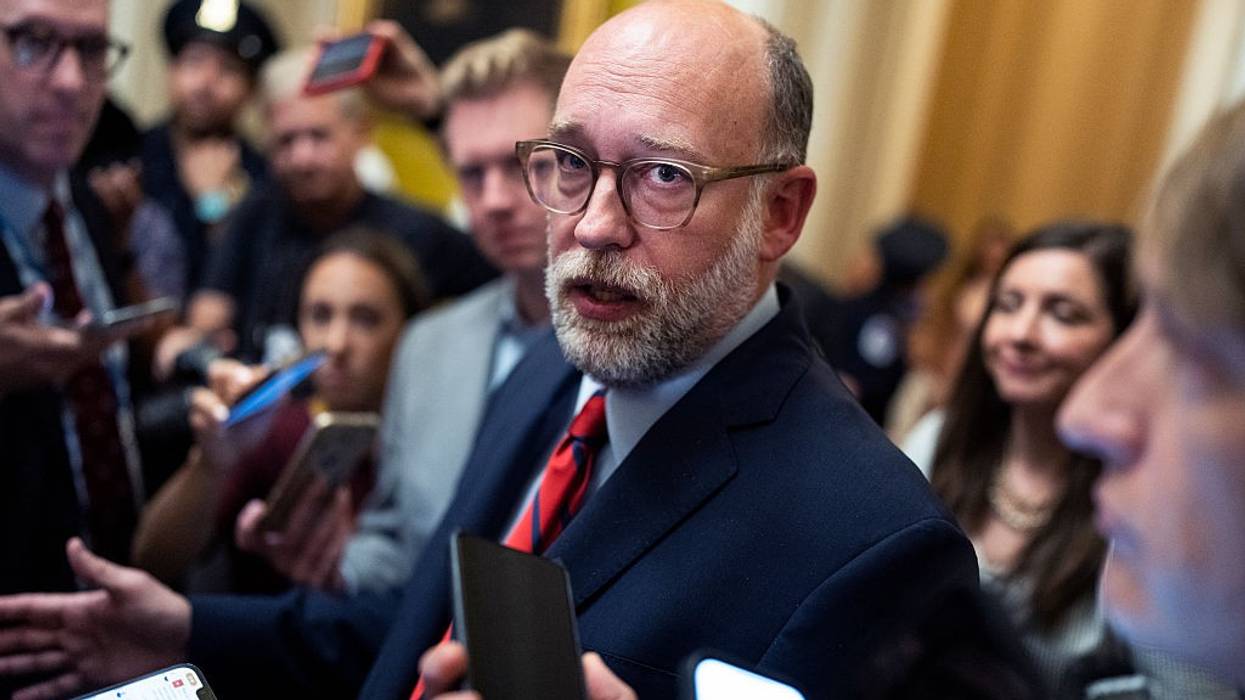
"At 2 am, Republicans just passed a bill to defund public broadcasting and lifesaving aid because Trump told them to—they wouldn't even protect rural radio or emergency alerts."
In the early hours of Thursday morning, Senate Republicans passed legislation that would claw back $9 billion in previously approved congressional funding for public broadcasting and foreign aid programs targeted by President Donald Trump's White House.
The final vote count was 51 to 48, with Sens. Susan Collins (R-Maine) and Lisa Murkowski (R-Alaska) joining Democrats in opposing the package, which now heads back to the GOP-controlled House for final passage. The legislation would cement some of the Trump administration's lawless, unilateral attacks on programs approved by Congress with bipartisan support.
"At 2 am, Republicans just passed a bill to defund public broadcasting and lifesaving aid because Trump told them to—they wouldn't even protect rural radio or emergency alerts," said Sen. Patty Murray (D-Wash.), the vice chair of the Senate Appropriations Committee, warning that the GOP's partisan clawback of funding imperils all future spending negotiations.
"Congress should decide what we spend and what we cut—not Trump and not Russ Vought," Murray added, referring to the director of the Office of Management and Budget (OMB).
In a floor speech ahead of the Thursday morning vote, Murray said Vought refused to be specific about which programs would be cut if the rescissions bill passes.
"It's one of the great outrages of this package," said Murray. "At our hearing with him, he refused to go into detail. He stonewalled us. We asked and we asked. The chair, the Republican chair, even asked him about this. But OMB would not tell us. The question is: What will you cut? The answer has been: Pass it, we'll see."
"The thing that's particularly dangerous about it is that this is probably a test case. If they pull it off with these topics, they'll move on to more and more and more topics."
The White House rescissions request was broadly outlined in a May memo authored by Vought, an architect of the far-right Project 2025 agenda.
The Corporation for Public Broadcasting, which helps fund PBS and NPR, is expected to face over $1 billion in cuts, while the rest of the rescissions package targets foreign assistance.
"With this vote, Senate Republicans are telling us everything we need to know about their priorities," said Alex Jacquez, the Groundwork Collaborative's chief of policy and advocacy. "After passing a tax law that gives a massive giveaway to billionaires and raises costs on working families, Senate Republicans are now codifying DOGE's deeply unpopular and reckless cuts to vital programs. Once again, Republicans are failing to deliver on the one thing they promised: lower prices. Instead, they're waging a campaign that will make life more expensive and difficult for working families while lining the pockets of the wealthy."
During the marathon amendment process, Republicans rejected Democratic proposals to shield public safety alerts and prevent cuts to international disaster relief programs.
Vought has signaled that the White House will likely submit more rescissions requests if the $9 billion in cuts make it through Congress.
Kate Riley, the president and CEO of America's Public Television Stations, said in a statement following the Senate vote that the rescissions bill would "eliminate federal funding to the local public television stations throughout this country that provide essential lifesaving public safety services, proven educational services, and community connections to their communities every day for free."
"This elimination of federal funding will decimate public media and put local stations at risk of going dark, cutting off service to communities that rely on them—many of which have no other access to locally controlled media," Riley warned.
Sen. Sheldon Whitehouse (D-R.I.) accused Republicans of weaponizing the rescissions process to attack "some of their favorite enemies, like National Public Radio, Elmo, or food for starving people overseas."
"The thing that's particularly dangerous about it is that this is probably a test case," Whitehouse added. "If they pull it off with these topics, they'll move on to more and more and more topics, bringing their Musk-type chainsaw to projects which Congress has approved on a bipartisan basis, put into law, and funded."
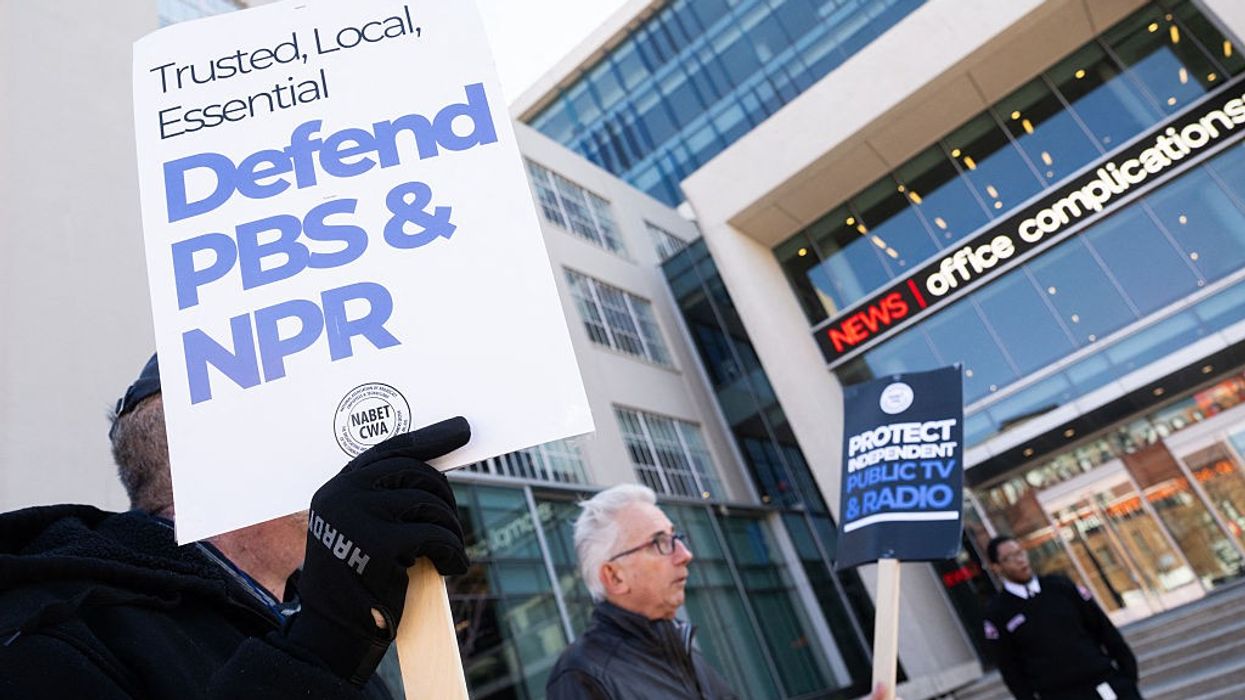
The bill threatens "emergency alerts that save lives, local journalism that informs communities, and educational tools that support families, job seekers, and teachers," according to Protect My Public Media.
The Republican-controlled U.S. Senate is on the verge of stripping more than a billion dollars from the Corporation for Public Broadcasting, which could decimate local news stations.
On Tuesday, the chamber voted 50-50, with a tie broken by Vice President JD Vance to move forward with debate on the package, which is underway as of Wednesday morning.
Three Republicans—Sens. Susan Collins (R-Maine), Lisa Murkowski (R-Alaska), and Mitch McConnell (R-Ky.)—joined Democrats in opposition.
If passed, the bill would codify President Donald Trump's illegal impoundment of more than $9 billion in funds that were already appropriated by Congress.
Defenders of public media have mobilized a last-ditch effort to stop the bill, which strips more than $1.1 billion from the CPB, which includes cuts to NPR and PBS.
The progressive group Our Revolution on Tuesday delivered more than 70,000 petitions to the Senate urging them it to vote against the bill's advancement.
"This is a coordinated, authoritarian attempt to silence dissent and dismantle the public good—not 'fiscal policy,'" the group said in a post on social media.
Despite the bill's advancement to the debate stage, the group Protect My Public Media says that the cuts can still be stopped.
"Changes to the bill are still possible," the group said. "Now is the time to urge your senators to remove the proposal targeting public media from the package."
"Taking back this funding—just $1.60 per person per year—wouldn't simply force stations to scale back," the group continued. "It would dismantle services that millions rely on every day: emergency alerts that save lives, local journalism that informs communities, and educational tools that support families, job seekers, and teachers. In many rural and underserved areas, the loss could be total. Some stations may be forced off the air entirely, leaving entire communities without access to essential information."
Legislators have similarly warned about the bill's devastating effects on local news.
This was highlighted in a letter sent Tuesday by Congressional Asian Pacific American Caucus Chair Grace Meng (D-N.Y.), Congressional Black Caucus Chair Yvette Clarke (D-N.Y.), and Congressional Hispanic Caucus Chair Adriano Espaillat (D-N.Y.).
"The federal government is the largest single funding source for public television and radio stations," the letter said. "CPB's elimination would decimate public media infrastructure, as the vast majority of its funding goes directly to local stations, many of which rely on it for over half their operating budgets."
More than 70% of CPB funding goes to local news and radio stations, according to its website. This funds more than 1,500 locally-owned public radio and television stations. Around half of those are in rural areas, which are often "news deserts" that lack other sources of regular coverage.
Murkowski, one of three Republicans who voted against the bill Tuesday, noted this at a Senate Appropriations hearing last month. Speaking about public news stations in her home state of Alaska, she said, "[A]lmost to a number, they're saying that they will go under if public broadcasting funds are no longer available to them."
In May, NPR President and CEO Katherine Maher disputed the Republican characterization of these cuts as a cost-saving measure.
"This is not about balancing the federal budget," she said. "The appropriation for public broadcasting, including NPR and PBS, represents less than 0.0001% of the federal budget."
Rather, she said, it's an investment in a local news ecosystem that pays off in the long-run.
"Every $1 of federal funding generates $7 from local sources," she said, "enabling stations to produce local journalism, support local and regional music and arts, and develop creative, informative, and entertaining programming for distribution across the nation."
The plan to cut public broadcast funding is overwhelmingly unpopular. In a poll conducted by Data for Progress last week, just 21% of voters said they wanted to defund public broadcasting including NPR and PBS, compared with 67% who said they wanted to either keep funding at its current levels or increase it.
The Senate vote on whether to pass the rescissions package could take place Wednesday following debate and amendment votes. Should it pass, it will return to the House, where the deadline for its passage is Friday.
Though it moved on to the debate stage Tuesday, just one more Republican defector could force the bill's cuts to public broadcasting to be revised.
"Now it's our job to speak up and make sure the Senate hears us," said Protect My Public Media in a final urgent plea. "Pulling back support from local stations would leave communities less safe, children less prepared for school, and all of us less connected."
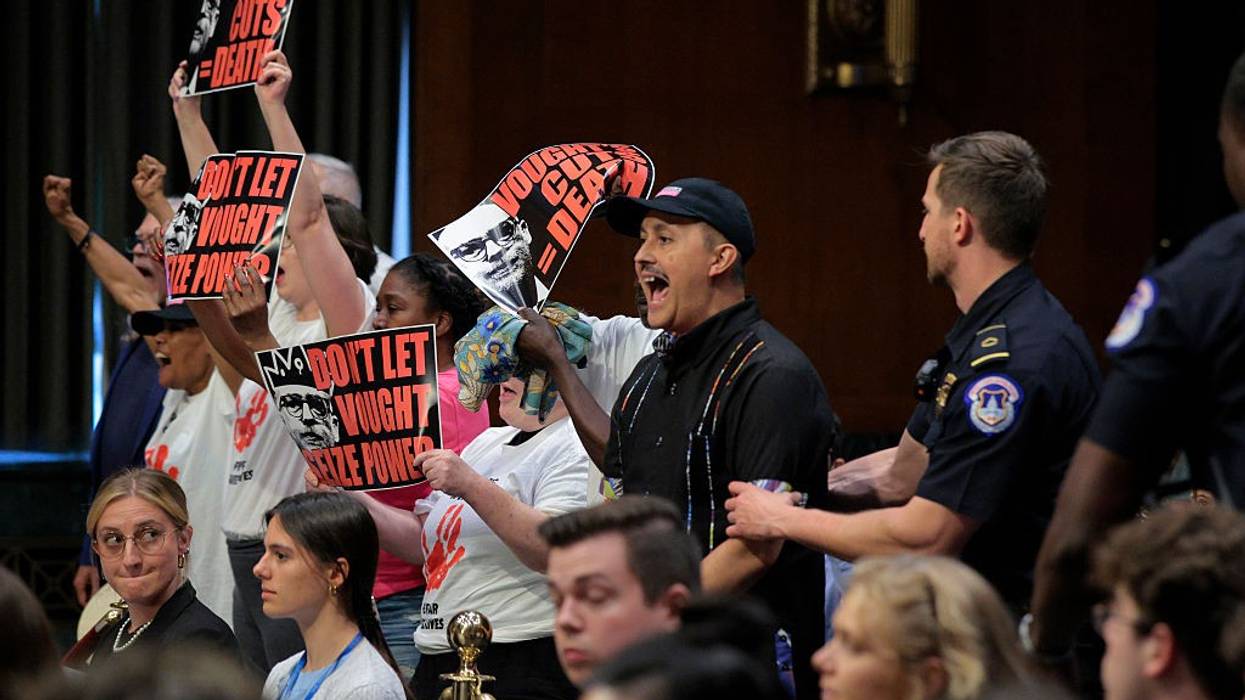
One humanitarian leader pointed out that the bill contains $1.3 billion in cuts to initiatives "every bit as lifesaving" as the AIDS prevention program that Republicans spared amid public pressure.
Progressives and public health advocates on Tuesday were among those urging U.S. senators to vote against Republican legislation that would let President Donald Trump claw back billions of dollars already appropriated by Congress, even as GOP lawmakers ditched plans to cut funding for an HIV-AIDS prevention program that has saved tens of millions of lives in Africa.
Politico reported that Senate Republicans will remove $400 million in funding cuts to the President's Emergency Plan For AIDS Relief (PEPFAR), an initiative of former President George W. Bush credited with saving more than 25 million lives in Africa since its implementation in 2003.
However, the rescission package—a version of which was passed last month by the House of Representatives—still includes $1.3 billion in cuts to humanitarian aid programs that Jeremy Konyndyk, president of the advocacy group Refugees International, called "every bit as lifesaving as PEPFAR."
These include programs to fund public health, emergency food and shelter assistance, peacekeeping, economic development, and other essential aid that helps stabilize war- and disaster-stricken populations in the Global South.
"Even though the Senate has removed $400 million in PEPFAR funding from the rescissions package, another $500 million in global health funding could still be cut," Think Global Health managing editor Nsikan Akpan noted Tuesday.
Office of Management and Budget Director Russell Vought said Tuesday that the White House has agreed to an exemption for PEPFAR funding via a substitute amendment.
"It's substantially the same package and the Senate has to work its will and we've appreciated the work along the way to get to a place where they've got the votes," he explained.
Jacob Leibenluft and Devin O'Connor, respectively senior adviser and senior fellow at the Washington, D.C.-based Center on Budget and Policy Priorities, noted that in addition to cuts to critical programs, the rescission package, combined with the Trump administration's wider campaign of unlawfully impounding funds, "could also make it far more difficult for Congress to fund the government in a bipartisan way in the future."
As the pair explained:
Most of the funds in the rescission package were enacted in March legislation that was passed by Congress—including on a bipartisan basis in the Senate—and signed into law by the president to fund the government for the rest of fiscal year 2025. To provide the 60 votes required to avoid a Senate filibuster, at least eight Democratic senators needed to join with 52 Republican senators to invoke cloture on the funding bill.
But presidential rescission requests operate under different rules and require only 51 votes to pass the Senate, so no Democratic votes are needed. If the Senate approves the package (which passed the House on a party-line vote), this would show that Republicans could quickly revise on a partisan basis, with merely 51 votes in the Senate, a bipartisan funding agreement reached only a few months earlier that required support from no fewer than 60 senators.
"Senators should keep those consequences in mind as they consider the president's current rescission request," Leibenluft and O'Connor advised.
The consumer advocacy group Public Citizen cited both PEPFAR and the billions of dollars in other cuts to foreign aid contained in the package as reasons to oppose it.
Sen. Bernie Sanders (I-Vt.) took aim at the bill's $1.1 billion in cuts to the Corporation for Public Broadcasting (CPB), which funds PBS and NPR.
"Like all authoritarians, Trump doesn't like criticism or objective reporting. He just wants flattery," the senator said on social media. "That's why he wants to defund NPR and PBS. We need media in this country that is not owned by billionaires and corporate interests. I will vote to support public broadcasting."
The chairs of the Congressional Tri-Caucus—Congressional Asian Pacific American Caucus Chair Grace Meng (D-N.Y.), Congressional Black Caucus Chair Yvette Clarke (D-N.Y.), and Congressional Hispanic Caucus Chair Adriano Espaillat (D-N.Y.)—on Tuesday led a letter urging senators to reject the rescissions bill due to CPB cuts.
"CPB's elimination would decimate public media infrastructure, as the vast majority of its funding goes directly to local stations, many of which rely on it for over half their operating budgets," the lawmakers wrote. "In rural and tribal areas, this would shut down stations that serve as lifelines for public safety, education, and culturally relevant programming. Eighty percent of Native American and Alaska Native communities are rural or remote, and public television is often the only station reaching them consistently."
Polling published Tuesday by Data for Progress revealed that the proposed cuts in the rescission package are deeply unpopular, with a majority of respondents saying that funding for global health programs, public broadcasting, and developmental aid should be maintained at current levels or increased.
NEW: As Senate Republicans approach the Friday deadline to pass Trump’s rescissions package, voters reject the proposed billions of dollars in cuts to global aid and public broadcasting.We find that less than 30% of voters want cuts to these programs.www.dataforprogress.org/datasets/pol...
[image or embed]
— Data for Progress (@dataforprogress.org) July 15, 2025 at 6:54 AM
GOP senators—who are under pressure, as the proposed cuts must be approved by Friday under the Impoundment Control Act (ICA) of 1974, the law they are using to skirt a Democratic filibuster—say they hope to pass the entire package before next month's summer recess.
On Monday, a coalition of 24 states and the District of Columbia sued the Trump administration, alleging it violated the ICA and demanding the release of $6.8 billion in approved education funds that the suit argues have been illegally withheld.
"Courts across the country have made it clear to Donald Trump that he and his administration do not have the authority to unilaterally block funding that Congress has already approved," Democratic Michigan Attorney General Dana Nessel said in a statement. "These education grants are designed to help Michigan students thrive. By freezing them, the Trump White House is not just breaking the law but jeopardizing our kids' future."