

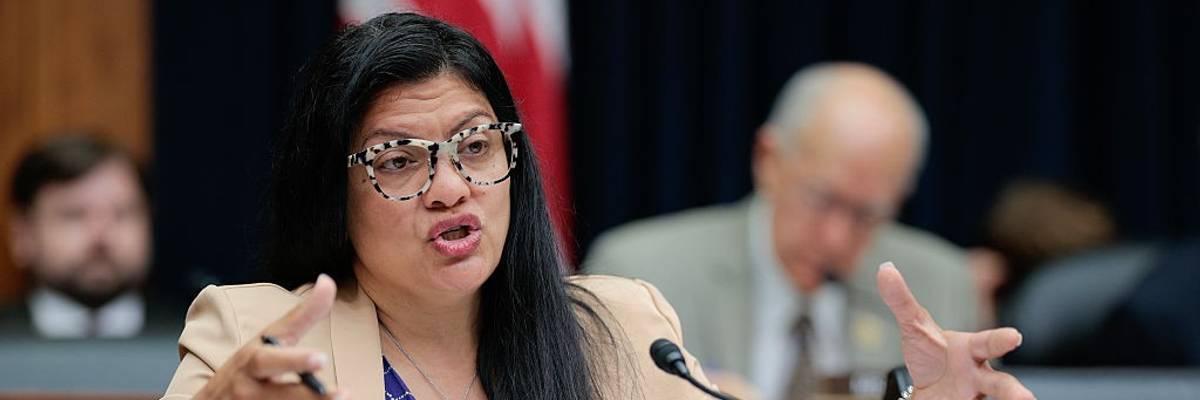
U.S. Rep. Rashida Tlaib (D-Mich.) speaks during a hearing on Capitol Hill on June 24, 2025.
'Our Country Is Obsessed With War,' Tlaib Says as House Approves $832 Billion Military Bill
"Every year, Congress votes to invest in death and destruction instead of healthcare, housing, clean air and water, or ending child poverty here at home," said Rep. Rashida Tlaib.
The U.S. House passed legislation early Friday that would provide roughly $832 billion in funding for military programs for the coming fiscal year, a vote that came shortly after the chamber approved a $9 billion rescissions package that takes an axe to public media and foreign aid.
Five House Democrats—Reps. Don Davis of North Carolina, Jared Golden of Maine, Vicente Gonzalez of Texas, Adam Gray of California, and Marie Gluesenkamp Perez of Washington—joined most Republicans in voting for the military appropriations bill for fiscal year 2026. Just three Republicans voted no.
Rep. Rashida Tlaib (D-Mich.), who opposed the legislation along with other members of the Congressional Progressive Caucus, wrote on social media following the vote that "our country is obsessed with war."
"Every year, Congress votes to invest in death and destruction instead of healthcare, housing, clean air and water, or ending child poverty here at home," Tlaib continued. "I will not vote to send another $831.5 billion to the Pentagon."
Republican supporters of the legislation touted provisions that boost investments in the immensely wasteful F-35 and other aircraft, support "modernization of the nuclear triad," and allocate "approximately $13 billion for missile defense and space programs to augment and integrate in support of the Golden Dome effort."
"In the middle of the night, House Republicans just passed a bill that will dump billions into the Pentagon, the only agency that has NEVER passed an audit," wrote Rep. Pramila Jayapal (D-Wash.), who voted against the legislation. "If we want to actually cut spending—this is a good spot to start. Not by kicking 17 million Americans off their healthcare."
The measure's passage came as the House also worked on an authorization bill that would allow the U.S. military to spend the funds appropriated by lawmakers.
During a House Armed Services Committee hearing on the authorization bill earlier this week, the panel's Republican chairman—who has received millions of dollars in campaign cash from military contractors that benefit from an ever-increasing Pentagon budget—mocked Reps. Ro Khanna (D-Calif.) and Sara Jacobs (D-Calif.) for being the lone opponents of advancing the measure out of committee.
"I am used to the good-natured ribbing from my colleagues," Khanna wrote. "But I do not believe we need a $1 trillion budget to have a strong, modern defense. And I want to see more investment in good jobs at home than billions spent on more wars abroad."
WATCH: Armed Services members mock @RoKhanna for voting against the largest military budget in US history
All other @HASCDemocrats (except @RepSaraJacobs) voted to spend 1 TRILLION on war — even as working families continue to struggle across the country#NDAA @HASCRepublicans https://t.co/uKC9dB7m2J pic.twitter.com/d41N1KYJSO
— Just Foreign Policy (@justfp) July 16, 2025
The House's passage of the military funding bill came minutes after the chamber approved a White House-backed rescissions package that aims to claw back $9 billion in previously approved spending on public broadcasting and foreign assistance.
The rescissions bill now heads to President Donald Trump's desk for his signature.
Rep. Brendan Boyle (D-Pa.), the top Democrat on the House Budget Committee, said in a statement that "Republicans once again handed over the congressional power of the purse to Donald Trump and Russell Vought," the director of the Office of Management and Budget.
"This was never about exercising fiscal responsibility," said Boyle. "If it were, Republicans would never have passed their Big Ugly Law that adds trillions to the national debt with massive tax breaks for billionaires. This was about caving to Trump."
The budget law Boyle referenced also included more than $150 billion for the Pentagon, pushing U.S. military spending above $1 trillion.
We are at a crossroads
This country and this world are at a monumental crossroads. In a few short weeks, US voters will have an opportunity to beat back the forces of fascism and confront the billionaires who are rigging the economy, our media system, and our democracy, making it increasingly impossible for ordinary people to get by. We’re not just talking about the election. We’re talking about what must be done once these fascist elements are vanquished from power. We need a bolder set of solutions than what either major party has so far been willing to offer and a working-class movement ready to fight like hell for it. Trump didn't emerge from nowhere. The conditions that fueled MAGA authoritarianism were created by decades of radical neoliberal economic policies and a corrupt political system dominated by corporate interests. They slashed taxes on the super-rich, promising that the benefits would trickle down. They said giveaways to the corporate titans would make life more affordable for the rest of us. It was all bullshit. And when a bitter, betrayed populace searches for someone to blame, right-wing demagogues have little trouble finding scapegoats. People know when they're being lied to, but you won't hear any of this from the corporate media. Only independent journalism—powered and funded by people who believe in building a better world—can deliver truly trustworthy daily news. Our Fall Campaign is underway, and we need your help. To power our newsroom through the rest of the year, we need to raise $125,000 by midnight on October 31. So if you share our vision, please contribute whatever you can to sustain our work. |
The U.S. House passed legislation early Friday that would provide roughly $832 billion in funding for military programs for the coming fiscal year, a vote that came shortly after the chamber approved a $9 billion rescissions package that takes an axe to public media and foreign aid.
Five House Democrats—Reps. Don Davis of North Carolina, Jared Golden of Maine, Vicente Gonzalez of Texas, Adam Gray of California, and Marie Gluesenkamp Perez of Washington—joined most Republicans in voting for the military appropriations bill for fiscal year 2026. Just three Republicans voted no.
Rep. Rashida Tlaib (D-Mich.), who opposed the legislation along with other members of the Congressional Progressive Caucus, wrote on social media following the vote that "our country is obsessed with war."
"Every year, Congress votes to invest in death and destruction instead of healthcare, housing, clean air and water, or ending child poverty here at home," Tlaib continued. "I will not vote to send another $831.5 billion to the Pentagon."
Republican supporters of the legislation touted provisions that boost investments in the immensely wasteful F-35 and other aircraft, support "modernization of the nuclear triad," and allocate "approximately $13 billion for missile defense and space programs to augment and integrate in support of the Golden Dome effort."
"In the middle of the night, House Republicans just passed a bill that will dump billions into the Pentagon, the only agency that has NEVER passed an audit," wrote Rep. Pramila Jayapal (D-Wash.), who voted against the legislation. "If we want to actually cut spending—this is a good spot to start. Not by kicking 17 million Americans off their healthcare."
The measure's passage came as the House also worked on an authorization bill that would allow the U.S. military to spend the funds appropriated by lawmakers.
During a House Armed Services Committee hearing on the authorization bill earlier this week, the panel's Republican chairman—who has received millions of dollars in campaign cash from military contractors that benefit from an ever-increasing Pentagon budget—mocked Reps. Ro Khanna (D-Calif.) and Sara Jacobs (D-Calif.) for being the lone opponents of advancing the measure out of committee.
"I am used to the good-natured ribbing from my colleagues," Khanna wrote. "But I do not believe we need a $1 trillion budget to have a strong, modern defense. And I want to see more investment in good jobs at home than billions spent on more wars abroad."
WATCH: Armed Services members mock @RoKhanna for voting against the largest military budget in US history
All other @HASCDemocrats (except @RepSaraJacobs) voted to spend 1 TRILLION on war — even as working families continue to struggle across the country#NDAA @HASCRepublicans https://t.co/uKC9dB7m2J pic.twitter.com/d41N1KYJSO
— Just Foreign Policy (@justfp) July 16, 2025
The House's passage of the military funding bill came minutes after the chamber approved a White House-backed rescissions package that aims to claw back $9 billion in previously approved spending on public broadcasting and foreign assistance.
The rescissions bill now heads to President Donald Trump's desk for his signature.
Rep. Brendan Boyle (D-Pa.), the top Democrat on the House Budget Committee, said in a statement that "Republicans once again handed over the congressional power of the purse to Donald Trump and Russell Vought," the director of the Office of Management and Budget.
"This was never about exercising fiscal responsibility," said Boyle. "If it were, Republicans would never have passed their Big Ugly Law that adds trillions to the national debt with massive tax breaks for billionaires. This was about caving to Trump."
The budget law Boyle referenced also included more than $150 billion for the Pentagon, pushing U.S. military spending above $1 trillion.
The U.S. House passed legislation early Friday that would provide roughly $832 billion in funding for military programs for the coming fiscal year, a vote that came shortly after the chamber approved a $9 billion rescissions package that takes an axe to public media and foreign aid.
Five House Democrats—Reps. Don Davis of North Carolina, Jared Golden of Maine, Vicente Gonzalez of Texas, Adam Gray of California, and Marie Gluesenkamp Perez of Washington—joined most Republicans in voting for the military appropriations bill for fiscal year 2026. Just three Republicans voted no.
Rep. Rashida Tlaib (D-Mich.), who opposed the legislation along with other members of the Congressional Progressive Caucus, wrote on social media following the vote that "our country is obsessed with war."
"Every year, Congress votes to invest in death and destruction instead of healthcare, housing, clean air and water, or ending child poverty here at home," Tlaib continued. "I will not vote to send another $831.5 billion to the Pentagon."
Republican supporters of the legislation touted provisions that boost investments in the immensely wasteful F-35 and other aircraft, support "modernization of the nuclear triad," and allocate "approximately $13 billion for missile defense and space programs to augment and integrate in support of the Golden Dome effort."
"In the middle of the night, House Republicans just passed a bill that will dump billions into the Pentagon, the only agency that has NEVER passed an audit," wrote Rep. Pramila Jayapal (D-Wash.), who voted against the legislation. "If we want to actually cut spending—this is a good spot to start. Not by kicking 17 million Americans off their healthcare."
The measure's passage came as the House also worked on an authorization bill that would allow the U.S. military to spend the funds appropriated by lawmakers.
During a House Armed Services Committee hearing on the authorization bill earlier this week, the panel's Republican chairman—who has received millions of dollars in campaign cash from military contractors that benefit from an ever-increasing Pentagon budget—mocked Reps. Ro Khanna (D-Calif.) and Sara Jacobs (D-Calif.) for being the lone opponents of advancing the measure out of committee.
"I am used to the good-natured ribbing from my colleagues," Khanna wrote. "But I do not believe we need a $1 trillion budget to have a strong, modern defense. And I want to see more investment in good jobs at home than billions spent on more wars abroad."
WATCH: Armed Services members mock @RoKhanna for voting against the largest military budget in US history
All other @HASCDemocrats (except @RepSaraJacobs) voted to spend 1 TRILLION on war — even as working families continue to struggle across the country#NDAA @HASCRepublicans https://t.co/uKC9dB7m2J pic.twitter.com/d41N1KYJSO
— Just Foreign Policy (@justfp) July 16, 2025
The House's passage of the military funding bill came minutes after the chamber approved a White House-backed rescissions package that aims to claw back $9 billion in previously approved spending on public broadcasting and foreign assistance.
The rescissions bill now heads to President Donald Trump's desk for his signature.
Rep. Brendan Boyle (D-Pa.), the top Democrat on the House Budget Committee, said in a statement that "Republicans once again handed over the congressional power of the purse to Donald Trump and Russell Vought," the director of the Office of Management and Budget.
"This was never about exercising fiscal responsibility," said Boyle. "If it were, Republicans would never have passed their Big Ugly Law that adds trillions to the national debt with massive tax breaks for billionaires. This was about caving to Trump."
The budget law Boyle referenced also included more than $150 billion for the Pentagon, pushing U.S. military spending above $1 trillion.