

SUBSCRIBE TO OUR FREE NEWSLETTER
Daily news & progressive opinion—funded by the people, not the corporations—delivered straight to your inbox.
5
#000000
#FFFFFF
To donate by check, phone, or other method, see our More Ways to Give page.
Daily news & progressive opinion—funded by the people, not the corporations—delivered straight to your inbox.

"The Iran war is exposing the deadly consequences of global fossil fuel dependence."
With the price of oil surging and showing no signs of coming down anytime soon thanks to President Donald Trump's illegal war in Iran, renewable energy advocacy organization 350.org renewed its previous call to slap fossil fuel companies with a windfall profits tax.
In a Friday statement, 350.org noted that the oil supply shortage caused by the Iran war is growing so acute that it's leading to a "global surge" in coal production to meet energy demands.
Specifically, 350.org pointed to both Japan and South Korea lifting their coal consumption limits, as well as Thailand firing up old coal plants that had previously been shut down.
Additionally, the group found that "Indonesia, the world’s largest coal exporter, has reversed planned cuts to production," while "Australia, South Africa, Turkey, and the Philippines are also increasing exports to meet soaring demand."
The group said it expects the increased demand in coal to be a temporary byproduct of the Iran crisis, but warned "it will still impose heavy costs: increased deaths from air pollution, more climate chaos, and a transfer of wealth from consumers to coal producers in the form of windfall profits."
Given this, 350.org executive director Anne Jellema said it was time to impose a windfall profits tax on fossil fuel companies to help fund the continued development of renewable energy sources and provide real long-term relief to global consumers.
"The Iran war is exposing the deadly consequences of global fossil fuel dependence," said Jellema. "Coal producers are making massive profits while governments delay the clean energy transition. It’s a stark reminder why windfall taxes on fossil fuel companies are more relevant than ever."
Jellema added that Trump's Iran war "shows what we have long warned: fossil fuel dependence creates crises, profits for polluters, and suffering for ordinary people," and promoted windfall taxes and accelerated deployment of renewables as "urgent tools to turn this around."
Nations including Germany and Australia are weighing windfall oil taxes during the Iran crisis, and US Sen. Sheldon Whitehouse (D-RI) and Rep. Ro Khanna (D-Calif.) last month reintroduced their the Big Oil Windfall Profits Tax Act, a bill whose stated aim is "to curb profiteering by oil companies and provide Americans relief at the gas pump."
US consumers have been getting hit hard at the gas pump in recent weeks, and Democratic members of the Joint Economic Committee on Thursday released a report showing that Americans have collectively spent $8.4 billion more on gas than they otherwise would have since the beginning of the war.

"They have no anti-aircraft equipment," Trump told the nation. Two days later, a pair of US planes and a helicopter were hit.
Two days after President Donald Trump declared that Iran was "no longer a threat" and that its air defense had been "annihilated," Iranian forces reportedly struck down two US jets on Friday.
Citing an Israeli official and a second source with knowledge of the situation, Axios reported on Friday afternoon that the two crew members piloting the F-15E Strike Eagle jet were struck by Iranian fire and ejected from the plane.
It is the first known time a manned US aircraft has been shot down over Iranian territory since the US and Israel launched the war on February 28.
One of the crew members has been rescued by US special forces, though according to The Washington Post, his condition is not known. The second has not been found, and an intensive operation is reportedly underway to locate him in Iran.
The Intercept then reported later on Friday afternoon that a second US plane, an A-10 Warthog, had crashed near the Strait of Hormuz at around the same time. Similarly, one of the crew members was recovered while another remains missing.
Al Jazeera has reported that a US Black Hawk helicopter was also hit with a projectile while taking part in the search mission and that it managed to leave Iranian airspace before landing safely.
If captured by Iranian forces, analysts have raised the possibility that the missing crew members could be used as bargaining chips in negotiations with Washington.
Iran has claimed responsibility for taking down the F-15 with anti-aircraft fire, with the Islamic Revolutionary Guard Corps' (IRGC) semiofficial news agency Tasnim stating that it was destroyed.
US Central Command (CENTCOM) has denied Iran's previous boasts of having downed US jets—including one it claimed was shot down near the Strait of Hormuz on Thursday. But the US has not yet made similar denials about Friday's incidents and has confirmed that the F-15 was lost.
Trump claimed during a televised address to the nation on Wednesday that Iran "has been eviscerated and essentially is really no longer a threat," thanks to a merciless five-week-long US bombing campaign.
He specifically said that Iran's air defenses had been totally eliminated: "They have no anti-aircraft equipment," Trump said. "Their radar is 100% annihilated. We are unstoppable."
The previous week, he claimed Iranian leadership was ready to make a deal with the US because they "can't do a thing" to protect themselves from US aerial attacks. Defense Secretary Pete Hegseth has taken a similar line, lauding America's "air superiority."
These claims were already brought into doubt by a report on Thursday by CNN that roughly half of Iran's missile launchers are still intact, and the country still has about 50% of its drones, according to internal US intelligence assessments. One source told the network that Iran was still "very much poised to wreak absolute havoc throughout the entire region."
If it is confirmed that Iran was responsible for downing the American jets, it takes a sledgehammer to the idea that the country's capabilities have been destroyed, adding to the seemingly endless stream of lies coming out of the administration about everything from the price of gas to whether Iran is negotiating, to who is even in charge of the country.
At least 15 American troops have been killed in the region since Trump launched the war in Iran, according to an analysis by The Intercept earlier this week. More than 520 US troops have also been injured, but CENTCOM has sent outdated casualty numbers to media outlets and refused to say how many total troops have been killed, leading to accusations of a "cover-up."
Mohammad Ghalibaf, the speaker of Iran’s Parliament, took a victory lap on social media after news broke of a US plane being downed on Friday and mocked Trump’s claims that the US and Israel have destroyed Iran’s regime.
“After defeating Iran 37 times in a row," Ghalibaf said, "this brilliant no-strategy war they started has now been downgraded from 'regime change' to 'Hey! Can anyone find our pilots? Please?'"
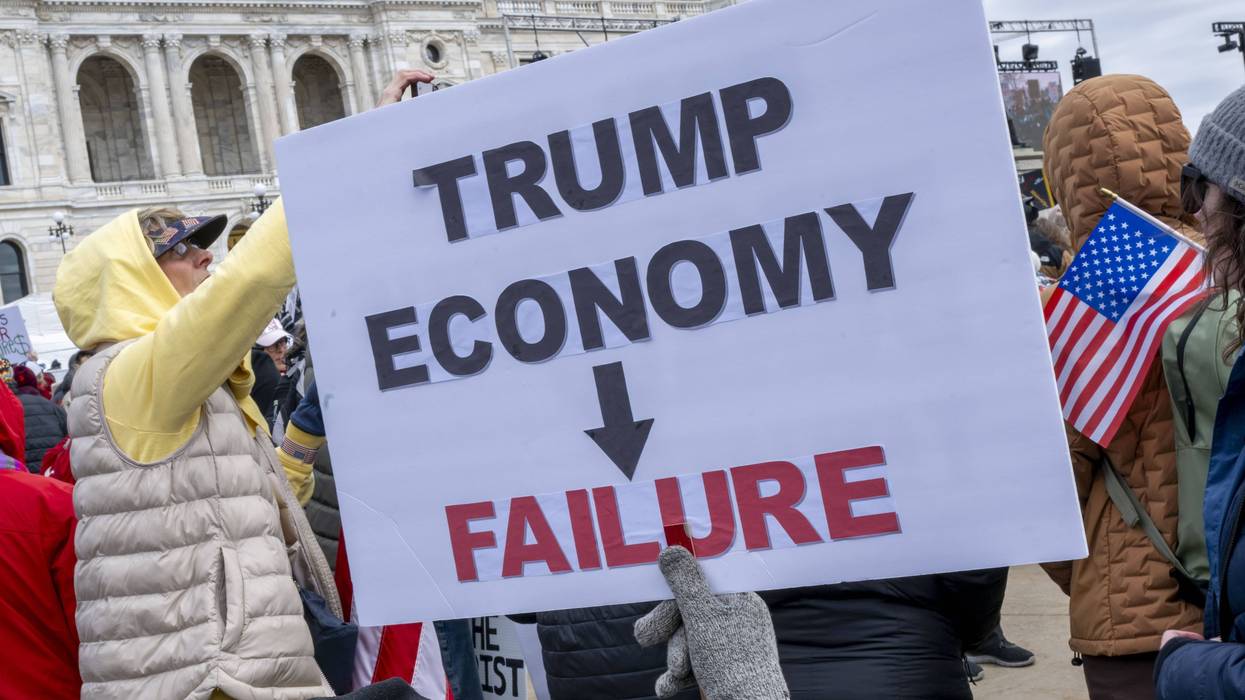
"The latest jobs data show how President Trump's mismanagement of the economy—both domestically and internationally—is harming workers at home," said another expert.
As US Labor Secretary Lori Chavez-DeRemer on Friday declared that "America's economic comeback is on full display" and the country's "workers are winning again" due to what the business press and top newspapers called a "strong" March jobs report, some economists stressed the importance of looking beyond the topline figure and one month of data.
The US Bureau of Labor Statistics announced that employers added 178,000 jobs last month, with gains in construction, healthcare, and transportation and warehousing, and declines in the federal government. The unemployment rate fell slightly to 4.3%, with 7.2 million people officially jobless.
"Folks, today's jobs report is not good," declared Heidi Shierholz, president of the think tank Economic Policy Institute (EPI). She pointed to average job growth over the past two months, the reason for the drop in unemployment ("people leaving the labor force"), slowing wage growth, and the fact that "the effects of our war in Iran aren't even in these numbers yet."
EPI senior economist Elise Gould further explained those points on social media. Although the report "came in stronger than expected... much of the gain was a bounce back to February declines (now a loss of 133,000 jobs)," she said. "As a result, average monthly growth the last two months was only 22,500 jobs."
As far as the unemployment rate ticking down, "it's important to note that this happened for the 'wrong' reasons as both the labor force participation and the share of the population with a job also ticked down," Gould continued. "Job gains were strongest in healthcare as striking workers returned to work."
"Attacks on the federal workforce continue," she highlighted, with the sector down 18,000 jobs in March and 352,000 positions since January 2025, when President Donald returned to power. "The vital services federal employees provide cannot be done without these essential workers. The cost of these losses are only just beginning."
"Manufacturing rose 15,000 jobs in March, but still has a huge deficit since Trump took office. Since January 2025, the manufacturing sector has lost 82,000 jobs," the economist noted. "Wage growth has been slowing for the last few months, particularly driven by slower growth for production and nonsupervisory workers, roughly the lower 82% of the workforce."
Gould added that "we don't have the inflation data yet to show real wage changes in March, but slowing nominal wage growth coupled with rising prices from the Iran war almost surely means real wages will suffer, contributing to worsening affordability."
Trump and Israel launched their war on Iran at the end of February, and the new data is from the middle of March, so "the impact of the war and higher fuel prices will be limited" in this report, as Center for Economic and Policy Research co-founder Dean Baker acknowledged. "April could look considerably worse."
Breyon Williams, chief economist at another think tank, Groundwork Collaborative, said that "beyond today's headline bounce, the labor market continues to deteriorate under Trump's economic mismanagement: Hiring has ground to a halt, paychecks are shrinking, and workers are giving up on finding a job altogether. A single month of modest gains can't reverse the damage that the president has inflicted on working families."
A former senior Labor Department official who's now chief of policy programs at The Century Foundation, Angela Hanks, similarly asserted that "the latest jobs data show how President Trump's mismanagement of the economy—both domestically and internationally—is harming workers at home."
"While the topline rate does not yet reflect the war's impact on the job market, wage growth has stalled, and oil prices are skyrocketing, resulting in higher prices for consumers and threatening to weaken the job market," she noted. Specifically, according to a Thursday report from Democratic members of the congressional Joint Economic Committee, Americans spent an extra $8.4 billion at the gas pump in the first month of Trump's war.
"Families are already under tremendous pressure from rising prices, slowing job growth, and mounting debt as they struggle to make ends meet, and not seeing help on the way," said Hanks. "Families and workers across the country deserve leadership that puts them first and works to make living a fulfilling life affordable for everyone. Instead, they're stuck with leaders in Washington more focused on needless and damaging wars and slashing the safety net to pay for them."
After passing a 2025 budget package that gave the rich more tax breaks by slashing over $1 trillion from the safety net, including food assistance and Medicaid—which is expected to leave millions of Americans without health insurance—congressional Republicans are considering more healthcare cuts to fund Trump's war. The Pentagon has asked for at least $200 billion for Iran, and more broadly, the president wants an unprecedented $1.5 trillion in military spending for the next fiscal year.
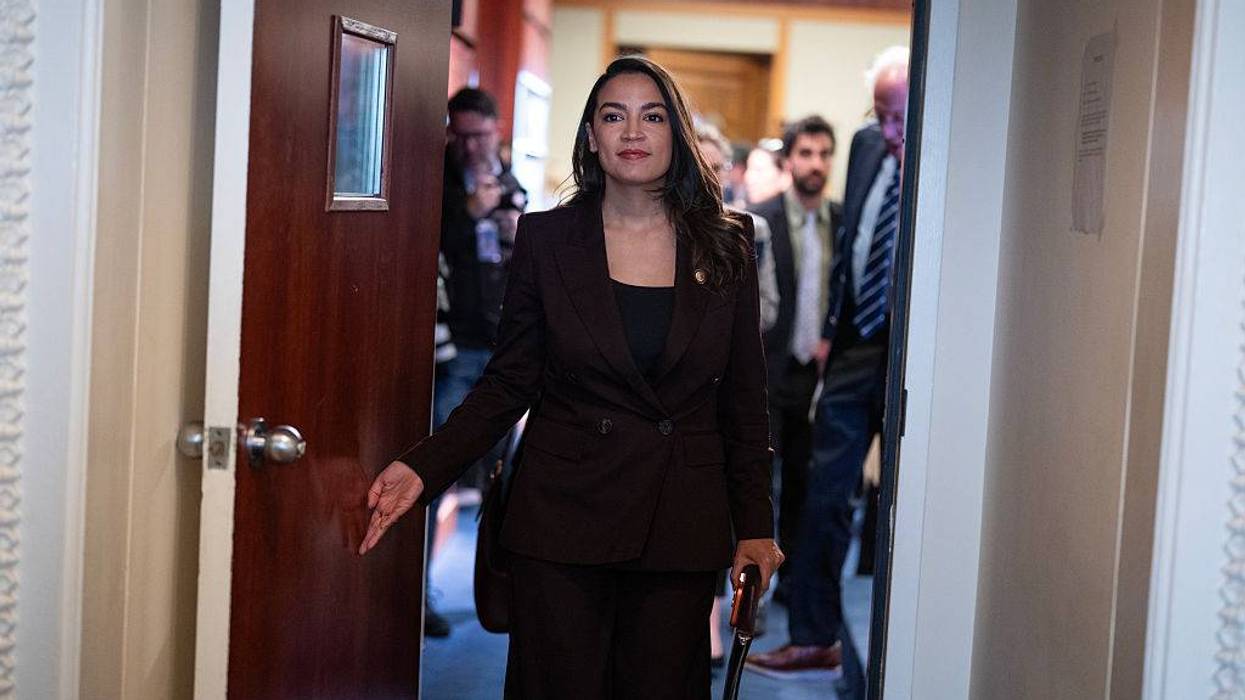
The Amazon mega-facility has consistently failed to meet job creation expectations, reported a Virginia-based business publication.
Although Rep. Alexandria Ocasio-Cortez took criticism from some mainstream media pundits after she helped rally public opinion against the construction of Amazon's HQ2 in Long Island City, new data revealed this week has seemingly vindicated her skepticism of the project.
Virginia Business reported on Thursday that a filing submitted to the Virginia Economic Development Partnership this week showed that Amazon created no jobs at its HQ2 in Arlington County last year, and thus "will not seek a state payment" under the state's workforce grant incentives.
Last year, reported Virginia Business, Amazon requested more than $6.4 million through the grant program for adding just under 293 jobs in 2024.
"The hiring slowdown follows earlier signs that Amazon’s HQ2 buildout has fallen short of initial expectations," Virginia Business explained. "The company originally projected it would create 10,000 jobs by 2024, but hiring totals fell well short of that mark. The company currently has nearly 8,500 employees who work out of HQ2."
In 2018, Ocasio-Cortez (D-NY) joined with local activists to oppose the construction of HQ2 in Long Island City, and they pointed to the billions of dollars in tax incentives offered by New York City and New York state as an example of wasteful corporate welfare being given to one of the world's richest companies.
Amazon canceled its plans to build HQ2 in New York in February 2019, prompting Ocasio-Cortez to take a victory lap.
"Anything is possible," the then-freshman congresswoman wrote in a social media post. "Today was the day a group of dedicated, everyday New Yorkers and their neighbors defeated Amazon’s corporate greed, its worker exploitation, and the power of the richest man in the world."
Amazon would subsequently move construction of HQ2 to Virginia after being offered hundreds of millions in potential tax incentives, but it delayed construction of the facility in 2023, which again led Ocasio-Cortez to declare vindication.
"When I opposed this Amazon project coming to New York because it was a scam of public funds, the whole power establishment came after us," she wrote. "Billboards went up in Times Square denouncing me. Powerful pols promised revenge. Op-eds and CEOs insulted my intelligence. In the end, we were right."