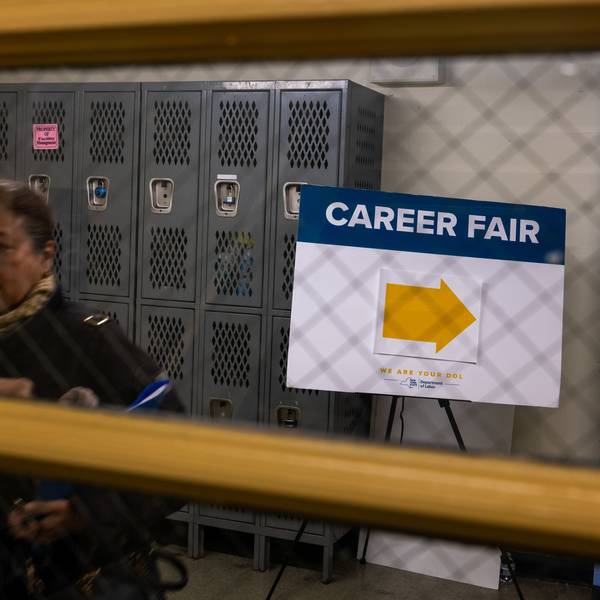

Job seekers attend a career fair in Harlem hosted by Assemblymember Jordan Wright on December 10, 2025, in New York City.
'Dismal' Employment Report Shows Trump Economy Lost 92,000 Jobs in February
“Month after month, the data shows Donald Trump’s economy is failing American families.”
President Donald Trump's self-proclaimed "greatest" economy in history took another major blow on Friday as the US Bureau of Labor Statistics revealed that the American economy lost 92,000 jobs in February.
Heather Long, chief economist at Navy Federal Credit Union, described the report as "dismal," while noting that the US economy as a whole has actually lost jobs since Trump announced his "liberation day" global tariffs in April 2025.
"Total job gains since from May 2025 to February 2026 are now -19,000," she wrote. "Companies are not hiring in the face of all of these headwinds and uncertainty. And even healthcare is starting to slow down."
University of Michigan economist Justin Wolfers argued that "the economic story just changed dramatically" because of the jobs report, which also showed downward revisions to the estimated jobs created in December and January.
"Recession questions are back on the menu," he said.
Mike Konczal, senior director of policy and research at the Economic Security Project, zeroed in on the surprise loss of healthcare jobs in February as particularly concerning given that healthcare has been the lone industry to consistently add jobs in recent months.
"This is the first month in years where healthcare jobs went negative, really changing the dynamic," he said. "Cuts to Medicaid, cuts to ACA... suddenly the thing that was 187% of private jobs since liberation day, holding it together, may be giving out?"
Rep. Brendan Boyle (D-Pa.), ranking member of the House Budget Committee, said that the terrible jobs report was a direct reflection of Trump's economic mismanagement.
"Month after month, the data shows Donald Trump’s economy is failing American families," Boyle said. "The job market is weakening, costs remain high, and Trump’s illegal tariff taxes continue to hurt businesses and workers. Trump and his allies in Congress know their agenda isn’t working. Instead of helping working families, they are pushing more tariff taxes and more tax breaks for billionaires. It is clear Republicans in Washington simply do not care about working families."
Alex Jacquez, chief of policy and advocacy at Groundwork Collaborative, declared that "the deterioration in the labor market is visible from space," and pinned the blame on "Trump’s reckless economic agenda."
"As the president piles on blanket tariffs and oil prices soar," Jacquez said, "today's report confirms he's sent the economy straight into a stagflation spiral."
University of Pennsylvania economist Heather Boushey said weakness in the US economy had been evident for several months, although Friday's jobs report showed the largest job losses of any month during Trump's second term.
"Today's data should not come as a shock as there have been signs of weakening in the US labor market for quite some time," she said. "The Trump administration’s focus on undermining the US economy rather than investing in America may be coming home to roost."
Daniel Hornung, policy fellow at the Stanford Institute for Economic Policy Research, said that the bad jobs report will make things even harder for the US Federal Reserve when it comes to making interest rate cut decisions.
"This morning’s report... comes at a difficult moment, with inflation still above target and an oil price shock threatening to raise inflation further," Hornung said. "The report complicates the Fed’s efforts to keep both unemployment and inflation low, and it makes it difficult for the [Trump] administration to argue heading into the midterms that their policies are leading to the kind of growth or improvement in living standards that they’ve long promised."
We are at a crossroads
This country and this world are at a monumental crossroads. In a few short weeks, US voters will have an opportunity to beat back the forces of fascism and confront the billionaires who are rigging the economy, our media system, and our democracy, making it increasingly impossible for ordinary people to get by. We’re not just talking about the election. We’re talking about what must be done once these fascist elements are vanquished from power. We need a bolder set of solutions than what either major party has so far been willing to offer and a working-class movement ready to fight like hell for it. Trump didn't emerge from nowhere. The conditions that fueled MAGA authoritarianism were created by decades of radical neoliberal economic policies and a corrupt political system dominated by corporate interests. They slashed taxes on the super-rich, promising that the benefits would trickle down. They said giveaways to the corporate titans would make life more affordable for the rest of us. It was all bullshit. And when a bitter, betrayed populace searches for someone to blame, right-wing demagogues have little trouble finding scapegoats. People know when they're being lied to, but you won't hear any of this from the corporate media. Only independent journalism—powered and funded by people who believe in building a better world—can deliver truly trustworthy daily news. Our Fall Campaign is underway, and we need your help. To power our newsroom through the rest of the year, we need to raise $125,000 by midnight on October 31. So if you share our vision, please contribute whatever you can to sustain our work. |
President Donald Trump's self-proclaimed "greatest" economy in history took another major blow on Friday as the US Bureau of Labor Statistics revealed that the American economy lost 92,000 jobs in February.
Heather Long, chief economist at Navy Federal Credit Union, described the report as "dismal," while noting that the US economy as a whole has actually lost jobs since Trump announced his "liberation day" global tariffs in April 2025.
"Total job gains since from May 2025 to February 2026 are now -19,000," she wrote. "Companies are not hiring in the face of all of these headwinds and uncertainty. And even healthcare is starting to slow down."
University of Michigan economist Justin Wolfers argued that "the economic story just changed dramatically" because of the jobs report, which also showed downward revisions to the estimated jobs created in December and January.
"Recession questions are back on the menu," he said.
Mike Konczal, senior director of policy and research at the Economic Security Project, zeroed in on the surprise loss of healthcare jobs in February as particularly concerning given that healthcare has been the lone industry to consistently add jobs in recent months.
"This is the first month in years where healthcare jobs went negative, really changing the dynamic," he said. "Cuts to Medicaid, cuts to ACA... suddenly the thing that was 187% of private jobs since liberation day, holding it together, may be giving out?"
Rep. Brendan Boyle (D-Pa.), ranking member of the House Budget Committee, said that the terrible jobs report was a direct reflection of Trump's economic mismanagement.
"Month after month, the data shows Donald Trump’s economy is failing American families," Boyle said. "The job market is weakening, costs remain high, and Trump’s illegal tariff taxes continue to hurt businesses and workers. Trump and his allies in Congress know their agenda isn’t working. Instead of helping working families, they are pushing more tariff taxes and more tax breaks for billionaires. It is clear Republicans in Washington simply do not care about working families."
Alex Jacquez, chief of policy and advocacy at Groundwork Collaborative, declared that "the deterioration in the labor market is visible from space," and pinned the blame on "Trump’s reckless economic agenda."
"As the president piles on blanket tariffs and oil prices soar," Jacquez said, "today's report confirms he's sent the economy straight into a stagflation spiral."
University of Pennsylvania economist Heather Boushey said weakness in the US economy had been evident for several months, although Friday's jobs report showed the largest job losses of any month during Trump's second term.
"Today's data should not come as a shock as there have been signs of weakening in the US labor market for quite some time," she said. "The Trump administration’s focus on undermining the US economy rather than investing in America may be coming home to roost."
Daniel Hornung, policy fellow at the Stanford Institute for Economic Policy Research, said that the bad jobs report will make things even harder for the US Federal Reserve when it comes to making interest rate cut decisions.
"This morning’s report... comes at a difficult moment, with inflation still above target and an oil price shock threatening to raise inflation further," Hornung said. "The report complicates the Fed’s efforts to keep both unemployment and inflation low, and it makes it difficult for the [Trump] administration to argue heading into the midterms that their policies are leading to the kind of growth or improvement in living standards that they’ve long promised."
- 'So Much for the Golden Age of America': Layoffs Hit 17-Year High Under Trump ›
- Data Reveals Trump Economy Added Hundreds of Thousands Fewer Jobs in 2025 Than Previously Reported ›
- Revised Data Paints a Grim Picture of 2025 Jobs Market ›
- 'This Is a Hiring Recession': Economists Raise Red Flags at Latest Gloomy Data in Trump Economy | Common Dreams ›
- No, Says Economist, March US Jobs Report 'Is Not Good' | Common Dreams ›
President Donald Trump's self-proclaimed "greatest" economy in history took another major blow on Friday as the US Bureau of Labor Statistics revealed that the American economy lost 92,000 jobs in February.
Heather Long, chief economist at Navy Federal Credit Union, described the report as "dismal," while noting that the US economy as a whole has actually lost jobs since Trump announced his "liberation day" global tariffs in April 2025.
"Total job gains since from May 2025 to February 2026 are now -19,000," she wrote. "Companies are not hiring in the face of all of these headwinds and uncertainty. And even healthcare is starting to slow down."
University of Michigan economist Justin Wolfers argued that "the economic story just changed dramatically" because of the jobs report, which also showed downward revisions to the estimated jobs created in December and January.
"Recession questions are back on the menu," he said.
Mike Konczal, senior director of policy and research at the Economic Security Project, zeroed in on the surprise loss of healthcare jobs in February as particularly concerning given that healthcare has been the lone industry to consistently add jobs in recent months.
"This is the first month in years where healthcare jobs went negative, really changing the dynamic," he said. "Cuts to Medicaid, cuts to ACA... suddenly the thing that was 187% of private jobs since liberation day, holding it together, may be giving out?"
Rep. Brendan Boyle (D-Pa.), ranking member of the House Budget Committee, said that the terrible jobs report was a direct reflection of Trump's economic mismanagement.
"Month after month, the data shows Donald Trump’s economy is failing American families," Boyle said. "The job market is weakening, costs remain high, and Trump’s illegal tariff taxes continue to hurt businesses and workers. Trump and his allies in Congress know their agenda isn’t working. Instead of helping working families, they are pushing more tariff taxes and more tax breaks for billionaires. It is clear Republicans in Washington simply do not care about working families."
Alex Jacquez, chief of policy and advocacy at Groundwork Collaborative, declared that "the deterioration in the labor market is visible from space," and pinned the blame on "Trump’s reckless economic agenda."
"As the president piles on blanket tariffs and oil prices soar," Jacquez said, "today's report confirms he's sent the economy straight into a stagflation spiral."
University of Pennsylvania economist Heather Boushey said weakness in the US economy had been evident for several months, although Friday's jobs report showed the largest job losses of any month during Trump's second term.
"Today's data should not come as a shock as there have been signs of weakening in the US labor market for quite some time," she said. "The Trump administration’s focus on undermining the US economy rather than investing in America may be coming home to roost."
Daniel Hornung, policy fellow at the Stanford Institute for Economic Policy Research, said that the bad jobs report will make things even harder for the US Federal Reserve when it comes to making interest rate cut decisions.
"This morning’s report... comes at a difficult moment, with inflation still above target and an oil price shock threatening to raise inflation further," Hornung said. "The report complicates the Fed’s efforts to keep both unemployment and inflation low, and it makes it difficult for the [Trump] administration to argue heading into the midterms that their policies are leading to the kind of growth or improvement in living standards that they’ve long promised."
- 'So Much for the Golden Age of America': Layoffs Hit 17-Year High Under Trump ›
- Data Reveals Trump Economy Added Hundreds of Thousands Fewer Jobs in 2025 Than Previously Reported ›
- Revised Data Paints a Grim Picture of 2025 Jobs Market ›
- 'This Is a Hiring Recession': Economists Raise Red Flags at Latest Gloomy Data in Trump Economy | Common Dreams ›
- No, Says Economist, March US Jobs Report 'Is Not Good' | Common Dreams ›