

SUBSCRIBE TO OUR FREE NEWSLETTER
Daily news & progressive opinion—funded by the people, not the corporations—delivered straight to your inbox.
5
#000000
#FFFFFF
To donate by check, phone, or other method, see our More Ways to Give page.
Daily news & progressive opinion—funded by the people, not the corporations—delivered straight to your inbox.
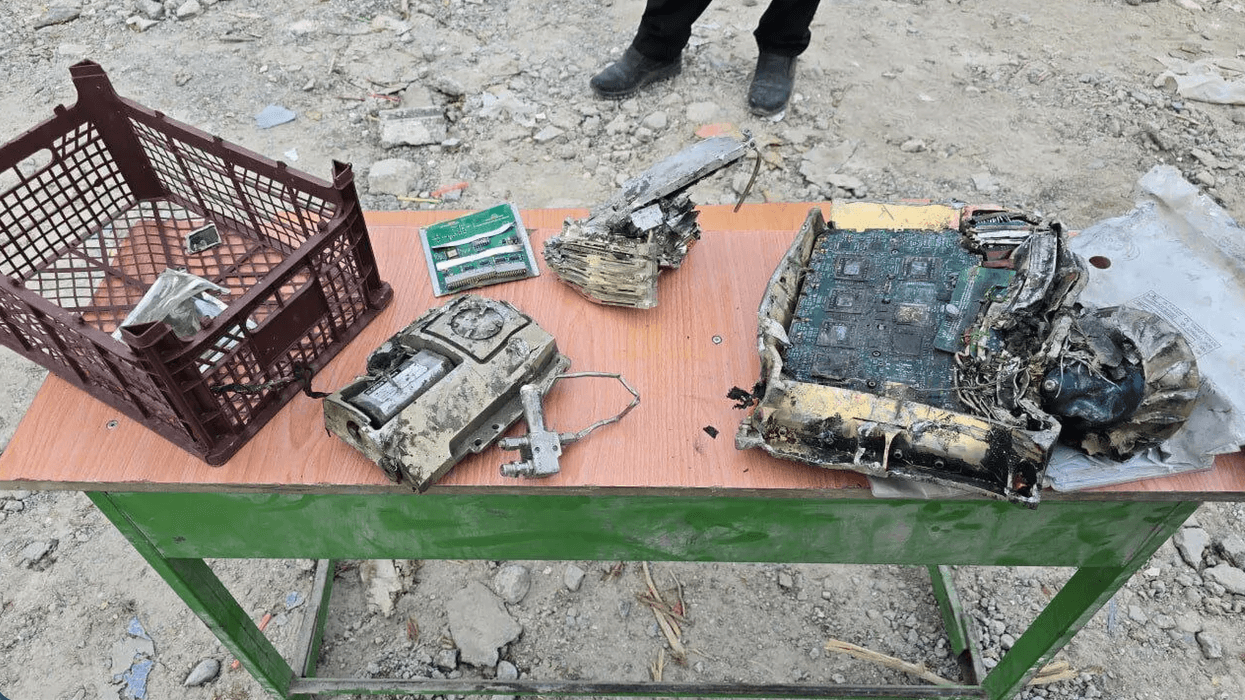
Trump falsely claimed that Iran has “some” highly restricted Tomahawk missiles as additional evidence pointed to US culpability for the deadly strike.
As Iranian officials displayed US-marked fragments of a missile believed to have been used in Saturday's massacre of around 175 mostly school children in Minab, President Donald Trump on Monday doubled down on his unfounded claim that Iran carried out the strike.
The president suggested during a press conference at his Trump National Doral Miami resort that Iran may have used a US Tomahawk missile to carry out the February 28 attack on the Shajareh Tayyebeh girls’ elementary school in Minab.
Trump falsely claimed that Iran has "some" of the highly restricted cruise missiles after one of them was recorded hitting an Iranian military facility near the school just after Saturday's strike there.
"A Tomahawk is very generic," Trump added. "It’s sold to other countries.”
New York Times reporter Shawn McCreesh pressed Trump on his claim, asking, "You just suggested that Iran somehow got its hands on a Tomahawk and bombed its own elementary school on the first day of the war... Why are you the only person saying this?"
Trump replied: "Because I just don't know enough about it. I think it’s something that I was told is under investigation, but Tomahawks are, are used by others. As you know, numerous other nations have Tomahawks. They buy them from us.”
Reporter: You just suggested that Iran somehow got its hands on a tomahawk and bombed its own elementary school on the first day of the war. But you're the only person in your government saying this. Why?Trump: Because I just don't know enough about it.
[image or embed]
— Acyn (@acyn.bsky.social) March 9, 2026 at 3:39 PM
Iran has no Tomahawks, which are not "generic." Originally developed by General Dynamics and now manufactured by Raytheon, the BGM‑109 Tomahawk is a specific long-range cruise missile designed and produced in the United States. Only two other countries—Australia and the United Kingdom—are known to have Tomahawks in their arsenals, although Japan and the Netherlands have also agreed to buy them.
The US also does not sell weaponry to the Iranian government—with the extraordinary exception of the Iran-Contra Affair, in which the Reagan administration secretly sold arms to Iran in order to fund anti-communist Contra terrorists in Nicaragua.
Trump's Monday remarks followed his Saturday comments to reporters aboard Air Force One, where he said that the bombing "was done by Iran."
However, Defense Secretary Pete Hegseth, who was accompanying Trump, notably declined to back Trump's claim, saying only that "we're certainly investigating" the strike.
US Ambassador to the United Nations Michael Waltz also did not endorse the president's assertion, telling ABC News' Martha Raddatz Sunday that he would “leave that to the investigators to determine.”
Waltz—a former Army Special Forces officer who served in Afghanistan—also told NBC News' Meet the Press Sunday that "we never deliberately attack civilians."
More than 400,000 civilians in over half a dozen countries have been killed in US-led wars since 9/11, according to the Costs of War Project at Brown University's Watson Institute for International and Public Affairs.
Hundreds of Iranian civilians have been killed by US and Israeli bombing since February 28. Israeli airstrikes have also killed hundreds of Lebanese civilians during the same period.
During Monday's press conference, Trump said that he is "willing to live with" whatever the probe into the Minab school strike shows.
A preliminary US intelligence assessment reportedly concluded that the United States is "likely" responsible for the strike, although a probe is ongoing.
On Monday, the New York Times published photos of fragments purportedly from a missile used in the school strike, which were marked with the names of multiple companies that produce Tomahawk components, a unique Department of Defense contract number, and "Made in USA." Another remnant is marked SDL ANTENNA, a key satellite data link component of Tomahawk missiles.
Paramedics and victims' relatives said the school bombing was a so-called “double-tap” airstrike—a common tactic used by US, Israeli, and Russian forces in which attackers bomb a target and then follow up with a second strike meant to kill survivors and first responders.
If carried out by the US, the Minab school strike would be one of the deadliest US civilian massacres in modern times, ranking with the bombing of a Baghdad bomb shelter during the 1991 Gulf War—which killed more than 400 people—and the March 2017 slaughter of at least 105 people in an apartment building in Mosul, Iraq during Trump's "war of annihilation" against the so-called Islamic State.
Trump's claim that Iran may have bought a US missile whose sale is restricted to just a handful of close allies and used it to bomb its own school prompted worldwide ridicule.
US Senate Majority Leader Chuck Schumer (D-NY) said on the upper chamber floor Tuesday that "Iran doesn't have Tomahawk missiles, Donald Trump!"
"The claim is beyond asinine," he continued. "He says whatever pops into his head no matter what the truth is. And we all know he lies, but on something as formidable as this, it's appalling."
"Trump is lying through his teeth," Schumer added.
Schumer: "Iran doesn't have Tomahawk missiles, Donald Trump! The claim is beyond asinine. He says whatever pops into his head no matter what the truth is. And we all know he lies, but on something as formidable as this, it's appalling."
[image or embed]
— Aaron Rupar (@atrupar.com) March 10, 2026 at 7:37 AM
Barry Andrews, an Irish politician who serves as a Member of the European Parliament for the Dublin constituency, said on X that Trump's "latest use of the 'big lie' tactic... was to claim that Iran somehow possesses US-made Tomahawk missiles and fired upon its own girls school."
"Such blatant lies are meant to distract," Andrews added. "He knows the world will move on."
New Yorker cartoonist Mark Thompson quipped, "How Iran fired a Tomahawk missile at their own school is beyond me, but President Trump wouldn’t lie to us."
Reza Nasri, an international law expert at the Graduate Institute of International and Development Studies in Geneva, said on X that "Trump claims that Iran somehow got its hands on a US Tomahawk cruise missile and used it to bomb its own elementary school."
"Ask him how Iran could possibly have obtained such missiles—and how it allegedly launched one, given that Tomahawks are typically fired from naval platforms, primarily warships and submarines," Nasri added. "Did Iran get its hands on US warships and submarines too?"
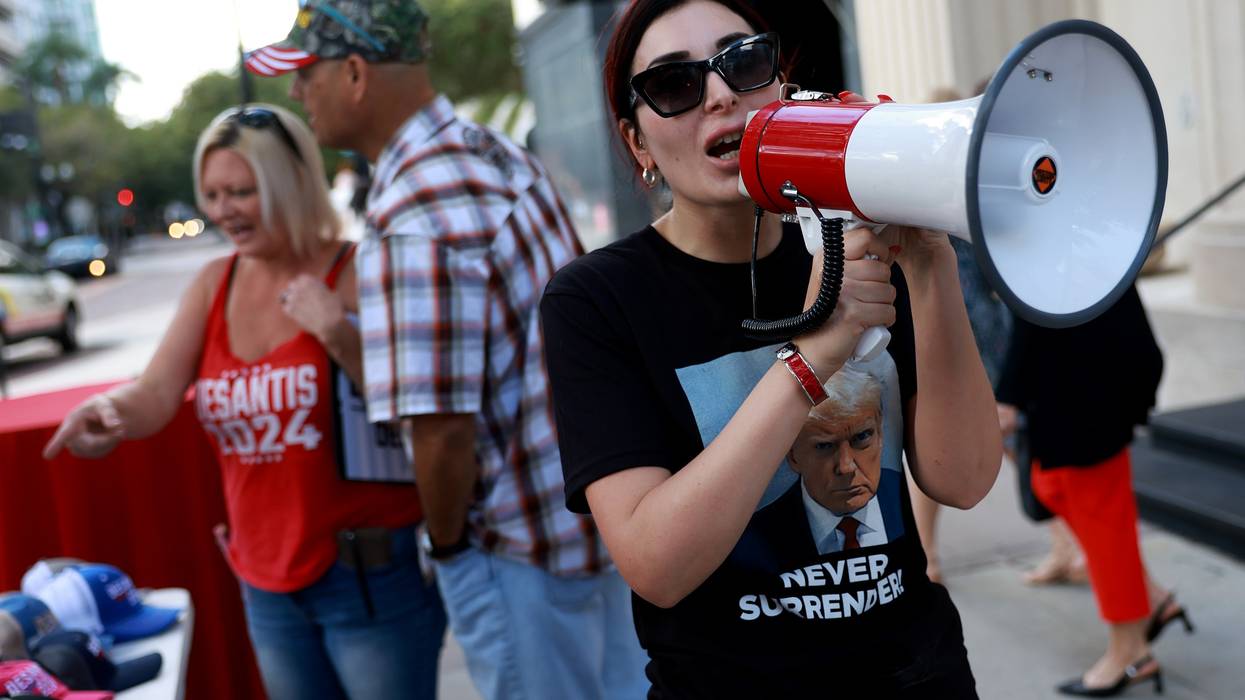
Meet the influential right-wing conspiracy theorist who has U.S. President Donald Trump’s ear.
Laura Loomer is 31 years old and a graduate of Barry University, a private Catholic university. A former commentator on Alex Jones’s Infowars and a far-right conspiracy theorist, she has 1.5 million followers on X. Loomer traffics in anti-Muslim and anti-immigrant rhetoric. She has called herself a “proud Islamophobe” and “pro-white nationalism.”
And she has U.S. President Donald Trump’s ear.
In 2020, Loomer was the Republican nominee for Congress from the Florida district where Mar-a-Lago is located. She campaigned almost exclusively on her allegiance to Trump who, along with Roger Stone, supported her candidacy. Loomer lost the election, as well as her bid to become the party’s nominee again in 2022.
During the 2024 campaign, Loomer said on X that if Vice President Kamala Harris—whose mother was born in India—won the election, “the White House will smell like curry.” Those comments drew the condemnation of even Rep. Marjorie Taylor Greene (R-Ga.) and Sen. Lindsey Graham (R-S.C.), who called her “toxic.”
“Getting Loomered” means targeting someone to determine the sufficiency of the person’s loyalty to Trump and his agenda.
A fervent Trump supporter during the 2024 Republican primaries, she claimed without evidence that Republican Florida Gov. Ron DeSantis exaggerated his wife’s bout with breast cancer to gain sympathy votes during his presidential campaign. Her conspiracy theories range from school shootings to election fraud. She shared a video on X stating that the 9/11 attacks were an “inside job.”
According to Sen. Thom Tillis (R-N.C.), “Laura Loomer is a crazy conspiracy theorist who regularly utters disgusting garbage intended to divide Republicans.”
Trump aides have tried to limit Loomer’s access to the president—with mixed results. In 2024, She accompanied Trump during appearances commemorating 9/11 in New York and Pennsylvania and traveled on his plane to Iowa where Trump told the audience, “You want her on your side.”
Trump’s top advisers have learned the price of not being on Loomer’s side. In March 2025, she started her own research firm— Loomered Strategies—to provide high-level opposition research and vetting for hire. “Getting Loomered” means targeting someone to determine the sufficiency of the person’s loyalty to Trump and his agenda.
According to Trump, “She’s a strong person. She’s got strong opinions…”
On April 2, she “Loomered” the National Security Council (NSC). Meeting with Trump in the Oval Office, she attacked the character and loyalty of several NSC officials and named the people he should fire. Michael Waltz, who headed the agency, joined the meeting late and briefly tried to defend some of his people. But Trump immediately fired six of her targets.
Waltz and his deputy, Alex Wong, managed to survive Loomer’s onslaught that day, but not for long. Less than a month later, Trump announced Waltz’s termination. The intervening revelation of his inadvertent inclusion of The Atlantic’s editor Jeffrey Goldberg on a sensitive group chat on the Signal app had made him vulnerable in any event.
But Wong was out too. Loomer had speculated that Wong’s family was part of a conspiracy and that he had added Goldberg to the Signal chat “on purpose as part of a foreign opp to embarrass the Trump administration on behalf of China.” Wong’s father is of Taiwanese descent, and Loomer had referred to Wong’s wife Candice as a “Chinese woman.” Candice Wong had clerked for U.S. Supreme Court Justice Brett Kavanaugh, was a career prosecutor, and served as a Justice Department official during Trump’s first term.
Three weeks later, Loomer went after an assistant U.S. attorney in Los Angeles, Adam Schleifer, who had unsuccessfully run for Congress as a Democrat in 2020. She posted on social media that Schleifer was a “Biden holdover” and a “Trump hater” who should be fired. An hour later, Schleifer received a one-sentence email terminating his employment. In a highly unusual action, the message came directly from the White House on behalf of the president personally. It gave no reason for Schleifer’s dismissal.
Loomer has also attacked the National Intelligence Council, an elite internal think tank that reports to the director of national intelligence, Tulsi Gabbard. Previously, the White House had asked the council to assess the link between the Venezuelan government and the notorious Tren de Aragua gang. Without such a link, Trump could not rely on the Alien Enemies Act of 1798 to deprive the gang’s members of due process before deporting them.
On February 26, senior analyst at the council Michael Collins reported the intelligence community’s consensus that the Venezuelan government did not control the gang. But on March 15, Trump signed a proclamation invoking the Alien Enemies Act based on purportedly factual findings that contradicted the report.
With a presidential inner circle that includes Laura Loomer, we’re all in deep trouble.
When Collins’ report became public and revealed Trump’s lie, Loomer blasted the council as “career anti-Trump bureaucrats” who “need to be replaced if they want to promote open borders.” In the same post, she pasted images of Collins’s LinkedIn profile and an article about the council’s memo. Three weeks later, Gabbard fired Collins.
Meanwhile, federal courts have blocked Trump’s use of the Alien Enemies Act in every district where he has tried to invoke it. The courts have found that the act’s predicate—that the Venezuelan gang is engaged in either a “war,” “invasion,” or a “predatory incursion” of the United States—does not exist.
At a Mar-a-Lago press conference in April 2024, Trump praised Loomer as “a woman of courage,” he said, “You don’t want to be Loomered. If you’re Loomered, you’re in deep trouble.”
With a presidential inner circle that includes Laura Loomer, we’re all in deep trouble.

Greenlanders are giving the administration of President Donald Trump—who renewed threats to take the Danish territory—the cold shoulder.
U.S. Vice President JD Vance, Second Lady Usha Vance, and two top Trump administration officials traveled to Greenland on Friday on an itinerary that was markedly curtailed from its original plans due to Greenlanders' frosty reception amid President Donald Trump's ongoing threats to take the Arctic island from NATO ally Denmark—even by armed force if deemed necessary.
Vance visited Pituffik Space Base—a U.S. Space Force installation on the northwestern coast of Greenland about 930 miles (1,500 km) north of the capital, Nuuk—with his wife, National Security Adviser Michael Waltz, and Energy Secretary Chris Wright.
The vice president's wife originally planned on a more interactive and cultural itinerary, including attending a dogsled race. However, Greenland's leftist government said earlier this week that is had "not extended any invitations for any visits, neither private nor official."
Compounding the Trump administration's embarrassment, U.S. representatives reportedly came up empty handed after canvassing door to door in Nuuk in an effort to drum up support for the visit. The administration denies this ever happened.
And so the Trump officials' audience was limited to U.S. troops stationed at Pituffik. After arriving at the base, the vice president told troops in the mess hall he was surprised to find the snow- and ice-covered Arctic island is "cold as shit."
"Nobody told me!" he added.
Vice President JD Vance and Second Lady Usha Vance visited a U.S. Space Force base in Greenland Friday. Vance is expected to receive briefings on Arctic security and address US service members.
Read more: https://t.co/1OIkkT3VnD pic.twitter.com/lbXeObJTgq
— Newsweek (@Newsweek) March 28, 2025
Getting down to more serious business, Vance said: "Our message to Denmark is very simple—you have not done a good job by the people of Greenland. You have under-invested in the people of Greenland and you have under-invested in the security architecture of this incredible, beautiful land mass."
Addressing Arctic geopolitics, Vance argued that "we can't just bury our head in the sand—or in Greenland, bury our head in the snow—and pretend that the Chinese are not interested in this very large land mass. We know that they are."
"The president said we have to have Greenland, and I think that we do have to be more serious about the security of Greenland," Vance continued. "We respect the self-determination of the people of Greenland, but my argument to them is: I think that you'd be a lot better coming under the United States' security umbrella than you have been under Denmark's security umbrella. Because what Denmark's security umbrella has meant is effectively they've passed it all off to brave Americans and hoped that we would pick up the tab."
This follows remarks earlier this week from Vance, who said during a Fox News interview that Denmark, which faithfully sent troops to fight in both Afghanistan and Iraq—43 of whom died, the highest per capita casualty rate of the alliance—is "not being a good ally" to the United States.
Asked by reporters on Friday if the U.S. would ever conquer Greenland by military force, Vance said he didn't think that would be necessary.
However, just a day earlier, Trump—who on Friday posted a video highlighting defense cooperation between the U.S. and Greenland—said his administration will "go as far as we have to go" to acquire the island, which he claimed the United States needs "for national security and international security."
It was far from the first time that Trump—who has also threatened to take over parts or all of countries including Panama and even Canada—vowed to annex Greenland, and other administration officials have repeated the president's threats.
"It's oil and gas. It's our national security. It's critical minerals," Waltz said in January, explaining why Trump wants Greenland.
The U.S. has long been interested in Greenland, and while the close relationship between the United States and Denmark has been mostly mutually beneficial, it has sometimes come at the expense of Greenland's people, environment, and wildlife.
Such was the case when a U.S. Air Force B-52 bomber laden with four thermonuclear warheads crashed into the sea ice of Wolstenholme Fjord in 1968. The accident caused widespread radioactive contamination, and the nuclear fuel components of one of the bombs remain unrecovered to this day.
Elected officials from across Greenland and Denmark's political spectrum expressed alarm over the Trump administration's actions.
Outgoing Greenland Prime Minister Múte Bourup Egede earlier this week
called Vance's trip "highly aggressive" and said that it "can in no way be characterized as a harmless visit."
"Because what is the security advisor doing in Greenland?" Egede asked. "The only purpose is to show a demonstration of power to us, and the signal is not to be misunderstood."
Danish Foreign Minister Lars Løkke called Vance's remarks on Friday "a bit inappropriate," adding that maybe the Trump administration "should look at yourself in the mirror too."
"When the vice president.. creates an image that the only way Greenland can be protected is by coming under the American umbrella, so you can say that Greenland is already there," Løkke elaborated. "They are part of the common security umbrella that we created together with the Americans after the end of World War II called NATO."
"We have always looked at America like the nice big brother to help you out and now it's like the big brother is bullying you."
Ordinary Greenlanders and Danish residents of the island were not happy about the Trump delegation's visit.
Anders Laursen, who owns a local water taxi company, told NBC News that "we have always looked at America like the nice big brother to help you out and now it's like the big brother is bullying you."
Nuuk resident Marie Olsen said of Vance, "I think he's a big child who wants it all."
In the Danish capital Copenhagen, hundreds of people rallied Friday against the U.S. delegation's visit to Greenland. One protester decried what she called the U.S. administration's "mafia methods."
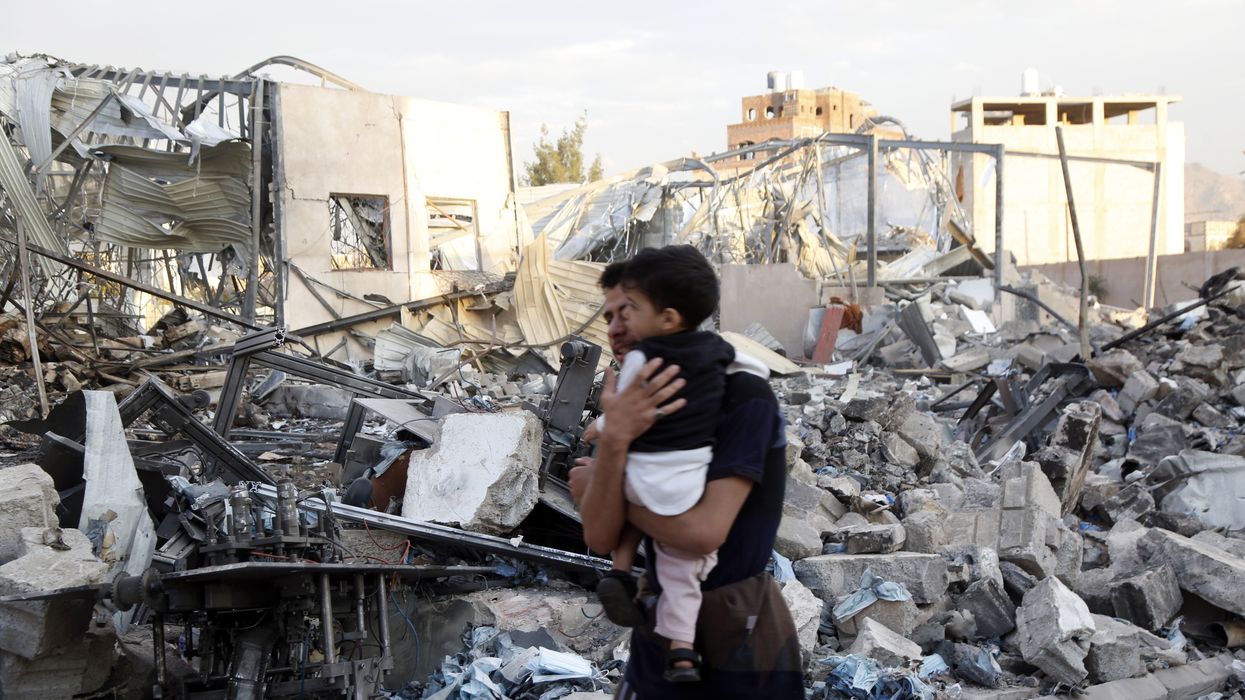
"President Trump has not only launched us into a new military escapade in the Middle East, he's done so in breach of our Constitution," said one advocate.
The leaked messages among top Trump administration officials about U.S. strikes in Yemen earlier this month, which were held via a private sector messaging app in breach of national security protocol and inadvertently included a journalist, sparked considerable discussion among political commentators and social media users—but as the initial shock regarding the Signal conversation faded, advocates and policy experts said lawmakers' attention should turn to the illegality of the attacks on Yemen.
The advocacy groups Just Foreign Policy, DAWN, and Action Corps released a joint statement Thursday calling on Congress to take action to stop U.S. military action in Yemen by upholding "its sole authority to declare war under Article I of the Constitution and the 1973 War Powers Resolution (WPR)."
The chat messages sent between officials including Vice President JD Vance, Defense Secretary Pete Hegseth, and National Security Adviser Michael Waltz stunned the public and Washington insiders this week because they had accidentally also been sent to Atlantic journalist Jeffrey Goldberg, but the three groups pointed out that they also included an admission from Vance that the strikes were not defensive—contrary to claims by President Donald Trump:
I think we are making a mistake… 3 percent of US trade runs through the suez. 40 percent of European trade does. There is a real risk that the public doesn't understand this or why it's necessary. The strongest reason to do this is, as POTUS said, to send a message…
Vance's comments bolster the three groups' position that "the strikes also violate Chapters I and VII of the United Nations Charter, which prohibit states from launching a war unless in self-defense or authorized by the U.N. Security Council."
Even before the chats were leaked, said the groups, it was clear that Trump had not sought congressional authorization for military strikes in Yemen, which have killed at least 53 people since the U.S. launched attacks on March 15.
The War Powers Resolution of 1973, which was introduced after former President Richard Nixon's secretive bombings of Cambodia, requires congressional authorization for "the introduction of the United States armed forces into hostilities, or into situations where imminent involvement in hostilities is clearly indicated by the circumstances," while Article I of the Constitution grants Congress the authority to declare war.
"Congress should demand an end to this reckless, unauthorized war that will both harm U.S. interests and continue to terrorize the Yemeni people who have already suffered years of U.S.-backed violence."
"President Trump has not only launched us into a new military escapade in the Middle East, he's done so in breach of our Constitution," said Isaac Evans-Frantz, director of Action Corps. "Congress should demand an end to this reckless, unauthorized war that will both harm U.S. interests and continue to terrorize the Yemeni people who have already suffered years of U.S.-backed violence."
The groups' comments echoed those of Michigan State University professor and Quincy Institute fellow Shireen Al-Adeimi, who is Yemeni-American.
"With all the noise about the Signal leak, is anyone in Congress or the media concerned that actually bombing Yemeni people and Yemen's infrastructure is unconstitutional?" she asked on Tuesday. "Anyone?"
The Trump administration claimed that the strikes in Yemen were made because the Houthis' blockade on Israeli ships—established in retaliation for Israel's breaking of a cease-fire in Gaza—was an attack on U.S. economic interests and economic security, but the three groups noted that "there is no evidence that Houthi forces attacked any U.S. ships or personnel from the beginning of the Gaza cease-fire in January 2025 through March 15."
The Houthis struck cargo ships they deemed to be tied to Israel starting in November 2023, in response to Israel's relentless assault on Gaza. They stopped the attacks for the duration of the cease-fire, which lasted nearly two months starting in mid-January.
"The cessation of Houthi attacks during the short-lived Gaza truce underscores their primary focus to defend Palestinians from genocide—a reality obscured by Trump's rhetoric to justify unauthorized military action and deepen U.S. aggression in a widening conflict," said Sarah Leah Whitson, executive director of DAWN. "The best way to protect global maritime navigation through the Red Sea is to ensure the Israeli government ends its genocidal violence in Gaza."
Along with Vance's apparent admission that the strikes were not in self-defense, the Signal discussion included what observers called a "confession" to alleged war crimes by Waltz, who said the residential building of the girlfriend of a Houthi leader had "collapsed" after a U.S. strike. As Common Dreams reported Wednesday, Waltz and Vance celebrated the strike.
Etan Mabourakh, a fellow at Action Corps, called on Congress to introduce a Yemen War Powers Resolution. The House and Senate both passed such a resolution in 2019 to bar the U.S. from participating in the Saudi war in Yemen.
"Congress should take the necessary step to stop these illegal, ineffective, and unauthorized airstrikes in Yemen," said Mabourakh. "Rather than debating the Trump administration's violation of security protocols in their Signal chats, they should do their job and challenge another unlawful new war in the region that is making everyone less safe."
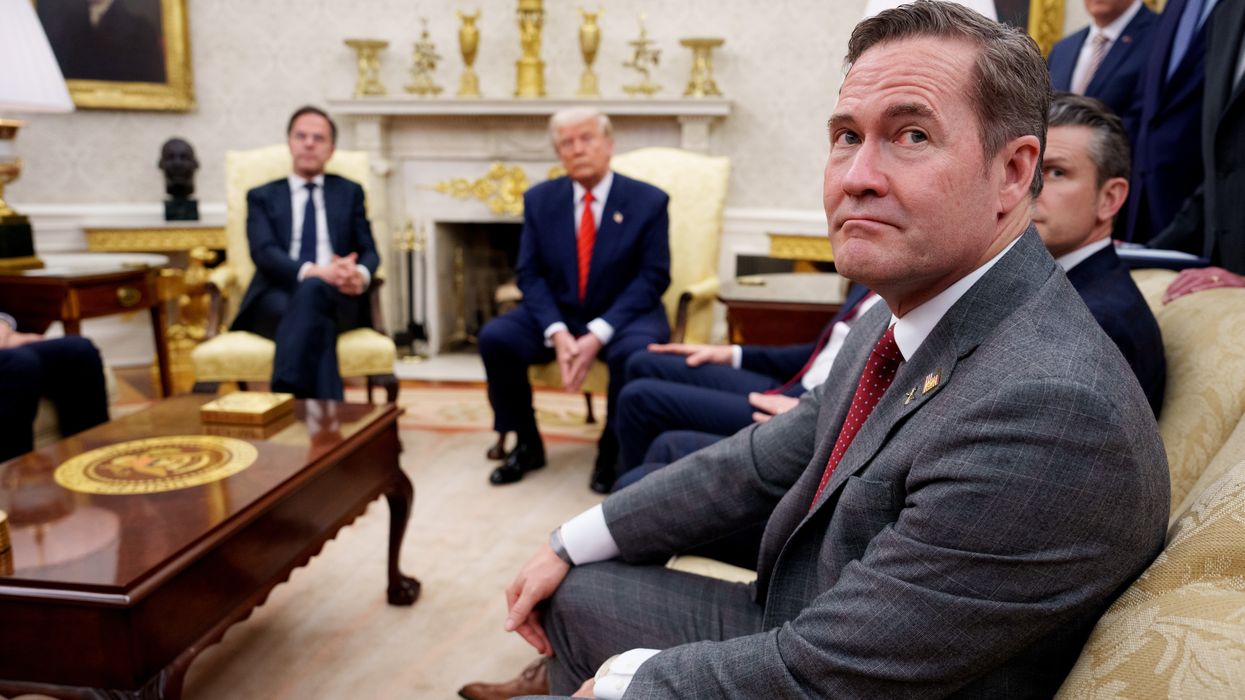
National Security Adviser Michael Waltz and Vice President JD Vance celebrated as a residential building "collapsed" following a U.S. strike.
Along with raising alarm about a massive national security breach—and questions about the competence of top officials in the Trump administration who "inadvertently" added a journalist to a Signal group chat about plans to bomb targets in Yemen—the incident that Atlantic reporter Jeffrey Goldberg publicized this week included an apparent "confession" of at least one alleged war crime.
As
Common Dreams reported Wednesday, Goldberg released the entirety of the group chat that was held via the commercial messaging app Signal, following denials by Defense Secretary Pete Hegseth and White House Press Secretary Karoline Leavitt that any classified information was transmitted in the discussion.
In addition to making clear the detailed plans for attacks on Houthi targets in Yemen using F-18s and drones, the conversation included a brief message from National Security Adviser Michael Waltz in which he appeared to casually describe a strike on a civilian target in Sanaa.
Waltz first praised Hegseth, Central Command leader Gen. Michael Kurilla, and the intelligence community for an "amazing job," saying a "building collapsed" after U.S. intelligence identified a Houthi leader who was targeted for a strike.
He then clarified his message for Vice President JD Vance: "Their first target—their top missile guy—we had positive ID of him walking into his girlfriend's building and it's now collapsed," wrote Waltz.
The vice president replied, "Excellent."
The messages Goldberg disclosed to the public were sent over several days after he received a connection request from "Michael Waltz" via the Signal app. The conversation took place around the Trump administration's March 15 bombing of Yemen, which was carried out after the Houthis renewed a blockade on Israeli ships.
At least 31 civilians were killed in the bombing campaign, and the Houthi media office reported at the time that the U.S. had struck a "residential neighborhood" in Sanaa.
On Wednesday, journalist and author Kim Zetter said Waltz's message suggested top administration officials knew U.S. forces had "targeted [a] residential building," despite President Donald Trump's claims to the contrary.
Dylan Williams, vice president for government affairs at the Center for International Policy, said the messages contain "prima facie evidence of at least one war crime applauded by the people who conspired to commit it."
Matt Duss, executive vice president of the organization, recalled the warning of Foundation for Middle East Peace president Lara Friedman in September 2024 regarding the Biden administration's support for Israel's "rules of war" in Gaza—where "every human being" has been defined "as a legitimate military target—a terrorist, a terrorist supporter or sympathizer, or a 'human shield'... allowing the annihilation of huge numbers of civilians and destruction of entire cities."
"The costs of these new rules of war will be paid with the blood of civilians worldwide for generations to come, and the U.S. responsibility for enabling, defending, and normalizing these new rules—and their horrific, dehumanizing consequences—will not be forgotten,"
said Friedman at the time.
Duss
said Wednesday that "rules of engagement that permit destroying an entire civilian apartment building to kill one alleged terrorist is part of [former President] Joe Biden's legacy."
"It's still a war crime though," he added, "and Waltz's text is a confession."
Reactions included: "Dangerous." "Gross incompetence." "Unfathomable."
U.S. President Donald Trump's administration came under fire Monday after a journalist revealed that he was added to a group on a commercial messaging application in which top officials discussed secret plans for the recent bombing of Yemen.
"I have never seen a breach quite like this," Jeffrey Goldberg, editor in chief of The Atlantic, wrote of his experience in the group, which began with a March 11 connection request on the app Signal from "Michael Waltz," the name of Trump's national security adviser. The journalist—who has faced public attacks from the president—figured "someone could be masquerading as Waltz in order to somehow entrap me."
However, in the days that followed, Goldberg saw messages from accounts with names or initials of top officials—including Vice President JD Vance, Central Intelligence Agency Director John Ratcliffe, Director of National Intelligence Tulsi Gabbard, Defense Secretary Pete Hegseth, Secretary of State Marco Rubio, and Treasury Secretary Scott Bessent. On March 15, Trump bombed Yemen, citing the Houthis' interference with global shipping over Israel's U.S.-backed assault on the Gaza Strip.
"Jeffrey Goldberg's reporting in The Atlantic calls for a prompt and thorough investigation...There needs to be an oversight hearing and accountability for these actions."
Goldberg published quotes and screenshots from the group but withheld some details due to security risks for U.S. personnel. Noting a March 15 message from the Pentagon chief, he wrote, "What I will say, in order to illustrate the shocking recklessness of this Signal conversation, is that the Hegseth post contained operational details of forthcoming strikes on Yemen, including information about targets."
The journalist also highlighted how—according to lawyers interviewed by his colleague Shane Harris—Waltz "may have violated several provisions of the Espionage Act," as well as federal records laws, given that he set some messages to eventually disappear.
After Goldberg formally inquired about the Signal group on Monday, Brian Hughes, the spokesperson for the National Security Council, told him: "This appears to be an authentic message chain, and we are reviewing how an inadvertent number was added to the chain... The thread is a demonstration of the deep and thoughtful policy coordination between senior officials. The ongoing success of the Houthi operation demonstrates that there were no threats to troops or national security."
Political figures and observers swiftly weighed in and shared the article on social media, with reporters calling it "unfathomable" and "the must-read of the week," and saying that "this story almost seems too wild to be real, but no one involved is disputing it."
CNN's Christiane Amanpour said: "Amateur hour? Is the president, is America, being properly served? Dangerous."
The group VoteVets took aim at the defense secretary—a former Fox News host—saying: "Gross incompetence. The Trump admin accidentally texted a journalist our war plans. This proves what we always knew: Hegseth was never qualified to be SecDef—now his recklessness is putting troops' lives at risk. This is deadly serious."
Democratic Minnesota Gov. Tim Walz—who was former Vice President Kamala Harris' running mate—pointed to the Department of Government Efficiency's attacks on the federal bureaucracy, including the Department of Veterans Affairs: "You know where DOGE should take a closer look? Trump's Cabinet. None of the 83,000 caregivers Trump fired from the VA leaked classified information."
Congressman Joe Neguse (D-Colo.) said: "If you read one article today, make it this one. Total incompetence, yet again. And putting our national security at great risk."
U.S. Senate Select Committee on Intelligence Vice Chair Mark Warner (D-Va.) declared that "this administration is playing fast and loose with our nation's most classified info, and it makes all Americans less safe."
Sen. Chris Coons (D-Del.) said: "Jeffrey Goldberg's reporting in The Atlantic calls for a prompt and thorough investigation. If senior advisers to President Trump in fact used nonsecure, nongovernment systems to discuss and convey detailed war plans, it's a shocking breach of the standards for sharing classified information that could have put American servicemembers at risk. There needs to be an oversight hearing and accountability for these actions."
When asked about the reporting on Monday, Trump—a serial liar—said: "I don't know anything about it. I'm not a big fan of The Atlantic. It's, to me, it's a magazine that's going out of business. I think it's not much of a magazine, but I know nothing about it."
"You're saying that they had what?" Trump asked the inquiring journalist, who explained that top officials were using Signal to coordinate on sensitive materials related to the U.S. attack targeting the Houthis.
Trump then added: "Well, it couldn't have been very effective, because the attack was very effective, I can tell you that. I don't know anything about it. You're telling me about it for the first time."
Responding to a clip of Trump's remarks, David Badash, founder and editor of The New Civil Rights Movement, said: "1. 100% incompetence if his comms staff did not brief him on this before he got in front of a camera. 2. This is the commander-in-chief admitting that he is unaware of what his top NatSec officials are doing. This is bad."
As Common Dreams has reported, Trump has also faced criticism for the assault on Yemen—which killed more than 50 people, mostly women and children, according to the Yemeni Health Ministry. Critics, including U.S. lawmakers, have long argued that airstrikes on the Middle Eastern country are illegal because Congress has not declared war.

Ukraine's foreign minister called the endorsement a "step that proves Ukraine is ready to move forward on the path to a just end to the war."
The Trump administration said Tuesday that it would resume military aid to and intelligence-sharing with Ukraine after that country's leadership endorsed a U.S. proposal for a 30-day cease-fire in the war defending against Russia's three-year invasion and occupation.
The Washington Post reports that U.S., Ukrainian, and Saudi officials met for eight hours on Tuesday in Jeddah, Saudi Arabia. No Russian officials were present at the negotiations.
"We're going to tell them this is what's on the table. Ukraine is ready to stop shooting and start talking," U.S. Secretary of State Marco Rubio said after the meeting. "And now it'll be up to them to say yes or no. If they say no, then we'll unfortunately know what the impediment is to peace here."
Ukraine has agreed to a 30 day ceasefire. Incredible work by Trump team. Now if Russia agrees, Trump may have gotten cease fires in the Middle East and Europe in his first 60 days. Nobel Peace Prize worthy: pic.twitter.com/lYogXVP8wj
— Clay Travis (@ClayTravis) March 11, 2025
White House National Security Adviser Michael Waltz said following the talks that "the Ukrainian delegation today made something very clear, that they share President [Donald] Trump's vision for peace, they share his determination to end the fighting, to end the killing, to end the tragic meat grinder of people."
Ukrainian Foreign Minister Andrii Sybiha called his country's endorsement of the cease-fire proposal a "step that proves Ukraine is ready to move forward on the path to a just end to the war."
"Ukraine is not an obstacle to peace; it is a partner in its restoration," Sybiha added.
U.S. officials said the cease-fire proposal will now be sent to Russia for approval. It is unclear whether Russian President Vladimir Putin will accept the offer.
"The ball is now in their court," Rubio said of the Russians.
Buoyed by Western support but stretched thin and vastly outmanned and outgunned, Ukrainian forces have been struggling to repel Russia's invasion and hold Russian territory they seized in the Kursk region, with an eye toward potential future territorial exchanges.
On Tuesday, Ukrainian forces launched a massive drone attack on Moscow. Three people were reportedly killed and six others were injured when debris struck a meat processing facility.
Tuesday's development marked a dramatic turnaround from just two weeks ago, when Trump and Vice President JD Vance lambasted Ukrainian President Volodymyr Zelenskyy during a highly contentious White House meeting that was followed by a suspension of all U.S. military assistance and intelligence-sharing with Kyiv.
The U.S. has "provided $66.5 billion in military assistance since Russia launched its premeditated, unprovoked, and brutal full-scale invasion of Ukraine on February 24, 2022, and approximately $69.2 billion in military assistance since Russia's initial invasion of Ukraine in 2014," according to a State Department fact sheet dated March 4.