SUBSCRIBE TO OUR FREE NEWSLETTER
Daily news & progressive opinion—funded by the people, not the corporations—delivered straight to your inbox.
5
#000000
#FFFFFF
To donate by check, phone, or other method, see our More Ways to Give page.
Daily news & progressive opinion—funded by the people, not the corporations—delivered straight to your inbox.
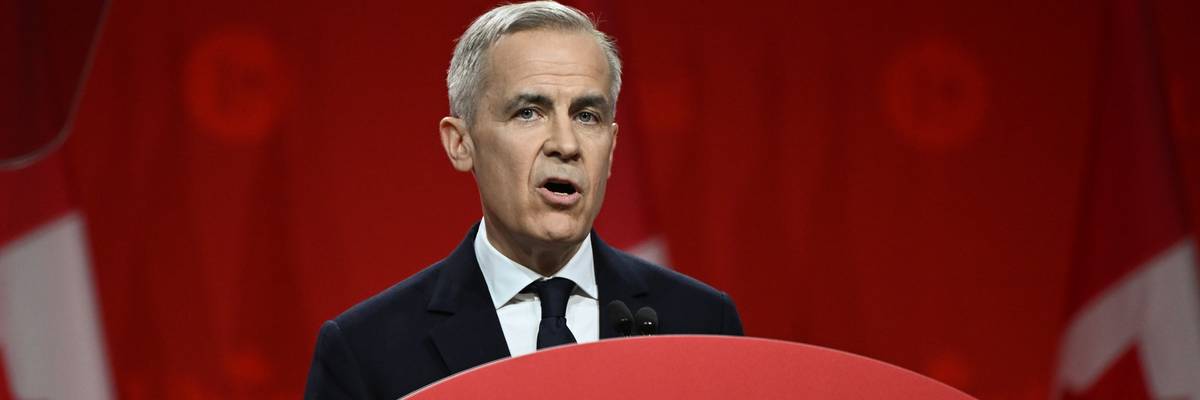
Mark Carney, newly elected as the leader of the Liberal Party of Canada, delivers his victory address following the official announcement of the 2025 Liberal Leadership race results at Rogers Centre, in Ottawa, Ontario, Canada, on March 9, 2025.
"There is someone who is trying to weaken our economy: Donald Trump," said Carney in his victory speech.
Former central banker Mark Carney will replace outgoing Prime Minister Justin Trudeau and take the helm of Canada's centrist Liberal Party after winning the leadership race by more than 80%. In his victory speech in Ottawa, Carney took direct aim at U.S President Donald Trump.
"There is someone who is trying to weaken our economy: Donald Trump," said Carney. "Donald Trump, as we know, has put... unjustified tariffs on what we build, on what we sell, on how we make a living. He's attacking Canadian families, workers, and businesses."
Last week, the Trump administration imposed 25% tariffs on most goods imported from Canada and Mexico last week, prompting Canada to impose retaliatory tariffs. Trump has paused tariffs on some products from Canada, but the duties could still return in April, according to Bloomberg. But a trade war isn't the only area where Canadian and U.S. relations are feeling a chill. Trump has made threats to Canadian sovereignty by repeatedly saying Canada should be the 51st state of the U.S., which Carney also addressed in his speech.
"America is not Canada. And Canada never, ever, will be part of America in any way, shape or form," Carney told the crowd. "We didn't ask for this fight, but Canadians are always ready when someone else drops the gloves."
After nearly a decade leading the Canadian government, outgoing Prime Minister Justin Trudeau announced in January that he intended to resign as the head of the Liberal Party after it selected a new leader—acquiescing to calls that he should make way for new leadership ahead of a federal election later this year. Trudeau faced declining public polling and calls from within his own party to resign.
In recent weeks, however, the Liberal Party has sharply rebounded in public opinion polls—rising from 20% in early January to 30% as of March 5. A federal election must be held by October 20, 2025, but could be held sooner if a snap election is called. Carney will serve as prime minister for the duration of the party's ruling term.
Polling has the Conservative Party, lead by Pierre Poilievre, in the lead.
Carney will be the second Canadian prime minister "with no concrete links to parliament at the time of his appointment, including no seat in the House of Commons. While no rule bars this, convention suggests Carney will need to quickly announce plans to run for a federal seat," according to The Guardian.
Carney was the governor of the Bank of Canada from 2008 to 2013, and later was the first non-British person selected to run the Bank of England, from 2013 to 2020, according to The Associated Press. In both cases, Carney earned acclaim for helping the countries navigate economic hardship. From 2020 to early 2025 he was the United Nations’ special envoy for climate action and finance, per his LinkedIn page.
This country and this world are at a monumental crossroads. US voters have an opportunity to beat back the forces of fascism and confront the billionaires who are rigging the economy, our media system, and our democracy, making it increasingly impossible for ordinary people to get by. We’re not just talking about the election. We’re talking about what must be done once these fascist elements are vanquished from power. We need a bolder set of solutions than what either major party has so far been willing to offer and a working-class movement ready to fight like hell for it. Trump didn't emerge from nowhere. The conditions that fueled MAGA authoritarianism were created by decades of radical neoliberal economic policies and a corrupt political system dominated by corporate interests. They slashed taxes on the super-rich, promising that the benefits would trickle down. They said giveaways to the corporate titans would make life more affordable for the rest of us. It was all bullshit. And when a bitter, betrayed populace searches for someone to blame, right-wing demagogues have little trouble finding scapegoats. People know when they're being lied to, but you won't hear any of this from the corporate media. Only independent journalism—powered and funded by people who believe in building a better world—can deliver truly trustworthy daily news. If you share our vision, please contribute whatever you can to sustain our work. |
Former central banker Mark Carney will replace outgoing Prime Minister Justin Trudeau and take the helm of Canada's centrist Liberal Party after winning the leadership race by more than 80%. In his victory speech in Ottawa, Carney took direct aim at U.S President Donald Trump.
"There is someone who is trying to weaken our economy: Donald Trump," said Carney. "Donald Trump, as we know, has put... unjustified tariffs on what we build, on what we sell, on how we make a living. He's attacking Canadian families, workers, and businesses."
Last week, the Trump administration imposed 25% tariffs on most goods imported from Canada and Mexico last week, prompting Canada to impose retaliatory tariffs. Trump has paused tariffs on some products from Canada, but the duties could still return in April, according to Bloomberg. But a trade war isn't the only area where Canadian and U.S. relations are feeling a chill. Trump has made threats to Canadian sovereignty by repeatedly saying Canada should be the 51st state of the U.S., which Carney also addressed in his speech.
"America is not Canada. And Canada never, ever, will be part of America in any way, shape or form," Carney told the crowd. "We didn't ask for this fight, but Canadians are always ready when someone else drops the gloves."
After nearly a decade leading the Canadian government, outgoing Prime Minister Justin Trudeau announced in January that he intended to resign as the head of the Liberal Party after it selected a new leader—acquiescing to calls that he should make way for new leadership ahead of a federal election later this year. Trudeau faced declining public polling and calls from within his own party to resign.
In recent weeks, however, the Liberal Party has sharply rebounded in public opinion polls—rising from 20% in early January to 30% as of March 5. A federal election must be held by October 20, 2025, but could be held sooner if a snap election is called. Carney will serve as prime minister for the duration of the party's ruling term.
Polling has the Conservative Party, lead by Pierre Poilievre, in the lead.
Carney will be the second Canadian prime minister "with no concrete links to parliament at the time of his appointment, including no seat in the House of Commons. While no rule bars this, convention suggests Carney will need to quickly announce plans to run for a federal seat," according to The Guardian.
Carney was the governor of the Bank of Canada from 2008 to 2013, and later was the first non-British person selected to run the Bank of England, from 2013 to 2020, according to The Associated Press. In both cases, Carney earned acclaim for helping the countries navigate economic hardship. From 2020 to early 2025 he was the United Nations’ special envoy for climate action and finance, per his LinkedIn page.