

SUBSCRIBE TO OUR FREE NEWSLETTER
Daily news & progressive opinion—funded by the people, not the corporations—delivered straight to your inbox.
5
#000000
#FFFFFF
To donate by check, phone, or other method, see our More Ways to Give page.
Daily news & progressive opinion—funded by the people, not the corporations—delivered straight to your inbox.
"When we STRIKE, we WIN!" said the AFL-CIO, the nation's largest federation of unions.
The union representing East and Gulf Coast dockworkers suspended its strike on Thursday after reaching a tentative agreement with shipping giants that reportedly includes a 62% wage boost over six years.
The International Longshoremen's Association (ILA) said in a joint statement with the United States Maritime Alliance (USMX) that the union would suspend its strike until January 15 so the two sides can "return to the bargaining table to negotiate all other outstanding issues."
"Effective immediately, all current job actions will cease and all work covered by the Master Contract will resume," the statement added.
The tentative deal followed three days on the picket line during which dockworkers—who are essential to the functioning of the U.S. economy—cast their fight as a critical struggle against multinational corporations that raked in huge profits during the Covid-19 pandemic and enriched their investors as wages failed to keep pace with inflation.
“These companies... they don't give a fuck about us," Harold Daggett, the ILA's president, said from a picket line in New Jersey earlier this week. "Well, we're gonna show them they're gonna have to give a fuck about us. Because nothing's gonna move without us."
According to one estimate, the dozens of ports affected by the strike handle a combined 25% of the United States' international trade.
The Associated Press reported Thursday that the two sides reached a tentative deal after "the ports sweetened their wage offer from about 50% over six years to 62%."
The union originally sought a 77% raise, but in recent days Daggett said the ILA would pursue a 61.5% raise for workers over the course of a new contract. Daggett rejected the shipping industry's previous wage offers as "insulting."
"Congratulations to ILA members for making huge strides and thank you to the millions of union members who stood in solidarity with them."
Under the contract that expired earlier this week, starting pay for dockworkers was $20 an hour.
Any final agreement must be ratified by union members, who also demanded protections from automation and other benefit improvements. Reuters reported that automation is among the "key issues that remain unresolved."
"When we STRIKE, we WIN!" the AFL-CIO, the nation's largest federation of unions, wrote on social media late Thursday. "Congratulations to ILA members for making huge strides and thank you to the millions of union members who stood in solidarity with them."
U.S. Sen. Bernie Sanders (I-Vt.) also congratulated "the 50,000 port workers who went on strike against the outrageous corporate greed of the shipping industry and won a historic increase in wages."
"Billionaires in the shipping industry must not be allowed to get even richer by replacing port workers with robots," the senator wrote.
Sanders added that Acting Labor Secretary Julie Su "did a great job negotiating a tentative agreement to increase the wages of port workers by 62% over six years."
The Biden administration declined to intervene on the side of industry to halt the strike, and President Joe Biden issued a statement earlier this week noting that "ocean carriers have made record profits since the pandemic and in some cases profits grew in excess of 800% compared to their profits prior to the pandemic."
"Executive compensation has grown in line with those profits and profits have been returned to shareholders at record rates," said Biden. "It's only fair that workers, who put themselves at risk during the pandemic to keep ports open, see a meaningful increase in their wages as well."
In a statement following news of the tentative deal, Biden said that "today's tentative agreement on a record wage and an extension of the collective bargaining process represents critical progress towards a strong contract."
"I congratulate the dockworkers from the ILA, who deserve a strong contract after sacrificing so much to keep our ports open during the pandemic," the president said. "And I applaud the port operators and carriers who are members of the U.S. Maritime Alliance for working hard and putting a strong offer on the table."
"The same foreign-owned shipping giants that say they can't find the money for fairer wages and treatment of American port workers managed to find billions of dollars to enrich a small group of wealthy investors."
Amid a strike that dockworkers along the East and Gulf Coasts argue is about "corporate greed vs. workers rights," a watchdog group is highlighting how at least one shipping giant on the other side of the labor battle has recently poured billions of dollars into stock buybacks.
Around 45,000 members of the International Longshoremen's Association (ILA) walked off the job at 12:01 am Tuesday after unsuccessful negotiations with the United States Maritime Alliance (USMX), a shipping industry group that includes Maersk.
In an analysis released Wednesday, Accountable.US pointed out that as part of Maersk's $12 billion stock buyback program, the Danish shipping company "has spent $6.5 billion buying back nearly 3 million Class A and B shares as of January 2024."
"When the big shipping industry was faced with a choice—share its success with the U.S. workers that delivered it, or go overboard with greed—its executives clearly chose the latter."
When companies pursue stock buybacks—also called share repurchases—they reduce the number of shares available on the market, which inflates earnings per share, enriching shareholders. The practice has fueled calls to hike the U.S. corporate tax rate.
Maersk paused its buybacks in February. CNBC reported at the time that the company "flagged 'high uncertainty' in its 2024 earnings outlook amid Red Sea disruptions and an oversupply of shipping vessels."
Still, Accountable.US framed what Maersk has done so far as proof that the shipping giant and fellow USMX members have the capital to end this strike, as ILA president Harold Daggett asserted this week.
"The same foreign-owned shipping giants that say they can't find the money for fairer wages and treatment of American port workers managed to find billions of dollars to enrich a small group of wealthy investors after riding a wave of record profits," said Liz Zelnick, director of the Economic Security & Corporate Power Program at Accountable.US, in a statement.
"When the big shipping industry was faced with a choice—share its success with the U.S. workers that delivered it, or go overboard with greed—its executives clearly chose the latter," Zelnick added.
The watchdog also took aim at COSCO Shipping Holdings, which last year "announced plans to buy back up to $101 million of its A shares, with plans for further buybacks, after reporting an 'industry-beating' profit of $2.7 billion in the first half of 2023."
Meanwhile, amid concerns about the economic fallout from the strike, the tens of thousands of striking ILA port workers emphasize that they are eager to return to work, but need a contract with wage increases and protections from automation.
"The action is going to give us a fair contract and we can get back to work to get people the goods they need," Joe Mosquera, a crane operator and union organizer with ILA, Local 1235, told The Guardian Thursday. "This is for our future generations. To keep automation out is to keep our jobs for the future. And if anything becomes automated, we want to make sure that there's a worker to back it up."
The industry's biggest strike since 1977 is already having an impact. Citing Everstream Analytics, Reuters reported Thursday that "at least 45 container vessels that have been unable to unload had anchored up outside the strike-hit East Coast and Gulf Coast ports by Wednesday, up from just three before the strike began on Sunday."
The workers are backed by U.S. President Joe Biden—who is empowered by an anti-union federal law to break the strike but has signaled he won't—and various pro-worker lawmakers, including the congressional Labor Caucus, co-chaired by Reps. Debbie Dingell (D-Mich.), Steven Horsford (D-Nev.) Donal Norcross (D-N.J.), and Mark Pocan (D-Wis.).
"We stand in solidarity with the ILA workers in their fight for a fair contract with USMX," the caucus said in a statement shared by the union Wednesday. "We've seen unions secure historic contracts for workers across the country in recent years, and now ILA workers—who kept our economy moving throughout the pandemic—are fighting for their share of the profits they helped create."
"Contract negotiations can be difficult at times, but collective bargaining is the best way for workers and employers to come to a fair agreement," the caucus added. "We encourage all parties to remain at the bargaining table and negotiate in good faith to reach a fair contract that reflects the success of the companies."
"People never gave a shit about us until now, when they finally realized that the chain is being broke now."
Amid concerns over fallout from the dockworker strike at ports up and down the East Coast, the head of the International Longshoremen's Association stressed in a Fox News appearance Tuesday that it's greedy companies, not 45,000 striking workers, who are to blame for any economic impacts that may follow from the labor dispute.
"They don't care," ILA president Harold Daggett said of shipping companies. "It's not fair. And if we don't put our foot down now, they would like to run over us, and we're not gonna allow that."
The Fox reporter then said, "You are gonna grind the economy to a halt here on the East Coast and the Gulf Coast."
Daggett fired back: "Not us—they are! Don't spin it now because you're Fox News... They have the capital to settle this thing."
Longshoreman President Harold Daggett praises Secretary of Labor Julie Su, and attacks the corporations whose greed has seen them make $400 billion in profit by jacking up prices since the start of the pandemic. pic.twitter.com/IO2hizqpOX
— More Perfect Union (@MorePerfectUS) October 1, 2024
Reuters reported Wednesday that "the strike, the ILA's first major stoppage since 1977, is worrying businesses that rely on ocean shipping to export their wares or secure crucial imports. It affects 36 ports—including New York, Baltimore, and Houston—that handle a range of containerized goods ranging from bananas to clothing to cars."
As the Fox reporter emphasized the impacts of the strike, Daggett said, "Now you start to realize who the longshoremen are, right?"
"People never gave a shit about us until now, when they finally realized that the chain is being broke now," he continued. "Cars won't come in. Food won't come in. Clothing won't come in. You know how many people depend on our jobs? Half the world!"
"And it's time for them, and time for Washington, to put so much pressure on them to take care of us," he added. "Because we took care of them, and we're here 135 years and brought them where they are today and they don't want to share!"
The ILA members walked off the job just after midnight on Tuesday, following the collapse of negotiations with the United States Maritime Alliance (USMX). The union is pushing for annual raises and protections from automation in the six-year contract.
Democratic President Joe Biden has power to break the strike—thanks to the anti-union law known as the Taft-Hartley Act—but has said he doesn't plan to do so. The ILA has welcomed the involvement of Biden's acting secretary of labor, Julie Su, whom Daggett called "terrific."
"We took care of them... and brought them where they are today and they don't want to share!"
In a Wednesday statement, the union leader said that his members "are grateful for the wisdom, courage, and leadership" of Su.
"Our ILA rank-and-file members will continue to strike for fair wages and their share of the foreign ocean carriers record billion-dollar profits and we are grateful to have the support of the U.S. Labor Department," Daggett declared.
His comments came in response to Su saying Tuesday that "over the last week and more, I have spent hours on the phone and in meetings with the parties urging them to find a way to reach a fair contract. This country's port workers put their health and safety on the line to keep working through the pandemic so we could get the goods we needed as Covid raged and these workers will help communities recover from the devastating effects of Hurricane Helene."
"As these companies make billions and their CEOs bring in millions of dollars in compensation per year, they have refused to put an offer on the table that reflects workers' sacrifice and contributions to their employer's profits," she added. "The American economy has defied all expectations thanks to the Biden-Harris administration's leadership. There is room for both companies and their workers to prosper. The parties need to get back to the negotiating table, and that must begin with these giant shipping magnates acknowledging that if they can make record profits, their workers should share in that economic success."
Biden—who blocked a rail strike in 2022 but then last year became the first sitting president to walk a picket line—put out a similar statement in support of longshoremen on Tuesday, saying on social media that "it's time those ocean carriers offered a strong and fair contract that reflects ILA workers’ contribution to our economy and to their record profits."
Vice President Kamala Harris, the Democratic nominee for the November election, piled on with a Wedneday campaign statement highlighting that "this strike is about fairness. Foreign-owned shipping companies have made record profits and executive compensation has grown. The longshoremen, who play a vital role transporting essential goods across America, deserve a fair share of these record profits."
Harris pointed out that her Republican opponent, former President Donald Trump, "wants to pull us back to a time before workers had the freedom to organize," noting that "as president, he blocked overtime benefits for millions of workers, he appointed union-busters to the [National Labor Relations Board]—and just recently, he said striking workers should be fired."
"Donald Trump makes empty promise after empty promise to American workers, but never delivers. He thinks our economy should only work for those who own the big skyscrapers, not those who actually build them," she added. "As president, I will have workers' backs and finally pass the [Protecting the Right to Organize] Act. And I will fight for an opportunity economy—where every person has the chance not just to get by but to get ahead."

"We are prepared to fight as long as necessary, to stay out on strike for whatever period of time it takes, to get the wages and protections against automation our ILA members deserve."
Dockworkers at East and Gulf Coast ports went on strike Tuesday morning, forming picket lines from Massachusetts to Texas.
The International Longshoremen's Association (ILA), the union that represents the 45,000 affected dockworkers, didn't accept terms offered by the United States Maritime Alliance (USMX), the port operators' group, and initiated a walkout that began at 12:01 am Tuesday.
It's the first strike at the three dozen East and Gulf Coast ports since 1977, when dockworkers won major concessions.
The labor dispute centers on the level of pay increase and the degree of automation allowed at the ports.
"We are prepared to fight as long as necessary, to stay out on strike for whatever period of time it takes, to get the wages and protections against automation our ILA members deserve," ILA President Harold Daggett said in a statement on Tuesday.
NOW: The port strike has begun here in Boston.
Members of the International Longshoremen's Association are marching to the Conley Terminal to hit the picket line after failed contract negotiations with the US Maritime Alliance. This will impact ports from ME to TX. @NBC10Boston pic.twitter.com/w7l3JC9iAB
— Kirsten Glavin (@kirstenglavin) October 1, 2024
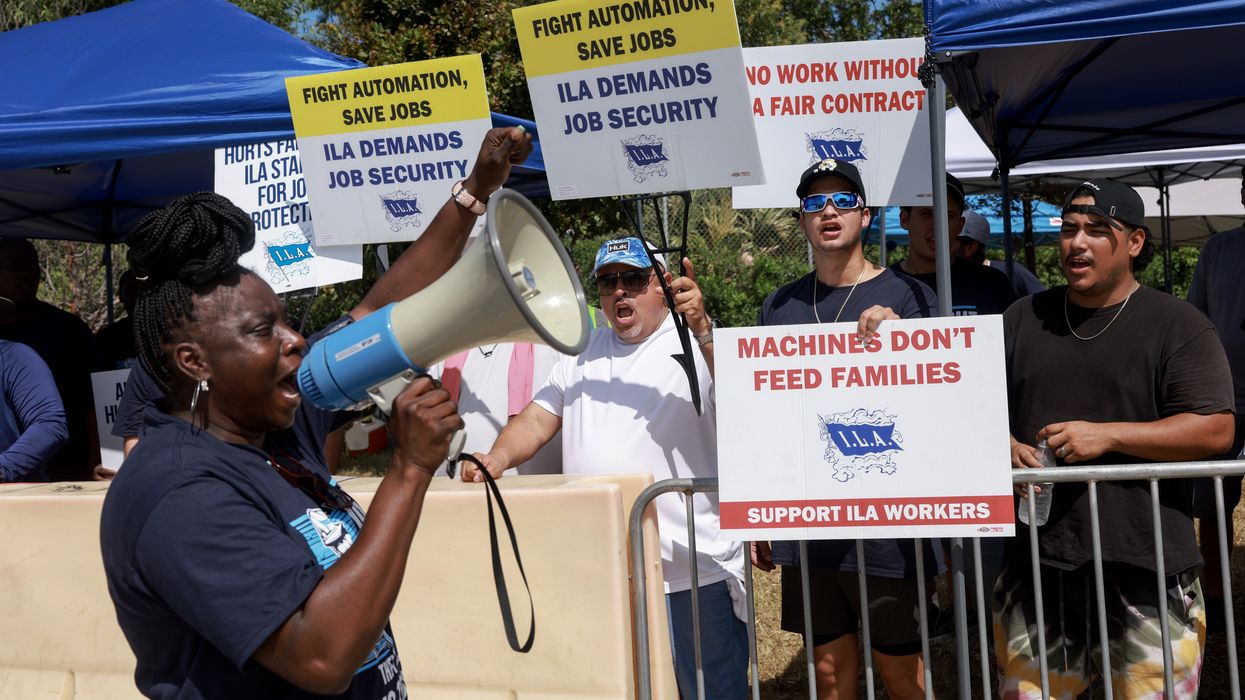
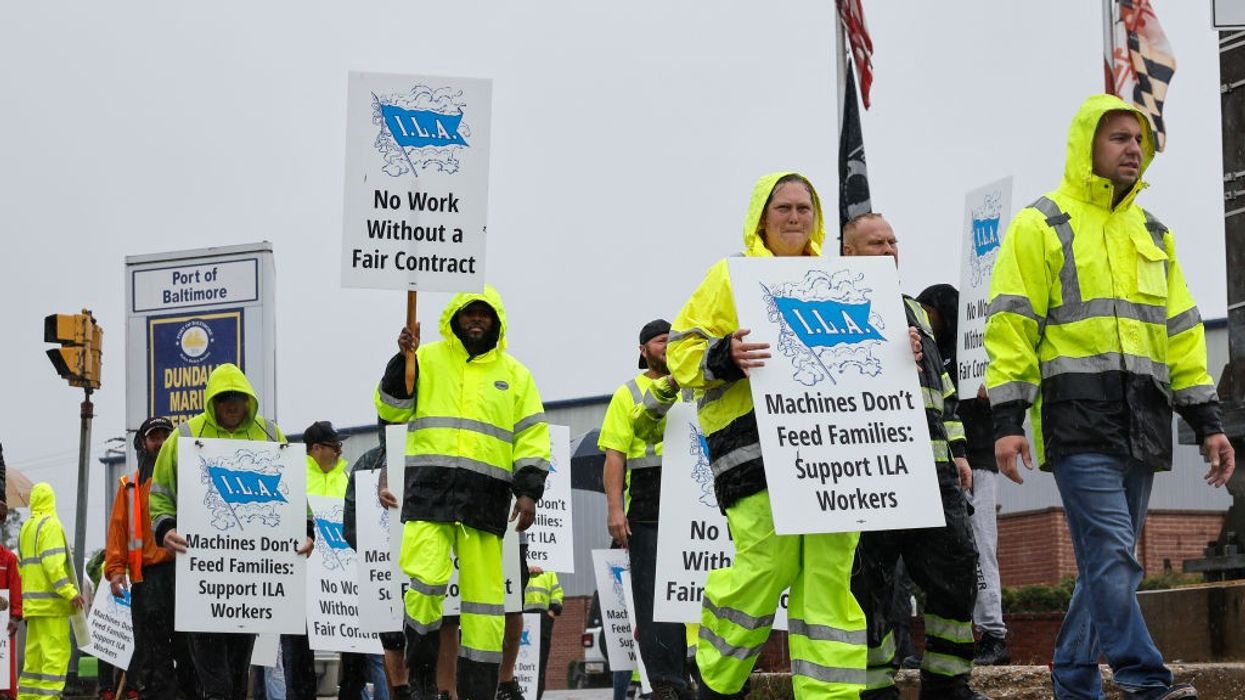
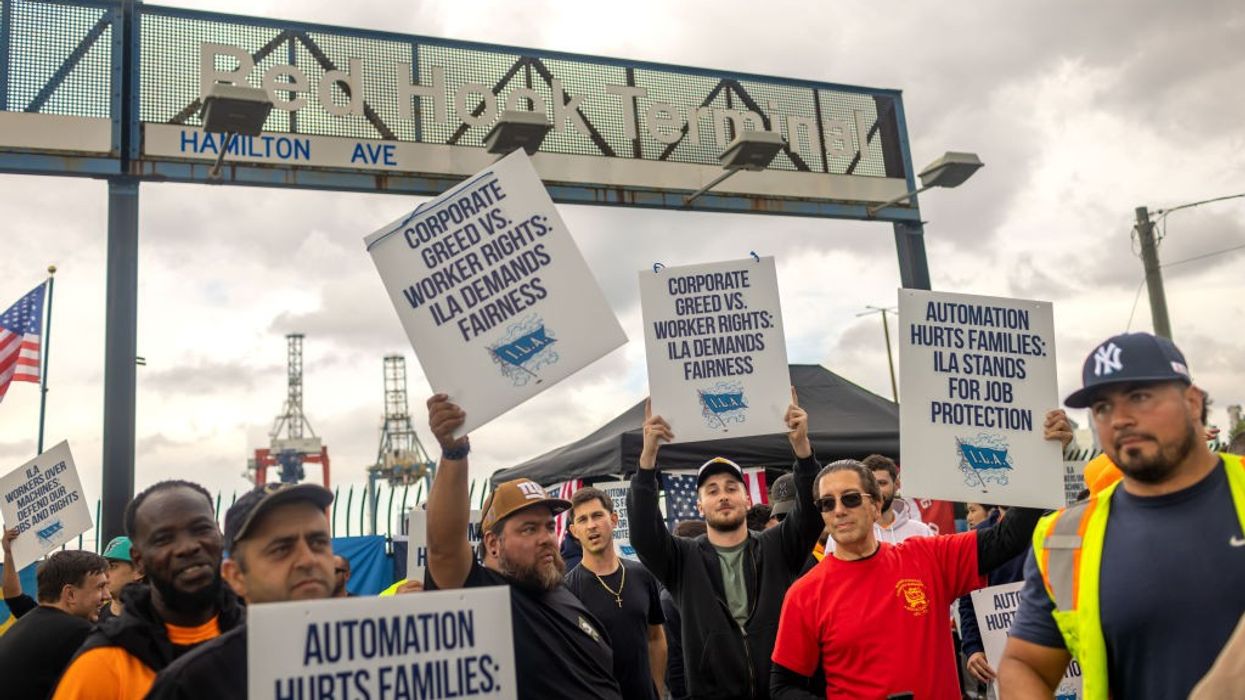
Workers picketed at the ports just after their contract expired at midnight, carrying placards with messages such as: "Automation Hurts Families: ILA Stands For Job Protection"; "No Work Without a Fair Contract"; "Corporate Greed vs. Workers Rights: ILA Demands Fairness!"; and "Fight Automation, Save Jobs: ILA Demands Job Security."
Daggett spoke to picketers at a terminal in Elizabeth, New Jersey, saying the strike would "go down in history" and referencing his participation in the 1977 strike. He pointed the finger at USMX's global shipping companies, some of which are based in Europe, saying that they price-gouge their customers—echoing an argument the ILA had made in a statement Monday—and short-change dockworkers.
"Who's the greedy one here?" asked Daggett. "These companies over in Europe. They don't give a fuck about us. We're going to show them they're going to have to give a fuck about us. Because nothing's going to move without us."
In Philadelphia, workers walked in a circular picket line at a rail crossing outside the port, just after midnight, and chanted, "No work without a fair contract," The Associated Press reported. Local ILA president Boise Butler made remarks on wages and automation. Like Daggett, he mentioned the billions that shipping companies made during the pandemic.
"Now we want them to pay back," Butler said. "They’re going to pay back."
The striking dockworkers drew support from other unions, including the United Auto Workers (UAW).
"The UAW stands in solidarity with the 45,000 courageous port workers fighting for economic justice. Without their labor, nothing in this country moves," the UAW wrote on social media.
Most recently, some ILA dockworkers have reportedly had a base salary of $81,000 and some have earned as much as $200,000 with large amounts of overtime. They say their hours are extremely long and the conditions are harsh or even dangerous. The top hourly rate has been $39 and the hourly pay can be as low as $20 for "backbreaking, indispensable work," according to More Perfect Union, a progressive media outlet.
The ILA reportedly demanded a $5 per year raise in hourly pay over the course of a six-year contract, so that the top hourly rate in the final year would be $69. West Coast dockworkers reached a deal with operators that will have them earning just over $60 an hour by 2027. USMX offered only a $2.50 raise each year.
The two sides exchanged counteroffers regarding wages on Monday, with each side moving from its initial position, according to USMX.
President Joe Biden, a Democrat, has the authority under the 1947 Taft-Hartley Act to break the strike and institute an 80-day cooling off period—a power that Republican presidents have used. Biden said Sunday that he doesn't plan to do so.
Sen. Bernie Sanders (I-Vt.) on Tuesday pushed Biden to stick to that plan not to interfere.
"President Biden is right," Sanders wrote on social media. "He should not invoke Taft-Hartley to end the port strike. Dock workers are striking against excessive corporate greed. The shipping industry has made $400 billion in profits since 2020. It's time for dock workers to be treated with respect, not contempt."
The New York Times reported Tuesday that Biden faced a "quandary" five weeks before the election—not wanting to anger union allies and working class advocates by intervening, but also not wanting the strike to "weigh on the economy."
More than half of the country's container shipments go through the three dozen affected ports, and a prolonged strike would cause major economic disruptions, experts say. More Perfect Union wrote that "port owners' refusal" to meet union demands could cost the U.S. economy billions of dollars a week.
This story has been updated to include comment from Sen. Bernie Sanders (I-Vt.).

The union called out "a half-century of wage subjugation" and said the wages the port operators were offering were "a joke."
Dockworkers at East and Gulf Coast ports are set to go on strike after their contract expires at midnight on Monday as they seek higher pay and better job protections, in what would be the first coordinated walkout at ports from Maine to Texas since 1977.
The International Longshoremen's Association (ILA), a union, has reached an impasse with the United States Maritime Alliance (USMX), the port operators' group, over pay rises and protection against automation of jobs, among other benefits.
The strike is expected to have consequences across the economy: East and Gulf Coast ports bring in about half of the country's containerized goods and send out about two-thirds of them.
President Joe Biden doesn't plan to intervene to force a deal, administration officials have said, following pressure from union officials and advocates who want to ensure the dockworkers keep their right to strike.
An ILA statement on Sunday said USMX "refuses to address a half-century of wage subjugation," and another earlier in the week referred to the wages the port operators were offering as "insulting" and "a joke."
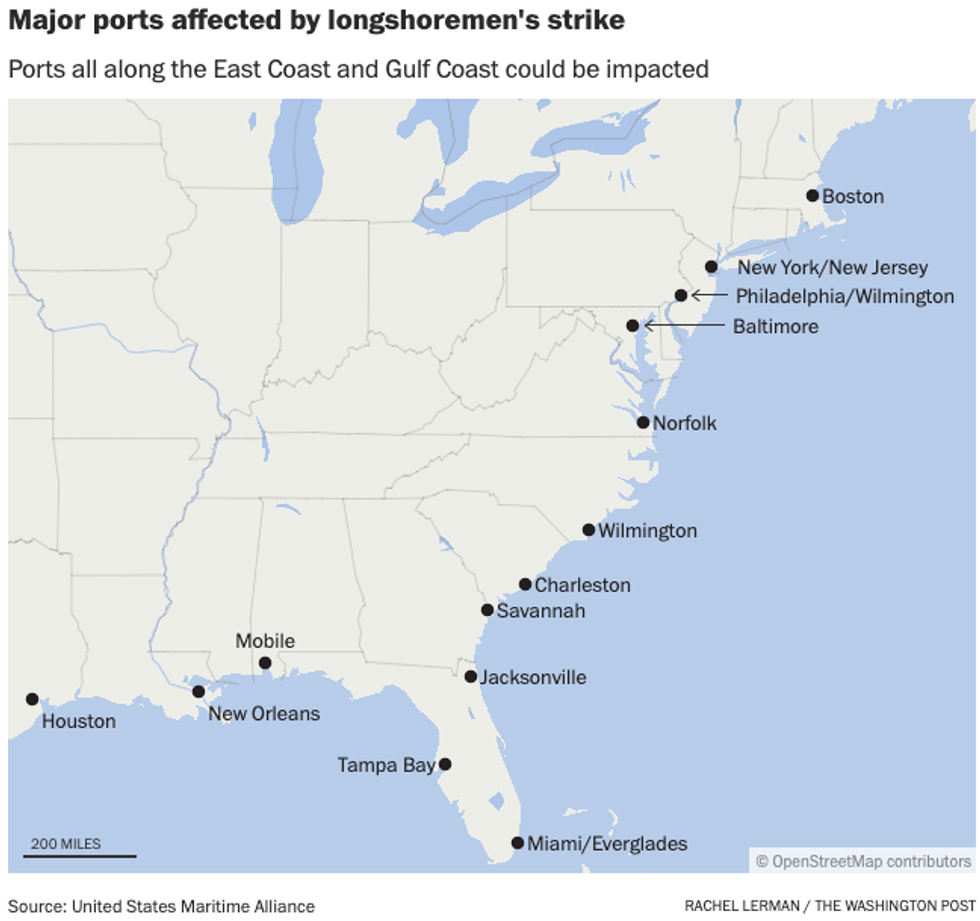
The expiring contract covers 45,000 longshoremen at about three dozen ports, including the Port of New York and New Jersey, which is the third busiest in the country.
The last strike at all of the East and Gulf Coast ports was in 1977; containerized trade is now even more essential to the U.S. economy than it was then.
West Coast dockworkers are covered under a different contract that was reached last year after many months of acrimonious negotiations.
The U.S. president has the authority to suspend a dockworkers strike under the Taft-Hartley Act, anti-union legislation passed in 1947. Presidents Richard Nixon and George W. Bush both used the act to break dockworkers strikes.
Union officials are watching the Biden administration closely in the current labor dispute. AFL-CIO President Elizabeth Shuler last week implored Congress to stay out of the process, warning that even the suggestion of federal intervention could prevent USMX from negotiating in good faith.
"Averting a strike is the responsibility of the employers who refuse to offer ILA members a contract that reflects the dignity and value of their labor," Schuler wrote.
Biden, a Democrat, angered many union members and working class advocates in 2022 by working with Congress to intervene to stop a major railworkers strike.
Some experts believe the president won't want to do that again ahead of the November election, for fear of hurting Democratic turnout.
"They just don't want to have a fight with labor going into the election," Harry Katz, an economist and labor relations expert at Cornell University, told The New York Times. "Because you need the unions to get out the vote."
However, the administration will also likely face pressure from certain Democrats and business interests who worry about the economic impact of a strike just before the elections. JPMorgan analysts estimated that the strike would cost the U.S. economy about $5 billion per day, roughly 6% of gross domestic product.
"There is little chance that the administration would risk jeopardizing its recent economic successes less than two months before a tightly-contested election," Bradley Saunders, an economist at Capital Economics, wrote in a note to clients last week, according to The Washington Post.
The ILA and USMX are negotiating pay increases, healthcare benefits, and the use of automated or semi-automated terminals, which threaten jobs. Pay has reportedly emerged as a central point of contention in recent negotiations. USMX offered an hourly pay rise of $2.50 each year over the course of a six-year contract; the ILA asked for a $5 raise per year, the Times reported.
The current top pay rate for the 45,000 longshoremen is $39 an hour, but the West Coast dockworkers are set to receive just over $60 in 2027, the final year of their contract. The ILA's requested rate would mean the top rate was $69 an hour in the final year of the new contract.
USMX is made up of global shipping companies that made "windfall profits" in 2021 and 2022, according to the Times.
The shutdown, which could begin as early as 12:01 am on Tuesday, won't affect cruise ships or military cargo, which the ILA has pledged to continue transporting.

"Instead of calling for government intervention, a far more productive tact would be to press the companies to meet the workers' very reasonable demands," the AFL-CIO president said.
The president of the AFL-CIO sent a letter to House Republicans on Thursday asking them not to intervene in contract negotiations between the International Longshoremen's Association and the U.S. Maritime Alliance, which could lead to the first East Coast port strike since 1977 if a deal is not struck by October 1.
The letter came in response to another letter sent by Republican lawmakers to U.S. President Joe Biden on September 19, urging him to "find a reasonable resolution to these contract disputes" and to "utilize every authority at its disposal to ensure the continuing flow of goods" if a strike does occur.
"Averting a strike is the responsibility of the employers who refuse to offer ILA members a contract that reflects the dignity and value of their labor," AFL-CIO president Elizabeth H. Shuler wrote in response to the GOP representatives. "The fight for a fair contract for longshoremen is the entire labor movement's fight."
"The public strongly supports these front-line workers and their just demand for economic security."
A potential strike would see between 25,000 and 50,000 workers walk off the job on Tuesday at 36 locations along 14 East and Gulf Coast port authorities, including 10 of the busiest in North America.
The union wants substantial raises to cover the cost of inflation. While West Coast port workers make a base wage of $54.85, their East and Gulf Coast counterparts make only $39.
The ILA is also demanding better healthcare, and a promise not to install automated or semi-automated terminals at the ports. However, negotiations between the union and the U.S. Maritime Alliance (USMX) broke down in June when the ILA said that USMX had begun using an automated gate to allow trucks into ports, in violation of the current contract.
The union has since contacted USMX to discuss wage increases, but the company has not upped its offer.
"My ILA members are not going to accept these insulting offers that are a joke considering the work my ILA longshore workers perform, and the billion-dollar profits the companies make off the backs of their labor," ILA president and lead negotiator Harold J. Daggett said in a statement on Monday.
"The blame for a coast wide strike in a week that will shut down all ports on the Atlantic and Gulf Coasts falls squarely on the shoulders of USMX," Daggett continued.
In their letter, the Republican representatives warned about how the strike "would result in delays and dire impacts to our supply chains, our economy, and the American consumer." They evoked the "supply-chain crisis" during the Covid-19 pandemic that was a major driver of inflation, saying that a one-week strike would cause a one-and-a-half month backlog.
However, Shuler said that the GOP letter made a strike—and its economic consequences—more likely, not less. That's because the leaning on Biden to use his authority to "ensure the continuing flow of goods," suggested Shuler, could reasonably be interpreted as a request for him to file a judicial injunction under the Taft-Hartely Act to stop a strike from taking place.
"History tells us that when companies can count on an injunction against a strike, they do not negotiate in good faith to reach an agreement. By even suggesting a possible injunction, your letter makes a deal less likely and a strike all the more likely," Shuler said.
This is especially the case because the Biden administration told Reuters earlier this month that it had "never invoked Taft-Hartley to break a strike and are not considering doing so now."
"Yet," Shuler told the representatives, "your letter tries to suggest otherwise, giving the companies reason to dig in their heels. Instead of calling for government intervention, a far more productive tact would be to press the companies to meet the workers' very reasonable demands."
Shuler defended the workers' rights to wages that keep pace with living costs as well as job security in a changing technological landscape.
"Like workers in many other industries—from hospitality to healthcare to film and television—they need fair contract provisions that protect their jobs from being eliminated by automation," Shuler said.
She also noted that the port workers had made significant sacrifices to keep the ports moving during the early years of Covid-19.
"Throughout the pandemic, longshore workers never took a day off, risking their health and lives to make sure shelves were stocked and the supply chain remained strong," Shuler wrote. "The public strongly supports these front-line workers and their just demand for economic security."
She continued: "It adds insult to injury to encourage USMX to provoke a strike rather than agree to a fair contract for the workers who kept food on the table and our economy running through the darkest days of the Covid-19 crisis."
The Transportation Trades Department (TTD) of the AFL-CIO also spoke out against government intervention in the negotiations.
"Relying on Taft-Hartley is not a winning strategy and should not be USMX's expected path to resolution," TTD president and scretary Greg Regan and Shari Semelsberger said in a statement. "The Biden-Harris administration has already stated, in their own words, 'We've never invoked Taft-Hartley to break a strike and are not considering doing so now.'"
Regan and Semelsberg added that USMX was to blame for the risk of a strike.
"Let us be clear: The employers, not the workers, have shirked their responsibility and punted labor negotiations to the 11th hour, when the damage to the public and the national supply chain would be most detrimental," they said. "While USMX seeks to cast blame on the frontline workers who move our supply chain, they are at fault."
"Remember this as they seek shelter from the disaster that they created," Regan and Semelsberg concluded.
This piece has been updated with a statement from the Transportation Trades Department of the AFL-CIO.