

SUBSCRIBE TO OUR FREE NEWSLETTER
Daily news & progressive opinion—funded by the people, not the corporations—delivered straight to your inbox.
5
#000000
#FFFFFF
To donate by check, phone, or other method, see our More Ways to Give page.
Daily news & progressive opinion—funded by the people, not the corporations—delivered straight to your inbox.
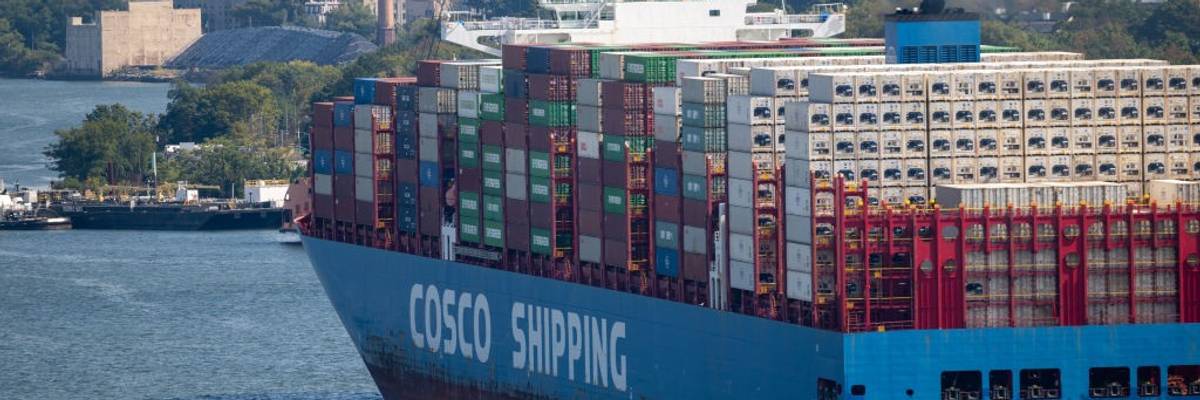
A container ship departs a terminal in Newark for the Atlantic Ocean on September 30, 2024.
"We are prepared to fight as long as necessary, to stay out on strike for whatever period of time it takes, to get the wages and protections against automation our ILA members deserve."
Dockworkers at East and Gulf Coast ports went on strike Tuesday morning, forming picket lines from Massachusetts to Texas.
The International Longshoremen's Association (ILA), the union that represents the 45,000 affected dockworkers, didn't accept terms offered by the United States Maritime Alliance (USMX), the port operators' group, and initiated a walkout that began at 12:01 am Tuesday.
It's the first strike at the three dozen East and Gulf Coast ports since 1977, when dockworkers won major concessions.
The labor dispute centers on the level of pay increase and the degree of automation allowed at the ports.
"We are prepared to fight as long as necessary, to stay out on strike for whatever period of time it takes, to get the wages and protections against automation our ILA members deserve," ILA President Harold Daggett said in a statement on Tuesday.
NOW: The port strike has begun here in Boston.
Members of the International Longshoremen's Association are marching to the Conley Terminal to hit the picket line after failed contract negotiations with the US Maritime Alliance. This will impact ports from ME to TX. @NBC10Boston pic.twitter.com/w7l3JC9iAB
— Kirsten Glavin (@kirstenglavin) October 1, 2024
Workers picketed at the ports just after their contract expired at midnight, carrying placards with messages such as: "Automation Hurts Families: ILA Stands For Job Protection"; "No Work Without a Fair Contract"; "Corporate Greed vs. Workers Rights: ILA Demands Fairness!"; and "Fight Automation, Save Jobs: ILA Demands Job Security."
Daggett spoke to picketers at a terminal in Elizabeth, New Jersey, saying the strike would "go down in history" and referencing his participation in the 1977 strike. He pointed the finger at USMX's global shipping companies, some of which are based in Europe, saying that they price-gouge their customers—echoing an argument the ILA had made in a statement Monday—and short-change dockworkers.
"Who's the greedy one here?" asked Daggett. "These companies over in Europe. They don't give a fuck about us. We're going to show them they're going to have to give a fuck about us. Because nothing's going to move without us."
In Philadelphia, workers walked in a circular picket line at a rail crossing outside the port, just after midnight, and chanted, "No work without a fair contract," The Associated Press reported. Local ILA president Boise Butler made remarks on wages and automation. Like Daggett, he mentioned the billions that shipping companies made during the pandemic.
"Now we want them to pay back," Butler said. "They’re going to pay back."
The striking dockworkers drew support from other unions, including the United Auto Workers (UAW).
"The UAW stands in solidarity with the 45,000 courageous port workers fighting for economic justice. Without their labor, nothing in this country moves," the UAW wrote on social media.
Most recently, some ILA dockworkers have reportedly had a base salary of $81,000 and some have earned as much as $200,000 with large amounts of overtime. They say their hours are extremely long and the conditions are harsh or even dangerous. The top hourly rate has been $39 and the hourly pay can be as low as $20 for "backbreaking, indispensable work," according to More Perfect Union, a progressive media outlet.
The ILA reportedly demanded a $5 per year raise in hourly pay over the course of a six-year contract, so that the top hourly rate in the final year would be $69. West Coast dockworkers reached a deal with operators that will have them earning just over $60 an hour by 2027. USMX offered only a $2.50 raise each year.
The two sides exchanged counteroffers regarding wages on Monday, with each side moving from its initial position, according to USMX.
President Joe Biden, a Democrat, has the authority under the 1947 Taft-Hartley Act to break the strike and institute an 80-day cooling off period—a power that Republican presidents have used. Biden said Sunday that he doesn't plan to do so.
Sen. Bernie Sanders (I-Vt.) on Tuesday pushed Biden to stick to that plan not to interfere.
"President Biden is right," Sanders wrote on social media. "He should not invoke Taft-Hartley to end the port strike. Dock workers are striking against excessive corporate greed. The shipping industry has made $400 billion in profits since 2020. It's time for dock workers to be treated with respect, not contempt."
The New York Times reported Tuesday that Biden faced a "quandary" five weeks before the election—not wanting to anger union allies and working class advocates by intervening, but also not wanting the strike to "weigh on the economy."
More than half of the country's container shipments go through the three dozen affected ports, and a prolonged strike would cause major economic disruptions, experts say. More Perfect Union wrote that "port owners' refusal" to meet union demands could cost the U.S. economy billions of dollars a week.
This story has been updated to include comment from Sen. Bernie Sanders (I-Vt.).
Dear Common Dreams reader, It’s been nearly 30 years since I co-founded Common Dreams with my late wife, Lina Newhouser. We had the radical notion that journalism should serve the public good, not corporate profits. It was clear to us from the outset what it would take to build such a project. No paid advertisements. No corporate sponsors. No millionaire publisher telling us what to think or do. Many people said we wouldn't last a year, but we proved those doubters wrong. Together with a tremendous team of journalists and dedicated staff, we built an independent media outlet free from the constraints of profits and corporate control. Our mission has always been simple: To inform. To inspire. To ignite change for the common good. Building Common Dreams was not easy. Our survival was never guaranteed. When you take on the most powerful forces—Wall Street greed, fossil fuel industry destruction, Big Tech lobbyists, and uber-rich oligarchs who have spent billions upon billions rigging the economy and democracy in their favor—the only bulwark you have is supporters who believe in your work. But here’s the urgent message from me today. It's never been this bad out there. And it's never been this hard to keep us going. At the very moment Common Dreams is most needed, the threats we face are intensifying. We need your support now more than ever. We don't accept corporate advertising and never will. We don't have a paywall because we don't think people should be blocked from critical news based on their ability to pay. Everything we do is funded by the donations of readers like you. When everyone does the little they can afford, we are strong. But if that support retreats or dries up, so do we. Will you donate now to make sure Common Dreams not only survives but thrives? —Craig Brown, Co-founder |
Dockworkers at East and Gulf Coast ports went on strike Tuesday morning, forming picket lines from Massachusetts to Texas.
The International Longshoremen's Association (ILA), the union that represents the 45,000 affected dockworkers, didn't accept terms offered by the United States Maritime Alliance (USMX), the port operators' group, and initiated a walkout that began at 12:01 am Tuesday.
It's the first strike at the three dozen East and Gulf Coast ports since 1977, when dockworkers won major concessions.
The labor dispute centers on the level of pay increase and the degree of automation allowed at the ports.
"We are prepared to fight as long as necessary, to stay out on strike for whatever period of time it takes, to get the wages and protections against automation our ILA members deserve," ILA President Harold Daggett said in a statement on Tuesday.
NOW: The port strike has begun here in Boston.
Members of the International Longshoremen's Association are marching to the Conley Terminal to hit the picket line after failed contract negotiations with the US Maritime Alliance. This will impact ports from ME to TX. @NBC10Boston pic.twitter.com/w7l3JC9iAB
— Kirsten Glavin (@kirstenglavin) October 1, 2024
Workers picketed at the ports just after their contract expired at midnight, carrying placards with messages such as: "Automation Hurts Families: ILA Stands For Job Protection"; "No Work Without a Fair Contract"; "Corporate Greed vs. Workers Rights: ILA Demands Fairness!"; and "Fight Automation, Save Jobs: ILA Demands Job Security."
Daggett spoke to picketers at a terminal in Elizabeth, New Jersey, saying the strike would "go down in history" and referencing his participation in the 1977 strike. He pointed the finger at USMX's global shipping companies, some of which are based in Europe, saying that they price-gouge their customers—echoing an argument the ILA had made in a statement Monday—and short-change dockworkers.
"Who's the greedy one here?" asked Daggett. "These companies over in Europe. They don't give a fuck about us. We're going to show them they're going to have to give a fuck about us. Because nothing's going to move without us."
In Philadelphia, workers walked in a circular picket line at a rail crossing outside the port, just after midnight, and chanted, "No work without a fair contract," The Associated Press reported. Local ILA president Boise Butler made remarks on wages and automation. Like Daggett, he mentioned the billions that shipping companies made during the pandemic.
"Now we want them to pay back," Butler said. "They’re going to pay back."
The striking dockworkers drew support from other unions, including the United Auto Workers (UAW).
"The UAW stands in solidarity with the 45,000 courageous port workers fighting for economic justice. Without their labor, nothing in this country moves," the UAW wrote on social media.
Most recently, some ILA dockworkers have reportedly had a base salary of $81,000 and some have earned as much as $200,000 with large amounts of overtime. They say their hours are extremely long and the conditions are harsh or even dangerous. The top hourly rate has been $39 and the hourly pay can be as low as $20 for "backbreaking, indispensable work," according to More Perfect Union, a progressive media outlet.
The ILA reportedly demanded a $5 per year raise in hourly pay over the course of a six-year contract, so that the top hourly rate in the final year would be $69. West Coast dockworkers reached a deal with operators that will have them earning just over $60 an hour by 2027. USMX offered only a $2.50 raise each year.
The two sides exchanged counteroffers regarding wages on Monday, with each side moving from its initial position, according to USMX.
President Joe Biden, a Democrat, has the authority under the 1947 Taft-Hartley Act to break the strike and institute an 80-day cooling off period—a power that Republican presidents have used. Biden said Sunday that he doesn't plan to do so.
Sen. Bernie Sanders (I-Vt.) on Tuesday pushed Biden to stick to that plan not to interfere.
"President Biden is right," Sanders wrote on social media. "He should not invoke Taft-Hartley to end the port strike. Dock workers are striking against excessive corporate greed. The shipping industry has made $400 billion in profits since 2020. It's time for dock workers to be treated with respect, not contempt."
The New York Times reported Tuesday that Biden faced a "quandary" five weeks before the election—not wanting to anger union allies and working class advocates by intervening, but also not wanting the strike to "weigh on the economy."
More than half of the country's container shipments go through the three dozen affected ports, and a prolonged strike would cause major economic disruptions, experts say. More Perfect Union wrote that "port owners' refusal" to meet union demands could cost the U.S. economy billions of dollars a week.
This story has been updated to include comment from Sen. Bernie Sanders (I-Vt.).
Dockworkers at East and Gulf Coast ports went on strike Tuesday morning, forming picket lines from Massachusetts to Texas.
The International Longshoremen's Association (ILA), the union that represents the 45,000 affected dockworkers, didn't accept terms offered by the United States Maritime Alliance (USMX), the port operators' group, and initiated a walkout that began at 12:01 am Tuesday.
It's the first strike at the three dozen East and Gulf Coast ports since 1977, when dockworkers won major concessions.
The labor dispute centers on the level of pay increase and the degree of automation allowed at the ports.
"We are prepared to fight as long as necessary, to stay out on strike for whatever period of time it takes, to get the wages and protections against automation our ILA members deserve," ILA President Harold Daggett said in a statement on Tuesday.
NOW: The port strike has begun here in Boston.
Members of the International Longshoremen's Association are marching to the Conley Terminal to hit the picket line after failed contract negotiations with the US Maritime Alliance. This will impact ports from ME to TX. @NBC10Boston pic.twitter.com/w7l3JC9iAB
— Kirsten Glavin (@kirstenglavin) October 1, 2024
Workers picketed at the ports just after their contract expired at midnight, carrying placards with messages such as: "Automation Hurts Families: ILA Stands For Job Protection"; "No Work Without a Fair Contract"; "Corporate Greed vs. Workers Rights: ILA Demands Fairness!"; and "Fight Automation, Save Jobs: ILA Demands Job Security."
Daggett spoke to picketers at a terminal in Elizabeth, New Jersey, saying the strike would "go down in history" and referencing his participation in the 1977 strike. He pointed the finger at USMX's global shipping companies, some of which are based in Europe, saying that they price-gouge their customers—echoing an argument the ILA had made in a statement Monday—and short-change dockworkers.
"Who's the greedy one here?" asked Daggett. "These companies over in Europe. They don't give a fuck about us. We're going to show them they're going to have to give a fuck about us. Because nothing's going to move without us."
In Philadelphia, workers walked in a circular picket line at a rail crossing outside the port, just after midnight, and chanted, "No work without a fair contract," The Associated Press reported. Local ILA president Boise Butler made remarks on wages and automation. Like Daggett, he mentioned the billions that shipping companies made during the pandemic.
"Now we want them to pay back," Butler said. "They’re going to pay back."
The striking dockworkers drew support from other unions, including the United Auto Workers (UAW).
"The UAW stands in solidarity with the 45,000 courageous port workers fighting for economic justice. Without their labor, nothing in this country moves," the UAW wrote on social media.
Most recently, some ILA dockworkers have reportedly had a base salary of $81,000 and some have earned as much as $200,000 with large amounts of overtime. They say their hours are extremely long and the conditions are harsh or even dangerous. The top hourly rate has been $39 and the hourly pay can be as low as $20 for "backbreaking, indispensable work," according to More Perfect Union, a progressive media outlet.
The ILA reportedly demanded a $5 per year raise in hourly pay over the course of a six-year contract, so that the top hourly rate in the final year would be $69. West Coast dockworkers reached a deal with operators that will have them earning just over $60 an hour by 2027. USMX offered only a $2.50 raise each year.
The two sides exchanged counteroffers regarding wages on Monday, with each side moving from its initial position, according to USMX.
President Joe Biden, a Democrat, has the authority under the 1947 Taft-Hartley Act to break the strike and institute an 80-day cooling off period—a power that Republican presidents have used. Biden said Sunday that he doesn't plan to do so.
Sen. Bernie Sanders (I-Vt.) on Tuesday pushed Biden to stick to that plan not to interfere.
"President Biden is right," Sanders wrote on social media. "He should not invoke Taft-Hartley to end the port strike. Dock workers are striking against excessive corporate greed. The shipping industry has made $400 billion in profits since 2020. It's time for dock workers to be treated with respect, not contempt."
The New York Times reported Tuesday that Biden faced a "quandary" five weeks before the election—not wanting to anger union allies and working class advocates by intervening, but also not wanting the strike to "weigh on the economy."
More than half of the country's container shipments go through the three dozen affected ports, and a prolonged strike would cause major economic disruptions, experts say. More Perfect Union wrote that "port owners' refusal" to meet union demands could cost the U.S. economy billions of dollars a week.
This story has been updated to include comment from Sen. Bernie Sanders (I-Vt.).

