

SUBSCRIBE TO OUR FREE NEWSLETTER
Daily news & progressive opinion—funded by the people, not the corporations—delivered straight to your inbox.
5
#000000
#FFFFFF
To donate by check, phone, or other method, see our More Ways to Give page.
Daily news & progressive opinion—funded by the people, not the corporations—delivered straight to your inbox.
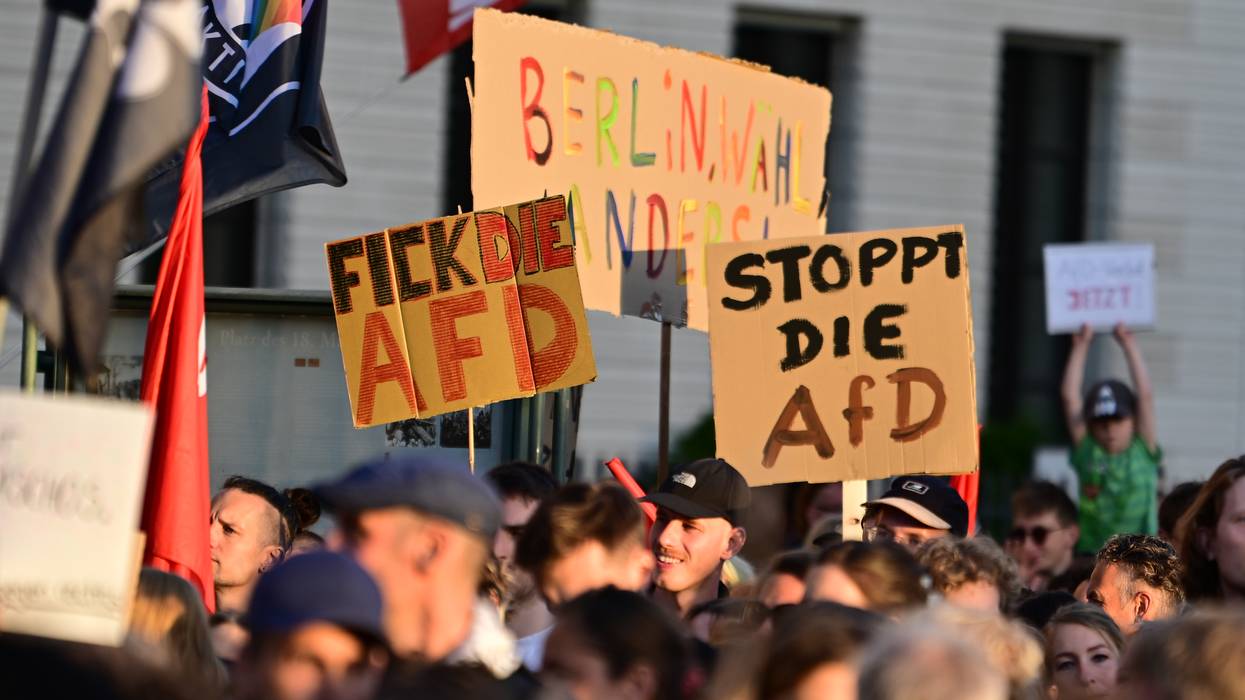
For the rest of Germany, the overwhelming majority of whom firmly reject fascism as the future, the mandate is clear: Solidarity Forever!
Upon learning of the landslide electoral triumph of a fascist political party in a province that was once part of socialist Germany, these foreboding words immediately came to mind: “The womb is fertile still from which that crawled.” It is the concluding line from Bertolt Brecht’s brilliant denunciation of the Hitler regime, The Resistible Rise of Arturo Ui. What happened in Saxony-Anhalt in the last election with the far-right AfD, or Alternative for Germany, gaining 43.5% of the vote is certainly a somber vindication of Brecht’s warning. But why there and why now? The answers are not readily apparent, but neither are they inscrutable.
First, the resistible rise of the AfD was not resisted sufficiently or effectively enough. In fact, the prevailing policies of Germany’s ruling parties—whether CDU (Christian Democratic Union) or SPD (Social Democratic Party of Germany)—actually served to propel alienation, angst, and anger among the masses. This is particularly true for the provinces of the former German Democratic Republic, all of which have significantly higher support for the AfD than their counterparts in the west.
The tactic of imposing a firewall (Brandmauer) of noncooperation around the AfD proved to be a poor choice for the resistance. After 30 years of being largely treated as second-class citizens, to be functionally defined as some sort of political leper for their party preference only strengthened the resolve and resentment of AfD voters in the east.
Germany remains, as before, a deeply divided country. The Reunification (die Wende) decades ago did little to integrate, let alone unify, east and west. “Ossies” and “Wessies” largely live in separate political and economic universes divided by colonial-like snobbery on the one side and legitimate grievances on the other.
The AfD officially associates itself with Blau (blue). It is perhaps worth noting that in common German parlance when someone is said to be Blau, they are totally drunk.
What was once a gap in living standards has become a chasm. The annual GDP per capita in Bavaria, for example, is $68,619, while in Saxony-Anhalt it is $42,471, the lowest of all provinces. Eastern German employees earn about 80%-86% of the income levels of their western counterparts. Employees in the western state of Baden-Württemberg earn on average 23% more than workers in Mecklenburg-Vorpommern, where provincial elections will be held on September 20 and where polls indicate the AfD will get at least 37% of the vote. The unemployment rate in eastern Germany sits around 8.1%, whereas in the west it is about 6.1%. Poverty rates in the east, now well over 20%, have consistently remained higher than in the west, now under 15%.
Despite these economic woes, the current embattled Chancellor, Friedrich Merz, and his CDU cohorts have proposed major rollbacks in the social safety net, stricter rules for sick leave, cuts to family benefits, and plans to alter pension payments. “The welfare state as we have known it,” proclaimed the multimillionaire Mertz, “can no longer be financed.” Mertz, a corporate lawyer and former head of Germany’s branch of BlackRock, the world’s largest asset management company with over $15 trillion in assets, is an unabashed cheerleader for monopoly capitalism as expressed in his book, Daring More Capitalism. Militarism is also high on his imperialist agenda.
His proposed military budget for 2027 is $125 billion, an increase of 33% from 2026. As he stated at the onset of his political career in the national government: My “government will provide the Bundeswehr with all the financial resources it needs to become the strongest conventional army in Europe.”
Not surprisingly, his CDU party crashed in the Saxony-Anhalt election, receiving only 16.7% of the vote, a 20.4 point drop from the previous election. It, along with the SPD, is projected to register colossal losses in the coming Mecklenburg-Vorpommern election as well.
A glimmer of hope in the east for anti-fascist and anti-capitalist forces emerges from Berlin. Polls there indicate that the Left Party (Die Linke) is projected to receive about 20% of the vote on September 20, the highest of all political parties on the ballot. There is a very real possibility that a prominent leader of the Left Party, Elif Eralp, will become the next mayor of Berlin replacing the disgraced CDU mayor Kai Wegner. Eralp is the daughter of politically active trade unionists in Turkey. She continues that legacy of activism with her outspoken opposition to racism and for affordable housing. “I don’t want large real estate firms to determine in which direction Berlin develops,” declared Eralp in her progressive campaign, “I believe a different Berlin is possible, one in which everyone is able to afford housing.”
More hope for the future comes from the massive anti-fascist protests in the wake of the AfD victory promptly held in Berlin, Potsdam, Münster, Göttingen, Dresden. Frankfurt, Aachen, Bamberg, Darmstadt, Halle, and elsewhere. One protest sign read, “The rainbow has no color brown.” Brown, of course, refers to the NSDAP, the Nazis. The AfD officially associates itself with Blau (blue). It is perhaps worth noting that in common German parlance when someone is said to be Blau, they are totally drunk.
For those intoxicated by a lust for power, now dangerously rejuvenated, sobriety in politics is no alternative. That means for the rest of Germany, the overwhelming majority of whom firmly reject fascism as the future, the mandate is clear: Solidarity Forever!
The womb from which the AfD crawled must be made infertile, forever.
History tells us that when ordinary people are forced to watch the rich buy their government and that government then fails to sustain them, they lose faith in democracy long before they realize it was actually unregulated capitalism that screwed them.
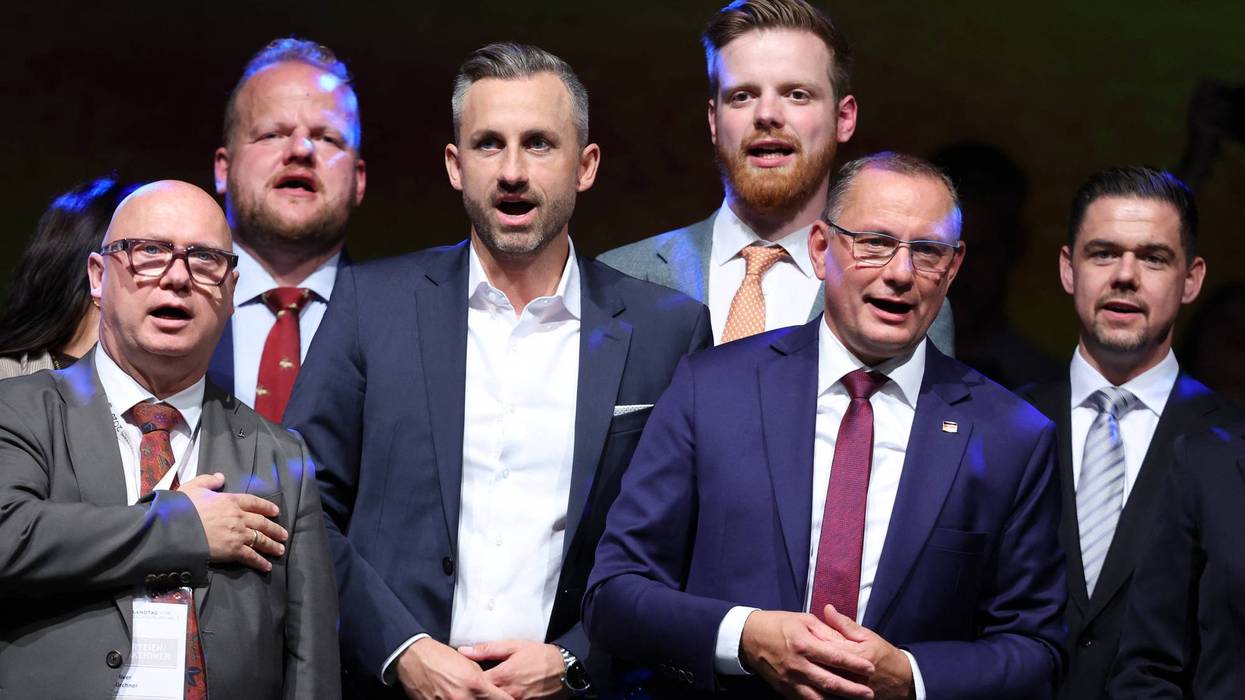
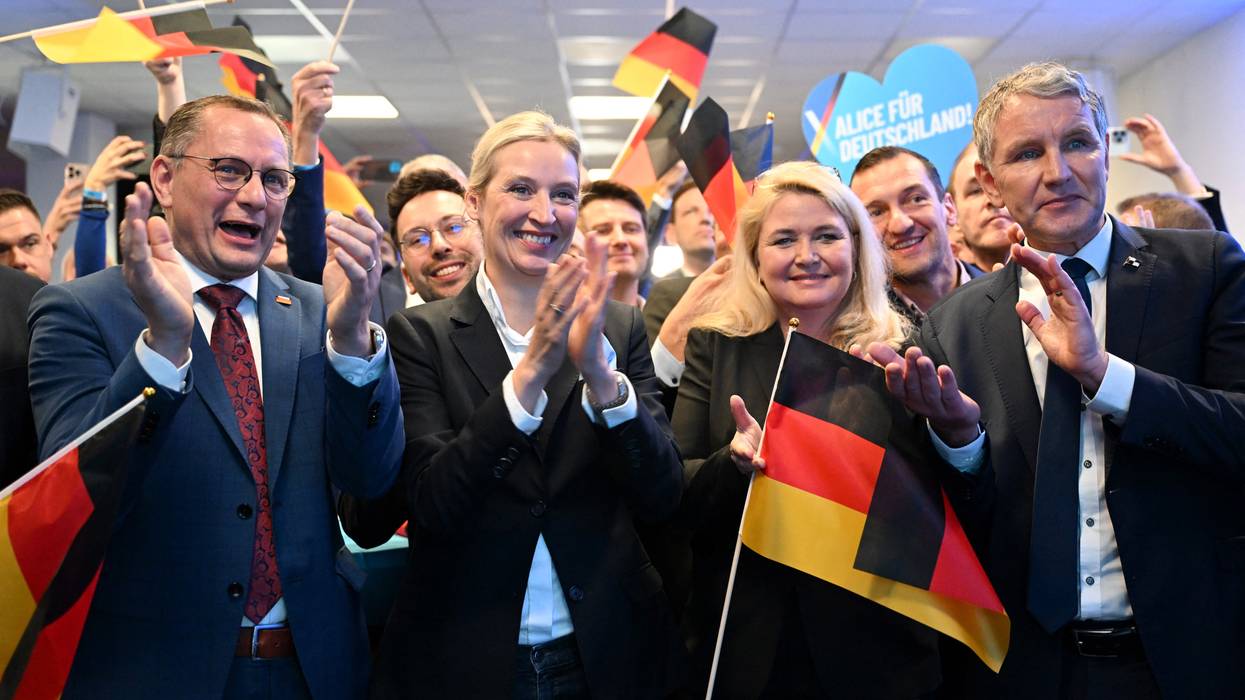
While Americans were celebrating this Labor Day weekend, in Magdenburg, Germany a 35-year-old neofascist, Ulrich Siegmund, told a cheering crowd that his right-wing Alternative für Deutschland party was “taking our country back.” They’d just pulled 44% of the vote in the German state of Saxony-Anhalt, double what it’d been just five years ago.
Their platform was simple: Expel brown-skinned immigrants; dump the EU and NATO to instead build an alliance with Russia; and tear up the tech, climate, and energy rules so the fossil fuel and tech billionaires could take over Germany’s government like they are America’s under President Donald Trump.
It was a stunning victory for Russian President Vladimir Putin, Elon Musk, and Trump, who all went online (Putin through spokesman Kirill Dmitriev) and immediately congratulated the heirs to Hitler’s party on their showing in the election.
That same weekend, Fareed Zakaria aired a conversation with Chrystia Freeland, Francis Fukuyama, and David French about why liberal democracy is in retreat, and Freeland argued that China’s so-far-successful model of state-directed capitalism is the biggest threat to democracy around the world.
If you let the winners of capitalism write the rules of capitalism, they’ll first destroy the competition and then come for the government that hosts them.
And there’s a lot of truth in that, since China’s success proves that capitalism doesn’t need democracy to flourish and, in fact, may do even better in an authoritarian state like modern China and 1930s Germany.
But the most serious threat to American democracy isn’t coming from Beijing; it’s coming out of Wichita, Silicon Valley, Mar-a-Lago, and from Republicans in black robes who’ve been taking gifts from billionaires for years. Here’s why.
At the end of the day, capitalism is just a game we play, which is why pro football is such a good analogy. Football is a phenomenal engine for producing it’s goal—entertainment—and it works because there are rules, referees who enforce them, and a league that ruthlessly punishes cheaters.
But imagine a Trump-run NFL announcing that whichever team wrote the biggest check to the league’s head guy could put 14 men on the field, pull face masks, and throw kidney punches with no flags. The richest team would win every game, the entertainment value would ultimately collapse, and within a few seasons the game itself would be dead.
Capitalism is exactly that kind of engine. Since Deng Xiaoping opened China to markets in 1978, according to the World Bank, growth of the Chinese economy has averaged over 9% a year, lifting nearly 800 million people out of extreme poverty, the largest reduction of human misery in recorded history.
I spent the month of November, 1986 in Beijing studying acupuncture; the city was poor, the air choked with coal smoke, and capitalism was just getting off the block with experimental “special economic zones” like Shenzhen. Nobody voted for it; China was then and is now essentially a totalitarian state, proving that capitalism doesn’t need democracy to be successful.
As the Chinese figured out in the 1970s when they rejected President Ronald Reagan’s neoliberalism and instead embraced state-run capitalism (I wrote about this at length in The Hidden History of Neoliberalism: How Reaganism Gutted America), in order to work well and produce general prosperity, capitalism just requires rules that prevent the most successful capitalists from rising up and taking over the state (as is happening here).
For example, when China’s richest man (Jack Ma) started complaining in 2020 that government regulators were holding his companies back from maximum profitability, the Chinese government killed off Ma’s Ant Group’s IPO and fined his Alibaba $2.8 billion for the monopolistic behavior of forcing merchants into exclusive contracts. Ma himself vanished from public view for a few months while he was “rehabilitated.”
I’m no admirer of a one-party state, and I’d never want to live under one. But the Chinese Communist Party figured out more than 50 years ago—from watching the failures in our example—that if you let the winners of capitalism write the rules of capitalism, they’ll first destroy the competition and then come for the government that hosts them.
They instead regulated their billionaires and their companies, in other words, because they knew what unregulated billionaires typically do to whoever’s in charge.
We Americans once understood that, and had a president who spoke about it in simple, straightforward terms.
President Franklin D. Roosevelt came into office in 1933 to clean up the GOP’s mess of the Republican Great Depression; he fought back against his generation’s oligarchs, declaring in 1936:
For out of this modern civilization economic royalists carved new dynasties. New kingdoms were built upon concentration of control over material things…
It was natural and perhaps human that the privileged princes of these new economic dynasties, thirsting for power, reached out for control over Government itself.
FDR took on those “economic royalists” and defeated them. He explicitly called them out when the Democratic Party renominated him for president in 1936 in Philadelphia:
"These economic royalists complain that we seek to overthrow the institutions of America. What they really complain of is that we seek to take away their power."
He paused for a moment, then thundered, “Our allegiance to American institutions requires the overthrow of this kind of power!”
The crowd roared, delighted that he’d put millions to work while stripping that day’s oligarchs of their power. And he raised the top tax rate on the morbidly rich back up to 90%, while stopping an effort to kidnap him and turn our government fascist:
“In vain,” Roosevelt said, “they seek to hide behind the Flag and the Constitution. In their blindness they forget what the Flag and the Constitution stand for. Now, as always, they stand for democracy, not tyranny; for freedom, not subjection; and against a dictatorship by mob rule and the over-privileged alike.”
Four months later at Madison Square Garden FDR named the forces of “monopoly, speculation, and reckless banking,” said they were “unanimous in their hate” for him, and told the crowd he welcomed their hatred.
He wasn’t trying to abolish capitalism. He was putting it back under control of the people’s rule book: Glass-Steagall, the Securities and Exchange Commission, the Wagner Act, antitrust enforcement, a minimum wage, and a top tax rate of 90%.
Republicans fought it all, calling it “socialism” in increasingly hysterical tones, but it worked and FDR put America back together and built the world’s first middle class that was more than half of a nation’s people.
The American oligarchs of that era, in response, pulled out of politics and went back to just doing business and getting rich, until President Richard Nixon put Lewis Powell on the Supreme Court and Powell began the process—from the bench—of turning America into a full-blown oligarchy.
During FDR’s era, fascism had risen out of the ashes of the Republican Great Depression, sweeping in a few short years across Italy, Germany, Austria, and Spain.
History tells us that when ordinary people are forced to watch the rich buy their government and that government then fails to sustain them, they lose faith in democracy long before they realize it was actually unregulated capitalism that screwed them.
Invariably, that’s when a strongman shows up promising to “take their country back,” and they cheer.
Roosevelt’s answer was to make democracy deliver for the working people, and to make the morbidly rich pay for it. And it worked: Over the next 40 years America built the largest middle class the world had ever seen.
I’ve spent most of my adult life inside capitalism; over the past 55 years Louise and I have started and run five small businesses. Not once in all those years did we go to a politician with a wad of cash and ask him to change the rules so we could get richer. We were working under FDR’s rules.
Then along came the fossil fuel billionaires funding Reagan, and it all changed in a single generation. The Powell Memo laid out the plan in 1971, and Fred Koch’s sons, along with Coors, Scaife, Olin, Murdoch, and Bradley built the think tanks, the media, and captured the university chairs to indoctrinate the next generation.
What Reagan added was a new sales pitch Americans hadn’t heard before: Government is the problem, the rules are the enemy, and your real opponent is the Black family down the street or the woman you think took your promotion.
Regulation is capitalism’s immune system and works for an economy the same way the NFL’s rules work for that game.
In one fell swoop, the richest men in America dismantled four decades of FDR’s restraints and taxes while working people argued with each other about whether Reagan’s reviled “union bosses,” immigrants, “welfare queens,” or queer people were responsible for their troubles.
Then in 2010 the five corrupt Republican appointees on the Supreme Court handed down Citizens United and told the billionaires they could buy American democracy’s referees openly. Several of those justices, we later learned from ProPublica, had spent years accepting undisclosed yacht cruises, private jets, and luxury vacations from billionaire donors with business before the court while John Robert’s wife took millions from the same law firms that argued in front of her husband.
The result of this “football game” being corrupted by America’s capitalists is measurable. In the 2024 election, just 100 billionaire families spent $2.6 billion on federal races, 1 of every 6 dollars spent by anyone, and roughly 160 times what billionaires spent before Citizens United.
Virtually all of that money went to support Republican candidates who are back to Reagan’s old trick of blaming the middle class’ ills on the poorest and least powerful among us while jacking trillions into the money bins of Zuck, Musk, Trump, and Bezos.
Musk alone put up $278 million, then got handed the keys to the federal government so he could shut down investigations into himself and his businesses. And the man who moved JD Vance from obscure writer to vice president, Peter Thiel, wrote in 2009 that he no longer believed freedom and democracy were compatible, a perspective both Putin and Xi Jinping heartily endorse.
These men aren’t confused about how they’re trying to transform America: they’ve watched Chinese state-run capitalism produce vast wealth without elections and concluded, correctly, that the elections were the unnecessary part, if only the people can be sufficiently intimidated or brainwashed.
Europe’s been running this same neoliberal experiment since the Reagan-Thatcher 1980s, and Saxony-Anhalt is its poster child. Decades of privatization, austerity, and deregulation left eastern Germans feeling that the government in Berlin had forgotten about them.
Into that void came a party whose leading figures have been under investigation for taking money from a Kremlin-linked influence network and whose richest cheerleader lives in Texas and controls the social media outlet that was arguably largely responsible for AfD’s success.
When Putin took over the new, fragile Russian democracy at the beginning of this millennium, his first job was to get control of the oligarchs who largely owned the economy. He killed some, imprisoned others, and made those who’d swear total loyalty and fealty to him richer than Midas.
Trump appears to be following that same plan, which is why America’s oligarchs are beating a path to his door, bearing gifts.
Democracy not only isn’t necessary in the minds of these “new Republicans”; it’s there to be bought-and-sold, bent to their will with billions spent on elections and propaganda, and ultimately turned against itself to create an authoritarian surveillance state of, by, and for the wealthiest capitalists.
Regulation is capitalism’s immune system and works for an economy the same way the NFL’s rules work for that game. Antitrust laws, campaign finance limits, financial transparency rules, and progressive taxation keep the richest teams from “buying the league” and corrupting the entire system.
Roosevelt understood that the “privileged princes” would always reach for control over government, and that the only defense was a government strong enough to say no. We had that for 40 years, from the 1930s to the 1980s.
We can have it again, but only if the people who benefit from an honest game outvote the followers of the billionaires like Trump and Musk who’ve been paying to rig it.
We need a constitutional amendment overturning Citizens United like I detail in Who Killed the American Dream?, real antitrust enforcement, free or low-cost healthcare and college for the middle class, more widespread unionization, rational immigration reform, and a return to high taxes on the morbidly rich: all programs the billionaires and their lickspittle elected Republicans oppose.
Check your registration at vote.org and find out who’s running for your state legislature at openstates.org, because the rule book gets rewritten in statehouses too.
And if you found this useful, please subscribe to and share the Hartmann Report, because independent media that isn’t owned by a billionaire is also a major part of democracy’s immune system.
Tag, we’re it.

"The far-right rampage is not slowing down, but accelerating instead."
The far-right Alternative for Germany party thanked the world's richest man, Elon Musk, after decisively winning a key regional election on Sunday, sparking alarm across Europe and around the globe.
Ulrich Siegmund, AfD's lead candidate in the eastern state of Saxony-Anhalt, praised Musk—who has openly advocated for the far-right, xenophobic party—for his support and "clear and highly important perspective on the political developments of our time—including here in Germany." Siegmund wrote that if AfD ends up leading the state government, the party "would very much welcome the opportunity for strong and constructive cooperation," adding that "Germany would once again be a place worth investing in."
Siegmund's post on the social media platform X, which Musk owns, came after AfD won just over 44% of the vote in the Saxony-Anhalt election, trouncing the Christian Democratic Union (CDU), led by Chancellor Friedrich Merz. CDU finished a distant second with 17.1% of the vote.
"Well done!" Musk wrote, in German, following AfD's election win. The mega-billionaire has called AfD "the only hope for Germany."
US President Donald Trump, a political ally of Musk, posted to Truth Social a screenshot of exit polls showing AfD leading the regional election on Sunday afternoon.
"Leave it to Trump to celebrate the victory of a far-right German party that shows sympathy for the Nazis, downplays the Holocaust, and flirts with Putin," Kenneth Roth, the former executive director of Human Rights Watch, wrote on social media in response to the US president.
The Associated Press noted that "to win an absolute majority, AfD needed to clinch 42 of the 83 seats in the state parliament, but the party appeared on track to win 39. Depending on the ultimate make-up of parliament, it could still end up leading the state government." Siegmund would be the first far-right leader to govern a German state since 1945.
But other German parties have refused to work with AfD, raising doubts about its ability to form a government in Saxony-Anhalt, which has a population of around 2.1 million people.
David Adler, co-general coordinator of the Progressive International, wrote that the election "sent a clear message, to Germany as to all of Europe, that the far-right rampage is not slowing down, but accelerating instead."
AfD focuses heavily on immigration, vowing "deportation from minute one" and calling for abolition of "the fundamental right to asylum."
"In addition to deporting immigrants, the party has proposed cutting funding for public broadcasters, banning gay pride flags in schools, and teaching more Russian, as well as tax breaks for large families and free childcare," The New York Times reported. The newspaper noted that Siegmund declined to condemn supporters who "chanted his surname... in the style of the Nazi salute, 'Sieg Heil.'"
European officials voiced deep concern about AfD's surge in the regional election, with France's Europe minister calling the results "a serious moment."
"Nationalism and xenophobia will never be a solution," said Benjamin Haddad. "We must listen with humility to the anger, the concerns, the fears, and respond to them. We cannot forget our history. That is the meaning behind the choices made by France and Germany.”
Spanish Julen Bollain wrote on social media that "the far-right is managing to turn discontent, economic insecurity, and disaffection into votes."
"AfD is doing something that should especially worry the left: transforming precarity, frustration, and disaffection into political identity and votes," Bollain added. "And if we don't manage to give a collective response to the existing social discontent, someone always shows up ready to turn it into fear, hate, and scapegoats. And there they beat us, because they move like fish in water."

Investigative journalist Ken Klippenstein warns that the designation opens up US citizens to government surveillance, asset seizure, and material support charges.
President Donald Trump's State Department on Thursday broadened his efforts to use "terrorism" to crush his enemies on the left, designating four European groups as "foreign terrorist organizations" based on their alleged connections to the vaguely defined network of leftist agitators known as "antifa," short for "anti-fascist."
Following the assassination of right-wing activist Charlie Kirk in September, Trump turned his attention toward waging a war on left-wing protest groups and liberal nonprofits, describing them as part of a vast, interconnected web that was fomenting "terrorism," primarily through First Amendment-protected speech.
As part of that effort, Trump formally designated "antifa" as a "domestic terrorist organization," even though it is not a formal group with any structure, but rather, a loose confederation of individuals all expressing an amorphous political belief. Civil rights advocates warned that the vague nature of the designation could be extended to bring terrorism charges against anyone who describes the Trump administration's actions as fascist or authoritarian.
Shortly after, Trump also signed a little-reported national security order, known as National Security Presidential Memorandum 7 (NSPM-7), which mandated a “national strategy to investigate and disrupt networks, entities, and organizations that foment political violence so that law enforcement can intervene in criminal conspiracies before they result in violent political acts.”
Some of the indicators of potential violence, the memo said, were “anti-Americanism, anti-capitalism, and anti-Christianity," "extremism on migration, race, and gender," and "hostility towards those who hold traditional American views on family, religion, and morality.“
Referencing NSPM-7 explicitly, the State Department on Thursday spread that crusade against the left overseas, slapping four German, Greek, and Italian anarchist groups with the label of "foreign terrorist organization" (FTO). The same designation has been given to groups like al-Qaeda, ISIS, and al-Shabaab.
The groups targeted were Antifa Ost in Germany; the Informal Anarchist Federation/International Revolutionary Front (FAI/FRI) in Italy; Armed Proletarian Justice in Greece; and Revolutionary Class Self-Defense, also in Greece.
The State Department said:
The designation of Antifa Ost and other violent Antifa groups supports President Trump’s National Security Presidential Memorandum-7, an initiative to disrupt self-described ‘anti-fascism’ networks, entities, and organizations that use political violence and terroristic acts to undermine democratic institutions, constitutional rights, and fundamental liberties.
Groups affiliated with this movement ascribe to revolutionary anarchist or Marxist ideologies, including anti-Americanism, ‘anti-capitalism,’ and anti-Christianity, using these to incite and justify violent assaults domestically and overseas.
Each of the accused groups has had members charged with or convicted of violence, often against Neo-Nazis or adjacent far-right causes. But while they are more organized than America's anti-fascist movement, they are still broad-based and diffuse.
Mirroring what studies have shown in the US, the far-right is responsible for the overwhelming bulk of political violence in the European Union. A 2024 study by Armed Conflict Location and Event Data (ACLED) found that across Europe, the far-right was responsible for 85% of the violent targeted incidents they tracked.
Though Greece was one exception, where far-left violence was more prevalent than far-right violence, Mary Bossis, an emeritus professor of international security at Piraeus University in Athens, told The Guardian that Greece's anti-fascist movement has little to do with it.
"It is highly exaggerated to say that the antifa movement in Greece employs terror tactics," she said. "They even run in elections and have never shown any sign of violence.”
While most social movements have some violent adherents, Bossis said, "that does not mean, as in the case of antifa, that the whole movement is either violent or supportive of terrorism. In fact, it is very much not the case… Standing against fascism does not make someone a terrorist.”
As Mark Bray, a Rutgers University professor who teaches a course on the history of antifascism, pointed out in The Guardian, Antifa Ost is the only one of the four groups designated by Trump that self-identifies as anti-fascist.
“The others are revolutionary groups,” he said. “This shows how the Trump administration is trying to lump all revolutionary and radical groups together under the label ‘antifa’. By establishing the (alleged) existence of foreign antifa groups, the Trump administration seems to be setting the stage for declaring American antifa groups (and all that they deem to be ‘antifa’) to be affiliated with these supposed foreign terrorist groups.”
Ken Klippenstein, an independent investigative journalist who has warned about NSPM-7 since its release, noted that this marks the first time that an entity in any of these three European countries has ever been slapped with the label of an FTO.
"The move seems an attempt to make people accustomed to white Westerners being treated as terrorists," he wrote Thursday. "That, after all, is the goal of Trump’s national security directive NSPM-7."
While there is no law on the books to back Trump's designation of antifa as a domestic terrorist organization, there is such a designation for foreign terrorist groups.
Being designated as a member of a foreign terrorist organization can subject one to significant sanctions, including having assets in American banks frozen, being unable to enter the country, or being prosecuted for "material support."
The government has used accusations of terrorism to go much farther, including carrying out extrajudicial assassinations of targets. Over the past two months, the Trump administration has bombed over a dozen boats in the Caribbean using the unsubstantiated justification that their passengers are "narco-terrorists" shipping drugs for cartels, which the administration has also designated as FTOs. The attacks have killed at least 76 people.
Attorney General Pam Bondi suggested last month that the Trump administration planned to use the "same approach" to antifa as it has with cartels, leading many to fear that might include assassinations.
Mehdi Hasan, the founder of the media outlet Zeteo, said the designation of these groups as terrorist organizations was "super bad for US citizens, especially on the left of the spectrum," because it "gives this authoritarian administration potentially the power to surveil and go after US citizens on spurious 'funding of FTO' grounds."
The State Department noted in a fact sheet on the designations that it is also seeking to target those in the US accused of supporting these groups.
"US persons are generally prohibited from conducting business with sanctioned persons. It is also a crime to knowingly provide material support or resources to those designated, or to attempt or conspire to do so," the memo said. "Persons that engage in certain transactions or activities with those designated today may expose themselves to sanctions risk. Notably, engaging in certain transactions with them entails risk of secondary sanctions pursuant to counterterrorism authorities."
Klippenstein said that while Trump's "domestic terrorist" designation was limited, "with an FTO designation, the gloves come off," opening Americans up to "FISA surveillance, seizure of financial assets, [and] material support charges."
"It underscores that his critiques of white supremacy in the Age of Trump are perceived as threatening for one simple reason: He's right."
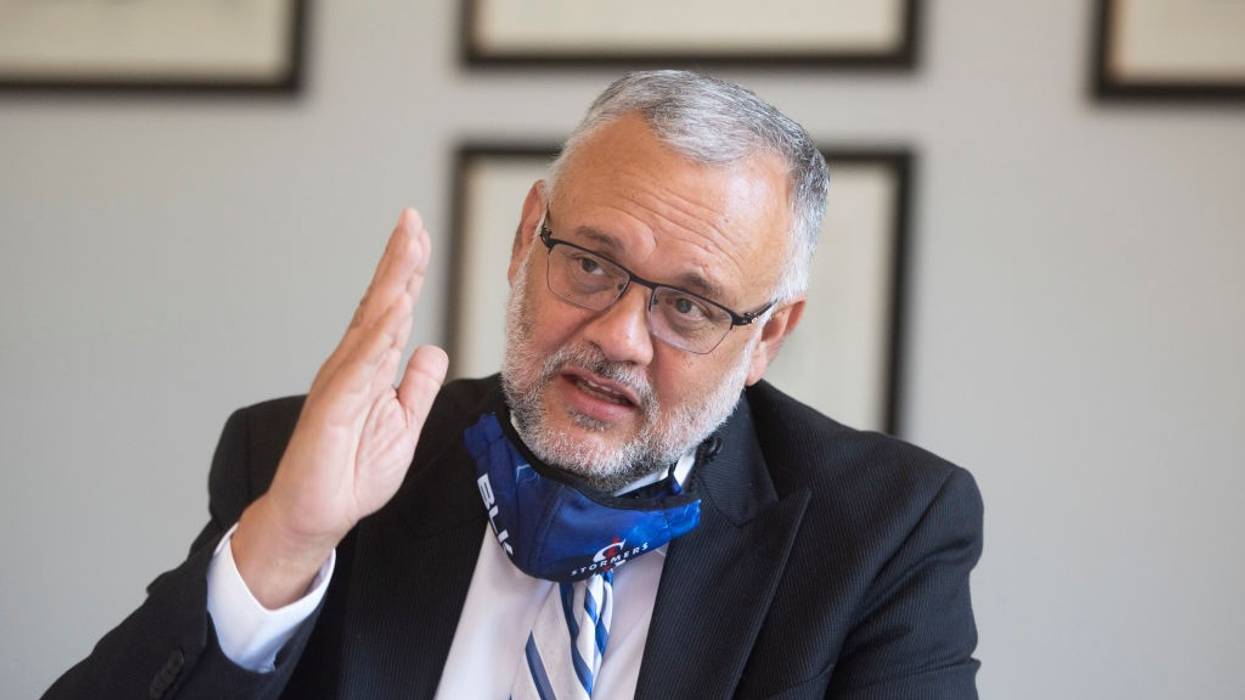
U.S. Secretary of State Marco Rubio has faced a flood of condemnation since announcing on social media Friday that "South Africa's ambassador to the United States is no longer welcome in our great country."
"Ebrahim Rasool is a race-baiting politician who hates America and hates President Donald Trump," the secretary claimed. "We have nothing to discuss with him and so he is considered PERSONA NON GRATA."
In the post on X—the social media site owned by Elon Musk, Trump's South Africa-born billionaire adviser—Rubio linked to an article by the right-wing news site Breitbart about Rasool saying during a Friday webinar that the U.S. president is leading global a white supremacist movement.
As examples of Trump's "Make America Great Again" movement exporting its "supremacist assault," Rasool pointed to Musk elevating Nigel Farage, leader of the far-right Reform U.K. party, and Vice President JD Vance meeting with the leader of the neo-Nazi Alternative for Germany party.
Responding to Rubio on X, North Carolina State University assistant teaching professor Nathan Lean said: "Ebrahim Rasool is a man of genuine decency, moral courage, and is a friend. This makes me absolutely embarrassed to be an American. And it underscores that his critiques of white supremacy in the Age of Trump are perceived as threatening for one simple reason: He's right."
The Muslim Public Affairs Council (MPAC) similarly responded: "Ambassador Ebrahim Rasool is a principled leader who fought alongside Nelson Mandela against apartheid and has dedicated his career to democracy, interfaith cooperation, and justice. Baseless attacks like this only serve to divide. We stand by him and his lifelong commitment to building a more just and inclusive world."
Laila Al-Arian, executive producer of Al Jazeera's "Fault Lines," declared that "this administration is virulently and unabashedly Islamophobic, not even trying to hide how unhinged they are as they go after people for speech."
Rasool previously served as ambassador during the Obama administration and returned to the role shortly before Trump began his second term. Earlier this week, Semafor reported on his difficulties dealing with the current administration:
He has failed to secure routine meetings with State Department officials and key Republican figures since Trump took office in January, Washington and South African government insiders told Semafor, drawing frustration in Pretoria.
Rasool is likely to have been frozen out for his prior vocal criticism of Israel, a South African diplomat, based in Washington, told Semafor. "A man named Ebrahim, who is Muslim, with a history of pro-Palestine politics, is not likely to do well in that job right now," said one of them. While South Africa brought a case against Israel to the International Court of Justice in December 2023, accusing it of genocide in Gaza, Rasool is nevertheless widely considered to be among the government's most ardent pro-Palestine voices.
South African political analyst Sandile Swana told Al Jazeera on Friday that the "core of the dispute" with the diplomatic was the genocide case against U.S.-armed Israel. In the fight against apartheid, the U.S. "supported the apartheid regime," said Swana. "Rasool continues to point out the behaviour of the United States, even now is to support apartheid and genocide."
Other critics also pointed to the ongoing court battle over Israel's utter destruction of Gaza and mass slaughter of Palestinians.
Council on American-Islamic Relations (CAIR) national executive director Nihad Awad told Rubio: "Your declaration of Ambassador Ebrahim Rasool as persona non grata is a racist, Islamophobic, transparent act of retaliation for South Africa's opposition to Israel's genocide in Gaza."
Imraan Siddiqi, a former congressional candidate in Washington who now leads the state's branch of CAIR, said that "he stood up firmly against apartheid, so it's no coincidence you're punishing him in favor of an openly apartheid state."
South African President Cyril Ramaphosa's office said in a statement Saturday that "the presidency has noted the regrettable expulsion of South Africa's ambassador to the United States of America, Mr. Ebrahim Rasool.
"The presidency urges all relevant and impacted stakeholders to maintain the established diplomatic decorum in their engagement with the matter," the office added. "South Africa remains committed to building a mutually beneficial relationship with the United States of America."
The diplomat's expulsion follows Trump signing an executive order last month that frames South Africa's land law as "blatant discrimination" against the country's white minority. Writing about the order for Foreign Policy in Focus, Zeb Larson and William Minter noted that "his actions echo a long history of right-wing support in the United States for racism in Southern Africa, including mobilization of support for white Rhodesia (now Zimbabwe) as well as the apartheid regime in South Africa."
##
"A lot of people feel betrayed by our closest ally," said one marketer in Canada, where President Donald Trump has imposed 25% tariffs.
With declining consumer interest in Tesla vehicles sending CEO and Trump administration ally Elon Musk into an apparent panic over the electric automaker's plummeting stock—spurring an impromptu car show on the White House lawn Tuesday with President Donald Trump scolding Americans for not buying Musk's products—recent reports from across Europe and Canada suggest the two right-wing leaders are pushing global consumers to reject not just Tesla, but a wide array of American goods.
As The Guardian reported Wednesday, numbers released this week by Statistics Canada showed waning enthusiasm for Canadians to visit their southern neighbor, with 23% fewer Canadians taking road trips into the U.S.—the most popular mode of cross-border travel—this year so far compared to February 2024.
With Trump initiating a trade war with Canada—falsely claiming the country is a major source of fentanyl flowing into the U.S.—by imposing 25% tariffs on all Canadian imports and threatening to take over the country as the "cherished Fifty First State," consumers have been downloading apps like "Maple Scan" and "Is This Canadian?" to avoid purchasing U.S.-made products.
"A lot of people feel betrayed by our closest ally," Emma Cochran, an Ottawa-based marketer, told NBC News on Wednesday.
Cochrane partnered with a colleague to make hats and shirts emblazoned with the phrase, "Canada is not for sale," one of which was worn by Ontario Premier Doug Ford last week.
"This felt like a way that we could participate and just kind of say, 'We're going to stand up for Canada,'" she told NBC.
Canadian officials announced retaliatory tariffs on $21 billion in goods on Wednesday after Trump raised global steel and aluminum tariffs to 25%—backing off of an earlier threat of a 50% levy.
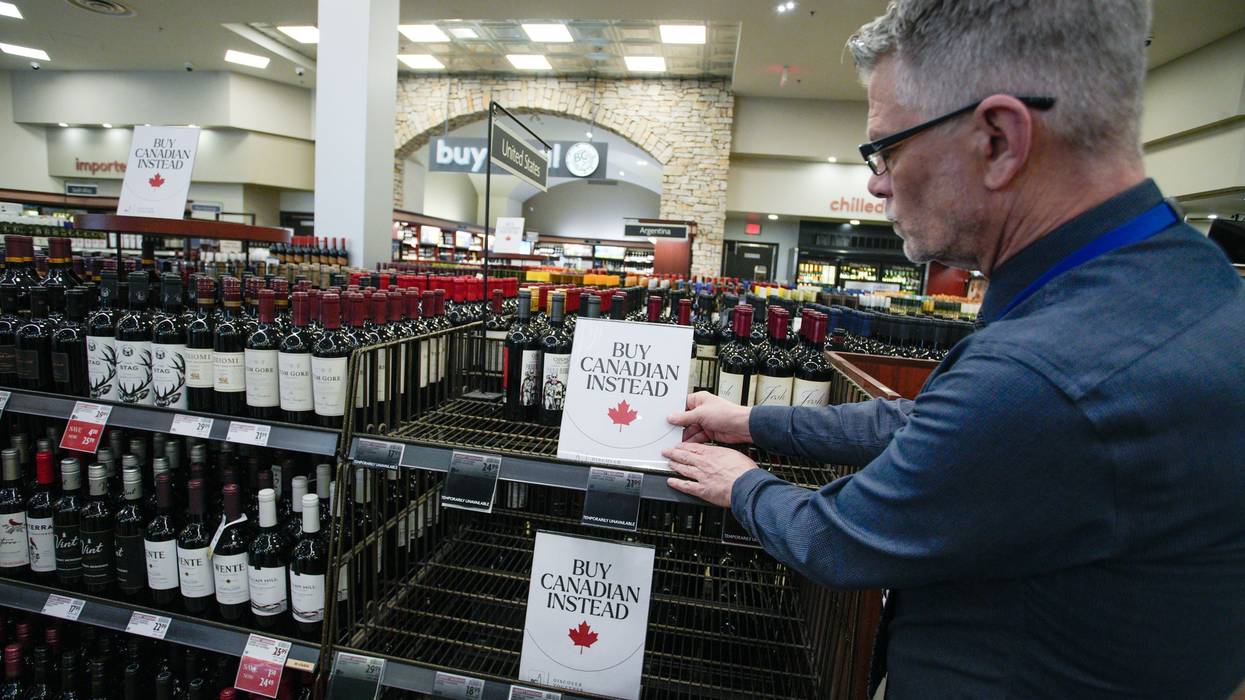
As some Canadian provinces began pulling U.S. liquor brands from government-run stores and replacing bottles with "Buy Canadian Instead" signs, the CEO of the Kentucky-based Brown-Forman, which makes Jack Daniel's, called the boycott "frustrating."
"That's worse than a tariff because it's literally taking your sales away," Whiting said on an earnings call last week.
Nick Talley, a physician-scientist in New South Wales, Australia, said Trump "presumably... thought everyone would just bow down" after he imposed tariffs and raised prices for consumers around the world.
Danish grocery company Salling Group has also taken action to oppose Trump's threat to take control of Greenland, an autonomous territory within the Danish kingdom.
The company is still carrying U.S.-made products but is marking European-made goods with a black star to identify them for shoppers.
A Verian/SVT survey in Sweden on Tuesday found that "the U.S.'s actions in world politics... have led many Swedes to hesitate in the face of American products."
Twenty-nine percent of Swedish residents said they had refrained from buying U.S. goods in the last month amid Trump's trade war, his temporary suspension of aid to Ukraine after publicly berating Ukrainian President Volodymyr Zelenskyy at the White House earlier this month, and Musk's meddling in European politics by expressing support for British right-wing extremist Tommy Robinson and German political party Alternative for Germany, which has embraced Nazi slogans and came in second in last month's elections.
Norwegian fuel company Haltbakk urged "all Norwegians and Europeans" to join in boycotting the U.S. after the confrontation between Trump and Zelenskyy, which the firm called "the biggest shit show ever presented 'live on TV' by the current American president and his vice president."
The company has provided fuel to U.S. ships in Norwegian ports but said it would no longer do so as the international community expressed shock over Trump's treatment of Zelenskyy and Ukrainian victims of Russia's invasion.
Meanwhile, European consumers have continued to make their views on Musk—a "special government employee" of Trump's who has spearheaded the slashing of federal jobs and spending and threatened to cut $700 billion from Social Security, Medicare, and Medicaid—by refusing to buy Tesla cars.
February sales were down 76% in Germany, 53% in Portugal, 55% in Italy, and 48% in Norway and Denmark—contributing the company's plummeting share price and loss of $800 billion in market cap.
Trump offered to buy a Tesla before staging a showing of five of the cars at the White House Tuesday, claiming American consumers are "illegally" boycotting the company, but as Channel 4 in the U.K. reported, "the company will have to find a lot more buyers to make up for a sharp decline in sales across Europe" as both boycotts and protests at Tesla dealerships spread.

"Distorting the meaning of antisemitism and making Jews the face of a campaign to crush free speech is deeply dangerous to Jewish Americans and all of us who work for collective liberation."
A video shown at the beginning of a hearing on antisemitism held by the U.S. Senate Judiciary Committee on Wednesday set the tone for the Republican Party's approach to the issue, with the GOP-led panel featuring images of student protesters against Israel's U.S.-backed assault on Gaza—but none of Elon Musk, a top adviser to President Donald Trump, publicly displaying a Nazi salute at an inauguration event in January.
Beth Miller, political director for Jewish Voice for Peace (JVP) Action, said she was "shocked" by the omission, but argued that "the Trump administration and its allies in Congress are operating under the guise of fighting antisemitism, while actually working to attack the Palestinian rights movement, universities, and civil liberties."
The hearing, said Miller, is consistent with the threat Trump issued Tuesday to student organizers who take part in protests like those that spread across the U.S. last year in support of Palestinian rights, when he said he would "jail and deport" students and pull federal funding from schools that allow what he called "illegal protests."
"The GOP does not care about Jewish safety," said Miller. "This is political theater."
One witness called by the committee Democrats was Kevin Rachlin, Washington director of the Nexus Project, which promotes government action against antisemitism. Rachlin testified that while seeing Musk display a Nazi salute at an event for the president was "beyond terrifying for American Jews," what was "most troubling" about Musk's actions was the "lack of condemnation" from Trump's own party.
Leading antisemitism expert: Seeing the Nazi salute on the most prestigious platform in the country is beyond terrifying for American Jews.
What's most troubling? Lacking condemnation when "public figures like Steve Bannon and Elon Musk advance antisemitic conspiracy theories.” pic.twitter.com/dY5BjeBXk3
— Senate Judiciary Democrats 🇺🇸 (🦋 now on bsky) (@JudiciaryDems) March 5, 2025
Republicans called three people to testify: Adela Cojab, a legal fellow at the National Jewish Advocacy Center; Alyza Lewin, president of the Louis D. Brandeis Center for Human Rights Under Law; and Asra Nomani, editor of the Pearl Project. All three witnesses suggested students who oppose Israel's violent policies in Palestine, not the far right, are the propelling force behind antisemitism in the U.S.—despite the fact that many Jewish students organized, participated in, and supported the campus protests that spread nationwide last year and reported that pro-Israel counter-protesters were largely responsible for making demonstrations unsafe.
Nomani warned that antisemitism "has become an industry," but the advocacy group Bend the Arc: Jewish Action suggested her words carried little credibility considering she was "talking about student protesters... not Trump, Musk, and their enablers in Congress who are actively wielding the machinery of antisemitism and making Jews in America less safe."
Cojab called for the official adoption of the International Holocaust Remembrance Alliance's (IHRA) working definition of antisemitism, which uses examples of antisemitism including "denying the Jewish people their right to self-determination, i.e. by claiming that the existence of a state of Israel is a racist endeavor," and "drawing comparisons of contemporary Israeli policy to that of the Nazis"—suggesting that statements by Israeli officials calling for the "cleansing" of Gaza and Israel's blocking of humanitarian aid to Gaza should never be referred to as genocidal actions.
Miller noted that the IHRA's definition is "opposed by Jewish, Palestinian, and Israeli groups, as well as civil liberties organizations like the ACLU," and urged viewers to tell their senators to oppose the Antisemitism Awareness Act, which would codify the IHRA's definition.
Barry Trachtenberg, presidential chair of Jewish History at Wake Forest University and a member of JVP's academic advisory council, warned that "distorting the meaning of antisemitism and making Jews the face of a campaign to crush free speech is deeply dangerous to Jewish Americans and all of us who work for collective liberation."
JVP Action warned that although the hearing "will do nothing to promote Jewish safety, it will expand authoritarian policies to dismantle civil liberties, and enable the MAGA Right to score cheap political points."
Bend the Arc credited Ranking Member Sen. Dick Durbin for pointing to Musk's amplifying of the far-right, Nazi-aligned Alternative for Germany political party ahead of February's elections, the promotion of the antisemitic Great Replacement conspiracy theory by Trump and others on the far right, and the president's dismantling of the Department of Education's Office of Civil Rights as evidence that "Trump administration actions do NOT make Jews safer."
Meirav Solomon, a Jewish student at Tufts University and co-vice president of J Street U's New England branch, testified that "Congress and the Trump administration are abandoning the most effective tool the government has to fight antisemitism in all of its forms."
"The Department of Education's Office of Civil Rights (OCR) handles cases of discrimination and harassment against Jewish students, providing a crucial avenue for Jews and other minorities to advocate for our rights," said Solomon. "This administration has suspended thousands of OCR investigations and no longer allows students or their families to file complaints, and now the office's future is uncertain."
Jewish college student and advocate against antisemitism: The actions of the Trump Administration are divisive, and they erode the rights and freedoms that've allowed American Jews to flourish.
Our future depends on your commitment to protect pluralism and democracy. pic.twitter.com/SwSJ10tMic
— Senate Judiciary Democrats 🇺🇸 (🦋 now on bsky) (@JudiciaryDems) March 5, 2025
Solomon called on lawmakers on the committee to "be honest about the most urgent threat to the Jewish community. It is not student protesters but the bloody legacy of Pittsburgh and Poway, Charlottesville and the Capitol riot."
Ahead of the hearing, Bryn Mawr College student Ellie Baron told JVP Action that organizers must "continue working to dismantle real antisemitism while also defending our friends and community members who are falsely accused of antisemitism. The only way forward is through forging greater solidarity with all people who are targeted by fascism and supremacist ideologies, including antisemitism and anti-Palestinian racism."

The Tesla, promises an advertisement posted in London, "goes from zero to 1939 in three seconds."
With the motto, "Pissing off Elon Musk, one small action at a time," a U.K.-based campaign group unveiled an advertisement this week promoting what it called a "swasticar": the Tesla vehicles sold by the billionaire mogul who has taken a front-and-center role in U.S. President Donald Trump's administration.
The ad, which first appeared Monday, features an image of Musk standing in one of his cars while displaying a Nazi salute—as he appeared to do twice at an event for Trump shortly after the president's inauguration last month.
The Tesla, the ad promises, "goes from zero to 1939 in three seconds."
The image has been displayed on at least one bus stop in Bethnal Green, London, by a group called Everyone Hates Elon.
Pictures of the ad have gone viral online, and the group called on supporters to help ensure its message spreads far and wide as Musk's dismantling of U.S. government agencies and services, including its foreign aid agency, and his support for far-right political parties in Europe sparks outrage.
"Not happy with fueling the far-right in the USA, Elon Musk is now doing the same in Europe," wrote organizers on a GoFundMe page, where they are attempting to raise £10,000 ($12,632) to plaster its "swasticar" ad in more public places.
"We can't let the richest man in the world poison our politics. While nurses use food banks, his wealth grew by $200 billion last year," wrote the group, referring to the U.K.'s cost-of-living crisis.
In the U.K., Musk has expressed support for the far-right, virulently anti-immigrant Reform Party and attacked officials from the Labour government, spreading what Prime Minister Keir Starmer decried last month as "lies and misinformation" about crimes allegedly committed by immigrants.
This week, Musk's favored party in Germany, Alternative for Germany, lost the elections but caused international alarm as it doubled its vote share since the last nationwide vote. The party has platformed candidates who have used Nazi slogans and diminished the Holocaust, and has been classified as a suspected extremist group by Germany's intelligence service.
Musk's encroachment in European politics has been met with contempt, with Tesla sales dropping by more than half in Germany last month.
Everyone Hates Elon wrote sardonically in an Instagram post that it would "be a shame if [the swasticar ads] popped up around the world." Organizers have also plastered hundreds of Teslas in London with stickers telling passersby, "Don't buy a swasticar."
The group's GoFundMe page had raised more than £9,000 as of Thursday morning.
As they united around neoliberalism and an aggressive foreign policy, mainstream parties created a dangerous democratic vacuum. This vacuum can now be exploited in particular by extremist parties on the right.
According to the preliminary results of the Bundestag, or parliamentary, elections, the extreme right-wing party Alternative for Germany (AfD) has become the second-strongest force in Germany. It now has 20.8% of the vote, doubling its result compared to the last election. The conservative CDU/CSU got 28.5%. The Social Democrats and the Greens, who have been in government so far, were punished, receiving 16.4 and 11.6% of the vote, respectively.
However, the party Die Linke was able to achieve a success. For a long time, it was stuck in polls well below the 5%, which is the mark to enter the Bundestag. But in a final sprint, it was able to significantly increase the result and garner 8.7%. Above all, strong speeches by Member of Parliament Heidi Reichinnek against the anti-migration agenda of all other parties and for real social change were able to mobilize.
Now the established parties and the mainstream press are engaging in the usual complaints and soul-searching about how things could have come to this. In the face of the rapid rise of the Alternative for Germany, journalists and political commentators often say that dissatisfaction with the established parties is the reason why more and more people are voting for the AfD. The dissatisfaction is then mostly seen as created by "mass immigration," the rejection of climate protection, and a left-liberal view of society ("wokeness")—in other words, a growing front against overly left-wing, progressive, liberal politics. This is seen to be the central cause of the shift to the right in society. Politicians must now respond to this.
The political class is reaping what is has sown and now is shedding crocodile tears about the results.
This is a narrative that is not only convenient and leads to false right-wing solutions, but also distorts reality by blaming those who are supposedly rebelling against progressive politics and thinking backward. At the same time, the other parties and their supporters appear as a haven of reason and morality, striving to hold society together.
The thesis that a shift to the right in the population is the reason for the rapid rise of the AfD also obscures the root of the problem. Looking closer, large portions of today's AfD voters have by no means been attracted to the AfD and its better policy proposals.
Even significant portions of AfD voters agree with the majority of Germans on polls that favor a fair solution to refugee protection and a quarter believe that the energy transition is indispensable; only a few describe themselves as extreme right and "only" 40% have right-wing tendencies. Most of them demand a social policy that benefits them, as many of them are unemployed or low-income earners, while the AfD takes a diametrically opposed, extreme position on all these issues, and their neoliberal program would make the rich even richer and the poor poorer.
In fact, more and more people were driven from the so-called "extreme center" into the arms of the AfD. In some ways, the political class is reaping what is has sown and now is shedding crocodile tears about the results.
The term "extreme center" was coined 10 years ago by the British intellectual Tariq Ali in his book The Extreme Centre: A Warning. It essentially refers to what often is referred to as "bourgeois parties," "parties of the political center," "established parties," sometimes also as "democratic parties" or "parties capable of forming a government." In Germany, these are the CDU/CSU, SPD, the liberals FDP, and the Greens. They distinguish themselves from the "extremes" on the left and right, which they regard as a danger to society and democracy, and see themselves as a force that balances interests and creates harmony.
According to Tariq Ali, the parties of the so-called center have been indistinguishable from each other in important policy areas since the 1980s. In the Western industrialized countries, a kind of "government of national unity" has emerged. It has implemented and maintained extreme policies—including the neoliberal turn and an aggressively oriented foreign policy under U.S. leadership—against the needs of the general population.
In the process, the space for alternative policy proposals and democratic debate has been reduced to a minimum. It created a dangerous democratic vacuum. This vacuum can now be exploited in particular by extremist parties on the right.
Let's take a look at how the "non-partisan political class, beyond particular interests" has operated in Germany in recent decades. Since the 1990s (or even earlier, in the years under chancellor Helmut Kohl, CDU), various governing coalitions have implemented policies that have led to Germany becoming the country in Europe with the greatest material and social inequality.
On the one hand, the established parties created a high concentration of wealth through various neoliberal measures. On the other hand, parts of the middle class were put under financial pressure. A huge low-wage sector was built up, widespread poverty (especially child and old-age poverty) was created, and the welfare state was dismantled.
Many services that people in the country rely on to live in safety have been commercialized, privatized, and "streamlined." The state of Germany's railways, healthcare system, pensions, agriculture, real estate markets, and education systems shows where this has led. Once in comparatively good condition, these infrastructures are now dysfunctional, expensive, unjust, and environmentally harmful.
The austerity for the poor and many ordinary citizens, and the welfare state for the rich and super-rich, has led to Germany becoming increasingly divided—especially the eastern federal states that were hit hard by the inequality policy after reunification.
The Agenda 2010, introduced and enacted under the red-green government in the early 2000s, was pushed forward by massive pressure from corporate and business lobbying groups (see the tens of millions of euros spent on the so called "reform movement," including the Initiative für Soziale Marktwirtschaft led by the employers' federation of metal and electronics industry Gesamtmetall) has finally turned on the inequality turbo. As a result, the lower and middle classes have become poorer and the rich and hyper-rich fantastically richer.
This process is uncontroversial today. According to the Global Wealth Report, in 1970 the top 1% of the German population (around 800,000 people) owned 20% of the total private wealth. That, too, is enormous, meaning that Germany was by no means a balanced or even just society at the time.
By 2020, the share had risen to 35%. The super-rich, the top 0.1% (around 85,000 Germans), can now claim up to 20% of the national wealth for themselves (as much as the top 1% in 1970). The top 10% own around 67%, which corresponds to two-thirds of total private wealth. Like many large properties, corporate assets are almost exclusively in the hands of the top 1%. The lower, poorer half of the population in Germany, on the other hand, owns practically no wealth, apart from a few small credit-financed and self-occupied apartments, houses, or cars.
This extreme concentration of wealth in the hands of very few continues to grow without countermeasures being taken. For example, the number of millionaires in Germany rose from 2.1 million to 2.8 million between 2019 and 2024, an increase of 30% in just a few years. A similar curve can be seen among billionaires. In 2001, there were 69 billionaires in Germany; by 2022, this number had already risen to 212, and last year there were 249 (including extended families) who own a billion or more.
According to the Global Wealth Report and other studies, "wealth inequality in Germany is higher than in other large Western European countries. For example, the Gini coefficient [it measures inequality: 100% means that all wealth is in one hand, at zero everyone would own the same] for wealth in Germany is 82%, compared to 67% in Italy and 70% in France."
In other rich industrialized countries, a comparable process of concentration and inequality can be observed, despite slight differences. The division of society is increasing everywhere in Western democracies, deliberately set in motion and nourished by the politics of the extreme center.
The regime of inequality has been further expanded in the United States and Great Britain than in Germany. There, neoliberal programs were initiated under former U.S. President Ronald Reagan and former U.K. Prime Minister Margaret Thatcher in the 1970s and 1980s, and were implemented particularly rigorously in the U.S. by the business class and the political establishment.
Above all, these were drastic tax cuts for the rich and super-rich, i.e. for capital, and the deregulation of the financial industry, while the real wages (purchasing power adjusted for inflation) of the lower and middle classes fell and the welfare state, on which large sections of the population depended, was forced to retreat.
The U.S. extreme center, both Republicans and Democrats, wanted it that way. The media celebrated the policy as a dynamic growth strategy, even though growth rates and productivity were significantly lower than in the three "golden decades" before.
The direct effects of these neoliberal measures are mind-boggling. A 2020 study by the U.S.-based Rand Corporation shows that the top 1% of income earners in the U.S. have siphoned off $50 trillion (50,000 billion) from the bottom 90% in recent decades.
If the more equitable distribution of the approximately 30-year post-war period had continued, with wages rising in line with productivity, the total annual income of the bottom 90% of American workers in 2018 would have been $2.5 trillion higher, or about 12% of gross domestic product. In other words, the upward redistribution of income has enriched the top 1% by about $50 trillion at the expense of American workers.
Or to put it another way, the average income of a full-time employee in the U.S. in 2020 was $50,000. If wages had kept pace with economic output since the mid-1970s, the average worker's salary would be around $100,000 today.
But politicians and corporations blocked wage increases in the wake of the growing national income and handed out ever greater proportions of it with "reform measures" (i.e., redistribution measures) to the hyper-rich. U.S. labor unionsspeak of a "trillion-dollar robbery," criticizing an extremely successful "class war from above."
For decades, the extreme center has offered the right something that it continues to deny the left to this day: mobilization platforms for its political proposals.
A similar redistribution from bottom to top has taken place in Germany, albeit not as blatantly as across the Atlantic. Even though there is no comparable study for Germany to that of the Rand Corporation, most Germans would earn significantly more today if it had not been for the neoliberal redistribution policy.
The structural change, or rather the structural break, has had of course far-reaching effects. Studies show that the effects of inequality range from very negative to destructive. Accordingly, inequality generates and promotes economic crises and ecological catastrophes and intensifies conflicts, wars, global injustice, and the plight of refugees. Kate Pickett, professor of epidemiology at the Department of Health Sciences, and Richard Wilkinson, professor at the University of York, have been systematically studying the effects on living standards in rich countries for many years.
Their research, summarized in the books The Spirit Level and The Inner Level, shows that income inequality—the gap between rich and poor—has a strong influence on people's health and well-being, as well as on human capabilities and social cohesion. Inequality causes health and social problems.
This ranges from lower life expectancy and lower levels of education and social mobility to higher levels of violence and mental illness. The scientists argue that inequality hinders the creation of sustainable economies that ensure the well-being of people and the planet.
Above all, inequality undermines solidarity, provision for future generations, and social cohesion, and encourages more and more people to vote for right-wing or even far-right parties—initially as a form of protest, but then increasingly out of conviction.
In general, inequality and isolation lead to selfish, even authoritarian and irrational attitudes that lack solidarity. When a large part of the population sees a tiny minority amassing enormous wealth and bathing in luxury while many others do not know how to make ends meet in the face of skyrocketing rents and prices and a lack of public services, this is toxic for any society.
Instead of addressing these problems and their causes, the parties and the major media have chosen a different strategy to counter the growing dissatisfaction in the country. And that has created a second mobilizing factor for far-right answers, alongside inequality.
In principle, it is the well-known logic of "Divide and Rule" or "Us" against "Them" that allows frustration to be deflected and groups to be set against each other. It is simple but very effective: It is not the hyper-rich, entrepreneurs, and profiteers of the redistribution from bottom to top (the 0.1 or 1% class), including the political extreme center and their accomplices in the media, who are responsible for the conditions and frustration. It is "the others." They take away the prosperity of the Germans and make them dissatisfied.
This has allowed the privileges of those who own the companies and large portions of German wealth, as well as the politics that serve their interests, to be protected from real reform, while also deflecting people's anger at inequality and grievances from the causes of that frustration.
To illustrate this, Guardian columnist Fatma Aydemir cites a joke: A banker, a welfare recipient, and an asylum-seeker are sitting at a table. In front of them are 12 biscuits. The banker takes 11 biscuits and says to the welfare recipient: "Watch out, the refugee wants your biscuit."
In this way, minorities were declared scapegoats, marginalized, and stigmatized as a danger to the lower and middle classes. In the 1990s, after the Yugoslavian wars and the NATO bombings, opinion makers and prominent politicians blamed refugees from the Balkans for social and economic problems and ultimately shredded the right of asylum enshrined in the German constitution.
The same spectacle has been taking place since 2015. In major waves of campaigning, people fleeing from war, persecution, and misery have been presented by the media and politicians as the central threat to the social order.
They are portrayed as illegitimate "social parasites" and ungrateful "misogynists" (see the artificially scandalized "Sodom and Gomorrah" of Cologne during New Year's Eve 2015-2016, of which nothing remained in the investigation committee of the NRW state parliament) or terrorists and knife murderers (see the exaggerated coverage of isolated acts by mostly traumatized asylum-seekers and refugees) who want to snatch the last biscuit from the Germans.
The AfD was finally able to reap the political rewards, the grapes of wrath. In 2015, the party was in a tailspin after a desperate attempt to capitalize on anti-E.U. sentiment. Internal squabbles weakened it more and more, so that in September 2015 it plummeted to 4% in the polls and was on the verge of disappearing into insignificance.
But then came the dramatic turnaround. In the fall of the same year, the party's unstoppable rise began when the extreme center decided to spread a historic moral panic through all channels in the wake of the so-called "refugee crisis" of 2015-2016. A year later, in September 2016, the AfD was at 16% in the polls. Riding the wave of success, it was able to push ahead with political radicalization and spread "Vogelschiss" (bird droppings) theories about the insignificance of the Holocaust.
The AfD did not become what it is today on its own. It was the political class and the mainstream press that served and continue to serve up the "illegal intruders" as the perfect scapegoats for the authoritarian right. Only then did the far-right experience a rapid rise, successfully campaigning on the issue of refugees, who were widely vilified, and winning votes.
It is often claimed that the refugees, their influx, and their numbers have strengthened the right wing. The blame lies with the "migration pressure." But that is not true. As stated in the 2018 annual report of the Mercator Forum Migration and Democracy (Midem) Migration and Populism, it was not the influx of refugees that was the central factor, but the media and political discourse about the crisis.
As long as the reduction of inequality and social grievances are not placed at the top of the political agenda and addressed properly, while the extreme center keeps pursuing right-wing cultural wars as a distraction, rational answers to frustrations will have to swim against a powerful current.
Support for the AfD fell, as already mentioned, to four% in the opinion polls between 2015 and late summer of the same year (from 9% the previous year), while—calculated from 2014—750,000 refugees came to Germany during this time. Support for the AfD was indeed negatively correlated with the sharp increase in the number of refugees in Germany. During this period, more refugees actually led to a decline in support for the AfD.
From October 2015, when the discourse of crisis was launched by politicians and the media, the AfD's poll numbers rose sharply, reaching a preliminary high of 18% in September 2018. During this "AfD growth phase," the number of refugees coming to Germany and the E.U. dropped significantly, so that by the end of 2018, when the AfD reached its peak, almost no refugees were able to enter Germany thanks to the brutal sealing of the country's borders under the leadership of the Merkel government.
Hence, also during the "crisis phase," support for the AfD correlates negatively with the influx of refugees, according to the rule: fewer refugees, more support for the AfD. The actual influx of refugees is obviously not the reason for the success or failure of the AfD. What the AfD has actually benefited from since 2015 has been the political discourse of permanent crisis and alarmist reporting on asylum-seekers and "illegal migration."
Even today, the rise of the AfD is still associated with a conjured up second "refugee crisis." Although asylum-seekers from the southern Mediterranean region make up only a small proportion of those admitted (190,000 compared to over a million Ukrainians in 2020), they are once again the focus of media debate, which, as with the last "refugee crisis," focuses on deportation and strengthening "Fortress Europe"—a "refugee crisis" that in fact was a crisis of the European repulsion regime that was met with even more sealing off.
Meanwhile, the Germans at the bottom of society are also being discredited in order to deflect the frustration of the groups above them, especially the middle classes, onto them (and not upward, onto the culprit of the frustration). Thus, journalists and politicians discredited the unemployed and welfare recipients as "social parasites" and "work-shy" in order to push through the Hartz IV reforms to pressure the unemployed and the dismantling of the welfare state against popular resistance. As surveys show, majorities were against it and wanted a different, more solidarity-based modernization.
And while today the multimillionaires and billionaires in the country can hardly walk because of all their wealth, property, and investment portfolios, more and more money is being put into their pockets, while for those who (due to a lack of jobs, low wages, or exploding rents and prices) have to stay afloat with state support, every euro is questioned. So the political opinion makers argue about a too-high support for the long-term unemployed, the so called "Bürgergeld" (now 563 euros for a single person per month), with the adjustment in recent years barely offsetting inflation, but they don't talk about the constant pampering of millionaires and billionaires.
The mainstream media continue to spread the myth that basically everything is fine and a few Band-Aids here and there would suffice: a euro more minimum wage, for example—which would do no more than compensate for inflation and is often undermined by companies anyway.
But anyone who wants to address the extreme salaries and wealth, the capital gains of investors and companies (often parked in tax havens), is either met with ignorance (see the left-wing demands in the Bundestag) or attacked with economic doomsday scenarios.
And yet another group has become the target of the political establishment. Politicians and journalists have fueled toxic narratives on climate protection. To appease fossil lobbies and slow down the transition to renewable energy, the establishment (or rather, significant parts of it) sabotages the energy transition, denounces calls for immediate action, discredits demonstrators as "eco-terrorists" and presents climate protection as an economic burden and a brake on prosperity, especially for the lower and middle classes. At the same time, wind turbines, solar panels, and electric cars are drawn into culture wars.
This makes it easy for the AfD and right-wing forces to present climate policy as an elite project and to portray themselves as guardians of ordinary people, protecting them from the burdens and costs of the energy transition. Similar things could be said about the "wokeness" debate—pushed by conservative sectors of the extreme center, while the resulting defensive reactions in the population could be used by the extreme right for campaigns.
The "political center" has created an extreme social situation, from which only the AfD is profiting in Germany. Its rise is closely linked to the failures of the establishment, which has shifted the overall frustration onto the weak, while the representatives of the political class shed crocodile tears over the popularity and election wins of the AfD. The same is true in other European countries and the United States.
The question remains as to why left-wing solutions have not been able to fill the gap created by the extreme center in the same way as right-wing extremist ones could—although the surprising election result of the Left Party on Sunday shows that this does not have to remain the case. Certainly, mistakes have been made by left-wing parties. But the real reason lies elsewhere. For decades, the extreme center has offered the right something that it continues to deny the left to this day: mobilization platforms for its political proposals.
While AfD talking points such as the threat posed by refugees, an energy transition that is harassing citizens, and a mass indoctrination of wokeness have been flooding the media for decades, a debate on progressive measures that address the social causes of frustration is suppressed.
As the asylum law and the sealing-off regime are tightened ever further and the energy transition is blocked, people continue to wait for the reintroduction of the wealth tax in Germany (suspended in 1997), a real inheritance tax for the hyper-rich, a closure of tax havens and loopholes, the end of destructive subsidies, the regulation of the finance industry, or a revival of the welfare state. If anything, Germans are put off with vague promises before elections. After that, the popular ideas are put on ice or not seriously addressed.
The progressive political climate, as it existed to at least some extent in the late 1960s and early 1970s, has been systematically deprived of oxygen ever since—a very significant process that effectively blocked democracy. However, as long as the reduction of inequality and social grievances are not placed at the top of the political agenda and addressed properly, while the extreme center keeps pursuing right-wing cultural wars as a distraction, rational answers to frustrations will have to swim against a powerful current. To the detriment of society, its prosperity, and stability.

A sordid history to remember and the horrific prospects of a vice president's embrace of Germany's neo-Nazi party.
Vice President J.D. Vance’s embrace of Germany’s neo-Nazi party in a high profile Munich visit this past week sparked outrage and alarm across Europe. It was the latest example of a long history of U.S.-Nazi racism and dictatorship ties that should be a stark warning of what it portends for the U.S. as well.
Vance’s refusal to meet with German Chancellor Olof Scholz, instead holding a private meeting with the Alternative for Germany (AfD) leader, followed Elon Musk’s video appearance at a campaign kickoff for the AfD ahead of next Sunday’s German elections. It also coincided with escalation of the Musk-Trump administration’s gutting of federal programs and firing of workers, a key step for establishing authoritarian rule at home.
The rise of the AfD and President Donald Trump’s election were both animated by vitriolic, racist practices and ideology, a stark reminder of how the U.S. legacy of racist behavior and laws were a prime model for the ascent of Hitler and Nazi fascism. And how Hitler’s success inspired U.S. acolytes of Hitler like Charles Lindberg, Father Coughlin, and Henry Ford.
Just as Hitler utilized antisemitism, along with vilification of the left and traditional party elites to propel his dictatorial dreams, Trump has long employed speech and actions to animate his thirst for unchecked power. For Trump it went from launching his first campaign by branding Mexican immigrants as “rapists and murders,” to today’s demonization of diversity, equity, and inclusion (DEI) as a vehicle to rally support for his autocratic goals.
Unleashing Musk’s Department of Government Efficiency (DOGE) on public agencies and staff accelerated the longtime far right libertarian goal and Project 2025 plan to privatize, deregulate and shrink federal government to nothing more than handouts to corporations and the super-rich and expanding military, policing and border control. Augmenting it with a DEI shroud enabled them to further a white surpremacist vision of purging workers of color from public service.
Trump and Musk seem intent on reversing every political, economic, multi-cultural democratic advance envisioned by the post-Civil War Reconstruction reforms that also were the foundation of subsequent legislative and cultural gains of the 1960s and ‘70s for racial, ethnic, gender and LBGTQ+, and disability rights.
That plan is just getting started, as illuminated by the Washington Post in a preview of the next phase, escalating evisceration of critical public health, safety net and environmental and consumer protection programs already underway. On February 11, Trump signed an updated executive order directing federal agency heads to prepare wholesale “reorganization plans,” commencing a “critical transformation” of “our system of Government itself.”
Even two veteran Republican budget experts, told Reuters the plan is “driven more by an ideological assault on federal agencies long hated by conservatives than a good-faith effort to save taxpayer dollars.” The goal, says Our Revolution more pointedly, is to “consolidate billionaire power and dismantle democracy as we know it. This is not efficiency—it's a coup."
The DEI demagogy, a focus of Trump’s 2024 campaign, drives Trump 2.0. Following the Potomac plane crash, White House press secretary made it explicit, “when you are flying on an airplane with your loved ones, do you pray that your plane lands safely, or do you pray that your pilot has a certain skin color?”
Building authoritarian power through fanning bigotry has a long backstory in the U.S., from the slave states’ power over the federal government and post-Civil War in the former Confederate states following the counter revolution against Reconstruction. It was also the cudgel used by Hitler, along with political violence, to attain power following his failed 1923 Beer Hall Putsch coup and then to secure his regime.
As James Whitman writes in his book, Hitler’s American Model: The United States and the Making of Nazi Race Law, Hitler praised the U.S. as “the one state” that had made progress for a racial order that has allowed it “to become the master of the American continent and … remain the master as long as he does not fall victim to racial pollution.” Hitler used antisemitic demagogy blaming Jews, especially, for Germany’s defeat of in World War I and its economic crisis, as a key lever to gain votes, leading to being handed the Chancellorship in 1933.
Nazi demagogy admired how Americans felt the need to exclude the “foreign body” of “strangers to the blood” of the ruling race, Whitman observes, an eerie prelude to Trump’s depiction of immigrants from South America, Asia and Africa “poisoning the blood of our country” that built upon year of similar racist rants.
Echoing Mein Kampf in the 1930s segregationist Mississippi Senator Theodore Bilbo asserted “one drop of Negro blood placed in the veins of the purest Caucasian destroys the inventive genius of his mind and palsies his creative faculty,” a racist trope Trump nearly a century later paraphrased to disparage the intellect of numerous Black leaders, including Vice President Kamala Harris.
Shortly after Hitler’s reign began, Germany adopted a law on the Revocation of Naturalization and the Withdrawal of German Citizenship for the “denaturalization and expulsion of Eastern European Jews who arrived after the First World War,” Whitman observes.
Nazi lawyer Otto Koellreutter called it, “a further necessary measure for maintaining the healthy racial cohesion of the Volk (German people),” another step influenced by U.S. as well as British Dominion laws that parallels Trump’s racist immigration goals and his effort to overturn the 14th Amendment right of birthright citizenship.
By 1934, as the Nazis were well on their way to sustaining their dictatorship they moved to codify persecution of German Jews. Leading Nazi lawyers began crafting the notorious 1935 Nuremberg Race Laws to prevent “any further penetration of Jewish blood into the body of the German Volk.” It banned intermarriages and sexual relations between Jews and other Germans. They cited anti-miscegenation laws ultimately adopted in 30 U.S. states, and not finally expunged until the 1967 Supreme Court Loving v Virginia ruling.
Jews were also barred from a broad swath of employment in governing, academia, and the legal world. “What they were worried about,” Whitman explained to journalist Bill Moyers, “was that Jews might take over Germany, so the Jews had to be kept out of government, out of the legal profession, and out of any other situation in which they might exercise what the Nazis always called influence.” It looks like a harbinger of Trump and Musk’s DEI goals.
The U.S. assumed the mantle of “the leadership of the white peoples” after World War I, wrote far-right German professor Wahrhold Drascher in The Supremacy of the White Race, in 1936, adding without the leadership of the U.S. “a conscious unity of the white race would never have emerged.” He termed the founding of the U.S. “the turning point” for the theory of the white supremacy.
What especially appealed to Nazi legal experts, Whitman concludes, was how readily traditional legal norms were overridden in the United States. “What commanded the respect of the Nazi lawyers," he said, "was an America where politics was comparatively unencumbered by law,” which the Nazis quickly replicated.
“While it is true that ordinary citizens were to be blindly obedient, Nazi officials were expected to take a different attitude,” writes Whitman. “Political leaders were enjoined to be loyal to the spirit of Hitler. Whatever you do, always ask: How would the Fuhrer act, in accordance with the image you have of him.”
Whitman could have envisioned how Vance, Musk, and Trump would endorse defying multiple adverse court rulings on DOGE “reorganization,” illegal firings and executive orders, best evidenced in Trump’s post quoting Napoleon: “He who saves his Country does not violate any Law.”
What will actually “save the country” is spirited fight and resistance to the coup.
German Chancellor Scholz responded to Vance noting the U.S. helped overthrow Nazism. “‘Never again’ is the historical mission that Germany, as a free democracy, must and wants to continue to live up to day after day,” he said. “Never again fascism, never again racism, never again war of aggression.”
What is needed right now across the country, said Indivisble in a recent call to action, is "an unprecedented show of constituent power to hold Republicans accountable for their complicity in the Trump-Musk coup and demand that Democrats in Congress use every ounce of leverage and power they have to fight back.”