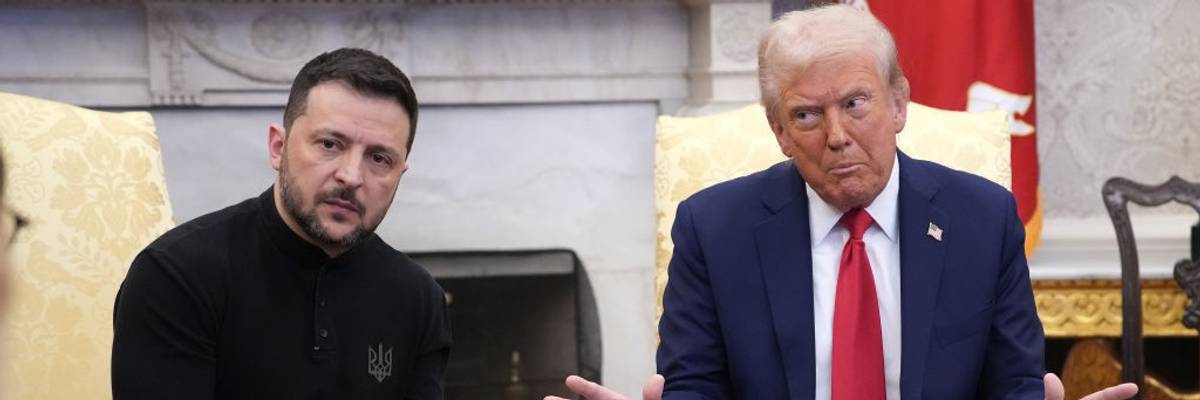
U.S. President Donald Trump and Ukrainian President Volodymyr Zelenskyy meet in the Oval Office at the White House on February 28, 2025.
After Oval Office Meltdown, Trump Cuts Off All US Military Aid to Ukraine
"Let's be clear—this is not about bringing peace," argued Democratic Rep. Pramila Jayapal. "Donald Trump is siding with Russia, Putin, and dictators across the world over our allies and the defense of democracy."
U.S. President Donald Trump late Monday ordered a suspension of all American military assistance to Ukraine after his conduct in a televised meeting with the war-torn country's president in the Oval Office last week sparked international dismay and outrage.
Trump's decision reportedly impacts over $1 billion worth of weaponry and ammunition that was set to be delivered to Ukraine, which has been under attack by invading Russian forces since February 2022. The U.S. has provided more than $65 billion in military aid to Ukraine during the full-scale Russian assault, according to State Department figures.
The Associated Press noted Monday that the U.S. president's move "comes some five years after Trump held up congressionally authorized assistance to Ukraine as he sought to pressure [Ukrainian President Volodymyr] Zelenskyy to launch an investigation into Joe Biden, then a Democratic presidential candidate."
"The moment led to Trump's first impeachment," the news outlet observed.
Democratic members of Congress argued that Trump's aid cutoff amounts to another instance of the U.S. president unlawfully withholding spending approved by lawmakers—and rejected the White House's claim that the move was motivated by a genuine desire for peace.
"Let's be clear—this is not about bringing peace," said Rep. Pramila Jayapal (D-Wash.), who faced backlash in late 2022 over her handling of a Congressional Progressive Caucus letter urging the Biden administration to "seriously explore all possible avenues, including direct engagement with Russia, to reduce harm and support Ukraine in achieving a peaceful settlement."
"Donald Trump is siding with Russia, Putin, and dictators across the world over our allies and the defense of democracy," Jayapal said Monday. "This is a shameful day in American history."
Rep. Gregory Meeks (D-N.Y.), the top Democrat on the House Foreign Affairs Committee, said in a statement that "if President Trump was truly concerned with securing a just and sustainable peace deal for Ukraine, he wouldn't have conceded every piece of leverage the United States, our allies, and Ukraine held before even beginning negotiations."
"He wouldn't be siding with an authoritarian responsible for war crimes," Meeks continued. "And he certainly wouldn't be forcing Ukraine into surrender, while claiming it's a deal. Instead, he would have continued U.S. support for Ukraine to put it in the best possible position to secure a peace deal for Russia's illegal and unjustified war against it."
"Ukraine is left with impossible choices: fight a losing war without U.S. support, or submit to economic vassalage under the very powers that prolonged its suffering."
Trump's decision to suspend U.S. aid to Ukraine, which the Kremlin welcomed, came after Zelenskyy said in the wake of the Oval Office meeting that "an agreement to end the war is still very, very far away."
"The peace that we foresee in the future must be just, honest, and most importantly, sustainable," added Zelenskyy, who has demanded security guarantees from the West as part of any diplomatic resolution with Russia.
Trump, who is pushing for U.S. control of Ukraine's mineral wealth, responded furiously to Zelenskyy's comment, calling it "the worst statement that could have been made."
Trump's Oval Office blow-up and subsequent aid suspension led some to lament missed opportunities for diplomacy under U.S. President Joe Biden.
"It would have been better for Ukraine—and the world—if Biden had pursued diplomacy much earlier," said Trita Parsi, executive vice president of the Quincy Institute for Responsible Statecraft. "But the Blob and the Democratic centrists shut down even any whisper of diplomacy."
Aída Chávez, communications director and policy adviser at Just Foreign Policy, argued in a recent column for The Intercept that "Trump's demand for 'payback' from Ukraine—treating the bloodiest conflict in Europe since World War II as if it's some unappreciated favor—presents U.S. foreign policy in its most naked form."
"As a result of the West's refusal to seriously consider diplomacy," Chávez added, "Ukraine is left with impossible choices: fight a losing war without U.S. support, or submit to economic vassalage under the very powers that prolonged its suffering."
We are at a crossroads
This country and this world are at a monumental crossroads. In a few short weeks, US voters will have an opportunity to beat back the forces of fascism and confront the billionaires who are rigging the economy, our media system, and our democracy, making it increasingly impossible for ordinary people to get by. We’re not just talking about the election. We’re talking about what must be done once these fascist elements are vanquished from power. We need a bolder set of solutions than what either major party has so far been willing to offer and a working-class movement ready to fight like hell for it. Trump didn't emerge from nowhere. The conditions that fueled MAGA authoritarianism were created by decades of radical neoliberal economic policies and a corrupt political system dominated by corporate interests. They slashed taxes on the super-rich, promising that the benefits would trickle down. They said giveaways to the corporate titans would make life more affordable for the rest of us. It was all bullshit. And when a bitter, betrayed populace searches for someone to blame, right-wing demagogues have little trouble finding scapegoats. People know when they're being lied to, but you won't hear any of this from the corporate media. Only independent journalism—powered and funded by people who believe in building a better world—can deliver truly trustworthy daily news. Our Fall Campaign is underway, and we need your help. To power our newsroom through the rest of the year, we need to raise $125,000 by midnight on October 31. So if you share our vision, please contribute whatever you can to sustain our work. |
U.S. President Donald Trump late Monday ordered a suspension of all American military assistance to Ukraine after his conduct in a televised meeting with the war-torn country's president in the Oval Office last week sparked international dismay and outrage.
Trump's decision reportedly impacts over $1 billion worth of weaponry and ammunition that was set to be delivered to Ukraine, which has been under attack by invading Russian forces since February 2022. The U.S. has provided more than $65 billion in military aid to Ukraine during the full-scale Russian assault, according to State Department figures.
The Associated Press noted Monday that the U.S. president's move "comes some five years after Trump held up congressionally authorized assistance to Ukraine as he sought to pressure [Ukrainian President Volodymyr] Zelenskyy to launch an investigation into Joe Biden, then a Democratic presidential candidate."
"The moment led to Trump's first impeachment," the news outlet observed.
Democratic members of Congress argued that Trump's aid cutoff amounts to another instance of the U.S. president unlawfully withholding spending approved by lawmakers—and rejected the White House's claim that the move was motivated by a genuine desire for peace.
"Let's be clear—this is not about bringing peace," said Rep. Pramila Jayapal (D-Wash.), who faced backlash in late 2022 over her handling of a Congressional Progressive Caucus letter urging the Biden administration to "seriously explore all possible avenues, including direct engagement with Russia, to reduce harm and support Ukraine in achieving a peaceful settlement."
"Donald Trump is siding with Russia, Putin, and dictators across the world over our allies and the defense of democracy," Jayapal said Monday. "This is a shameful day in American history."
Rep. Gregory Meeks (D-N.Y.), the top Democrat on the House Foreign Affairs Committee, said in a statement that "if President Trump was truly concerned with securing a just and sustainable peace deal for Ukraine, he wouldn't have conceded every piece of leverage the United States, our allies, and Ukraine held before even beginning negotiations."
"He wouldn't be siding with an authoritarian responsible for war crimes," Meeks continued. "And he certainly wouldn't be forcing Ukraine into surrender, while claiming it's a deal. Instead, he would have continued U.S. support for Ukraine to put it in the best possible position to secure a peace deal for Russia's illegal and unjustified war against it."
"Ukraine is left with impossible choices: fight a losing war without U.S. support, or submit to economic vassalage under the very powers that prolonged its suffering."
Trump's decision to suspend U.S. aid to Ukraine, which the Kremlin welcomed, came after Zelenskyy said in the wake of the Oval Office meeting that "an agreement to end the war is still very, very far away."
"The peace that we foresee in the future must be just, honest, and most importantly, sustainable," added Zelenskyy, who has demanded security guarantees from the West as part of any diplomatic resolution with Russia.
Trump, who is pushing for U.S. control of Ukraine's mineral wealth, responded furiously to Zelenskyy's comment, calling it "the worst statement that could have been made."
Trump's Oval Office blow-up and subsequent aid suspension led some to lament missed opportunities for diplomacy under U.S. President Joe Biden.
"It would have been better for Ukraine—and the world—if Biden had pursued diplomacy much earlier," said Trita Parsi, executive vice president of the Quincy Institute for Responsible Statecraft. "But the Blob and the Democratic centrists shut down even any whisper of diplomacy."
Aída Chávez, communications director and policy adviser at Just Foreign Policy, argued in a recent column for The Intercept that "Trump's demand for 'payback' from Ukraine—treating the bloodiest conflict in Europe since World War II as if it's some unappreciated favor—presents U.S. foreign policy in its most naked form."
"As a result of the West's refusal to seriously consider diplomacy," Chávez added, "Ukraine is left with impossible choices: fight a losing war without U.S. support, or submit to economic vassalage under the very powers that prolonged its suffering."
U.S. President Donald Trump late Monday ordered a suspension of all American military assistance to Ukraine after his conduct in a televised meeting with the war-torn country's president in the Oval Office last week sparked international dismay and outrage.
Trump's decision reportedly impacts over $1 billion worth of weaponry and ammunition that was set to be delivered to Ukraine, which has been under attack by invading Russian forces since February 2022. The U.S. has provided more than $65 billion in military aid to Ukraine during the full-scale Russian assault, according to State Department figures.
The Associated Press noted Monday that the U.S. president's move "comes some five years after Trump held up congressionally authorized assistance to Ukraine as he sought to pressure [Ukrainian President Volodymyr] Zelenskyy to launch an investigation into Joe Biden, then a Democratic presidential candidate."
"The moment led to Trump's first impeachment," the news outlet observed.
Democratic members of Congress argued that Trump's aid cutoff amounts to another instance of the U.S. president unlawfully withholding spending approved by lawmakers—and rejected the White House's claim that the move was motivated by a genuine desire for peace.
"Let's be clear—this is not about bringing peace," said Rep. Pramila Jayapal (D-Wash.), who faced backlash in late 2022 over her handling of a Congressional Progressive Caucus letter urging the Biden administration to "seriously explore all possible avenues, including direct engagement with Russia, to reduce harm and support Ukraine in achieving a peaceful settlement."
"Donald Trump is siding with Russia, Putin, and dictators across the world over our allies and the defense of democracy," Jayapal said Monday. "This is a shameful day in American history."
Rep. Gregory Meeks (D-N.Y.), the top Democrat on the House Foreign Affairs Committee, said in a statement that "if President Trump was truly concerned with securing a just and sustainable peace deal for Ukraine, he wouldn't have conceded every piece of leverage the United States, our allies, and Ukraine held before even beginning negotiations."
"He wouldn't be siding with an authoritarian responsible for war crimes," Meeks continued. "And he certainly wouldn't be forcing Ukraine into surrender, while claiming it's a deal. Instead, he would have continued U.S. support for Ukraine to put it in the best possible position to secure a peace deal for Russia's illegal and unjustified war against it."
"Ukraine is left with impossible choices: fight a losing war without U.S. support, or submit to economic vassalage under the very powers that prolonged its suffering."
Trump's decision to suspend U.S. aid to Ukraine, which the Kremlin welcomed, came after Zelenskyy said in the wake of the Oval Office meeting that "an agreement to end the war is still very, very far away."
"The peace that we foresee in the future must be just, honest, and most importantly, sustainable," added Zelenskyy, who has demanded security guarantees from the West as part of any diplomatic resolution with Russia.
Trump, who is pushing for U.S. control of Ukraine's mineral wealth, responded furiously to Zelenskyy's comment, calling it "the worst statement that could have been made."
Trump's Oval Office blow-up and subsequent aid suspension led some to lament missed opportunities for diplomacy under U.S. President Joe Biden.
"It would have been better for Ukraine—and the world—if Biden had pursued diplomacy much earlier," said Trita Parsi, executive vice president of the Quincy Institute for Responsible Statecraft. "But the Blob and the Democratic centrists shut down even any whisper of diplomacy."
Aída Chávez, communications director and policy adviser at Just Foreign Policy, argued in a recent column for The Intercept that "Trump's demand for 'payback' from Ukraine—treating the bloodiest conflict in Europe since World War II as if it's some unappreciated favor—presents U.S. foreign policy in its most naked form."
"As a result of the West's refusal to seriously consider diplomacy," Chávez added, "Ukraine is left with impossible choices: fight a losing war without U.S. support, or submit to economic vassalage under the very powers that prolonged its suffering."