SUBSCRIBE TO OUR FREE NEWSLETTER
Daily news & progressive opinion—funded by the people, not the corporations—delivered straight to your inbox.
5
#000000
#FFFFFF
To donate by check, phone, or other method, see our More Ways to Give page.
Daily news & progressive opinion—funded by the people, not the corporations—delivered straight to your inbox.
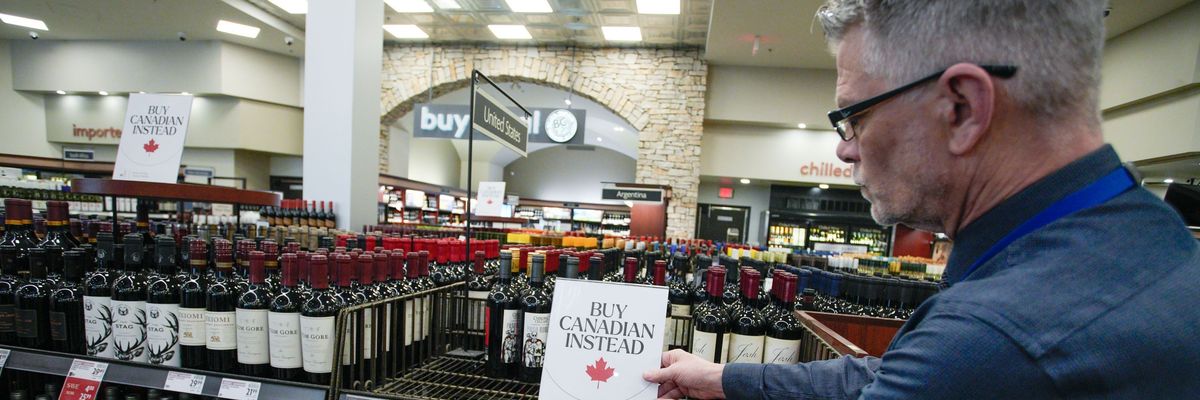
An employee places "Buy Canadian Instead" signs on a shelf at a liquor store in Vancouver, British Columbia, Canada on March 10, 2025.
"A lot of people feel betrayed by our closest ally," said one marketer in Canada, where President Donald Trump has imposed 25% tariffs.
With declining consumer interest in Tesla vehicles sending CEO and Trump administration ally Elon Musk into an apparent panic over the electric automaker's plummeting stock—spurring an impromptu car show on the White House lawn Tuesday with President Donald Trump scolding Americans for not buying Musk's products—recent reports from across Europe and Canada suggest the two right-wing leaders are pushing global consumers to reject not just Tesla, but a wide array of American goods.
As The Guardian reported Wednesday, numbers released this week by Statistics Canada showed waning enthusiasm for Canadians to visit their southern neighbor, with 23% fewer Canadians taking road trips into the U.S.—the most popular mode of cross-border travel—this year so far compared to February 2024.
With Trump initiating a trade war with Canada—falsely claiming the country is a major source of fentanyl flowing into the U.S.—by imposing 25% tariffs on all Canadian imports and threatening to take over the country as the "cherished Fifty First State," consumers have been downloading apps like "Maple Scan" and "Is This Canadian?" to avoid purchasing U.S.-made products.
"A lot of people feel betrayed by our closest ally," Emma Cochran, an Ottawa-based marketer, told NBC News on Wednesday.
Cochrane partnered with a colleague to make hats and shirts emblazoned with the phrase, "Canada is not for sale," one of which was worn by Ontario Premier Doug Ford last week.
"This felt like a way that we could participate and just kind of say, 'We're going to stand up for Canada,'" she told NBC.
Canadian officials announced retaliatory tariffs on $21 billion in goods on Wednesday after Trump raised global steel and aluminum tariffs to 25%—backing off of an earlier threat of a 50% levy.
As some Canadian provinces began pulling U.S. liquor brands from government-run stores and replacing bottles with "Buy Canadian Instead" signs, the CEO of the Kentucky-based Brown-Forman, which makes Jack Daniel's, called the boycott "frustrating."
"That's worse than a tariff because it's literally taking your sales away," Whiting said on an earnings call last week.
Nick Talley, a physician-scientist in New South Wales, Australia, said Trump "presumably... thought everyone would just bow down" after he imposed tariffs and raised prices for consumers around the world.
Danish grocery company Salling Group has also taken action to oppose Trump's threat to take control of Greenland, an autonomous territory within the Danish kingdom.
The company is still carrying U.S.-made products but is marking European-made goods with a black star to identify them for shoppers.
A Verian/SVT survey in Sweden on Tuesday found that "the U.S.'s actions in world politics... have led many Swedes to hesitate in the face of American products."
Twenty-nine percent of Swedish residents said they had refrained from buying U.S. goods in the last month amid Trump's trade war, his temporary suspension of aid to Ukraine after publicly berating Ukrainian President Volodymyr Zelenskyy at the White House earlier this month, and Musk's meddling in European politics by expressing support for British right-wing extremist Tommy Robinson and German political party Alternative for Germany, which has embraced Nazi slogans and came in second in last month's elections.
Norwegian fuel company Haltbakk urged "all Norwegians and Europeans" to join in boycotting the U.S. after the confrontation between Trump and Zelenskyy, which the firm called "the biggest shit show ever presented 'live on TV' by the current American president and his vice president."
The company has provided fuel to U.S. ships in Norwegian ports but said it would no longer do so as the international community expressed shock over Trump's treatment of Zelenskyy and Ukrainian victims of Russia's invasion.
Meanwhile, European consumers have continued to make their views on Musk—a "special government employee" of Trump's who has spearheaded the slashing of federal jobs and spending and threatened to cut $700 billion from Social Security, Medicare, and Medicaid—by refusing to buy Tesla cars.
February sales were down 76% in Germany, 53% in Portugal, 55% in Italy, and 48% in Norway and Denmark—contributing the company's plummeting share price and loss of $800 billion in market cap.
Trump offered to buy a Tesla before staging a showing of five of the cars at the White House Tuesday, claiming American consumers are "illegally" boycotting the company, but as Channel 4 in the U.K. reported, "the company will have to find a lot more buyers to make up for a sharp decline in sales across Europe" as both boycotts and protests at Tesla dealerships spread.
Dear Common Dreams reader, It’s been nearly 30 years since I co-founded Common Dreams with my late wife, Lina Newhouser. We had the radical notion that journalism should serve the public good, not corporate profits. It was clear to us from the outset what it would take to build such a project. No paid advertisements. No corporate sponsors. No millionaire publisher telling us what to think or do. Many people said we wouldn't last a year, but we proved those doubters wrong. Together with a tremendous team of journalists and dedicated staff, we built an independent media outlet free from the constraints of profits and corporate control. Our mission has always been simple: To inform. To inspire. To ignite change for the common good. Building Common Dreams was not easy. Our survival was never guaranteed. When you take on the most powerful forces—Wall Street greed, fossil fuel industry destruction, Big Tech lobbyists, and uber-rich oligarchs who have spent billions upon billions rigging the economy and democracy in their favor—the only bulwark you have is supporters who believe in your work. But here’s the urgent message from me today. It's never been this bad out there. And it's never been this hard to keep us going. At the very moment Common Dreams is most needed, the threats we face are intensifying. We need your support now more than ever. We don't accept corporate advertising and never will. We don't have a paywall because we don't think people should be blocked from critical news based on their ability to pay. Everything we do is funded by the donations of readers like you. When everyone does the little they can afford, we are strong. But if that support retreats or dries up, so do we. Will you donate now to make sure Common Dreams not only survives but thrives? —Craig Brown, Co-founder |
With declining consumer interest in Tesla vehicles sending CEO and Trump administration ally Elon Musk into an apparent panic over the electric automaker's plummeting stock—spurring an impromptu car show on the White House lawn Tuesday with President Donald Trump scolding Americans for not buying Musk's products—recent reports from across Europe and Canada suggest the two right-wing leaders are pushing global consumers to reject not just Tesla, but a wide array of American goods.
As The Guardian reported Wednesday, numbers released this week by Statistics Canada showed waning enthusiasm for Canadians to visit their southern neighbor, with 23% fewer Canadians taking road trips into the U.S.—the most popular mode of cross-border travel—this year so far compared to February 2024.
With Trump initiating a trade war with Canada—falsely claiming the country is a major source of fentanyl flowing into the U.S.—by imposing 25% tariffs on all Canadian imports and threatening to take over the country as the "cherished Fifty First State," consumers have been downloading apps like "Maple Scan" and "Is This Canadian?" to avoid purchasing U.S.-made products.
"A lot of people feel betrayed by our closest ally," Emma Cochran, an Ottawa-based marketer, told NBC News on Wednesday.
Cochrane partnered with a colleague to make hats and shirts emblazoned with the phrase, "Canada is not for sale," one of which was worn by Ontario Premier Doug Ford last week.
"This felt like a way that we could participate and just kind of say, 'We're going to stand up for Canada,'" she told NBC.
Canadian officials announced retaliatory tariffs on $21 billion in goods on Wednesday after Trump raised global steel and aluminum tariffs to 25%—backing off of an earlier threat of a 50% levy.
As some Canadian provinces began pulling U.S. liquor brands from government-run stores and replacing bottles with "Buy Canadian Instead" signs, the CEO of the Kentucky-based Brown-Forman, which makes Jack Daniel's, called the boycott "frustrating."
"That's worse than a tariff because it's literally taking your sales away," Whiting said on an earnings call last week.
Nick Talley, a physician-scientist in New South Wales, Australia, said Trump "presumably... thought everyone would just bow down" after he imposed tariffs and raised prices for consumers around the world.
Danish grocery company Salling Group has also taken action to oppose Trump's threat to take control of Greenland, an autonomous territory within the Danish kingdom.
The company is still carrying U.S.-made products but is marking European-made goods with a black star to identify them for shoppers.
A Verian/SVT survey in Sweden on Tuesday found that "the U.S.'s actions in world politics... have led many Swedes to hesitate in the face of American products."
Twenty-nine percent of Swedish residents said they had refrained from buying U.S. goods in the last month amid Trump's trade war, his temporary suspension of aid to Ukraine after publicly berating Ukrainian President Volodymyr Zelenskyy at the White House earlier this month, and Musk's meddling in European politics by expressing support for British right-wing extremist Tommy Robinson and German political party Alternative for Germany, which has embraced Nazi slogans and came in second in last month's elections.
Norwegian fuel company Haltbakk urged "all Norwegians and Europeans" to join in boycotting the U.S. after the confrontation between Trump and Zelenskyy, which the firm called "the biggest shit show ever presented 'live on TV' by the current American president and his vice president."
The company has provided fuel to U.S. ships in Norwegian ports but said it would no longer do so as the international community expressed shock over Trump's treatment of Zelenskyy and Ukrainian victims of Russia's invasion.
Meanwhile, European consumers have continued to make their views on Musk—a "special government employee" of Trump's who has spearheaded the slashing of federal jobs and spending and threatened to cut $700 billion from Social Security, Medicare, and Medicaid—by refusing to buy Tesla cars.
February sales were down 76% in Germany, 53% in Portugal, 55% in Italy, and 48% in Norway and Denmark—contributing the company's plummeting share price and loss of $800 billion in market cap.
Trump offered to buy a Tesla before staging a showing of five of the cars at the White House Tuesday, claiming American consumers are "illegally" boycotting the company, but as Channel 4 in the U.K. reported, "the company will have to find a lot more buyers to make up for a sharp decline in sales across Europe" as both boycotts and protests at Tesla dealerships spread.
With declining consumer interest in Tesla vehicles sending CEO and Trump administration ally Elon Musk into an apparent panic over the electric automaker's plummeting stock—spurring an impromptu car show on the White House lawn Tuesday with President Donald Trump scolding Americans for not buying Musk's products—recent reports from across Europe and Canada suggest the two right-wing leaders are pushing global consumers to reject not just Tesla, but a wide array of American goods.
As The Guardian reported Wednesday, numbers released this week by Statistics Canada showed waning enthusiasm for Canadians to visit their southern neighbor, with 23% fewer Canadians taking road trips into the U.S.—the most popular mode of cross-border travel—this year so far compared to February 2024.
With Trump initiating a trade war with Canada—falsely claiming the country is a major source of fentanyl flowing into the U.S.—by imposing 25% tariffs on all Canadian imports and threatening to take over the country as the "cherished Fifty First State," consumers have been downloading apps like "Maple Scan" and "Is This Canadian?" to avoid purchasing U.S.-made products.
"A lot of people feel betrayed by our closest ally," Emma Cochran, an Ottawa-based marketer, told NBC News on Wednesday.
Cochrane partnered with a colleague to make hats and shirts emblazoned with the phrase, "Canada is not for sale," one of which was worn by Ontario Premier Doug Ford last week.
"This felt like a way that we could participate and just kind of say, 'We're going to stand up for Canada,'" she told NBC.
Canadian officials announced retaliatory tariffs on $21 billion in goods on Wednesday after Trump raised global steel and aluminum tariffs to 25%—backing off of an earlier threat of a 50% levy.
As some Canadian provinces began pulling U.S. liquor brands from government-run stores and replacing bottles with "Buy Canadian Instead" signs, the CEO of the Kentucky-based Brown-Forman, which makes Jack Daniel's, called the boycott "frustrating."
"That's worse than a tariff because it's literally taking your sales away," Whiting said on an earnings call last week.
Nick Talley, a physician-scientist in New South Wales, Australia, said Trump "presumably... thought everyone would just bow down" after he imposed tariffs and raised prices for consumers around the world.
Danish grocery company Salling Group has also taken action to oppose Trump's threat to take control of Greenland, an autonomous territory within the Danish kingdom.
The company is still carrying U.S.-made products but is marking European-made goods with a black star to identify them for shoppers.
A Verian/SVT survey in Sweden on Tuesday found that "the U.S.'s actions in world politics... have led many Swedes to hesitate in the face of American products."
Twenty-nine percent of Swedish residents said they had refrained from buying U.S. goods in the last month amid Trump's trade war, his temporary suspension of aid to Ukraine after publicly berating Ukrainian President Volodymyr Zelenskyy at the White House earlier this month, and Musk's meddling in European politics by expressing support for British right-wing extremist Tommy Robinson and German political party Alternative for Germany, which has embraced Nazi slogans and came in second in last month's elections.
Norwegian fuel company Haltbakk urged "all Norwegians and Europeans" to join in boycotting the U.S. after the confrontation between Trump and Zelenskyy, which the firm called "the biggest shit show ever presented 'live on TV' by the current American president and his vice president."
The company has provided fuel to U.S. ships in Norwegian ports but said it would no longer do so as the international community expressed shock over Trump's treatment of Zelenskyy and Ukrainian victims of Russia's invasion.
Meanwhile, European consumers have continued to make their views on Musk—a "special government employee" of Trump's who has spearheaded the slashing of federal jobs and spending and threatened to cut $700 billion from Social Security, Medicare, and Medicaid—by refusing to buy Tesla cars.
February sales were down 76% in Germany, 53% in Portugal, 55% in Italy, and 48% in Norway and Denmark—contributing the company's plummeting share price and loss of $800 billion in market cap.
Trump offered to buy a Tesla before staging a showing of five of the cars at the White House Tuesday, claiming American consumers are "illegally" boycotting the company, but as Channel 4 in the U.K. reported, "the company will have to find a lot more buyers to make up for a sharp decline in sales across Europe" as both boycotts and protests at Tesla dealerships spread.