

SUBSCRIBE TO OUR FREE NEWSLETTER
Daily news & progressive opinion—funded by the people, not the corporations—delivered straight to your inbox.
5
#000000
#FFFFFF
To donate by check, phone, or other method, see our More Ways to Give page.
Daily news & progressive opinion—funded by the people, not the corporations—delivered straight to your inbox.

"History will show that it was the Supreme Court that denied us justice," said Salah Al-Ejaili, one of the Iraqi plaintiffs.
The US Supreme Court recently delivered a "lethal blow" to lawsuits filed under an 18th-century law, including a case brought by Iraqis tortured at Abu Ghraib as part of the George W. Bush administration's invasion of Iraq, whose landmark verdict was struck down on Friday by a federal appellate court.
The Iraqis' case against US military contractor CACI Premier Technology was first filed in 2008, and eventually led to a trial and retrial in 2024. That November, a federal jury found the company liable for torture at the notorious prison in Iraq, and ordered it to pay the three prisoners a total of $42 million.
After unsuccessfully seeking another trial at the US District Court for the District of Virginia, CACI turned to the US Court of Appeals for the 4th Circuit, which this past March upheld the historic verdict in favor of the three tortured men: middle school principal Suhail Al Shimari, fruit vendor Asa'ad Zuba'e, and journalist Salah Al-Ejaili.
Then came the Supreme Court's June decision in Cisco Systems v. Doe, which effectively reversed the high court's 2004 ruling on the Alien Tort Statute (ATS), nullifying "a vital law that could check corporate abuses and provide an essential remedy to those whose rights have been violated," as University of California, Berkeley law professor Erwin Chemerinsky wrote earlier this week.
As legal experts feared, the 4th Circuit reconsidered the CACI verdict in the wake of the June decision, and determined that "just as the court concluded that the Cisco plaintiffs' ATS claims—including aiding and abetting torture—must be dismissed, so too must we dismiss plaintiffs' claims here—conspiracy to commit torture" and cruel, inhuman, and degrading treatment.
Baher Azmy, legal director of the Center for Constitutional Rights, which represented the Iraqis alongside other law firms, responded with a Friday statement calling out both the Supreme Court and CACI.
"As radical and regressive as the Supreme Court's decision in Cisco is," Azmy said, "it will never change this fundamental truth: A jury heard voluminous testimony and unanimously concluded CACI was responsible for the torture and abuse of dozens of Iraqis at Abu Ghraib, including these plaintiffs, rendering CACI, in the words of a foundational ATS-human rights case, 'hostis humani generis'—an 'enemy of all mankind.'"
"We remain in awe of the bravery and dedication of our clients, who fought for 18 years for justice for themselves, their families, and other survivors of horrific human rights abuses," Azmy added. "This Supreme Court may continue to do great damage to human rights cases, but it cannot take the courage and dignity away from our clients' historic achievement."
One of the plaintiffs in the case, Al-Ejaili, also took aim at the country's highest court, which is dominated by right-wing justices.
"What we did in pursuing accountability for 18 years for the torture we suffered at Abu Ghraib was a big thing. We trusted a US jury with our stories, and they believed us and sided with us—this is the most important part of the case," he said Friday. "History will show that it was the Supreme Court that denied us justice."
In a landmark verdict cheered by human rights defenders around the world, a federal jury in Virginia found a U.S. military contractor liable for the torture of three prisoners at the notorious Abu Ghraib prison during the invasion and occupation of Iraq in the early 2000s.
The jury ordered CACI Premier Technology to pay each of the three Iraqi plaintiffs $3 million in compensatory damages and $11 million in punitive damages, for a total of $42 million. It is the first time that a civilian contractor has been found legally responsible for abusing Abu Ghraib detainees.
The lawsuit against CACI—filed in 2008 by the Center for Constitutional Rights (CCR) on behalf of Suhail Al Shimari, Asa'ad Al Zuba'e, and Salah Al-Ejaili—alleged that company officials conspired with U.S. military personnel in subjecting the plaintiffs to torture and other crimes.
As CCR noted Tuesday:
The plaintiffs brought their case under the Alien Tort Statute, a 1789 federal law that allows foreign nationals to seek redress in U.S. courts for certain violations of international law. This historic outcome follows 16 years of litigation, more than 20 attempts by CACI to have the case dismissed, and a previous trial in which the jury was unable to reach a verdict. Never before this case had survivors of U.S. post-9/11 torture testified in a U.S. courtroom. It also featured testimony from U.S. generals, CACI employees, and former [military police officers] involved in the torture.
"Today is a big day for me and for justice," said Al-Ejaili. "I've waited a long time for this day."
"This victory isn't only for the three plaintiffs in this case against a corporation," he added. "This victory is a shining light for everyone who has been oppressed and a strong warning to any company or contractor practicing different forms of torture and abuse."
CCR legal director Baher Azmy said that "our clients have fought bravely for 16 years in search of justice for the horrors they endured at Abu Ghraib, against all of the challenges this massive private military contractor threw in their way over the years to avoid basic accountability for its role in this shameful episode in American history."
"We are awed by our clients' courage and by the power of their testimony in court, and we are grateful that this jury knew enough to credit their story over the deflections of CACI," Azmy added. "We thank the jury for affording our clients the measure of justice they came to a United States court to seek."
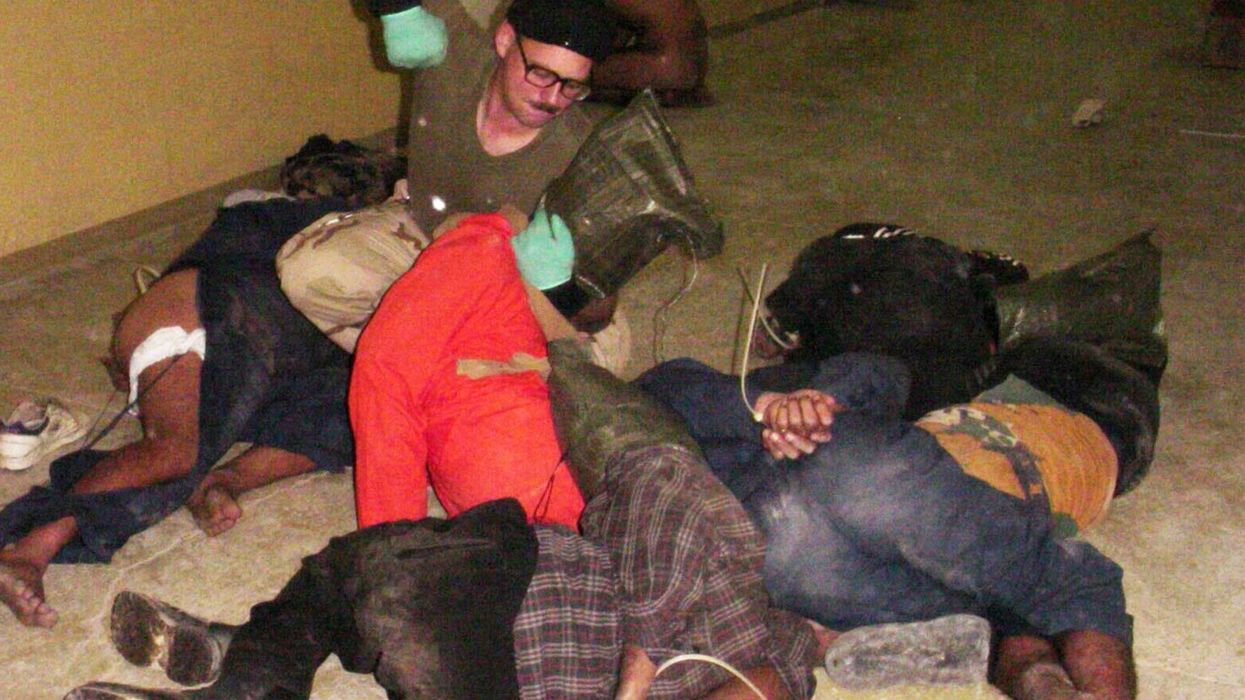
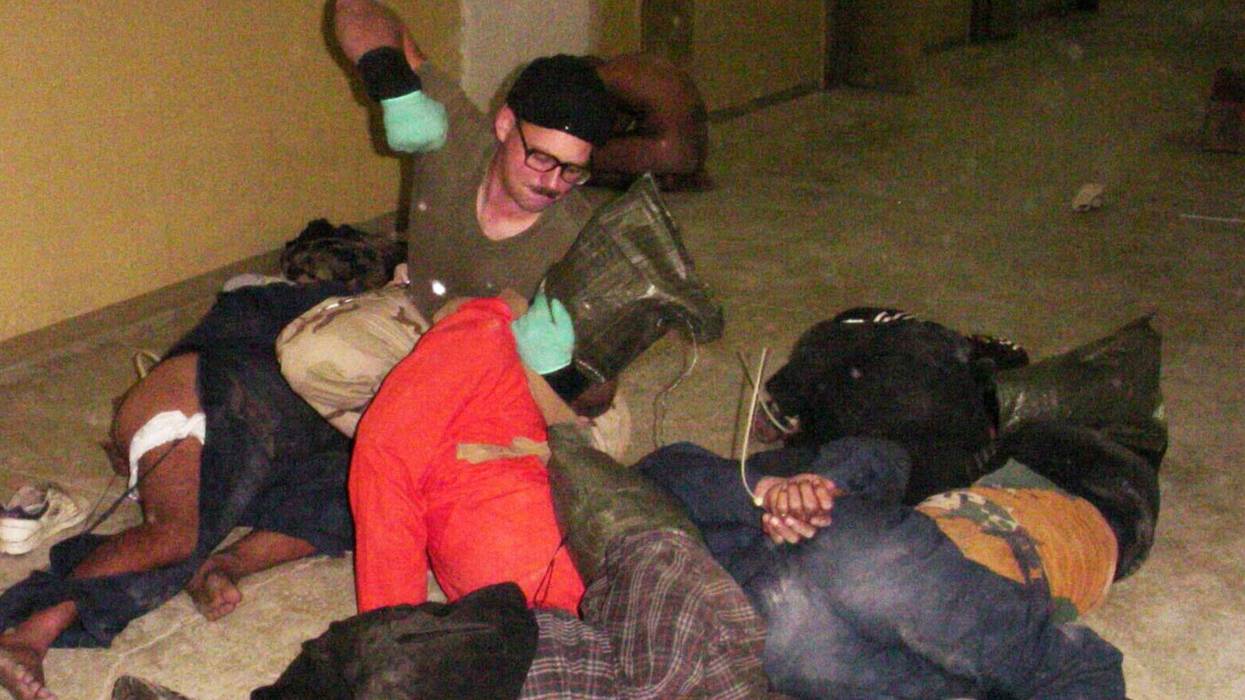
Like Guantánamo Bay, Abu Ghraib became a byword for U.S. torture during the Bush administration as it waged a worldwide war on terrorism following the September 11, 2001 attacks. The prison's worldwide notoriety stems from the leak and publication in 2004 of photos showing U.S. troops torturing and abusing Abu Ghraib detainees, both living and dead, often with smiles on their faces.
A 2004 investigation by U.S. Army Lt. Gen. Anthony Jones and Maj. Gen. George Fay found that CACI employees participated in and encouraged the torture of Abu Ghraib prisoners.
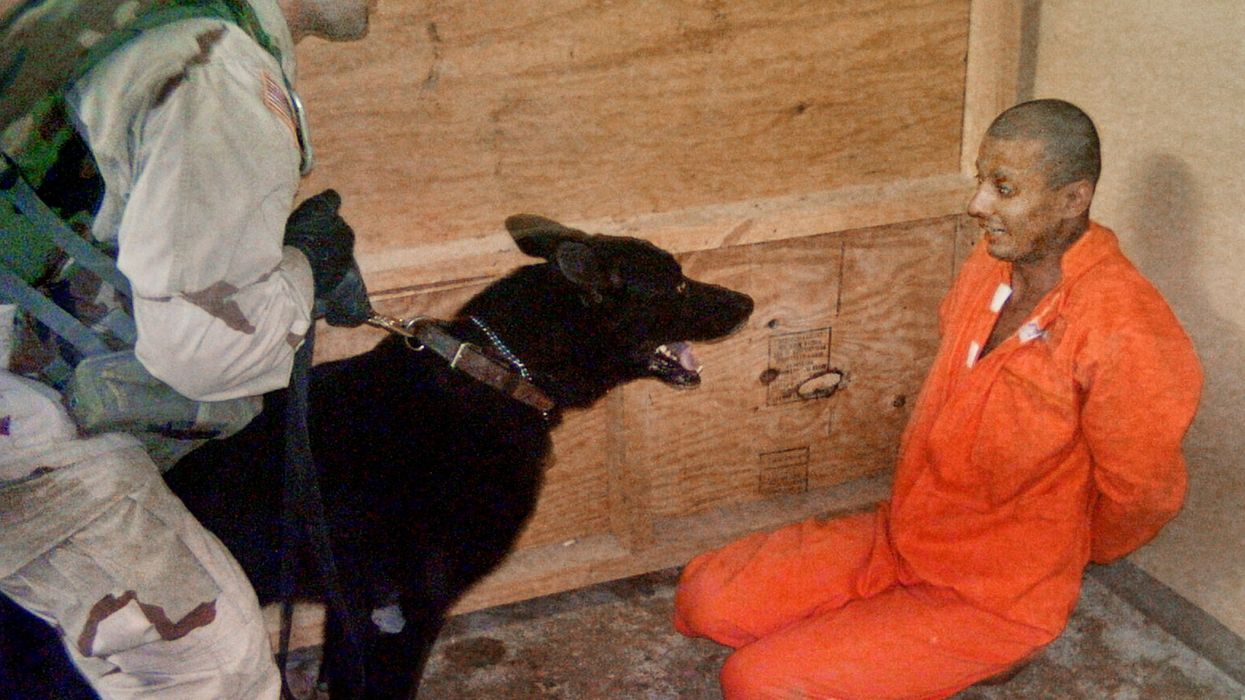
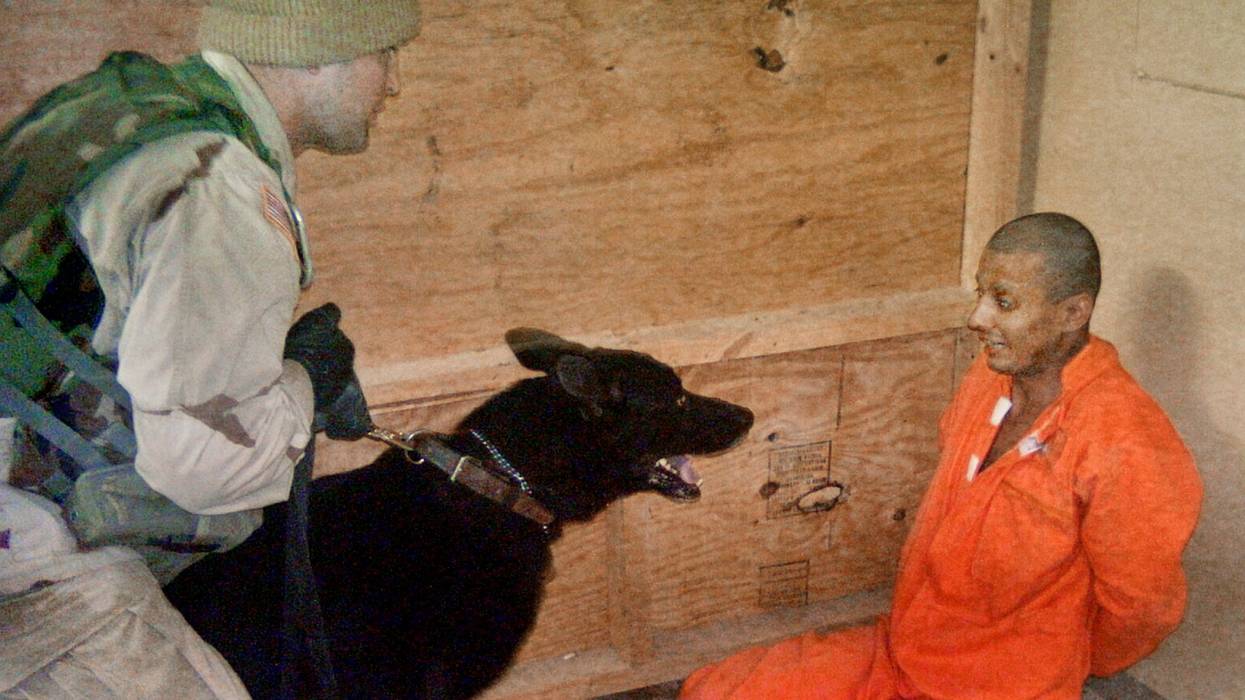
Investigators found that employees of CACI and Titan Corporation (now L3 Technologies) tortured Abu Ghraib detainees and encouraged U.S. troops to do likewise. Dozens of Abu Ghraib detainees died in U.S. custody, some of them as a result of being tortured to death. Abu Ghraib prisoners endured torture ranging from rape and being attacked with dogs to being forced to eat pork and renounce Islam.
A separate U.S. Army report concluded that most Abu Ghraib prisoners were innocent, with the Red Cross estimating that between 70-90% of inmates there were wrongfully detained. These include women who were held as bargaining chips to induce suspected militants to surrender.
Eleven low-ranking U.S. soldiers were convicted and jailed for their roles in Abu Ghraib torture. Brig. Gen. Janis Karpinski, the prison's commanding officer, was demoted. No other high-ranking military officer faced accountability for the abuse. Senior Bush administration officials—who had authorized many of the "enhanced interrogation techniques" used at prisons including Abu Ghraib and Guantánamo Bay—lied about their knowledge of the torture. None of them were ever held accountable.
"This will not be the final word; what happened in Abu Ghraib is engraved into our memories and will never be forgotten in history," one plaintiff vowed.
The federal judge presiding over a case filed by three Iraqis who were tortured by U.S. military contractors in the notorious Abu Ghraib prison two decades ago declared a mistrial Thursday after jurors were unable to reach a unanimous verdict.
After eight days of deliberation—a longer period than the trial itself—the eight civil jurors in Alexandria deadlocked over whether employees of CACI conspired with soldiers to torture detainees. The Virginia-based professional services and information technology firm was hired in 2003 during the George W. Bush administration to provide translators and interrogators in Iraq during the U.S.-led invasion and occupation, conspired with soldiers to torture detainees.
U.S. District Judge Leonie Brinkema—who said Wednesday that "it's a very difficult case"—declared a mistrial.
Plaintiff Salah Al-Ejaili told The Guardian that "it is enough that we tried and didn't remain silent."
"We might not have received justice yet in our just case today, but what is more important is that we made it to trial and spoke up so the world could hear from us directly," he added. "This will not be the final word; what happened in Abu Ghraib is engraved into our memories and will never be forgotten in history."
Baher Azmy, legal director of the Center for Constitutional Rights—which filed the case—said that "we are, of course, disappointed by the jury's failure to reach a unanimous verdict in favor of our plaintiffs despite the wealth of evidence."
"But we remain awed by the courage of our clients, who have fought for justice for their torment for 16 years," Azmy added. "We look forward to the opportunity to present our case again."
Al Shimari v. CACI, which was first filed in 2008 under the Alien Tort Statute—a law allowing non-U.S. citizens to sue for human rights abuses committed abroad—plaintiffs Suhail Al Shimari, Asa'ad Zuba'e, and Al-Ejaili accused CACI of conspiring with the U.S. military to perpetrate war crimes including torture at Abu Ghraib. The men suffered broken bones, electric shocks, sexual abuse, extreme temperatures, and death threats at the hands of their U.S. interrogators.
The case marked the first time a U.S. jury heard a case brought by Abu Ghraib survivors. Along with the Guantánamo Bay detention camp in Cuba, the prison became synonymous worldwide with U.S. torture during the War on Terror. Dozens of Abu Ghraib detainees died while in U.S. custody, some of them as a result of being tortured to death. Abu Ghraib prisoners suffered torture and abuse ranging from rape and being attacked with dogs to being forced to eat pork and renounce Islam.
A 2004 probe by Maj. Gen. Anthony Taguba found that the majority of Abu Ghraib prisoners—the Red Cross said 70-90%—were innocent. Women and girls were also imprisoned at Abu Ghraib as bargaining chips to lure militants wanted for resisting the U.S.-led invasion and occupation of their homeland. Some reported rape and sexual abuse by their captors, which reportedly led to the "honor killing" murders of multiple women.
CACI denies any wrongdoing and still gets millions of dollars worth of U.S. government contracts each year. In February, Fortune named CACI one of the "World's Most Admired Companies" for the seventh consecutive year.
"Meanwhile, the U.S. government STILL hasn't provided compensation or other redress to people tortured by U.S. troops in Iraq," said one observer. "These three men are the lucky few."
Two decades after they were tortured by U.S. military contractors at the notorious Abu Ghraib prison near Baghdad, three Iraqi victims are finally getting their day in court Monday as a federal court in Virginia takes up a case they brought during the George W. Bush administration.
The case being heard in the U.S. District Court in Alexandria, Al Shimari v. CACI, was first filed in 2008 under the Alien Tort Statute—which allows non-U.S. citizens to sue for human rights abuses committed abroad—by the Center for Constitutional Rights (CCR) on behalf of three Iraqis. The men suffered torture directed and perpetrated by employees of CACI, a Virginia-based professional services and information technology firm hired in 2003 by the Bush administration as translators and interrogators in Iraq during the illegal U.S.-led invasion and occupation.
"This lawsuit is a critical step towards justice for these three men who will finally have their day in court."
Plaintiffs Suhail Al Shimari, Asa'ad Zuba'e, and Salah Al-Ejaili accuse CACI of conspiring to commit war crimes including torture at Abu Ghraib, where the men suffered broken bones, electric shocks, sexual abuse, extreme temperatures, and death threats at the hands of their U.S. interrogators.
"This lawsuit is a critical step towards justice for these three men who will finally have their day in court. But they are the lucky few," Sarah Sanbar, an Iraq researcher at Human Rights Watch, wrote on Monday. "For the hundreds of other survivors still suffering from past abuses, their chances of justice remain slim."
"The U.S. government should do the right thing: Take responsibility for their abuses, offer an apology, and open an avenue to redress that has been denied them for too many years," Sanbar added.
U.S. military investigators found that employees of CACI and Titan Corporation (now L3 Technologies) tortured Iraqi prisoners and encouraged U.S. troops to do likewise. Dozens of Abu Ghraib detainees died in U.S. custody, some of them as a result of being tortured to death. Abu Ghraib prisoners endured torture ranging from rape and being attacked with dogs to being forced to eat pork and renounce Islam.
A May 2004 report by Maj. Gen. Anthony Taguba concluded that the majority of Abu Ghraib prisoners—the Red Cross said 70-90%— were innocent. In addition to thousands of men and boys, some women and girls were also jailed there as bargaining chips meant to induce wanted insurgents to surrender. Some of them said they were raped or sexually abused by their American captors; lesser-known Abu Ghraib photos show women being forced to expose their private parts. Some female detainees were reportedly murdered by their own relatives in so-called "honor killings" after their release.
Eleven low-ranking U.S. soldiers were convicted and jailed for their roles in the Abu Ghraib torture scandal. Brig. Gen. Janis Karpinski, the prison's commanding officer, was demoted. No other high-ranking military officer faced accountability for the abuse. Senior Bush administration officials—who had authorized many of the "enhanced interrogation techniques" used at prisons including Abu Ghraib and Guantánamo Bay—lied about their knowledge of the torture. None of them were ever held accountable.
Bush's successor, former President Barack Obama, promised to investigate—and if warranted, to prosecute—the Bush-era officials responsible for the torture that had become synonymous with the War on Terror. Instead, the Obama administration protected them from prosecution.
In 2013, L3 Technologies agreed to pay $5.28 million to 71 former Abu Ghraib detainees who were subjected to sexual assault and humiliation, rape threats, electrical shocks, mock executions, brutal beatings, and other abuse.
The following year, the 4th U.S. Circuit Court of Appeals overturned a lower court ruling prohibiting Abu Ghraib torture victims from suing U.S. companies implicated in their abuse. But the court later reversed itself, finding the case had sufficient ties to the United States to be heard in an American court. The suit was later dismissed under the political question doctrine, which prevents courts from ruling on issues determined to be essentially political.
However, in 2016, a 4th Circuit panel ruled that "the political question doctrine does not shield from judicial review intentional acts by a government contractor that were unlawful at the time they were committed," allowing the Iraqis' case to proceed.
"This is a historic trial that we hope will deliver some measure of justice and healing for what President Bush rightly deemed disgraceful conduct that dishonored the United States and its values," CCR senior attorney Katherine Gallagher told The Guardian on Monday.
"In many ways, this case may be seen as setting a precedent for holding contractors accountable for human rights violations should they happen in other contexts, too," she added.
CACI—which denies any wrongdoing—has tried to get the case dismissed 20 times. The company still lands millions of dollars worth of U.S. government contracts. In February, Fortune included the firm on its "World's Most Admired Companies" list for the seventh straight year.
"The ruling has cleared the way, almost 20 years hence, for our clients to tell their story in open court," said the legal director at the Center for Constitutional Rights, which filed suit on behalf of detainees.
Survivors of torture at the hands of U.S. troops and private interrogators cheered a federal judge's rejection this week of an infamous military contractor's latest bid to dismiss a lawsuit brought by Iraqis formerly jailed in the notorious Abu Ghraib prison during the early years of the American-led occupation.
On Monday, Judge Leonie Brinkema of the U.S. District Court for the Eastern District of Virginia in Alexandria refused to dismiss the torture suit against CACI Premier Technology, a military-industrial complex linchpin based in nearby Arlington with more than 22,000 employees and billions of dollars in government contracts.
"I am so happy to receive the news that our case can proceed toward trial."
The lawsuit against CACI—filed in 2008 by the Center for Constitutional Rights on behalf of former detainees Suhail Al Shimari, Asa'ad Al Zuba'e, and Salah Al-Ejaili—alleges that company officials conspired with U.S. military personnel in subjecting the plaintiffs to torture and other crimes. A 2004 investigation by U.S. Army Lt. Gen. Anthony Jones and Maj. Gen. George Fay found that CACI employees participated in and encouraged the torture of Abu Ghraib prisoners.
"I am so happy to receive the news that our case can proceed toward trial," plaintiff Salah Al-Ejaili—an Al Jazeera journalist imprisoned and tortured for two months at Abu Ghraib—said in a statement Tuesday.
"I have stayed patient and hopeful during the two years we have waited for this decision—and throughout the nearly two decades since I was abused at Abu Ghraib—that one day I would achieve justice and accountability in a U.S. court," he added. "Today brings me and the other plaintiffs one step closer."
At Abu Ghraib—where one U.S. torturer "welcomed" a new handcuffed and blindfolded prisoner by throwing him face-first from a vehicle and proclaiming, "You can't spell abuse without Abu"—detainees faced daily abuse described as "sadistic, blatant, and wanton" in a report by Army Maj. Gen. Antonio Taguba.
Beatings, death threats, and sexual, religious, and racial abuse were commonplace. Prisoners—up to 90% of whom were innocent, according to a Red Cross report—were also menaced or attacked by trained dogs, forced to masturbate in groups in front of male and female interrogators, and were raped by men and objects, in one instance while a female soldier photographed the teenaged victim. Others were forced to curse their religion or eat pork, which is strictly forbidden to Muslims.
In addition to men, women—some of whom said they were raped or sexually abused by their U.S. captors—were held at Abu Ghraib as bargaining chips meant to coerce wanted males to surrender to occupation authorities. One woman said she was thrown in a cell with the bloody corpse of her brother, one of dozens of Abu Ghraib detainees who died at the hands of U.S. troops, from medical neglect, or shelling by Iraqi insurgents.
Photographs of smiling U.S. troops posing beside the body Manadel al-Jamadi, who was tortured to death at Abu Ghraib, were among the hundreds of horrific images that shocked the world's conscience upon their release after Army whistleblower Sgt. Joe Darby leaked them.
Although 11 low-ranking soldiers were convicted and jailed for their roles in the Abu Ghraib torture scandal and Brig. Gen. Janis Karpinski, the prison's commanding officer, was demoted, no other high-ranking military officer faced accountability for the abuse. Nor did any of the officials in the George W. Bush administration or the Central Intelligence Agency who devised, approved, and ordered the torture of detainees in the so-called War on Terror.
CACI—which has tried to get the case dropped 18 times—argues it is not responsible for its employees' torture of Abu Ghraib prisoners, this time unsuccessfully citing the U.S. Supreme Court's 2021 Doe v. Nestle decision. In that case, the justices ruled 8-1 that companies could not be sued under the Alien Tort Statute—which grants federal courts jurisdiction over civil suits brought by foreign nationals alleging violations of international law—for their alleged complicity in the trafficking and enslavement of West African children in the cocoa industry.
In 2013, CACI shocked observers by suing four of the former Abu Ghraib plaintiffs for $15,000 in witness fees, travel allowances, and deposition transcripts incurred by the multibillion-dollar corporation.
Also in 2013, another contractor, Engility Holdings—formerly known as L-3 Services and Titan Corp.—agreed to pay $5.28 million to 71 former prisoners tortured at Abu Ghraib and other U.S. detention sites in Iraq during the American occupation.
Center for Constitutional Rights legal director Baher Azmy said Brinkema's decision "affirms that the human rights norms vindicated by the Alien Tort Statute remain vital and are available to address a case revealing substantial evidence identified by the court that CACI facilitated and promoted the torture and abuse of detainees at Abu Ghraib."
"The ruling," Azmy added, "has cleared the way, almost 20 years hence, for our clients to tell their story in open court."
The two psychologists credited with creating the brutal, post-9/11 Central Intelligence Agency (CIA) torture regime are being sued by three victims of their program on charges that include "human experimentation" and "war crimes."
The American Civil Liberties Union (ACLU) on Tuesday filed the suit against CIA contractors James Mitchell and Bruce Jessen on behalf of torture survivors Suleiman Abdullah Salim and Mohamed Ahmed Ben Soud, as well as the family of Gul Rahman, who died of hypothermia in his cell as a result of the torture he endured.
The suit, which is the first to rely on the findings of the Senate Intelligence Committee report on CIA torture, charges Mitchell and Jessen under the Alien Tort Statute for "their commission of torture, cruel, inhuman, and degrading treatment; non-consensual human experimentation; and war crimes," all of which violate international law.
The pair, both former U.S. military psychologists, earned more than $80 million for "designing, implementing, and personally administering" the program, which employed "a pseudo-scientific theory of countering resistance that justified the use of torture" that was based on studies in which researchers "taught dogs 'helplessness' by subjecting them to uncontrollable pain," according to the suit.
"These psychologists devised and supervised an experiment to degrade human beings and break their bodies and minds," said Dror Ladin, a staff attorney with the ACLU National Security Project. "It was cruel and unethical, and it violated a prohibition against human experimentation that has been in place since World War II."
In a lengthy report, the ACLU describes each plaintiff's journey.
After being abducted by CIA and Kenyan agents in Somalia, Suleiman Abdullah, a newlywed fisherman from Tanzania, was subjected to "an incessant barrage of torture techniques," including being forced to listen to pounding music, doused with ice-cold water, beaten, hung from a metal rod, chained into stress positions "for days at a time," starved, and sleep deprived. This went on for over a month and was continually interspersed with "terrifying interrogation sessions in which he was grilled about what he was doing in Somalia and the names of people, all but one of whom he'd never heard of."
Held for over five years without charge and moved numerous times, Abdullah was eventually sent home to Zanzibar "with a document confirming he posed no threat to the United States." He continues to suffer from flashbacks and physical pain and has "become a shell of himself."
Mohamed Ben Soud was captured in April 2003 during a joint U.S.-Pakistani raid on his home in Pakistan, where he and his wife moved after fleeing the Gaddafi regime in Libya. Ben Soud said that Mitchell even "supervised the proceedings" at one of his water torture sessions.
Describing Ben Soud's ordeal, the ACLU writes:
The course of Mohamed's torture adhered closely to the "procedures" the CIA laid out in a 2004 memo to the Justice Department. Even before arriving at COBALT, [a CIA prison in Afghanistan] Mohamed was subjected to "conditioning" procedures designed to cause terror and vulnerability. He was rendered to COBALT hooded, handcuffed, and shackled. When he arrived, an American woman told him he was a prisoner of the CIA, that human rights ended on September 11, and that no laws applied in the prison.
Quickly, his torture escalated. For much of the next year, CIA personnel kept Mohamed naked and chained to the wall in one of three painful stress positions designed to keep him awake. He was held in complete isolation in a dungeon-like cell, starved, with no bed, blanket, or light. A bucket served as his toilet. Ear-splitting music pounded constantly. The stench was unbearable. He was kept naked for weeks. He wasn't permitted to wash for five months.
According to the report, the torture regime designed and implemented by Mitchell and Jessen "ensnared at least 119 men, and killed at least one--a man named Gul Rahman who died in November 2002 of hypothermia after being tortured and left half naked, chained to the wall of a freezing-cold cell."
Gul's family has never been formally notified of his death, nor has his body been returned to them for a dignified burial, the ACLU states. Further, no one has been held accountable for his murder. But the report notes, "An unnamed CIA officer who was trained by Jessen and who tortured Rahman up until the day before he was found dead, however, later received a $2,500 bonus for 'consistently superior work.'"
The ACLU charges that the theories devised by Mitchell and Jessen and employed by the CIA "had never been scientifically tested because such trials would violate human experimentation bans established after Nazi experiments and atrocities during World War II." Yet, they were the basis of "some of the worst systematic brutality ever inflicted on detainees in modern American history."
Despite last year's release of the Senate Torture Report, the government has prosecuted only a handful of low-level soldiers and one CIA contractor for prisoner abuse. Meanwhile, the architects of the CIA's torture program, which include Mitchell and Jessen, have escaped any form of accountability.
Physicians for Human Rights (PHR) issued a statement saying they welcomed the federal lawsuit as "a landmark step toward accountability" and urged the U.S. Department to follow suit and criminally "investigate and prosecute all those responsible for torture, including health professionals."
In the wake of the Senate report, the group strongly criticized Mitchell and Jessen for betraying "the most fundamental duty of the healing professions."
In Tuesday's statement, Donna McKay, PHR's executive director, said: "Psychologists have an ethical responsibility to 'do no harm,' but Mitchell and Jessen's actions rank among the worst medical crimes in U.S. history."