SUBSCRIBE TO OUR FREE NEWSLETTER
Daily news & progressive opinion—funded by the people, not the corporations—delivered straight to your inbox.
5
#000000
#FFFFFF
To donate by check, phone, or other method, see our More Ways to Give page.
Daily news & progressive opinion—funded by the people, not the corporations—delivered straight to your inbox.
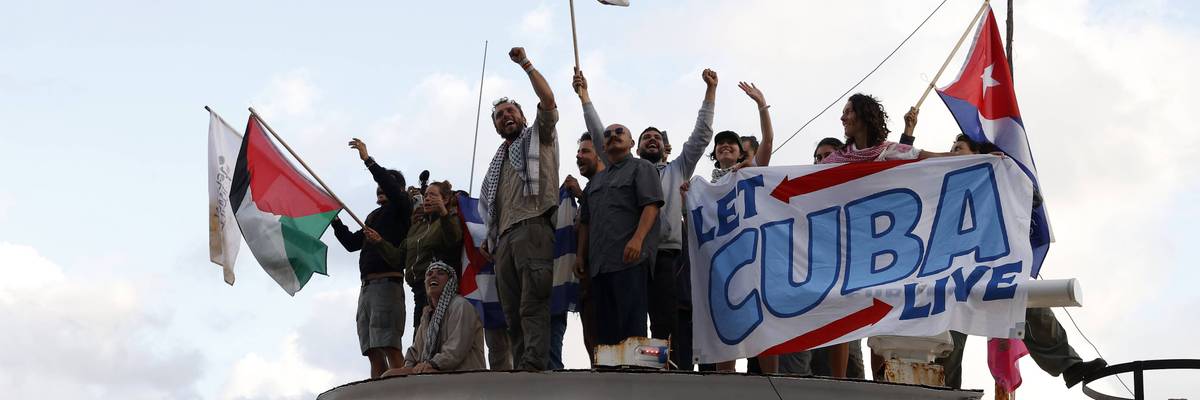
People celebrate holding flags who arrive from several countries with the first ship of the humanitarian convoy in solidarity with Cuba, in Havana, Cuba, on March 24, 2026. The ship docked at the Havana port where a large crowd awaited them.
Americans need to be vigilant. The pretext for an invasion is being written in real time.
The federal indictment of Raúl Castro on decades-old charges is just the latest escalation in a long-running US campaign to justify invading Cuba.
The case against the 95-year-old former Cuban president — based on his alleged involvement in the downing of two planes in 1996 — comes in a year of intensified anti-Cuban policy that has steadily built since the beginning of President Donald Trump’s first term.
For many on the island, the Obama presidency had felt like a real turning point in US-Cuban relations.
“The Cuba of 2015, 2016, was quite different than the Cuba we are living in now,” Liz Oliva Fernández, a Cuban journalist at the US-based news outlet Belly of the Beast, tells In These Times and Foreign Policy in Focus. “For the first time in my life my friends weren’t thinking of leaving Cuba in order to have a better future.”
The Obama administration’s steps toward normalization, underscored by the restoration of diplomatic ties and an easing of the blockade between 2014 and 2016, didn’t last long though. The first Trump administration not only rolled back progress made under Obama, but actually tightened the sanctions regime even further.
Under Trump, Cuba was re-added to the State Sponsor of Terrorism list, which imposes penalties on other countries that trade with the island nation. US diplomatic personnel were pulled out of the US embassy in Cuba following baseless conspiracies about “Havana Syndrome.” And perhaps most damagingly, Trump lifted the suspension of Title III of the Helms Burton Act.
This last move opened the floodgates for Americans who had claims to property nationalized after the 1959 Cuban Revolution to sue companies for doing business on that property, hamstringing the economy even further.
“That scared a lot of people,” Oliva Fernández says.
The election of President Joe Biden did not change things, even though he had been a central player in the Obama White House. Biden’s feeble effort to remove Cuba from the list of state sponsors of terrorism — less than a week before Trump was re-inaugurated — is emblematic of an administration that did too little, too late.
“Biden didn’t do anything, he didn’t lift a finger,” Oliva Fernández says. “There was no difference between Trump and Biden policy on Cuba.”
Trump’s second term has taken America’s anti-Cuba policies even further.
In January, the administration declared the Cuban government posed an “unusual and extraordinary threat” to the United States. This designation, based on familiar yet baseless accusations of collusion with Russia, China, Hamas, and Hezbollah, has been devastating for the island because it created a secondary tariff system against any country selling or providing oil to Cuba.
In the six months since that executive order, only one tanker — the Russian ship Anatoly Kolodkin — has delivered fuel to Cuba. Over that period of time, the people of Cuba have dealt with rolling blackouts and a near collapse of the nation’s healthcare system.
In May, another executive order by President Trump imposed new sanctions targeting foreign individuals and businesses that engage with Cuba economically.
Then came the indictment against Raúl Castro, which Acting US Attorney General Todd Blanche implied could be enforced by the US military. That threat carries more weight after the illegal US capture of President Nicolás Maduro from Venezuela early this year. Maduro was indicted in 2020 — the final year of the first Trump administration — before the US bombed Venezuela and captured him in 2025, the first year of the second Trump administration.
“The decision to indict Raúl Castro is a pretext that’s prompting fears of a Venezuela-like scenario via leadership decapitation,” Oliva Fernández says.
On May 20, the same day the indictment was filed, the American aircraft carrier USS Nimitz was deployed to the Caribbean, increasing the possibility of coming military action.
Meanwhile, mainstream US media has been busy setting the stage for a potential military move against Cuba. In May, for example, Axios ran a report citing “classified intelligence” for a claim that the Cuban has been buying drones for a potential upcoming attack on America’s military base at Guantanamo Bay. Other recent stories in the Wall Street Journal and CBS News also raise the possibility of armed conflict.
The accusation of drone purchases for possible military action follows a familiar script of creating a pretext for military aggression. “It’s the same recipe they have been feeding the American people from Iraq to Libya to Afghanistan,” Oliva Fernández says.
In an interview on Democracy Now! last month, Princeton University historian Ada Ferrer said, “In terms of invading, Trump has been threatening that since January, since the Maduro operation…I have no doubt Trump would do that if he thought it would work.”
And while the Trump administration has accelerated this aggression toward Cuba, US foreign policy has been building toward this posture for decades. Since the overthrow of the US-allied Batista regime during the Cuban revolution of 1959, successive US presidential administrations have relentlessly tried to unseat the communist government. Beyond the economic embargo, the US has been behind multiple coup attempts such as the Bay of Pigs invasion and covertly supported government opposition figures.
In the face of the most recent aggression, some Americans — including some Cuban Americans — have been organizing to prevent an invasion. In February, for example, hundreds of activists mobilized under the banner of the Nuestra América Convoy to break the siege by flying to Cuba to deliver food, medicine, and solar panels to alleviate the effects of the oil embargo.
An invasion of Cuba would be a disaster for both the residents of the island and the American public. President Miguel Díaz-Canal has pledged that any incursion would be met with “a struggle.”
“We will defend ourselves, and if we need to die, we’ll die,” Díaz-Canal told NBC News. A military conflict would only worsen the existing energy and food crises on the island, and likely lead to casualties from the type of bombing campaign the US has recently deployed in Venezuela and Iran.
With working people already wracked by a high cost of living, the war in Iran, and a Pentagon budget that now tops $1 trillion, polls show over half of Americans would oppose military action against Cuba. The cost of opening yet another front in the US’s imperial wars would be borne by the public.
That’s why Americans need to be vigilant. The pretext for an invasion is being written in real time. We have the power to push back against these war-mongering narratives, denying public support for an invasion.
This article was jointly published by In These Times Magazine and Foreign Policy In Focus.
Dear Common Dreams reader, It’s been nearly 30 years since I co-founded Common Dreams with my late wife, Lina Newhouser. We had the radical notion that journalism should serve the public good, not corporate profits. It was clear to us from the outset what it would take to build such a project. No paid advertisements. No corporate sponsors. No millionaire publisher telling us what to think or do. Many people said we wouldn't last a year, but we proved those doubters wrong. Together with a tremendous team of journalists and dedicated staff, we built an independent media outlet free from the constraints of profits and corporate control. Our mission has always been simple: To inform. To inspire. To ignite change for the common good. Building Common Dreams was not easy. Our survival was never guaranteed. When you take on the most powerful forces—Wall Street greed, fossil fuel industry destruction, Big Tech lobbyists, and uber-rich oligarchs who have spent billions upon billions rigging the economy and democracy in their favor—the only bulwark you have is supporters who believe in your work. But here’s the urgent message from me today. It's never been this bad out there. And it's never been this hard to keep us going. At the very moment Common Dreams is most needed, the threats we face are intensifying. We need your support now more than ever. We don't accept corporate advertising and never will. We don't have a paywall because we don't think people should be blocked from critical news based on their ability to pay. Everything we do is funded by the donations of readers like you. When everyone does the little they can afford, we are strong. But if that support retreats or dries up, so do we. Will you donate now to make sure Common Dreams not only survives but thrives? —Craig Brown, Co-founder |
The federal indictment of Raúl Castro on decades-old charges is just the latest escalation in a long-running US campaign to justify invading Cuba.
The case against the 95-year-old former Cuban president — based on his alleged involvement in the downing of two planes in 1996 — comes in a year of intensified anti-Cuban policy that has steadily built since the beginning of President Donald Trump’s first term.
For many on the island, the Obama presidency had felt like a real turning point in US-Cuban relations.
“The Cuba of 2015, 2016, was quite different than the Cuba we are living in now,” Liz Oliva Fernández, a Cuban journalist at the US-based news outlet Belly of the Beast, tells In These Times and Foreign Policy in Focus. “For the first time in my life my friends weren’t thinking of leaving Cuba in order to have a better future.”
The Obama administration’s steps toward normalization, underscored by the restoration of diplomatic ties and an easing of the blockade between 2014 and 2016, didn’t last long though. The first Trump administration not only rolled back progress made under Obama, but actually tightened the sanctions regime even further.
Under Trump, Cuba was re-added to the State Sponsor of Terrorism list, which imposes penalties on other countries that trade with the island nation. US diplomatic personnel were pulled out of the US embassy in Cuba following baseless conspiracies about “Havana Syndrome.” And perhaps most damagingly, Trump lifted the suspension of Title III of the Helms Burton Act.
This last move opened the floodgates for Americans who had claims to property nationalized after the 1959 Cuban Revolution to sue companies for doing business on that property, hamstringing the economy even further.
“That scared a lot of people,” Oliva Fernández says.
The election of President Joe Biden did not change things, even though he had been a central player in the Obama White House. Biden’s feeble effort to remove Cuba from the list of state sponsors of terrorism — less than a week before Trump was re-inaugurated — is emblematic of an administration that did too little, too late.
“Biden didn’t do anything, he didn’t lift a finger,” Oliva Fernández says. “There was no difference between Trump and Biden policy on Cuba.”
Trump’s second term has taken America’s anti-Cuba policies even further.
In January, the administration declared the Cuban government posed an “unusual and extraordinary threat” to the United States. This designation, based on familiar yet baseless accusations of collusion with Russia, China, Hamas, and Hezbollah, has been devastating for the island because it created a secondary tariff system against any country selling or providing oil to Cuba.
In the six months since that executive order, only one tanker — the Russian ship Anatoly Kolodkin — has delivered fuel to Cuba. Over that period of time, the people of Cuba have dealt with rolling blackouts and a near collapse of the nation’s healthcare system.
In May, another executive order by President Trump imposed new sanctions targeting foreign individuals and businesses that engage with Cuba economically.
Then came the indictment against Raúl Castro, which Acting US Attorney General Todd Blanche implied could be enforced by the US military. That threat carries more weight after the illegal US capture of President Nicolás Maduro from Venezuela early this year. Maduro was indicted in 2020 — the final year of the first Trump administration — before the US bombed Venezuela and captured him in 2025, the first year of the second Trump administration.
“The decision to indict Raúl Castro is a pretext that’s prompting fears of a Venezuela-like scenario via leadership decapitation,” Oliva Fernández says.
On May 20, the same day the indictment was filed, the American aircraft carrier USS Nimitz was deployed to the Caribbean, increasing the possibility of coming military action.
Meanwhile, mainstream US media has been busy setting the stage for a potential military move against Cuba. In May, for example, Axios ran a report citing “classified intelligence” for a claim that the Cuban has been buying drones for a potential upcoming attack on America’s military base at Guantanamo Bay. Other recent stories in the Wall Street Journal and CBS News also raise the possibility of armed conflict.
The accusation of drone purchases for possible military action follows a familiar script of creating a pretext for military aggression. “It’s the same recipe they have been feeding the American people from Iraq to Libya to Afghanistan,” Oliva Fernández says.
In an interview on Democracy Now! last month, Princeton University historian Ada Ferrer said, “In terms of invading, Trump has been threatening that since January, since the Maduro operation…I have no doubt Trump would do that if he thought it would work.”
And while the Trump administration has accelerated this aggression toward Cuba, US foreign policy has been building toward this posture for decades. Since the overthrow of the US-allied Batista regime during the Cuban revolution of 1959, successive US presidential administrations have relentlessly tried to unseat the communist government. Beyond the economic embargo, the US has been behind multiple coup attempts such as the Bay of Pigs invasion and covertly supported government opposition figures.
In the face of the most recent aggression, some Americans — including some Cuban Americans — have been organizing to prevent an invasion. In February, for example, hundreds of activists mobilized under the banner of the Nuestra América Convoy to break the siege by flying to Cuba to deliver food, medicine, and solar panels to alleviate the effects of the oil embargo.
An invasion of Cuba would be a disaster for both the residents of the island and the American public. President Miguel Díaz-Canal has pledged that any incursion would be met with “a struggle.”
“We will defend ourselves, and if we need to die, we’ll die,” Díaz-Canal told NBC News. A military conflict would only worsen the existing energy and food crises on the island, and likely lead to casualties from the type of bombing campaign the US has recently deployed in Venezuela and Iran.
With working people already wracked by a high cost of living, the war in Iran, and a Pentagon budget that now tops $1 trillion, polls show over half of Americans would oppose military action against Cuba. The cost of opening yet another front in the US’s imperial wars would be borne by the public.
That’s why Americans need to be vigilant. The pretext for an invasion is being written in real time. We have the power to push back against these war-mongering narratives, denying public support for an invasion.
This article was jointly published by In These Times Magazine and Foreign Policy In Focus.
The federal indictment of Raúl Castro on decades-old charges is just the latest escalation in a long-running US campaign to justify invading Cuba.
The case against the 95-year-old former Cuban president — based on his alleged involvement in the downing of two planes in 1996 — comes in a year of intensified anti-Cuban policy that has steadily built since the beginning of President Donald Trump’s first term.
For many on the island, the Obama presidency had felt like a real turning point in US-Cuban relations.
“The Cuba of 2015, 2016, was quite different than the Cuba we are living in now,” Liz Oliva Fernández, a Cuban journalist at the US-based news outlet Belly of the Beast, tells In These Times and Foreign Policy in Focus. “For the first time in my life my friends weren’t thinking of leaving Cuba in order to have a better future.”
The Obama administration’s steps toward normalization, underscored by the restoration of diplomatic ties and an easing of the blockade between 2014 and 2016, didn’t last long though. The first Trump administration not only rolled back progress made under Obama, but actually tightened the sanctions regime even further.
Under Trump, Cuba was re-added to the State Sponsor of Terrorism list, which imposes penalties on other countries that trade with the island nation. US diplomatic personnel were pulled out of the US embassy in Cuba following baseless conspiracies about “Havana Syndrome.” And perhaps most damagingly, Trump lifted the suspension of Title III of the Helms Burton Act.
This last move opened the floodgates for Americans who had claims to property nationalized after the 1959 Cuban Revolution to sue companies for doing business on that property, hamstringing the economy even further.
“That scared a lot of people,” Oliva Fernández says.
The election of President Joe Biden did not change things, even though he had been a central player in the Obama White House. Biden’s feeble effort to remove Cuba from the list of state sponsors of terrorism — less than a week before Trump was re-inaugurated — is emblematic of an administration that did too little, too late.
“Biden didn’t do anything, he didn’t lift a finger,” Oliva Fernández says. “There was no difference between Trump and Biden policy on Cuba.”
Trump’s second term has taken America’s anti-Cuba policies even further.
In January, the administration declared the Cuban government posed an “unusual and extraordinary threat” to the United States. This designation, based on familiar yet baseless accusations of collusion with Russia, China, Hamas, and Hezbollah, has been devastating for the island because it created a secondary tariff system against any country selling or providing oil to Cuba.
In the six months since that executive order, only one tanker — the Russian ship Anatoly Kolodkin — has delivered fuel to Cuba. Over that period of time, the people of Cuba have dealt with rolling blackouts and a near collapse of the nation’s healthcare system.
In May, another executive order by President Trump imposed new sanctions targeting foreign individuals and businesses that engage with Cuba economically.
Then came the indictment against Raúl Castro, which Acting US Attorney General Todd Blanche implied could be enforced by the US military. That threat carries more weight after the illegal US capture of President Nicolás Maduro from Venezuela early this year. Maduro was indicted in 2020 — the final year of the first Trump administration — before the US bombed Venezuela and captured him in 2025, the first year of the second Trump administration.
“The decision to indict Raúl Castro is a pretext that’s prompting fears of a Venezuela-like scenario via leadership decapitation,” Oliva Fernández says.
On May 20, the same day the indictment was filed, the American aircraft carrier USS Nimitz was deployed to the Caribbean, increasing the possibility of coming military action.
Meanwhile, mainstream US media has been busy setting the stage for a potential military move against Cuba. In May, for example, Axios ran a report citing “classified intelligence” for a claim that the Cuban has been buying drones for a potential upcoming attack on America’s military base at Guantanamo Bay. Other recent stories in the Wall Street Journal and CBS News also raise the possibility of armed conflict.
The accusation of drone purchases for possible military action follows a familiar script of creating a pretext for military aggression. “It’s the same recipe they have been feeding the American people from Iraq to Libya to Afghanistan,” Oliva Fernández says.
In an interview on Democracy Now! last month, Princeton University historian Ada Ferrer said, “In terms of invading, Trump has been threatening that since January, since the Maduro operation…I have no doubt Trump would do that if he thought it would work.”
And while the Trump administration has accelerated this aggression toward Cuba, US foreign policy has been building toward this posture for decades. Since the overthrow of the US-allied Batista regime during the Cuban revolution of 1959, successive US presidential administrations have relentlessly tried to unseat the communist government. Beyond the economic embargo, the US has been behind multiple coup attempts such as the Bay of Pigs invasion and covertly supported government opposition figures.
In the face of the most recent aggression, some Americans — including some Cuban Americans — have been organizing to prevent an invasion. In February, for example, hundreds of activists mobilized under the banner of the Nuestra América Convoy to break the siege by flying to Cuba to deliver food, medicine, and solar panels to alleviate the effects of the oil embargo.
An invasion of Cuba would be a disaster for both the residents of the island and the American public. President Miguel Díaz-Canal has pledged that any incursion would be met with “a struggle.”
“We will defend ourselves, and if we need to die, we’ll die,” Díaz-Canal told NBC News. A military conflict would only worsen the existing energy and food crises on the island, and likely lead to casualties from the type of bombing campaign the US has recently deployed in Venezuela and Iran.
With working people already wracked by a high cost of living, the war in Iran, and a Pentagon budget that now tops $1 trillion, polls show over half of Americans would oppose military action against Cuba. The cost of opening yet another front in the US’s imperial wars would be borne by the public.
That’s why Americans need to be vigilant. The pretext for an invasion is being written in real time. We have the power to push back against these war-mongering narratives, denying public support for an invasion.
This article was jointly published by In These Times Magazine and Foreign Policy In Focus.