

SUBSCRIBE TO OUR FREE NEWSLETTER
Daily news & progressive opinion—funded by the people, not the corporations—delivered straight to your inbox.
5
#000000
#FFFFFF
To donate by check, phone, or other method, see our More Ways to Give page.
Daily news & progressive opinion—funded by the people, not the corporations—delivered straight to your inbox.
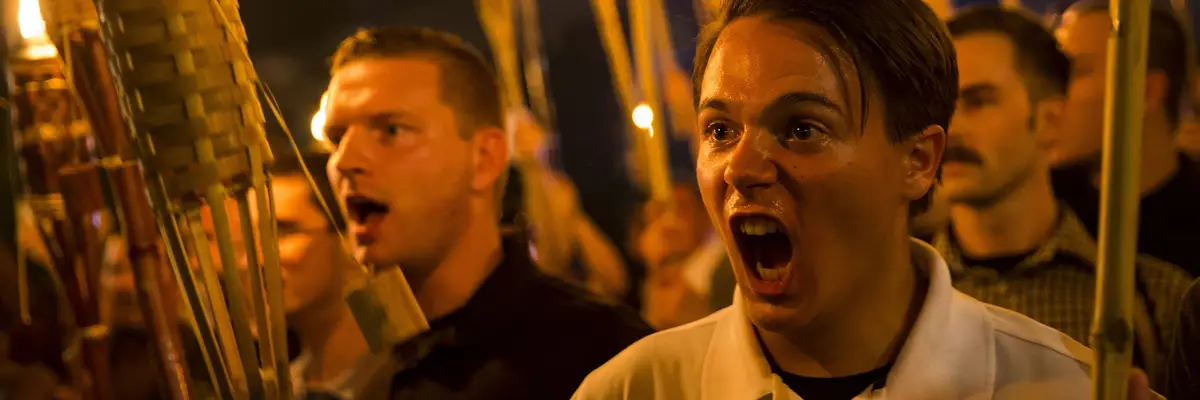
Peter Cvjetanovic (R) along with neo-Nazis, alt-right, and white supremacists, encircle and chant at counterprotesters at the base of a statue of Thomas Jefferson after marching through the University of Virginia campus with torches in Charlottesville, Virginia, USA on August 11, 2017.
The advice of President Donald Trump and Secretary of State Marco Rubio to the European Union to adopt a white nationalist domestic and foreign policy and attempt to initiate a new round of colonialism is monstrous, both morally and in practical terms.
Under President Donald J. Trump, the United States has now become an engine for the promulgation of white nationalism. Not since the 1930s has such an ideology, which exalts those ethnic groups it codes as “white,” while denigrating all others, underpinned the domestic and foreign policies of a major world power.
Typically (for our moment), Trump’s recent National Security Strategy (NSS) depicted Europe as in distinct “civilizational decline” because of the European Union’s commitment to multiracial democracy and international humanitarian law. These days, thanks to its racial policies, the Trump team even finds a way to inject racial hatred into dry economic statistics, complaining that “Continental Europe has been losing share of global GDP [gross domestic product]—down from 25% in 1990 to 14% today.”
As it happens, though, on a per-person basis, Europeans are more than twice as wealthy today in real terms as they were 36 years ago. The dictum once cited by Mark Twain that there are “lies, damned lies, and statistics” is exemplified in Trump’s National Security Strategy. In 1991, just two years before the European Union (EU) was first formed, the per-capita GDP there was $15,470 (in today’s dollars). In 2024, that figure was $43,305. What changed since then wasn’t that Europe began decaying, but that the well-being of the people in the global South, in what Trump dismisses as “shithole countries,” has actually also improved significantly, whether he likes it or not, changing Europe’s share of global GDP.
In his National Security Strategy, Trump admits, however, that Europe’s supposed economic degradation doesn’t bother him nearly as much as another issue: “This economic decline is eclipsed by the real and more stark prospect of civilizational erasure,” thanks to Europe’s migration policies. In short, Trump’s government has now adopted a modernized version of the Nazi Great Replacement ideology, slamming “migration policies that are transforming the [European] continent and creating strife,” along with “cratering birthrates, and loss of national identities and self-confidence.”
The only thing that outstrips Trump’s Islamophobia is his horror of Black people.
Trump claims that he’s no longer sure Europeans will even remain European. He supposedly worries that, two decades from now, the continent will be unrecognizable and EU countries no longer capable of being Washington’s “reliable allies.” That barb is, of course, clearly aimed at Muslim immigrants to Europe, even though they are a distinct minority of those arriving there. In an interview about his NSS, Trump snidely remarked, “If you take a look at London, you have a mayor named Khan.” And he then went on to exclaim in horror that immigrants aren’t just coming from the Middle East, “they’re coming in from the Congo, tremendous numbers of people coming from the Congo.” In other words, the only thing that outstrips Trump’s Islamophobia is his horror of Black people.
Of course, he’s completely misinformed about immigration to Europe, which means his NSS is as well. As a start, the largest influx of people into the EU in recent few years has been 4.3 million Ukrainians. The major sources of immigration to Germany in 2024 were Ukraine, Romania, Turkey, Syria, and India. For Spain, it was Colombia, Morocco, Venezuela, Peru, and Argentina. As for Europe’s future reliability, Trump has already said that he “can’t trust” Denmark, no matter that its population is solidly Lutheran and predominantly blond, because that country won’t give him Greenland. And since the president has expressed a willingness to break up the NATO alliance, if necessary, to add 57,000 Greenlanders to his feudal domains, his doubting of European dependability should be considered richly ironic.
The underpinnings of Trump’s reasoning can (or at least should) be described as Nazi in style. After all, he’s assuming that the immigrants he loathes are inherently incapable of becoming Europeans and will make those countries intrinsically untrustworthy as allies of the United States. Of the EU countries, he recently asserted that “they’ll change their ideology, obviously, because the people coming in have a totally different ideology.” Yet British Prime Minister Rishi Sunak, born in Southampton to an immigrant Indian-East African family of Hindu faith, was widely viewed as having restored British-US diplomatic relations after years of strain.
In reality, studies show that socioeconomic status, not national origin, best predicts how immigrants will vote. In Germany, the better-off Russian Germans, who far outnumber largely working-class Turkish Germans, tend to vote for right-of-center parties. Both groups, however, seem happy to participate in European politics in accordance with local norms. If, for Trump, the term “immigrants” in this context is a dog whistle for Muslims, it might be noted that 9 of the 22 countries, including Egypt, Saudi Arabia, and Pakistan, that have been formally designated by Trump as “major non-NATO allies” are Muslim majority.
His foreign policy reasoning in that NSS eerily mirrors the crackpot logic of Adolf Hitler, who saw France as an enemy of Germany’s because it had allegedly fallen irretrievably under non-Aryan Jewish influence, and who held out hope in the 1920s and early 1930s that Aryan elements would prevail over Jewish ones in Britain, a country he preferred as a strategic partner because of the Germanic ancestry of part of its population. In Trump’s NSS, immigrant Europeans from Africa and the Middle East play the role that Jews did in Hitler’s thinking—that is, non-Aryan underminers of national integrity. Hitler’s conspiratorial racism was, of course, all too grimly insane, and so, too, is that of Trump’s NSS.
Central to the NSS is the Great Replacement. The idea, though not the phrase, goes back to 1900 when the French nationalist parliamentarian and novelist Maurice Barrès wrote, “Today, new French have slipped in among us… who want to impose on us their ways of feeling.” He warned of Jewish, Italian, and other immigrants. “The name of France might well survive,” he commented, but “the special character of our country would nevertheless be destroyed.” Amid a political crisis over the wrongful conviction of Captain Alfred Dreyfus (of Jewish and Alsatian heritage) for supposed espionage for the German embassy, Barrès denounced the famed French novelist Émile Zola, a supporter of Dreyfus, as “not French” but a rootless cosmopolitan from a Venetian background.
Fifty years later, the French Nazi René Binet (1913-1957) coined the phrase “Great Replacement.” An ex-Communist, he had served as a Nazi collaborator during World War II in the Waffen Grenadier Brigade of the Charlemagne paramilitary Protection Squadron (Schutzstaffel or SS). After the war, in his 1950 book Theory of Racism, he wrote in dismay about how Western Europe had been invaded by “Mongols and Negroes”—that is, by the Soviets and the Americans. He lamented that Jewish-dominated capital also supposedly controlled Europe (it didn’t, of course) and falsely alleged that Jewish CEOs were bringing in immigrants in a deliberate attempt to replace civilized white Europeans.
Prime Minister Pedro Sánchez had it right when he said that Spain faces a choice between “being an open and prosperous country or a closed and poor one.”
Sadly enough, Binet’s ideas have been revived in this century by French thinkers and politicians. Renaud Camus published his 21st century version of the theory in 2010, entitling his book The Great Replacement. Such falsehoods were echoed in Charlottesville, Virginia, in 2017, when American Nazis chanted, “Jews will not replace us” (and President Trump called the assembled protesters, as well as those who opposed them, “very fine people”). Camus came around to supporting like-minded politicians in the far-right French National Rally (formerly the National Front) party, led by Marine Le Pen, who also became a Trump ally. When a French court convicted her of embezzlement in 2025 and excluded her from politics for five years, Trump denounced the verdict and launched the slogan, “Free Marine Le Pen.” Holding Le Pen, a far-right racist politician, accountable to the rule of law is part of what Trump was complaining about in his NSS when he cited European “censorship of free speech and suppression of political opposition.”
Marine Le Pen’s father, Jean-Marie Le Pen, had been a paratrooper in the ruthless Algerian War (1954-1962) that killed between half a million and a million Algerians in a bid to keep that country under French colonial domination. The elder Le Pen came to lead the newly founded National Front in 1972 and was surrounded by far-right figures who had collaborated with the Nazis. While the party reinvented itself under Marine Le Pen in 2017 as the National Rally and has moved slightly toward the center, many of its supporters harbor neo-Nazi ideas about racial purity, now typically aimed at Arab and Amazigh Muslims.
The central concerns of that National Security Strategy now animate the Trump administration’s foreign policy. At the annual Munich Security Conference in early February, for instance, Secretary of State Marco Rubio took up what the Victorian jingoist writer Rudyard Kipling once termed the White Man’s Burden, crowing that “for five centuries, before the end of the Second World War, the West had been expanding.” He neglected to mention all the massacres, destruction, and looting that European colonialists perpetrated over those centuries. Belgium’s King Leopold II alone, for instance, instituted policies in the Congo from 1885 to 1908 that may have killed as many as 10 million people. That bloody episode inspired Joseph Conrad’s novel The Heart of Darkness, in the final sentence of which the protagonist utters, “The horror! The horror!“
After the end of World War II in 1945, Rubio lamented, a Europe in ruins contracted. “Half of it,” he added, “lived behind an Iron Curtain and the rest looked like it would soon follow.” He mourned that “the great Western empires had entered into terminal decline, accelerated by godless communist revolutions and by anti-colonial uprisings that would transform the world and drape the red hammer and sickle across vast swaths of the map in the years to come.”
He also displayed a striking mixture of white nationalism and colonial nostalgia—and with it, an ignorance of the history of decolonization, which neither occurred only after 1945, nor was in the main communist led. After all, the United States launched its anti-colonial struggle in 1776. Most of Latin America was liberated from the Spanish Empire in the early 19th century by Simón Bolívar and other fighters who would have been characterized at the time as liberals. As for the post-World War II liberation movements, most leaders of former colonialized countries, including India, Kenya, Malaysia, Morocco, Pakistan, Senegal, and Sudan, among other places, tilted either to capitalism or to social democracy.
Marco Rubio’s mixing of white nationalism and colonial nostalgia is, of course, nothing new. A return of German colonies in Africa, lost in World War I to Britain and France, was among the Nazi regime’s most insistent demands in the late 1930s, and dreams of a new version of German imperialism in Africa were part of what was meant by the Third Reich.
Rubio has depicted decolonization as a failure of the European will to power. Most historians, on the other hand, point to the way their colonies mobilized for independence. Political scientists point to two crucial kinds of mobilization. The first was “social mobilization,” which involved urbanization, industrialization, and increased literacy. By 1945, ever more Asians and Africans were no longer illiterates living in small, disconnected villages. As for political mobilization, parties, chambers of commerce, and labor unions put millions of the previously colonized in the streets. New social classes of entrepreneurs, professionals, and workers demanded the right to control their own destinies.
And in the wake of World War II, attitudes were changing even among the colonial powers. The British public, for instance, could no longer be persuaded to spend money in an attempt to quell an India where the Congress Party of Mahatma Gandhi and Jawaharlal Nehru had brought millions into the streets demanding independence. And while the Netherlands did fight viciously to roll back Indonesia’s declaration of independence in 1945 (despite having itself been occupied by Germany during World War II), after four years of massacres, it was forced out. The impoverished French had no choice but to give up most of their African possessions, but in a sanguinary failure attempted to keep their colonies in Algeria and Vietnam by military force. American President Dwight D. Eisenhower, a wiser man than Rubio, twisted French President Charles De Gaulle’s arm to get him out of Algeria lest the revolutionaries there turn to Moscow and Communism.
Given that history, the advice of President Donald Trump and Secretary of State Marco Rubio to the European Union to adopt a white nationalist domestic and foreign policy and attempt to initiate a new round of European colonialism in the global South is monstrous indeed, both morally and in practical terms. Without immigration today, Europe would soon face Japan’s dilemma of rapid population loss, along with the loss of international economic and political power.
Prime Minister Pedro Sánchez had it right when he said that Spain faces a choice between “being an open and prosperous country or a closed and poor one.” As for the white nationalist pronatalist dream of keeping women barefoot and pregnant in accordance with the old German slogan, Kinder, Küche, Kirche (children, kitchen, church), it’s a chimera given the electoral power of women in today’s Europe (and the United States).
In reality, the European Union’s project of multicultural democracy has yielded enormous prosperity, while expanding and deepening human rights.
Meanwhile, Donald Trump’s cruel, heavily ICED anti-immigrant campaign has already hurt the American economy and Europeans would be deeply unwise to emulate it in any way, including colonially. The neoconservative project of rehabilitating American colonialism crashed and burned in this country’s disastrous 21st-century wars in Afghanistan and Iraq (and won’t be aided by the present assault on Iran either) for reasons similar to those that made European colonialism impossible in the post-World War II period.
In reality, the European Union’s project of multicultural democracy has yielded enormous prosperity, while expanding and deepening human rights. Trump’s white nationalism, on the other hand, is a formula for division, poverty, and mass violence, as was demonstrated in the 1930s and 1940s when a form of that ideology was last tried in Europe.
And count on this: Trump and crew are going to give the phrase “the white man’s burden” a grim new meaning.
Dear Common Dreams reader, It’s been nearly 30 years since I co-founded Common Dreams with my late wife, Lina Newhouser. We had the radical notion that journalism should serve the public good, not corporate profits. It was clear to us from the outset what it would take to build such a project. No paid advertisements. No corporate sponsors. No millionaire publisher telling us what to think or do. Many people said we wouldn't last a year, but we proved those doubters wrong. Together with a tremendous team of journalists and dedicated staff, we built an independent media outlet free from the constraints of profits and corporate control. Our mission has always been simple: To inform. To inspire. To ignite change for the common good. Building Common Dreams was not easy. Our survival was never guaranteed. When you take on the most powerful forces—Wall Street greed, fossil fuel industry destruction, Big Tech lobbyists, and uber-rich oligarchs who have spent billions upon billions rigging the economy and democracy in their favor—the only bulwark you have is supporters who believe in your work. But here’s the urgent message from me today. It's never been this bad out there. And it's never been this hard to keep us going. At the very moment Common Dreams is most needed, the threats we face are intensifying. We need your support now more than ever. We don't accept corporate advertising and never will. We don't have a paywall because we don't think people should be blocked from critical news based on their ability to pay. Everything we do is funded by the donations of readers like you. When everyone does the little they can afford, we are strong. But if that support retreats or dries up, so do we. Will you donate now to make sure Common Dreams not only survives but thrives? —Craig Brown, Co-founder |
Under President Donald J. Trump, the United States has now become an engine for the promulgation of white nationalism. Not since the 1930s has such an ideology, which exalts those ethnic groups it codes as “white,” while denigrating all others, underpinned the domestic and foreign policies of a major world power.
Typically (for our moment), Trump’s recent National Security Strategy (NSS) depicted Europe as in distinct “civilizational decline” because of the European Union’s commitment to multiracial democracy and international humanitarian law. These days, thanks to its racial policies, the Trump team even finds a way to inject racial hatred into dry economic statistics, complaining that “Continental Europe has been losing share of global GDP [gross domestic product]—down from 25% in 1990 to 14% today.”
As it happens, though, on a per-person basis, Europeans are more than twice as wealthy today in real terms as they were 36 years ago. The dictum once cited by Mark Twain that there are “lies, damned lies, and statistics” is exemplified in Trump’s National Security Strategy. In 1991, just two years before the European Union (EU) was first formed, the per-capita GDP there was $15,470 (in today’s dollars). In 2024, that figure was $43,305. What changed since then wasn’t that Europe began decaying, but that the well-being of the people in the global South, in what Trump dismisses as “shithole countries,” has actually also improved significantly, whether he likes it or not, changing Europe’s share of global GDP.
In his National Security Strategy, Trump admits, however, that Europe’s supposed economic degradation doesn’t bother him nearly as much as another issue: “This economic decline is eclipsed by the real and more stark prospect of civilizational erasure,” thanks to Europe’s migration policies. In short, Trump’s government has now adopted a modernized version of the Nazi Great Replacement ideology, slamming “migration policies that are transforming the [European] continent and creating strife,” along with “cratering birthrates, and loss of national identities and self-confidence.”
The only thing that outstrips Trump’s Islamophobia is his horror of Black people.
Trump claims that he’s no longer sure Europeans will even remain European. He supposedly worries that, two decades from now, the continent will be unrecognizable and EU countries no longer capable of being Washington’s “reliable allies.” That barb is, of course, clearly aimed at Muslim immigrants to Europe, even though they are a distinct minority of those arriving there. In an interview about his NSS, Trump snidely remarked, “If you take a look at London, you have a mayor named Khan.” And he then went on to exclaim in horror that immigrants aren’t just coming from the Middle East, “they’re coming in from the Congo, tremendous numbers of people coming from the Congo.” In other words, the only thing that outstrips Trump’s Islamophobia is his horror of Black people.
Of course, he’s completely misinformed about immigration to Europe, which means his NSS is as well. As a start, the largest influx of people into the EU in recent few years has been 4.3 million Ukrainians. The major sources of immigration to Germany in 2024 were Ukraine, Romania, Turkey, Syria, and India. For Spain, it was Colombia, Morocco, Venezuela, Peru, and Argentina. As for Europe’s future reliability, Trump has already said that he “can’t trust” Denmark, no matter that its population is solidly Lutheran and predominantly blond, because that country won’t give him Greenland. And since the president has expressed a willingness to break up the NATO alliance, if necessary, to add 57,000 Greenlanders to his feudal domains, his doubting of European dependability should be considered richly ironic.
The underpinnings of Trump’s reasoning can (or at least should) be described as Nazi in style. After all, he’s assuming that the immigrants he loathes are inherently incapable of becoming Europeans and will make those countries intrinsically untrustworthy as allies of the United States. Of the EU countries, he recently asserted that “they’ll change their ideology, obviously, because the people coming in have a totally different ideology.” Yet British Prime Minister Rishi Sunak, born in Southampton to an immigrant Indian-East African family of Hindu faith, was widely viewed as having restored British-US diplomatic relations after years of strain.
In reality, studies show that socioeconomic status, not national origin, best predicts how immigrants will vote. In Germany, the better-off Russian Germans, who far outnumber largely working-class Turkish Germans, tend to vote for right-of-center parties. Both groups, however, seem happy to participate in European politics in accordance with local norms. If, for Trump, the term “immigrants” in this context is a dog whistle for Muslims, it might be noted that 9 of the 22 countries, including Egypt, Saudi Arabia, and Pakistan, that have been formally designated by Trump as “major non-NATO allies” are Muslim majority.
His foreign policy reasoning in that NSS eerily mirrors the crackpot logic of Adolf Hitler, who saw France as an enemy of Germany’s because it had allegedly fallen irretrievably under non-Aryan Jewish influence, and who held out hope in the 1920s and early 1930s that Aryan elements would prevail over Jewish ones in Britain, a country he preferred as a strategic partner because of the Germanic ancestry of part of its population. In Trump’s NSS, immigrant Europeans from Africa and the Middle East play the role that Jews did in Hitler’s thinking—that is, non-Aryan underminers of national integrity. Hitler’s conspiratorial racism was, of course, all too grimly insane, and so, too, is that of Trump’s NSS.
Central to the NSS is the Great Replacement. The idea, though not the phrase, goes back to 1900 when the French nationalist parliamentarian and novelist Maurice Barrès wrote, “Today, new French have slipped in among us… who want to impose on us their ways of feeling.” He warned of Jewish, Italian, and other immigrants. “The name of France might well survive,” he commented, but “the special character of our country would nevertheless be destroyed.” Amid a political crisis over the wrongful conviction of Captain Alfred Dreyfus (of Jewish and Alsatian heritage) for supposed espionage for the German embassy, Barrès denounced the famed French novelist Émile Zola, a supporter of Dreyfus, as “not French” but a rootless cosmopolitan from a Venetian background.
Fifty years later, the French Nazi René Binet (1913-1957) coined the phrase “Great Replacement.” An ex-Communist, he had served as a Nazi collaborator during World War II in the Waffen Grenadier Brigade of the Charlemagne paramilitary Protection Squadron (Schutzstaffel or SS). After the war, in his 1950 book Theory of Racism, he wrote in dismay about how Western Europe had been invaded by “Mongols and Negroes”—that is, by the Soviets and the Americans. He lamented that Jewish-dominated capital also supposedly controlled Europe (it didn’t, of course) and falsely alleged that Jewish CEOs were bringing in immigrants in a deliberate attempt to replace civilized white Europeans.
Prime Minister Pedro Sánchez had it right when he said that Spain faces a choice between “being an open and prosperous country or a closed and poor one.”
Sadly enough, Binet’s ideas have been revived in this century by French thinkers and politicians. Renaud Camus published his 21st century version of the theory in 2010, entitling his book The Great Replacement. Such falsehoods were echoed in Charlottesville, Virginia, in 2017, when American Nazis chanted, “Jews will not replace us” (and President Trump called the assembled protesters, as well as those who opposed them, “very fine people”). Camus came around to supporting like-minded politicians in the far-right French National Rally (formerly the National Front) party, led by Marine Le Pen, who also became a Trump ally. When a French court convicted her of embezzlement in 2025 and excluded her from politics for five years, Trump denounced the verdict and launched the slogan, “Free Marine Le Pen.” Holding Le Pen, a far-right racist politician, accountable to the rule of law is part of what Trump was complaining about in his NSS when he cited European “censorship of free speech and suppression of political opposition.”
Marine Le Pen’s father, Jean-Marie Le Pen, had been a paratrooper in the ruthless Algerian War (1954-1962) that killed between half a million and a million Algerians in a bid to keep that country under French colonial domination. The elder Le Pen came to lead the newly founded National Front in 1972 and was surrounded by far-right figures who had collaborated with the Nazis. While the party reinvented itself under Marine Le Pen in 2017 as the National Rally and has moved slightly toward the center, many of its supporters harbor neo-Nazi ideas about racial purity, now typically aimed at Arab and Amazigh Muslims.
The central concerns of that National Security Strategy now animate the Trump administration’s foreign policy. At the annual Munich Security Conference in early February, for instance, Secretary of State Marco Rubio took up what the Victorian jingoist writer Rudyard Kipling once termed the White Man’s Burden, crowing that “for five centuries, before the end of the Second World War, the West had been expanding.” He neglected to mention all the massacres, destruction, and looting that European colonialists perpetrated over those centuries. Belgium’s King Leopold II alone, for instance, instituted policies in the Congo from 1885 to 1908 that may have killed as many as 10 million people. That bloody episode inspired Joseph Conrad’s novel The Heart of Darkness, in the final sentence of which the protagonist utters, “The horror! The horror!“
After the end of World War II in 1945, Rubio lamented, a Europe in ruins contracted. “Half of it,” he added, “lived behind an Iron Curtain and the rest looked like it would soon follow.” He mourned that “the great Western empires had entered into terminal decline, accelerated by godless communist revolutions and by anti-colonial uprisings that would transform the world and drape the red hammer and sickle across vast swaths of the map in the years to come.”
He also displayed a striking mixture of white nationalism and colonial nostalgia—and with it, an ignorance of the history of decolonization, which neither occurred only after 1945, nor was in the main communist led. After all, the United States launched its anti-colonial struggle in 1776. Most of Latin America was liberated from the Spanish Empire in the early 19th century by Simón Bolívar and other fighters who would have been characterized at the time as liberals. As for the post-World War II liberation movements, most leaders of former colonialized countries, including India, Kenya, Malaysia, Morocco, Pakistan, Senegal, and Sudan, among other places, tilted either to capitalism or to social democracy.
Marco Rubio’s mixing of white nationalism and colonial nostalgia is, of course, nothing new. A return of German colonies in Africa, lost in World War I to Britain and France, was among the Nazi regime’s most insistent demands in the late 1930s, and dreams of a new version of German imperialism in Africa were part of what was meant by the Third Reich.
Rubio has depicted decolonization as a failure of the European will to power. Most historians, on the other hand, point to the way their colonies mobilized for independence. Political scientists point to two crucial kinds of mobilization. The first was “social mobilization,” which involved urbanization, industrialization, and increased literacy. By 1945, ever more Asians and Africans were no longer illiterates living in small, disconnected villages. As for political mobilization, parties, chambers of commerce, and labor unions put millions of the previously colonized in the streets. New social classes of entrepreneurs, professionals, and workers demanded the right to control their own destinies.
And in the wake of World War II, attitudes were changing even among the colonial powers. The British public, for instance, could no longer be persuaded to spend money in an attempt to quell an India where the Congress Party of Mahatma Gandhi and Jawaharlal Nehru had brought millions into the streets demanding independence. And while the Netherlands did fight viciously to roll back Indonesia’s declaration of independence in 1945 (despite having itself been occupied by Germany during World War II), after four years of massacres, it was forced out. The impoverished French had no choice but to give up most of their African possessions, but in a sanguinary failure attempted to keep their colonies in Algeria and Vietnam by military force. American President Dwight D. Eisenhower, a wiser man than Rubio, twisted French President Charles De Gaulle’s arm to get him out of Algeria lest the revolutionaries there turn to Moscow and Communism.
Given that history, the advice of President Donald Trump and Secretary of State Marco Rubio to the European Union to adopt a white nationalist domestic and foreign policy and attempt to initiate a new round of European colonialism in the global South is monstrous indeed, both morally and in practical terms. Without immigration today, Europe would soon face Japan’s dilemma of rapid population loss, along with the loss of international economic and political power.
Prime Minister Pedro Sánchez had it right when he said that Spain faces a choice between “being an open and prosperous country or a closed and poor one.” As for the white nationalist pronatalist dream of keeping women barefoot and pregnant in accordance with the old German slogan, Kinder, Küche, Kirche (children, kitchen, church), it’s a chimera given the electoral power of women in today’s Europe (and the United States).
In reality, the European Union’s project of multicultural democracy has yielded enormous prosperity, while expanding and deepening human rights.
Meanwhile, Donald Trump’s cruel, heavily ICED anti-immigrant campaign has already hurt the American economy and Europeans would be deeply unwise to emulate it in any way, including colonially. The neoconservative project of rehabilitating American colonialism crashed and burned in this country’s disastrous 21st-century wars in Afghanistan and Iraq (and won’t be aided by the present assault on Iran either) for reasons similar to those that made European colonialism impossible in the post-World War II period.
In reality, the European Union’s project of multicultural democracy has yielded enormous prosperity, while expanding and deepening human rights. Trump’s white nationalism, on the other hand, is a formula for division, poverty, and mass violence, as was demonstrated in the 1930s and 1940s when a form of that ideology was last tried in Europe.
And count on this: Trump and crew are going to give the phrase “the white man’s burden” a grim new meaning.
Under President Donald J. Trump, the United States has now become an engine for the promulgation of white nationalism. Not since the 1930s has such an ideology, which exalts those ethnic groups it codes as “white,” while denigrating all others, underpinned the domestic and foreign policies of a major world power.
Typically (for our moment), Trump’s recent National Security Strategy (NSS) depicted Europe as in distinct “civilizational decline” because of the European Union’s commitment to multiracial democracy and international humanitarian law. These days, thanks to its racial policies, the Trump team even finds a way to inject racial hatred into dry economic statistics, complaining that “Continental Europe has been losing share of global GDP [gross domestic product]—down from 25% in 1990 to 14% today.”
As it happens, though, on a per-person basis, Europeans are more than twice as wealthy today in real terms as they were 36 years ago. The dictum once cited by Mark Twain that there are “lies, damned lies, and statistics” is exemplified in Trump’s National Security Strategy. In 1991, just two years before the European Union (EU) was first formed, the per-capita GDP there was $15,470 (in today’s dollars). In 2024, that figure was $43,305. What changed since then wasn’t that Europe began decaying, but that the well-being of the people in the global South, in what Trump dismisses as “shithole countries,” has actually also improved significantly, whether he likes it or not, changing Europe’s share of global GDP.
In his National Security Strategy, Trump admits, however, that Europe’s supposed economic degradation doesn’t bother him nearly as much as another issue: “This economic decline is eclipsed by the real and more stark prospect of civilizational erasure,” thanks to Europe’s migration policies. In short, Trump’s government has now adopted a modernized version of the Nazi Great Replacement ideology, slamming “migration policies that are transforming the [European] continent and creating strife,” along with “cratering birthrates, and loss of national identities and self-confidence.”
The only thing that outstrips Trump’s Islamophobia is his horror of Black people.
Trump claims that he’s no longer sure Europeans will even remain European. He supposedly worries that, two decades from now, the continent will be unrecognizable and EU countries no longer capable of being Washington’s “reliable allies.” That barb is, of course, clearly aimed at Muslim immigrants to Europe, even though they are a distinct minority of those arriving there. In an interview about his NSS, Trump snidely remarked, “If you take a look at London, you have a mayor named Khan.” And he then went on to exclaim in horror that immigrants aren’t just coming from the Middle East, “they’re coming in from the Congo, tremendous numbers of people coming from the Congo.” In other words, the only thing that outstrips Trump’s Islamophobia is his horror of Black people.
Of course, he’s completely misinformed about immigration to Europe, which means his NSS is as well. As a start, the largest influx of people into the EU in recent few years has been 4.3 million Ukrainians. The major sources of immigration to Germany in 2024 were Ukraine, Romania, Turkey, Syria, and India. For Spain, it was Colombia, Morocco, Venezuela, Peru, and Argentina. As for Europe’s future reliability, Trump has already said that he “can’t trust” Denmark, no matter that its population is solidly Lutheran and predominantly blond, because that country won’t give him Greenland. And since the president has expressed a willingness to break up the NATO alliance, if necessary, to add 57,000 Greenlanders to his feudal domains, his doubting of European dependability should be considered richly ironic.
The underpinnings of Trump’s reasoning can (or at least should) be described as Nazi in style. After all, he’s assuming that the immigrants he loathes are inherently incapable of becoming Europeans and will make those countries intrinsically untrustworthy as allies of the United States. Of the EU countries, he recently asserted that “they’ll change their ideology, obviously, because the people coming in have a totally different ideology.” Yet British Prime Minister Rishi Sunak, born in Southampton to an immigrant Indian-East African family of Hindu faith, was widely viewed as having restored British-US diplomatic relations after years of strain.
In reality, studies show that socioeconomic status, not national origin, best predicts how immigrants will vote. In Germany, the better-off Russian Germans, who far outnumber largely working-class Turkish Germans, tend to vote for right-of-center parties. Both groups, however, seem happy to participate in European politics in accordance with local norms. If, for Trump, the term “immigrants” in this context is a dog whistle for Muslims, it might be noted that 9 of the 22 countries, including Egypt, Saudi Arabia, and Pakistan, that have been formally designated by Trump as “major non-NATO allies” are Muslim majority.
His foreign policy reasoning in that NSS eerily mirrors the crackpot logic of Adolf Hitler, who saw France as an enemy of Germany’s because it had allegedly fallen irretrievably under non-Aryan Jewish influence, and who held out hope in the 1920s and early 1930s that Aryan elements would prevail over Jewish ones in Britain, a country he preferred as a strategic partner because of the Germanic ancestry of part of its population. In Trump’s NSS, immigrant Europeans from Africa and the Middle East play the role that Jews did in Hitler’s thinking—that is, non-Aryan underminers of national integrity. Hitler’s conspiratorial racism was, of course, all too grimly insane, and so, too, is that of Trump’s NSS.
Central to the NSS is the Great Replacement. The idea, though not the phrase, goes back to 1900 when the French nationalist parliamentarian and novelist Maurice Barrès wrote, “Today, new French have slipped in among us… who want to impose on us their ways of feeling.” He warned of Jewish, Italian, and other immigrants. “The name of France might well survive,” he commented, but “the special character of our country would nevertheless be destroyed.” Amid a political crisis over the wrongful conviction of Captain Alfred Dreyfus (of Jewish and Alsatian heritage) for supposed espionage for the German embassy, Barrès denounced the famed French novelist Émile Zola, a supporter of Dreyfus, as “not French” but a rootless cosmopolitan from a Venetian background.
Fifty years later, the French Nazi René Binet (1913-1957) coined the phrase “Great Replacement.” An ex-Communist, he had served as a Nazi collaborator during World War II in the Waffen Grenadier Brigade of the Charlemagne paramilitary Protection Squadron (Schutzstaffel or SS). After the war, in his 1950 book Theory of Racism, he wrote in dismay about how Western Europe had been invaded by “Mongols and Negroes”—that is, by the Soviets and the Americans. He lamented that Jewish-dominated capital also supposedly controlled Europe (it didn’t, of course) and falsely alleged that Jewish CEOs were bringing in immigrants in a deliberate attempt to replace civilized white Europeans.
Prime Minister Pedro Sánchez had it right when he said that Spain faces a choice between “being an open and prosperous country or a closed and poor one.”
Sadly enough, Binet’s ideas have been revived in this century by French thinkers and politicians. Renaud Camus published his 21st century version of the theory in 2010, entitling his book The Great Replacement. Such falsehoods were echoed in Charlottesville, Virginia, in 2017, when American Nazis chanted, “Jews will not replace us” (and President Trump called the assembled protesters, as well as those who opposed them, “very fine people”). Camus came around to supporting like-minded politicians in the far-right French National Rally (formerly the National Front) party, led by Marine Le Pen, who also became a Trump ally. When a French court convicted her of embezzlement in 2025 and excluded her from politics for five years, Trump denounced the verdict and launched the slogan, “Free Marine Le Pen.” Holding Le Pen, a far-right racist politician, accountable to the rule of law is part of what Trump was complaining about in his NSS when he cited European “censorship of free speech and suppression of political opposition.”
Marine Le Pen’s father, Jean-Marie Le Pen, had been a paratrooper in the ruthless Algerian War (1954-1962) that killed between half a million and a million Algerians in a bid to keep that country under French colonial domination. The elder Le Pen came to lead the newly founded National Front in 1972 and was surrounded by far-right figures who had collaborated with the Nazis. While the party reinvented itself under Marine Le Pen in 2017 as the National Rally and has moved slightly toward the center, many of its supporters harbor neo-Nazi ideas about racial purity, now typically aimed at Arab and Amazigh Muslims.
The central concerns of that National Security Strategy now animate the Trump administration’s foreign policy. At the annual Munich Security Conference in early February, for instance, Secretary of State Marco Rubio took up what the Victorian jingoist writer Rudyard Kipling once termed the White Man’s Burden, crowing that “for five centuries, before the end of the Second World War, the West had been expanding.” He neglected to mention all the massacres, destruction, and looting that European colonialists perpetrated over those centuries. Belgium’s King Leopold II alone, for instance, instituted policies in the Congo from 1885 to 1908 that may have killed as many as 10 million people. That bloody episode inspired Joseph Conrad’s novel The Heart of Darkness, in the final sentence of which the protagonist utters, “The horror! The horror!“
After the end of World War II in 1945, Rubio lamented, a Europe in ruins contracted. “Half of it,” he added, “lived behind an Iron Curtain and the rest looked like it would soon follow.” He mourned that “the great Western empires had entered into terminal decline, accelerated by godless communist revolutions and by anti-colonial uprisings that would transform the world and drape the red hammer and sickle across vast swaths of the map in the years to come.”
He also displayed a striking mixture of white nationalism and colonial nostalgia—and with it, an ignorance of the history of decolonization, which neither occurred only after 1945, nor was in the main communist led. After all, the United States launched its anti-colonial struggle in 1776. Most of Latin America was liberated from the Spanish Empire in the early 19th century by Simón Bolívar and other fighters who would have been characterized at the time as liberals. As for the post-World War II liberation movements, most leaders of former colonialized countries, including India, Kenya, Malaysia, Morocco, Pakistan, Senegal, and Sudan, among other places, tilted either to capitalism or to social democracy.
Marco Rubio’s mixing of white nationalism and colonial nostalgia is, of course, nothing new. A return of German colonies in Africa, lost in World War I to Britain and France, was among the Nazi regime’s most insistent demands in the late 1930s, and dreams of a new version of German imperialism in Africa were part of what was meant by the Third Reich.
Rubio has depicted decolonization as a failure of the European will to power. Most historians, on the other hand, point to the way their colonies mobilized for independence. Political scientists point to two crucial kinds of mobilization. The first was “social mobilization,” which involved urbanization, industrialization, and increased literacy. By 1945, ever more Asians and Africans were no longer illiterates living in small, disconnected villages. As for political mobilization, parties, chambers of commerce, and labor unions put millions of the previously colonized in the streets. New social classes of entrepreneurs, professionals, and workers demanded the right to control their own destinies.
And in the wake of World War II, attitudes were changing even among the colonial powers. The British public, for instance, could no longer be persuaded to spend money in an attempt to quell an India where the Congress Party of Mahatma Gandhi and Jawaharlal Nehru had brought millions into the streets demanding independence. And while the Netherlands did fight viciously to roll back Indonesia’s declaration of independence in 1945 (despite having itself been occupied by Germany during World War II), after four years of massacres, it was forced out. The impoverished French had no choice but to give up most of their African possessions, but in a sanguinary failure attempted to keep their colonies in Algeria and Vietnam by military force. American President Dwight D. Eisenhower, a wiser man than Rubio, twisted French President Charles De Gaulle’s arm to get him out of Algeria lest the revolutionaries there turn to Moscow and Communism.
Given that history, the advice of President Donald Trump and Secretary of State Marco Rubio to the European Union to adopt a white nationalist domestic and foreign policy and attempt to initiate a new round of European colonialism in the global South is monstrous indeed, both morally and in practical terms. Without immigration today, Europe would soon face Japan’s dilemma of rapid population loss, along with the loss of international economic and political power.
Prime Minister Pedro Sánchez had it right when he said that Spain faces a choice between “being an open and prosperous country or a closed and poor one.” As for the white nationalist pronatalist dream of keeping women barefoot and pregnant in accordance with the old German slogan, Kinder, Küche, Kirche (children, kitchen, church), it’s a chimera given the electoral power of women in today’s Europe (and the United States).
In reality, the European Union’s project of multicultural democracy has yielded enormous prosperity, while expanding and deepening human rights.
Meanwhile, Donald Trump’s cruel, heavily ICED anti-immigrant campaign has already hurt the American economy and Europeans would be deeply unwise to emulate it in any way, including colonially. The neoconservative project of rehabilitating American colonialism crashed and burned in this country’s disastrous 21st-century wars in Afghanistan and Iraq (and won’t be aided by the present assault on Iran either) for reasons similar to those that made European colonialism impossible in the post-World War II period.
In reality, the European Union’s project of multicultural democracy has yielded enormous prosperity, while expanding and deepening human rights. Trump’s white nationalism, on the other hand, is a formula for division, poverty, and mass violence, as was demonstrated in the 1930s and 1940s when a form of that ideology was last tried in Europe.
And count on this: Trump and crew are going to give the phrase “the white man’s burden” a grim new meaning.

