SUBSCRIBE TO OUR FREE NEWSLETTER
Daily news & progressive opinion—funded by the people, not the corporations—delivered straight to your inbox.
5
#000000
#FFFFFF
To donate by check, phone, or other method, see our More Ways to Give page.
Daily news & progressive opinion—funded by the people, not the corporations—delivered straight to your inbox.
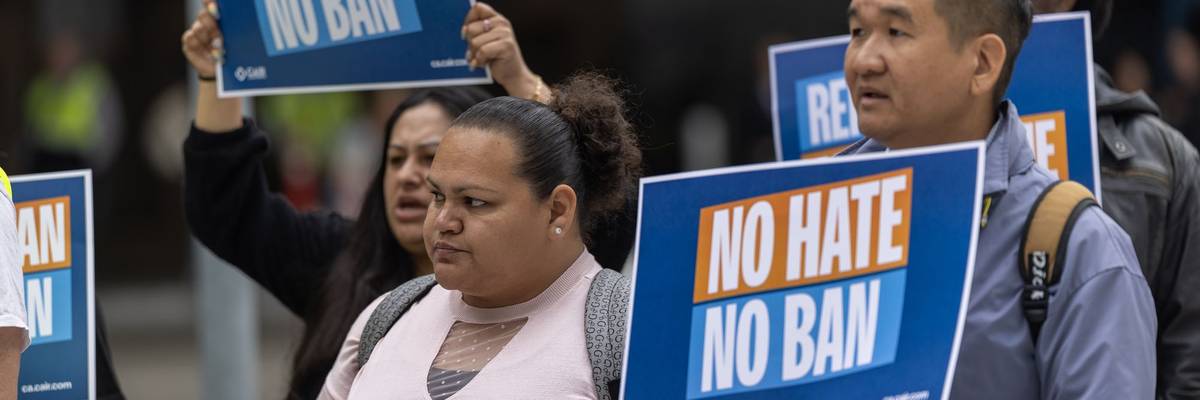
People protest against the Trump administration's travel ban at California's Los Angeles International Airport on June 9, 2025.
"This administration's racist cruelty knows no limits, expanding their travel ban to include even more African and Muslim-majority countries, even Palestinians fleeing a genocide," said Rep. Rashida Tlaib.
President Donald Trump faced sharp criticism on Tuesday after further expanding his travel ban—an effort the US leader launched during his first term, reinstated upon returning to office in January, and previously ramped up in June.
The Republican's new proclamation maintains full restrictions for people from Afghanistan, Burma, Chad, the Republic of the Congo, Equatorial Guinea, Eritrea, Haiti, Iran, Libya, Somalia, Sudan, and Yemen, and introduces them for travelers from Laos and Sierra Leone, who previously faced partial limitations.
Trump also added Burkina Faso, Mali, Niger, South Sudan, and Syria to that list, just days after he vowed to "retaliate" for an Islamic State gunman killing three Americans, including two service members, and wounding three others in Syria. Journalist James Stout warned that "expanding the travel ban to Syria leaves few options for the people who fought and defeated the Islamic State and are being increasingly threatened by the Syrian state."
While the US government does not recognize Palestine as a state—and has backed Israel's genocidal assault on the Gaza Strip—the president also imposed full restrictions on individuals holding travel documents issued by the Palestinian Authority.
"The harm isn't theoretical," stressed Etan Nechin, a New York-based reporter for the Israeli newspaper Haaretz. Pointing to Palestinian peace activist Awdah Hathaleen, who earlier this year was denied entry at San Francisco International Airport, deported, and then murdered by an Israeli settler in the West Bank, the journalist suggested that Trump and his allies know the consequences of the travel ban, and "they don't care."
As Common Dreams reported earlier Tuesday, Sudan, Palestine, and South Sudan topped the International Rescue Committee's annual humanitarian crisis forecast.
Trump's latest proclamation continues partial restrictions for Burundi, Cuba, Togo, and Venezuela, and adds such limitations for Angola, Antigua and Barbuda, Benin, Cote d'Ivoire, Dominica, Gabon, Gambia, Malawi, Mauritania, Nigeria, Senegal, Tanzania, Tonga, Zambia, and Zimbabwe.
It also lifts a ban on nonimmigrant visas for people from Turkmenistan but maintains the suspension of entry for them as immigrants, with a White House fact sheet stating the country "has engaged productively with the United States and demonstrated significant progress."
Writer Mark Chadbourn said, "It's a white nationalist list—mainly Africa, some Middle East, plus Haiti and Cuba."
Here is a map of the affected countries (excluding Tonga), to give you a sense of how much this new ban restricts immigration from Africa in particular.Of the newly-added country, Nigeria faces the largest impact, with tens of thousands of visas issued every year to Nigerians.
[image or embed]
— Aaron Reichlin-Melnick (@reichlinmelnick.bsky.social) December 16, 2025 at 3:58 PM
US Rep. Rashida Tlaib (D-Mich.), the only Palestinian American in Congress, said that "this administration's racist cruelty knows no limits, expanding their travel ban to include even more African and Muslim-majority countries, even Palestinians fleeing a genocide."
Tlaib also accused the president, along with his deputy chief of staff for policy and homeland security adviser, of wanting the United States to resemble a Ku Klux Klan event, declaring that "Trump and Stephen Miller won't be satisfied until our country has the demographics of a klan rally."
As the Associated Press noted:
The administration suggested it would expand the restrictions after the arrest of an Afghan national suspect in the shooting of two National Guard troops over Thanksgiving weekend...
The Afghan man accused of shooting the two National Guard troops near the White House has pleaded not guilty to murder and assault charges. In the aftermath of that incident, the administration announced a flurry of immigration restrictions, including further restrictions on people from those initial 19 countries who were already in the US.
Laurie Ball Cooper, vice president of US Legal Programs at the International Refugee Assistance Project, said in a statement that "IRAP condemns the Trump administration's escalating crackdown on immigrants from Muslim-majority and nonwhite countries. This expanded ban is not about national security but instead is another shameful attempt to demonize people simply for where they are from."
"Subjecting more people to this policy is especially harmful given the administration's recent invocation of the travel ban to prevent immigrants already living in the United States from accessing basic immigration benefits, including pulling them out of line at citizenship ceremonies," she continued.
"The expanded proclamation notably includes Palestinians and eliminates some exceptions to the original ban," she added. "This racist and xenophobic ban will keep families apart, but we are prepared to defend our clients, their communities, and the American values of welcome, justice, and dignity for all."
Dear Common Dreams reader, It’s been nearly 30 years since I co-founded Common Dreams with my late wife, Lina Newhouser. We had the radical notion that journalism should serve the public good, not corporate profits. It was clear to us from the outset what it would take to build such a project. No paid advertisements. No corporate sponsors. No millionaire publisher telling us what to think or do. Many people said we wouldn't last a year, but we proved those doubters wrong. Together with a tremendous team of journalists and dedicated staff, we built an independent media outlet free from the constraints of profits and corporate control. Our mission has always been simple: To inform. To inspire. To ignite change for the common good. Building Common Dreams was not easy. Our survival was never guaranteed. When you take on the most powerful forces—Wall Street greed, fossil fuel industry destruction, Big Tech lobbyists, and uber-rich oligarchs who have spent billions upon billions rigging the economy and democracy in their favor—the only bulwark you have is supporters who believe in your work. But here’s the urgent message from me today. It's never been this bad out there. And it's never been this hard to keep us going. At the very moment Common Dreams is most needed, the threats we face are intensifying. We need your support now more than ever. We don't accept corporate advertising and never will. We don't have a paywall because we don't think people should be blocked from critical news based on their ability to pay. Everything we do is funded by the donations of readers like you. When everyone does the little they can afford, we are strong. But if that support retreats or dries up, so do we. Will you donate now to make sure Common Dreams not only survives but thrives? —Craig Brown, Co-founder |
President Donald Trump faced sharp criticism on Tuesday after further expanding his travel ban—an effort the US leader launched during his first term, reinstated upon returning to office in January, and previously ramped up in June.
The Republican's new proclamation maintains full restrictions for people from Afghanistan, Burma, Chad, the Republic of the Congo, Equatorial Guinea, Eritrea, Haiti, Iran, Libya, Somalia, Sudan, and Yemen, and introduces them for travelers from Laos and Sierra Leone, who previously faced partial limitations.
Trump also added Burkina Faso, Mali, Niger, South Sudan, and Syria to that list, just days after he vowed to "retaliate" for an Islamic State gunman killing three Americans, including two service members, and wounding three others in Syria. Journalist James Stout warned that "expanding the travel ban to Syria leaves few options for the people who fought and defeated the Islamic State and are being increasingly threatened by the Syrian state."
While the US government does not recognize Palestine as a state—and has backed Israel's genocidal assault on the Gaza Strip—the president also imposed full restrictions on individuals holding travel documents issued by the Palestinian Authority.
"The harm isn't theoretical," stressed Etan Nechin, a New York-based reporter for the Israeli newspaper Haaretz. Pointing to Palestinian peace activist Awdah Hathaleen, who earlier this year was denied entry at San Francisco International Airport, deported, and then murdered by an Israeli settler in the West Bank, the journalist suggested that Trump and his allies know the consequences of the travel ban, and "they don't care."
As Common Dreams reported earlier Tuesday, Sudan, Palestine, and South Sudan topped the International Rescue Committee's annual humanitarian crisis forecast.
Trump's latest proclamation continues partial restrictions for Burundi, Cuba, Togo, and Venezuela, and adds such limitations for Angola, Antigua and Barbuda, Benin, Cote d'Ivoire, Dominica, Gabon, Gambia, Malawi, Mauritania, Nigeria, Senegal, Tanzania, Tonga, Zambia, and Zimbabwe.
It also lifts a ban on nonimmigrant visas for people from Turkmenistan but maintains the suspension of entry for them as immigrants, with a White House fact sheet stating the country "has engaged productively with the United States and demonstrated significant progress."
Writer Mark Chadbourn said, "It's a white nationalist list—mainly Africa, some Middle East, plus Haiti and Cuba."
Here is a map of the affected countries (excluding Tonga), to give you a sense of how much this new ban restricts immigration from Africa in particular.Of the newly-added country, Nigeria faces the largest impact, with tens of thousands of visas issued every year to Nigerians.
[image or embed]
— Aaron Reichlin-Melnick (@reichlinmelnick.bsky.social) December 16, 2025 at 3:58 PM
US Rep. Rashida Tlaib (D-Mich.), the only Palestinian American in Congress, said that "this administration's racist cruelty knows no limits, expanding their travel ban to include even more African and Muslim-majority countries, even Palestinians fleeing a genocide."
Tlaib also accused the president, along with his deputy chief of staff for policy and homeland security adviser, of wanting the United States to resemble a Ku Klux Klan event, declaring that "Trump and Stephen Miller won't be satisfied until our country has the demographics of a klan rally."
As the Associated Press noted:
The administration suggested it would expand the restrictions after the arrest of an Afghan national suspect in the shooting of two National Guard troops over Thanksgiving weekend...
The Afghan man accused of shooting the two National Guard troops near the White House has pleaded not guilty to murder and assault charges. In the aftermath of that incident, the administration announced a flurry of immigration restrictions, including further restrictions on people from those initial 19 countries who were already in the US.
Laurie Ball Cooper, vice president of US Legal Programs at the International Refugee Assistance Project, said in a statement that "IRAP condemns the Trump administration's escalating crackdown on immigrants from Muslim-majority and nonwhite countries. This expanded ban is not about national security but instead is another shameful attempt to demonize people simply for where they are from."
"Subjecting more people to this policy is especially harmful given the administration's recent invocation of the travel ban to prevent immigrants already living in the United States from accessing basic immigration benefits, including pulling them out of line at citizenship ceremonies," she continued.
"The expanded proclamation notably includes Palestinians and eliminates some exceptions to the original ban," she added. "This racist and xenophobic ban will keep families apart, but we are prepared to defend our clients, their communities, and the American values of welcome, justice, and dignity for all."
President Donald Trump faced sharp criticism on Tuesday after further expanding his travel ban—an effort the US leader launched during his first term, reinstated upon returning to office in January, and previously ramped up in June.
The Republican's new proclamation maintains full restrictions for people from Afghanistan, Burma, Chad, the Republic of the Congo, Equatorial Guinea, Eritrea, Haiti, Iran, Libya, Somalia, Sudan, and Yemen, and introduces them for travelers from Laos and Sierra Leone, who previously faced partial limitations.
Trump also added Burkina Faso, Mali, Niger, South Sudan, and Syria to that list, just days after he vowed to "retaliate" for an Islamic State gunman killing three Americans, including two service members, and wounding three others in Syria. Journalist James Stout warned that "expanding the travel ban to Syria leaves few options for the people who fought and defeated the Islamic State and are being increasingly threatened by the Syrian state."
While the US government does not recognize Palestine as a state—and has backed Israel's genocidal assault on the Gaza Strip—the president also imposed full restrictions on individuals holding travel documents issued by the Palestinian Authority.
"The harm isn't theoretical," stressed Etan Nechin, a New York-based reporter for the Israeli newspaper Haaretz. Pointing to Palestinian peace activist Awdah Hathaleen, who earlier this year was denied entry at San Francisco International Airport, deported, and then murdered by an Israeli settler in the West Bank, the journalist suggested that Trump and his allies know the consequences of the travel ban, and "they don't care."
As Common Dreams reported earlier Tuesday, Sudan, Palestine, and South Sudan topped the International Rescue Committee's annual humanitarian crisis forecast.
Trump's latest proclamation continues partial restrictions for Burundi, Cuba, Togo, and Venezuela, and adds such limitations for Angola, Antigua and Barbuda, Benin, Cote d'Ivoire, Dominica, Gabon, Gambia, Malawi, Mauritania, Nigeria, Senegal, Tanzania, Tonga, Zambia, and Zimbabwe.
It also lifts a ban on nonimmigrant visas for people from Turkmenistan but maintains the suspension of entry for them as immigrants, with a White House fact sheet stating the country "has engaged productively with the United States and demonstrated significant progress."
Writer Mark Chadbourn said, "It's a white nationalist list—mainly Africa, some Middle East, plus Haiti and Cuba."
Here is a map of the affected countries (excluding Tonga), to give you a sense of how much this new ban restricts immigration from Africa in particular.Of the newly-added country, Nigeria faces the largest impact, with tens of thousands of visas issued every year to Nigerians.
[image or embed]
— Aaron Reichlin-Melnick (@reichlinmelnick.bsky.social) December 16, 2025 at 3:58 PM
US Rep. Rashida Tlaib (D-Mich.), the only Palestinian American in Congress, said that "this administration's racist cruelty knows no limits, expanding their travel ban to include even more African and Muslim-majority countries, even Palestinians fleeing a genocide."
Tlaib also accused the president, along with his deputy chief of staff for policy and homeland security adviser, of wanting the United States to resemble a Ku Klux Klan event, declaring that "Trump and Stephen Miller won't be satisfied until our country has the demographics of a klan rally."
As the Associated Press noted:
The administration suggested it would expand the restrictions after the arrest of an Afghan national suspect in the shooting of two National Guard troops over Thanksgiving weekend...
The Afghan man accused of shooting the two National Guard troops near the White House has pleaded not guilty to murder and assault charges. In the aftermath of that incident, the administration announced a flurry of immigration restrictions, including further restrictions on people from those initial 19 countries who were already in the US.
Laurie Ball Cooper, vice president of US Legal Programs at the International Refugee Assistance Project, said in a statement that "IRAP condemns the Trump administration's escalating crackdown on immigrants from Muslim-majority and nonwhite countries. This expanded ban is not about national security but instead is another shameful attempt to demonize people simply for where they are from."
"Subjecting more people to this policy is especially harmful given the administration's recent invocation of the travel ban to prevent immigrants already living in the United States from accessing basic immigration benefits, including pulling them out of line at citizenship ceremonies," she continued.
"The expanded proclamation notably includes Palestinians and eliminates some exceptions to the original ban," she added. "This racist and xenophobic ban will keep families apart, but we are prepared to defend our clients, their communities, and the American values of welcome, justice, and dignity for all."