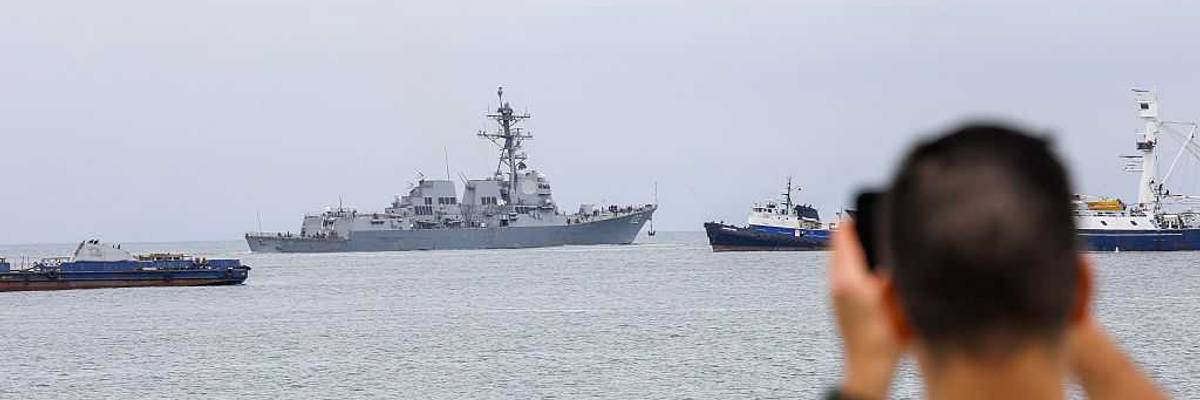
The USS Sampson (DDG 102), a US Navy missile destroyer, docks at the Amador International Cruise Terminal in Panama City, Panama, on September 2, 2025.
What Is Trump's True Endgame in Venezuela?
If a military invasion and occupation of Venezuela is not feasible and a successful CIA instigated coup is unlikely, what does Trump really want?
It’s ironic that in the same week that President Donald Trump escalated the drug war in the Caribbean by unleashing the CIA against Nicolás Maduro’s regime in Venezuela, the Department of Justice won an indictment against former National Security Adviser John Bolton, the architect of the failed covert strategy to overthrow Maduro during the first Trump administration.
The one thing the two regime change operations have in common is Marco Rubio, who, as a senator, was a vociferous opponent of Maduro. Now, as secretary of state and national security adviser, he’s the new architect of Trump’s Venezuela policy, having managed to cut short Richard Grenell’s attempt to negotiate a diplomatic deal with Maduro. Regime change is on the agenda once again, with gunboats in the Caribbean and the CIA on the ground. What could go wrong?
Donald Trump’s penchant for turning the metaphorical war on drugs into a real one by deploying the US military dates back to his first administration, when he threatened to designate drug cartels as foreign terrorists and proposed launching missiles to blow up drugs labs in Mexico. During the recent presidential campaign, he declared, “The drug cartels are waging war on America—and it's now time for America to wage war on the cartels.” Apparently, he meant it.
Back in office, he named six Mexican cartels, the Salvadoran gang MS-13, and the Venezuelan gang Tren de Aragua as foreign terrorist organizations (FTOs) and ordered the Pentagon to draw up plans for military action against them. Early on, White House officials seriously debated military strikes against cartel leaders and infrastructure inside Mexico, but decided that cooperation with the Mexican government would be more fruitful. Nevertheless, the unusual appointment of a veteran Special Forces military officer to head the Western Hemisphere Affairs office of the National Security Council signaled that Trump was still was serious about resorting to military force to wage the war on drugs.
Nobody has ever won the Nobel Peace Prize for starting a war.
The focus then shifted to Venezuela. The day before the New York Times broke the story about Pentagon planning for action against cartels, Attorney General Pam Bondi announced that the US government was offering a $50 million reward for information leadings to Maduro’s arrest, accusing him of the “use cocaine as a weapon to 'flood' the United States.” Trump claimed Maduro was directing Tren de Aragua in “undertaking hostile actions and conducting irregular warfare against the territory of the United States,” a claim that the intelligence community concluded was untrue, despite pressure from Trump political appointees to make the estimate conform to Trump’s claim. The two senior career intelligence officers who oversaw preparation of the estimate were summarily fired.
In August, the Trump administration deployed a naval task force to the Caribbean, including three guided-missile destroyers, an amphibious assault ship, a guided-missile cruiser, and a nuclear-powered attack submarine. The following month, US forces began air strikes on vessels allegedly smuggling narcotics in international waters off the Venezuelan coast. When Democrats and some Republicans questioned the legality of summarily killing civilians who posed no immediate threat, Trump informed Congress that he had determined that the United States was in a state of “armed conflict” with unnamed “drug cartels,” whose drug trafficking constituted an attack on the United States. Therefore, traffickers were “unlawful combatants” subject to being killed on sight. Admiral Alvin Holsey, commander of US Southern Command, resigned on Thursday, reportedly because of concerns over the extrajudicial killing of civilians in the air strikes.
When Venezuelan opposition leader María Corina Machado dedicated her Nobel Peace Prize to Trump and asked for his help to oust Maduro, US escalation ratcheted up another notch. Last week Trump acknowledged that he has approved lethal CIA operations inside Venezuela. Asked if he had given authorization to “take out” Maduro, he refused to answer. In the same news conference, he also revealed that he was considering military strikes inside Venezuela. B-52 bombers have been dispatched to fly just off the Venezuelan coast and US Special Forces air units are conducting exercises in the area as a “show of force,” according to one official. Some 10,000 US troops have been deployed to the region.
Yet despite this impressive show of military prowess, it seems unlikely that the Trump administration is prepared to invade Venezuela. The forces currently deployed are nowhere near enough to occupy the country, which is five times the size of Iraq, Washington’s last misadventure in nation-building. Moreover, Trump has repeatedly promised his MAGA base there would be no more “endless” foreign wars, telling a 2024 campaign rally he would “turn the page forever on those foolish, stupid days of never-ending wars.” Even the air strikes on Iranian nuclear facilities caused consternation in his “America First” base. And nobody has ever won the Nobel Peace Prize for starting a war.
The more likely next steps are targeted attacks on drug storage sites, on individuals involved in trafficking, and perhaps on members of the Maduro regime—the sort of strikes the White House contemplated launching against Mexico back in February. That could slow or even stop the flow of drugs through Venezuela, but Venezuela is not a drug producer. Colombia is the producer, and if it can’t send its drugs through Venezuela, it will send them through Mexico or up the Pacific coast in homemade “narco-submarines.” The obvious futility of trying to stop drug trafficking by waging covert or overt war against Venezuela suggests that the real motive is political—to bring about regime change.
Can the CIA’s covert operatives pull it off? In the places where they’ve been successful (Iran 1953, Guatemala 1954, Chile 1973), the key has been to turn the military against the civilian government. That’s not likely in Venezuela. The so-called “Cartel of the Suns” is a loose network of military officers profiting from a wide range of criminal enterprises, including collaboration with Colombia cocaine traffickers. Regime change in Caracas, especially the establishment of an opposition government led by María Corina Machado and friends, would pose a grave threat to the military’s interests. They might dispatch with Maduro, but if the infrastructure of the regime and armed forces remains intact, nothing would change.
The CIA’s efforts to foment a coup have already failed once. In 2019, at the peak of popular opposition to Maduro’s regime, with Washington promoting oppositionist Juan Guiadó as the legitimate president, “Operation Liberty” was a plan to split the army as a catalyst for regime collapse. Instead the plan collapsed when no significant military units defected.
If a military invasion and occupation of Venezuela is not feasible and a successful CIA instigated coup is unlikely, what is the end game for Trump’s escalating conflict with Venezuela? Will the president be satisfied with more performative displays of military force until the next crisis pushes Venezuela out of the headlines and off his agenda? Will he be satisfied if Nicolás Maduro is replaced by some other member of his regime so Trump can claim victory? Or will he finally conclude that Marco Rubio’s obsession with regime change in Venezuela is just as much a dead end as John Bolton’s was, and give Richard Grennel the nod to go back to Caracas and make a deal?
We are at a crossroads
This country and this world are at a monumental crossroads. In a few short weeks, US voters will have an opportunity to beat back the forces of fascism and confront the billionaires who are rigging the economy, our media system, and our democracy, making it increasingly impossible for ordinary people to get by. We’re not just talking about the election. We’re talking about what must be done once these fascist elements are vanquished from power. We need a bolder set of solutions than what either major party has so far been willing to offer and a working-class movement ready to fight like hell for it. Trump didn't emerge from nowhere. The conditions that fueled MAGA authoritarianism were created by decades of radical neoliberal economic policies and a corrupt political system dominated by corporate interests. They slashed taxes on the super-rich, promising that the benefits would trickle down. They said giveaways to the corporate titans would make life more affordable for the rest of us. It was all bullshit. And when a bitter, betrayed populace searches for someone to blame, right-wing demagogues have little trouble finding scapegoats. People know when they're being lied to, but you won't hear any of this from the corporate media. Only independent journalism—powered and funded by people who believe in building a better world—can deliver truly trustworthy daily news. Our Fall Campaign is underway, and we need your help. To power our newsroom through the rest of the year, we need to raise $125,000 by midnight on October 31. So if you share our vision, please contribute whatever you can to sustain our work. |
It’s ironic that in the same week that President Donald Trump escalated the drug war in the Caribbean by unleashing the CIA against Nicolás Maduro’s regime in Venezuela, the Department of Justice won an indictment against former National Security Adviser John Bolton, the architect of the failed covert strategy to overthrow Maduro during the first Trump administration.
The one thing the two regime change operations have in common is Marco Rubio, who, as a senator, was a vociferous opponent of Maduro. Now, as secretary of state and national security adviser, he’s the new architect of Trump’s Venezuela policy, having managed to cut short Richard Grenell’s attempt to negotiate a diplomatic deal with Maduro. Regime change is on the agenda once again, with gunboats in the Caribbean and the CIA on the ground. What could go wrong?
Donald Trump’s penchant for turning the metaphorical war on drugs into a real one by deploying the US military dates back to his first administration, when he threatened to designate drug cartels as foreign terrorists and proposed launching missiles to blow up drugs labs in Mexico. During the recent presidential campaign, he declared, “The drug cartels are waging war on America—and it's now time for America to wage war on the cartels.” Apparently, he meant it.
Back in office, he named six Mexican cartels, the Salvadoran gang MS-13, and the Venezuelan gang Tren de Aragua as foreign terrorist organizations (FTOs) and ordered the Pentagon to draw up plans for military action against them. Early on, White House officials seriously debated military strikes against cartel leaders and infrastructure inside Mexico, but decided that cooperation with the Mexican government would be more fruitful. Nevertheless, the unusual appointment of a veteran Special Forces military officer to head the Western Hemisphere Affairs office of the National Security Council signaled that Trump was still was serious about resorting to military force to wage the war on drugs.
Nobody has ever won the Nobel Peace Prize for starting a war.
The focus then shifted to Venezuela. The day before the New York Times broke the story about Pentagon planning for action against cartels, Attorney General Pam Bondi announced that the US government was offering a $50 million reward for information leadings to Maduro’s arrest, accusing him of the “use cocaine as a weapon to 'flood' the United States.” Trump claimed Maduro was directing Tren de Aragua in “undertaking hostile actions and conducting irregular warfare against the territory of the United States,” a claim that the intelligence community concluded was untrue, despite pressure from Trump political appointees to make the estimate conform to Trump’s claim. The two senior career intelligence officers who oversaw preparation of the estimate were summarily fired.
In August, the Trump administration deployed a naval task force to the Caribbean, including three guided-missile destroyers, an amphibious assault ship, a guided-missile cruiser, and a nuclear-powered attack submarine. The following month, US forces began air strikes on vessels allegedly smuggling narcotics in international waters off the Venezuelan coast. When Democrats and some Republicans questioned the legality of summarily killing civilians who posed no immediate threat, Trump informed Congress that he had determined that the United States was in a state of “armed conflict” with unnamed “drug cartels,” whose drug trafficking constituted an attack on the United States. Therefore, traffickers were “unlawful combatants” subject to being killed on sight. Admiral Alvin Holsey, commander of US Southern Command, resigned on Thursday, reportedly because of concerns over the extrajudicial killing of civilians in the air strikes.
When Venezuelan opposition leader María Corina Machado dedicated her Nobel Peace Prize to Trump and asked for his help to oust Maduro, US escalation ratcheted up another notch. Last week Trump acknowledged that he has approved lethal CIA operations inside Venezuela. Asked if he had given authorization to “take out” Maduro, he refused to answer. In the same news conference, he also revealed that he was considering military strikes inside Venezuela. B-52 bombers have been dispatched to fly just off the Venezuelan coast and US Special Forces air units are conducting exercises in the area as a “show of force,” according to one official. Some 10,000 US troops have been deployed to the region.
Yet despite this impressive show of military prowess, it seems unlikely that the Trump administration is prepared to invade Venezuela. The forces currently deployed are nowhere near enough to occupy the country, which is five times the size of Iraq, Washington’s last misadventure in nation-building. Moreover, Trump has repeatedly promised his MAGA base there would be no more “endless” foreign wars, telling a 2024 campaign rally he would “turn the page forever on those foolish, stupid days of never-ending wars.” Even the air strikes on Iranian nuclear facilities caused consternation in his “America First” base. And nobody has ever won the Nobel Peace Prize for starting a war.
The more likely next steps are targeted attacks on drug storage sites, on individuals involved in trafficking, and perhaps on members of the Maduro regime—the sort of strikes the White House contemplated launching against Mexico back in February. That could slow or even stop the flow of drugs through Venezuela, but Venezuela is not a drug producer. Colombia is the producer, and if it can’t send its drugs through Venezuela, it will send them through Mexico or up the Pacific coast in homemade “narco-submarines.” The obvious futility of trying to stop drug trafficking by waging covert or overt war against Venezuela suggests that the real motive is political—to bring about regime change.
Can the CIA’s covert operatives pull it off? In the places where they’ve been successful (Iran 1953, Guatemala 1954, Chile 1973), the key has been to turn the military against the civilian government. That’s not likely in Venezuela. The so-called “Cartel of the Suns” is a loose network of military officers profiting from a wide range of criminal enterprises, including collaboration with Colombia cocaine traffickers. Regime change in Caracas, especially the establishment of an opposition government led by María Corina Machado and friends, would pose a grave threat to the military’s interests. They might dispatch with Maduro, but if the infrastructure of the regime and armed forces remains intact, nothing would change.
The CIA’s efforts to foment a coup have already failed once. In 2019, at the peak of popular opposition to Maduro’s regime, with Washington promoting oppositionist Juan Guiadó as the legitimate president, “Operation Liberty” was a plan to split the army as a catalyst for regime collapse. Instead the plan collapsed when no significant military units defected.
If a military invasion and occupation of Venezuela is not feasible and a successful CIA instigated coup is unlikely, what is the end game for Trump’s escalating conflict with Venezuela? Will the president be satisfied with more performative displays of military force until the next crisis pushes Venezuela out of the headlines and off his agenda? Will he be satisfied if Nicolás Maduro is replaced by some other member of his regime so Trump can claim victory? Or will he finally conclude that Marco Rubio’s obsession with regime change in Venezuela is just as much a dead end as John Bolton’s was, and give Richard Grennel the nod to go back to Caracas and make a deal?
- Maduro Says US Pointing '1,200 Missiles' at Venezuela After Trump Sends More Warships ›
- Trump's Venezuela Boat Strikes Are War Crimes, So Where’s The Media? ›
- Trump’s Venezuela Drug War Gambit and the Militarization Playbook at Home ›
- ‘No War Crimes Are Off Limits' as Trump Reportedly Mulling Bombing Targets in Venezuela ›
- Senators Launch Bipartisan Bid to Block Trump War on Venezuela ›
- John Bolton Speaks Well of the Many US-Backed Coup D'Etats ›
- Opinion | 'Regime change' in Venezuela Is a Euphemism for US-Inflicted Carnage and Chaos | Common Dreams ›
- Opinion | The US War on China, Venezuela, and the Global Left | Common Dreams ›
- Opinion | Donald Trump Deserves the Nobel Prize for War | Common Dreams ›
- Opinion | A Rebuke to Elliot Abrams’ Venezuela Delusions | Common Dreams ›
- Opinion | When Orders Cross the Line: Why US Troops Must Refuse an Illegal War in Venezuela | Common Dreams ›
- Nobel Peace Prize Winner Rebuked for Backing Trump's March Toward War With Venezuela | Common Dreams ›
- Opinion | A Possible Strategy for Stopping War on Venezuela | Common Dreams ›
- Opinion | Donald Trump’s First Year Report Card Made Public: D+ | Common Dreams ›
- Opinion | Venezuela Invasion Proves There's No Limit to Trump's Abuses... Unless We Impose One | Common Dreams ›
- Opinion | Trump Is Just the Latest Strongman to Think He Can Control Venezuela | Common Dreams ›
- Opinion | Trump Declares War on Everyone | Common Dreams ›
- Opinion | Trump Is Turning the US Into the World's Rogue Policeman | Common Dreams ›