SUBSCRIBE TO OUR FREE NEWSLETTER
Daily news & progressive opinion—funded by the people, not the corporations—delivered straight to your inbox.
5
#000000
#FFFFFF
To donate by check, phone, or other method, see our More Ways to Give page.
Daily news & progressive opinion—funded by the people, not the corporations—delivered straight to your inbox.
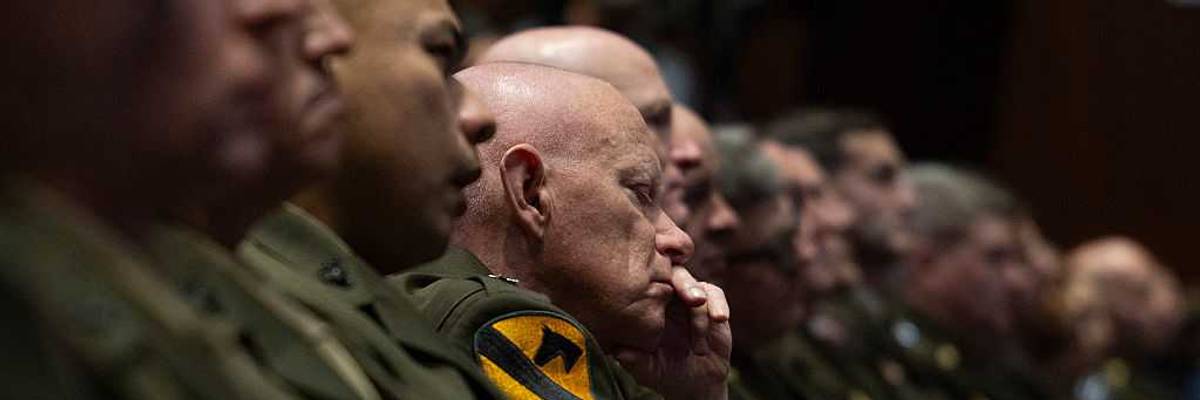
Military leaders listen as US President Donald Trump speaks at Marine Corps Base Quantico in Quantico, Virginia, on September 30, 2025.
A soldier’s oath is to the Constitution, not to unlawful commands. If the United States launches a ground invasion of Venezuela without congressional authorization or international sanction, service members have a duty to say, “No.”
Every man and woman who enlists in the United States Armed Forces raises their right hand and swears a solemn oath. It is a ritual of profound transformation, marking the passage from private citizen to guardian of the Republic. Yet buried within the cadence of those familiar words lies a paradox that has haunted battlefields from the Ardennes to the Euphrates. We swear to obey the orders of officers appointed over us, yes—but first, we swear to support and defend the Constitution of the United States.
That order of precedence is not accidental. In the American military tradition, loyalty to principles supersedes loyalty to any person, rank, or administration. This hierarchy of allegiance creates the most difficult, perilous, and essential duty a service member holds: the duty to refuse an unlawful order.
Today, that duty is no longer theoretical. When political leaders announce intentions to “soon” strike Venezuela on land, they are not merely rattling sabers—they are proposing an act that would be illegal under both US law and international law. The Constitution vests Congress, not the president, with the authority to declare war. Absent congressional authorization, a unilateral ground invasion would be unconstitutional. Under the United Nations Charter, such aggression would also violate international prohibitions against war absent self-defense or Security Council approval. To obey such a command would not be discipline; it would be complicity in a crime.
The Uniform Code of Military Justice (UCMJ) is explicit. Article 90 requires obedience only to lawful orders. This distinction is the firewall between a professional military and a Praetorian Guard or armed mob. A lawful order relates to military duty and promotes the well-being of the unit. An unlawful order—one that directs a crime, violates the laws of war, or targets civilians—is not an order at all. It is a solicitation of conspiracy. To obey such a command is not fidelity to the oath; it is betrayal of it.
A military that follows orders without question is a weapon that can be turned against the very people it was built to protect.
The ghost of Nuremberg hangs over every discussion of this duty. Following World War II, the United States led the world in establishing that “I was just following orders” is no defense for atrocities. We hanged men who claimed they were merely cogs in a machine of state violence. We cannot, morally or legally, hold our enemies to a standard we refuse to apply to ourselves. If we demand recognition of human rights, our own bayonets must be clean.
We have our own examples of this precipice. In 1968, amid the horror of My Lai, Warrant Officer Hugh Thompson Jr. saw American troops slaughtering unarmed Vietnamese civilians. He did not follow the flow of the operation. He landed his helicopter between villagers and advancing Americans, ordering his gunners to fire on his countrymen if they continued the massacre. Thompson was treated as a pariah for years, but today he is recognized as a paragon of military ethics. He understood his oath was not to the madness of the moment, but to the enduring values of the nation he served.
We must acknowledge the terrible weight this places on the individual soldier, marine, sailor, or airman. In the fog of war, where adrenaline spikes and intelligence is imperfect, distinguishing lawful from unlawful orders is agonizing. A soldier is trained to react instantly; hesitation is often synonymous with death. Asking a 19-year-old lance corporal to act as a constitutional jurist in the heat of battle is an immense demand.
Yet it is a necessary one. The complexities of modern conflict—counterinsurgency, urban warfare, domestic support operations—blur the lines between combatant and civilian. In these gray zones, the moral compass of the individual service member is often the only safeguard against atrocity.
Furthermore, domestic political turmoil raises the stakes. Should the military ever be called upon to act on American soil in ways that violate constitutional rights, the “duty to refuse” moves from theory to the final safeguard of democracy. The Founding Fathers feared a standing army for this reason; they mitigated that fear by tethering loyalty to law, not leaders.
We must train for disobedience as rigorously as we train for obedience. Troops must understand that refusal to violate the law is not mutiny, but fidelity. A military that follows orders without question is a weapon that can be turned against the very people it was built to protect. A military that thinks, judges, and holds the law above rank is the shield of a free republic.
The uniform does not silence conscience. When the order comes to cross the line—to torture, to target the innocent, to invade a sovereign nation without lawful authority—the American soldier has a duty to stand firm, look their commander in the eye, and say, “No.” In that moment, they are not breaking ranks. They are keeping the faith.
Dear Common Dreams reader, It’s been nearly 30 years since I co-founded Common Dreams with my late wife, Lina Newhouser. We had the radical notion that journalism should serve the public good, not corporate profits. It was clear to us from the outset what it would take to build such a project. No paid advertisements. No corporate sponsors. No millionaire publisher telling us what to think or do. Many people said we wouldn't last a year, but we proved those doubters wrong. Together with a tremendous team of journalists and dedicated staff, we built an independent media outlet free from the constraints of profits and corporate control. Our mission has always been simple: To inform. To inspire. To ignite change for the common good. Building Common Dreams was not easy. Our survival was never guaranteed. When you take on the most powerful forces—Wall Street greed, fossil fuel industry destruction, Big Tech lobbyists, and uber-rich oligarchs who have spent billions upon billions rigging the economy and democracy in their favor—the only bulwark you have is supporters who believe in your work. But here’s the urgent message from me today. It's never been this bad out there. And it's never been this hard to keep us going. At the very moment Common Dreams is most needed, the threats we face are intensifying. We need your support now more than ever. We don't accept corporate advertising and never will. We don't have a paywall because we don't think people should be blocked from critical news based on their ability to pay. Everything we do is funded by the donations of readers like you. When everyone does the little they can afford, we are strong. But if that support retreats or dries up, so do we. Will you donate now to make sure Common Dreams not only survives but thrives? —Craig Brown, Co-founder |
Every man and woman who enlists in the United States Armed Forces raises their right hand and swears a solemn oath. It is a ritual of profound transformation, marking the passage from private citizen to guardian of the Republic. Yet buried within the cadence of those familiar words lies a paradox that has haunted battlefields from the Ardennes to the Euphrates. We swear to obey the orders of officers appointed over us, yes—but first, we swear to support and defend the Constitution of the United States.
That order of precedence is not accidental. In the American military tradition, loyalty to principles supersedes loyalty to any person, rank, or administration. This hierarchy of allegiance creates the most difficult, perilous, and essential duty a service member holds: the duty to refuse an unlawful order.
Today, that duty is no longer theoretical. When political leaders announce intentions to “soon” strike Venezuela on land, they are not merely rattling sabers—they are proposing an act that would be illegal under both US law and international law. The Constitution vests Congress, not the president, with the authority to declare war. Absent congressional authorization, a unilateral ground invasion would be unconstitutional. Under the United Nations Charter, such aggression would also violate international prohibitions against war absent self-defense or Security Council approval. To obey such a command would not be discipline; it would be complicity in a crime.
The Uniform Code of Military Justice (UCMJ) is explicit. Article 90 requires obedience only to lawful orders. This distinction is the firewall between a professional military and a Praetorian Guard or armed mob. A lawful order relates to military duty and promotes the well-being of the unit. An unlawful order—one that directs a crime, violates the laws of war, or targets civilians—is not an order at all. It is a solicitation of conspiracy. To obey such a command is not fidelity to the oath; it is betrayal of it.
A military that follows orders without question is a weapon that can be turned against the very people it was built to protect.
The ghost of Nuremberg hangs over every discussion of this duty. Following World War II, the United States led the world in establishing that “I was just following orders” is no defense for atrocities. We hanged men who claimed they were merely cogs in a machine of state violence. We cannot, morally or legally, hold our enemies to a standard we refuse to apply to ourselves. If we demand recognition of human rights, our own bayonets must be clean.
We have our own examples of this precipice. In 1968, amid the horror of My Lai, Warrant Officer Hugh Thompson Jr. saw American troops slaughtering unarmed Vietnamese civilians. He did not follow the flow of the operation. He landed his helicopter between villagers and advancing Americans, ordering his gunners to fire on his countrymen if they continued the massacre. Thompson was treated as a pariah for years, but today he is recognized as a paragon of military ethics. He understood his oath was not to the madness of the moment, but to the enduring values of the nation he served.
We must acknowledge the terrible weight this places on the individual soldier, marine, sailor, or airman. In the fog of war, where adrenaline spikes and intelligence is imperfect, distinguishing lawful from unlawful orders is agonizing. A soldier is trained to react instantly; hesitation is often synonymous with death. Asking a 19-year-old lance corporal to act as a constitutional jurist in the heat of battle is an immense demand.
Yet it is a necessary one. The complexities of modern conflict—counterinsurgency, urban warfare, domestic support operations—blur the lines between combatant and civilian. In these gray zones, the moral compass of the individual service member is often the only safeguard against atrocity.
Furthermore, domestic political turmoil raises the stakes. Should the military ever be called upon to act on American soil in ways that violate constitutional rights, the “duty to refuse” moves from theory to the final safeguard of democracy. The Founding Fathers feared a standing army for this reason; they mitigated that fear by tethering loyalty to law, not leaders.
We must train for disobedience as rigorously as we train for obedience. Troops must understand that refusal to violate the law is not mutiny, but fidelity. A military that follows orders without question is a weapon that can be turned against the very people it was built to protect. A military that thinks, judges, and holds the law above rank is the shield of a free republic.
The uniform does not silence conscience. When the order comes to cross the line—to torture, to target the innocent, to invade a sovereign nation without lawful authority—the American soldier has a duty to stand firm, look their commander in the eye, and say, “No.” In that moment, they are not breaking ranks. They are keeping the faith.
Every man and woman who enlists in the United States Armed Forces raises their right hand and swears a solemn oath. It is a ritual of profound transformation, marking the passage from private citizen to guardian of the Republic. Yet buried within the cadence of those familiar words lies a paradox that has haunted battlefields from the Ardennes to the Euphrates. We swear to obey the orders of officers appointed over us, yes—but first, we swear to support and defend the Constitution of the United States.
That order of precedence is not accidental. In the American military tradition, loyalty to principles supersedes loyalty to any person, rank, or administration. This hierarchy of allegiance creates the most difficult, perilous, and essential duty a service member holds: the duty to refuse an unlawful order.
Today, that duty is no longer theoretical. When political leaders announce intentions to “soon” strike Venezuela on land, they are not merely rattling sabers—they are proposing an act that would be illegal under both US law and international law. The Constitution vests Congress, not the president, with the authority to declare war. Absent congressional authorization, a unilateral ground invasion would be unconstitutional. Under the United Nations Charter, such aggression would also violate international prohibitions against war absent self-defense or Security Council approval. To obey such a command would not be discipline; it would be complicity in a crime.
The Uniform Code of Military Justice (UCMJ) is explicit. Article 90 requires obedience only to lawful orders. This distinction is the firewall between a professional military and a Praetorian Guard or armed mob. A lawful order relates to military duty and promotes the well-being of the unit. An unlawful order—one that directs a crime, violates the laws of war, or targets civilians—is not an order at all. It is a solicitation of conspiracy. To obey such a command is not fidelity to the oath; it is betrayal of it.
A military that follows orders without question is a weapon that can be turned against the very people it was built to protect.
The ghost of Nuremberg hangs over every discussion of this duty. Following World War II, the United States led the world in establishing that “I was just following orders” is no defense for atrocities. We hanged men who claimed they were merely cogs in a machine of state violence. We cannot, morally or legally, hold our enemies to a standard we refuse to apply to ourselves. If we demand recognition of human rights, our own bayonets must be clean.
We have our own examples of this precipice. In 1968, amid the horror of My Lai, Warrant Officer Hugh Thompson Jr. saw American troops slaughtering unarmed Vietnamese civilians. He did not follow the flow of the operation. He landed his helicopter between villagers and advancing Americans, ordering his gunners to fire on his countrymen if they continued the massacre. Thompson was treated as a pariah for years, but today he is recognized as a paragon of military ethics. He understood his oath was not to the madness of the moment, but to the enduring values of the nation he served.
We must acknowledge the terrible weight this places on the individual soldier, marine, sailor, or airman. In the fog of war, where adrenaline spikes and intelligence is imperfect, distinguishing lawful from unlawful orders is agonizing. A soldier is trained to react instantly; hesitation is often synonymous with death. Asking a 19-year-old lance corporal to act as a constitutional jurist in the heat of battle is an immense demand.
Yet it is a necessary one. The complexities of modern conflict—counterinsurgency, urban warfare, domestic support operations—blur the lines between combatant and civilian. In these gray zones, the moral compass of the individual service member is often the only safeguard against atrocity.
Furthermore, domestic political turmoil raises the stakes. Should the military ever be called upon to act on American soil in ways that violate constitutional rights, the “duty to refuse” moves from theory to the final safeguard of democracy. The Founding Fathers feared a standing army for this reason; they mitigated that fear by tethering loyalty to law, not leaders.
We must train for disobedience as rigorously as we train for obedience. Troops must understand that refusal to violate the law is not mutiny, but fidelity. A military that follows orders without question is a weapon that can be turned against the very people it was built to protect. A military that thinks, judges, and holds the law above rank is the shield of a free republic.
The uniform does not silence conscience. When the order comes to cross the line—to torture, to target the innocent, to invade a sovereign nation without lawful authority—the American soldier has a duty to stand firm, look their commander in the eye, and say, “No.” In that moment, they are not breaking ranks. They are keeping the faith.