SUBSCRIBE TO OUR FREE NEWSLETTER
Daily news & progressive opinion—funded by the people, not the corporations—delivered straight to your inbox.
5
#000000
#FFFFFF
To donate by check, phone, or other method, see our More Ways to Give page.
Daily news & progressive opinion—funded by the people, not the corporations—delivered straight to your inbox.
Why hasn’t the mainstream media pressed the administration on these strikes being illegal and dangerous (and unpopular)?
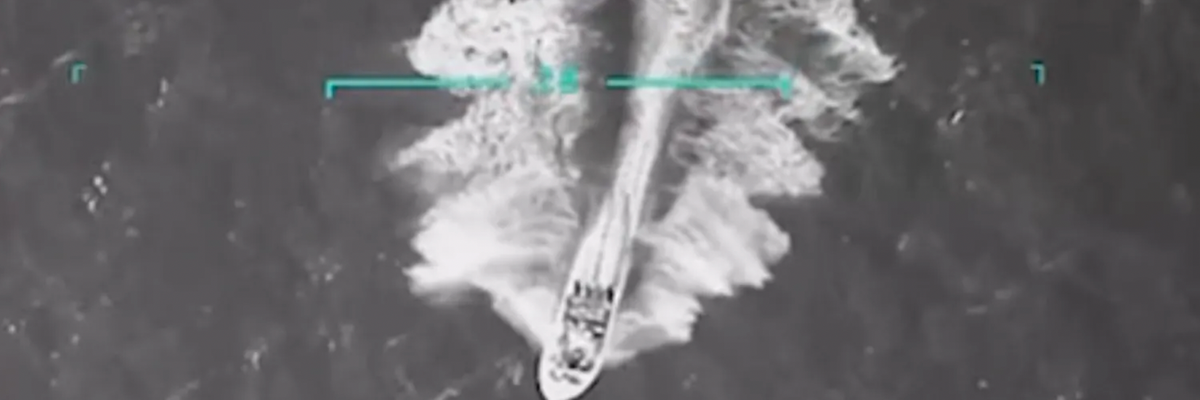
On September 2, the Trump administration shared footage purporting to show a US strike on a Venezuelan fishing boat. Even if we take the incident entirely at face value (and there are a lot of reasons to question the video itself)—the US Navy attacked a fishing boat off Venezuela, killing 11 people. On Monday, another strike was allegedly conducted on a boat, killing three people. The way the media has handled these strikes is an indictment of the state of American neoliberal reporting in a neofascist age.
Why hasn’t the mainstream media pressed the administration on these strikes being illegal and dangerous (and unpopular)? Why has no one in Washington considered the implications of calling a fishing boat carrying civilians a legitimate military target? Why isn’t the media calling the Venezuelan boat strike an abhorrent war crime at every turn?
It’s simple; they don’t care about defending the truth or holding the powerful accountable–they have no principles to stand on besides profit and access.
Within hours of these strikes breaking, major outlets were repeating the Trump administration’s line that this was a strike on a “drug boat.” According to this framing, the attacks were justified, necessary, and part of a broader war on drug trafficking. Virtually none of these outlets even entertained the obvious legal and ethical questions. Instead, they served as stenographers for the administration. This is not what an objective (not neutral) press in an advanced democracy does.
Would the Marines be greeted as liberators in Caracas?
This is reminiscent of the Iraq War era, when corporate media parroted the Bush administration’s ludicrous arguments, paving the way for invasion and occupation that would kill at least 200,000, maim millions, and destroy American democracy further.
Legal experts across the spectrum have already stood up to say the killings were illegal. Ilya Somin, a professor at George Mason University’s conservative Antonin Scalia Law School, called the strike “unjust and illegal.” Jeremy Wildeman, an adjunct professor of international Affairs at Carleton University and fellow at the Human Rights Research and Education Centre in Ottawa, described it as “part of the dangerous and ongoing erosion of due process and the very basic principles of how we interact with each other in domestic and foreign affairs, regulated by accepted norms, rules, and laws, that the Trump administration has been pointedly hostile toward following and specifically undermining.”
Wildeman added that “this is definitely about regime change and domination.” Even the Atlantic Council hedged, acknowledging that the legality was at best murky and in some cases advancing arguments to justify it. Meanwhile, US Vice President JD Vance bluntly stated that he does not care if the strikes are war crimes at all.
The available evidence does suggest this was an outright criminal massacre. The first boat was, we now know thanks to Sen. Rand Paul (R-Ky.), turning back to shore, not threatening US forces when it was fired upon. Those killed would be civilians. Even if they were transporting drugs, drug couriers are not lawful combatants. They are criminals under domestic law, not combatants in an armed conflict.
Due process was ignored. There was no trial, no arrest, no attempt at interdiction—just summary execution. And the strikes occurred in Venezuelan territorial waters, not in an international conflict zone. If another country did this, say Russia bombing a fishing boat in the Baltic, or China attacking smugglers near Taiwan, the Western media would have declared it a war crime the same day. Add this to the list of Western double standards in the international arena—we are seeing the destruction of the “liberal order” in real time.
These strikes are not a one-off. They fit into decades of US policy toward Venezuela, including economic sanctions, diplomatic isolation, and repeated regime change attempts. For 25 years, Washington has tried to topple the governments of Hugo Chávez and Nicolás Maduro through economic sabotage, coups, and support for far-right opposition. The humanitarian toll of those sanctions has been devastating. They have themselves emboldened the repression brought about by the Maduro government, which has used America as a scapegoat, with reason, for all its faults.
Now, with this attack, we see a dangerous escalation from economic to military means. If the precedent is set that the US can strike targets inside Venezuela (this was in Venezuela’s national waters) with impunity, it opens the door to a broader military campaign. That is exactly what think tanks like the Center for Strategic and International Studies have been preparing for. One CSIS report, now deleted, explicitly laid out “options for regime change” in Venezuela, against the “Maduro narco-terrorist regime.”
So why is the media so unwilling to call this what it is? Major outlets fear losing access to government sources if they challenge the official narrative. They also simply don’t want to admit that America is committing crimes, and may not be the moral actors in every major geopolitical event, as they were taught throughout their lives. Going back to Noam Chomsky’s Manufacturing Consent 101, corporate interests are also important, with companies like Exxon and Chevron having billions at stake in Venezuela’s oil fields (and a US-backed government running things in Caracas). US military action that destabilizes or topples Maduro could directly benefit those firms.
Many of the analysts quoted in media coverage are from think tanks funded by the defense industry or oil companies. They have an interest in exaggerating Venezuela’s threat and downplaying US abuses, to make the US intervention seem justified and good. And reporters too often repackage leaks from US intelligence agencies as fact, without independently verifying. A lot of the “analysis” on the strikes in mainstream news has been from the intelligence agencies, who have a direct incentive to lie and manipulate information in favor of regime change.
Even respected outlets have contributed to this dynamic. The New York Times and Wall Street Journal have both amplified the claim that Venezuela is a “narco-terrorist state.” That claim has been debunked by organizations like InSight Crime and the International Crisis Group, which show that while drugs transit Venezuela, it is hardly unique; Colombia and Mexico play a much larger role in global cocaine markets, yet they remain US allies.
Meanwhile, outlets like the Christian Science Monitor are pushing a narrative that “more Latin Americans welcome US intervention,” based on flimsy and cherry-picked anecdotes that, once again, helps the Trump administration lay the groundwork for more meddling and war. Would the Marines be greeted as liberators in Caracas? The hope is to expand the “War on Drugs” into the “War on Terror,” giving the US military more tools to intervene in Latin America, and then bringing repression to the home front (also called the Imperial Boomerang theory). In reality, the region is increasingly turning away from Washington’s militaristic and blusterous approach, seeking alternative frameworks to the failed War on Drugs.
Dear Common Dreams reader, It’s been nearly 30 years since I co-founded Common Dreams with my late wife, Lina Newhouser. We had the radical notion that journalism should serve the public good, not corporate profits. It was clear to us from the outset what it would take to build such a project. No paid advertisements. No corporate sponsors. No millionaire publisher telling us what to think or do. Many people said we wouldn't last a year, but we proved those doubters wrong. Together with a tremendous team of journalists and dedicated staff, we built an independent media outlet free from the constraints of profits and corporate control. Our mission has always been simple: To inform. To inspire. To ignite change for the common good. Building Common Dreams was not easy. Our survival was never guaranteed. When you take on the most powerful forces—Wall Street greed, fossil fuel industry destruction, Big Tech lobbyists, and uber-rich oligarchs who have spent billions upon billions rigging the economy and democracy in their favor—the only bulwark you have is supporters who believe in your work. But here’s the urgent message from me today. It's never been this bad out there. And it's never been this hard to keep us going. At the very moment Common Dreams is most needed, the threats we face are intensifying. We need your support now more than ever. We don't accept corporate advertising and never will. We don't have a paywall because we don't think people should be blocked from critical news based on their ability to pay. Everything we do is funded by the donations of readers like you. When everyone does the little they can afford, we are strong. But if that support retreats or dries up, so do we. Will you donate now to make sure Common Dreams not only survives but thrives? —Craig Brown, Co-founder |
On September 2, the Trump administration shared footage purporting to show a US strike on a Venezuelan fishing boat. Even if we take the incident entirely at face value (and there are a lot of reasons to question the video itself)—the US Navy attacked a fishing boat off Venezuela, killing 11 people. On Monday, another strike was allegedly conducted on a boat, killing three people. The way the media has handled these strikes is an indictment of the state of American neoliberal reporting in a neofascist age.
Why hasn’t the mainstream media pressed the administration on these strikes being illegal and dangerous (and unpopular)? Why has no one in Washington considered the implications of calling a fishing boat carrying civilians a legitimate military target? Why isn’t the media calling the Venezuelan boat strike an abhorrent war crime at every turn?
It’s simple; they don’t care about defending the truth or holding the powerful accountable–they have no principles to stand on besides profit and access.
Within hours of these strikes breaking, major outlets were repeating the Trump administration’s line that this was a strike on a “drug boat.” According to this framing, the attacks were justified, necessary, and part of a broader war on drug trafficking. Virtually none of these outlets even entertained the obvious legal and ethical questions. Instead, they served as stenographers for the administration. This is not what an objective (not neutral) press in an advanced democracy does.
Would the Marines be greeted as liberators in Caracas?
This is reminiscent of the Iraq War era, when corporate media parroted the Bush administration’s ludicrous arguments, paving the way for invasion and occupation that would kill at least 200,000, maim millions, and destroy American democracy further.
Legal experts across the spectrum have already stood up to say the killings were illegal. Ilya Somin, a professor at George Mason University’s conservative Antonin Scalia Law School, called the strike “unjust and illegal.” Jeremy Wildeman, an adjunct professor of international Affairs at Carleton University and fellow at the Human Rights Research and Education Centre in Ottawa, described it as “part of the dangerous and ongoing erosion of due process and the very basic principles of how we interact with each other in domestic and foreign affairs, regulated by accepted norms, rules, and laws, that the Trump administration has been pointedly hostile toward following and specifically undermining.”
Wildeman added that “this is definitely about regime change and domination.” Even the Atlantic Council hedged, acknowledging that the legality was at best murky and in some cases advancing arguments to justify it. Meanwhile, US Vice President JD Vance bluntly stated that he does not care if the strikes are war crimes at all.
The available evidence does suggest this was an outright criminal massacre. The first boat was, we now know thanks to Sen. Rand Paul (R-Ky.), turning back to shore, not threatening US forces when it was fired upon. Those killed would be civilians. Even if they were transporting drugs, drug couriers are not lawful combatants. They are criminals under domestic law, not combatants in an armed conflict.
Due process was ignored. There was no trial, no arrest, no attempt at interdiction—just summary execution. And the strikes occurred in Venezuelan territorial waters, not in an international conflict zone. If another country did this, say Russia bombing a fishing boat in the Baltic, or China attacking smugglers near Taiwan, the Western media would have declared it a war crime the same day. Add this to the list of Western double standards in the international arena—we are seeing the destruction of the “liberal order” in real time.
These strikes are not a one-off. They fit into decades of US policy toward Venezuela, including economic sanctions, diplomatic isolation, and repeated regime change attempts. For 25 years, Washington has tried to topple the governments of Hugo Chávez and Nicolás Maduro through economic sabotage, coups, and support for far-right opposition. The humanitarian toll of those sanctions has been devastating. They have themselves emboldened the repression brought about by the Maduro government, which has used America as a scapegoat, with reason, for all its faults.
Now, with this attack, we see a dangerous escalation from economic to military means. If the precedent is set that the US can strike targets inside Venezuela (this was in Venezuela’s national waters) with impunity, it opens the door to a broader military campaign. That is exactly what think tanks like the Center for Strategic and International Studies have been preparing for. One CSIS report, now deleted, explicitly laid out “options for regime change” in Venezuela, against the “Maduro narco-terrorist regime.”
So why is the media so unwilling to call this what it is? Major outlets fear losing access to government sources if they challenge the official narrative. They also simply don’t want to admit that America is committing crimes, and may not be the moral actors in every major geopolitical event, as they were taught throughout their lives. Going back to Noam Chomsky’s Manufacturing Consent 101, corporate interests are also important, with companies like Exxon and Chevron having billions at stake in Venezuela’s oil fields (and a US-backed government running things in Caracas). US military action that destabilizes or topples Maduro could directly benefit those firms.
Many of the analysts quoted in media coverage are from think tanks funded by the defense industry or oil companies. They have an interest in exaggerating Venezuela’s threat and downplaying US abuses, to make the US intervention seem justified and good. And reporters too often repackage leaks from US intelligence agencies as fact, without independently verifying. A lot of the “analysis” on the strikes in mainstream news has been from the intelligence agencies, who have a direct incentive to lie and manipulate information in favor of regime change.
Even respected outlets have contributed to this dynamic. The New York Times and Wall Street Journal have both amplified the claim that Venezuela is a “narco-terrorist state.” That claim has been debunked by organizations like InSight Crime and the International Crisis Group, which show that while drugs transit Venezuela, it is hardly unique; Colombia and Mexico play a much larger role in global cocaine markets, yet they remain US allies.
Meanwhile, outlets like the Christian Science Monitor are pushing a narrative that “more Latin Americans welcome US intervention,” based on flimsy and cherry-picked anecdotes that, once again, helps the Trump administration lay the groundwork for more meddling and war. Would the Marines be greeted as liberators in Caracas? The hope is to expand the “War on Drugs” into the “War on Terror,” giving the US military more tools to intervene in Latin America, and then bringing repression to the home front (also called the Imperial Boomerang theory). In reality, the region is increasingly turning away from Washington’s militaristic and blusterous approach, seeking alternative frameworks to the failed War on Drugs.
On September 2, the Trump administration shared footage purporting to show a US strike on a Venezuelan fishing boat. Even if we take the incident entirely at face value (and there are a lot of reasons to question the video itself)—the US Navy attacked a fishing boat off Venezuela, killing 11 people. On Monday, another strike was allegedly conducted on a boat, killing three people. The way the media has handled these strikes is an indictment of the state of American neoliberal reporting in a neofascist age.
Why hasn’t the mainstream media pressed the administration on these strikes being illegal and dangerous (and unpopular)? Why has no one in Washington considered the implications of calling a fishing boat carrying civilians a legitimate military target? Why isn’t the media calling the Venezuelan boat strike an abhorrent war crime at every turn?
It’s simple; they don’t care about defending the truth or holding the powerful accountable–they have no principles to stand on besides profit and access.
Within hours of these strikes breaking, major outlets were repeating the Trump administration’s line that this was a strike on a “drug boat.” According to this framing, the attacks were justified, necessary, and part of a broader war on drug trafficking. Virtually none of these outlets even entertained the obvious legal and ethical questions. Instead, they served as stenographers for the administration. This is not what an objective (not neutral) press in an advanced democracy does.
Would the Marines be greeted as liberators in Caracas?
This is reminiscent of the Iraq War era, when corporate media parroted the Bush administration’s ludicrous arguments, paving the way for invasion and occupation that would kill at least 200,000, maim millions, and destroy American democracy further.
Legal experts across the spectrum have already stood up to say the killings were illegal. Ilya Somin, a professor at George Mason University’s conservative Antonin Scalia Law School, called the strike “unjust and illegal.” Jeremy Wildeman, an adjunct professor of international Affairs at Carleton University and fellow at the Human Rights Research and Education Centre in Ottawa, described it as “part of the dangerous and ongoing erosion of due process and the very basic principles of how we interact with each other in domestic and foreign affairs, regulated by accepted norms, rules, and laws, that the Trump administration has been pointedly hostile toward following and specifically undermining.”
Wildeman added that “this is definitely about regime change and domination.” Even the Atlantic Council hedged, acknowledging that the legality was at best murky and in some cases advancing arguments to justify it. Meanwhile, US Vice President JD Vance bluntly stated that he does not care if the strikes are war crimes at all.
The available evidence does suggest this was an outright criminal massacre. The first boat was, we now know thanks to Sen. Rand Paul (R-Ky.), turning back to shore, not threatening US forces when it was fired upon. Those killed would be civilians. Even if they were transporting drugs, drug couriers are not lawful combatants. They are criminals under domestic law, not combatants in an armed conflict.
Due process was ignored. There was no trial, no arrest, no attempt at interdiction—just summary execution. And the strikes occurred in Venezuelan territorial waters, not in an international conflict zone. If another country did this, say Russia bombing a fishing boat in the Baltic, or China attacking smugglers near Taiwan, the Western media would have declared it a war crime the same day. Add this to the list of Western double standards in the international arena—we are seeing the destruction of the “liberal order” in real time.
These strikes are not a one-off. They fit into decades of US policy toward Venezuela, including economic sanctions, diplomatic isolation, and repeated regime change attempts. For 25 years, Washington has tried to topple the governments of Hugo Chávez and Nicolás Maduro through economic sabotage, coups, and support for far-right opposition. The humanitarian toll of those sanctions has been devastating. They have themselves emboldened the repression brought about by the Maduro government, which has used America as a scapegoat, with reason, for all its faults.
Now, with this attack, we see a dangerous escalation from economic to military means. If the precedent is set that the US can strike targets inside Venezuela (this was in Venezuela’s national waters) with impunity, it opens the door to a broader military campaign. That is exactly what think tanks like the Center for Strategic and International Studies have been preparing for. One CSIS report, now deleted, explicitly laid out “options for regime change” in Venezuela, against the “Maduro narco-terrorist regime.”
So why is the media so unwilling to call this what it is? Major outlets fear losing access to government sources if they challenge the official narrative. They also simply don’t want to admit that America is committing crimes, and may not be the moral actors in every major geopolitical event, as they were taught throughout their lives. Going back to Noam Chomsky’s Manufacturing Consent 101, corporate interests are also important, with companies like Exxon and Chevron having billions at stake in Venezuela’s oil fields (and a US-backed government running things in Caracas). US military action that destabilizes or topples Maduro could directly benefit those firms.
Many of the analysts quoted in media coverage are from think tanks funded by the defense industry or oil companies. They have an interest in exaggerating Venezuela’s threat and downplaying US abuses, to make the US intervention seem justified and good. And reporters too often repackage leaks from US intelligence agencies as fact, without independently verifying. A lot of the “analysis” on the strikes in mainstream news has been from the intelligence agencies, who have a direct incentive to lie and manipulate information in favor of regime change.
Even respected outlets have contributed to this dynamic. The New York Times and Wall Street Journal have both amplified the claim that Venezuela is a “narco-terrorist state.” That claim has been debunked by organizations like InSight Crime and the International Crisis Group, which show that while drugs transit Venezuela, it is hardly unique; Colombia and Mexico play a much larger role in global cocaine markets, yet they remain US allies.
Meanwhile, outlets like the Christian Science Monitor are pushing a narrative that “more Latin Americans welcome US intervention,” based on flimsy and cherry-picked anecdotes that, once again, helps the Trump administration lay the groundwork for more meddling and war. Would the Marines be greeted as liberators in Caracas? The hope is to expand the “War on Drugs” into the “War on Terror,” giving the US military more tools to intervene in Latin America, and then bringing repression to the home front (also called the Imperial Boomerang theory). In reality, the region is increasingly turning away from Washington’s militaristic and blusterous approach, seeking alternative frameworks to the failed War on Drugs.