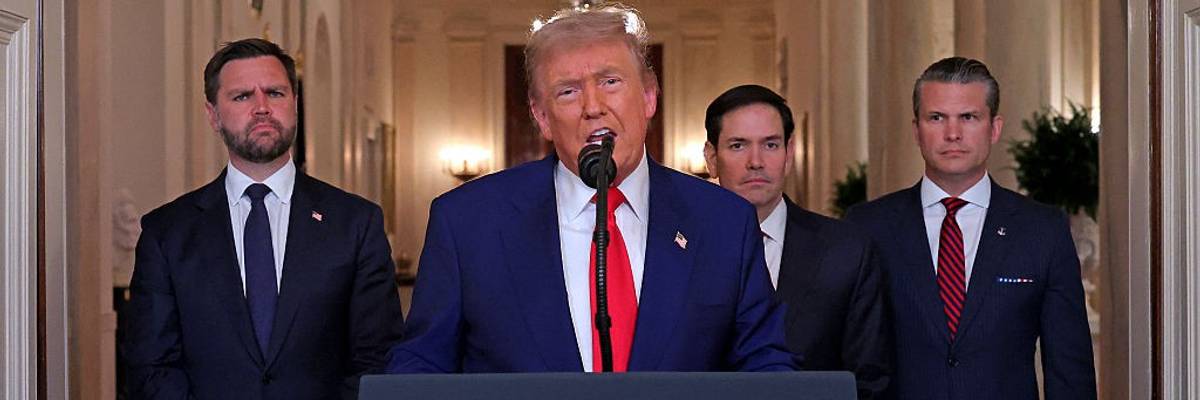
US President Donald Trump addresses the nation, alongside US Vice President JD Vance (L), US Secretary of State Marco Rubio (2nd R) and US Secretary of Defense Pete Hegseth (R), from the White House in Washington, DC on June 21, 2025, following the announcement that the US bombed nuclear sites in Iran.
Big Idiot Trump and His Disastrous Loser of a War Against Iran
Donald Trump takes his place among the great buffoons of history, leading an imperial power that hasn’t won a single war of any sort since World War II ended.
I recently drove to a gas station in Massachusetts to fill my tank with regular gas, the cheapest around, and, to my surprise, given what’s going on, it was only $4.59 a gallon.
Okay, okay, I take back that “only” and admit it. It’s not good to joke about the nightmare of gas prices these days. But in truth, that may indeed still prove to be the good news, since Donald Trump remains at war (or perhaps at chaos) with Iran, a country a mere 6,300 miles or so from Washington, DC, and so crucial to American power on this distinctly overheating planet of ours (right?). And even as I was writing this, Iran had indeed again closed the Strait of Hormuz through which about 25% of global oil and 20% of global natural gas normally passes, and Donald Trump was threatening to take over the Strait himself.
The terrible (even terrifying) logic of what he is now doing is (or at least should be) overwhelmingly obvious to anyone who has even a faint memory of this country’s imperial history since it emerged victorious from World War II in 1945. And yet give Donald Trump credit. People deal with him as if he were a unique figure in American history and in some ways, of course, he couldn’t be more so. But not, it turns out, when it comes to American-style war. There, he seems almost boringly part of a story (now more than three-quarters of a century old) of how the seemingly greatest power on Planet Earth in the endless decades after World War II simply couldn’t—no, not ever!—win a war.
After all, Harry S. Truman got us into a major conflict in Korea, almost 7,000 miles from Washington, D.C., in 1950, and when it ended three years later, the US left the North Koreans with approximately half of the Korean peninsula.
In 1961, President John F. Kennedy increased American support for what had been the French colony of Indochina (until its military lost the battle of Dien Bien Phu to Ho Chi Minh’s rebel forces in 1954). He would then oversee what would become a full-scale American war in Vietnam, a mere 8,500 or so miles from this country, as well as a war in Laos (also about 8,500 miles away) and Cambodia (nearly 9,000 miles away) that would last a mere 14 more years, ending in a chaotically disastrous US withdrawal and absolute defeat in 1975.
In 2001, President George W. Bush would launch a war in Afghanistan as part of what he labeled his Global War on Terror, a country a mere 7,000 miles from Washington. It would last just 20 more years before ending in—yes, of course!—a distinct American defeat and the grim withdrawal of the last US troops there by presidents Donald J. Trump and Joe Biden in 2021. In 2003, Bush would also launch a war in Iraq, a mere 10,000 or so miles from Washington, a conflict that would be ended by President Barack Obama, again in defeat, in 2011 (although Washington would continue to engage in some fighting there in subsequent years).
And that’s not even counting various other American war-making activities on this planet, including a never-ending air war in Somalia, launched by President George H.W. Bush in the early 1990s that continues today and still shows no sign of success.
So, just to make the obvious point, the greatest and—after the Soviet Union fell in 1991—only true imperial power on planet Earth hasn’t had a genuine war-making success to its name from the end of the Second World War in 1945 to the Trumpian moment 80 years later. And, of course, we’re talking about the country that has by far the largest military on planet Earth, puts more money (still called “defense spending,” even if the department that spends it has now been renamed the Department of War) into its military than the next six countries combined, and accounts for 33% of all military spending on this planet. And mind you, that’s even before Donald Trump tries to raise this country’s military spending from nearly one trillion dollars annually to almost $1.5 trillion dollars. And yet, we’re also talking about the power that hasn’t won a single war of any sort since World War II ended.
Now, given all of that, what should we expect when it comes to Donald Trump’s war against Iran? Don’t, of course, misunderstand me. The American president and his military are clearly capable of creating scenes of utter destruction and devastation there (as was true from Korea and Vietnam to Afghanistan and Iraq). They are also capable of killing staggering numbers of Iranians and turning that region into a potential disaster area. And President Trump is already insisting, of course, that he will reinstall the US blockade of Iranian ports, while calling himself and his country “the guardian“ of the Strait of Hormuz.
The one thing that history suggests, however, is that Trump and crew will not actually be capable of winning their war against that country.
When it comes to war and imperial powers on this planet, the US offers a staggering tale of defeat in our time (one that, it seems, Vladimir Putin may be repeating in Ukraine). And it may suggest why the country that’s clearly the next great imperial power on Planet Earth, China, has shown remarkably little desire to head down a similar road. Yes, in 1979, the Chinese did engage in a border war with Vietnam and, from 2020 to 2021, it also engaged in border skirmishes with India. And it certainly has built up both its military and its nuclear forces in these years.
Nonetheless, it seems to have remarkably little interest in heading down the usual imperial path of global warmaking, given the lesson that the United States has offered in spending staggering amounts of money on genuinely fruitless wars, decade after decade after decade to this very moment. There may never have been quite such a power and such a story in this planet’s imperial past.
We are at a crossroads
This country and this world are at a monumental crossroads. In a few short weeks, US voters will have an opportunity to beat back the forces of fascism and confront the billionaires who are rigging the economy, our media system, and our democracy, making it increasingly impossible for ordinary people to get by. We’re not just talking about the election. We’re talking about what must be done once these fascist elements are vanquished from power. We need a bolder set of solutions than what either major party has so far been willing to offer and a working-class movement ready to fight like hell for it. Trump didn't emerge from nowhere. The conditions that fueled MAGA authoritarianism were created by decades of radical neoliberal economic policies and a corrupt political system dominated by corporate interests. They slashed taxes on the super-rich, promising that the benefits would trickle down. They said giveaways to the corporate titans would make life more affordable for the rest of us. It was all bullshit. And when a bitter, betrayed populace searches for someone to blame, right-wing demagogues have little trouble finding scapegoats. People know when they're being lied to, but you won't hear any of this from the corporate media. Only independent journalism—powered and funded by people who believe in building a better world—can deliver truly trustworthy daily news. Our Fall Campaign is underway, and we need your help. To power our newsroom through the rest of the year, we need to raise $125,000 by midnight on October 31. So if you share our vision, please contribute whatever you can to sustain our work. |
The above piece, published here with permission, first appeared at Tom Engelhardt's substack page, where you can find more of his writing.
Engelhardt, was editor-in-chief of TomDispatch.com for over 24 years, is the author of numerous books, including: "A Nation Unmade by War" (2018, Dispatch Books), "Shadow Government: Surveillance, Secret Wars, and a Global Security State in a Single-Superpower World" (2014, with an introduction by Glenn Greenwald), "Terminator Planet: The First History of Drone Warfare, 2001-2050"(co-authored with Nick Turse), "The United States of Fear" (2011), "The American Way of War: How Bush's Wars Became Obama's" (2010), and "The End of Victory Culture: a History of the Cold War and Beyond" (2007).
I recently drove to a gas station in Massachusetts to fill my tank with regular gas, the cheapest around, and, to my surprise, given what’s going on, it was only $4.59 a gallon.
Okay, okay, I take back that “only” and admit it. It’s not good to joke about the nightmare of gas prices these days. But in truth, that may indeed still prove to be the good news, since Donald Trump remains at war (or perhaps at chaos) with Iran, a country a mere 6,300 miles or so from Washington, DC, and so crucial to American power on this distinctly overheating planet of ours (right?). And even as I was writing this, Iran had indeed again closed the Strait of Hormuz through which about 25% of global oil and 20% of global natural gas normally passes, and Donald Trump was threatening to take over the Strait himself.
The terrible (even terrifying) logic of what he is now doing is (or at least should be) overwhelmingly obvious to anyone who has even a faint memory of this country’s imperial history since it emerged victorious from World War II in 1945. And yet give Donald Trump credit. People deal with him as if he were a unique figure in American history and in some ways, of course, he couldn’t be more so. But not, it turns out, when it comes to American-style war. There, he seems almost boringly part of a story (now more than three-quarters of a century old) of how the seemingly greatest power on Planet Earth in the endless decades after World War II simply couldn’t—no, not ever!—win a war.
After all, Harry S. Truman got us into a major conflict in Korea, almost 7,000 miles from Washington, D.C., in 1950, and when it ended three years later, the US left the North Koreans with approximately half of the Korean peninsula.
In 1961, President John F. Kennedy increased American support for what had been the French colony of Indochina (until its military lost the battle of Dien Bien Phu to Ho Chi Minh’s rebel forces in 1954). He would then oversee what would become a full-scale American war in Vietnam, a mere 8,500 or so miles from this country, as well as a war in Laos (also about 8,500 miles away) and Cambodia (nearly 9,000 miles away) that would last a mere 14 more years, ending in a chaotically disastrous US withdrawal and absolute defeat in 1975.
In 2001, President George W. Bush would launch a war in Afghanistan as part of what he labeled his Global War on Terror, a country a mere 7,000 miles from Washington. It would last just 20 more years before ending in—yes, of course!—a distinct American defeat and the grim withdrawal of the last US troops there by presidents Donald J. Trump and Joe Biden in 2021. In 2003, Bush would also launch a war in Iraq, a mere 10,000 or so miles from Washington, a conflict that would be ended by President Barack Obama, again in defeat, in 2011 (although Washington would continue to engage in some fighting there in subsequent years).
And that’s not even counting various other American war-making activities on this planet, including a never-ending air war in Somalia, launched by President George H.W. Bush in the early 1990s that continues today and still shows no sign of success.
So, just to make the obvious point, the greatest and—after the Soviet Union fell in 1991—only true imperial power on planet Earth hasn’t had a genuine war-making success to its name from the end of the Second World War in 1945 to the Trumpian moment 80 years later. And, of course, we’re talking about the country that has by far the largest military on planet Earth, puts more money (still called “defense spending,” even if the department that spends it has now been renamed the Department of War) into its military than the next six countries combined, and accounts for 33% of all military spending on this planet. And mind you, that’s even before Donald Trump tries to raise this country’s military spending from nearly one trillion dollars annually to almost $1.5 trillion dollars. And yet, we’re also talking about the power that hasn’t won a single war of any sort since World War II ended.
Now, given all of that, what should we expect when it comes to Donald Trump’s war against Iran? Don’t, of course, misunderstand me. The American president and his military are clearly capable of creating scenes of utter destruction and devastation there (as was true from Korea and Vietnam to Afghanistan and Iraq). They are also capable of killing staggering numbers of Iranians and turning that region into a potential disaster area. And President Trump is already insisting, of course, that he will reinstall the US blockade of Iranian ports, while calling himself and his country “the guardian“ of the Strait of Hormuz.
The one thing that history suggests, however, is that Trump and crew will not actually be capable of winning their war against that country.
When it comes to war and imperial powers on this planet, the US offers a staggering tale of defeat in our time (one that, it seems, Vladimir Putin may be repeating in Ukraine). And it may suggest why the country that’s clearly the next great imperial power on Planet Earth, China, has shown remarkably little desire to head down a similar road. Yes, in 1979, the Chinese did engage in a border war with Vietnam and, from 2020 to 2021, it also engaged in border skirmishes with India. And it certainly has built up both its military and its nuclear forces in these years.
Nonetheless, it seems to have remarkably little interest in heading down the usual imperial path of global warmaking, given the lesson that the United States has offered in spending staggering amounts of money on genuinely fruitless wars, decade after decade after decade to this very moment. There may never have been quite such a power and such a story in this planet’s imperial past.
- 'Stupidity' of Iran War Becoming Increasingly 'Undeniable Even to Its Supporters,' Says Analyst ›
- 'Beyond Despicable,' Says Democrat After White House Official Says Trump 'Bored' With Iran War ›
- Trump 'Openly Flaunting His War Crimes' as US Bombs Iran's Civilian Infrastructure ›
- Senators Block $1.15 Trillion Pentagon Bill Over Trump's Illegal Iran War, Israel Integration ›
- Will Trump's Idiotic Iran War Spell the End of NATO? ›
- 'This War Is Dumb as Hell': Military Historian Assesses Trump's Disaster in Iran ›
- Opinion | Spoiled Rotten Donald Trump Can't Buy His Way Out of the Mess He Made When He Started War With Iran | Common Dreams ›
- Opinion | Trump Cannot Win the Iran War | Common Dreams ›
The above piece, published here with permission, first appeared at Tom Engelhardt's substack page, where you can find more of his writing.
Engelhardt, was editor-in-chief of TomDispatch.com for over 24 years, is the author of numerous books, including: "A Nation Unmade by War" (2018, Dispatch Books), "Shadow Government: Surveillance, Secret Wars, and a Global Security State in a Single-Superpower World" (2014, with an introduction by Glenn Greenwald), "Terminator Planet: The First History of Drone Warfare, 2001-2050"(co-authored with Nick Turse), "The United States of Fear" (2011), "The American Way of War: How Bush's Wars Became Obama's" (2010), and "The End of Victory Culture: a History of the Cold War and Beyond" (2007).
I recently drove to a gas station in Massachusetts to fill my tank with regular gas, the cheapest around, and, to my surprise, given what’s going on, it was only $4.59 a gallon.
Okay, okay, I take back that “only” and admit it. It’s not good to joke about the nightmare of gas prices these days. But in truth, that may indeed still prove to be the good news, since Donald Trump remains at war (or perhaps at chaos) with Iran, a country a mere 6,300 miles or so from Washington, DC, and so crucial to American power on this distinctly overheating planet of ours (right?). And even as I was writing this, Iran had indeed again closed the Strait of Hormuz through which about 25% of global oil and 20% of global natural gas normally passes, and Donald Trump was threatening to take over the Strait himself.
The terrible (even terrifying) logic of what he is now doing is (or at least should be) overwhelmingly obvious to anyone who has even a faint memory of this country’s imperial history since it emerged victorious from World War II in 1945. And yet give Donald Trump credit. People deal with him as if he were a unique figure in American history and in some ways, of course, he couldn’t be more so. But not, it turns out, when it comes to American-style war. There, he seems almost boringly part of a story (now more than three-quarters of a century old) of how the seemingly greatest power on Planet Earth in the endless decades after World War II simply couldn’t—no, not ever!—win a war.
After all, Harry S. Truman got us into a major conflict in Korea, almost 7,000 miles from Washington, D.C., in 1950, and when it ended three years later, the US left the North Koreans with approximately half of the Korean peninsula.
In 1961, President John F. Kennedy increased American support for what had been the French colony of Indochina (until its military lost the battle of Dien Bien Phu to Ho Chi Minh’s rebel forces in 1954). He would then oversee what would become a full-scale American war in Vietnam, a mere 8,500 or so miles from this country, as well as a war in Laos (also about 8,500 miles away) and Cambodia (nearly 9,000 miles away) that would last a mere 14 more years, ending in a chaotically disastrous US withdrawal and absolute defeat in 1975.
In 2001, President George W. Bush would launch a war in Afghanistan as part of what he labeled his Global War on Terror, a country a mere 7,000 miles from Washington. It would last just 20 more years before ending in—yes, of course!—a distinct American defeat and the grim withdrawal of the last US troops there by presidents Donald J. Trump and Joe Biden in 2021. In 2003, Bush would also launch a war in Iraq, a mere 10,000 or so miles from Washington, a conflict that would be ended by President Barack Obama, again in defeat, in 2011 (although Washington would continue to engage in some fighting there in subsequent years).
And that’s not even counting various other American war-making activities on this planet, including a never-ending air war in Somalia, launched by President George H.W. Bush in the early 1990s that continues today and still shows no sign of success.
So, just to make the obvious point, the greatest and—after the Soviet Union fell in 1991—only true imperial power on planet Earth hasn’t had a genuine war-making success to its name from the end of the Second World War in 1945 to the Trumpian moment 80 years later. And, of course, we’re talking about the country that has by far the largest military on planet Earth, puts more money (still called “defense spending,” even if the department that spends it has now been renamed the Department of War) into its military than the next six countries combined, and accounts for 33% of all military spending on this planet. And mind you, that’s even before Donald Trump tries to raise this country’s military spending from nearly one trillion dollars annually to almost $1.5 trillion dollars. And yet, we’re also talking about the power that hasn’t won a single war of any sort since World War II ended.
Now, given all of that, what should we expect when it comes to Donald Trump’s war against Iran? Don’t, of course, misunderstand me. The American president and his military are clearly capable of creating scenes of utter destruction and devastation there (as was true from Korea and Vietnam to Afghanistan and Iraq). They are also capable of killing staggering numbers of Iranians and turning that region into a potential disaster area. And President Trump is already insisting, of course, that he will reinstall the US blockade of Iranian ports, while calling himself and his country “the guardian“ of the Strait of Hormuz.
The one thing that history suggests, however, is that Trump and crew will not actually be capable of winning their war against that country.
When it comes to war and imperial powers on this planet, the US offers a staggering tale of defeat in our time (one that, it seems, Vladimir Putin may be repeating in Ukraine). And it may suggest why the country that’s clearly the next great imperial power on Planet Earth, China, has shown remarkably little desire to head down a similar road. Yes, in 1979, the Chinese did engage in a border war with Vietnam and, from 2020 to 2021, it also engaged in border skirmishes with India. And it certainly has built up both its military and its nuclear forces in these years.
Nonetheless, it seems to have remarkably little interest in heading down the usual imperial path of global warmaking, given the lesson that the United States has offered in spending staggering amounts of money on genuinely fruitless wars, decade after decade after decade to this very moment. There may never have been quite such a power and such a story in this planet’s imperial past.
- 'Stupidity' of Iran War Becoming Increasingly 'Undeniable Even to Its Supporters,' Says Analyst ›
- 'Beyond Despicable,' Says Democrat After White House Official Says Trump 'Bored' With Iran War ›
- Trump 'Openly Flaunting His War Crimes' as US Bombs Iran's Civilian Infrastructure ›
- Senators Block $1.15 Trillion Pentagon Bill Over Trump's Illegal Iran War, Israel Integration ›
- Will Trump's Idiotic Iran War Spell the End of NATO? ›
- 'This War Is Dumb as Hell': Military Historian Assesses Trump's Disaster in Iran ›
- Opinion | Spoiled Rotten Donald Trump Can't Buy His Way Out of the Mess He Made When He Started War With Iran | Common Dreams ›
- Opinion | Trump Cannot Win the Iran War | Common Dreams ›