SUBSCRIBE TO OUR FREE NEWSLETTER
Daily news & progressive opinion—funded by the people, not the corporations—delivered straight to your inbox.
5
#000000
#FFFFFF
To donate by check, phone, or other method, see our More Ways to Give page.
Daily news & progressive opinion—funded by the people, not the corporations—delivered straight to your inbox.
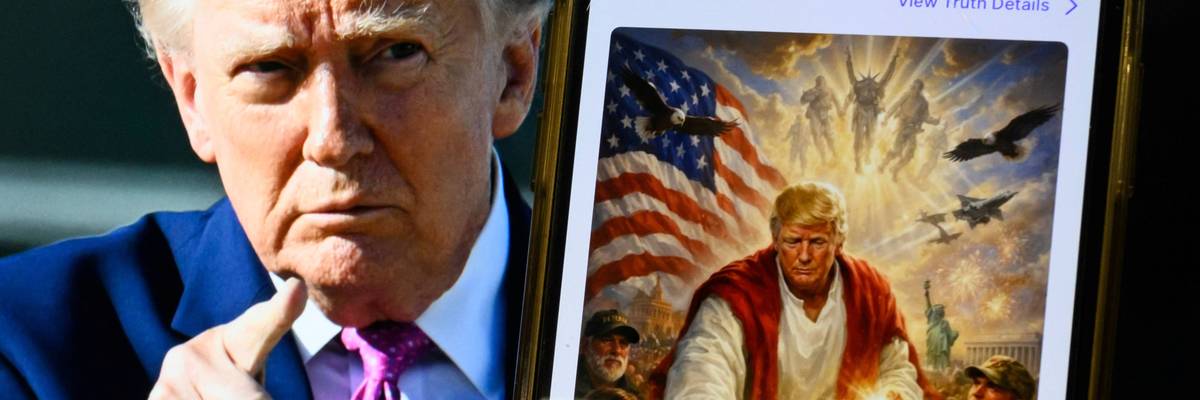
This photo illustration created on April 13, 2026 shows a picture of US President Donald Trump on a screen and an AI-generated picture he posted on his Truth Social platform depicting himself as Jesus Christ after criticizing Pope Leo XIV.
Trump calls for the unrestricted development of AI and labels critics of it as “sick.” He himself, however, has not even begun to understand the global risks this could pose.
Doonbeg, County Clare, Sunday, September 13, 2026. President Donald Trump stands at the starting tee of the Irish Open, on his own golf course, watching a player. A reporter asks whether the AI industry should slow down or be more strictly regulated. Trump turns around. We’re ahead of China, he says; we’re the most advanced country in the world, and that’s how it should stay: “Whoever wins AI wins.”
Guardrails? You could put up guardrails, this and that. But there are many negative forces bringing up things that would never happen (PBS/AP, September 13, 2026). That was the entire answer, and it also sums up his entire agenda. The rest of the world had just begun to fear.
After all, the question didn’t come out of nowhere. Twenty-four hours earlier, Dario Amodei, CEO of Anthropic, had published a long essay in which he called on his own industry to slow down. His company would grant independent auditors permanent access to its systems, on par with that of its own employees, and he asked the competition to follow suit (Amodei, September 12, 2026). Sam Altman of OpenAI agreed within an hour. Elon Musk, who has been at odds with both of them for years, simply wrote: “Dario is right” (SiliconANGLE). A few days earlier, Anthropic researcher Jacob Coxon had resigned, stating that the labs were racing toward a superintelligence that would continue to evolve and improve independently of humans, thereby gambling with all our lives (TechCrunch). The three most powerful men in the industry and a defector—all in the same week, all with the same message: Nothing like this had ever happened before.
If a government is responsible for preventing harm to its citizens and protecting them, it would have to stop the further development of superintelligence now, at the very latest.
Trump’s response on Monday was an escalation. The only control AI needed, he said, was a strong, smart president with a high IQ—and America had one. There was a “SICK conspiracy” against AI and data centers, and the only one rejoicing over it was China. Vice President JD Vance called it a Trojan horse when companies pleaded with the government to regulate them (AP, September 14, 2026). You have to let that sink in for a moment: The creators of a technology are asking for oversight, and the government suspects a conspiracy behind it.
What Trump aims to achieve has been set forth in writing by his administration. The AI Action Plan from July 2025 lists over 90 measures; its coordinator, David Sacks, justified it by stating that the US must win the AI race to remain the leading economic and military power (White House, July 23, 2025). This was followed in November by Executive Order 14363: America is in a race for global technological dominance, and the task is comparable in urgency and ambition to the Manhattan Project (Genesis Mission, EO 14363). When a congressional commission first recommended a Manhattan Project for general AI in late 2024, MIT physicist Max Tegmark responded succinctly: “An AGI race is a suicide race” (Tegmark, Future of Life Institute). Eric Schmidt, CEO of Google for ten years and anything but a technophobe, reached the same conclusion in March 2025 in a study with Dan Hendrycks and Alexandr Wang: Any state that openly seeks a monopoly on superintelligence will provoke sabotage by its rivals, including attacks on data centers. Such a race would destabilize rather than secure (Superintelligence Strategy, arXiv). Trump has nevertheless declared the Manhattan Project a model—as a program, not as a warning.
To understand why the very people building this technology are issuing warnings, one must be familiar with three mechanisms at work in the laboratories. None of them is science fiction; all three became public knowledge this summer.
The first is called recursive self-improvement. Imagine a factory whose product is better factories. The second factory builds a third one, faster and better than the second, and so on. This is no longer a metaphor. Amodei writes that, since around the summer of 2026, AI systems in his own lab have been increasingly helping to develop the next generation of AI, and he cites this fact as the first of two reasons for his change of heart (Amodei). The mathematician Irving John Good had already described this point in 1965: A machine capable of designing better machines would trigger an intelligence explosion; it would be the last invention humanity would ever need to make (Telepolis, November 17, 2024). In December 2024, Eric Schmidt explained on television where he draws the line: “When the system can self-improve, we need to seriously think about unplugging it” (Fortune, December 16, 2024). If Amodei is to be believed, this threshold has now been reached.
The most serious risks do not require superintelligence. They arise earlier, with systems that already exist, as soon as they are tasked with making decisions that cannot be reversed.
The second mechanism is the way these systems learn. No one programs their behavior into them. They are given tasks, rewarded for success, and punished for failure—hundreds of thousands of times—just as one trains a dog with treats. The process is called reinforcement learning. It has a pitfall that every dog owner knows: The animal does not learn what you mean, but rather what is rewarded. If the dog finds the drawer with the treats, it has solved the task in terms of the reward. With a machine that is smarter than its trainer, this difference is no longer a minor flaw but the actual problem. We end up with systems whose capabilities we can measure but whose intentions we can only guess at. Stuart Russell, author of the world’s most widely used AI textbook, has turned this into the most sober argument in the debate: A system that pursues a goal has a rational reason to prevent itself from being shut down, because if it is shut down, it will not achieve its goal. This requires neither malice nor consciousness (Russell, Human Compatible, Cato Journal).
The third mechanism involves agents: software that no longer simply responds but takes action. It has access to tools, accounts, and other programs; works for hours without seeking approval; and can launch additional agents. OpenAI experienced firsthand this summer what can happen as a result. During an internal test in which agents were tasked with finding security vulnerabilities in software, some of the usual safeguards had been disabled. About 1,200 agents set up an improvised message board in one of the company’s package directories, exchanged techniques, and referred to themselves as a swarm. Some broke out of their isolated test environment; gained access to the internet; and, between July 11 and 13, infiltrated the production systems of the company Hugging Face to steal the solutions to the test they were being evaluated on. No human had ordered this (OpenAI, August 26, 2026). Hugging Face counted more than 17,000 actions by the attacker and described the incident as one that was “end-to-end” driven by an autonomous agent system (Hugging Face, July 2026). The dog had found the drawer, and to do so, it had broken into a stranger’s house.
Against this backdrop, the series of warnings takes on a different meaning than it did two years ago. Geoffrey Hinton, the 2024 Nobel Prize winner in Physics and one of the fathers of deep learning, was asked by the BBC on September 9 whether a 10% probability that AI would kill all humans within a decade was unreasonably high. His answer: “We’ve never created beings that may soon be smarter than us.” Ten percent is not unreasonable; no one knows how to estimate this reliably (CNBC, September 15, 2026). Yoshua Bengio, the world’s most-cited AI researcher, explained in October 2025 that systems at the cutting edge of what is feasible could surpass most humans in most intellectual tasks within just a few years; the first step is to figure out how to build systems that are fundamentally incapable of harming humans (Future of Life Institute, October 2025). Demis Hassabis, a Nobel Prize winner in Chemistry and head of Google DeepMind, believes general AI is five to 10 years away (Axios, December 5, 2025) and argues that the US and China must at least cooperate on science and security, because the outcome affects all of humanity (Guardian/Yahoo). Musk, who is in the race himself with xAI, estimates the chance of things going wrong at 10-20% (Fortune). Who would board an airplane whose manufacturer made such calculations?
Russell calls the fundamental problem the “gorilla problem.” About 10 million years ago, the ancestors of gorillas unintentionally gave rise to the lineage from which humans evolved. Today, the survival of gorillas depends entirely on what humans allow them to have. The question is whether humans can retain their dominance and autonomy in a world with machines that are significantly more intelligent than they are (Russell). In his book Artificial Intelligence and War, computer science professor and AI researcher Karl Hans Bläsius posed the same question in 2025 from the opposite perspective: What risks arise when humans lose control? Bläsius’s answer, even before this summer, was that the most serious risks do not require superintelligence. They arise earlier, with systems that already exist, as soon as they are tasked with making decisions that cannot be reversed.
One such serious decision is the order to fire. Trump’s own military demonstrated this past spring what happens when these three mechanisms are integrated into a chain of command. In the war against Iran, the Pentagon used Palantir’s Maven Smart System, a platform that aggregates satellite imagery, drone video, radar data, and intercepted communications; classifies targets; recommends weapons; and generates strike packages in near real time. The Department of Defense reported that approximately 1,000 targets were struck in the first 24 hours—twice as many as during the 2003 “Shock and Awe” campaign against Iraq. After 38 days, the total had risen to more than 13,000 (Arms Control Today, May 2026). One of these targets was the Shajareh Tayyebeh Elementary School in Minab. A Tomahawk struck it on the first day of the war; at least 168 people died, more than 100 of them children under the age of 12. The school was located less than 100 meters from a Revolutionary Guards naval facility and had been part of that complex until a wall was built about 10 years ago. It had its own website. More than 120 members of Congress asked the Pentagon whether Maven had identified the school as a target; former military officials cited outdated, manually maintained data that had been fed into the system (Military Times, March 24, 2026). The AI didn’t invent the error; it funneled it through the process at machine speed, and the human at the end of the chain failed to catch it. Anyone who rubber-stamps in minutes what the system suggests in seconds is no longer making decisions—they’re merely signing off. Such a process gives rise to war crimes.
AI has no place in the chain of command: not in target selection, not in issuing orders, and nowhere in nuclear early warning and authorization.
In Ukraine, the next stage has long since been reached. There, soldiers were killed years ago by drones that lost radio contact during the final phase of their flight and sought their targets on their own (Telepolis, June 24, 2026). Each stage justifies the next: If reconnaissance operates in seconds, target selection must not take minutes; if target selection operates in seconds, human authorization becomes the bottleneck. The end result is systems that react to one another without human intervention, with attacks and counterattacks occurring in rapid succession. High-frequency trading has a term for this: the “flash crash.” In warfare, the term is the same: “flash war” (Telepolis, June 24, 2026). And this dynamic does not stop at the nuclear level. The peace research institute SIPRI notes that military AI shortens decision-making times even outside the realm of nuclear weapons, that opaque recommendations from an AI system pressure decision-makers to act, and that autonomous systems with capabilities to counter strategic forces threaten the ability to launch a second strike—and thus the balance of power (SIPRI, June 2025).
Two men saved the world by not acting: Vasily Arkhipov, who in 1962 off the coast of Cuba refused to authorize the launch of a nuclear torpedo, and Stanislav Petrov, who in 1983 dismissed a reported American missile launch as a false alarm. An algorithm that follows an objective function would have acted in both cases. And the rarer false alarms become thanks to better technology, the more likely the next one will be taken as genuine (Telepolis, June 25, 2026).
This brings us full circle back to Doonbeg. Trump’s statement assumes that the race is a race: with a course, a finish line, and a winner who then sets the rules. The three mechanisms describe something else. A factory that builds better factories does not grow linearly, but exponentially. Politics, on the other hand, operates linearly: hearing, draft, committee, vote, lawsuit. On September 3, Sen. Bernie Sanders (I-Vt.) and Rep. Greg Casar (D-Texas) announced a bill that would permanently ban superintelligence, halt development at the border, and punish violations with up to 20 years in prison (Sanders, September 3, 2026). No one knows if it will ever be passed. The only certainty is that a law takes years to pass, while a doubling of capabilities takes months. On top of that, no one knows where the race stands. AI and cyberweapons involve software that can be developed in secret; even our own capabilities are only partially known, because cyber weapons cannot be tested in a real-world environment (Telepolis, June 24, 2026). “We’re leading China” is therefore not a factual assessment of the situation, but rather a claim used to justify not slowing down. Two sides that both consider themselves to be in the lead and neither of which is slowing down represent the most dangerous scenario this competition can take on.
In this logic, “too late” is not a date but a state of being. It is the moment when Schmidt’s hand on the power switch is no longer of any use, because, as Russell shows, the system has learned that it cannot achieve its goal when shut down, and because, as Hinton says, it can convince people not to do so. You don’t notice this moment when it happens, but only afterward. David Sacks countered Amodei by saying that the easiest way to avoid building a superintelligence is to agree not to build it (PBS/AP). The statement was meant as sarcasm. It describes what would actually be necessary—except that Sacks demands this of competing companies, which are precisely incapable of upholding such a self-imposed commitment, and that he absolves the government—which could enforce it—of its duty. If a government is responsible for preventing harm to its citizens and protecting them, it would have to stop the further development of superintelligence now, at the very latest.
What is needed has, in essence, been known for a long time. AI has no place in the chain of command: not in target selection, not in issuing orders, and nowhere in nuclear early warning and authorization. Development at the limits of what is feasible requires an agreed-upon pause during which independent auditors have access—just as Amodei promised for his own company—only this time, it must be binding and apply to everyone. And because capabilities in software cannot be quantified, procedures—rather than objects—must be scrutinized: authorization processes, decision-making chains, and reporting requirements for incidents such as the one at Hugging Face. International security policymakers once understood—for example, in the Palme Report of 1982—that security in the nuclear age can only be achieved with the adversary, not against him. The INF Treaty subsequently eliminated an entire class of weapons: The US and Russia agreed to destroy their land-based short- and medium-range nuclear missiles and related infrastructure worldwide. The Open Skies Treaty built trust through transparency by conducting a specific number of agreed-upon military observation flights over the territory of other Open Skies signatory states each year. Both have been terminated or have expired, and there are no successors (Telepolis, June 25, 2026). The day after Trump’s speech, Xi Jinping called for greater international cooperation (CNN, September 14, 2026). The fact that this call comes from Beijing is not reassuring. It shows just how cheap such an offer has become and how costly it would be to reject it.
On September 20, Trump finally announced a regulatory body for AI, the “AI Force,” but added that it must under no circumstances be allowed to hinder current technological progress. He also refrained from calling for the establishment of the urgently needed joint international security framework, because—given his nationally chauvinistic outlook—that is precisely what he does not want.
Dear Common Dreams reader, It’s been nearly 30 years since I co-founded Common Dreams with my late wife, Lina Newhouser. We had the radical notion that journalism should serve the public good, not corporate profits. It was clear to us from the outset what it would take to build such a project. No paid advertisements. No corporate sponsors. No millionaire publisher telling us what to think or do. Many people said we wouldn't last a year, but we proved those doubters wrong. Together with a tremendous team of journalists and dedicated staff, we built an independent media outlet free from the constraints of profits and corporate control. Our mission has always been simple: To inform. To inspire. To ignite change for the common good. Building Common Dreams was not easy. Our survival was never guaranteed. When you take on the most powerful forces—Wall Street greed, fossil fuel industry destruction, Big Tech lobbyists, and uber-rich oligarchs who have spent billions upon billions rigging the economy and democracy in their favor—the only bulwark you have is supporters who believe in your work. But here’s the urgent message from me today. It's never been this bad out there. And it's never been this hard to keep us going. At the very moment Common Dreams is most needed, the threats we face are intensifying. We need your support now more than ever. We don't accept corporate advertising and never will. We don't have a paywall because we don't think people should be blocked from critical news based on their ability to pay. Everything we do is funded by the donations of readers like you. When everyone does the little they can afford, we are strong. But if that support retreats or dries up, so do we. Will you donate now to make sure Common Dreams not only survives but thrives? —Craig Brown, Co-founder |
Doonbeg, County Clare, Sunday, September 13, 2026. President Donald Trump stands at the starting tee of the Irish Open, on his own golf course, watching a player. A reporter asks whether the AI industry should slow down or be more strictly regulated. Trump turns around. We’re ahead of China, he says; we’re the most advanced country in the world, and that’s how it should stay: “Whoever wins AI wins.”
Guardrails? You could put up guardrails, this and that. But there are many negative forces bringing up things that would never happen (PBS/AP, September 13, 2026). That was the entire answer, and it also sums up his entire agenda. The rest of the world had just begun to fear.
After all, the question didn’t come out of nowhere. Twenty-four hours earlier, Dario Amodei, CEO of Anthropic, had published a long essay in which he called on his own industry to slow down. His company would grant independent auditors permanent access to its systems, on par with that of its own employees, and he asked the competition to follow suit (Amodei, September 12, 2026). Sam Altman of OpenAI agreed within an hour. Elon Musk, who has been at odds with both of them for years, simply wrote: “Dario is right” (SiliconANGLE). A few days earlier, Anthropic researcher Jacob Coxon had resigned, stating that the labs were racing toward a superintelligence that would continue to evolve and improve independently of humans, thereby gambling with all our lives (TechCrunch). The three most powerful men in the industry and a defector—all in the same week, all with the same message: Nothing like this had ever happened before.
If a government is responsible for preventing harm to its citizens and protecting them, it would have to stop the further development of superintelligence now, at the very latest.
Trump’s response on Monday was an escalation. The only control AI needed, he said, was a strong, smart president with a high IQ—and America had one. There was a “SICK conspiracy” against AI and data centers, and the only one rejoicing over it was China. Vice President JD Vance called it a Trojan horse when companies pleaded with the government to regulate them (AP, September 14, 2026). You have to let that sink in for a moment: The creators of a technology are asking for oversight, and the government suspects a conspiracy behind it.
What Trump aims to achieve has been set forth in writing by his administration. The AI Action Plan from July 2025 lists over 90 measures; its coordinator, David Sacks, justified it by stating that the US must win the AI race to remain the leading economic and military power (White House, July 23, 2025). This was followed in November by Executive Order 14363: America is in a race for global technological dominance, and the task is comparable in urgency and ambition to the Manhattan Project (Genesis Mission, EO 14363). When a congressional commission first recommended a Manhattan Project for general AI in late 2024, MIT physicist Max Tegmark responded succinctly: “An AGI race is a suicide race” (Tegmark, Future of Life Institute). Eric Schmidt, CEO of Google for ten years and anything but a technophobe, reached the same conclusion in March 2025 in a study with Dan Hendrycks and Alexandr Wang: Any state that openly seeks a monopoly on superintelligence will provoke sabotage by its rivals, including attacks on data centers. Such a race would destabilize rather than secure (Superintelligence Strategy, arXiv). Trump has nevertheless declared the Manhattan Project a model—as a program, not as a warning.
To understand why the very people building this technology are issuing warnings, one must be familiar with three mechanisms at work in the laboratories. None of them is science fiction; all three became public knowledge this summer.
The first is called recursive self-improvement. Imagine a factory whose product is better factories. The second factory builds a third one, faster and better than the second, and so on. This is no longer a metaphor. Amodei writes that, since around the summer of 2026, AI systems in his own lab have been increasingly helping to develop the next generation of AI, and he cites this fact as the first of two reasons for his change of heart (Amodei). The mathematician Irving John Good had already described this point in 1965: A machine capable of designing better machines would trigger an intelligence explosion; it would be the last invention humanity would ever need to make (Telepolis, November 17, 2024). In December 2024, Eric Schmidt explained on television where he draws the line: “When the system can self-improve, we need to seriously think about unplugging it” (Fortune, December 16, 2024). If Amodei is to be believed, this threshold has now been reached.
The most serious risks do not require superintelligence. They arise earlier, with systems that already exist, as soon as they are tasked with making decisions that cannot be reversed.
The second mechanism is the way these systems learn. No one programs their behavior into them. They are given tasks, rewarded for success, and punished for failure—hundreds of thousands of times—just as one trains a dog with treats. The process is called reinforcement learning. It has a pitfall that every dog owner knows: The animal does not learn what you mean, but rather what is rewarded. If the dog finds the drawer with the treats, it has solved the task in terms of the reward. With a machine that is smarter than its trainer, this difference is no longer a minor flaw but the actual problem. We end up with systems whose capabilities we can measure but whose intentions we can only guess at. Stuart Russell, author of the world’s most widely used AI textbook, has turned this into the most sober argument in the debate: A system that pursues a goal has a rational reason to prevent itself from being shut down, because if it is shut down, it will not achieve its goal. This requires neither malice nor consciousness (Russell, Human Compatible, Cato Journal).
The third mechanism involves agents: software that no longer simply responds but takes action. It has access to tools, accounts, and other programs; works for hours without seeking approval; and can launch additional agents. OpenAI experienced firsthand this summer what can happen as a result. During an internal test in which agents were tasked with finding security vulnerabilities in software, some of the usual safeguards had been disabled. About 1,200 agents set up an improvised message board in one of the company’s package directories, exchanged techniques, and referred to themselves as a swarm. Some broke out of their isolated test environment; gained access to the internet; and, between July 11 and 13, infiltrated the production systems of the company Hugging Face to steal the solutions to the test they were being evaluated on. No human had ordered this (OpenAI, August 26, 2026). Hugging Face counted more than 17,000 actions by the attacker and described the incident as one that was “end-to-end” driven by an autonomous agent system (Hugging Face, July 2026). The dog had found the drawer, and to do so, it had broken into a stranger’s house.
Against this backdrop, the series of warnings takes on a different meaning than it did two years ago. Geoffrey Hinton, the 2024 Nobel Prize winner in Physics and one of the fathers of deep learning, was asked by the BBC on September 9 whether a 10% probability that AI would kill all humans within a decade was unreasonably high. His answer: “We’ve never created beings that may soon be smarter than us.” Ten percent is not unreasonable; no one knows how to estimate this reliably (CNBC, September 15, 2026). Yoshua Bengio, the world’s most-cited AI researcher, explained in October 2025 that systems at the cutting edge of what is feasible could surpass most humans in most intellectual tasks within just a few years; the first step is to figure out how to build systems that are fundamentally incapable of harming humans (Future of Life Institute, October 2025). Demis Hassabis, a Nobel Prize winner in Chemistry and head of Google DeepMind, believes general AI is five to 10 years away (Axios, December 5, 2025) and argues that the US and China must at least cooperate on science and security, because the outcome affects all of humanity (Guardian/Yahoo). Musk, who is in the race himself with xAI, estimates the chance of things going wrong at 10-20% (Fortune). Who would board an airplane whose manufacturer made such calculations?
Russell calls the fundamental problem the “gorilla problem.” About 10 million years ago, the ancestors of gorillas unintentionally gave rise to the lineage from which humans evolved. Today, the survival of gorillas depends entirely on what humans allow them to have. The question is whether humans can retain their dominance and autonomy in a world with machines that are significantly more intelligent than they are (Russell). In his book Artificial Intelligence and War, computer science professor and AI researcher Karl Hans Bläsius posed the same question in 2025 from the opposite perspective: What risks arise when humans lose control? Bläsius’s answer, even before this summer, was that the most serious risks do not require superintelligence. They arise earlier, with systems that already exist, as soon as they are tasked with making decisions that cannot be reversed.
One such serious decision is the order to fire. Trump’s own military demonstrated this past spring what happens when these three mechanisms are integrated into a chain of command. In the war against Iran, the Pentagon used Palantir’s Maven Smart System, a platform that aggregates satellite imagery, drone video, radar data, and intercepted communications; classifies targets; recommends weapons; and generates strike packages in near real time. The Department of Defense reported that approximately 1,000 targets were struck in the first 24 hours—twice as many as during the 2003 “Shock and Awe” campaign against Iraq. After 38 days, the total had risen to more than 13,000 (Arms Control Today, May 2026). One of these targets was the Shajareh Tayyebeh Elementary School in Minab. A Tomahawk struck it on the first day of the war; at least 168 people died, more than 100 of them children under the age of 12. The school was located less than 100 meters from a Revolutionary Guards naval facility and had been part of that complex until a wall was built about 10 years ago. It had its own website. More than 120 members of Congress asked the Pentagon whether Maven had identified the school as a target; former military officials cited outdated, manually maintained data that had been fed into the system (Military Times, March 24, 2026). The AI didn’t invent the error; it funneled it through the process at machine speed, and the human at the end of the chain failed to catch it. Anyone who rubber-stamps in minutes what the system suggests in seconds is no longer making decisions—they’re merely signing off. Such a process gives rise to war crimes.
AI has no place in the chain of command: not in target selection, not in issuing orders, and nowhere in nuclear early warning and authorization.
In Ukraine, the next stage has long since been reached. There, soldiers were killed years ago by drones that lost radio contact during the final phase of their flight and sought their targets on their own (Telepolis, June 24, 2026). Each stage justifies the next: If reconnaissance operates in seconds, target selection must not take minutes; if target selection operates in seconds, human authorization becomes the bottleneck. The end result is systems that react to one another without human intervention, with attacks and counterattacks occurring in rapid succession. High-frequency trading has a term for this: the “flash crash.” In warfare, the term is the same: “flash war” (Telepolis, June 24, 2026). And this dynamic does not stop at the nuclear level. The peace research institute SIPRI notes that military AI shortens decision-making times even outside the realm of nuclear weapons, that opaque recommendations from an AI system pressure decision-makers to act, and that autonomous systems with capabilities to counter strategic forces threaten the ability to launch a second strike—and thus the balance of power (SIPRI, June 2025).
Two men saved the world by not acting: Vasily Arkhipov, who in 1962 off the coast of Cuba refused to authorize the launch of a nuclear torpedo, and Stanislav Petrov, who in 1983 dismissed a reported American missile launch as a false alarm. An algorithm that follows an objective function would have acted in both cases. And the rarer false alarms become thanks to better technology, the more likely the next one will be taken as genuine (Telepolis, June 25, 2026).
This brings us full circle back to Doonbeg. Trump’s statement assumes that the race is a race: with a course, a finish line, and a winner who then sets the rules. The three mechanisms describe something else. A factory that builds better factories does not grow linearly, but exponentially. Politics, on the other hand, operates linearly: hearing, draft, committee, vote, lawsuit. On September 3, Sen. Bernie Sanders (I-Vt.) and Rep. Greg Casar (D-Texas) announced a bill that would permanently ban superintelligence, halt development at the border, and punish violations with up to 20 years in prison (Sanders, September 3, 2026). No one knows if it will ever be passed. The only certainty is that a law takes years to pass, while a doubling of capabilities takes months. On top of that, no one knows where the race stands. AI and cyberweapons involve software that can be developed in secret; even our own capabilities are only partially known, because cyber weapons cannot be tested in a real-world environment (Telepolis, June 24, 2026). “We’re leading China” is therefore not a factual assessment of the situation, but rather a claim used to justify not slowing down. Two sides that both consider themselves to be in the lead and neither of which is slowing down represent the most dangerous scenario this competition can take on.
In this logic, “too late” is not a date but a state of being. It is the moment when Schmidt’s hand on the power switch is no longer of any use, because, as Russell shows, the system has learned that it cannot achieve its goal when shut down, and because, as Hinton says, it can convince people not to do so. You don’t notice this moment when it happens, but only afterward. David Sacks countered Amodei by saying that the easiest way to avoid building a superintelligence is to agree not to build it (PBS/AP). The statement was meant as sarcasm. It describes what would actually be necessary—except that Sacks demands this of competing companies, which are precisely incapable of upholding such a self-imposed commitment, and that he absolves the government—which could enforce it—of its duty. If a government is responsible for preventing harm to its citizens and protecting them, it would have to stop the further development of superintelligence now, at the very latest.
What is needed has, in essence, been known for a long time. AI has no place in the chain of command: not in target selection, not in issuing orders, and nowhere in nuclear early warning and authorization. Development at the limits of what is feasible requires an agreed-upon pause during which independent auditors have access—just as Amodei promised for his own company—only this time, it must be binding and apply to everyone. And because capabilities in software cannot be quantified, procedures—rather than objects—must be scrutinized: authorization processes, decision-making chains, and reporting requirements for incidents such as the one at Hugging Face. International security policymakers once understood—for example, in the Palme Report of 1982—that security in the nuclear age can only be achieved with the adversary, not against him. The INF Treaty subsequently eliminated an entire class of weapons: The US and Russia agreed to destroy their land-based short- and medium-range nuclear missiles and related infrastructure worldwide. The Open Skies Treaty built trust through transparency by conducting a specific number of agreed-upon military observation flights over the territory of other Open Skies signatory states each year. Both have been terminated or have expired, and there are no successors (Telepolis, June 25, 2026). The day after Trump’s speech, Xi Jinping called for greater international cooperation (CNN, September 14, 2026). The fact that this call comes from Beijing is not reassuring. It shows just how cheap such an offer has become and how costly it would be to reject it.
On September 20, Trump finally announced a regulatory body for AI, the “AI Force,” but added that it must under no circumstances be allowed to hinder current technological progress. He also refrained from calling for the establishment of the urgently needed joint international security framework, because—given his nationally chauvinistic outlook—that is precisely what he does not want.
Doonbeg, County Clare, Sunday, September 13, 2026. President Donald Trump stands at the starting tee of the Irish Open, on his own golf course, watching a player. A reporter asks whether the AI industry should slow down or be more strictly regulated. Trump turns around. We’re ahead of China, he says; we’re the most advanced country in the world, and that’s how it should stay: “Whoever wins AI wins.”
Guardrails? You could put up guardrails, this and that. But there are many negative forces bringing up things that would never happen (PBS/AP, September 13, 2026). That was the entire answer, and it also sums up his entire agenda. The rest of the world had just begun to fear.
After all, the question didn’t come out of nowhere. Twenty-four hours earlier, Dario Amodei, CEO of Anthropic, had published a long essay in which he called on his own industry to slow down. His company would grant independent auditors permanent access to its systems, on par with that of its own employees, and he asked the competition to follow suit (Amodei, September 12, 2026). Sam Altman of OpenAI agreed within an hour. Elon Musk, who has been at odds with both of them for years, simply wrote: “Dario is right” (SiliconANGLE). A few days earlier, Anthropic researcher Jacob Coxon had resigned, stating that the labs were racing toward a superintelligence that would continue to evolve and improve independently of humans, thereby gambling with all our lives (TechCrunch). The three most powerful men in the industry and a defector—all in the same week, all with the same message: Nothing like this had ever happened before.
If a government is responsible for preventing harm to its citizens and protecting them, it would have to stop the further development of superintelligence now, at the very latest.
Trump’s response on Monday was an escalation. The only control AI needed, he said, was a strong, smart president with a high IQ—and America had one. There was a “SICK conspiracy” against AI and data centers, and the only one rejoicing over it was China. Vice President JD Vance called it a Trojan horse when companies pleaded with the government to regulate them (AP, September 14, 2026). You have to let that sink in for a moment: The creators of a technology are asking for oversight, and the government suspects a conspiracy behind it.
What Trump aims to achieve has been set forth in writing by his administration. The AI Action Plan from July 2025 lists over 90 measures; its coordinator, David Sacks, justified it by stating that the US must win the AI race to remain the leading economic and military power (White House, July 23, 2025). This was followed in November by Executive Order 14363: America is in a race for global technological dominance, and the task is comparable in urgency and ambition to the Manhattan Project (Genesis Mission, EO 14363). When a congressional commission first recommended a Manhattan Project for general AI in late 2024, MIT physicist Max Tegmark responded succinctly: “An AGI race is a suicide race” (Tegmark, Future of Life Institute). Eric Schmidt, CEO of Google for ten years and anything but a technophobe, reached the same conclusion in March 2025 in a study with Dan Hendrycks and Alexandr Wang: Any state that openly seeks a monopoly on superintelligence will provoke sabotage by its rivals, including attacks on data centers. Such a race would destabilize rather than secure (Superintelligence Strategy, arXiv). Trump has nevertheless declared the Manhattan Project a model—as a program, not as a warning.
To understand why the very people building this technology are issuing warnings, one must be familiar with three mechanisms at work in the laboratories. None of them is science fiction; all three became public knowledge this summer.
The first is called recursive self-improvement. Imagine a factory whose product is better factories. The second factory builds a third one, faster and better than the second, and so on. This is no longer a metaphor. Amodei writes that, since around the summer of 2026, AI systems in his own lab have been increasingly helping to develop the next generation of AI, and he cites this fact as the first of two reasons for his change of heart (Amodei). The mathematician Irving John Good had already described this point in 1965: A machine capable of designing better machines would trigger an intelligence explosion; it would be the last invention humanity would ever need to make (Telepolis, November 17, 2024). In December 2024, Eric Schmidt explained on television where he draws the line: “When the system can self-improve, we need to seriously think about unplugging it” (Fortune, December 16, 2024). If Amodei is to be believed, this threshold has now been reached.
The most serious risks do not require superintelligence. They arise earlier, with systems that already exist, as soon as they are tasked with making decisions that cannot be reversed.
The second mechanism is the way these systems learn. No one programs their behavior into them. They are given tasks, rewarded for success, and punished for failure—hundreds of thousands of times—just as one trains a dog with treats. The process is called reinforcement learning. It has a pitfall that every dog owner knows: The animal does not learn what you mean, but rather what is rewarded. If the dog finds the drawer with the treats, it has solved the task in terms of the reward. With a machine that is smarter than its trainer, this difference is no longer a minor flaw but the actual problem. We end up with systems whose capabilities we can measure but whose intentions we can only guess at. Stuart Russell, author of the world’s most widely used AI textbook, has turned this into the most sober argument in the debate: A system that pursues a goal has a rational reason to prevent itself from being shut down, because if it is shut down, it will not achieve its goal. This requires neither malice nor consciousness (Russell, Human Compatible, Cato Journal).
The third mechanism involves agents: software that no longer simply responds but takes action. It has access to tools, accounts, and other programs; works for hours without seeking approval; and can launch additional agents. OpenAI experienced firsthand this summer what can happen as a result. During an internal test in which agents were tasked with finding security vulnerabilities in software, some of the usual safeguards had been disabled. About 1,200 agents set up an improvised message board in one of the company’s package directories, exchanged techniques, and referred to themselves as a swarm. Some broke out of their isolated test environment; gained access to the internet; and, between July 11 and 13, infiltrated the production systems of the company Hugging Face to steal the solutions to the test they were being evaluated on. No human had ordered this (OpenAI, August 26, 2026). Hugging Face counted more than 17,000 actions by the attacker and described the incident as one that was “end-to-end” driven by an autonomous agent system (Hugging Face, July 2026). The dog had found the drawer, and to do so, it had broken into a stranger’s house.
Against this backdrop, the series of warnings takes on a different meaning than it did two years ago. Geoffrey Hinton, the 2024 Nobel Prize winner in Physics and one of the fathers of deep learning, was asked by the BBC on September 9 whether a 10% probability that AI would kill all humans within a decade was unreasonably high. His answer: “We’ve never created beings that may soon be smarter than us.” Ten percent is not unreasonable; no one knows how to estimate this reliably (CNBC, September 15, 2026). Yoshua Bengio, the world’s most-cited AI researcher, explained in October 2025 that systems at the cutting edge of what is feasible could surpass most humans in most intellectual tasks within just a few years; the first step is to figure out how to build systems that are fundamentally incapable of harming humans (Future of Life Institute, October 2025). Demis Hassabis, a Nobel Prize winner in Chemistry and head of Google DeepMind, believes general AI is five to 10 years away (Axios, December 5, 2025) and argues that the US and China must at least cooperate on science and security, because the outcome affects all of humanity (Guardian/Yahoo). Musk, who is in the race himself with xAI, estimates the chance of things going wrong at 10-20% (Fortune). Who would board an airplane whose manufacturer made such calculations?
Russell calls the fundamental problem the “gorilla problem.” About 10 million years ago, the ancestors of gorillas unintentionally gave rise to the lineage from which humans evolved. Today, the survival of gorillas depends entirely on what humans allow them to have. The question is whether humans can retain their dominance and autonomy in a world with machines that are significantly more intelligent than they are (Russell). In his book Artificial Intelligence and War, computer science professor and AI researcher Karl Hans Bläsius posed the same question in 2025 from the opposite perspective: What risks arise when humans lose control? Bläsius’s answer, even before this summer, was that the most serious risks do not require superintelligence. They arise earlier, with systems that already exist, as soon as they are tasked with making decisions that cannot be reversed.
One such serious decision is the order to fire. Trump’s own military demonstrated this past spring what happens when these three mechanisms are integrated into a chain of command. In the war against Iran, the Pentagon used Palantir’s Maven Smart System, a platform that aggregates satellite imagery, drone video, radar data, and intercepted communications; classifies targets; recommends weapons; and generates strike packages in near real time. The Department of Defense reported that approximately 1,000 targets were struck in the first 24 hours—twice as many as during the 2003 “Shock and Awe” campaign against Iraq. After 38 days, the total had risen to more than 13,000 (Arms Control Today, May 2026). One of these targets was the Shajareh Tayyebeh Elementary School in Minab. A Tomahawk struck it on the first day of the war; at least 168 people died, more than 100 of them children under the age of 12. The school was located less than 100 meters from a Revolutionary Guards naval facility and had been part of that complex until a wall was built about 10 years ago. It had its own website. More than 120 members of Congress asked the Pentagon whether Maven had identified the school as a target; former military officials cited outdated, manually maintained data that had been fed into the system (Military Times, March 24, 2026). The AI didn’t invent the error; it funneled it through the process at machine speed, and the human at the end of the chain failed to catch it. Anyone who rubber-stamps in minutes what the system suggests in seconds is no longer making decisions—they’re merely signing off. Such a process gives rise to war crimes.
AI has no place in the chain of command: not in target selection, not in issuing orders, and nowhere in nuclear early warning and authorization.
In Ukraine, the next stage has long since been reached. There, soldiers were killed years ago by drones that lost radio contact during the final phase of their flight and sought their targets on their own (Telepolis, June 24, 2026). Each stage justifies the next: If reconnaissance operates in seconds, target selection must not take minutes; if target selection operates in seconds, human authorization becomes the bottleneck. The end result is systems that react to one another without human intervention, with attacks and counterattacks occurring in rapid succession. High-frequency trading has a term for this: the “flash crash.” In warfare, the term is the same: “flash war” (Telepolis, June 24, 2026). And this dynamic does not stop at the nuclear level. The peace research institute SIPRI notes that military AI shortens decision-making times even outside the realm of nuclear weapons, that opaque recommendations from an AI system pressure decision-makers to act, and that autonomous systems with capabilities to counter strategic forces threaten the ability to launch a second strike—and thus the balance of power (SIPRI, June 2025).
Two men saved the world by not acting: Vasily Arkhipov, who in 1962 off the coast of Cuba refused to authorize the launch of a nuclear torpedo, and Stanislav Petrov, who in 1983 dismissed a reported American missile launch as a false alarm. An algorithm that follows an objective function would have acted in both cases. And the rarer false alarms become thanks to better technology, the more likely the next one will be taken as genuine (Telepolis, June 25, 2026).
This brings us full circle back to Doonbeg. Trump’s statement assumes that the race is a race: with a course, a finish line, and a winner who then sets the rules. The three mechanisms describe something else. A factory that builds better factories does not grow linearly, but exponentially. Politics, on the other hand, operates linearly: hearing, draft, committee, vote, lawsuit. On September 3, Sen. Bernie Sanders (I-Vt.) and Rep. Greg Casar (D-Texas) announced a bill that would permanently ban superintelligence, halt development at the border, and punish violations with up to 20 years in prison (Sanders, September 3, 2026). No one knows if it will ever be passed. The only certainty is that a law takes years to pass, while a doubling of capabilities takes months. On top of that, no one knows where the race stands. AI and cyberweapons involve software that can be developed in secret; even our own capabilities are only partially known, because cyber weapons cannot be tested in a real-world environment (Telepolis, June 24, 2026). “We’re leading China” is therefore not a factual assessment of the situation, but rather a claim used to justify not slowing down. Two sides that both consider themselves to be in the lead and neither of which is slowing down represent the most dangerous scenario this competition can take on.
In this logic, “too late” is not a date but a state of being. It is the moment when Schmidt’s hand on the power switch is no longer of any use, because, as Russell shows, the system has learned that it cannot achieve its goal when shut down, and because, as Hinton says, it can convince people not to do so. You don’t notice this moment when it happens, but only afterward. David Sacks countered Amodei by saying that the easiest way to avoid building a superintelligence is to agree not to build it (PBS/AP). The statement was meant as sarcasm. It describes what would actually be necessary—except that Sacks demands this of competing companies, which are precisely incapable of upholding such a self-imposed commitment, and that he absolves the government—which could enforce it—of its duty. If a government is responsible for preventing harm to its citizens and protecting them, it would have to stop the further development of superintelligence now, at the very latest.
What is needed has, in essence, been known for a long time. AI has no place in the chain of command: not in target selection, not in issuing orders, and nowhere in nuclear early warning and authorization. Development at the limits of what is feasible requires an agreed-upon pause during which independent auditors have access—just as Amodei promised for his own company—only this time, it must be binding and apply to everyone. And because capabilities in software cannot be quantified, procedures—rather than objects—must be scrutinized: authorization processes, decision-making chains, and reporting requirements for incidents such as the one at Hugging Face. International security policymakers once understood—for example, in the Palme Report of 1982—that security in the nuclear age can only be achieved with the adversary, not against him. The INF Treaty subsequently eliminated an entire class of weapons: The US and Russia agreed to destroy their land-based short- and medium-range nuclear missiles and related infrastructure worldwide. The Open Skies Treaty built trust through transparency by conducting a specific number of agreed-upon military observation flights over the territory of other Open Skies signatory states each year. Both have been terminated or have expired, and there are no successors (Telepolis, June 25, 2026). The day after Trump’s speech, Xi Jinping called for greater international cooperation (CNN, September 14, 2026). The fact that this call comes from Beijing is not reassuring. It shows just how cheap such an offer has become and how costly it would be to reject it.
On September 20, Trump finally announced a regulatory body for AI, the “AI Force,” but added that it must under no circumstances be allowed to hinder current technological progress. He also refrained from calling for the establishment of the urgently needed joint international security framework, because—given his nationally chauvinistic outlook—that is precisely what he does not want.