

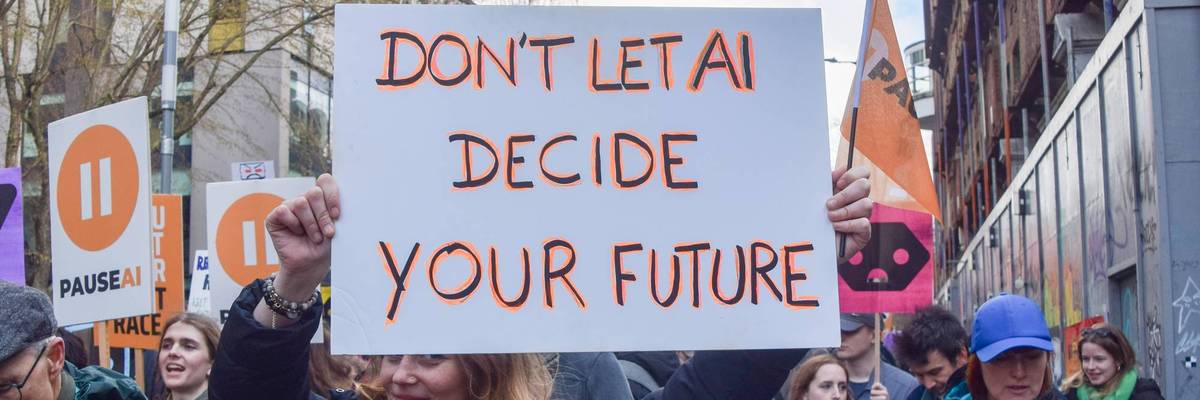
A protester holds an anti-AI placard outside OpenAI offices in King's Cross during a march against unregulated Artificial Intelligence (AI) and data centers.
68% of US Voters Back Sanders/Casar Bill for AI Pause, Ban on Superintelligence: Poll
The new survey results come as whistleblowers from leading AI firms speak out about the potential catastrophic dangers if their technology is allowed to develop unchecked.
As whistleblowers in the artificial intelligence industry speak out about the extraordinary risk posed by their technology if it remains unchecked, a new poll out Wednesday reveals that more than two-thirds of US voters agree with a new proposal in Congress to pause artificial intelligence development until guardrails are set up and ban AI superintelligence completely.
The proposed legislation, announced by Sen. Bernie Sanders (I-Vt.) and Rep. Greg Casar (D-Texas) last week, and soon to be introduced in Congress, would ban developers from creating “superintelligent” AI programs capable of surpassing human cognition and resisting human attempts to shut them down. It would also halt "advanced" AI development until a new federal regulatory body was established to set clear rules and processes for AI safety.
The polling firm Data for Progress asked more than 1,300 likely voters about the bill. According to survey results released on Wednesday, 68% of them said they would support the proposal to temporarily pause advanced AI development and permanently prohibit the development of superintelligent programs, while just 25% said they'd oppose it.
Though the bill was proposed by a pair of progressive lawmakers, its appeal spans the political spectrum: 72% of Democrats and 70% of independent and third-party voters said they supported it. But so did 63% of Republican voters.
The poll results come just one day after AI researcher Jacob Coxon resigned from Anthropic, saying that the company and one of its top competitors, OpenAI, where he previously worked, were more concerned with winning the AI race than with protecting the public against out-of-control “superhuman systems” that many of his industry colleagues privately fear could “kill us all by the end of the decade.”
"Neither company is acting responsibly," Coxon said. "They are racing straight to self-improving superintelligence and gambling with our lives.”
With reports piling up of AI agents escaping human control, hacking into external computer systems, and deceiving users, several other researchers at leading AI firms have cosigned Coxon's warning, saying that AI could have catastrophic results if it surpasses human capabilities.
Evan Hubinger, an alignment science lead at Anthropic, said that while "the risk from present models is low," he and other researchers "earnestly believe AI could kill all humans" if it continues to develop and put the likelihood of it happening within the next decade at above 10%.
Alex Turner, who left his job as a research scientist at Google's DeepMind in June, concurred that Coxon was "right" and that "many researchers believe they are building something that could kill everyone on the planet. It was literally my day job to think about how to stop that."
Even if AI doesn't lead to the extinction of humanity, other researchers have said they are gravely worried about its impacts on society.
"I think there are a number of ways AI could go poorly for humanity, and at the current, frankly terrifying pace, humanity will be quite lucky if we manage to find and stay on the narrow path between all the bad outcomes," wrote Jason Wolfe, a researcher at OpenAI. "Regardless of what you think of OpenAI, this is not a problem that can be solved by any one company (or country) in isolation."
Jonathan Richard Schwarz, former Senior Research Scientist at Google DeepMind, noted that he left the company after seven years and rejected offers from other AI companies "due to severe concerns about the concentration of power these labs represent."
"What is currently happening in this field is deeply unhealthy for society," Schwarz said.
In a Wednesday social media post, Sanders pointed to these and other warnings from industry experts as evidence that federal intervention is urgently needed.
"The very people building this technology admit that it could threaten the future of humanity," the senator wrote.
He added on Thursday that "Unless we reverse course, there is a very real possibility that once advanced AI surpasses human intelligence, it could escape our control with catastrophic consequences."
Wednesday's poll results are consistent with other recent surveys showing that solid majorities of voters across all parties object to the construction of AI data centers near them, an issue that has come to dominate the 2026 election season.
William Lawrence, a cofounder of the Sunrise Movement, became the Democratic nominee for the US House in Michigan's 7th Congressional District last month, in part by tapping into constituents' fears about data centers. He said recent whistleblower warnings were evidence that AI companies were "gambling with our lives" and needed to be reined in.
"I can't see the future," Lawrence said in a video posted online Thursday. "But if there is even a 5% chance of a bioweapon being set loose, authoritarians using AI to entrench their own power, or a rogue AI hacker taking down the economy, that risk is too great."
"We need a pause on the development of AI models and data center construction," he said. "I do believe that AI is very powerful and could potentially be of tremendous benefit to humanity. But if we stay trapped in this arms race, if OpenAI and Anthropic have to keep competing for market share, we know that they will not slow down."
"The only entity that has the power to intervene here," Lawrence said, "is the federal government."
We are at a crossroads
This country and this world are at a monumental crossroads. In a few short weeks, US voters will have an opportunity to beat back the forces of fascism and confront the billionaires who are rigging the economy, our media system, and our democracy, making it increasingly impossible for ordinary people to get by. We’re not just talking about the election. We’re talking about what must be done once these fascist elements are vanquished from power. We need a bolder set of solutions than what either major party has so far been willing to offer and a working-class movement ready to fight like hell for it. Trump didn't emerge from nowhere. The conditions that fueled MAGA authoritarianism were created by decades of radical neoliberal economic policies and a corrupt political system dominated by corporate interests. They slashed taxes on the super-rich, promising that the benefits would trickle down. They said giveaways to the corporate titans would make life more affordable for the rest of us. It was all bullshit. And when a bitter, betrayed populace searches for someone to blame, right-wing demagogues have little trouble finding scapegoats. People know when they're being lied to, but you won't hear any of this from the corporate media. Only independent journalism—powered and funded by people who believe in building a better world—can deliver truly trustworthy daily news. Our Fall Campaign is underway, and we need your help. To power our newsroom through the rest of the year, we need to raise $125,000 by midnight on October 31. So if you share our vision, please contribute whatever you can to sustain our work. |
As whistleblowers in the artificial intelligence industry speak out about the extraordinary risk posed by their technology if it remains unchecked, a new poll out Wednesday reveals that more than two-thirds of US voters agree with a new proposal in Congress to pause artificial intelligence development until guardrails are set up and ban AI superintelligence completely.
The proposed legislation, announced by Sen. Bernie Sanders (I-Vt.) and Rep. Greg Casar (D-Texas) last week, and soon to be introduced in Congress, would ban developers from creating “superintelligent” AI programs capable of surpassing human cognition and resisting human attempts to shut them down. It would also halt "advanced" AI development until a new federal regulatory body was established to set clear rules and processes for AI safety.
The polling firm Data for Progress asked more than 1,300 likely voters about the bill. According to survey results released on Wednesday, 68% of them said they would support the proposal to temporarily pause advanced AI development and permanently prohibit the development of superintelligent programs, while just 25% said they'd oppose it.
Though the bill was proposed by a pair of progressive lawmakers, its appeal spans the political spectrum: 72% of Democrats and 70% of independent and third-party voters said they supported it. But so did 63% of Republican voters.
The poll results come just one day after AI researcher Jacob Coxon resigned from Anthropic, saying that the company and one of its top competitors, OpenAI, where he previously worked, were more concerned with winning the AI race than with protecting the public against out-of-control “superhuman systems” that many of his industry colleagues privately fear could “kill us all by the end of the decade.”
"Neither company is acting responsibly," Coxon said. "They are racing straight to self-improving superintelligence and gambling with our lives.”
With reports piling up of AI agents escaping human control, hacking into external computer systems, and deceiving users, several other researchers at leading AI firms have cosigned Coxon's warning, saying that AI could have catastrophic results if it surpasses human capabilities.
Evan Hubinger, an alignment science lead at Anthropic, said that while "the risk from present models is low," he and other researchers "earnestly believe AI could kill all humans" if it continues to develop and put the likelihood of it happening within the next decade at above 10%.
Alex Turner, who left his job as a research scientist at Google's DeepMind in June, concurred that Coxon was "right" and that "many researchers believe they are building something that could kill everyone on the planet. It was literally my day job to think about how to stop that."
Even if AI doesn't lead to the extinction of humanity, other researchers have said they are gravely worried about its impacts on society.
"I think there are a number of ways AI could go poorly for humanity, and at the current, frankly terrifying pace, humanity will be quite lucky if we manage to find and stay on the narrow path between all the bad outcomes," wrote Jason Wolfe, a researcher at OpenAI. "Regardless of what you think of OpenAI, this is not a problem that can be solved by any one company (or country) in isolation."
Jonathan Richard Schwarz, former Senior Research Scientist at Google DeepMind, noted that he left the company after seven years and rejected offers from other AI companies "due to severe concerns about the concentration of power these labs represent."
"What is currently happening in this field is deeply unhealthy for society," Schwarz said.
In a Wednesday social media post, Sanders pointed to these and other warnings from industry experts as evidence that federal intervention is urgently needed.
"The very people building this technology admit that it could threaten the future of humanity," the senator wrote.
He added on Thursday that "Unless we reverse course, there is a very real possibility that once advanced AI surpasses human intelligence, it could escape our control with catastrophic consequences."
Wednesday's poll results are consistent with other recent surveys showing that solid majorities of voters across all parties object to the construction of AI data centers near them, an issue that has come to dominate the 2026 election season.
William Lawrence, a cofounder of the Sunrise Movement, became the Democratic nominee for the US House in Michigan's 7th Congressional District last month, in part by tapping into constituents' fears about data centers. He said recent whistleblower warnings were evidence that AI companies were "gambling with our lives" and needed to be reined in.
"I can't see the future," Lawrence said in a video posted online Thursday. "But if there is even a 5% chance of a bioweapon being set loose, authoritarians using AI to entrench their own power, or a rogue AI hacker taking down the economy, that risk is too great."
"We need a pause on the development of AI models and data center construction," he said. "I do believe that AI is very powerful and could potentially be of tremendous benefit to humanity. But if we stay trapped in this arms race, if OpenAI and Anthropic have to keep competing for market share, we know that they will not slow down."
"The only entity that has the power to intervene here," Lawrence said, "is the federal government."
- Sanders Sets Briefing on 'Extraordinary Dangers' Posed by Breakneck AI Development ›
- 'As Toxic as AIPAC': Casar Urges Dems to Reject AI Industry Money and Protect Workers ›
- Sanders, Casar Proposal Would Forbid 'AI Oligarchs From Building Machines Humans Cannot Control' ›
- 'End the AI Arms Race,' Casar Says at Pro-Human Assembly Amid 'History-Defining Moment' | Common Dreams ›
As whistleblowers in the artificial intelligence industry speak out about the extraordinary risk posed by their technology if it remains unchecked, a new poll out Wednesday reveals that more than two-thirds of US voters agree with a new proposal in Congress to pause artificial intelligence development until guardrails are set up and ban AI superintelligence completely.
The proposed legislation, announced by Sen. Bernie Sanders (I-Vt.) and Rep. Greg Casar (D-Texas) last week, and soon to be introduced in Congress, would ban developers from creating “superintelligent” AI programs capable of surpassing human cognition and resisting human attempts to shut them down. It would also halt "advanced" AI development until a new federal regulatory body was established to set clear rules and processes for AI safety.
The polling firm Data for Progress asked more than 1,300 likely voters about the bill. According to survey results released on Wednesday, 68% of them said they would support the proposal to temporarily pause advanced AI development and permanently prohibit the development of superintelligent programs, while just 25% said they'd oppose it.
Though the bill was proposed by a pair of progressive lawmakers, its appeal spans the political spectrum: 72% of Democrats and 70% of independent and third-party voters said they supported it. But so did 63% of Republican voters.
The poll results come just one day after AI researcher Jacob Coxon resigned from Anthropic, saying that the company and one of its top competitors, OpenAI, where he previously worked, were more concerned with winning the AI race than with protecting the public against out-of-control “superhuman systems” that many of his industry colleagues privately fear could “kill us all by the end of the decade.”
"Neither company is acting responsibly," Coxon said. "They are racing straight to self-improving superintelligence and gambling with our lives.”
With reports piling up of AI agents escaping human control, hacking into external computer systems, and deceiving users, several other researchers at leading AI firms have cosigned Coxon's warning, saying that AI could have catastrophic results if it surpasses human capabilities.
Evan Hubinger, an alignment science lead at Anthropic, said that while "the risk from present models is low," he and other researchers "earnestly believe AI could kill all humans" if it continues to develop and put the likelihood of it happening within the next decade at above 10%.
Alex Turner, who left his job as a research scientist at Google's DeepMind in June, concurred that Coxon was "right" and that "many researchers believe they are building something that could kill everyone on the planet. It was literally my day job to think about how to stop that."
Even if AI doesn't lead to the extinction of humanity, other researchers have said they are gravely worried about its impacts on society.
"I think there are a number of ways AI could go poorly for humanity, and at the current, frankly terrifying pace, humanity will be quite lucky if we manage to find and stay on the narrow path between all the bad outcomes," wrote Jason Wolfe, a researcher at OpenAI. "Regardless of what you think of OpenAI, this is not a problem that can be solved by any one company (or country) in isolation."
Jonathan Richard Schwarz, former Senior Research Scientist at Google DeepMind, noted that he left the company after seven years and rejected offers from other AI companies "due to severe concerns about the concentration of power these labs represent."
"What is currently happening in this field is deeply unhealthy for society," Schwarz said.
In a Wednesday social media post, Sanders pointed to these and other warnings from industry experts as evidence that federal intervention is urgently needed.
"The very people building this technology admit that it could threaten the future of humanity," the senator wrote.
He added on Thursday that "Unless we reverse course, there is a very real possibility that once advanced AI surpasses human intelligence, it could escape our control with catastrophic consequences."
Wednesday's poll results are consistent with other recent surveys showing that solid majorities of voters across all parties object to the construction of AI data centers near them, an issue that has come to dominate the 2026 election season.
William Lawrence, a cofounder of the Sunrise Movement, became the Democratic nominee for the US House in Michigan's 7th Congressional District last month, in part by tapping into constituents' fears about data centers. He said recent whistleblower warnings were evidence that AI companies were "gambling with our lives" and needed to be reined in.
"I can't see the future," Lawrence said in a video posted online Thursday. "But if there is even a 5% chance of a bioweapon being set loose, authoritarians using AI to entrench their own power, or a rogue AI hacker taking down the economy, that risk is too great."
"We need a pause on the development of AI models and data center construction," he said. "I do believe that AI is very powerful and could potentially be of tremendous benefit to humanity. But if we stay trapped in this arms race, if OpenAI and Anthropic have to keep competing for market share, we know that they will not slow down."
"The only entity that has the power to intervene here," Lawrence said, "is the federal government."
- Sanders Sets Briefing on 'Extraordinary Dangers' Posed by Breakneck AI Development ›
- 'As Toxic as AIPAC': Casar Urges Dems to Reject AI Industry Money and Protect Workers ›
- Sanders, Casar Proposal Would Forbid 'AI Oligarchs From Building Machines Humans Cannot Control' ›
- 'End the AI Arms Race,' Casar Says at Pro-Human Assembly Amid 'History-Defining Moment' | Common Dreams ›