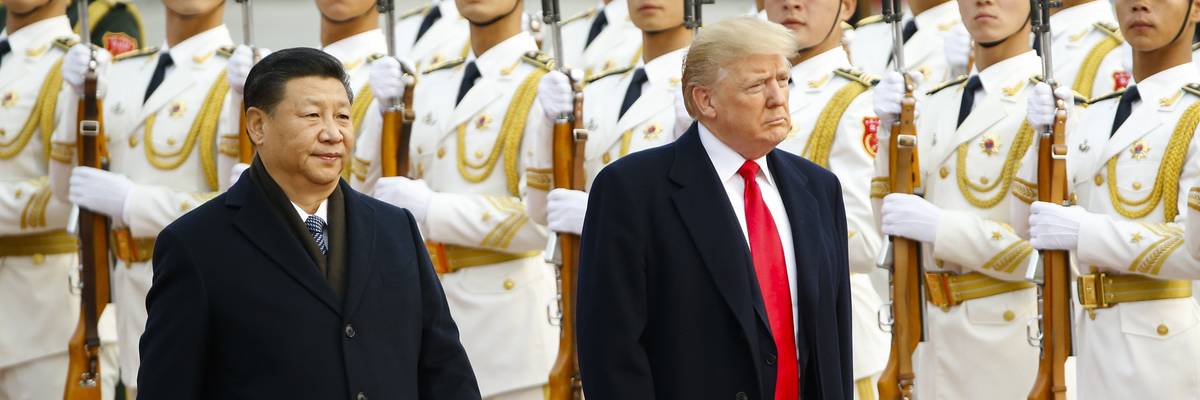
US President Donald Trump takes part in a welcoming ceremony with China's President Xi Jinping on November 9, 2017 in Beijing, China. Trump is on a 10-day trip to Asia.
Sanders Urges 'Great Deal Maker' Trump to Forge 'Comprehensive' AI Treaty With China
"In order to prevent a nuclear war, Reagan and Gorbachev negotiated a nuclear arms agreement in the 1980s. In order to prevent AI from acting independently of human control, Trump and Xi must do the same."
Amid intensifying debate in the US about domestic regulation of the artificial intelligence industry, Sen. Bernie Sanders on Sunday called on US President Donald Trump to end his hands-off approach to AI on the international stage by engaging directly and urgently with China to forestall a global AI race that could have devastating consequences in the years and decades ahead.
"President Trump prides himself on being a great deal maker," Sanders asserted in a social media post. "Well. He now has the opportunity to make 'the deal of the century," by reaching out to the Chinese government."
"With the future of humanity at stake," said Sanders, "Trump must negotiate a comprehensive treaty with President Xi of China to establish a pause on advanced AI development and a ban on superintelligence."
While major US-based tech companies—including OpenAI, Anthropic, Meta, Google, and others—race to unlock AI's potential, Chinese companies and researchers are seen as the main competition in the effort to win the technological race. With fresh warnings from industry insiders over recent weeks dominating headlines, AI experts and watchdog groups have said that a coordinated "pause" or a global treaty to govern the technology's future development is desperately needed.
With the question about whether unregulated AI has the potential to "wipe out humanity" if not curtailed dominating headlines and political conversations, Trump on Sunday downplayed such concerns while putting the issue in zero-sum terms, declaring that "whoever wins AI, wins."
"We're leading China in AI, we're the most sophisticated in the world, and frankly, I want to keep it that way," Trump said.
While Anthropic's CEO Dario Amodei backed the call to "hit the brakes" on AI in certain ways in a nearly 4,000-word essay on the subject published over the weekend, he explained to CBS News on Sunday that the "toughest aspect of our situation" for industry leaders in the US is what to do if China would not honor such a slowdown.
China has acknowledged the international competition and tensions driven by technology, but has also expressed skepticism about comments from US industry leaders and the Trump administration's position.
“Fearmongering, confrontation, and vicious competition will only disrupt the process of global AI governance which serves no one’s interest,” said Guo Jiakun, a spokesperson for the Chinese Foreign Ministry, said at a Monday press conference in Beijing.
"All parties should work together to advance AI in a manner that is open, inclusive, beneficial to all, and oriented toward the good," Jiakun added.
In a statement last week, however, China's Ministry of Commerce said accusations by the US about Chinese efforts only offer "further proof that the US is pursuing technological hegemony in AI, seeking to monopolize computing power, and suppressing competition," an effort that "China firmly opposes."
With Trump scheduled to meet with Chinese leader Xi Jinping later this month, AI governance is not expected to be high on the list of topics discussed.
Speaking with the BBC, Chang Jun Yan, an assistant professor with the military studies program at Singapore's S Rajaratnam School of International Studies, said a deal between Washington and Beijing on AI would be "next to impossible."
"As part of each state's core national security interests, cooperation in taking things slower and more safely in relation to AI is very, very unlikely," he argued.
In his Sunday statement, however, Sanders said diplomatic efforts—regardless of the difficulties—must be forged, and suggested that the US and China have a special responsibility when it comes to the powerful technology. Offering a historical analogy, Sanders cited the nuclear treaty brokered by US President Ronald Reagan and the Soviet Union's Mikhail Gorbachev in 1987.
"In order to prevent a nuclear war, Reagan and Gorbachev negotiated a nuclear arms agreement in the 1980s," Sanders said in his Sunday message. "In order to prevent AI from acting independently of human control, Trump and Xi must do the same."
We are at a crossroads
This country and this world are at a monumental crossroads. In a few short weeks, US voters will have an opportunity to beat back the forces of fascism and confront the billionaires who are rigging the economy, our media system, and our democracy, making it increasingly impossible for ordinary people to get by. We’re not just talking about the election. We’re talking about what must be done once these fascist elements are vanquished from power. We need a bolder set of solutions than what either major party has so far been willing to offer and a working-class movement ready to fight like hell for it. Trump didn't emerge from nowhere. The conditions that fueled MAGA authoritarianism were created by decades of radical neoliberal economic policies and a corrupt political system dominated by corporate interests. They slashed taxes on the super-rich, promising that the benefits would trickle down. They said giveaways to the corporate titans would make life more affordable for the rest of us. It was all bullshit. And when a bitter, betrayed populace searches for someone to blame, right-wing demagogues have little trouble finding scapegoats. People know when they're being lied to, but you won't hear any of this from the corporate media. Only independent journalism—powered and funded by people who believe in building a better world—can deliver truly trustworthy daily news. Our Fall Campaign is underway, and we need your help. To power our newsroom through the rest of the year, we need to raise $125,000 by midnight on October 31. So if you share our vision, please contribute whatever you can to sustain our work. |
Amid intensifying debate in the US about domestic regulation of the artificial intelligence industry, Sen. Bernie Sanders on Sunday called on US President Donald Trump to end his hands-off approach to AI on the international stage by engaging directly and urgently with China to forestall a global AI race that could have devastating consequences in the years and decades ahead.
"President Trump prides himself on being a great deal maker," Sanders asserted in a social media post. "Well. He now has the opportunity to make 'the deal of the century," by reaching out to the Chinese government."
"With the future of humanity at stake," said Sanders, "Trump must negotiate a comprehensive treaty with President Xi of China to establish a pause on advanced AI development and a ban on superintelligence."
While major US-based tech companies—including OpenAI, Anthropic, Meta, Google, and others—race to unlock AI's potential, Chinese companies and researchers are seen as the main competition in the effort to win the technological race. With fresh warnings from industry insiders over recent weeks dominating headlines, AI experts and watchdog groups have said that a coordinated "pause" or a global treaty to govern the technology's future development is desperately needed.
With the question about whether unregulated AI has the potential to "wipe out humanity" if not curtailed dominating headlines and political conversations, Trump on Sunday downplayed such concerns while putting the issue in zero-sum terms, declaring that "whoever wins AI, wins."
"We're leading China in AI, we're the most sophisticated in the world, and frankly, I want to keep it that way," Trump said.
While Anthropic's CEO Dario Amodei backed the call to "hit the brakes" on AI in certain ways in a nearly 4,000-word essay on the subject published over the weekend, he explained to CBS News on Sunday that the "toughest aspect of our situation" for industry leaders in the US is what to do if China would not honor such a slowdown.
China has acknowledged the international competition and tensions driven by technology, but has also expressed skepticism about comments from US industry leaders and the Trump administration's position.
“Fearmongering, confrontation, and vicious competition will only disrupt the process of global AI governance which serves no one’s interest,” said Guo Jiakun, a spokesperson for the Chinese Foreign Ministry, said at a Monday press conference in Beijing.
"All parties should work together to advance AI in a manner that is open, inclusive, beneficial to all, and oriented toward the good," Jiakun added.
In a statement last week, however, China's Ministry of Commerce said accusations by the US about Chinese efforts only offer "further proof that the US is pursuing technological hegemony in AI, seeking to monopolize computing power, and suppressing competition," an effort that "China firmly opposes."
With Trump scheduled to meet with Chinese leader Xi Jinping later this month, AI governance is not expected to be high on the list of topics discussed.
Speaking with the BBC, Chang Jun Yan, an assistant professor with the military studies program at Singapore's S Rajaratnam School of International Studies, said a deal between Washington and Beijing on AI would be "next to impossible."
"As part of each state's core national security interests, cooperation in taking things slower and more safely in relation to AI is very, very unlikely," he argued.
In his Sunday statement, however, Sanders said diplomatic efforts—regardless of the difficulties—must be forged, and suggested that the US and China have a special responsibility when it comes to the powerful technology. Offering a historical analogy, Sanders cited the nuclear treaty brokered by US President Ronald Reagan and the Soviet Union's Mikhail Gorbachev in 1987.
"In order to prevent a nuclear war, Reagan and Gorbachev negotiated a nuclear arms agreement in the 1980s," Sanders said in his Sunday message. "In order to prevent AI from acting independently of human control, Trump and Xi must do the same."
- Amid Fears of Killer Robots, Humanoid MMA Fight in China Ends With Decapitation ›
- The AI Emergency Is Already Here—and Progressives Must Confront It ›
- 'Hit the Brakes': Anthropic CEO's Push to 'Pace' AI Development Called Latest Sign Congress Must Act ›
- Opinion | Trump Stupidity and Recklessness vs Superintelligence | Common Dreams ›