SUBSCRIBE TO OUR FREE NEWSLETTER
Daily news & progressive opinion—funded by the people, not the corporations—delivered straight to your inbox.
5
#000000
#FFFFFF
To donate by check, phone, or other method, see our More Ways to Give page.
Daily news & progressive opinion—funded by the people, not the corporations—delivered straight to your inbox.
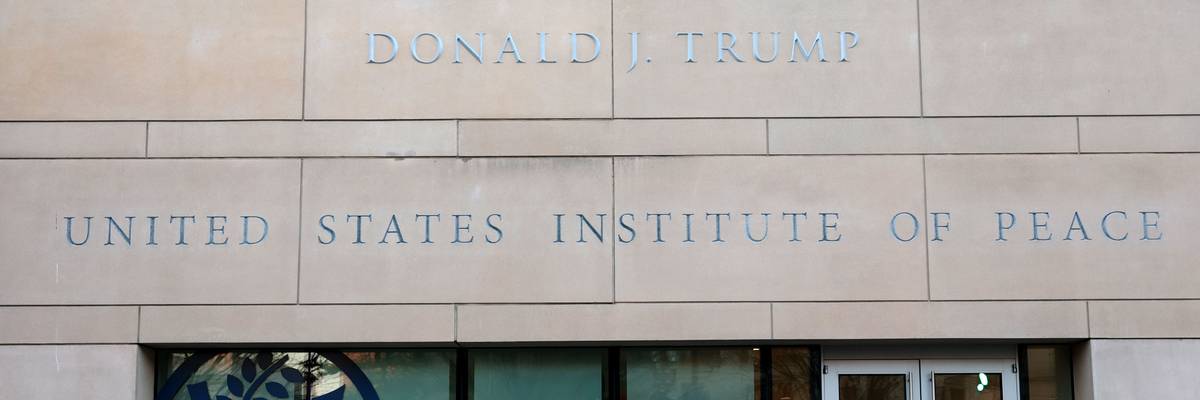
US President Donald Trump's name is seen recently placed on the outside of the United States Institute of Peace (USIP) building headquarters on December 3, 2025 in Washington, DC.
A year ago, the Trump administration abruptly terminated 40 years of conflict resolution work by the US Institute of Peace and confiscated its building. Renamed the “Donald J. Trump Institute of Peace,” it became the home for his nascent Board of Peace, which appears to be floundering in its attempts to bring peace to Gaza.
Established by Congress in 1984, with legislation signed by Ronald Reagan and funded annually by Congress, the United States Institute of Peace, or USIP, was a well-respected, authoritative, independent, officially nonpartisan, nonprofit organization, until it was eviscerated by President Donald Trump early last year.
Its purpose was to promote conflict prevention and resolution worldwide and to provide analysis, research, and training in diplomacy, mediation, and peace-related activities. In 2011, the Association of Professional Schools of International Affairs wrote that USIP “helped to build the conflict management and resolution field, both as an area of study and as an applied science.”
The institute had a staff of 300 professionals; a budget of $55 million; published numerous research reports on peace issues around the world; and trained 65,000 professionals. Although the institute’s extremely useful database was wantonly destroyed, one can see the breadth and depth of its important work by sampling some of its publications here.
Construction of an impressive $153 million building near the State Department was completed in 2011 but confiscated by the Trump administration in March 2025 with the help of the institute’s former security vendor, the FBI, and the DC Metropolitan Police. A few months later, it was renamed the “Donald J. Trump Institute of Peace” and has since become the home for his “Board of Peace.” An account of the events leading to this outcome explains the shameful way in which this was carried out:
The lesson from these two tragedies—the demise of the US Institute of Peace and the likely failure of the Board of Peace—is that voters must, in the future, avoid electing someone to a position of great power who doesn’t know what he doesn’t know.
One month after assuming office for the second time, on February 19, Trump signed an executive order calling for the elimination of USIP. The next day, USIP was contacted by a representative from the newly established “Department of Government Efficiency” (DOGE), set up by Trump under Elon Musk—allegedly to reduce government expenditure, but actually to eliminate institutions that Trump and the Heritage Foundation’s Project 2025 didn’t like. In a virtual meeting a few days later, USIP’s president-CEO and lawyer explained to three DOGE representatives that the institute was an “independent, nonprofit corporation outside the executive branch.”
When, on March 8, USIP’s president learned that DOGE had inquired about the status of the organization’s security arrangements, its lawyer contacted DOGE to explain that unauthorized personnel would only be admitted to the building with a valid court-issued warrant.
On March 14, all Biden-appointed members of USIP’s Board of Directors were fired by Trump. Three ex-officio members—Marco Rubio; Pete Hegseth; and Peter Garvin, president of the National Defense University—remained on the board.
The same day, a representative of DOGE and a State Department official arrived at USIP and requested entry, but were denied. That evening, two DOGE members arrived with FBI agents and a directive signed by Rubio, Hegseth, and Garvin to remove the president, naming a new acting president. They were again denied entry, with the USIP lawyer declaring the directive illegal.
The next day, the lawyer learned that two FBI agents had visited the home of USIP’s security vendor to discover how to gain physical entry to its headquarters; it was later reported that they threatened the vendor by warning that, if he didn’t comply, he would lose all government contracts. The lawyer contacted the FBI agents to inform them that all inquiries about USIP should be directed to him. Subsequently, the FBI also contacted USIP’s chief security officer to discuss the institute’s security procedures and threatened that he was the subject of investigation by the Department of Justice into denied entry.
Later that day, the US attorney for the District of Colombia Criminal Division Chief called the USIP lawyer, requesting access to the headquarters by Rubio and Hegseth to inspect records and books. The lawyer said he would provide access with a written request. The US attorney informed him that there was suspicion that USIP was engaging in criminal behavior. He also said that representatives would be sent to USIP headquarters the next day and that they would criminally investigate anyone who obstructed access.
USIP then suspended its security vendor’s contract, and its chief security officer deactivated the vendor’s staff badges and retrieved all physical keys except a master. But the next day, four security vendor employees arrived at USIP HQ and attempted to enter the building. They were ultimately admitted, but informed by the lawyer that they were trespassing. The chief security officer called 911 and reported them as intruders.
Armed Metropolitan Police officers then arrived at the USIP HQ and escorted the chief security officer, the USIP lawyer, and other staff from the building and turned the building over to DOGE.
Although members of the former Board of Directors contested the takeover in court, citing the agency’s independent status—and a first court ruling ruled in the institute’s favor—a federal court of appeals stayed the lower court’s ruling and, after a short reprieve, the building was returned to DOGE, which then took down USIP’s website, containing years of work.
It was later reported that DOGE’s physical occupation of the building led to thousands of dollars in damage, leaving the facility in disarray and littered with drugs and cockroaches.
The building and USIP’s assets were transferred to the General Services Administration and Office of Management and Budget Director, Russell Vought (who was involved in Project 2025) signed off on the transfer. On December 3, 2025, the State Department had “The Donald J. Trump Institute of Peace” inscribed on the outside of the building.
The Board of Peace (BOP) was established to implement Trump’s “Comprehensive Plan to End the Gaza Conflict,” a 20-point plan drawn up by Jared Kushner and Steve Witkoff and subsequently negotiated with Israel and Hamas with input from a number of Arab and Muslim countries. The agreement was signed on October 9, 2025 and came into force the next day. It was endorsed by United Nations Security Council Resolution 2803 on November 17, with 13 members of the council in favor and Russia and China abstaining.
The first phase of the plan began before the BOP was formed and involved the initial withdrawal of Israeli troops to agreed-upon deployment lines (although this did not hold and almost daily ceasefire violations ensued). It also involved the return to Israel by Hamas of all living hostages, as well as the remains of those deceased. This was followed by the release by Israel of a large number of Palestinian prisoners, including remains of those deceased. Humanitarian aid was gradually reintroduced by UN agencies and their partners, although needs continue to be extensive and restoration of basic services is far from complete. The Rafah border crossing was also reopened, although sporadically closed again.
On January 15, 2026, Trump announced the formation of a Board of Peace whose charter (drawn up by his administration) named Trump as its chairman for life and gave him extensive unilateral powers over the board. In his usual self-congratulatory style, he wrote on Truth Social, “I can say with certainty that it is the Greatest and Most Prestigious Board ever assembled at any time, any place.” He added that it “would be the most consequential international body in History.”
In the future, the pursuit of international peace and security must be left to the United Nations, which represents the entire world; is backed by the force of international law; and has extensive experience.
Trump invited some 60 countries to join his BOP, including Israel, although no sub-Saharan African country was invited. Israeli Prime Minister Benjamin Netanyahu initially refused because invitations had not been coordinated with him and he disapproved of invitations to Türkiye and Qatar. After further discussion with Trump, Israel agreed to join—along with 27 other countries. More than half of those invited, however, declined, concerned that its new charter was an attempt to establish a “Trump-dominated alternative to the United Nations” and could undermine the role of the UN and other multilateral organizations. Countries that agreed were appointed for a three-year term with those wanting lifetime membership required to contribute $1 billion.
It was also announced that Bulgarian Nikolay Mladenov, the former UN special coordinator for the Middle East Peace Process, would become director-general of the board and high representative for Gaza. As well, General Jasper Jeffers, was appointed commander of the planned International Stabilization Force.
A nine-member Executive Board was formed with seven who have close ties to Trump. The eighth member is Indian-born Ajay Banga, also a US citizen, who is president of the World Bank Group. Tony Blair is the only non-American.
Amid much fanfare, the BOP was officially launched on January 22, 2026 at the 56th World Economic Forum in Davos with Trump signing its charter in the presence of 19 new members.
After the signing, Jared Kushner made a presentation of plans for a “New Gaza,” using AI-generated slides, showing gleaming skyscrapers, deluxe hotels, and luxury villas lining Gaza’s Mediterranean shoreline, “reserved for coastal tourism.” Entirely new cities with multistory apartment buildings for Palestinians were also shown, as well as schools and hospitals, with sports facilities and parks breaking up industrial complexes, data centers, and advanced manufacturing facilities, as well as a new airport and port.
Kushner’s presentation was in stark contrast to the current reality of Gaza, where 2 million Palestinians live in tents and bombed-out buildings, amid 90,000 tons of rubble, with vastly insufficient food, water, electricity, fuel, healthcare, and medicine. The plans, which seemed more suited for wealthy tourists than for poor Palestinians, apparently had no Palestinian input and were coordinated with an Israeli real estate billionaire (later invited by Kushner to be on the BOP’s Gaza Executive Committee). They also seemed totally out-of-touch with the current or past crowded demographic situation in Gaza and appeared designed to enrich opportunistic developers.
The first and only meeting of the BOP was held on February 19 at the newly named Donald J. Trump Institute of Peace, designated as the seat of the board. There have been no further meetings—presumably, because Trump has been consumed by his war with Iran which he initiated nine days later.
At this meeting, nine members (Kazakhstan, Azerbaijan, the UAE, Morocco, Bahrain, Qatar, Saudi Arabia, Uzbekistan, and Kuwait) pledged $7 billion for the reconstruction of Gaza, and Trump announced a $10 billion pledge, although without consulting Congress. FIFA, which also attended, pledged $50 million for football facilities. It is estimated that $70 billion is required to rebuild the territory.
Five members (Indonesia, Morocco, Kazakhstan, Kosovo, and Albania) agreed to provide troops for the temporary International Stabilization Force (ISF), which the Security Council had authorized the BOP to create. It is intended to work with a newly trained and vetted Palestinian police force to oversee the ceasefire; monitor the security environment and borders; decommission weapons; destroy terrorist infrastructure (e.g., tunnels); and protect civilians and humanitarian operations.
Also at this meeting, Egypt and Jordan committed to training the police force. The plan is to deploy 20,000 ISF troops and 12,000 police. However, to date, neither the ISF nor the police force has deployed.
A National Committee for the Administration of Gaza (NCAG) was also formed of Palestinian technocrats under BOP supervision, led by Dr. Ali Shaath, a civil engineer from Gaza who held senior roles in the Ramallah-based Palestinian Authority. But the NCAG has not been able to enter Gaza, because the ISF meant to disarm Hamas and secure parts of Gaza has not materialized—so it remains in Cairo, unable to exercise any authority in Gaza.
More recently, on July 30, a 15-point “Roadmap for Completing the Implementation of President Trump’s Comprehensive Peace Plan in Gaza” was published. Hamas agreed to the road map and announced that it would dissolve its government in Gaza and disarm, appealing to the international community to push Israel to allow the NCAG to enter Gaza and take over.
Until now, Israel has refused to agree to the road map, arguing, in contradiction to the road map’s prescription for a phased Israel Defense Forces withdrawal from the parts of Gaza where Hamas disarmament has been completed and verified, that it won’t withdraw its troops at all until Hamas has totally disarmed everywhere.
There is, of course, always the possibility that things will change, if Trump can persuade Netanyahu to comply, or if the upcoming Israeli elections change the situation. But for the moment, things appear deadlocked.
There are also questions about BOP finances. When Marco Rubio recently requested that Congress transfer $50 million to the BOP from the State Department budget for international organizations (from which it has not yet paid its 2026 UN dues), Rep. Jamie Raskin (D-Md), ranking member of the House Committee on the Judiciary, and Rep. Gregory Meeks (D-NY), ranking member of the House Committee on Foreign Affairs, called for Rubio to “answer basic questions about the board’s structure, funding, and oversight, nine months after its creation.” In a confronting letter that can be read here, they write:
We thus have a profusion of questions about this mysterious operation: What is the Board of Peace? Is it a public or private entity? International or domestic? Is it registered as a corporation in the United States or abroad? What kind of corporation is it—for-profit or not-for-profit? Who controls the funds in its J.P. Morgan bank account? In what countries are those accounts located? Who will audit those funds and conduct oversight of the Board? What does President Trump intend to do with this vast slush fund while he is in office—or after he leaves? Can anyone assure Congress that billions of dollars from US taxpayers and foreign governments will not be flowing into the pockets of President Trump, members of his family, corrupt or incompetent contractors or business partners, or political allies and foot soldiers of the President?
The bottom line is that realizing the aspirations of the Comprehensive Plan with BOP oversight is an exceedingly tall order, given the utter devastation of Gaza, its infrastructure, and its people—and the extremely fraught political difficulties of getting Israel and Hamas to adhere to what they have agreed. Implementation of this process has been incremental, slow, and is at a virtual standstill. Although members of the NCAG have begun work in Egypt, they have not been able to deploy to Gaza. Although some funds have been pledged, most have not materialized. The same is true for pledges of ISF troops.
It will be exceedingly difficult for a new organization without full-fledged international support and clout, and without sufficiently experienced staff to know what approaches are most effective in peace building, creating new governance structures, and carrying out disarmament. At the moment, the whole endeavor looks more like a slow-motion train wreck than the effective implementation of a viable peace process.
As Mladenov warned at an August 26 meeting of the Security Council, called to discuss the obstacles—if the ceasefire is allowed to collapse, “There will be no road map to return to, there will be no administration to deploy, and there will be nothing left on the ground to rebuild... It would be a point of no return for everyone.”
The lesson from these two tragedies—the demise of the US Institute of Peace and the likely failure of the Board of Peace—is that voters must, in the future, avoid electing someone to a position of great power who doesn’t know what he doesn’t know and who has the hubris to create his own half-baked, cobbled-together international Board of Peace to try to resolve one of the world’s most intractable conflicts, allegedly in the hope of being awarded a Nobel Peace Prize—just like Barrack Obama.
Trump has even implied that somehow the BOP could replace the UN, saying, “Well, it might.” But what he doesn’t understand is that the legal foundations of the two are totally different. “The Security Council derives its authority from the UN Charter, a treaty ratified by UN Member States that explicitly assigned it primary responsibility for the maintenance of international peace and security. That mandate was conferred collectively by the international community and cannot be replicated.” Also, there is the question of binding authority: “UN Member States are obliged to carry out decisions of the Security Council. The Board of Peace has no comparable mechanism.”
Thus, in the future, the pursuit of international peace and security must be left to the United Nations, which represents the entire world; is backed by the force of international law; and has extensive experience in preventive diplomacy, peacemaking, peacekeeping, and post-conflict peace building.
In the case of Israel, however, the UN has been effectively sidelined, since the Israeli administration, and even much of the Israeli public, harbor a deep antipathy for the UN because of its past condemnation of Israeli behavior, which is nearly always vetoed by the US in the UN Security Council.
This means that the Comprehensive Plan and the BOP are “the only game in town.” Given that winter is on its way and 2 million Palestinians who are already in grave danger will once again be exposed to its ravages, it leaves one hoping against hope, in spite of major concerns about the BOP, that there is some way to salvage the Comprehensive Plan, so that the tremendous suffering by the people of Gaza can finally be lessened.
Dear Common Dreams reader, It’s been nearly 30 years since I co-founded Common Dreams with my late wife, Lina Newhouser. We had the radical notion that journalism should serve the public good, not corporate profits. It was clear to us from the outset what it would take to build such a project. No paid advertisements. No corporate sponsors. No millionaire publisher telling us what to think or do. Many people said we wouldn't last a year, but we proved those doubters wrong. Together with a tremendous team of journalists and dedicated staff, we built an independent media outlet free from the constraints of profits and corporate control. Our mission has always been simple: To inform. To inspire. To ignite change for the common good. Building Common Dreams was not easy. Our survival was never guaranteed. When you take on the most powerful forces—Wall Street greed, fossil fuel industry destruction, Big Tech lobbyists, and uber-rich oligarchs who have spent billions upon billions rigging the economy and democracy in their favor—the only bulwark you have is supporters who believe in your work. But here’s the urgent message from me today. It's never been this bad out there. And it's never been this hard to keep us going. At the very moment Common Dreams is most needed, the threats we face are intensifying. We need your support now more than ever. We don't accept corporate advertising and never will. We don't have a paywall because we don't think people should be blocked from critical news based on their ability to pay. Everything we do is funded by the donations of readers like you. When everyone does the little they can afford, we are strong. But if that support retreats or dries up, so do we. Will you donate now to make sure Common Dreams not only survives but thrives? —Craig Brown, Co-founder |
Established by Congress in 1984, with legislation signed by Ronald Reagan and funded annually by Congress, the United States Institute of Peace, or USIP, was a well-respected, authoritative, independent, officially nonpartisan, nonprofit organization, until it was eviscerated by President Donald Trump early last year.
Its purpose was to promote conflict prevention and resolution worldwide and to provide analysis, research, and training in diplomacy, mediation, and peace-related activities. In 2011, the Association of Professional Schools of International Affairs wrote that USIP “helped to build the conflict management and resolution field, both as an area of study and as an applied science.”
The institute had a staff of 300 professionals; a budget of $55 million; published numerous research reports on peace issues around the world; and trained 65,000 professionals. Although the institute’s extremely useful database was wantonly destroyed, one can see the breadth and depth of its important work by sampling some of its publications here.
Construction of an impressive $153 million building near the State Department was completed in 2011 but confiscated by the Trump administration in March 2025 with the help of the institute’s former security vendor, the FBI, and the DC Metropolitan Police. A few months later, it was renamed the “Donald J. Trump Institute of Peace” and has since become the home for his “Board of Peace.” An account of the events leading to this outcome explains the shameful way in which this was carried out:
The lesson from these two tragedies—the demise of the US Institute of Peace and the likely failure of the Board of Peace—is that voters must, in the future, avoid electing someone to a position of great power who doesn’t know what he doesn’t know.
One month after assuming office for the second time, on February 19, Trump signed an executive order calling for the elimination of USIP. The next day, USIP was contacted by a representative from the newly established “Department of Government Efficiency” (DOGE), set up by Trump under Elon Musk—allegedly to reduce government expenditure, but actually to eliminate institutions that Trump and the Heritage Foundation’s Project 2025 didn’t like. In a virtual meeting a few days later, USIP’s president-CEO and lawyer explained to three DOGE representatives that the institute was an “independent, nonprofit corporation outside the executive branch.”
When, on March 8, USIP’s president learned that DOGE had inquired about the status of the organization’s security arrangements, its lawyer contacted DOGE to explain that unauthorized personnel would only be admitted to the building with a valid court-issued warrant.
On March 14, all Biden-appointed members of USIP’s Board of Directors were fired by Trump. Three ex-officio members—Marco Rubio; Pete Hegseth; and Peter Garvin, president of the National Defense University—remained on the board.
The same day, a representative of DOGE and a State Department official arrived at USIP and requested entry, but were denied. That evening, two DOGE members arrived with FBI agents and a directive signed by Rubio, Hegseth, and Garvin to remove the president, naming a new acting president. They were again denied entry, with the USIP lawyer declaring the directive illegal.
The next day, the lawyer learned that two FBI agents had visited the home of USIP’s security vendor to discover how to gain physical entry to its headquarters; it was later reported that they threatened the vendor by warning that, if he didn’t comply, he would lose all government contracts. The lawyer contacted the FBI agents to inform them that all inquiries about USIP should be directed to him. Subsequently, the FBI also contacted USIP’s chief security officer to discuss the institute’s security procedures and threatened that he was the subject of investigation by the Department of Justice into denied entry.
Later that day, the US attorney for the District of Colombia Criminal Division Chief called the USIP lawyer, requesting access to the headquarters by Rubio and Hegseth to inspect records and books. The lawyer said he would provide access with a written request. The US attorney informed him that there was suspicion that USIP was engaging in criminal behavior. He also said that representatives would be sent to USIP headquarters the next day and that they would criminally investigate anyone who obstructed access.
USIP then suspended its security vendor’s contract, and its chief security officer deactivated the vendor’s staff badges and retrieved all physical keys except a master. But the next day, four security vendor employees arrived at USIP HQ and attempted to enter the building. They were ultimately admitted, but informed by the lawyer that they were trespassing. The chief security officer called 911 and reported them as intruders.
Armed Metropolitan Police officers then arrived at the USIP HQ and escorted the chief security officer, the USIP lawyer, and other staff from the building and turned the building over to DOGE.
Although members of the former Board of Directors contested the takeover in court, citing the agency’s independent status—and a first court ruling ruled in the institute’s favor—a federal court of appeals stayed the lower court’s ruling and, after a short reprieve, the building was returned to DOGE, which then took down USIP’s website, containing years of work.
It was later reported that DOGE’s physical occupation of the building led to thousands of dollars in damage, leaving the facility in disarray and littered with drugs and cockroaches.
The building and USIP’s assets were transferred to the General Services Administration and Office of Management and Budget Director, Russell Vought (who was involved in Project 2025) signed off on the transfer. On December 3, 2025, the State Department had “The Donald J. Trump Institute of Peace” inscribed on the outside of the building.
The Board of Peace (BOP) was established to implement Trump’s “Comprehensive Plan to End the Gaza Conflict,” a 20-point plan drawn up by Jared Kushner and Steve Witkoff and subsequently negotiated with Israel and Hamas with input from a number of Arab and Muslim countries. The agreement was signed on October 9, 2025 and came into force the next day. It was endorsed by United Nations Security Council Resolution 2803 on November 17, with 13 members of the council in favor and Russia and China abstaining.
The first phase of the plan began before the BOP was formed and involved the initial withdrawal of Israeli troops to agreed-upon deployment lines (although this did not hold and almost daily ceasefire violations ensued). It also involved the return to Israel by Hamas of all living hostages, as well as the remains of those deceased. This was followed by the release by Israel of a large number of Palestinian prisoners, including remains of those deceased. Humanitarian aid was gradually reintroduced by UN agencies and their partners, although needs continue to be extensive and restoration of basic services is far from complete. The Rafah border crossing was also reopened, although sporadically closed again.
On January 15, 2026, Trump announced the formation of a Board of Peace whose charter (drawn up by his administration) named Trump as its chairman for life and gave him extensive unilateral powers over the board. In his usual self-congratulatory style, he wrote on Truth Social, “I can say with certainty that it is the Greatest and Most Prestigious Board ever assembled at any time, any place.” He added that it “would be the most consequential international body in History.”
In the future, the pursuit of international peace and security must be left to the United Nations, which represents the entire world; is backed by the force of international law; and has extensive experience.
Trump invited some 60 countries to join his BOP, including Israel, although no sub-Saharan African country was invited. Israeli Prime Minister Benjamin Netanyahu initially refused because invitations had not been coordinated with him and he disapproved of invitations to Türkiye and Qatar. After further discussion with Trump, Israel agreed to join—along with 27 other countries. More than half of those invited, however, declined, concerned that its new charter was an attempt to establish a “Trump-dominated alternative to the United Nations” and could undermine the role of the UN and other multilateral organizations. Countries that agreed were appointed for a three-year term with those wanting lifetime membership required to contribute $1 billion.
It was also announced that Bulgarian Nikolay Mladenov, the former UN special coordinator for the Middle East Peace Process, would become director-general of the board and high representative for Gaza. As well, General Jasper Jeffers, was appointed commander of the planned International Stabilization Force.
A nine-member Executive Board was formed with seven who have close ties to Trump. The eighth member is Indian-born Ajay Banga, also a US citizen, who is president of the World Bank Group. Tony Blair is the only non-American.
Amid much fanfare, the BOP was officially launched on January 22, 2026 at the 56th World Economic Forum in Davos with Trump signing its charter in the presence of 19 new members.
After the signing, Jared Kushner made a presentation of plans for a “New Gaza,” using AI-generated slides, showing gleaming skyscrapers, deluxe hotels, and luxury villas lining Gaza’s Mediterranean shoreline, “reserved for coastal tourism.” Entirely new cities with multistory apartment buildings for Palestinians were also shown, as well as schools and hospitals, with sports facilities and parks breaking up industrial complexes, data centers, and advanced manufacturing facilities, as well as a new airport and port.
Kushner’s presentation was in stark contrast to the current reality of Gaza, where 2 million Palestinians live in tents and bombed-out buildings, amid 90,000 tons of rubble, with vastly insufficient food, water, electricity, fuel, healthcare, and medicine. The plans, which seemed more suited for wealthy tourists than for poor Palestinians, apparently had no Palestinian input and were coordinated with an Israeli real estate billionaire (later invited by Kushner to be on the BOP’s Gaza Executive Committee). They also seemed totally out-of-touch with the current or past crowded demographic situation in Gaza and appeared designed to enrich opportunistic developers.
The first and only meeting of the BOP was held on February 19 at the newly named Donald J. Trump Institute of Peace, designated as the seat of the board. There have been no further meetings—presumably, because Trump has been consumed by his war with Iran which he initiated nine days later.
At this meeting, nine members (Kazakhstan, Azerbaijan, the UAE, Morocco, Bahrain, Qatar, Saudi Arabia, Uzbekistan, and Kuwait) pledged $7 billion for the reconstruction of Gaza, and Trump announced a $10 billion pledge, although without consulting Congress. FIFA, which also attended, pledged $50 million for football facilities. It is estimated that $70 billion is required to rebuild the territory.
Five members (Indonesia, Morocco, Kazakhstan, Kosovo, and Albania) agreed to provide troops for the temporary International Stabilization Force (ISF), which the Security Council had authorized the BOP to create. It is intended to work with a newly trained and vetted Palestinian police force to oversee the ceasefire; monitor the security environment and borders; decommission weapons; destroy terrorist infrastructure (e.g., tunnels); and protect civilians and humanitarian operations.
Also at this meeting, Egypt and Jordan committed to training the police force. The plan is to deploy 20,000 ISF troops and 12,000 police. However, to date, neither the ISF nor the police force has deployed.
A National Committee for the Administration of Gaza (NCAG) was also formed of Palestinian technocrats under BOP supervision, led by Dr. Ali Shaath, a civil engineer from Gaza who held senior roles in the Ramallah-based Palestinian Authority. But the NCAG has not been able to enter Gaza, because the ISF meant to disarm Hamas and secure parts of Gaza has not materialized—so it remains in Cairo, unable to exercise any authority in Gaza.
More recently, on July 30, a 15-point “Roadmap for Completing the Implementation of President Trump’s Comprehensive Peace Plan in Gaza” was published. Hamas agreed to the road map and announced that it would dissolve its government in Gaza and disarm, appealing to the international community to push Israel to allow the NCAG to enter Gaza and take over.
Until now, Israel has refused to agree to the road map, arguing, in contradiction to the road map’s prescription for a phased Israel Defense Forces withdrawal from the parts of Gaza where Hamas disarmament has been completed and verified, that it won’t withdraw its troops at all until Hamas has totally disarmed everywhere.
There is, of course, always the possibility that things will change, if Trump can persuade Netanyahu to comply, or if the upcoming Israeli elections change the situation. But for the moment, things appear deadlocked.
There are also questions about BOP finances. When Marco Rubio recently requested that Congress transfer $50 million to the BOP from the State Department budget for international organizations (from which it has not yet paid its 2026 UN dues), Rep. Jamie Raskin (D-Md), ranking member of the House Committee on the Judiciary, and Rep. Gregory Meeks (D-NY), ranking member of the House Committee on Foreign Affairs, called for Rubio to “answer basic questions about the board’s structure, funding, and oversight, nine months after its creation.” In a confronting letter that can be read here, they write:
We thus have a profusion of questions about this mysterious operation: What is the Board of Peace? Is it a public or private entity? International or domestic? Is it registered as a corporation in the United States or abroad? What kind of corporation is it—for-profit or not-for-profit? Who controls the funds in its J.P. Morgan bank account? In what countries are those accounts located? Who will audit those funds and conduct oversight of the Board? What does President Trump intend to do with this vast slush fund while he is in office—or after he leaves? Can anyone assure Congress that billions of dollars from US taxpayers and foreign governments will not be flowing into the pockets of President Trump, members of his family, corrupt or incompetent contractors or business partners, or political allies and foot soldiers of the President?
The bottom line is that realizing the aspirations of the Comprehensive Plan with BOP oversight is an exceedingly tall order, given the utter devastation of Gaza, its infrastructure, and its people—and the extremely fraught political difficulties of getting Israel and Hamas to adhere to what they have agreed. Implementation of this process has been incremental, slow, and is at a virtual standstill. Although members of the NCAG have begun work in Egypt, they have not been able to deploy to Gaza. Although some funds have been pledged, most have not materialized. The same is true for pledges of ISF troops.
It will be exceedingly difficult for a new organization without full-fledged international support and clout, and without sufficiently experienced staff to know what approaches are most effective in peace building, creating new governance structures, and carrying out disarmament. At the moment, the whole endeavor looks more like a slow-motion train wreck than the effective implementation of a viable peace process.
As Mladenov warned at an August 26 meeting of the Security Council, called to discuss the obstacles—if the ceasefire is allowed to collapse, “There will be no road map to return to, there will be no administration to deploy, and there will be nothing left on the ground to rebuild... It would be a point of no return for everyone.”
The lesson from these two tragedies—the demise of the US Institute of Peace and the likely failure of the Board of Peace—is that voters must, in the future, avoid electing someone to a position of great power who doesn’t know what he doesn’t know and who has the hubris to create his own half-baked, cobbled-together international Board of Peace to try to resolve one of the world’s most intractable conflicts, allegedly in the hope of being awarded a Nobel Peace Prize—just like Barrack Obama.
Trump has even implied that somehow the BOP could replace the UN, saying, “Well, it might.” But what he doesn’t understand is that the legal foundations of the two are totally different. “The Security Council derives its authority from the UN Charter, a treaty ratified by UN Member States that explicitly assigned it primary responsibility for the maintenance of international peace and security. That mandate was conferred collectively by the international community and cannot be replicated.” Also, there is the question of binding authority: “UN Member States are obliged to carry out decisions of the Security Council. The Board of Peace has no comparable mechanism.”
Thus, in the future, the pursuit of international peace and security must be left to the United Nations, which represents the entire world; is backed by the force of international law; and has extensive experience in preventive diplomacy, peacemaking, peacekeeping, and post-conflict peace building.
In the case of Israel, however, the UN has been effectively sidelined, since the Israeli administration, and even much of the Israeli public, harbor a deep antipathy for the UN because of its past condemnation of Israeli behavior, which is nearly always vetoed by the US in the UN Security Council.
This means that the Comprehensive Plan and the BOP are “the only game in town.” Given that winter is on its way and 2 million Palestinians who are already in grave danger will once again be exposed to its ravages, it leaves one hoping against hope, in spite of major concerns about the BOP, that there is some way to salvage the Comprehensive Plan, so that the tremendous suffering by the people of Gaza can finally be lessened.
Established by Congress in 1984, with legislation signed by Ronald Reagan and funded annually by Congress, the United States Institute of Peace, or USIP, was a well-respected, authoritative, independent, officially nonpartisan, nonprofit organization, until it was eviscerated by President Donald Trump early last year.
Its purpose was to promote conflict prevention and resolution worldwide and to provide analysis, research, and training in diplomacy, mediation, and peace-related activities. In 2011, the Association of Professional Schools of International Affairs wrote that USIP “helped to build the conflict management and resolution field, both as an area of study and as an applied science.”
The institute had a staff of 300 professionals; a budget of $55 million; published numerous research reports on peace issues around the world; and trained 65,000 professionals. Although the institute’s extremely useful database was wantonly destroyed, one can see the breadth and depth of its important work by sampling some of its publications here.
Construction of an impressive $153 million building near the State Department was completed in 2011 but confiscated by the Trump administration in March 2025 with the help of the institute’s former security vendor, the FBI, and the DC Metropolitan Police. A few months later, it was renamed the “Donald J. Trump Institute of Peace” and has since become the home for his “Board of Peace.” An account of the events leading to this outcome explains the shameful way in which this was carried out:
The lesson from these two tragedies—the demise of the US Institute of Peace and the likely failure of the Board of Peace—is that voters must, in the future, avoid electing someone to a position of great power who doesn’t know what he doesn’t know.
One month after assuming office for the second time, on February 19, Trump signed an executive order calling for the elimination of USIP. The next day, USIP was contacted by a representative from the newly established “Department of Government Efficiency” (DOGE), set up by Trump under Elon Musk—allegedly to reduce government expenditure, but actually to eliminate institutions that Trump and the Heritage Foundation’s Project 2025 didn’t like. In a virtual meeting a few days later, USIP’s president-CEO and lawyer explained to three DOGE representatives that the institute was an “independent, nonprofit corporation outside the executive branch.”
When, on March 8, USIP’s president learned that DOGE had inquired about the status of the organization’s security arrangements, its lawyer contacted DOGE to explain that unauthorized personnel would only be admitted to the building with a valid court-issued warrant.
On March 14, all Biden-appointed members of USIP’s Board of Directors were fired by Trump. Three ex-officio members—Marco Rubio; Pete Hegseth; and Peter Garvin, president of the National Defense University—remained on the board.
The same day, a representative of DOGE and a State Department official arrived at USIP and requested entry, but were denied. That evening, two DOGE members arrived with FBI agents and a directive signed by Rubio, Hegseth, and Garvin to remove the president, naming a new acting president. They were again denied entry, with the USIP lawyer declaring the directive illegal.
The next day, the lawyer learned that two FBI agents had visited the home of USIP’s security vendor to discover how to gain physical entry to its headquarters; it was later reported that they threatened the vendor by warning that, if he didn’t comply, he would lose all government contracts. The lawyer contacted the FBI agents to inform them that all inquiries about USIP should be directed to him. Subsequently, the FBI also contacted USIP’s chief security officer to discuss the institute’s security procedures and threatened that he was the subject of investigation by the Department of Justice into denied entry.
Later that day, the US attorney for the District of Colombia Criminal Division Chief called the USIP lawyer, requesting access to the headquarters by Rubio and Hegseth to inspect records and books. The lawyer said he would provide access with a written request. The US attorney informed him that there was suspicion that USIP was engaging in criminal behavior. He also said that representatives would be sent to USIP headquarters the next day and that they would criminally investigate anyone who obstructed access.
USIP then suspended its security vendor’s contract, and its chief security officer deactivated the vendor’s staff badges and retrieved all physical keys except a master. But the next day, four security vendor employees arrived at USIP HQ and attempted to enter the building. They were ultimately admitted, but informed by the lawyer that they were trespassing. The chief security officer called 911 and reported them as intruders.
Armed Metropolitan Police officers then arrived at the USIP HQ and escorted the chief security officer, the USIP lawyer, and other staff from the building and turned the building over to DOGE.
Although members of the former Board of Directors contested the takeover in court, citing the agency’s independent status—and a first court ruling ruled in the institute’s favor—a federal court of appeals stayed the lower court’s ruling and, after a short reprieve, the building was returned to DOGE, which then took down USIP’s website, containing years of work.
It was later reported that DOGE’s physical occupation of the building led to thousands of dollars in damage, leaving the facility in disarray and littered with drugs and cockroaches.
The building and USIP’s assets were transferred to the General Services Administration and Office of Management and Budget Director, Russell Vought (who was involved in Project 2025) signed off on the transfer. On December 3, 2025, the State Department had “The Donald J. Trump Institute of Peace” inscribed on the outside of the building.
The Board of Peace (BOP) was established to implement Trump’s “Comprehensive Plan to End the Gaza Conflict,” a 20-point plan drawn up by Jared Kushner and Steve Witkoff and subsequently negotiated with Israel and Hamas with input from a number of Arab and Muslim countries. The agreement was signed on October 9, 2025 and came into force the next day. It was endorsed by United Nations Security Council Resolution 2803 on November 17, with 13 members of the council in favor and Russia and China abstaining.
The first phase of the plan began before the BOP was formed and involved the initial withdrawal of Israeli troops to agreed-upon deployment lines (although this did not hold and almost daily ceasefire violations ensued). It also involved the return to Israel by Hamas of all living hostages, as well as the remains of those deceased. This was followed by the release by Israel of a large number of Palestinian prisoners, including remains of those deceased. Humanitarian aid was gradually reintroduced by UN agencies and their partners, although needs continue to be extensive and restoration of basic services is far from complete. The Rafah border crossing was also reopened, although sporadically closed again.
On January 15, 2026, Trump announced the formation of a Board of Peace whose charter (drawn up by his administration) named Trump as its chairman for life and gave him extensive unilateral powers over the board. In his usual self-congratulatory style, he wrote on Truth Social, “I can say with certainty that it is the Greatest and Most Prestigious Board ever assembled at any time, any place.” He added that it “would be the most consequential international body in History.”
In the future, the pursuit of international peace and security must be left to the United Nations, which represents the entire world; is backed by the force of international law; and has extensive experience.
Trump invited some 60 countries to join his BOP, including Israel, although no sub-Saharan African country was invited. Israeli Prime Minister Benjamin Netanyahu initially refused because invitations had not been coordinated with him and he disapproved of invitations to Türkiye and Qatar. After further discussion with Trump, Israel agreed to join—along with 27 other countries. More than half of those invited, however, declined, concerned that its new charter was an attempt to establish a “Trump-dominated alternative to the United Nations” and could undermine the role of the UN and other multilateral organizations. Countries that agreed were appointed for a three-year term with those wanting lifetime membership required to contribute $1 billion.
It was also announced that Bulgarian Nikolay Mladenov, the former UN special coordinator for the Middle East Peace Process, would become director-general of the board and high representative for Gaza. As well, General Jasper Jeffers, was appointed commander of the planned International Stabilization Force.
A nine-member Executive Board was formed with seven who have close ties to Trump. The eighth member is Indian-born Ajay Banga, also a US citizen, who is president of the World Bank Group. Tony Blair is the only non-American.
Amid much fanfare, the BOP was officially launched on January 22, 2026 at the 56th World Economic Forum in Davos with Trump signing its charter in the presence of 19 new members.
After the signing, Jared Kushner made a presentation of plans for a “New Gaza,” using AI-generated slides, showing gleaming skyscrapers, deluxe hotels, and luxury villas lining Gaza’s Mediterranean shoreline, “reserved for coastal tourism.” Entirely new cities with multistory apartment buildings for Palestinians were also shown, as well as schools and hospitals, with sports facilities and parks breaking up industrial complexes, data centers, and advanced manufacturing facilities, as well as a new airport and port.
Kushner’s presentation was in stark contrast to the current reality of Gaza, where 2 million Palestinians live in tents and bombed-out buildings, amid 90,000 tons of rubble, with vastly insufficient food, water, electricity, fuel, healthcare, and medicine. The plans, which seemed more suited for wealthy tourists than for poor Palestinians, apparently had no Palestinian input and were coordinated with an Israeli real estate billionaire (later invited by Kushner to be on the BOP’s Gaza Executive Committee). They also seemed totally out-of-touch with the current or past crowded demographic situation in Gaza and appeared designed to enrich opportunistic developers.
The first and only meeting of the BOP was held on February 19 at the newly named Donald J. Trump Institute of Peace, designated as the seat of the board. There have been no further meetings—presumably, because Trump has been consumed by his war with Iran which he initiated nine days later.
At this meeting, nine members (Kazakhstan, Azerbaijan, the UAE, Morocco, Bahrain, Qatar, Saudi Arabia, Uzbekistan, and Kuwait) pledged $7 billion for the reconstruction of Gaza, and Trump announced a $10 billion pledge, although without consulting Congress. FIFA, which also attended, pledged $50 million for football facilities. It is estimated that $70 billion is required to rebuild the territory.
Five members (Indonesia, Morocco, Kazakhstan, Kosovo, and Albania) agreed to provide troops for the temporary International Stabilization Force (ISF), which the Security Council had authorized the BOP to create. It is intended to work with a newly trained and vetted Palestinian police force to oversee the ceasefire; monitor the security environment and borders; decommission weapons; destroy terrorist infrastructure (e.g., tunnels); and protect civilians and humanitarian operations.
Also at this meeting, Egypt and Jordan committed to training the police force. The plan is to deploy 20,000 ISF troops and 12,000 police. However, to date, neither the ISF nor the police force has deployed.
A National Committee for the Administration of Gaza (NCAG) was also formed of Palestinian technocrats under BOP supervision, led by Dr. Ali Shaath, a civil engineer from Gaza who held senior roles in the Ramallah-based Palestinian Authority. But the NCAG has not been able to enter Gaza, because the ISF meant to disarm Hamas and secure parts of Gaza has not materialized—so it remains in Cairo, unable to exercise any authority in Gaza.
More recently, on July 30, a 15-point “Roadmap for Completing the Implementation of President Trump’s Comprehensive Peace Plan in Gaza” was published. Hamas agreed to the road map and announced that it would dissolve its government in Gaza and disarm, appealing to the international community to push Israel to allow the NCAG to enter Gaza and take over.
Until now, Israel has refused to agree to the road map, arguing, in contradiction to the road map’s prescription for a phased Israel Defense Forces withdrawal from the parts of Gaza where Hamas disarmament has been completed and verified, that it won’t withdraw its troops at all until Hamas has totally disarmed everywhere.
There is, of course, always the possibility that things will change, if Trump can persuade Netanyahu to comply, or if the upcoming Israeli elections change the situation. But for the moment, things appear deadlocked.
There are also questions about BOP finances. When Marco Rubio recently requested that Congress transfer $50 million to the BOP from the State Department budget for international organizations (from which it has not yet paid its 2026 UN dues), Rep. Jamie Raskin (D-Md), ranking member of the House Committee on the Judiciary, and Rep. Gregory Meeks (D-NY), ranking member of the House Committee on Foreign Affairs, called for Rubio to “answer basic questions about the board’s structure, funding, and oversight, nine months after its creation.” In a confronting letter that can be read here, they write:
We thus have a profusion of questions about this mysterious operation: What is the Board of Peace? Is it a public or private entity? International or domestic? Is it registered as a corporation in the United States or abroad? What kind of corporation is it—for-profit or not-for-profit? Who controls the funds in its J.P. Morgan bank account? In what countries are those accounts located? Who will audit those funds and conduct oversight of the Board? What does President Trump intend to do with this vast slush fund while he is in office—or after he leaves? Can anyone assure Congress that billions of dollars from US taxpayers and foreign governments will not be flowing into the pockets of President Trump, members of his family, corrupt or incompetent contractors or business partners, or political allies and foot soldiers of the President?
The bottom line is that realizing the aspirations of the Comprehensive Plan with BOP oversight is an exceedingly tall order, given the utter devastation of Gaza, its infrastructure, and its people—and the extremely fraught political difficulties of getting Israel and Hamas to adhere to what they have agreed. Implementation of this process has been incremental, slow, and is at a virtual standstill. Although members of the NCAG have begun work in Egypt, they have not been able to deploy to Gaza. Although some funds have been pledged, most have not materialized. The same is true for pledges of ISF troops.
It will be exceedingly difficult for a new organization without full-fledged international support and clout, and without sufficiently experienced staff to know what approaches are most effective in peace building, creating new governance structures, and carrying out disarmament. At the moment, the whole endeavor looks more like a slow-motion train wreck than the effective implementation of a viable peace process.
As Mladenov warned at an August 26 meeting of the Security Council, called to discuss the obstacles—if the ceasefire is allowed to collapse, “There will be no road map to return to, there will be no administration to deploy, and there will be nothing left on the ground to rebuild... It would be a point of no return for everyone.”
The lesson from these two tragedies—the demise of the US Institute of Peace and the likely failure of the Board of Peace—is that voters must, in the future, avoid electing someone to a position of great power who doesn’t know what he doesn’t know and who has the hubris to create his own half-baked, cobbled-together international Board of Peace to try to resolve one of the world’s most intractable conflicts, allegedly in the hope of being awarded a Nobel Peace Prize—just like Barrack Obama.
Trump has even implied that somehow the BOP could replace the UN, saying, “Well, it might.” But what he doesn’t understand is that the legal foundations of the two are totally different. “The Security Council derives its authority from the UN Charter, a treaty ratified by UN Member States that explicitly assigned it primary responsibility for the maintenance of international peace and security. That mandate was conferred collectively by the international community and cannot be replicated.” Also, there is the question of binding authority: “UN Member States are obliged to carry out decisions of the Security Council. The Board of Peace has no comparable mechanism.”
Thus, in the future, the pursuit of international peace and security must be left to the United Nations, which represents the entire world; is backed by the force of international law; and has extensive experience in preventive diplomacy, peacemaking, peacekeeping, and post-conflict peace building.
In the case of Israel, however, the UN has been effectively sidelined, since the Israeli administration, and even much of the Israeli public, harbor a deep antipathy for the UN because of its past condemnation of Israeli behavior, which is nearly always vetoed by the US in the UN Security Council.
This means that the Comprehensive Plan and the BOP are “the only game in town.” Given that winter is on its way and 2 million Palestinians who are already in grave danger will once again be exposed to its ravages, it leaves one hoping against hope, in spite of major concerns about the BOP, that there is some way to salvage the Comprehensive Plan, so that the tremendous suffering by the people of Gaza can finally be lessened.