

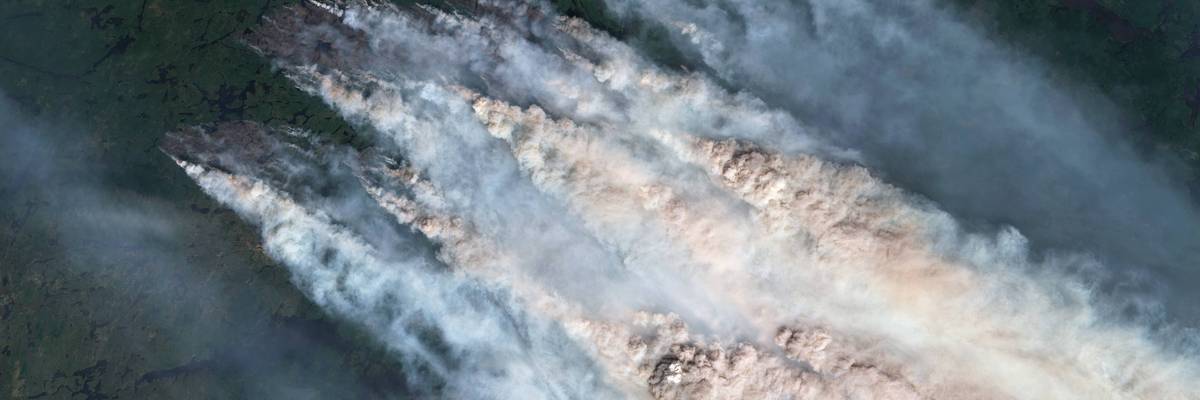
a satellite view shows Northwestern Ontario’s wildfires, including the Dryden and Thunder Bay fires, that forced evacuations, closed highways, and disrupted Canadian routes July 14, 2026.
(Photo by Gallo Images/Orbital Horizon/Copernicus Sentinel Data 2026)
The World Is Burning and Time Is Not Our Friend
We may despair and grieve for our planet, and we can try to “do what we can” as individuals. But we must act politically as well, or we—and especially our children and grandchildren—are doomed.
Aug 28, 2026
If you’ve paid any attention to the news lately, you’re aware of massive forest fires raging in Western North America and Europe this summer. It appears as if the world is on fire.
In an important sense, the world is burning, in two related ways. In the United States, as of this writing, there are 661 active wildfires covering 4.7 million acres, largely concentrated in the western states. British Columbia is currently experiencing 180 active wildfires, nearly half of which are burning out of control. So far this summer, fires in the US and Canada have burned 25% more land than the 10-year average, according to national wildfire centers.
This summer, Europe experienced two unprecedented wildfires in France and Spain, and fires have also raged in Greece and other nations. Fires are also raging in Indonesia and Australia.
If you’ve managed to see video of wildfires, you know that the living things in these forests are being burned alive. Tens of thousands of people are evacuated from their homes, which are often totally destroyed. The courageous firefighters, too, can suffer from profound health issues, even death, for their efforts. Fires also spew carbon and toxic pollution into the atmosphere.
We happen to live in the very nation whose president pursues policies that greatly accelerate rising global temperatures by promoting the expansion of fossil fuels while simultaneously slashing renewable energy options.
But the world is also burning up from unprecedented heatwaves over the past several years. You’ve probably heard of temperatures well over 100°F in the southeastern and southwestern United States. Northern parts of the country have also experienced unprecedented heatwaves, with a heat index over 100.
In a recently published New York Times article titled “Bigger and Hotter Fires are Erasing America’s Great Forests,” wildfires from Oregon to New Mexico “sweep through forests that have not evolved to survive such high-intensity blazes and a warmer climate.” Researchers contend that the shift to hotter fires reflects a permanent ecosystem shift with profound consequences for people, wildlife, and the planet.
The hotter fires leave a wasteland of spike shrubs rather than new tree seedlings. As trees disappear, spring snows melt faster leaving water shortages in their wake. The increasingly arid climate dries the soil and pulls moisture from the plants, making them more susceptible to wildfire. Since forests absorb planet-warming carbon dioxide from the atmosphere, as the Times put it, ‘The loss of conifer forests today means a hotter tomorrow.”
In sum, rising global temperatures and wildfires are interdependent. As hotter forest fires increase, greenhouse gases increase, heating the planet, producing extreme weather events like droughts, which themselves increase the spread of wildfires.
Several years of record heatwaves around the world are but one product of global climate change—along with melting ice caps and glaciers, rising sea levels, warming oceans, severe droughts, and more extreme storm weather: torrential rains and floods, hurricanes, tornadoes, and the like. People the world over are bearing the impact of global warming, albeit some far more than others.
However, we happen to live in the very nation whose president pursues policies that greatly accelerate rising global temperatures by promoting the expansion of fossil fuels while simultaneously slashing renewable energy options. Climate change is a profound political issue that calls on us to act together to realign our politics and our economy.
How we do that is the challenge.
Despite President Donald Trump’s continual harangue that climate change is a hoax, only 15% of Americans believed climate change is not happening, according to a 2025 Yale Program on Climate Change Communication poll. A full 69% believed it is happening, and 60% or more believed it is causing droughts, wildfires, and extreme heat. And that was before this summer.
Yet an article written by film director Adam McKay (Don't Look Up) in the August 6 edition of Current Affairs focuses on “The Gargantuan Lie that is Collapsing the World’s Climate.” In McKay’s words, the lie is “told worldwide by hundreds of thousands of institutions, elected officials, many universities, legacy news, some large nonprofits and eventually… by ourselves, to ourselves.”
He sums up that lie as “when it comes to climate change… we have more time.” We don’t.
The climate has already temporarily passed the 1.5°C target of the Paris Accords. With the likelihood that this year’s El Niño will push next year’s average warming to 1.7°C, it will likely cause agricultural failure and food shortages, leaving us staring at the catastrophic 2°C increase we are currently hurtling toward.
As Robert Hunziker wrote of McKay’s article, climate change is an “existential threat to all forms of life sooner rather than later, meaning current lifetimes.”
We are clearly facing many crises—horrific wars, unaffordable healthcare, income and wealth inequality, inflation, fascist-like repression, and targeting of vulnerable peoples. How can we cope with the impending doom suggested by the well-established scientific data on climate change, especially when elected officials virtually ignore the climate crisis and mass media treat critical events as isolated crises?
We may feel tempted to block or ignore messages like these, and powerful corporate interests are perpetually encouraging us to do exactly that. We may despair and grieve for our planet, and we can try to “do what we can” as individuals. But we must act politically as well, or we—and especially our children and grandchildren—are doomed. We must demand action from public officials; we can oppose data centers and boycott corporations that profit from climate damaging activities; we can join with others around the world, but we must act. Individually and collectively. We need to talk to each other.
More than any other crisis, our shared global climate has the potential to unite us on the path toward political and economic transformation.
An Urgent Message From Our Co-Founder
Dear Common Dreams reader, It’s been nearly 30 years since I co-founded Common Dreams with my late wife, Lina Newhouser. We had the radical notion that journalism should serve the public good, not corporate profits. It was clear to us from the outset what it would take to build such a project. No paid advertisements. No corporate sponsors. No millionaire publisher telling us what to think or do. Many people said we wouldn't last a year, but we proved those doubters wrong. Together with a tremendous team of journalists and dedicated staff, we built an independent media outlet free from the constraints of profits and corporate control. Our mission has always been simple: To inform. To inspire. To ignite change for the common good. Building Common Dreams was not easy. Our survival was never guaranteed. When you take on the most powerful forces—Wall Street greed, fossil fuel industry destruction, Big Tech lobbyists, and uber-rich oligarchs who have spent billions upon billions rigging the economy and democracy in their favor—the only bulwark you have is supporters who believe in your work. But here’s the urgent message from me today. It's never been this bad out there. And it's never been this hard to keep us going. At the very moment Common Dreams is most needed, the threats we face are intensifying. We need your support now more than ever. We don't accept corporate advertising and never will. We don't have a paywall because we don't think people should be blocked from critical news based on their ability to pay. Everything we do is funded by the donations of readers like you. When everyone does the little they can afford, we are strong. But if that support retreats or dries up, so do we. Will you donate now to make sure Common Dreams not only survives but thrives? —Craig Brown, Co-founder |
Our work is licensed under Creative Commons (CC BY-NC-ND 3.0). Feel free to republish and share widely.
Ted Morgan is a retired Lehigh University professor of political science. He is the author of What Really Happened to the 1960s: How Mass Media Culture Failed American Democracy.
If you’ve paid any attention to the news lately, you’re aware of massive forest fires raging in Western North America and Europe this summer. It appears as if the world is on fire.
In an important sense, the world is burning, in two related ways. In the United States, as of this writing, there are 661 active wildfires covering 4.7 million acres, largely concentrated in the western states. British Columbia is currently experiencing 180 active wildfires, nearly half of which are burning out of control. So far this summer, fires in the US and Canada have burned 25% more land than the 10-year average, according to national wildfire centers.
This summer, Europe experienced two unprecedented wildfires in France and Spain, and fires have also raged in Greece and other nations. Fires are also raging in Indonesia and Australia.
If you’ve managed to see video of wildfires, you know that the living things in these forests are being burned alive. Tens of thousands of people are evacuated from their homes, which are often totally destroyed. The courageous firefighters, too, can suffer from profound health issues, even death, for their efforts. Fires also spew carbon and toxic pollution into the atmosphere.
We happen to live in the very nation whose president pursues policies that greatly accelerate rising global temperatures by promoting the expansion of fossil fuels while simultaneously slashing renewable energy options.
But the world is also burning up from unprecedented heatwaves over the past several years. You’ve probably heard of temperatures well over 100°F in the southeastern and southwestern United States. Northern parts of the country have also experienced unprecedented heatwaves, with a heat index over 100.
In a recently published New York Times article titled “Bigger and Hotter Fires are Erasing America’s Great Forests,” wildfires from Oregon to New Mexico “sweep through forests that have not evolved to survive such high-intensity blazes and a warmer climate.” Researchers contend that the shift to hotter fires reflects a permanent ecosystem shift with profound consequences for people, wildlife, and the planet.
The hotter fires leave a wasteland of spike shrubs rather than new tree seedlings. As trees disappear, spring snows melt faster leaving water shortages in their wake. The increasingly arid climate dries the soil and pulls moisture from the plants, making them more susceptible to wildfire. Since forests absorb planet-warming carbon dioxide from the atmosphere, as the Times put it, ‘The loss of conifer forests today means a hotter tomorrow.”
In sum, rising global temperatures and wildfires are interdependent. As hotter forest fires increase, greenhouse gases increase, heating the planet, producing extreme weather events like droughts, which themselves increase the spread of wildfires.
Several years of record heatwaves around the world are but one product of global climate change—along with melting ice caps and glaciers, rising sea levels, warming oceans, severe droughts, and more extreme storm weather: torrential rains and floods, hurricanes, tornadoes, and the like. People the world over are bearing the impact of global warming, albeit some far more than others.
However, we happen to live in the very nation whose president pursues policies that greatly accelerate rising global temperatures by promoting the expansion of fossil fuels while simultaneously slashing renewable energy options. Climate change is a profound political issue that calls on us to act together to realign our politics and our economy.
How we do that is the challenge.
Despite President Donald Trump’s continual harangue that climate change is a hoax, only 15% of Americans believed climate change is not happening, according to a 2025 Yale Program on Climate Change Communication poll. A full 69% believed it is happening, and 60% or more believed it is causing droughts, wildfires, and extreme heat. And that was before this summer.
Yet an article written by film director Adam McKay (Don't Look Up) in the August 6 edition of Current Affairs focuses on “The Gargantuan Lie that is Collapsing the World’s Climate.” In McKay’s words, the lie is “told worldwide by hundreds of thousands of institutions, elected officials, many universities, legacy news, some large nonprofits and eventually… by ourselves, to ourselves.”
He sums up that lie as “when it comes to climate change… we have more time.” We don’t.
The climate has already temporarily passed the 1.5°C target of the Paris Accords. With the likelihood that this year’s El Niño will push next year’s average warming to 1.7°C, it will likely cause agricultural failure and food shortages, leaving us staring at the catastrophic 2°C increase we are currently hurtling toward.
As Robert Hunziker wrote of McKay’s article, climate change is an “existential threat to all forms of life sooner rather than later, meaning current lifetimes.”
We are clearly facing many crises—horrific wars, unaffordable healthcare, income and wealth inequality, inflation, fascist-like repression, and targeting of vulnerable peoples. How can we cope with the impending doom suggested by the well-established scientific data on climate change, especially when elected officials virtually ignore the climate crisis and mass media treat critical events as isolated crises?
We may feel tempted to block or ignore messages like these, and powerful corporate interests are perpetually encouraging us to do exactly that. We may despair and grieve for our planet, and we can try to “do what we can” as individuals. But we must act politically as well, or we—and especially our children and grandchildren—are doomed. We must demand action from public officials; we can oppose data centers and boycott corporations that profit from climate damaging activities; we can join with others around the world, but we must act. Individually and collectively. We need to talk to each other.
More than any other crisis, our shared global climate has the potential to unite us on the path toward political and economic transformation.
From Your Site Articles
- July Was Hottest Month in History of Contiguous US, Breaking Dust Bowl Record ›
- 4 Signs of Hope in a Burning World ›
- How Global Warming Can Wipe You Out Financially—Yes, You! ›
- 'Fossil Fuels Are Killing Us': Scientists Publish Sweeping Review of Industry Harms ›
- The Reality of the Climate Emergency Is Becoming Impossible to Ignore ›
- As the World Burns ›
Ted Morgan is a retired Lehigh University professor of political science. He is the author of What Really Happened to the 1960s: How Mass Media Culture Failed American Democracy.
If you’ve paid any attention to the news lately, you’re aware of massive forest fires raging in Western North America and Europe this summer. It appears as if the world is on fire.
In an important sense, the world is burning, in two related ways. In the United States, as of this writing, there are 661 active wildfires covering 4.7 million acres, largely concentrated in the western states. British Columbia is currently experiencing 180 active wildfires, nearly half of which are burning out of control. So far this summer, fires in the US and Canada have burned 25% more land than the 10-year average, according to national wildfire centers.
This summer, Europe experienced two unprecedented wildfires in France and Spain, and fires have also raged in Greece and other nations. Fires are also raging in Indonesia and Australia.
If you’ve managed to see video of wildfires, you know that the living things in these forests are being burned alive. Tens of thousands of people are evacuated from their homes, which are often totally destroyed. The courageous firefighters, too, can suffer from profound health issues, even death, for their efforts. Fires also spew carbon and toxic pollution into the atmosphere.
We happen to live in the very nation whose president pursues policies that greatly accelerate rising global temperatures by promoting the expansion of fossil fuels while simultaneously slashing renewable energy options.
But the world is also burning up from unprecedented heatwaves over the past several years. You’ve probably heard of temperatures well over 100°F in the southeastern and southwestern United States. Northern parts of the country have also experienced unprecedented heatwaves, with a heat index over 100.
In a recently published New York Times article titled “Bigger and Hotter Fires are Erasing America’s Great Forests,” wildfires from Oregon to New Mexico “sweep through forests that have not evolved to survive such high-intensity blazes and a warmer climate.” Researchers contend that the shift to hotter fires reflects a permanent ecosystem shift with profound consequences for people, wildlife, and the planet.
The hotter fires leave a wasteland of spike shrubs rather than new tree seedlings. As trees disappear, spring snows melt faster leaving water shortages in their wake. The increasingly arid climate dries the soil and pulls moisture from the plants, making them more susceptible to wildfire. Since forests absorb planet-warming carbon dioxide from the atmosphere, as the Times put it, ‘The loss of conifer forests today means a hotter tomorrow.”
In sum, rising global temperatures and wildfires are interdependent. As hotter forest fires increase, greenhouse gases increase, heating the planet, producing extreme weather events like droughts, which themselves increase the spread of wildfires.
Several years of record heatwaves around the world are but one product of global climate change—along with melting ice caps and glaciers, rising sea levels, warming oceans, severe droughts, and more extreme storm weather: torrential rains and floods, hurricanes, tornadoes, and the like. People the world over are bearing the impact of global warming, albeit some far more than others.
However, we happen to live in the very nation whose president pursues policies that greatly accelerate rising global temperatures by promoting the expansion of fossil fuels while simultaneously slashing renewable energy options. Climate change is a profound political issue that calls on us to act together to realign our politics and our economy.
How we do that is the challenge.
Despite President Donald Trump’s continual harangue that climate change is a hoax, only 15% of Americans believed climate change is not happening, according to a 2025 Yale Program on Climate Change Communication poll. A full 69% believed it is happening, and 60% or more believed it is causing droughts, wildfires, and extreme heat. And that was before this summer.
Yet an article written by film director Adam McKay (Don't Look Up) in the August 6 edition of Current Affairs focuses on “The Gargantuan Lie that is Collapsing the World’s Climate.” In McKay’s words, the lie is “told worldwide by hundreds of thousands of institutions, elected officials, many universities, legacy news, some large nonprofits and eventually… by ourselves, to ourselves.”
He sums up that lie as “when it comes to climate change… we have more time.” We don’t.
The climate has already temporarily passed the 1.5°C target of the Paris Accords. With the likelihood that this year’s El Niño will push next year’s average warming to 1.7°C, it will likely cause agricultural failure and food shortages, leaving us staring at the catastrophic 2°C increase we are currently hurtling toward.
As Robert Hunziker wrote of McKay’s article, climate change is an “existential threat to all forms of life sooner rather than later, meaning current lifetimes.”
We are clearly facing many crises—horrific wars, unaffordable healthcare, income and wealth inequality, inflation, fascist-like repression, and targeting of vulnerable peoples. How can we cope with the impending doom suggested by the well-established scientific data on climate change, especially when elected officials virtually ignore the climate crisis and mass media treat critical events as isolated crises?
We may feel tempted to block or ignore messages like these, and powerful corporate interests are perpetually encouraging us to do exactly that. We may despair and grieve for our planet, and we can try to “do what we can” as individuals. But we must act politically as well, or we—and especially our children and grandchildren—are doomed. We must demand action from public officials; we can oppose data centers and boycott corporations that profit from climate damaging activities; we can join with others around the world, but we must act. Individually and collectively. We need to talk to each other.
More than any other crisis, our shared global climate has the potential to unite us on the path toward political and economic transformation.
From Your Site Articles
- July Was Hottest Month in History of Contiguous US, Breaking Dust Bowl Record ›
- 4 Signs of Hope in a Burning World ›
- How Global Warming Can Wipe You Out Financially—Yes, You! ›
- 'Fossil Fuels Are Killing Us': Scientists Publish Sweeping Review of Industry Harms ›
- The Reality of the Climate Emergency Is Becoming Impossible to Ignore ›
- As the World Burns ›
We've had enough. The 1% own and operate the corporate media. They are doing everything they can to defend the status quo, squash dissent and protect the wealthy and the powerful. The Common Dreams media model is different. We cover the news that matters to the 99%. Our mission? To inform. To inspire. To ignite change for the common good. How? Nonprofit. Independent. Reader-supported. Free to read. Free to republish. Free to share. With no advertising. No paywalls. No selling of your data. Thousands of small donations fund our newsroom and allow us to continue publishing. Can you chip in? We can't do it without you. Thank you.
To inform. To inspire. To ignite change for the common good.
News & Opinion
Trending
Common Dreams, Inc. Founded 1997. Registered 501(c3) Non-Profit
Privacy Policy