SUBSCRIBE TO OUR FREE NEWSLETTER
Daily news & progressive opinion—funded by the people, not the corporations—delivered straight to your inbox.
5
#000000
#FFFFFF
To donate by check, phone, or other method, see our More Ways to Give page.
Daily news & progressive opinion—funded by the people, not the corporations—delivered straight to your inbox.
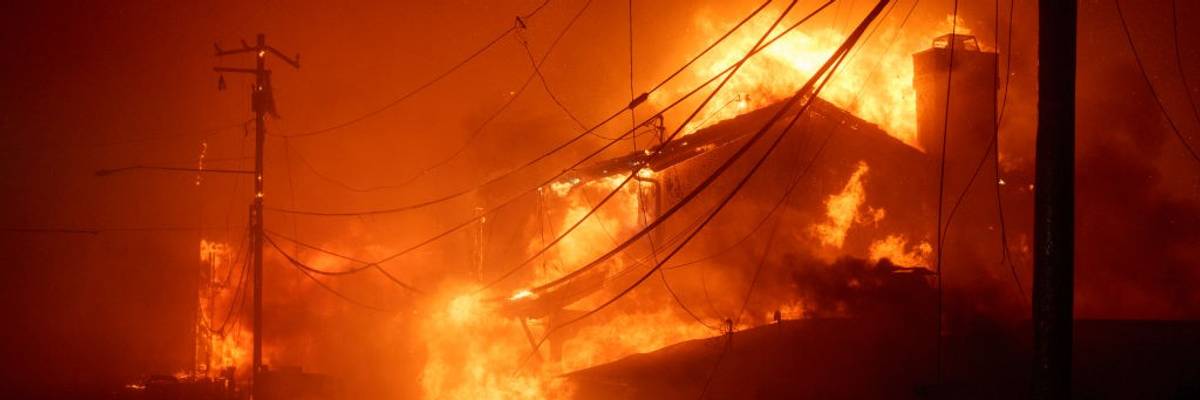
Flames from the Palisades Fire burn homes on January 7, 2025 in the Pacific Palisades neighborhood of Los Angeles, California.
Recent personal experience suggests that the climate crisis can lead to financial disaster in the very short run; even those of us in our mid 80s are not immune.
Most people probably think that global warming will cause problems for their children and grandchildren, but not for themselves. I used to assume that those of us who are older need not worry.
But recent personal experience suggests that global warming can lead to financial disaster in the very short run. Even those of us in our mid 80s are not immune.
Several months ago, our house caught fire, forcing us into temporary accommodations. Only one room suffered major damage, but smoke permeated the whole house, requiring extensive remediation and destroying lots of furniture and clothing.
Fortunately, we had good insurance, which included coverage for contents and temporary housing as well as the cost of the repairs themselves.
If Dante were writing today, he could appropriately reserve a specially unpleasant level of his hell for the energy managers and politicians who are trying to stop the development of green energy.
Temporary housing is not cheap. We probably ran up $20,000 in hotel bills during the nearly two months before we could find more adequate housing. And temporary furnished housing itself is not cheap, easily amounting to thousands of dollars a month.
To state the obvious, owning a house without insuring it is highly risky. But what does this fact have to do with global warming?
Global warming has been setting off an increasing number of floods, fires, hurricanes, and tornadoes, damaging or destroying more and more homes. Up until now typical homes have been insured, which—as in our own case—has protected their owners from financial ruin.
But the money insurance companies pay for repairs or replacements has to be obtained through the premiums charged to homeowners. When the percentage of homes damaged by extreme weather increases, the insurance companies must increase what they charge for their coverage. If they do not do this, they will not be able to stay in business.
As a result, it is getting much more expensive to insure houses in many states, especially in California and some southeastern states. But the higher insurance premiums are making it more and more difficult for people to afford property insurance in the first place.
Some people may be forced to get no insurance, in effect self-insuring themselves. Since houses cost hundreds of thousands of dollars and are often the principal assets of families, those without insurance risk being wiped out financially.
And people cannot escape from this problem by renting a place to live instead of buying one. Landlords from whom people rent apartments and houses must increase rents in order to pay for the insurance they need.
Anybody following the news cannot help but be aware that floods, heat domes, hurricanes, and tornadoes are becoming more frequent and more devastating. And although climate has been always changing, the size and speed of the current changes cannot be explained away as just more of the same historical pattern.
A lot of future global heating is already “baked into” the world by carbon dioxide emitted by burning coal, oil, and gas during the last 200 years. But there is no reason why the human race should continue fouling its own nest now that we understand why climate change is accelerating.
At some point, people are going to stop falling for the propaganda emitted by coal, oil, and gas corporations; by political leaders these companies have bought; and by media organizations like Fox News catering to these wealthy and powerful interests.
Fortunately, new solar energy facilities are now cheaper than new atomic, coal, oil, or gas generators. And solar’s local intermittency, the principal weakness cited by anti-green spin doctors, will disappear when the already expanding distribution systems are united into a single worldwide high voltage direct current (HVDC) grid.
In recent decades we have seen similar movements to worldwide systems with telephones and computer networks. The technical and economic advantages of a worldwide electrical grid are so huge that it will be built.
Dante Alighieri (1265-1321) wrote about nine different “levels” of hell in "Inferno," the first part of his long narrative poem, The Divine Comedy. If Dante were writing today, he could appropriately reserve a specially unpleasant level of his hell for the energy managers and politicians who are trying to stop the development of green energy.
Hell has generally been considered a hot place. The longer these folks are allowed to continue putting their own interests over the general welfare, the more Earth itself may become like hell for its inhabitants.
Dear Common Dreams reader, It’s been nearly 30 years since I co-founded Common Dreams with my late wife, Lina Newhouser. We had the radical notion that journalism should serve the public good, not corporate profits. It was clear to us from the outset what it would take to build such a project. No paid advertisements. No corporate sponsors. No millionaire publisher telling us what to think or do. Many people said we wouldn't last a year, but we proved those doubters wrong. Together with a tremendous team of journalists and dedicated staff, we built an independent media outlet free from the constraints of profits and corporate control. Our mission has always been simple: To inform. To inspire. To ignite change for the common good. Building Common Dreams was not easy. Our survival was never guaranteed. When you take on the most powerful forces—Wall Street greed, fossil fuel industry destruction, Big Tech lobbyists, and uber-rich oligarchs who have spent billions upon billions rigging the economy and democracy in their favor—the only bulwark you have is supporters who believe in your work. But here’s the urgent message from me today. It's never been this bad out there. And it's never been this hard to keep us going. At the very moment Common Dreams is most needed, the threats we face are intensifying. We need your support now more than ever. We don't accept corporate advertising and never will. We don't have a paywall because we don't think people should be blocked from critical news based on their ability to pay. Everything we do is funded by the donations of readers like you. When everyone does the little they can afford, we are strong. But if that support retreats or dries up, so do we. Will you donate now to make sure Common Dreams not only survives but thrives? —Craig Brown, Co-founder |
Most people probably think that global warming will cause problems for their children and grandchildren, but not for themselves. I used to assume that those of us who are older need not worry.
But recent personal experience suggests that global warming can lead to financial disaster in the very short run. Even those of us in our mid 80s are not immune.
Several months ago, our house caught fire, forcing us into temporary accommodations. Only one room suffered major damage, but smoke permeated the whole house, requiring extensive remediation and destroying lots of furniture and clothing.
Fortunately, we had good insurance, which included coverage for contents and temporary housing as well as the cost of the repairs themselves.
If Dante were writing today, he could appropriately reserve a specially unpleasant level of his hell for the energy managers and politicians who are trying to stop the development of green energy.
Temporary housing is not cheap. We probably ran up $20,000 in hotel bills during the nearly two months before we could find more adequate housing. And temporary furnished housing itself is not cheap, easily amounting to thousands of dollars a month.
To state the obvious, owning a house without insuring it is highly risky. But what does this fact have to do with global warming?
Global warming has been setting off an increasing number of floods, fires, hurricanes, and tornadoes, damaging or destroying more and more homes. Up until now typical homes have been insured, which—as in our own case—has protected their owners from financial ruin.
But the money insurance companies pay for repairs or replacements has to be obtained through the premiums charged to homeowners. When the percentage of homes damaged by extreme weather increases, the insurance companies must increase what they charge for their coverage. If they do not do this, they will not be able to stay in business.
As a result, it is getting much more expensive to insure houses in many states, especially in California and some southeastern states. But the higher insurance premiums are making it more and more difficult for people to afford property insurance in the first place.
Some people may be forced to get no insurance, in effect self-insuring themselves. Since houses cost hundreds of thousands of dollars and are often the principal assets of families, those without insurance risk being wiped out financially.
And people cannot escape from this problem by renting a place to live instead of buying one. Landlords from whom people rent apartments and houses must increase rents in order to pay for the insurance they need.
Anybody following the news cannot help but be aware that floods, heat domes, hurricanes, and tornadoes are becoming more frequent and more devastating. And although climate has been always changing, the size and speed of the current changes cannot be explained away as just more of the same historical pattern.
A lot of future global heating is already “baked into” the world by carbon dioxide emitted by burning coal, oil, and gas during the last 200 years. But there is no reason why the human race should continue fouling its own nest now that we understand why climate change is accelerating.
At some point, people are going to stop falling for the propaganda emitted by coal, oil, and gas corporations; by political leaders these companies have bought; and by media organizations like Fox News catering to these wealthy and powerful interests.
Fortunately, new solar energy facilities are now cheaper than new atomic, coal, oil, or gas generators. And solar’s local intermittency, the principal weakness cited by anti-green spin doctors, will disappear when the already expanding distribution systems are united into a single worldwide high voltage direct current (HVDC) grid.
In recent decades we have seen similar movements to worldwide systems with telephones and computer networks. The technical and economic advantages of a worldwide electrical grid are so huge that it will be built.
Dante Alighieri (1265-1321) wrote about nine different “levels” of hell in "Inferno," the first part of his long narrative poem, The Divine Comedy. If Dante were writing today, he could appropriately reserve a specially unpleasant level of his hell for the energy managers and politicians who are trying to stop the development of green energy.
Hell has generally been considered a hot place. The longer these folks are allowed to continue putting their own interests over the general welfare, the more Earth itself may become like hell for its inhabitants.
Most people probably think that global warming will cause problems for their children and grandchildren, but not for themselves. I used to assume that those of us who are older need not worry.
But recent personal experience suggests that global warming can lead to financial disaster in the very short run. Even those of us in our mid 80s are not immune.
Several months ago, our house caught fire, forcing us into temporary accommodations. Only one room suffered major damage, but smoke permeated the whole house, requiring extensive remediation and destroying lots of furniture and clothing.
Fortunately, we had good insurance, which included coverage for contents and temporary housing as well as the cost of the repairs themselves.
If Dante were writing today, he could appropriately reserve a specially unpleasant level of his hell for the energy managers and politicians who are trying to stop the development of green energy.
Temporary housing is not cheap. We probably ran up $20,000 in hotel bills during the nearly two months before we could find more adequate housing. And temporary furnished housing itself is not cheap, easily amounting to thousands of dollars a month.
To state the obvious, owning a house without insuring it is highly risky. But what does this fact have to do with global warming?
Global warming has been setting off an increasing number of floods, fires, hurricanes, and tornadoes, damaging or destroying more and more homes. Up until now typical homes have been insured, which—as in our own case—has protected their owners from financial ruin.
But the money insurance companies pay for repairs or replacements has to be obtained through the premiums charged to homeowners. When the percentage of homes damaged by extreme weather increases, the insurance companies must increase what they charge for their coverage. If they do not do this, they will not be able to stay in business.
As a result, it is getting much more expensive to insure houses in many states, especially in California and some southeastern states. But the higher insurance premiums are making it more and more difficult for people to afford property insurance in the first place.
Some people may be forced to get no insurance, in effect self-insuring themselves. Since houses cost hundreds of thousands of dollars and are often the principal assets of families, those without insurance risk being wiped out financially.
And people cannot escape from this problem by renting a place to live instead of buying one. Landlords from whom people rent apartments and houses must increase rents in order to pay for the insurance they need.
Anybody following the news cannot help but be aware that floods, heat domes, hurricanes, and tornadoes are becoming more frequent and more devastating. And although climate has been always changing, the size and speed of the current changes cannot be explained away as just more of the same historical pattern.
A lot of future global heating is already “baked into” the world by carbon dioxide emitted by burning coal, oil, and gas during the last 200 years. But there is no reason why the human race should continue fouling its own nest now that we understand why climate change is accelerating.
At some point, people are going to stop falling for the propaganda emitted by coal, oil, and gas corporations; by political leaders these companies have bought; and by media organizations like Fox News catering to these wealthy and powerful interests.
Fortunately, new solar energy facilities are now cheaper than new atomic, coal, oil, or gas generators. And solar’s local intermittency, the principal weakness cited by anti-green spin doctors, will disappear when the already expanding distribution systems are united into a single worldwide high voltage direct current (HVDC) grid.
In recent decades we have seen similar movements to worldwide systems with telephones and computer networks. The technical and economic advantages of a worldwide electrical grid are so huge that it will be built.
Dante Alighieri (1265-1321) wrote about nine different “levels” of hell in "Inferno," the first part of his long narrative poem, The Divine Comedy. If Dante were writing today, he could appropriately reserve a specially unpleasant level of his hell for the energy managers and politicians who are trying to stop the development of green energy.
Hell has generally been considered a hot place. The longer these folks are allowed to continue putting their own interests over the general welfare, the more Earth itself may become like hell for its inhabitants.