SUBSCRIBE TO OUR FREE NEWSLETTER
Daily news & progressive opinion—funded by the people, not the corporations—delivered straight to your inbox.
5
#000000
#FFFFFF
To donate by check, phone, or other method, see our More Ways to Give page.
Daily news & progressive opinion—funded by the people, not the corporations—delivered straight to your inbox.
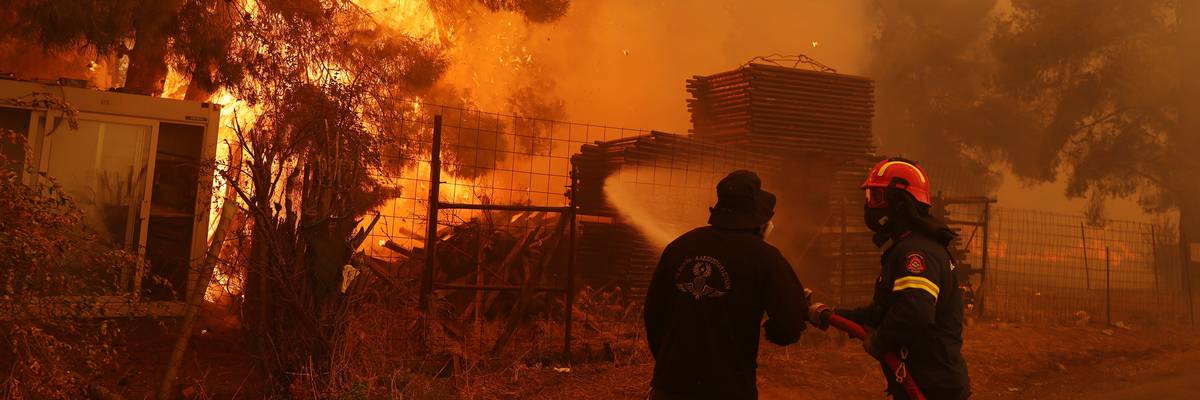
Firefighters spray water, during a wildfire in Nea Penteli near Athens, Greece on August 12, 2024.
Rapid and radical decarbonization is possible and is starting to happen on a near-global scale, but it must proceed very much faster.
The recent wildfires in Greece started on Sunday 11 August in Varnavas, 35 kilometres (22 miles) north of Athens. By the time they were brought under control three days later, they had reached the capital’s suburbs, having burnt through 25,000 acres of forest.
Though the fires fortunately did not get fully into Athens, it was a close call. Similar extreme weather events—whether wildfire, drought, storm, flood, or heat dome—are now seen on a near-daily basis somewhere around the world, and are often more intense than even a couple of decades ago. They are the most visible elements of climate change’s shift into climate breakdown.
We are also seeing clear worldwide changes. Last year was exceptionally hot—the hottest year since accurate weather records were first kept in the 1880s—but this year is perhaps more worrying. 2023 was an El Niňo year; one in which the sea surface temperature warms by 0.5°C above the long-term average. It’s a climate phenomenon that occurs every two to seven years and leads to temporary air temperature increases across much of the world in those years.
The future really does look grim. A world of devastating weather events, unliveable cities, gross food shortages, mass migration, and global marginalization beckons.
The problem is that El Niňo has been fading since February, yet the global pattern does not show the anticipated easing of temperatures. Instead, we are seeing the opposite; 15 national heat records have been broken so far this year, as have 130 monthly national temperature records. As Costa Rican climate historian Maximiliano Herrera told The Guardian: “Far from dwindling with the end of El Niňo, records are falling at even much faster pace compared to late 2023.”
In fact, June this year was the 13th month in a row to set a monthly global temperature record, according to the EU’s Copernicus Climate Change Service, whose ERA5 satellite suggested that 22 July was the hottest day ever recorded on Earth. The World Meteorological Organisation, meanwhile, has reported that at least 10 countries have already recorded temperatures above 50°C this year.
The implications are clear enough. We are heading for a global disaster at a level frequently warned of but even more frequently ignored—whether by politicians, business leaders, or others—while the fossil fuel industries and countries that exploit oil, gas, and coal continue to argue that the problem is grossly exaggerated.
More than 50 years ago, economic geographer Edwin Brooks, in a much-quoted remark, warned of “a crowded glowering planet of massive inequalities of wealth buttressed by stark force yet endlessly threatened by desperate men in the global ghettoes.” His warning focused on economic inequalities and was made before the full impact of climate change was apparent, yet it is more timely than ever.
The future really does look grim. A world of devastating weather events, unliveable cities, gross food shortages, mass migration, and global marginalization beckons.
The task of avoiding this dystopic future is huge. Four years ago, a U.N. report identified the need to decrease carbon emissions by 7% a year until 2030 to avoid the worst impacts of climate breakdown. They are still rising, and the need now is for an annual reduction of at least 10%.
It is a predicament that will require a third societal transition. The first was the farming revolution over several thousand years and the second was the industrial revolution, which started close to four centuries ago and is still under way. The third will be learning to live within the limits set by the capacity of the world’s ecosystem to handle human activity, initially by preventing climate breakdown, which must be achieved in mere decades.
But there are some signs of hope.
The first is that climate science has come on by leaps and bounds in the past 40 years and there is much greater confidence in its predictions. This means intergovernmental panels—which have tended to be overly cautious about not exaggerating the impact of the climate crisis, due to a need to work in consensus—will able to be far blunter in their statements.
Then there is the evidence just about everywhere that climate breakdown is happening. The third reason is that the first two will combine to inspire more activists, both young and old, to act. Many are willing to engage in nonviolent direct action despite elite determination to maintain the status quo through harsh legal measures.
There is a fourth reason for hope: the extraordinary way that rapidly improving technologies mean it is so often (and increasingly) much cheaper to use renewable energy than relying on fossil carbon energy sources.
Rapid and radical decarbonization is possible and is starting to happen on a near-global scale. But it must proceed very much faster. Global net zero needs to be achieved by 2040, not 2050, and that means that richer states must aim for net zero by 2035 while providing funding to speed up the process right across the Global South. It is a huge task, but that is the way to prevent climate breakdown.
To put it in a wider context, three tasks face us all. The first is the most urgent: coming to terms with environmental limitations. The second is an evolution of the world economy to ensure a far more equal sharing of what we have, and the third is responding to security challenges without depending on the early use of military force.
It is a transformational task but thanks to the immediacy of climate breakdown there isn’t really any alternative. Luckily, for now, there is time to do it, just.
Dear Common Dreams reader, It’s been nearly 30 years since I co-founded Common Dreams with my late wife, Lina Newhouser. We had the radical notion that journalism should serve the public good, not corporate profits. It was clear to us from the outset what it would take to build such a project. No paid advertisements. No corporate sponsors. No millionaire publisher telling us what to think or do. Many people said we wouldn't last a year, but we proved those doubters wrong. Together with a tremendous team of journalists and dedicated staff, we built an independent media outlet free from the constraints of profits and corporate control. Our mission has always been simple: To inform. To inspire. To ignite change for the common good. Building Common Dreams was not easy. Our survival was never guaranteed. When you take on the most powerful forces—Wall Street greed, fossil fuel industry destruction, Big Tech lobbyists, and uber-rich oligarchs who have spent billions upon billions rigging the economy and democracy in their favor—the only bulwark you have is supporters who believe in your work. But here’s the urgent message from me today. It's never been this bad out there. And it's never been this hard to keep us going. At the very moment Common Dreams is most needed, the threats we face are intensifying. We need your support now more than ever. We don't accept corporate advertising and never will. We don't have a paywall because we don't think people should be blocked from critical news based on their ability to pay. Everything we do is funded by the donations of readers like you. When everyone does the little they can afford, we are strong. But if that support retreats or dries up, so do we. Will you donate now to make sure Common Dreams not only survives but thrives? —Craig Brown, Co-founder |
The recent wildfires in Greece started on Sunday 11 August in Varnavas, 35 kilometres (22 miles) north of Athens. By the time they were brought under control three days later, they had reached the capital’s suburbs, having burnt through 25,000 acres of forest.
Though the fires fortunately did not get fully into Athens, it was a close call. Similar extreme weather events—whether wildfire, drought, storm, flood, or heat dome—are now seen on a near-daily basis somewhere around the world, and are often more intense than even a couple of decades ago. They are the most visible elements of climate change’s shift into climate breakdown.
We are also seeing clear worldwide changes. Last year was exceptionally hot—the hottest year since accurate weather records were first kept in the 1880s—but this year is perhaps more worrying. 2023 was an El Niňo year; one in which the sea surface temperature warms by 0.5°C above the long-term average. It’s a climate phenomenon that occurs every two to seven years and leads to temporary air temperature increases across much of the world in those years.
The future really does look grim. A world of devastating weather events, unliveable cities, gross food shortages, mass migration, and global marginalization beckons.
The problem is that El Niňo has been fading since February, yet the global pattern does not show the anticipated easing of temperatures. Instead, we are seeing the opposite; 15 national heat records have been broken so far this year, as have 130 monthly national temperature records. As Costa Rican climate historian Maximiliano Herrera told The Guardian: “Far from dwindling with the end of El Niňo, records are falling at even much faster pace compared to late 2023.”
In fact, June this year was the 13th month in a row to set a monthly global temperature record, according to the EU’s Copernicus Climate Change Service, whose ERA5 satellite suggested that 22 July was the hottest day ever recorded on Earth. The World Meteorological Organisation, meanwhile, has reported that at least 10 countries have already recorded temperatures above 50°C this year.
The implications are clear enough. We are heading for a global disaster at a level frequently warned of but even more frequently ignored—whether by politicians, business leaders, or others—while the fossil fuel industries and countries that exploit oil, gas, and coal continue to argue that the problem is grossly exaggerated.
More than 50 years ago, economic geographer Edwin Brooks, in a much-quoted remark, warned of “a crowded glowering planet of massive inequalities of wealth buttressed by stark force yet endlessly threatened by desperate men in the global ghettoes.” His warning focused on economic inequalities and was made before the full impact of climate change was apparent, yet it is more timely than ever.
The future really does look grim. A world of devastating weather events, unliveable cities, gross food shortages, mass migration, and global marginalization beckons.
The task of avoiding this dystopic future is huge. Four years ago, a U.N. report identified the need to decrease carbon emissions by 7% a year until 2030 to avoid the worst impacts of climate breakdown. They are still rising, and the need now is for an annual reduction of at least 10%.
It is a predicament that will require a third societal transition. The first was the farming revolution over several thousand years and the second was the industrial revolution, which started close to four centuries ago and is still under way. The third will be learning to live within the limits set by the capacity of the world’s ecosystem to handle human activity, initially by preventing climate breakdown, which must be achieved in mere decades.
But there are some signs of hope.
The first is that climate science has come on by leaps and bounds in the past 40 years and there is much greater confidence in its predictions. This means intergovernmental panels—which have tended to be overly cautious about not exaggerating the impact of the climate crisis, due to a need to work in consensus—will able to be far blunter in their statements.
Then there is the evidence just about everywhere that climate breakdown is happening. The third reason is that the first two will combine to inspire more activists, both young and old, to act. Many are willing to engage in nonviolent direct action despite elite determination to maintain the status quo through harsh legal measures.
There is a fourth reason for hope: the extraordinary way that rapidly improving technologies mean it is so often (and increasingly) much cheaper to use renewable energy than relying on fossil carbon energy sources.
Rapid and radical decarbonization is possible and is starting to happen on a near-global scale. But it must proceed very much faster. Global net zero needs to be achieved by 2040, not 2050, and that means that richer states must aim for net zero by 2035 while providing funding to speed up the process right across the Global South. It is a huge task, but that is the way to prevent climate breakdown.
To put it in a wider context, three tasks face us all. The first is the most urgent: coming to terms with environmental limitations. The second is an evolution of the world economy to ensure a far more equal sharing of what we have, and the third is responding to security challenges without depending on the early use of military force.
It is a transformational task but thanks to the immediacy of climate breakdown there isn’t really any alternative. Luckily, for now, there is time to do it, just.
The recent wildfires in Greece started on Sunday 11 August in Varnavas, 35 kilometres (22 miles) north of Athens. By the time they were brought under control three days later, they had reached the capital’s suburbs, having burnt through 25,000 acres of forest.
Though the fires fortunately did not get fully into Athens, it was a close call. Similar extreme weather events—whether wildfire, drought, storm, flood, or heat dome—are now seen on a near-daily basis somewhere around the world, and are often more intense than even a couple of decades ago. They are the most visible elements of climate change’s shift into climate breakdown.
We are also seeing clear worldwide changes. Last year was exceptionally hot—the hottest year since accurate weather records were first kept in the 1880s—but this year is perhaps more worrying. 2023 was an El Niňo year; one in which the sea surface temperature warms by 0.5°C above the long-term average. It’s a climate phenomenon that occurs every two to seven years and leads to temporary air temperature increases across much of the world in those years.
The future really does look grim. A world of devastating weather events, unliveable cities, gross food shortages, mass migration, and global marginalization beckons.
The problem is that El Niňo has been fading since February, yet the global pattern does not show the anticipated easing of temperatures. Instead, we are seeing the opposite; 15 national heat records have been broken so far this year, as have 130 monthly national temperature records. As Costa Rican climate historian Maximiliano Herrera told The Guardian: “Far from dwindling with the end of El Niňo, records are falling at even much faster pace compared to late 2023.”
In fact, June this year was the 13th month in a row to set a monthly global temperature record, according to the EU’s Copernicus Climate Change Service, whose ERA5 satellite suggested that 22 July was the hottest day ever recorded on Earth. The World Meteorological Organisation, meanwhile, has reported that at least 10 countries have already recorded temperatures above 50°C this year.
The implications are clear enough. We are heading for a global disaster at a level frequently warned of but even more frequently ignored—whether by politicians, business leaders, or others—while the fossil fuel industries and countries that exploit oil, gas, and coal continue to argue that the problem is grossly exaggerated.
More than 50 years ago, economic geographer Edwin Brooks, in a much-quoted remark, warned of “a crowded glowering planet of massive inequalities of wealth buttressed by stark force yet endlessly threatened by desperate men in the global ghettoes.” His warning focused on economic inequalities and was made before the full impact of climate change was apparent, yet it is more timely than ever.
The future really does look grim. A world of devastating weather events, unliveable cities, gross food shortages, mass migration, and global marginalization beckons.
The task of avoiding this dystopic future is huge. Four years ago, a U.N. report identified the need to decrease carbon emissions by 7% a year until 2030 to avoid the worst impacts of climate breakdown. They are still rising, and the need now is for an annual reduction of at least 10%.
It is a predicament that will require a third societal transition. The first was the farming revolution over several thousand years and the second was the industrial revolution, which started close to four centuries ago and is still under way. The third will be learning to live within the limits set by the capacity of the world’s ecosystem to handle human activity, initially by preventing climate breakdown, which must be achieved in mere decades.
But there are some signs of hope.
The first is that climate science has come on by leaps and bounds in the past 40 years and there is much greater confidence in its predictions. This means intergovernmental panels—which have tended to be overly cautious about not exaggerating the impact of the climate crisis, due to a need to work in consensus—will able to be far blunter in their statements.
Then there is the evidence just about everywhere that climate breakdown is happening. The third reason is that the first two will combine to inspire more activists, both young and old, to act. Many are willing to engage in nonviolent direct action despite elite determination to maintain the status quo through harsh legal measures.
There is a fourth reason for hope: the extraordinary way that rapidly improving technologies mean it is so often (and increasingly) much cheaper to use renewable energy than relying on fossil carbon energy sources.
Rapid and radical decarbonization is possible and is starting to happen on a near-global scale. But it must proceed very much faster. Global net zero needs to be achieved by 2040, not 2050, and that means that richer states must aim for net zero by 2035 while providing funding to speed up the process right across the Global South. It is a huge task, but that is the way to prevent climate breakdown.
To put it in a wider context, three tasks face us all. The first is the most urgent: coming to terms with environmental limitations. The second is an evolution of the world economy to ensure a far more equal sharing of what we have, and the third is responding to security challenges without depending on the early use of military force.
It is a transformational task but thanks to the immediacy of climate breakdown there isn’t really any alternative. Luckily, for now, there is time to do it, just.