SUBSCRIBE TO OUR FREE NEWSLETTER
Daily news & progressive opinion—funded by the people, not the corporations—delivered straight to your inbox.
5
#000000
#FFFFFF
To donate by check, phone, or other method, see our More Ways to Give page.
Daily news & progressive opinion—funded by the people, not the corporations—delivered straight to your inbox.
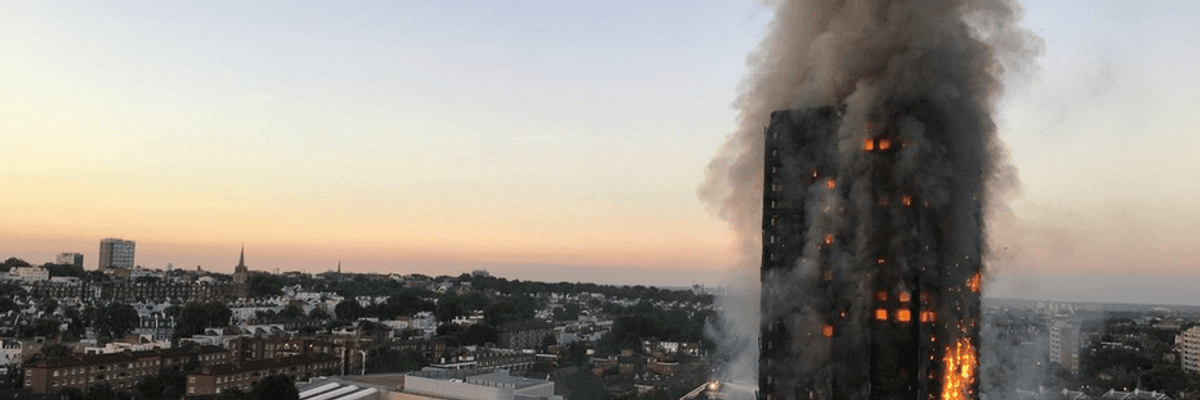
The 2017 Grenfell Tower fire in London killed seventy-two people. (Photo: Natalie Oxford)
Photographs of the Amazon rainforest on fire have made it hard to think about anything else.
There's a sense of existential horror in watching the trees burn, knowing that this particular stretch of green keeps us all breathing day in and day out as the world heats, and that the Brazilian president, the gleefully violent Jair Bolsonaro, wants to continue to destroy the rainforest in the name of profit.
No matter how little meat we eat, the relentless drive for profit is going to keep the forests burning. Capitalism doesn't care if we try to opt out.
What Jasper Bernes called the "awful temporality" of the climate crisis means that we are grieving things we haven't yet lost, watching futures slip away while the sun shines on a lovely summer, having to go on with life because we are too far away to physically stop the crisis with our bodies.
The world is ending, and we are at Target. We are trying to make little changes, to stop eating meat or taking airplanes or using plastic straws or recycle more or any number of things that, in the aggregate, would indeed help but on an individual level feel pitifully inadequate. Or begging the Democratic National Committee to pretend to care enough to stage a debate on climate change, as if there's anything left to be debated anymore.
Because no matter how little meat we eat, the relentless drive for profit is going to keep the forests burning. Capitalism doesn't care if we try to opt out. Commentators for centuries have noted that the Earth and its inhabitants are ground to shreds in the process of accumulation, that, in Marx's words, "capital comes dripping from head to toe, from every pore, with blood and dirt."
It is a process that cares not one bit for the fast-approaching, yet still eventual end of the world as long as there's a little more to be gathered today. It doesn't matter that, as many people gleefully noted when David Koch died last week, individual capitalists can't take their wealth with them. Governments may declare climate emergency as the activists want, and then approve new pipelines. The emergency is never enough to admit the scale of what needs to be done.
This is not to be fatalist and say that we cannot fight back. The relentless gaze of the world on those photos of the Amazon has led to outcry, too-small attempts at backtracking, tiny drips of funding from the G7, plans build apace toward a climate strike. DNC or no, candidates keep putting out proposals for dealing with the crisis.
But it is important to remember where the crisis begins, and who will be fighting to ensure it continues. It has been stated many times but bears repeating that the struggle for a livable planet has been led by indigenous people, from the Amazon to the tar sands to the Dakota Access Pipeline. Because while capitalism sees us all as potential sacrifices, certain people are marked for the slaughter first.
Here in London, where I've spent the summer, there was another fire last week, one less tracked by eyeballs around the globe. It was a fire in a tower block in Notting Hill, just meters from where Grenfell Tower burned in 2017, killing seventy-two people.
The people at the helm, around the world, would watch us all burn rather than shake up the way things are, as long as they can be the last ones standing atop the wreckage.
The 2017 fire came just days after a general election, which put an anti-gentrification campaigner in the seat for that district, and it was reported that the fire spread up the building so quickly because of cladding on the building designed to make it more attractive for the area's richer residents. It may have been the lack of such cladding that stopped last week's fire before it could cause injuries, as one resident noted, but the flames still terrified the locals who watched (and in some cases escaped) the Grenfell fire.
A resident of the building, who raised the alarm to his neighbors, told reporters that there were no alarms going off, and that the fire hoses at first only reached the fifth floor. Another complained, "No sprinklers. No alarms, nothing. You would think after Grenfell they would have learned and listened. I just don't think they care about this part of the community."
The working-class people of color and migrants in Notting Hill are considered expendable, and the two years since Grenfell burned have changed nothing in how they feel. Walking through the neighborhood, still dotted with memorials, murals, graffiti and signs, you cannot escape the feeling of walking through a battlefield.
The fires going up as we consider an overheating planet can feel almost too on-the-nose for our current apocalypse, stark visuals for a catastrophe that all too often is measured in smaller, slow-moving increments. They are flash points, though, for the ongoing crisis that claims lives in less spectacular fashion, that sees life itself as expendable.
The stakes are unbearably high. What writer and cultural theorist Mark Fisher called capitalist realism, the feeling that it was simply impossible to imagine system change, or as Margaret Thatcher famously proclaimed, there is no alternative, is at this point suicidal climate change denial.
The people at the helm, around the world, would watch us all burn rather than shake up the way things are, as long as they can be the last ones standing atop the wreckage. If we want to do more than watch those fires helplessly, we are going to have to demand much better, and fast.
Dear Common Dreams reader, It’s been nearly 30 years since I co-founded Common Dreams with my late wife, Lina Newhouser. We had the radical notion that journalism should serve the public good, not corporate profits. It was clear to us from the outset what it would take to build such a project. No paid advertisements. No corporate sponsors. No millionaire publisher telling us what to think or do. Many people said we wouldn't last a year, but we proved those doubters wrong. Together with a tremendous team of journalists and dedicated staff, we built an independent media outlet free from the constraints of profits and corporate control. Our mission has always been simple: To inform. To inspire. To ignite change for the common good. Building Common Dreams was not easy. Our survival was never guaranteed. When you take on the most powerful forces—Wall Street greed, fossil fuel industry destruction, Big Tech lobbyists, and uber-rich oligarchs who have spent billions upon billions rigging the economy and democracy in their favor—the only bulwark you have is supporters who believe in your work. But here’s the urgent message from me today. It's never been this bad out there. And it's never been this hard to keep us going. At the very moment Common Dreams is most needed, the threats we face are intensifying. We need your support now more than ever. We don't accept corporate advertising and never will. We don't have a paywall because we don't think people should be blocked from critical news based on their ability to pay. Everything we do is funded by the donations of readers like you. When everyone does the little they can afford, we are strong. But if that support retreats or dries up, so do we. Will you donate now to make sure Common Dreams not only survives but thrives? —Craig Brown, Co-founder |
Photographs of the Amazon rainforest on fire have made it hard to think about anything else.
There's a sense of existential horror in watching the trees burn, knowing that this particular stretch of green keeps us all breathing day in and day out as the world heats, and that the Brazilian president, the gleefully violent Jair Bolsonaro, wants to continue to destroy the rainforest in the name of profit.
No matter how little meat we eat, the relentless drive for profit is going to keep the forests burning. Capitalism doesn't care if we try to opt out.
What Jasper Bernes called the "awful temporality" of the climate crisis means that we are grieving things we haven't yet lost, watching futures slip away while the sun shines on a lovely summer, having to go on with life because we are too far away to physically stop the crisis with our bodies.
The world is ending, and we are at Target. We are trying to make little changes, to stop eating meat or taking airplanes or using plastic straws or recycle more or any number of things that, in the aggregate, would indeed help but on an individual level feel pitifully inadequate. Or begging the Democratic National Committee to pretend to care enough to stage a debate on climate change, as if there's anything left to be debated anymore.
Because no matter how little meat we eat, the relentless drive for profit is going to keep the forests burning. Capitalism doesn't care if we try to opt out. Commentators for centuries have noted that the Earth and its inhabitants are ground to shreds in the process of accumulation, that, in Marx's words, "capital comes dripping from head to toe, from every pore, with blood and dirt."
It is a process that cares not one bit for the fast-approaching, yet still eventual end of the world as long as there's a little more to be gathered today. It doesn't matter that, as many people gleefully noted when David Koch died last week, individual capitalists can't take their wealth with them. Governments may declare climate emergency as the activists want, and then approve new pipelines. The emergency is never enough to admit the scale of what needs to be done.
This is not to be fatalist and say that we cannot fight back. The relentless gaze of the world on those photos of the Amazon has led to outcry, too-small attempts at backtracking, tiny drips of funding from the G7, plans build apace toward a climate strike. DNC or no, candidates keep putting out proposals for dealing with the crisis.
But it is important to remember where the crisis begins, and who will be fighting to ensure it continues. It has been stated many times but bears repeating that the struggle for a livable planet has been led by indigenous people, from the Amazon to the tar sands to the Dakota Access Pipeline. Because while capitalism sees us all as potential sacrifices, certain people are marked for the slaughter first.
Here in London, where I've spent the summer, there was another fire last week, one less tracked by eyeballs around the globe. It was a fire in a tower block in Notting Hill, just meters from where Grenfell Tower burned in 2017, killing seventy-two people.
The people at the helm, around the world, would watch us all burn rather than shake up the way things are, as long as they can be the last ones standing atop the wreckage.
The 2017 fire came just days after a general election, which put an anti-gentrification campaigner in the seat for that district, and it was reported that the fire spread up the building so quickly because of cladding on the building designed to make it more attractive for the area's richer residents. It may have been the lack of such cladding that stopped last week's fire before it could cause injuries, as one resident noted, but the flames still terrified the locals who watched (and in some cases escaped) the Grenfell fire.
A resident of the building, who raised the alarm to his neighbors, told reporters that there were no alarms going off, and that the fire hoses at first only reached the fifth floor. Another complained, "No sprinklers. No alarms, nothing. You would think after Grenfell they would have learned and listened. I just don't think they care about this part of the community."
The working-class people of color and migrants in Notting Hill are considered expendable, and the two years since Grenfell burned have changed nothing in how they feel. Walking through the neighborhood, still dotted with memorials, murals, graffiti and signs, you cannot escape the feeling of walking through a battlefield.
The fires going up as we consider an overheating planet can feel almost too on-the-nose for our current apocalypse, stark visuals for a catastrophe that all too often is measured in smaller, slow-moving increments. They are flash points, though, for the ongoing crisis that claims lives in less spectacular fashion, that sees life itself as expendable.
The stakes are unbearably high. What writer and cultural theorist Mark Fisher called capitalist realism, the feeling that it was simply impossible to imagine system change, or as Margaret Thatcher famously proclaimed, there is no alternative, is at this point suicidal climate change denial.
The people at the helm, around the world, would watch us all burn rather than shake up the way things are, as long as they can be the last ones standing atop the wreckage. If we want to do more than watch those fires helplessly, we are going to have to demand much better, and fast.
Photographs of the Amazon rainforest on fire have made it hard to think about anything else.
There's a sense of existential horror in watching the trees burn, knowing that this particular stretch of green keeps us all breathing day in and day out as the world heats, and that the Brazilian president, the gleefully violent Jair Bolsonaro, wants to continue to destroy the rainforest in the name of profit.
No matter how little meat we eat, the relentless drive for profit is going to keep the forests burning. Capitalism doesn't care if we try to opt out.
What Jasper Bernes called the "awful temporality" of the climate crisis means that we are grieving things we haven't yet lost, watching futures slip away while the sun shines on a lovely summer, having to go on with life because we are too far away to physically stop the crisis with our bodies.
The world is ending, and we are at Target. We are trying to make little changes, to stop eating meat or taking airplanes or using plastic straws or recycle more or any number of things that, in the aggregate, would indeed help but on an individual level feel pitifully inadequate. Or begging the Democratic National Committee to pretend to care enough to stage a debate on climate change, as if there's anything left to be debated anymore.
Because no matter how little meat we eat, the relentless drive for profit is going to keep the forests burning. Capitalism doesn't care if we try to opt out. Commentators for centuries have noted that the Earth and its inhabitants are ground to shreds in the process of accumulation, that, in Marx's words, "capital comes dripping from head to toe, from every pore, with blood and dirt."
It is a process that cares not one bit for the fast-approaching, yet still eventual end of the world as long as there's a little more to be gathered today. It doesn't matter that, as many people gleefully noted when David Koch died last week, individual capitalists can't take their wealth with them. Governments may declare climate emergency as the activists want, and then approve new pipelines. The emergency is never enough to admit the scale of what needs to be done.
This is not to be fatalist and say that we cannot fight back. The relentless gaze of the world on those photos of the Amazon has led to outcry, too-small attempts at backtracking, tiny drips of funding from the G7, plans build apace toward a climate strike. DNC or no, candidates keep putting out proposals for dealing with the crisis.
But it is important to remember where the crisis begins, and who will be fighting to ensure it continues. It has been stated many times but bears repeating that the struggle for a livable planet has been led by indigenous people, from the Amazon to the tar sands to the Dakota Access Pipeline. Because while capitalism sees us all as potential sacrifices, certain people are marked for the slaughter first.
Here in London, where I've spent the summer, there was another fire last week, one less tracked by eyeballs around the globe. It was a fire in a tower block in Notting Hill, just meters from where Grenfell Tower burned in 2017, killing seventy-two people.
The people at the helm, around the world, would watch us all burn rather than shake up the way things are, as long as they can be the last ones standing atop the wreckage.
The 2017 fire came just days after a general election, which put an anti-gentrification campaigner in the seat for that district, and it was reported that the fire spread up the building so quickly because of cladding on the building designed to make it more attractive for the area's richer residents. It may have been the lack of such cladding that stopped last week's fire before it could cause injuries, as one resident noted, but the flames still terrified the locals who watched (and in some cases escaped) the Grenfell fire.
A resident of the building, who raised the alarm to his neighbors, told reporters that there were no alarms going off, and that the fire hoses at first only reached the fifth floor. Another complained, "No sprinklers. No alarms, nothing. You would think after Grenfell they would have learned and listened. I just don't think they care about this part of the community."
The working-class people of color and migrants in Notting Hill are considered expendable, and the two years since Grenfell burned have changed nothing in how they feel. Walking through the neighborhood, still dotted with memorials, murals, graffiti and signs, you cannot escape the feeling of walking through a battlefield.
The fires going up as we consider an overheating planet can feel almost too on-the-nose for our current apocalypse, stark visuals for a catastrophe that all too often is measured in smaller, slow-moving increments. They are flash points, though, for the ongoing crisis that claims lives in less spectacular fashion, that sees life itself as expendable.
The stakes are unbearably high. What writer and cultural theorist Mark Fisher called capitalist realism, the feeling that it was simply impossible to imagine system change, or as Margaret Thatcher famously proclaimed, there is no alternative, is at this point suicidal climate change denial.
The people at the helm, around the world, would watch us all burn rather than shake up the way things are, as long as they can be the last ones standing atop the wreckage. If we want to do more than watch those fires helplessly, we are going to have to demand much better, and fast.