SUBSCRIBE TO OUR FREE NEWSLETTER
Daily news & progressive opinion—funded by the people, not the corporations—delivered straight to your inbox.
5
#000000
#FFFFFF
To donate by check, phone, or other method, see our More Ways to Give page.
Daily news & progressive opinion—funded by the people, not the corporations—delivered straight to your inbox.
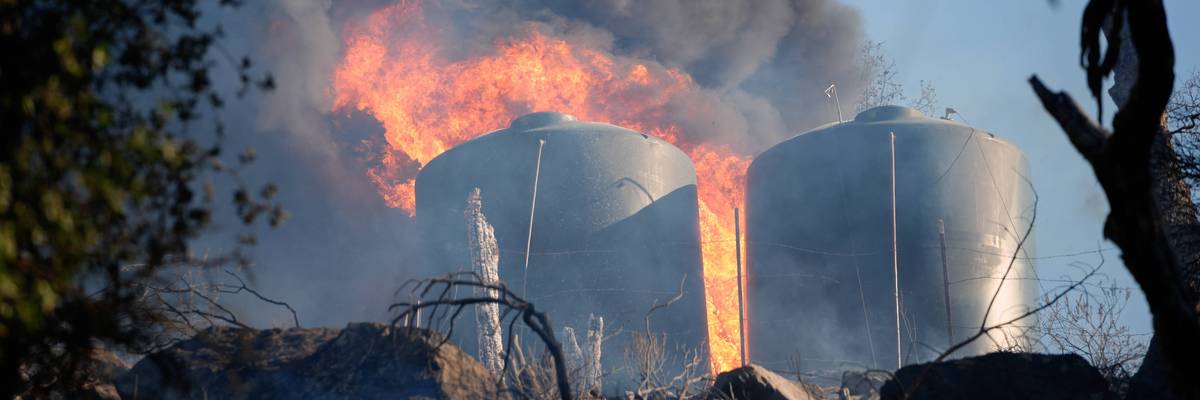
Crews battle the Mines Fire in Santa Clara County, California on July 26, 2026.
"If we're exceeding records from the Dust Bowl, that says that we're in deep trouble," warned one meteorologist.
While President Donald Trump continued his war on renewables and support for climate-wrecking fossil fuels, the contiguous United States endured the hottest July on record, according to data released Monday by his own government.
"July 2026 averaged 76.9ºF, the warmest month on record (1895-present)," National Oceanic and Atmospheric Administration (NOAA) announced. That figure was "3.3ºF above the 20th-century average. This was the warmest July—and warmest month—in the 132-year record, 0.1-0.2ºF warmer than July 1936 and July 2012."
The Associated Press highlighted that last month's average for the Lower 48 eclipsed "the Dust Bowl's July 1936 by an eighth of a degree," a development that meteorologist Jeff Masters of Yale Climate Connections described as alarming.
"It's not good when you’re breaking records from the Dust Bowl, which we are in this case," he told the AP. "And that was a crazy sort of situation where you put tens of millions of people in motion. You had this great migration because of the drought and the heat that hit the center of the US—just a cataclysmic event in US history. If we're exceeding records from the Dust Bowl, that says that we're in deep trouble."
Separately, Masters and fellow meteorologist Bob Henson wrote at Yale Climate Connections that "there's no denying the scorching conditions of the 1930s Dust Bowl. An impressive 24 of the 48 contiguous US states have yet to exceed the single hottest readings observed in each of those states during the 1930s."
"However, the Dust Bowl has been misused for years in climate-denial writing and speaking to argue that human activity isn't warming the nation's climate to any great degree. In fact, human influence played a vast part in the Dust Bowl itself," they explained. "Decades of overplowing by European settlers in the Plains and Midwest—in the erroneous belief that 'rain follows the plow'—left the landscape vulnerable when a sequence of multi-year droughts struck. Huge volumes of topsoil simply blew away, and the denuded land heated up far more quickly than better-managed land would have. The Dust Bowl intersected with the Great Depression to make the 1930s a period of profound misery for millions of Americans."
"A 2022 study, 'How the Great Plains Dust Bowl drought spread heat extremes around the Northern Hemisphere,' showed how the Dust Bowl's physical influence extended well beyond US borders," the pair added. "As lead author Gerald Meehl of the National Center for Atmospheric Research put it, 'This is a mechanism that arose in a unique way from human influence—not by burning fossil fuels but from plowing up the middle third of the US.'"
We just broke a heat record set during the Dust Bowl. 😬That record has been a favorite talking point of climate deniers. Now it's bitten the dust: yaleclimateconnections.org/2026/08/the-...New from @drjeffmasters.bsky.social and @bhensonweather.bsky.social
[image or embed]
— Yale Climate Connections (@climateconnections.bsky.social) August 10, 2026 at 2:50 PM
Wildfires broke out across Canada and in the United States' Pacific Northwest last month, burning over 140,000 acres in Oregon alone. NOAA found that "daytime maximum temperatures averaged 89.5ºF, 2.9ºF above average, ranking as the sixth-warmest month on record for average high temperatures, while overnight minimum temperatures averaged 64.2ºF, 3.7ºF above average, ranking as the warmest month on record for average low temperatures, surpassing July 2022 by 0.7ºF."
Those high temperatures overnight can be dangerous. Masters told the AP that "if you're talking heatwaves, that nighttime low is incredibly important for determining total heat stress... So if it doesn’t cool off at night, your body doesn't have time to readjust to all the heat."
While July set a new record in the United States, because of the fossil fuel-driven climate crisis, "this may be one of the coolest years we’re gonna experience for the rest of our lives," the meteorologist also said. He added that humanity needs "to stop burning so many fossil fuels. We also need to be spending money to adapt to the new climate that we've put in place."
Wildfires also impacted the European Union last month—and NOAA's new numbers came out as the EU's Copernicus Climate Change Service announced Monday that worldwide, last month was second warmest July on record, tied with 2024. The agency also found that the average global ocean surface temperature was the hottest ever recorded in July, fueled in part by El Niño conditions.
"Our leaders’ response has to be swifter and stronger than El Niño," argued Anne Jellema, executive director of the advocacy group 350.org. "We already know that global heating is supercharging extreme weather damage, and the public wants polluters to pay for it. With Big Oil's earnings skyrocketing while a global food crisis looms, now is the time to act. The only way to stave off a humanitarian disaster is to make those causing it pay upfront—before even more damage is done."
The Guardian pointed out that "an unusually strong El Niño event, a periodic climate feature where a section of the Pacific Ocean heats up causing weather around the world to alter, is likely to cause next year to be the hottest on record globally, surpassing a record set just in 2024. Some scientists think the developing El Niño could even ensure that this year is the one that breaks the record."
Michael Mann, a climate scientist at the University of Pennsylvania, told the newspaper that "the bottom line... is that we expect to set record global temperatures as long as carbon emissions continue to warm the planet, and typically these records are set during major El Niño events."
Dear Common Dreams reader, It’s been nearly 30 years since I co-founded Common Dreams with my late wife, Lina Newhouser. We had the radical notion that journalism should serve the public good, not corporate profits. It was clear to us from the outset what it would take to build such a project. No paid advertisements. No corporate sponsors. No millionaire publisher telling us what to think or do. Many people said we wouldn't last a year, but we proved those doubters wrong. Together with a tremendous team of journalists and dedicated staff, we built an independent media outlet free from the constraints of profits and corporate control. Our mission has always been simple: To inform. To inspire. To ignite change for the common good. Building Common Dreams was not easy. Our survival was never guaranteed. When you take on the most powerful forces—Wall Street greed, fossil fuel industry destruction, Big Tech lobbyists, and uber-rich oligarchs who have spent billions upon billions rigging the economy and democracy in their favor—the only bulwark you have is supporters who believe in your work. But here’s the urgent message from me today. It's never been this bad out there. And it's never been this hard to keep us going. At the very moment Common Dreams is most needed, the threats we face are intensifying. We need your support now more than ever. We don't accept corporate advertising and never will. We don't have a paywall because we don't think people should be blocked from critical news based on their ability to pay. Everything we do is funded by the donations of readers like you. When everyone does the little they can afford, we are strong. But if that support retreats or dries up, so do we. Will you donate now to make sure Common Dreams not only survives but thrives? —Craig Brown, Co-founder |
While President Donald Trump continued his war on renewables and support for climate-wrecking fossil fuels, the contiguous United States endured the hottest July on record, according to data released Monday by his own government.
"July 2026 averaged 76.9ºF, the warmest month on record (1895-present)," National Oceanic and Atmospheric Administration (NOAA) announced. That figure was "3.3ºF above the 20th-century average. This was the warmest July—and warmest month—in the 132-year record, 0.1-0.2ºF warmer than July 1936 and July 2012."
The Associated Press highlighted that last month's average for the Lower 48 eclipsed "the Dust Bowl's July 1936 by an eighth of a degree," a development that meteorologist Jeff Masters of Yale Climate Connections described as alarming.
"It's not good when you’re breaking records from the Dust Bowl, which we are in this case," he told the AP. "And that was a crazy sort of situation where you put tens of millions of people in motion. You had this great migration because of the drought and the heat that hit the center of the US—just a cataclysmic event in US history. If we're exceeding records from the Dust Bowl, that says that we're in deep trouble."
Separately, Masters and fellow meteorologist Bob Henson wrote at Yale Climate Connections that "there's no denying the scorching conditions of the 1930s Dust Bowl. An impressive 24 of the 48 contiguous US states have yet to exceed the single hottest readings observed in each of those states during the 1930s."
"However, the Dust Bowl has been misused for years in climate-denial writing and speaking to argue that human activity isn't warming the nation's climate to any great degree. In fact, human influence played a vast part in the Dust Bowl itself," they explained. "Decades of overplowing by European settlers in the Plains and Midwest—in the erroneous belief that 'rain follows the plow'—left the landscape vulnerable when a sequence of multi-year droughts struck. Huge volumes of topsoil simply blew away, and the denuded land heated up far more quickly than better-managed land would have. The Dust Bowl intersected with the Great Depression to make the 1930s a period of profound misery for millions of Americans."
"A 2022 study, 'How the Great Plains Dust Bowl drought spread heat extremes around the Northern Hemisphere,' showed how the Dust Bowl's physical influence extended well beyond US borders," the pair added. "As lead author Gerald Meehl of the National Center for Atmospheric Research put it, 'This is a mechanism that arose in a unique way from human influence—not by burning fossil fuels but from plowing up the middle third of the US.'"
We just broke a heat record set during the Dust Bowl. 😬That record has been a favorite talking point of climate deniers. Now it's bitten the dust: yaleclimateconnections.org/2026/08/the-...New from @drjeffmasters.bsky.social and @bhensonweather.bsky.social
[image or embed]
— Yale Climate Connections (@climateconnections.bsky.social) August 10, 2026 at 2:50 PM
Wildfires broke out across Canada and in the United States' Pacific Northwest last month, burning over 140,000 acres in Oregon alone. NOAA found that "daytime maximum temperatures averaged 89.5ºF, 2.9ºF above average, ranking as the sixth-warmest month on record for average high temperatures, while overnight minimum temperatures averaged 64.2ºF, 3.7ºF above average, ranking as the warmest month on record for average low temperatures, surpassing July 2022 by 0.7ºF."
Those high temperatures overnight can be dangerous. Masters told the AP that "if you're talking heatwaves, that nighttime low is incredibly important for determining total heat stress... So if it doesn’t cool off at night, your body doesn't have time to readjust to all the heat."
While July set a new record in the United States, because of the fossil fuel-driven climate crisis, "this may be one of the coolest years we’re gonna experience for the rest of our lives," the meteorologist also said. He added that humanity needs "to stop burning so many fossil fuels. We also need to be spending money to adapt to the new climate that we've put in place."
Wildfires also impacted the European Union last month—and NOAA's new numbers came out as the EU's Copernicus Climate Change Service announced Monday that worldwide, last month was second warmest July on record, tied with 2024. The agency also found that the average global ocean surface temperature was the hottest ever recorded in July, fueled in part by El Niño conditions.
"Our leaders’ response has to be swifter and stronger than El Niño," argued Anne Jellema, executive director of the advocacy group 350.org. "We already know that global heating is supercharging extreme weather damage, and the public wants polluters to pay for it. With Big Oil's earnings skyrocketing while a global food crisis looms, now is the time to act. The only way to stave off a humanitarian disaster is to make those causing it pay upfront—before even more damage is done."
The Guardian pointed out that "an unusually strong El Niño event, a periodic climate feature where a section of the Pacific Ocean heats up causing weather around the world to alter, is likely to cause next year to be the hottest on record globally, surpassing a record set just in 2024. Some scientists think the developing El Niño could even ensure that this year is the one that breaks the record."
Michael Mann, a climate scientist at the University of Pennsylvania, told the newspaper that "the bottom line... is that we expect to set record global temperatures as long as carbon emissions continue to warm the planet, and typically these records are set during major El Niño events."
While President Donald Trump continued his war on renewables and support for climate-wrecking fossil fuels, the contiguous United States endured the hottest July on record, according to data released Monday by his own government.
"July 2026 averaged 76.9ºF, the warmest month on record (1895-present)," National Oceanic and Atmospheric Administration (NOAA) announced. That figure was "3.3ºF above the 20th-century average. This was the warmest July—and warmest month—in the 132-year record, 0.1-0.2ºF warmer than July 1936 and July 2012."
The Associated Press highlighted that last month's average for the Lower 48 eclipsed "the Dust Bowl's July 1936 by an eighth of a degree," a development that meteorologist Jeff Masters of Yale Climate Connections described as alarming.
"It's not good when you’re breaking records from the Dust Bowl, which we are in this case," he told the AP. "And that was a crazy sort of situation where you put tens of millions of people in motion. You had this great migration because of the drought and the heat that hit the center of the US—just a cataclysmic event in US history. If we're exceeding records from the Dust Bowl, that says that we're in deep trouble."
Separately, Masters and fellow meteorologist Bob Henson wrote at Yale Climate Connections that "there's no denying the scorching conditions of the 1930s Dust Bowl. An impressive 24 of the 48 contiguous US states have yet to exceed the single hottest readings observed in each of those states during the 1930s."
"However, the Dust Bowl has been misused for years in climate-denial writing and speaking to argue that human activity isn't warming the nation's climate to any great degree. In fact, human influence played a vast part in the Dust Bowl itself," they explained. "Decades of overplowing by European settlers in the Plains and Midwest—in the erroneous belief that 'rain follows the plow'—left the landscape vulnerable when a sequence of multi-year droughts struck. Huge volumes of topsoil simply blew away, and the denuded land heated up far more quickly than better-managed land would have. The Dust Bowl intersected with the Great Depression to make the 1930s a period of profound misery for millions of Americans."
"A 2022 study, 'How the Great Plains Dust Bowl drought spread heat extremes around the Northern Hemisphere,' showed how the Dust Bowl's physical influence extended well beyond US borders," the pair added. "As lead author Gerald Meehl of the National Center for Atmospheric Research put it, 'This is a mechanism that arose in a unique way from human influence—not by burning fossil fuels but from plowing up the middle third of the US.'"
We just broke a heat record set during the Dust Bowl. 😬That record has been a favorite talking point of climate deniers. Now it's bitten the dust: yaleclimateconnections.org/2026/08/the-...New from @drjeffmasters.bsky.social and @bhensonweather.bsky.social
[image or embed]
— Yale Climate Connections (@climateconnections.bsky.social) August 10, 2026 at 2:50 PM
Wildfires broke out across Canada and in the United States' Pacific Northwest last month, burning over 140,000 acres in Oregon alone. NOAA found that "daytime maximum temperatures averaged 89.5ºF, 2.9ºF above average, ranking as the sixth-warmest month on record for average high temperatures, while overnight minimum temperatures averaged 64.2ºF, 3.7ºF above average, ranking as the warmest month on record for average low temperatures, surpassing July 2022 by 0.7ºF."
Those high temperatures overnight can be dangerous. Masters told the AP that "if you're talking heatwaves, that nighttime low is incredibly important for determining total heat stress... So if it doesn’t cool off at night, your body doesn't have time to readjust to all the heat."
While July set a new record in the United States, because of the fossil fuel-driven climate crisis, "this may be one of the coolest years we’re gonna experience for the rest of our lives," the meteorologist also said. He added that humanity needs "to stop burning so many fossil fuels. We also need to be spending money to adapt to the new climate that we've put in place."
Wildfires also impacted the European Union last month—and NOAA's new numbers came out as the EU's Copernicus Climate Change Service announced Monday that worldwide, last month was second warmest July on record, tied with 2024. The agency also found that the average global ocean surface temperature was the hottest ever recorded in July, fueled in part by El Niño conditions.
"Our leaders’ response has to be swifter and stronger than El Niño," argued Anne Jellema, executive director of the advocacy group 350.org. "We already know that global heating is supercharging extreme weather damage, and the public wants polluters to pay for it. With Big Oil's earnings skyrocketing while a global food crisis looms, now is the time to act. The only way to stave off a humanitarian disaster is to make those causing it pay upfront—before even more damage is done."
The Guardian pointed out that "an unusually strong El Niño event, a periodic climate feature where a section of the Pacific Ocean heats up causing weather around the world to alter, is likely to cause next year to be the hottest on record globally, surpassing a record set just in 2024. Some scientists think the developing El Niño could even ensure that this year is the one that breaks the record."
Michael Mann, a climate scientist at the University of Pennsylvania, told the newspaper that "the bottom line... is that we expect to set record global temperatures as long as carbon emissions continue to warm the planet, and typically these records are set during major El Niño events."