SUBSCRIBE TO OUR FREE NEWSLETTER
Daily news & progressive opinion—funded by the people, not the corporations—delivered straight to your inbox.
5
#000000
#FFFFFF
To donate by check, phone, or other method, see our More Ways to Give page.
Daily news & progressive opinion—funded by the people, not the corporations—delivered straight to your inbox.
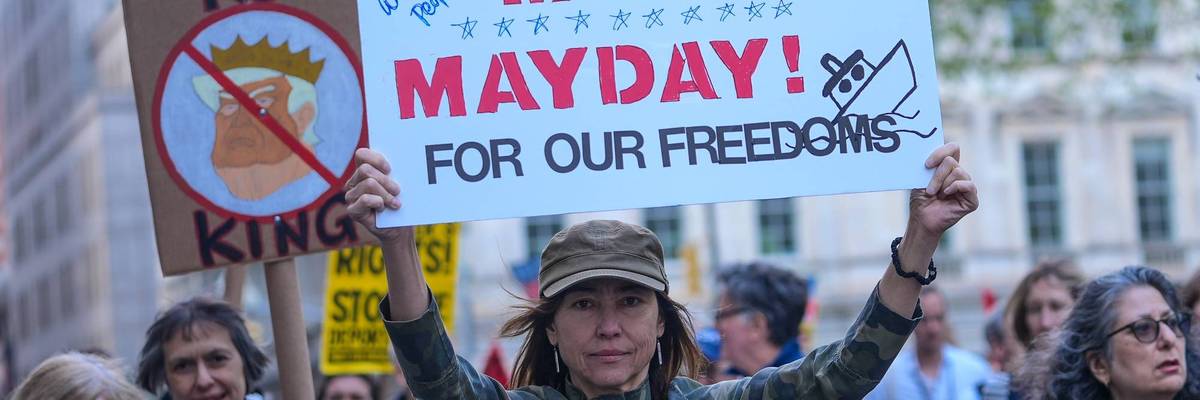
People take part in May Day rally and march in New York City to protest the Trump administration, New York, U.S., May 1, 2025.
This year's May Day rallies go beyond workers’ rights.
Unlike the rest of the world's democracies, the United States doesn't use the metric system, doesn't require employers to provide workers with paid vacations, hasn't abolished the death penalty, and doesn't celebrate May Day as an official national holiday.
Outside the US, May 1 is international workers' day, observed with speeches, rallies and demonstrations. This year, millions of workers in Europe, Asia and Latin America will take to the streets to demand higher wages, better benefits and improved working conditions.
Ironically, this celebration of working-class solidarity was started by the US labor movement and soon spread around the world, but it never earned official recognition in this country.
This year, on the heels of the three massive nationwide “No Kings” marches and rallies, millions of Americans will join forces, in thousands of cities and towns, in May Day Strong events.
The May Day Strong organizers hoping to bring Americans together to challenge the billionaires, big corporations, and the Trump administration, who have manipulated the rules to lower living standards, attack immigrants, undermine democracy, and direct tax dollars for wars rather than meeting human needs. It will be a day of rallies, marches, teach-ins, labor actions, and a refusal to participate in business as usual—because, as the organizers say, “when those at the top rig the system, collective action is how we set it right.”
Organizers expect over several thousand nonviolent actions across the country. The broad coalition behind the protests include major unions, civil rights, reproductive justice, environmental, immigrant rights, and faith groups, and tenant and community organizations, as well as Indivisible and Democratic Socialists of America.
The protest is inspired by the large day of action on January 23 that shut down much of Minneapolis by asking people not to work, shop, or attend school that day to challenge ICE’s occupation and its illegal actions (including murder) against immigrants and activists.
But the May Day Strong leaders are not calling for a general strike to shut down the economy. That tactic—allowing unions to strike in solidarity with other unions’ strikes—was banned in 1946 when Congress passed the anti-union Taft-Hartley Act over President Harry Truman’s veto. Even so, organizers view this year’s May Day events as a dress rehearsal something close to a general strike in 2028, in anticipation of the presidential and mid-term elections, but that would require the participation of many large unions who may not believe they and their members are prepared for such a militant action or the possible political backlash by the Trump administration and by voters if employers threaten to fire workers for engaging in an illegal strike. In addition, as Philadelphia Inquirer columnist Will Bunch noted, “How many people would need to stop shopping to make a noticeable dent in the nearly $3 billion per day Americans spend?””
But another massive national day of protest this May Day could help inspire voters to oust more Trump Republicans in November, give Democrats a majority of seats in both the House and Senate, and lay the groundwork for a more progressive policy agenda if the Democrats take back the White House in two years.
In doing so, they will be honoring the original May Day, which was born of the movement for an eight-hour workday. After the Civil War, unregulated capitalism ran rampant in America. It was the Gilded Age, a time of merger mania, increasing concentration of wealth and growing political influence by corporate power brokers known as Robber Barons. New technologies made possible new industries, which generated great riches for the fortunate few, but at the expense of workers, many of them immigrants, who worked long hours, under dangerous conditions, for little pay.
As the gap between the rich and other Americans widened dramatically, workers began to resist in a variety of ways. The first major wave of labor unions pushed employers to limit the workday to ten hours and then later down to eight hours. The 1877 strike by tens of thousands of railroad, factory and mine workers—which shut down the nation's major industries and was brutally suppressed by the corporations and their friends in government—was the first of many mass actions to demand living wages and humane working conditions. By 1884, the campaign had gained enough momentum that the predecessor to the American Federation of Labor adopted a resolution at its annual meeting, "that eight hours shall constitute legal day's labor from and after May 1, 1886."
On the appointed date, unions and radical groups orchestrated strikes and large-scale demonstrations in cities across the country. More than 500,000 workers went on strike or marched in solidarity and many more people protested in the streets. In Chicago, a labor stronghold, at least 30,000 workers struck. Rallies and parades across the city more than doubled that number, and the May 1 demonstrations continued for several days. The protests were mostly nonviolent, but they included skirmishes with strikebreakers, company-hired thugs and police.
On May 3, at a rally outside the McCormick Harvesting Machine Company factory, police fired on the crowd, killing at least two workers. The next day, at a rally at Haymarket Square to protest the shootings, police moved in to clear the crowd. Someone threw a bomb at the police, killing at least one officer. Another seven policemen were killed during the ensuing riot, and police gunfire killed at least four protesters and injured many others.
After a controversial investigation, seven anarchists were sentenced to death for murder, while another was sentenced to 15 years in prison. The anarchists won global notoriety, being seen as martyrs by many radicals and reformers, who viewed the trial and executions as politically motivated.
Within a few years, unions and radical groups around the world had established May Day as an international holiday to commemorate the Haymarket martyrs and continue the struggle for the eight-hour day, workers' rights, and social justice.
In the United States, however, the burgeoning Knights of Labor, uneasy with May Day's connection to anarchists and other radicals, adopted another day to celebrate workers' rights. In 1887, Oregon was the first state to make Labor Day an official holiday, celebrated in September. Other states soon followed. Unions sponsored parades to celebrate Labor Day, but such one-day festivities didn't make corporations any more willing to grant workers decent conditions. To make their voices heard, workers had to resort to massive strikes, typically put down with brutal violence by government troops.
In 1894, the American Railway Union, led by Eugene Debs, went on strike against the Pullman Palace Car Company to demand lower rents (Pullman was a company town that owned its employees' homes) and higher pay following huge layoffs and wage cuts. In solidarity with the Pullman workers, railroad workers across the country boycotted the trains with Pullman cars, paralyzing the nation's economy as well as its mail service. President Grover Cleveland declared the strike a federal crime and called out 12,000 soldiers to break the strike. They crushed the walkout and killed at least two protesters. Six days later, Cleveland—facing worker protests for his repression of the Pullman strikers—signed a bill creating Labor Day as an official national holiday in September. He hoped that giving the working class a day off to celebrate one Monday a year might pacify them.
For most of the 20th century, Labor Day was reserved for festive parades, picnics and speeches sponsored by unions in major cities. But contrary to what President Cleveland had hoped, American workers, their families and allies, found other occasions to mobilize for better working conditions and a more humane society. America witnessed massive strike waves throughout the century, including militant general strikes and occupations. These included a general strike in Seattle in 1919, the 1934 San Francisco general strike, led by the longshoremen's union; a strike of about 400,000 textile workers that same year; militant sit-down strikes in 1937 by autoworkers in Flint, Michigan, women workers at Woolworth's department stores in New York, aviation workers in Los Angeles, and others, and the largest strike wave in US history in 1946, triggered by pent-up demands following World War Two.
May 1 faded away as a day of protest. From the 1920s through the 1950s, radical groups sought to keep the tradition alive with parades and other events, but the mainstream labor movement and most liberal organizations kept their distance, making May Day an increasingly marginal affair. In 1958, in the midst of the cold war, President Dwight Eisenhower proclaimed May 1 as Loyalty Day. Each subsequent president has issued a similar proclamation, although few Americans know about or celebrate the day.
Since 2001, American unions and immigrant rights activists have resurrected May 1 as a day of protest around both workers’ rights and immigrant rights. That year, millions of people in over 100 cities—including more than a million in Los Angeles, 200,000 in New York and 300,000 in Chicago—participated in May Day demonstrations.
The huge turnout was catalyzed by a bill, sponsored by Representative James Sensenbrenner Jr. (R-Wis.) and passed by the House the previous December, that would have classified as a felon anyone who helped undocumented immigrants enter or remain in the United States. Since then, immigrant workers and their allies have adopted May Day as an occasion for protest.
In 2006, organized launched a protest they called “A Day Without Immigrants,” which was also termed the “Great American Boycott.” In many cities, workers refused to go to work, high school students walked out of their classrooms and into the street, while consumers shut down businesses that depended on immigrant workers.
In 2017, activists organized another “Day Without Immigrants” protest to dramatize the importance of immigrants to the American economy and protest Trump’s plans to build a border wall and deport millions of undocumented immigrants. The organizers called for immigrants and allies not to go to work, to avoid spending money, and keep children home from school.
"It was mostly immigrants who led the first May Day movement for the eight-hour day. Now a new generation of immigrant workers have revitalized and brought May Day back to life," observed California State Senator María Elena Durazo, the former head of the Los Angeles County Federation of Labor.
Although the labor movement fell on hard times starting in the 1950s, it nevertheless helped guarantee that more Americans would share in the nation’s post-war prosperity and join the middle class. Moreover, the civil rights, feminist, environmental and gay rights movements, and the more recent immigrant rights movement, drew important lessons from labor movement tactics and built coalitions with organized labor to advance their goals.
America is now in the midst of a new Gilded Age with a new group of corporate Robber Barons, many of them operating on a global scale. The top of the income scale has the biggest concentration of income and wealth since 1928. Several decades of corporate-backed assaults on unions have left only six percent of private sector employees with union cards, down from about one-third of all workers in the 1950s. More than half of America's 15 million union members now work for government (representing 33 percent of all government employees), so business groups and conservative politicians, including Trump, have targeted public sector unions for destruction.
Despite this, we’ve seen a recent resurgence of activism among rank-and-file workers at fast-food chains, Starbucks, Amazon, Ford, General Motors and Stellantis, Volkswagen, Boeing, Trader Joe’s, Apple, Barnes and Noble, Chipotle, Disneyland, Kaiser Permanente, UPS, Uber and LYFT, REI, film companies and TV studios, meatpacking companies, major hospitals and universities, school districts, and other employers. They have waged strikes, walkouts and union recognition campaigns to win better pay and working conditions.
Public opinion in solidly behind these demands. The decline of union membership is not due to Americans’ opposition to unions. A recent Gallup poll found that 68% of Americans support unions. Support is particularly high among Americans between 18 and 34 years old, 72% of whom embrace unions as a vehicle to address economic inequality and workplace problems. About two-thirds (64%) of Americans think the federal minimum wage—which has been stuck at $7.25 an hour since 2009—should be increased to $17.
The biggest obstacle to a union resurgence is federal labor law. American workers understand that employers resort to a variety of antiunion tactics—including firing employees illegally—to thwart unionization efforts. And there’s the rub. Americans have far fewer rights at work than employees in other democratic societies. Current federal laws are an impediment to union organizing rather than a protector of workers’ rights. The rules are stacked against workers, making it extremely difficult for even the most talented organizers to win union elections. Under current law, and with Trump stacking the National Labor Relations Board with anti-union members, any employer with a clever attorney can stall union elections, giving management time to scare the living daylights out of potential recruits.
This year's May Day rallies go beyond workers’ rights. They will focus on issues like stopping the billionaire takeover and rampant corruption of the Trump administration, protecting Medicaid, Social Security, and other programs working people rely on, fully funding public schools, healthcare, and housing for all, and stopping the attacks on communities, including policies that target immigrants and people of color. It will also build momentum for a large-scale voter mobilization effort to elect liberals and progressives in the November mid-terms.
“It isn't just about immigrant rights. It isn't just about workers’ rights on the job or even about raising the standard of living for all workers,” said Durazo. “It's about what kind of country we want to be.”
Dear Common Dreams reader, It’s been nearly 30 years since I co-founded Common Dreams with my late wife, Lina Newhouser. We had the radical notion that journalism should serve the public good, not corporate profits. It was clear to us from the outset what it would take to build such a project. No paid advertisements. No corporate sponsors. No millionaire publisher telling us what to think or do. Many people said we wouldn't last a year, but we proved those doubters wrong. Together with a tremendous team of journalists and dedicated staff, we built an independent media outlet free from the constraints of profits and corporate control. Our mission has always been simple: To inform. To inspire. To ignite change for the common good. Building Common Dreams was not easy. Our survival was never guaranteed. When you take on the most powerful forces—Wall Street greed, fossil fuel industry destruction, Big Tech lobbyists, and uber-rich oligarchs who have spent billions upon billions rigging the economy and democracy in their favor—the only bulwark you have is supporters who believe in your work. But here’s the urgent message from me today. It's never been this bad out there. And it's never been this hard to keep us going. At the very moment Common Dreams is most needed, the threats we face are intensifying. We need your support now more than ever. We don't accept corporate advertising and never will. We don't have a paywall because we don't think people should be blocked from critical news based on their ability to pay. Everything we do is funded by the donations of readers like you. When everyone does the little they can afford, we are strong. But if that support retreats or dries up, so do we. Will you donate now to make sure Common Dreams not only survives but thrives? —Craig Brown, Co-founder |
Unlike the rest of the world's democracies, the United States doesn't use the metric system, doesn't require employers to provide workers with paid vacations, hasn't abolished the death penalty, and doesn't celebrate May Day as an official national holiday.
Outside the US, May 1 is international workers' day, observed with speeches, rallies and demonstrations. This year, millions of workers in Europe, Asia and Latin America will take to the streets to demand higher wages, better benefits and improved working conditions.
Ironically, this celebration of working-class solidarity was started by the US labor movement and soon spread around the world, but it never earned official recognition in this country.
This year, on the heels of the three massive nationwide “No Kings” marches and rallies, millions of Americans will join forces, in thousands of cities and towns, in May Day Strong events.
The May Day Strong organizers hoping to bring Americans together to challenge the billionaires, big corporations, and the Trump administration, who have manipulated the rules to lower living standards, attack immigrants, undermine democracy, and direct tax dollars for wars rather than meeting human needs. It will be a day of rallies, marches, teach-ins, labor actions, and a refusal to participate in business as usual—because, as the organizers say, “when those at the top rig the system, collective action is how we set it right.”
Organizers expect over several thousand nonviolent actions across the country. The broad coalition behind the protests include major unions, civil rights, reproductive justice, environmental, immigrant rights, and faith groups, and tenant and community organizations, as well as Indivisible and Democratic Socialists of America.
The protest is inspired by the large day of action on January 23 that shut down much of Minneapolis by asking people not to work, shop, or attend school that day to challenge ICE’s occupation and its illegal actions (including murder) against immigrants and activists.
But the May Day Strong leaders are not calling for a general strike to shut down the economy. That tactic—allowing unions to strike in solidarity with other unions’ strikes—was banned in 1946 when Congress passed the anti-union Taft-Hartley Act over President Harry Truman’s veto. Even so, organizers view this year’s May Day events as a dress rehearsal something close to a general strike in 2028, in anticipation of the presidential and mid-term elections, but that would require the participation of many large unions who may not believe they and their members are prepared for such a militant action or the possible political backlash by the Trump administration and by voters if employers threaten to fire workers for engaging in an illegal strike. In addition, as Philadelphia Inquirer columnist Will Bunch noted, “How many people would need to stop shopping to make a noticeable dent in the nearly $3 billion per day Americans spend?””
But another massive national day of protest this May Day could help inspire voters to oust more Trump Republicans in November, give Democrats a majority of seats in both the House and Senate, and lay the groundwork for a more progressive policy agenda if the Democrats take back the White House in two years.
In doing so, they will be honoring the original May Day, which was born of the movement for an eight-hour workday. After the Civil War, unregulated capitalism ran rampant in America. It was the Gilded Age, a time of merger mania, increasing concentration of wealth and growing political influence by corporate power brokers known as Robber Barons. New technologies made possible new industries, which generated great riches for the fortunate few, but at the expense of workers, many of them immigrants, who worked long hours, under dangerous conditions, for little pay.
As the gap between the rich and other Americans widened dramatically, workers began to resist in a variety of ways. The first major wave of labor unions pushed employers to limit the workday to ten hours and then later down to eight hours. The 1877 strike by tens of thousands of railroad, factory and mine workers—which shut down the nation's major industries and was brutally suppressed by the corporations and their friends in government—was the first of many mass actions to demand living wages and humane working conditions. By 1884, the campaign had gained enough momentum that the predecessor to the American Federation of Labor adopted a resolution at its annual meeting, "that eight hours shall constitute legal day's labor from and after May 1, 1886."
On the appointed date, unions and radical groups orchestrated strikes and large-scale demonstrations in cities across the country. More than 500,000 workers went on strike or marched in solidarity and many more people protested in the streets. In Chicago, a labor stronghold, at least 30,000 workers struck. Rallies and parades across the city more than doubled that number, and the May 1 demonstrations continued for several days. The protests were mostly nonviolent, but they included skirmishes with strikebreakers, company-hired thugs and police.
On May 3, at a rally outside the McCormick Harvesting Machine Company factory, police fired on the crowd, killing at least two workers. The next day, at a rally at Haymarket Square to protest the shootings, police moved in to clear the crowd. Someone threw a bomb at the police, killing at least one officer. Another seven policemen were killed during the ensuing riot, and police gunfire killed at least four protesters and injured many others.
After a controversial investigation, seven anarchists were sentenced to death for murder, while another was sentenced to 15 years in prison. The anarchists won global notoriety, being seen as martyrs by many radicals and reformers, who viewed the trial and executions as politically motivated.
Within a few years, unions and radical groups around the world had established May Day as an international holiday to commemorate the Haymarket martyrs and continue the struggle for the eight-hour day, workers' rights, and social justice.
In the United States, however, the burgeoning Knights of Labor, uneasy with May Day's connection to anarchists and other radicals, adopted another day to celebrate workers' rights. In 1887, Oregon was the first state to make Labor Day an official holiday, celebrated in September. Other states soon followed. Unions sponsored parades to celebrate Labor Day, but such one-day festivities didn't make corporations any more willing to grant workers decent conditions. To make their voices heard, workers had to resort to massive strikes, typically put down with brutal violence by government troops.
In 1894, the American Railway Union, led by Eugene Debs, went on strike against the Pullman Palace Car Company to demand lower rents (Pullman was a company town that owned its employees' homes) and higher pay following huge layoffs and wage cuts. In solidarity with the Pullman workers, railroad workers across the country boycotted the trains with Pullman cars, paralyzing the nation's economy as well as its mail service. President Grover Cleveland declared the strike a federal crime and called out 12,000 soldiers to break the strike. They crushed the walkout and killed at least two protesters. Six days later, Cleveland—facing worker protests for his repression of the Pullman strikers—signed a bill creating Labor Day as an official national holiday in September. He hoped that giving the working class a day off to celebrate one Monday a year might pacify them.
For most of the 20th century, Labor Day was reserved for festive parades, picnics and speeches sponsored by unions in major cities. But contrary to what President Cleveland had hoped, American workers, their families and allies, found other occasions to mobilize for better working conditions and a more humane society. America witnessed massive strike waves throughout the century, including militant general strikes and occupations. These included a general strike in Seattle in 1919, the 1934 San Francisco general strike, led by the longshoremen's union; a strike of about 400,000 textile workers that same year; militant sit-down strikes in 1937 by autoworkers in Flint, Michigan, women workers at Woolworth's department stores in New York, aviation workers in Los Angeles, and others, and the largest strike wave in US history in 1946, triggered by pent-up demands following World War Two.
May 1 faded away as a day of protest. From the 1920s through the 1950s, radical groups sought to keep the tradition alive with parades and other events, but the mainstream labor movement and most liberal organizations kept their distance, making May Day an increasingly marginal affair. In 1958, in the midst of the cold war, President Dwight Eisenhower proclaimed May 1 as Loyalty Day. Each subsequent president has issued a similar proclamation, although few Americans know about or celebrate the day.
Since 2001, American unions and immigrant rights activists have resurrected May 1 as a day of protest around both workers’ rights and immigrant rights. That year, millions of people in over 100 cities—including more than a million in Los Angeles, 200,000 in New York and 300,000 in Chicago—participated in May Day demonstrations.
The huge turnout was catalyzed by a bill, sponsored by Representative James Sensenbrenner Jr. (R-Wis.) and passed by the House the previous December, that would have classified as a felon anyone who helped undocumented immigrants enter or remain in the United States. Since then, immigrant workers and their allies have adopted May Day as an occasion for protest.
In 2006, organized launched a protest they called “A Day Without Immigrants,” which was also termed the “Great American Boycott.” In many cities, workers refused to go to work, high school students walked out of their classrooms and into the street, while consumers shut down businesses that depended on immigrant workers.
In 2017, activists organized another “Day Without Immigrants” protest to dramatize the importance of immigrants to the American economy and protest Trump’s plans to build a border wall and deport millions of undocumented immigrants. The organizers called for immigrants and allies not to go to work, to avoid spending money, and keep children home from school.
"It was mostly immigrants who led the first May Day movement for the eight-hour day. Now a new generation of immigrant workers have revitalized and brought May Day back to life," observed California State Senator María Elena Durazo, the former head of the Los Angeles County Federation of Labor.
Although the labor movement fell on hard times starting in the 1950s, it nevertheless helped guarantee that more Americans would share in the nation’s post-war prosperity and join the middle class. Moreover, the civil rights, feminist, environmental and gay rights movements, and the more recent immigrant rights movement, drew important lessons from labor movement tactics and built coalitions with organized labor to advance their goals.
America is now in the midst of a new Gilded Age with a new group of corporate Robber Barons, many of them operating on a global scale. The top of the income scale has the biggest concentration of income and wealth since 1928. Several decades of corporate-backed assaults on unions have left only six percent of private sector employees with union cards, down from about one-third of all workers in the 1950s. More than half of America's 15 million union members now work for government (representing 33 percent of all government employees), so business groups and conservative politicians, including Trump, have targeted public sector unions for destruction.
Despite this, we’ve seen a recent resurgence of activism among rank-and-file workers at fast-food chains, Starbucks, Amazon, Ford, General Motors and Stellantis, Volkswagen, Boeing, Trader Joe’s, Apple, Barnes and Noble, Chipotle, Disneyland, Kaiser Permanente, UPS, Uber and LYFT, REI, film companies and TV studios, meatpacking companies, major hospitals and universities, school districts, and other employers. They have waged strikes, walkouts and union recognition campaigns to win better pay and working conditions.
Public opinion in solidly behind these demands. The decline of union membership is not due to Americans’ opposition to unions. A recent Gallup poll found that 68% of Americans support unions. Support is particularly high among Americans between 18 and 34 years old, 72% of whom embrace unions as a vehicle to address economic inequality and workplace problems. About two-thirds (64%) of Americans think the federal minimum wage—which has been stuck at $7.25 an hour since 2009—should be increased to $17.
The biggest obstacle to a union resurgence is federal labor law. American workers understand that employers resort to a variety of antiunion tactics—including firing employees illegally—to thwart unionization efforts. And there’s the rub. Americans have far fewer rights at work than employees in other democratic societies. Current federal laws are an impediment to union organizing rather than a protector of workers’ rights. The rules are stacked against workers, making it extremely difficult for even the most talented organizers to win union elections. Under current law, and with Trump stacking the National Labor Relations Board with anti-union members, any employer with a clever attorney can stall union elections, giving management time to scare the living daylights out of potential recruits.
This year's May Day rallies go beyond workers’ rights. They will focus on issues like stopping the billionaire takeover and rampant corruption of the Trump administration, protecting Medicaid, Social Security, and other programs working people rely on, fully funding public schools, healthcare, and housing for all, and stopping the attacks on communities, including policies that target immigrants and people of color. It will also build momentum for a large-scale voter mobilization effort to elect liberals and progressives in the November mid-terms.
“It isn't just about immigrant rights. It isn't just about workers’ rights on the job or even about raising the standard of living for all workers,” said Durazo. “It's about what kind of country we want to be.”
Unlike the rest of the world's democracies, the United States doesn't use the metric system, doesn't require employers to provide workers with paid vacations, hasn't abolished the death penalty, and doesn't celebrate May Day as an official national holiday.
Outside the US, May 1 is international workers' day, observed with speeches, rallies and demonstrations. This year, millions of workers in Europe, Asia and Latin America will take to the streets to demand higher wages, better benefits and improved working conditions.
Ironically, this celebration of working-class solidarity was started by the US labor movement and soon spread around the world, but it never earned official recognition in this country.
This year, on the heels of the three massive nationwide “No Kings” marches and rallies, millions of Americans will join forces, in thousands of cities and towns, in May Day Strong events.
The May Day Strong organizers hoping to bring Americans together to challenge the billionaires, big corporations, and the Trump administration, who have manipulated the rules to lower living standards, attack immigrants, undermine democracy, and direct tax dollars for wars rather than meeting human needs. It will be a day of rallies, marches, teach-ins, labor actions, and a refusal to participate in business as usual—because, as the organizers say, “when those at the top rig the system, collective action is how we set it right.”
Organizers expect over several thousand nonviolent actions across the country. The broad coalition behind the protests include major unions, civil rights, reproductive justice, environmental, immigrant rights, and faith groups, and tenant and community organizations, as well as Indivisible and Democratic Socialists of America.
The protest is inspired by the large day of action on January 23 that shut down much of Minneapolis by asking people not to work, shop, or attend school that day to challenge ICE’s occupation and its illegal actions (including murder) against immigrants and activists.
But the May Day Strong leaders are not calling for a general strike to shut down the economy. That tactic—allowing unions to strike in solidarity with other unions’ strikes—was banned in 1946 when Congress passed the anti-union Taft-Hartley Act over President Harry Truman’s veto. Even so, organizers view this year’s May Day events as a dress rehearsal something close to a general strike in 2028, in anticipation of the presidential and mid-term elections, but that would require the participation of many large unions who may not believe they and their members are prepared for such a militant action or the possible political backlash by the Trump administration and by voters if employers threaten to fire workers for engaging in an illegal strike. In addition, as Philadelphia Inquirer columnist Will Bunch noted, “How many people would need to stop shopping to make a noticeable dent in the nearly $3 billion per day Americans spend?””
But another massive national day of protest this May Day could help inspire voters to oust more Trump Republicans in November, give Democrats a majority of seats in both the House and Senate, and lay the groundwork for a more progressive policy agenda if the Democrats take back the White House in two years.
In doing so, they will be honoring the original May Day, which was born of the movement for an eight-hour workday. After the Civil War, unregulated capitalism ran rampant in America. It was the Gilded Age, a time of merger mania, increasing concentration of wealth and growing political influence by corporate power brokers known as Robber Barons. New technologies made possible new industries, which generated great riches for the fortunate few, but at the expense of workers, many of them immigrants, who worked long hours, under dangerous conditions, for little pay.
As the gap between the rich and other Americans widened dramatically, workers began to resist in a variety of ways. The first major wave of labor unions pushed employers to limit the workday to ten hours and then later down to eight hours. The 1877 strike by tens of thousands of railroad, factory and mine workers—which shut down the nation's major industries and was brutally suppressed by the corporations and their friends in government—was the first of many mass actions to demand living wages and humane working conditions. By 1884, the campaign had gained enough momentum that the predecessor to the American Federation of Labor adopted a resolution at its annual meeting, "that eight hours shall constitute legal day's labor from and after May 1, 1886."
On the appointed date, unions and radical groups orchestrated strikes and large-scale demonstrations in cities across the country. More than 500,000 workers went on strike or marched in solidarity and many more people protested in the streets. In Chicago, a labor stronghold, at least 30,000 workers struck. Rallies and parades across the city more than doubled that number, and the May 1 demonstrations continued for several days. The protests were mostly nonviolent, but they included skirmishes with strikebreakers, company-hired thugs and police.
On May 3, at a rally outside the McCormick Harvesting Machine Company factory, police fired on the crowd, killing at least two workers. The next day, at a rally at Haymarket Square to protest the shootings, police moved in to clear the crowd. Someone threw a bomb at the police, killing at least one officer. Another seven policemen were killed during the ensuing riot, and police gunfire killed at least four protesters and injured many others.
After a controversial investigation, seven anarchists were sentenced to death for murder, while another was sentenced to 15 years in prison. The anarchists won global notoriety, being seen as martyrs by many radicals and reformers, who viewed the trial and executions as politically motivated.
Within a few years, unions and radical groups around the world had established May Day as an international holiday to commemorate the Haymarket martyrs and continue the struggle for the eight-hour day, workers' rights, and social justice.
In the United States, however, the burgeoning Knights of Labor, uneasy with May Day's connection to anarchists and other radicals, adopted another day to celebrate workers' rights. In 1887, Oregon was the first state to make Labor Day an official holiday, celebrated in September. Other states soon followed. Unions sponsored parades to celebrate Labor Day, but such one-day festivities didn't make corporations any more willing to grant workers decent conditions. To make their voices heard, workers had to resort to massive strikes, typically put down with brutal violence by government troops.
In 1894, the American Railway Union, led by Eugene Debs, went on strike against the Pullman Palace Car Company to demand lower rents (Pullman was a company town that owned its employees' homes) and higher pay following huge layoffs and wage cuts. In solidarity with the Pullman workers, railroad workers across the country boycotted the trains with Pullman cars, paralyzing the nation's economy as well as its mail service. President Grover Cleveland declared the strike a federal crime and called out 12,000 soldiers to break the strike. They crushed the walkout and killed at least two protesters. Six days later, Cleveland—facing worker protests for his repression of the Pullman strikers—signed a bill creating Labor Day as an official national holiday in September. He hoped that giving the working class a day off to celebrate one Monday a year might pacify them.
For most of the 20th century, Labor Day was reserved for festive parades, picnics and speeches sponsored by unions in major cities. But contrary to what President Cleveland had hoped, American workers, their families and allies, found other occasions to mobilize for better working conditions and a more humane society. America witnessed massive strike waves throughout the century, including militant general strikes and occupations. These included a general strike in Seattle in 1919, the 1934 San Francisco general strike, led by the longshoremen's union; a strike of about 400,000 textile workers that same year; militant sit-down strikes in 1937 by autoworkers in Flint, Michigan, women workers at Woolworth's department stores in New York, aviation workers in Los Angeles, and others, and the largest strike wave in US history in 1946, triggered by pent-up demands following World War Two.
May 1 faded away as a day of protest. From the 1920s through the 1950s, radical groups sought to keep the tradition alive with parades and other events, but the mainstream labor movement and most liberal organizations kept their distance, making May Day an increasingly marginal affair. In 1958, in the midst of the cold war, President Dwight Eisenhower proclaimed May 1 as Loyalty Day. Each subsequent president has issued a similar proclamation, although few Americans know about or celebrate the day.
Since 2001, American unions and immigrant rights activists have resurrected May 1 as a day of protest around both workers’ rights and immigrant rights. That year, millions of people in over 100 cities—including more than a million in Los Angeles, 200,000 in New York and 300,000 in Chicago—participated in May Day demonstrations.
The huge turnout was catalyzed by a bill, sponsored by Representative James Sensenbrenner Jr. (R-Wis.) and passed by the House the previous December, that would have classified as a felon anyone who helped undocumented immigrants enter or remain in the United States. Since then, immigrant workers and their allies have adopted May Day as an occasion for protest.
In 2006, organized launched a protest they called “A Day Without Immigrants,” which was also termed the “Great American Boycott.” In many cities, workers refused to go to work, high school students walked out of their classrooms and into the street, while consumers shut down businesses that depended on immigrant workers.
In 2017, activists organized another “Day Without Immigrants” protest to dramatize the importance of immigrants to the American economy and protest Trump’s plans to build a border wall and deport millions of undocumented immigrants. The organizers called for immigrants and allies not to go to work, to avoid spending money, and keep children home from school.
"It was mostly immigrants who led the first May Day movement for the eight-hour day. Now a new generation of immigrant workers have revitalized and brought May Day back to life," observed California State Senator María Elena Durazo, the former head of the Los Angeles County Federation of Labor.
Although the labor movement fell on hard times starting in the 1950s, it nevertheless helped guarantee that more Americans would share in the nation’s post-war prosperity and join the middle class. Moreover, the civil rights, feminist, environmental and gay rights movements, and the more recent immigrant rights movement, drew important lessons from labor movement tactics and built coalitions with organized labor to advance their goals.
America is now in the midst of a new Gilded Age with a new group of corporate Robber Barons, many of them operating on a global scale. The top of the income scale has the biggest concentration of income and wealth since 1928. Several decades of corporate-backed assaults on unions have left only six percent of private sector employees with union cards, down from about one-third of all workers in the 1950s. More than half of America's 15 million union members now work for government (representing 33 percent of all government employees), so business groups and conservative politicians, including Trump, have targeted public sector unions for destruction.
Despite this, we’ve seen a recent resurgence of activism among rank-and-file workers at fast-food chains, Starbucks, Amazon, Ford, General Motors and Stellantis, Volkswagen, Boeing, Trader Joe’s, Apple, Barnes and Noble, Chipotle, Disneyland, Kaiser Permanente, UPS, Uber and LYFT, REI, film companies and TV studios, meatpacking companies, major hospitals and universities, school districts, and other employers. They have waged strikes, walkouts and union recognition campaigns to win better pay and working conditions.
Public opinion in solidly behind these demands. The decline of union membership is not due to Americans’ opposition to unions. A recent Gallup poll found that 68% of Americans support unions. Support is particularly high among Americans between 18 and 34 years old, 72% of whom embrace unions as a vehicle to address economic inequality and workplace problems. About two-thirds (64%) of Americans think the federal minimum wage—which has been stuck at $7.25 an hour since 2009—should be increased to $17.
The biggest obstacle to a union resurgence is federal labor law. American workers understand that employers resort to a variety of antiunion tactics—including firing employees illegally—to thwart unionization efforts. And there’s the rub. Americans have far fewer rights at work than employees in other democratic societies. Current federal laws are an impediment to union organizing rather than a protector of workers’ rights. The rules are stacked against workers, making it extremely difficult for even the most talented organizers to win union elections. Under current law, and with Trump stacking the National Labor Relations Board with anti-union members, any employer with a clever attorney can stall union elections, giving management time to scare the living daylights out of potential recruits.
This year's May Day rallies go beyond workers’ rights. They will focus on issues like stopping the billionaire takeover and rampant corruption of the Trump administration, protecting Medicaid, Social Security, and other programs working people rely on, fully funding public schools, healthcare, and housing for all, and stopping the attacks on communities, including policies that target immigrants and people of color. It will also build momentum for a large-scale voter mobilization effort to elect liberals and progressives in the November mid-terms.
“It isn't just about immigrant rights. It isn't just about workers’ rights on the job or even about raising the standard of living for all workers,” said Durazo. “It's about what kind of country we want to be.”